Greek Philosophy
natural philosopher
Nothing comes from nothing
Everything was made up of some fundamental substance
sna.syednomanli@gmail.com 1
Historical period
Mycenaean civilisation 1580-1120 BC
Minoan civilization 3000-1000 BC
Ancient philosophy (585B.C-529A.D)
Pre-Socratic ( 585-400 BC)
Southern Italy and Sicily
Greek Empire (300-100 BC)
Roman Empire (100 BC to 400 AD)
Renaissance (1450-1600 AD) dark ages
sna.syednomanli@gmail.com 2
The Big Questions
∗ From where does everything come?
∗ From what is everything created?
∗ How do we explain the things found in nature?
∗ How might we describe nature systematically?
∗ What is the ultimate explanation of cosmos and world?
∗ The Questions mainly concerned on
 one and multiplicity
 Reality and appearance
 Being and non-being
sna.syednomanli@gmail.com 3
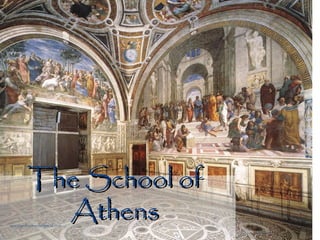
The School ofThe School of
AthensAthenssna.syednomanli@gmail.com 4
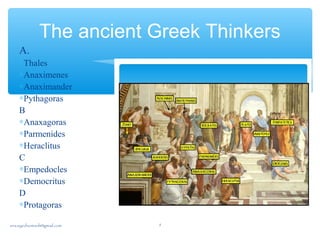
The ancient Greek Thinkers
A.
∗Thales
∗Anaximenes
∗Anaximander
∗Pythagoras
B
∗Anaxagoras
∗Parmenides
∗Heraclitus
C
∗Empedocles
∗Democritus
D
∗Protagoras
sna.syednomanli@gmail.com 5
Earliest first known philosopher
Primarily he wanted to know what was the principle behind
nature.
What was it made of and how was it made.
Believed that the universe was controlled by fixed laws
All things are made up of water.The earth floats on water.
All life originated from the hydro and turn into water again.
He measured the height of pyramid by shadow.
Introduced deductive science, by means of logic.
First attempt to explain the universe on scientific principles.
Thales of Miletus
636-546 B.C.
sna.syednomanali@gmail.com 6
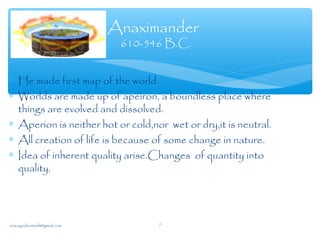
∗ He made first map of the world.
∗ Worlds are made up of apeiron, a boundless place where
things are evolved and dissolved.
∗ Aperion is neither hot or cold,nor wet or dry,it is neutral.
∗ All creation of life is because of some change in nature.
∗ Idea of inherent quality arise.Changes of quantity into
quality.
Anaximander
610-546 B.C.
sna.syednomanli@gmail.com 7
∗The earth does not move in cylindrical shape.
∗The earth was motionless and moved by opposite
forces.
∗Sea is the begetter of winds. Everything is air
∗Air is in constant motion in the method of :
ocondensation – increase in density (turns into earth).
orarefaction – decrease in density (clouds & fire).
∗The earth is on air surrounded by celestial bodies.
Anaximenes
570-526 B.C.
sna.syednomanli@gmail.com 8
∗ All things are number in ratio and proportions.
∗ The universe could only be understood through numbers.
∗ Number 1 is point,2 is line 3 is surface & 4 is solid.
∗ Line is infinite divisible so space is in infinite
∗ Things are in opposites odd and even ,plus and minus.
∗ Established deductive reasoning with axiom 2 + 2 = 4.
∗ Famous for the Pythagorean Theorem: a2
+ b2
= c2
∗ discovered music is governed with the principle of math.
Pythagoras
582-500 B.C.
sna.syednomanli@gmail.com 9
Heraclitus
540-480B.C
∗ Everything is flux , a change of nature.
∗ There is no being just becoming.
∗ We cannot step twice into the same river.
∗ Our sense perception are reliable source.
∗ The nature force is fire.
∗ The world is characterized by two opposites.
∗ Teach “unity of opposites” dark and light are the form
of temperature.
∗ The road up and down are the one and same.
sna.syednomanli@gmail.com 10
∗ Nature is constant which is one .
∗ Change in nature are delusion. Reality is single.
∗ Change become something,something become nothing.
∗ Something exist it is said it cannot exist (it is not)
∗ Multiplicity occur due to our senses that gives illusion.
∗ What is, is; what is not, is not. Change requires motion.
∗ Motion requires empty space. Empty space is not.
∗ Therefore, Nothing ever changes or can change.
Parmenides
540-480 B.C
sna.syednomanli@gmail.com 11
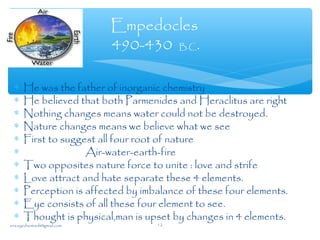
∗ He was the father of inorganic chemistry
∗ He believed that both Parmenides and Heraclitus are right
∗ Nothing changes means water could not be destroyed.
∗ Nature changes means we believe what we see
∗ First to suggest all four root of nature
∗ Air-water-earth-fire
∗ Two opposites nature force to unite : love and strife
∗ Love attract and hate separate these 4 elements.
∗ Perception is affected by imbalance of these four elements.
∗ Eye consists of all these four element to see.
∗ Thought is physical,man is upset by changes in 4 elements.
Empedocles
490-430 B.C.
sna.syednomanli@gmail.com 12
∗ Motion and changes are possible.
∗ There are no basic 4 elements ,they are unlimited .
∗ Nous ,mind (intellect) is a force which is infinite.
∗ Mind is immaterial that animates all living thing.
∗ The world is built of seeds that is indivisible
∗ Mind is there where everything else is others.
∗ a skin cell contain nucleus reveal hair,body i-eDNA
Anaxagoras
500-428 B.C
sna.syednomanli@gmail.com 13
∗ On his concept, the atomic theory was developed.
∗ the universe came in atom that are indivisible particles.
∗ Atom has size ,shape ,motion,color and heat.
∗ Nothing beyond the natural order.
∗ There is Only two things, atoms and empty space.
∗ The atoms move is space which is uncountable.
∗ Man is the micro organism of the universe.
Democritus
460?- 360 B.C
sna.syednomanli@gmail.com 14
∗Man is the measures of all things of what are
that(how?)they are ,of what are not that (how?)they are
not.
∗Most famous of the Sophists who teach to elite.
∗The sophist have encyclopedic knowledge.
∗Teachings to equip citizens for life ie -art of rhetoric
∗Concept of Relativism :each one has own truth.
∗Might is right –everything is relative.
∗Both people speak truth at same time.
∗We communicate in symbols & no one symbolize same.
Protagoras
485 - 410 B.C.
sna.syednomanli@gmail.com 15
The Sophists
• Democracy and the need for public speakers.
• Relativism.
• “A human being is the measure of all things – of things
that are, that they are, and of things that are not, that
they are not.”
• There are two opposing arguments concerning
everything.”
• “To make the weaker argument the stronger.”
sna.syednomanli@gmail.com 16
∗ Thales “All is water”
∗ Anaximander “All is boundless”
∗ Anaximenes “All is air”
∗ Parmenides “All is permanent”
∗ Heraclitus “All is change”
∗ Empedocles “All are air ,water, fire and earth.
∗ Pythagoras “All are numbers”
Natural philosophy
sna.syednomanli@gmail.com 17
Study text on
ancient philosophy
∗ History of western philosophy
By Bertrand Russell
∗ An Introduction to Ancient Philosophy
by A. H. Armstrong
∗ A History of Philosophy
by Frederick Copleston
sna.syednomanli@gmail.com 18

Ancient greek

  • 1.
    Greek Philosophy natural philosopher Nothingcomes from nothing Everything was made up of some fundamental substance sna.syednomanli@gmail.com 1
  • 2.
    Historical period Mycenaean civilisation1580-1120 BC Minoan civilization 3000-1000 BC Ancient philosophy (585B.C-529A.D) Pre-Socratic ( 585-400 BC) Southern Italy and Sicily Greek Empire (300-100 BC) Roman Empire (100 BC to 400 AD) Renaissance (1450-1600 AD) dark ages sna.syednomanli@gmail.com 2
  • 3.
    The Big Questions ∗From where does everything come? ∗ From what is everything created? ∗ How do we explain the things found in nature? ∗ How might we describe nature systematically? ∗ What is the ultimate explanation of cosmos and world? ∗ The Questions mainly concerned on  one and multiplicity  Reality and appearance  Being and non-being sna.syednomanli@gmail.com 3
  • 4.
    The School ofTheSchool of AthensAthenssna.syednomanli@gmail.com 4
  • 5.
    The ancient GreekThinkers A. ∗Thales ∗Anaximenes ∗Anaximander ∗Pythagoras B ∗Anaxagoras ∗Parmenides ∗Heraclitus C ∗Empedocles ∗Democritus D ∗Protagoras sna.syednomanli@gmail.com 5
  • 6.
    Earliest first knownphilosopher Primarily he wanted to know what was the principle behind nature. What was it made of and how was it made. Believed that the universe was controlled by fixed laws All things are made up of water.The earth floats on water. All life originated from the hydro and turn into water again. He measured the height of pyramid by shadow. Introduced deductive science, by means of logic. First attempt to explain the universe on scientific principles. Thales of Miletus 636-546 B.C. sna.syednomanali@gmail.com 6
  • 7.
    ∗ He madefirst map of the world. ∗ Worlds are made up of apeiron, a boundless place where things are evolved and dissolved. ∗ Aperion is neither hot or cold,nor wet or dry,it is neutral. ∗ All creation of life is because of some change in nature. ∗ Idea of inherent quality arise.Changes of quantity into quality. Anaximander 610-546 B.C. sna.syednomanli@gmail.com 7
  • 8.
    ∗The earth doesnot move in cylindrical shape. ∗The earth was motionless and moved by opposite forces. ∗Sea is the begetter of winds. Everything is air ∗Air is in constant motion in the method of : ocondensation – increase in density (turns into earth). orarefaction – decrease in density (clouds & fire). ∗The earth is on air surrounded by celestial bodies. Anaximenes 570-526 B.C. sna.syednomanli@gmail.com 8
  • 9.
    ∗ All thingsare number in ratio and proportions. ∗ The universe could only be understood through numbers. ∗ Number 1 is point,2 is line 3 is surface & 4 is solid. ∗ Line is infinite divisible so space is in infinite ∗ Things are in opposites odd and even ,plus and minus. ∗ Established deductive reasoning with axiom 2 + 2 = 4. ∗ Famous for the Pythagorean Theorem: a2 + b2 = c2 ∗ discovered music is governed with the principle of math. Pythagoras 582-500 B.C. sna.syednomanli@gmail.com 9
  • 10.
    Heraclitus 540-480B.C ∗ Everything isflux , a change of nature. ∗ There is no being just becoming. ∗ We cannot step twice into the same river. ∗ Our sense perception are reliable source. ∗ The nature force is fire. ∗ The world is characterized by two opposites. ∗ Teach “unity of opposites” dark and light are the form of temperature. ∗ The road up and down are the one and same. sna.syednomanli@gmail.com 10
  • 11.
    ∗ Nature isconstant which is one . ∗ Change in nature are delusion. Reality is single. ∗ Change become something,something become nothing. ∗ Something exist it is said it cannot exist (it is not) ∗ Multiplicity occur due to our senses that gives illusion. ∗ What is, is; what is not, is not. Change requires motion. ∗ Motion requires empty space. Empty space is not. ∗ Therefore, Nothing ever changes or can change. Parmenides 540-480 B.C sna.syednomanli@gmail.com 11
  • 12.
    ∗ He wasthe father of inorganic chemistry ∗ He believed that both Parmenides and Heraclitus are right ∗ Nothing changes means water could not be destroyed. ∗ Nature changes means we believe what we see ∗ First to suggest all four root of nature ∗ Air-water-earth-fire ∗ Two opposites nature force to unite : love and strife ∗ Love attract and hate separate these 4 elements. ∗ Perception is affected by imbalance of these four elements. ∗ Eye consists of all these four element to see. ∗ Thought is physical,man is upset by changes in 4 elements. Empedocles 490-430 B.C. sna.syednomanli@gmail.com 12
  • 13.
    ∗ Motion andchanges are possible. ∗ There are no basic 4 elements ,they are unlimited . ∗ Nous ,mind (intellect) is a force which is infinite. ∗ Mind is immaterial that animates all living thing. ∗ The world is built of seeds that is indivisible ∗ Mind is there where everything else is others. ∗ a skin cell contain nucleus reveal hair,body i-eDNA Anaxagoras 500-428 B.C sna.syednomanli@gmail.com 13
  • 14.
    ∗ On hisconcept, the atomic theory was developed. ∗ the universe came in atom that are indivisible particles. ∗ Atom has size ,shape ,motion,color and heat. ∗ Nothing beyond the natural order. ∗ There is Only two things, atoms and empty space. ∗ The atoms move is space which is uncountable. ∗ Man is the micro organism of the universe. Democritus 460?- 360 B.C sna.syednomanli@gmail.com 14
  • 15.
    ∗Man is themeasures of all things of what are that(how?)they are ,of what are not that (how?)they are not. ∗Most famous of the Sophists who teach to elite. ∗The sophist have encyclopedic knowledge. ∗Teachings to equip citizens for life ie -art of rhetoric ∗Concept of Relativism :each one has own truth. ∗Might is right –everything is relative. ∗Both people speak truth at same time. ∗We communicate in symbols & no one symbolize same. Protagoras 485 - 410 B.C. sna.syednomanli@gmail.com 15
  • 16.
    The Sophists • Democracyand the need for public speakers. • Relativism. • “A human being is the measure of all things – of things that are, that they are, and of things that are not, that they are not.” • There are two opposing arguments concerning everything.” • “To make the weaker argument the stronger.” sna.syednomanli@gmail.com 16
  • 17.
    ∗ Thales “Allis water” ∗ Anaximander “All is boundless” ∗ Anaximenes “All is air” ∗ Parmenides “All is permanent” ∗ Heraclitus “All is change” ∗ Empedocles “All are air ,water, fire and earth. ∗ Pythagoras “All are numbers” Natural philosophy sna.syednomanli@gmail.com 17
  • 18.
    Study text on ancientphilosophy ∗ History of western philosophy By Bertrand Russell ∗ An Introduction to Ancient Philosophy by A. H. Armstrong ∗ A History of Philosophy by Frederick Copleston sna.syednomanli@gmail.com 18