From Republic to Empire
• Led by military dictators, of which Julius
Caesar was the best known
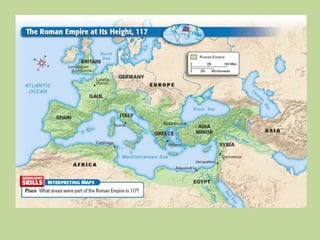
• He expanded the empire to include western
and central Europe
• He directed the construction of a wooden
bridge to enable the troop to invade and
conquer Germania (central Europe)
• Under Caesar Augustus, the empire entered
into a pax romana (peace under Rome)
• This, which brought in a long era of high
culture and stability
Roman Law
• Formed the model of legal systems
throughout European countries except
England, which relied on common law
• The term jus meant both the law and justice
• The system of customary law (ius) was written
down as codes (lex)
• These were displayed as the Twelve Tables of
Law at the Forum.
Twelve Tables of Roman Law
• The Twelve Tables of Law formed the basis
of all Roman law
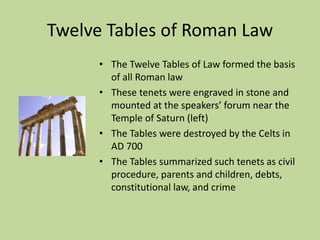
• These tenets were engraved in stone and
mounted at the speakers’ forum near the
Temple of Saturn (left)
• The Tables were destroyed by the Celts in
AD 700
• The Tables summarized such tenets as civil
procedure, parents and children, debts,
constitutional law, and crime
Democracy
• For much of human history, people have lived
under the rule of kings or rulers who held
absolute power.
• A direct contrast is the system of democracy,
in which people govern themselves through
councils and agreed-upon laws.
• The earliest democracies arose in ancient
Greece and Rome.
Direct and Indirect Democracy
• Ancient Greece had a (limited) form of direct
democracy. In a direct democracy, citizens
represent themselves directly at councils.
• Ancient Rome saw the rise of the republic—an
indirect democracy in which citizens rule
through representatives, whom they elect.
LATER/ROMAN
• THE CONCEPT OF NATURAL LAW WHICH GIVES
CERTAIN RIGHTS TO ALL PEOPLE WAS
ELABORATED AND UNIVERSALIZED
• PRIMARILY CONCERNED WITH MORALITY
Roman Contributions
• Roman Empire contributed to democracy
• Republic-form of govt. where power rests
with people. The people vote for
representatives who vote on their behalf.
• Contrast this with the Greeks (direct
democracy)
• There should be written law.
Around 200 BC, some conservative Romans began to worry that contact
with Greek philosophy would corrupt and weaken their fellow citizens. One
of them, the statesman Marcus Porcius Cato – Cato the Elder – disliked the
softer manners of the Greeks. He was fluent in Greek but opposed to Greek
literature, poetry and art, and he opposed Greek medicine, claiming that it
was poisoning Romans. In particular he was opposed to a philosophy called
Epicureanism, which at its most extreme taught that finding and
experiencing pleasure was the most important thing a person could do
during their life.
Many Romans instead turned to the philosophy of Stoicism which taught
that people shouldn’t be concerned with possessions but should instead try
to live lives of virtue (from the Latin world “virtutem” meaning manliness).
For Romans virtue meant acting based on whether an action would be good
for Rome and the empire rather than for the individual or single family. Of
all the virtues Stoics valued the most important were courage, resilience,
endurance, self-denial, and integrity. Romans looked for their qualities in
their heroes, myths, leaders, and in many other parts of their culture.
Roman Philosophy
• Much of philosophy was derived from the Stoics of
the Hellenistic empire, who saw life as adversity to
be endured
• Happiness lies in acceptance of things as they are
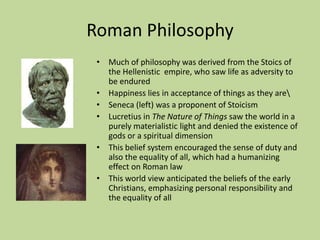
• Seneca (left) was a proponent of Stoicism
• Lucretius in The Nature of Things saw the world in a
purely materialistic light and denied the existence of
gods or a spiritual dimension
• This belief system encouraged the sense of duty and
also the equality of all, which had a humanizing
effect on Roman law
• This world view anticipated the beliefs of the early
Christians, emphasizing personal responsibility and
the equality of all
EPICTETUS AND STOICISM:
Three Stoics:
Seneca (3 BC-65 AD), Roman Senator
Epictetus, (50-60 to 100-130 AD) Slave
Marcus Aurelius, (121-180 AD) Emperor
virtue = good will = will that things happen as they
are going to.
EPICURUS AND EPICTETUS ON THE
FEAR OF DEATH:
Epictetus:
Death is among the things we should be indifferent about. The
wise person will keep her or his desires away from immortality,
since it is not among the things that are up to us.
Keep your desires away from immortality. To fear death is to
allow yourself to indulge in an inappropriate aversion. Brace up
and extinguish it!
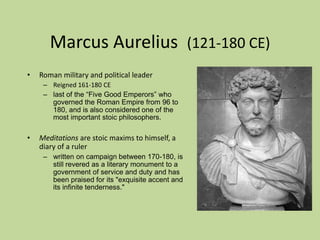
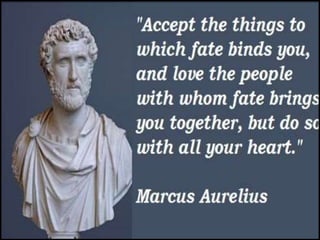
Marcus Aurelius (121-180 CE)
• Roman military and political leader
– Reigned 161-180 CE
– last of the “Five Good Emperors” who
governed the Roman Empire from 96 to
180, and is also considered one of the
most important stoic philosophers.
• Meditations are stoic maxims to himself, a
diary of a ruler
– written on campaign between 170-180, is
still revered as a literary monument to a
government of service and duty and has
been praised for its "exquisite accent and
its infinite tenderness."
The Early Life
• Cicero was born January 3, 106 B.C.
• According to Plutarch, he was an extremely adept student
• Cicero also had a love for almost everything Greek. He
found the ancient philosophers such as Plato very thought
provoking.
• Cicero served as quaestor (elected official) in western Sicily
in 75 BC
• Despite his great political success, Cicero suffered from his
lack of reputable ancestry
• In 63 BC, Cicero was elected to the Roman consul
Cicero (106 – 43 BCE)
Roman politician, lawyer and
legal philosopher.
Law is rooted a divine source;
Jupiter.
Natural Law is universal and
unchanging. Nature ensures the
common good.
Law is in the mind of “wise
and intelligent men” and they
are the standard by which justice
and injustice are measured
(philosopher kings).
If in the minds of “wise and
intelligent men” the law is in
conflict with the laws of nature it
should be disobeyed.
Civil disobedience should be used to
force the government to make laws that
conform to natural law.
Last Attempts at Politics
• Cicero was taken completely by surprise when Caesar was
assassinated on the Ides of March 44 BC
• In a letter to one of the conspirators, Cicero expressed a
wish of having been "...invited to that superb banquet"
• Cicero became a popular leader during the instability and
was disgusted with Mark Antony
• Cicero and Antony became the leading men in Rome;
Cicero as spokesman for the Senate, and Antony as consul
and as executor of Caesar's wishes
• During this time, Cicero became an unrivaled popular
leader
Cicero’s Legacy
• He was declared a "Righteous Pagan" by the early Catholic
Church, and therefore many of his works were deemed
worthy of preservation
• Saint Augustine and others quoted liberally from his works
"The Republic" and "The Laws," and it is due to this that we
are able to recreate much of the work from the surviving
fragments
• Of Cicero's books, six on rhetoric have survived, as well as
parts of seven on philosophy
• Of his speeches, eighty-eight were recorded, but only fifty-
eight survive
• More than 800 letters by Cicero to others exist, and over
100 letters from others to him
Seneca
• Born in Cordoba of
Spain in 4 BC
• Brought to Rome
and studied near to
stoicians
• Became lawyer
• Founder of famous
philosophical faculty
in Rome
• Exiled by Kaligula
• Restored by Agrippina
• Tutor of emperor Nero
from 49 AD
• Owner of a big fortune
• Remarkable influence
on Nero
• Accused of conspiracy
and made by Nero to
commit a suicide
Philosophical cosmotheory
Seneca:
A) is the greatest Roman stoician influenced by Plato,
Cynics and Epicurus.
B) is the man of guidance, adherent of moral
evolution and completion of the human being
through education and humanity
C) accepts the flaws and weaknesses of the humans
D) believes that humans are evil and weak and they
will always be
Beliefs
God is the first cause
and his will the law
 The human reason or the
immortal psyche is the
outcome of the god – like
spirit bound in the body
Philosophy is the love of
wisdom, inseparate from
virtue and teaches the doing
and the right
 Humans should be
humanistic .
* The Cosmos – everything else - is a divine emanation
(a sort of radiation) from The One
Neoplatonism: a spiritual re-awakening of Platonic thought
(Plotinus (204-270 AD))
Intro: … very low period of Roman history, from cities to ends
of empire. Material world … low ebb … little cause for hope.
* There is a great order … many levels of existence … with
‘The One’ (indefinable) at its heart.
Neoplatonism (an impression):
Neoplatonism (contd):
* 1st emanation – called ‘nous’ by Plotinus – a sort of
cosmic intellectual spirit (a universal wisdom, perhaps,
containing the world of ideas and more … )
* 2nd emanation – from the ‘nous’ comes the (World) Soul …
The soul is the author of nature … beautiful in Plotinus:
‘Who that truly perceived the harmony of the Intellectual Realm
could fail, if he has any bent towards music, to answer to the
harmony in sensible sounds? What geometrician or arithmetician
could fail to take pleasure in the symmetries, correspondences and
principles of order observed in visible things?’
(Soul is between the ‘nous’ and the material world.)
Finitely Bound
Character of
Being
Unity of God
Via Negativa
“Being” is derived from and applies to
things of sense experience: the realm of
finite, individual, changing things. God is
necessarily above the finite things of sense
experience and so must be above being.
Since multiplicity is a feature of finite
things, God must be one. God is the One,
since God is not a single or individual
thing, nor can God be divided into parts.
Nothing can be positively predicated of God
since this would entail multiplicity
(substance and properties). We can only
deny of God things that are true of finite
things. Immaterial = not material; one = not
many; eternal = not temporal, etc.
Nous has the One and itself as the object of immediate
apprehension. Nous contains the Forms.
The World Soul is the link between Nous
and the sensible world.
Individual Souls
Physical Universe
The One
Plotinus Philosophy
• Philosophy for Plotinus was religion, the effort to actualize in
oneself the great impulse of return to the One; and religion for
him was philosophy.
• For him the combination of moral purification and intellectual
enlightment, which only Platonist philosophy as he understood it
could give, was the only way to prepare oneself for an ecstatic
reunion with the One.
• Later Neo-Platonism aspired to be not only a completed and
coherent metaphysical system but also a complete pagan
theology, perhaps best seen in Proclus’ Platonic theology (below).
• The maintenance and defense of the religion in a world more and
more intolerantly dominated by rival Christianity was one of the
main concerns of the Platonists after Plotinus.
Saint Augustine
• First truly important philosopher in the
Christian Platonic tradition
• Maintained ideals somewhere in between the
classical world and medieval world
• His philosophy is a profound meditation on
the relation between God and the human
being
• Very focused on the ideas of free will and evil
His legacy.
• He believed humans
cannot experience true
happiness until they find
God.
• His work centred around
the notion that
everything in the world is
basically good.
• He wrote many works
over his lifetime.
• He attempted to dispel
heresy and blasphemous
ideologies.
Augustines’ Solutions
1. For God there is no past or future. Only an
eternal present. Everything exists in an eternal
moment. God is outside of time.
2. God’s knowledge of the world entails necessity,
but to deny that necessity is incompatible with
freedom.
3. Freedom is the capacity to do what one wants
and one can do what one wants even if God (or
anyone else) already knows what that person
wants.
Boethius
• Boethius (480-524 AD)
– Fluent in both Latin and Greek
• Familiar with works of both Plato & Aristotle
• Translated Aristotle’s logical works into Latin
• Thereby transmits Aristotle’s logical works
to early medieval western Europe
• Aristotle’s other works remain unknown in
western Europe until 1100+
32
Freedom & Determinism
• Is Human Freedom Compatible with God’s
omniscience?
• If God already knows with complete
certainty whatever you will ever do, how
could your future be up to you to
determine?
• How could you be genuinely free in
planning your life and enacting your plans if
God already knows what you will plan and
what you will do?
33
The Preliminary Argument
• God foreknows everything that will happen
• So, God foreknows my future in full detail
• What God foreknows must happen exactly
as it does happen
• Hence, my future must happen exactly as it
does
• If my future must happen exactly as it does,
then my future is necessary
• Thus, my future is necessary
• If my future is necessary, then I am not free
• Consequently, I am not free!
34
Boethius Rejects the Preliminary
Argument
• The preliminary argument conceals a mistake
pertaining to how the concept of necessity
appears in the argument
• It is true that if my future is necessary, then I
am not free
• But the argument fails to prove that my future
is necessary
• Hence, the argument fails to prove that I am
not free
35
The Hidden Error in the Preliminary
Argument
Mistaken version of argument
1. If God foreknows the future, then the future is necessary
(This is the mistaken assumption, according to Boethius)
2. God foreknows the future
3. So, the future is necessary
4. If the future is necessary, then I am not free
5. Hence, I am not free
Since Boethius rejects 1, he rejects the soundness of this version of
the argument
36
The Byzantine Empire
The Big Idea
The Roman Empire split into two parts, and the Eastern Roman Empire
prospered for hundreds of years after the western empire fell.
Main Ideas
• Eastern emperors ruled from Constantinople and tried but failed to
reunite the whole Roman Empire.
• The people of the eastern empire created a new society that was very
different from society in the west.
• Byzantine Christianity was different from religion in the west.
How the eastern empire differed
from the western empire
• The society was called the Byzantine Empire.
• People studied Greek, not Latin.
• They traded with and were influenced by other cultures.
• Emperors had more power and were thought to be chosen
by God. They had both political and religious power.
The people of the eastern empire created
a new society that was very different
from society in the west
Roman philosophy
Roman philosophy
Roman philosophy
Roman philosophy

Roman philosophy

  • 1.
    From Republic toEmpire • Led by military dictators, of which Julius Caesar was the best known • He expanded the empire to include western and central Europe • He directed the construction of a wooden bridge to enable the troop to invade and conquer Germania (central Europe) • Under Caesar Augustus, the empire entered into a pax romana (peace under Rome) • This, which brought in a long era of high culture and stability
  • 2.
    Roman Law • Formedthe model of legal systems throughout European countries except England, which relied on common law • The term jus meant both the law and justice • The system of customary law (ius) was written down as codes (lex) • These were displayed as the Twelve Tables of Law at the Forum.
  • 3.
    Twelve Tables ofRoman Law • The Twelve Tables of Law formed the basis of all Roman law • These tenets were engraved in stone and mounted at the speakers’ forum near the Temple of Saturn (left) • The Tables were destroyed by the Celts in AD 700 • The Tables summarized such tenets as civil procedure, parents and children, debts, constitutional law, and crime
  • 4.
    Democracy • For muchof human history, people have lived under the rule of kings or rulers who held absolute power. • A direct contrast is the system of democracy, in which people govern themselves through councils and agreed-upon laws. • The earliest democracies arose in ancient Greece and Rome.
  • 5.
    Direct and IndirectDemocracy • Ancient Greece had a (limited) form of direct democracy. In a direct democracy, citizens represent themselves directly at councils. • Ancient Rome saw the rise of the republic—an indirect democracy in which citizens rule through representatives, whom they elect.
  • 6.
    LATER/ROMAN • THE CONCEPTOF NATURAL LAW WHICH GIVES CERTAIN RIGHTS TO ALL PEOPLE WAS ELABORATED AND UNIVERSALIZED • PRIMARILY CONCERNED WITH MORALITY
  • 7.
    Roman Contributions • RomanEmpire contributed to democracy • Republic-form of govt. where power rests with people. The people vote for representatives who vote on their behalf. • Contrast this with the Greeks (direct democracy) • There should be written law.
  • 8.
    Around 200 BC,some conservative Romans began to worry that contact with Greek philosophy would corrupt and weaken their fellow citizens. One of them, the statesman Marcus Porcius Cato – Cato the Elder – disliked the softer manners of the Greeks. He was fluent in Greek but opposed to Greek literature, poetry and art, and he opposed Greek medicine, claiming that it was poisoning Romans. In particular he was opposed to a philosophy called Epicureanism, which at its most extreme taught that finding and experiencing pleasure was the most important thing a person could do during their life. Many Romans instead turned to the philosophy of Stoicism which taught that people shouldn’t be concerned with possessions but should instead try to live lives of virtue (from the Latin world “virtutem” meaning manliness). For Romans virtue meant acting based on whether an action would be good for Rome and the empire rather than for the individual or single family. Of all the virtues Stoics valued the most important were courage, resilience, endurance, self-denial, and integrity. Romans looked for their qualities in their heroes, myths, leaders, and in many other parts of their culture.
  • 9.
    Roman Philosophy • Muchof philosophy was derived from the Stoics of the Hellenistic empire, who saw life as adversity to be endured • Happiness lies in acceptance of things as they are • Seneca (left) was a proponent of Stoicism • Lucretius in The Nature of Things saw the world in a purely materialistic light and denied the existence of gods or a spiritual dimension • This belief system encouraged the sense of duty and also the equality of all, which had a humanizing effect on Roman law • This world view anticipated the beliefs of the early Christians, emphasizing personal responsibility and the equality of all
  • 10.
    EPICTETUS AND STOICISM: ThreeStoics: Seneca (3 BC-65 AD), Roman Senator Epictetus, (50-60 to 100-130 AD) Slave Marcus Aurelius, (121-180 AD) Emperor virtue = good will = will that things happen as they are going to.
  • 11.
    EPICURUS AND EPICTETUSON THE FEAR OF DEATH: Epictetus: Death is among the things we should be indifferent about. The wise person will keep her or his desires away from immortality, since it is not among the things that are up to us. Keep your desires away from immortality. To fear death is to allow yourself to indulge in an inappropriate aversion. Brace up and extinguish it!
  • 12.
    Marcus Aurelius (121-180CE) • Roman military and political leader – Reigned 161-180 CE – last of the “Five Good Emperors” who governed the Roman Empire from 96 to 180, and is also considered one of the most important stoic philosophers. • Meditations are stoic maxims to himself, a diary of a ruler – written on campaign between 170-180, is still revered as a literary monument to a government of service and duty and has been praised for its "exquisite accent and its infinite tenderness."
  • 17.
    The Early Life •Cicero was born January 3, 106 B.C. • According to Plutarch, he was an extremely adept student • Cicero also had a love for almost everything Greek. He found the ancient philosophers such as Plato very thought provoking. • Cicero served as quaestor (elected official) in western Sicily in 75 BC • Despite his great political success, Cicero suffered from his lack of reputable ancestry • In 63 BC, Cicero was elected to the Roman consul
  • 18.
    Cicero (106 –43 BCE) Roman politician, lawyer and legal philosopher. Law is rooted a divine source; Jupiter. Natural Law is universal and unchanging. Nature ensures the common good. Law is in the mind of “wise and intelligent men” and they are the standard by which justice and injustice are measured (philosopher kings). If in the minds of “wise and intelligent men” the law is in conflict with the laws of nature it should be disobeyed. Civil disobedience should be used to force the government to make laws that conform to natural law.
  • 19.
    Last Attempts atPolitics • Cicero was taken completely by surprise when Caesar was assassinated on the Ides of March 44 BC • In a letter to one of the conspirators, Cicero expressed a wish of having been "...invited to that superb banquet" • Cicero became a popular leader during the instability and was disgusted with Mark Antony • Cicero and Antony became the leading men in Rome; Cicero as spokesman for the Senate, and Antony as consul and as executor of Caesar's wishes • During this time, Cicero became an unrivaled popular leader
  • 20.
    Cicero’s Legacy • Hewas declared a "Righteous Pagan" by the early Catholic Church, and therefore many of his works were deemed worthy of preservation • Saint Augustine and others quoted liberally from his works "The Republic" and "The Laws," and it is due to this that we are able to recreate much of the work from the surviving fragments • Of Cicero's books, six on rhetoric have survived, as well as parts of seven on philosophy • Of his speeches, eighty-eight were recorded, but only fifty- eight survive • More than 800 letters by Cicero to others exist, and over 100 letters from others to him
  • 21.
    Seneca • Born inCordoba of Spain in 4 BC • Brought to Rome and studied near to stoicians • Became lawyer • Founder of famous philosophical faculty in Rome • Exiled by Kaligula • Restored by Agrippina • Tutor of emperor Nero from 49 AD • Owner of a big fortune • Remarkable influence on Nero • Accused of conspiracy and made by Nero to commit a suicide
  • 22.
    Philosophical cosmotheory Seneca: A) isthe greatest Roman stoician influenced by Plato, Cynics and Epicurus. B) is the man of guidance, adherent of moral evolution and completion of the human being through education and humanity C) accepts the flaws and weaknesses of the humans D) believes that humans are evil and weak and they will always be
  • 23.
    Beliefs God is thefirst cause and his will the law  The human reason or the immortal psyche is the outcome of the god – like spirit bound in the body Philosophy is the love of wisdom, inseparate from virtue and teaches the doing and the right  Humans should be humanistic .
  • 24.
    * The Cosmos– everything else - is a divine emanation (a sort of radiation) from The One Neoplatonism: a spiritual re-awakening of Platonic thought (Plotinus (204-270 AD)) Intro: … very low period of Roman history, from cities to ends of empire. Material world … low ebb … little cause for hope. * There is a great order … many levels of existence … with ‘The One’ (indefinable) at its heart. Neoplatonism (an impression):
  • 25.
    Neoplatonism (contd): * 1stemanation – called ‘nous’ by Plotinus – a sort of cosmic intellectual spirit (a universal wisdom, perhaps, containing the world of ideas and more … ) * 2nd emanation – from the ‘nous’ comes the (World) Soul … The soul is the author of nature … beautiful in Plotinus: ‘Who that truly perceived the harmony of the Intellectual Realm could fail, if he has any bent towards music, to answer to the harmony in sensible sounds? What geometrician or arithmetician could fail to take pleasure in the symmetries, correspondences and principles of order observed in visible things?’ (Soul is between the ‘nous’ and the material world.)
  • 26.
    Finitely Bound Character of Being Unityof God Via Negativa “Being” is derived from and applies to things of sense experience: the realm of finite, individual, changing things. God is necessarily above the finite things of sense experience and so must be above being. Since multiplicity is a feature of finite things, God must be one. God is the One, since God is not a single or individual thing, nor can God be divided into parts. Nothing can be positively predicated of God since this would entail multiplicity (substance and properties). We can only deny of God things that are true of finite things. Immaterial = not material; one = not many; eternal = not temporal, etc.
  • 27.
    Nous has theOne and itself as the object of immediate apprehension. Nous contains the Forms. The World Soul is the link between Nous and the sensible world. Individual Souls Physical Universe The One
  • 28.
    Plotinus Philosophy • Philosophyfor Plotinus was religion, the effort to actualize in oneself the great impulse of return to the One; and religion for him was philosophy. • For him the combination of moral purification and intellectual enlightment, which only Platonist philosophy as he understood it could give, was the only way to prepare oneself for an ecstatic reunion with the One. • Later Neo-Platonism aspired to be not only a completed and coherent metaphysical system but also a complete pagan theology, perhaps best seen in Proclus’ Platonic theology (below). • The maintenance and defense of the religion in a world more and more intolerantly dominated by rival Christianity was one of the main concerns of the Platonists after Plotinus.
  • 29.
    Saint Augustine • Firsttruly important philosopher in the Christian Platonic tradition • Maintained ideals somewhere in between the classical world and medieval world • His philosophy is a profound meditation on the relation between God and the human being • Very focused on the ideas of free will and evil
  • 30.
    His legacy. • Hebelieved humans cannot experience true happiness until they find God. • His work centred around the notion that everything in the world is basically good. • He wrote many works over his lifetime. • He attempted to dispel heresy and blasphemous ideologies.
  • 31.
    Augustines’ Solutions 1. ForGod there is no past or future. Only an eternal present. Everything exists in an eternal moment. God is outside of time. 2. God’s knowledge of the world entails necessity, but to deny that necessity is incompatible with freedom. 3. Freedom is the capacity to do what one wants and one can do what one wants even if God (or anyone else) already knows what that person wants.
  • 32.
    Boethius • Boethius (480-524AD) – Fluent in both Latin and Greek • Familiar with works of both Plato & Aristotle • Translated Aristotle’s logical works into Latin • Thereby transmits Aristotle’s logical works to early medieval western Europe • Aristotle’s other works remain unknown in western Europe until 1100+ 32
  • 33.
    Freedom & Determinism •Is Human Freedom Compatible with God’s omniscience? • If God already knows with complete certainty whatever you will ever do, how could your future be up to you to determine? • How could you be genuinely free in planning your life and enacting your plans if God already knows what you will plan and what you will do? 33
  • 34.
    The Preliminary Argument •God foreknows everything that will happen • So, God foreknows my future in full detail • What God foreknows must happen exactly as it does happen • Hence, my future must happen exactly as it does • If my future must happen exactly as it does, then my future is necessary • Thus, my future is necessary • If my future is necessary, then I am not free • Consequently, I am not free! 34
  • 35.
    Boethius Rejects thePreliminary Argument • The preliminary argument conceals a mistake pertaining to how the concept of necessity appears in the argument • It is true that if my future is necessary, then I am not free • But the argument fails to prove that my future is necessary • Hence, the argument fails to prove that I am not free 35
  • 36.
    The Hidden Errorin the Preliminary Argument Mistaken version of argument 1. If God foreknows the future, then the future is necessary (This is the mistaken assumption, according to Boethius) 2. God foreknows the future 3. So, the future is necessary 4. If the future is necessary, then I am not free 5. Hence, I am not free Since Boethius rejects 1, he rejects the soundness of this version of the argument 36
  • 38.
    The Byzantine Empire TheBig Idea The Roman Empire split into two parts, and the Eastern Roman Empire prospered for hundreds of years after the western empire fell. Main Ideas • Eastern emperors ruled from Constantinople and tried but failed to reunite the whole Roman Empire. • The people of the eastern empire created a new society that was very different from society in the west. • Byzantine Christianity was different from religion in the west.
  • 39.
    How the easternempire differed from the western empire • The society was called the Byzantine Empire. • People studied Greek, not Latin. • They traded with and were influenced by other cultures. • Emperors had more power and were thought to be chosen by God. They had both political and religious power. The people of the eastern empire created a new society that was very different from society in the west