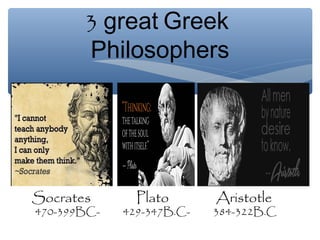
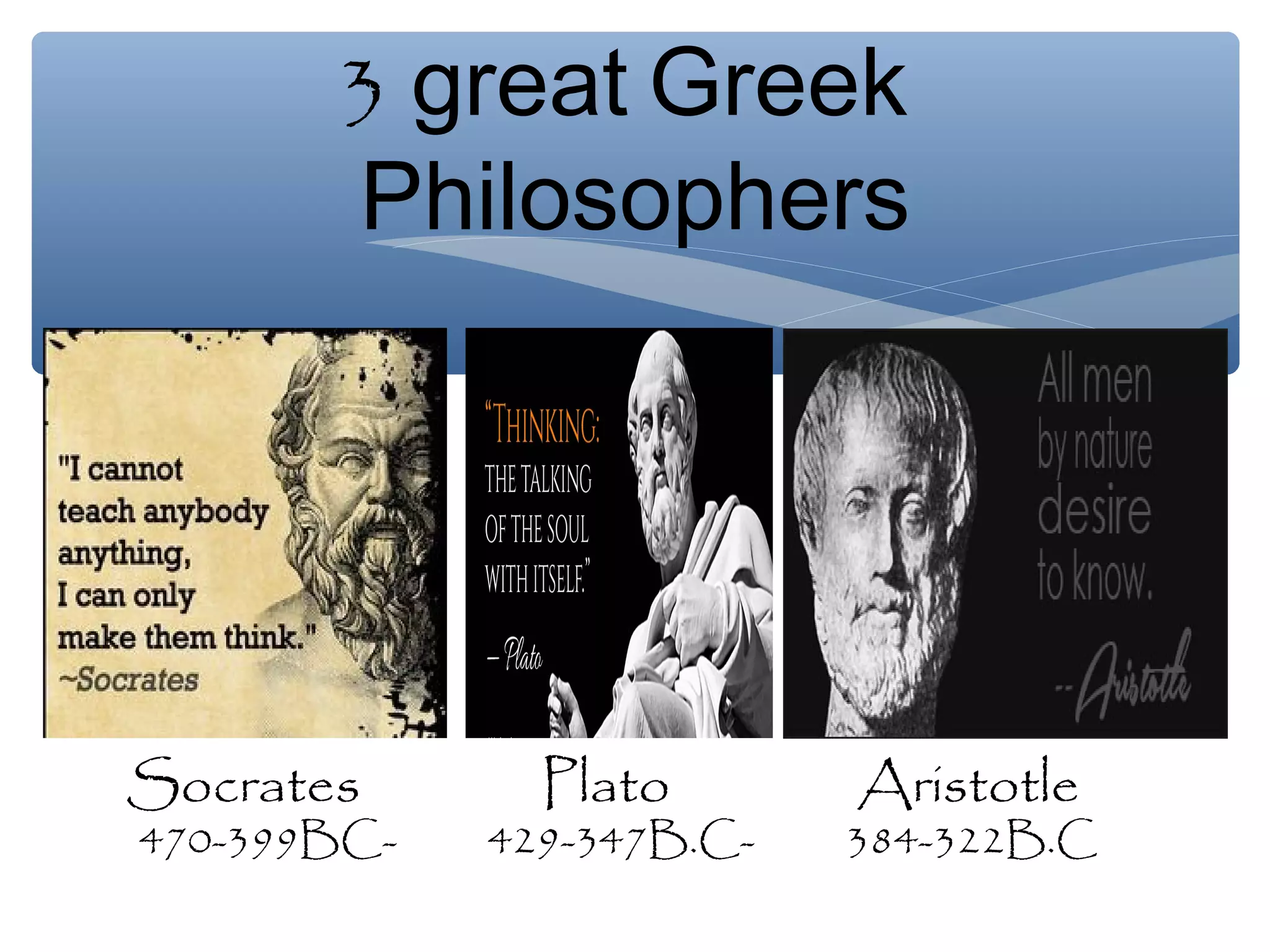
3 great Greek
Philosophers
Socrates Plato Aristotle
470-399BC- 429-347B.C- 384-322B.C
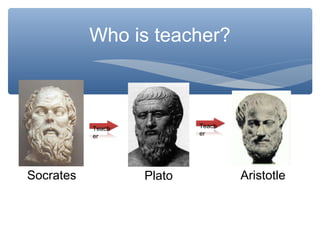
Who is teacher?
Teach
er
Teach
er
Socrates Plato Aristotle
“The unexamined life is not worth living.”
Knowledge is virtue for the sake of virtue only.
Wiser is one who knows that he knows nothing.
Keep examine the truth by using dialectic method.
His project is to expose the contradictions within conversation.
His interest is in search for definition of the universal truth.
Man centered philosophy begins.
There is one good “knowledge” and evil “ignorance”.
People should focus only on self improvement.
Socrates
399-470 B.C.
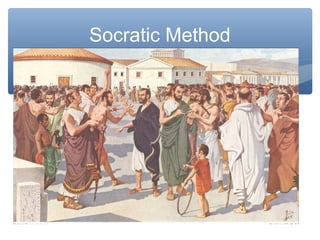
What is the Socratic Method?
•A type of pedagogy that seeks to encourage fundamental
insight into issues and ideas via questioning
• Designed to encourage self-examination: “The highest form
of human excellence is to question oneself and others”
• Argument, cross-examining, testing, scrutinizing
• “Life without examination [dialogue] is not worth living.”
• Two styles: Classic (two-way freestyle) & Modern
(constructive)
- the Classic style is more true to Socrates himself
- the Modern style may be Plato improving upon
Socrates
Socratic Method
Socratic Method
He spent most of his time in the marketplace discussing
virtue, justice and piety
He would draw as much information out of people as
possible before refuting what they had said
Would argue against their views to arrive at a new, more
logical truth
"The unexamined life is not worth living."
Socrates was concerned with the question of
ETHICS (moral behaviour)
 Unlike the Sophists, he believed that there was definite
right and wrong
 He believed that people could accept it and apply it into
their daily lives
 He said that it was up to people (society), as a whole, to
establish those things that are right and those that are
wrong
 Dedicated his life to searching for standards by which
people could live a virtuous/good life
The philosophy of Socrates
Socrates was also concerned with justice
∗ He wanted life to be fair for all
∗ It was a person’s duty to explore the truth
regarding right and wrong, justice and
injustice, courage and cowardice
∗ He worked to find principles and laws that all
could live by and be happy
∗ Universal: these truths would be applicable for
all people, at any time, everywhere and in all
cases
The philosophy of Socrates
∗ Virtue (knowledge) is the most valuable of all things
∗ Life should be spent in search of goodness.
∗ Truth is possible to achieve
∗ People should focus on self-development rather than
material wealth
∗ It is the job of the philosopher to show people how little
they really know
∗ An action is right when it promoted true happiness
Summarising Socrates
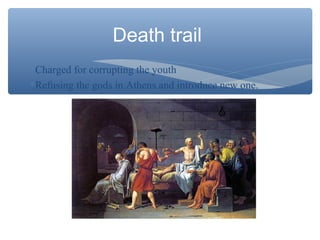
∗Charged for corrupting the youth
∗Refusing the gods in Athens and introduce new one.
Death trail
IF YOU RUIN
YOUR SOUL
WITH YOUR
ACTIONS,
THEN THERE IS NO
POINT IN
ACHIEVEING
SUCCESS IN ANY
FORM -Socrates
Plato and Socrates
∗ Plato was Socrates’ student.
∗ Almost all we know about Socrates is from Plato’s
writings.
∗ After Socrates’ execution for corrupting the young and
neglecting the gods, Plato left Athens in disgust and
travelled widely.
∗ In Italy, Plato met the Pythagoreans.
“Everything is shadow of its ideal form in the world of ideas”
∗Knowledge of the world is limited to mere shadow of reality
∗Perfect from of everything exists in the world of ideas.
∗His world is eternal and immutable where ideas are innate.
∗We reach to the highest from with our ability of reason.
∗He build the academy that was closed over 900 years.
∗No one enter in academy ,who does not know mathematics.
∗In allegory of the cave ,we all are prisoner from the birth.
∗What we call learning is only a process of collection
Plato
429-347 B.C.
Philosophy
∗ The changing physical world is a poor, decaying copy
of a perfect, rational, eternal, and changeless original.
∗ The beauty of a flower is an imperfect imitation of
Beauty itself.
∗ Other essences such as Justice is impossible in the real
world.
∗ A geometrical shape such as a Circle is a
mathematical ideal.
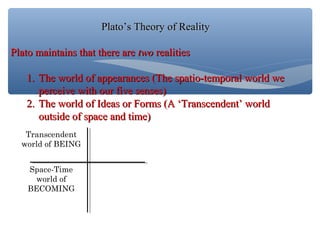
Plato’s theory of Reality
Plato’s Theory of RealityPlato’s Theory of Reality
Plato maintains that there arePlato maintains that there are twotwo realitiesrealities
1.1. The world of appearances (The spatio-temporal world weThe world of appearances (The spatio-temporal world we
perceive with our five senses)perceive with our five senses)
2.2. The world of Ideas or Forms (A ‘Transcendent’ worldThe world of Ideas or Forms (A ‘Transcendent’ world
outside of space and time)outside of space and time)
Transcendent
world of BEING
Space-Time
world of
BECOMING
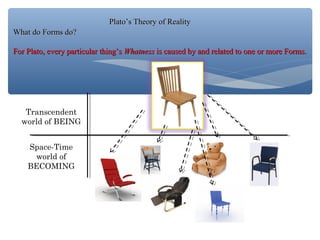
Plato’s Theory of Forms
Plato’s Theory of RealityPlato’s Theory of Reality
What do Forms do?What do Forms do?
For Plato, every particular thing’sFor Plato, every particular thing’s WhatnessWhatness is caused by and related to one or more Forms.is caused by and related to one or more Forms.
Transcendent
world of BEING
Space-Time
world of
BECOMING
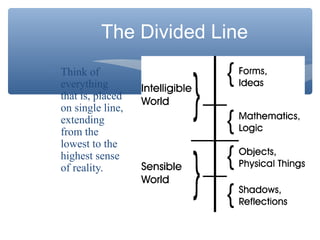
The Divided Line
∗ Think of
everything
that is, placed
on single line,
extending
from the
lowest to the
highest sense
of reality.
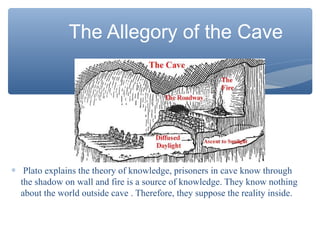
The Allegory of the Cave
∗ Plato explains the theory of knowledge, prisoners in cave know through
the shadow on wall and fire is a source of knowledge. They know nothing
about the world outside cave . Therefore, they suppose the reality inside.
The Allegory of the Cave
∗ Now, suppose one of the prisoners is unshackled and led away,
up out of the cave and into the world outside.
∗ The prisoner will probably object and when outside, will be
blinded by the light.
∗ But in time the released prisoner will realize that it is the world
outside that is real and the world in the cave only one of
illusion.
Plato & Politics
∗ The Republic
∗ Virtues of Justice
∗ Courage
∗ Wisdom and Moderation (Individual and Society)
∗ 3 Parts of Society
∗ Workers (producing)
∗ The “appetite” of the soul
∗ Warriors (protecting)
∗ The “spirit” of the soul
∗ Rulers (governing)
∗ The “reason” of the soul
The Academy
∗ In (ca.) 387 BCE, Plato returned to Athens and
established a school for philosophy, built in a grove
dedicated to the famous hero Academos.
∗ The Academy continued until it was closed in 529 CE,
over 900 years.
∗He was a student of Plato and teacher of Alexander.
∗He was scholarly and methodical in writing approach.
∗His writing is about 170 title of lecture notes.
∗Truth resides in the world around us.
∗Minds are blank slate, man by nature desire to know.
∗Everything has potentiality of achieving a actual form.
∗He classified the knowledge into distinct disciplines.
Physics,Biology,Ethics,Politics,Poetry,Rhetoric.
Aristotle(384-322 B.C)
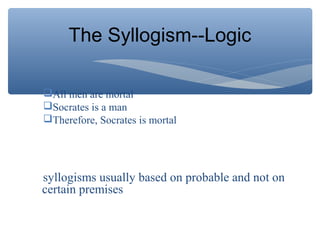
The Syllogism--Logic
All men are mortal
Socrates is a man
Therefore, Socrates is mortal
syllogisms usually based on probable and not on
certain premises
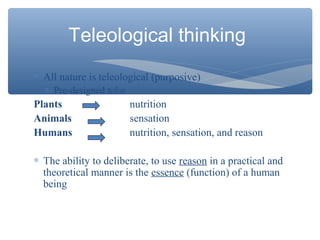
Teleological thinking
∗ All nature is teleological (purposive)
∗ Pre-designed telos
Plants nutrition
Animals sensation
Humans nutrition, sensation, and reason
∗ The ability to deliberate, to use reason in a practical and
theoretical manner is the essence (function) of a human
being
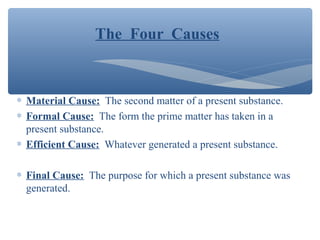
The Four Causes
∗ Material Cause: The second matter of a present substance.
∗ Formal Cause: The form the prime matter has taken in a
present substance.
∗ Efficient Cause: Whatever generated a present substance.
∗ Final Cause: The purpose for which a present substance was
generated.
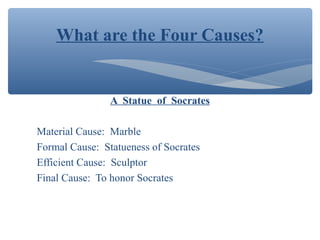
What are the Four Causes?
A Statue of Socrates
Material Cause: Marble
Formal Cause: Statueness of Socrates
Efficient Cause: Sculptor
Final Cause: To honor Socrates
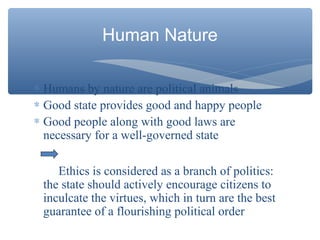
Human Nature
∗ Humans by nature are political animals
∗ Good state provides good and happy people
∗ Good people along with good laws are
necessary for a well-governed state
Ethics is considered as a branch of politics:
the state should actively encourage citizens to
inculcate the virtues, which in turn are the best
guarantee of a flourishing political order
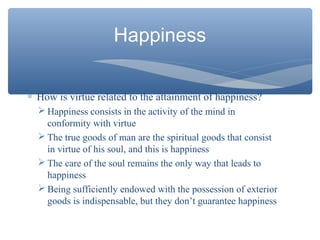
Happiness
∗ How is virtue related to the attainment of happiness?
 Happiness consists in the activity of the mind in
conformity with virtue
 The true goods of man are the spiritual goods that consist
in virtue of his soul, and this is happiness
 The care of the soul remains the only way that leads to
happiness
 Being sufficiently endowed with the possession of exterior
goods is indispensable, but they don’t guarantee happiness
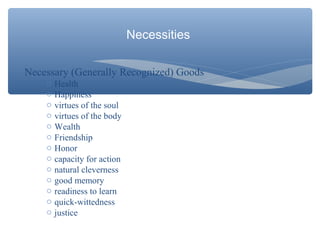
Necessities
Necessary (Generally Recognized) Goods
o Health
o Happiness
o virtues of the soul
o virtues of the body
o Wealth
o Friendship
o Honor
o capacity for action
o natural cleverness
o good memory
o readiness to learn
o quick-wittedness
o justice
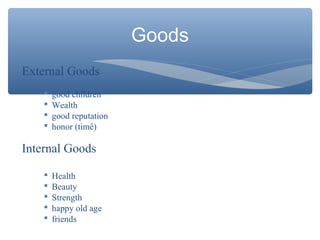
Goods
External Goods
 good children
 Wealth
 good reputation
 honor (timê)
Internal Goods
 Health
 Beauty
 Strength
 happy old age
 friends
Aristotle’s Virtue
∗ “Virtue… is a state involving rational
choice, consisting in a mean relative to us
and determined by reason – the reason,
that is, by reference to which practically
wise person would determine it. It is a
mean between two vices, one of excess,
the other of deficiency.” (NE)
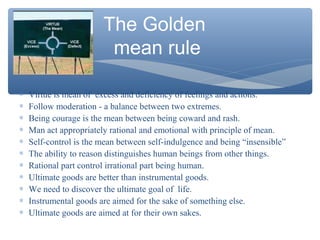
The Golden
mean rule
∗ Virtue is mean of excess and deficiency of feelings and actions.
∗ Follow moderation - a balance between two extremes.
∗ Being courage is the mean between being coward and rash.
∗ Man act appropriately rational and emotional with principle of mean.
∗ Self-control is the mean between self-indulgence and being “insensible”
∗ The ability to reason distinguishes human beings from other things.
∗ Rational part control irrational part being human.
∗ Ultimate goods are better than instrumental goods.
∗ We need to discover the ultimate goal of life.
∗ Instrumental goods are aimed for the sake of something else.
∗ Ultimate goods are aimed at for their own sakes.
Examples
∗ Courage is the mean between recklessness and
cowardice
∗ Self-control is the mean between self-indulgence and
being “insensible”
∗ Generosity is the mean between extravagance and
stinginess
∗ Wittiness is the mean between bufoonery and
boorishnes.

05 classic greek - philosophy

  • 1.
    3 great Greek Philosophers SocratesPlato Aristotle 470-399BC- 429-347B.C- 384-322B.C
  • 2.
  • 3.
    “The unexamined lifeis not worth living.” Knowledge is virtue for the sake of virtue only. Wiser is one who knows that he knows nothing. Keep examine the truth by using dialectic method. His project is to expose the contradictions within conversation. His interest is in search for definition of the universal truth. Man centered philosophy begins. There is one good “knowledge” and evil “ignorance”. People should focus only on self improvement. Socrates 399-470 B.C.
  • 4.
    What is theSocratic Method? •A type of pedagogy that seeks to encourage fundamental insight into issues and ideas via questioning • Designed to encourage self-examination: “The highest form of human excellence is to question oneself and others” • Argument, cross-examining, testing, scrutinizing • “Life without examination [dialogue] is not worth living.” • Two styles: Classic (two-way freestyle) & Modern (constructive) - the Classic style is more true to Socrates himself - the Modern style may be Plato improving upon Socrates
  • 5.
  • 6.
    Socratic Method He spentmost of his time in the marketplace discussing virtue, justice and piety He would draw as much information out of people as possible before refuting what they had said Would argue against their views to arrive at a new, more logical truth "The unexamined life is not worth living."
  • 7.
    Socrates was concernedwith the question of ETHICS (moral behaviour)  Unlike the Sophists, he believed that there was definite right and wrong  He believed that people could accept it and apply it into their daily lives  He said that it was up to people (society), as a whole, to establish those things that are right and those that are wrong  Dedicated his life to searching for standards by which people could live a virtuous/good life The philosophy of Socrates
  • 8.
    Socrates was alsoconcerned with justice ∗ He wanted life to be fair for all ∗ It was a person’s duty to explore the truth regarding right and wrong, justice and injustice, courage and cowardice ∗ He worked to find principles and laws that all could live by and be happy ∗ Universal: these truths would be applicable for all people, at any time, everywhere and in all cases The philosophy of Socrates
  • 9.
    ∗ Virtue (knowledge)is the most valuable of all things ∗ Life should be spent in search of goodness. ∗ Truth is possible to achieve ∗ People should focus on self-development rather than material wealth ∗ It is the job of the philosopher to show people how little they really know ∗ An action is right when it promoted true happiness Summarising Socrates
  • 10.
    ∗Charged for corruptingthe youth ∗Refusing the gods in Athens and introduce new one. Death trail
  • 11.
    IF YOU RUIN YOURSOUL WITH YOUR ACTIONS, THEN THERE IS NO POINT IN ACHIEVEING SUCCESS IN ANY FORM -Socrates
  • 12.
    Plato and Socrates ∗Plato was Socrates’ student. ∗ Almost all we know about Socrates is from Plato’s writings. ∗ After Socrates’ execution for corrupting the young and neglecting the gods, Plato left Athens in disgust and travelled widely. ∗ In Italy, Plato met the Pythagoreans.
  • 13.
    “Everything is shadowof its ideal form in the world of ideas” ∗Knowledge of the world is limited to mere shadow of reality ∗Perfect from of everything exists in the world of ideas. ∗His world is eternal and immutable where ideas are innate. ∗We reach to the highest from with our ability of reason. ∗He build the academy that was closed over 900 years. ∗No one enter in academy ,who does not know mathematics. ∗In allegory of the cave ,we all are prisoner from the birth. ∗What we call learning is only a process of collection Plato 429-347 B.C.
  • 14.
    Philosophy ∗ The changingphysical world is a poor, decaying copy of a perfect, rational, eternal, and changeless original. ∗ The beauty of a flower is an imperfect imitation of Beauty itself. ∗ Other essences such as Justice is impossible in the real world. ∗ A geometrical shape such as a Circle is a mathematical ideal.
  • 15.
    Plato’s theory ofReality Plato’s Theory of RealityPlato’s Theory of Reality Plato maintains that there arePlato maintains that there are twotwo realitiesrealities 1.1. The world of appearances (The spatio-temporal world weThe world of appearances (The spatio-temporal world we perceive with our five senses)perceive with our five senses) 2.2. The world of Ideas or Forms (A ‘Transcendent’ worldThe world of Ideas or Forms (A ‘Transcendent’ world outside of space and time)outside of space and time) Transcendent world of BEING Space-Time world of BECOMING
  • 16.
    Plato’s Theory ofForms Plato’s Theory of RealityPlato’s Theory of Reality What do Forms do?What do Forms do? For Plato, every particular thing’sFor Plato, every particular thing’s WhatnessWhatness is caused by and related to one or more Forms.is caused by and related to one or more Forms. Transcendent world of BEING Space-Time world of BECOMING
  • 17.
    The Divided Line ∗Think of everything that is, placed on single line, extending from the lowest to the highest sense of reality.
  • 18.
    The Allegory ofthe Cave ∗ Plato explains the theory of knowledge, prisoners in cave know through the shadow on wall and fire is a source of knowledge. They know nothing about the world outside cave . Therefore, they suppose the reality inside.
  • 19.
    The Allegory ofthe Cave ∗ Now, suppose one of the prisoners is unshackled and led away, up out of the cave and into the world outside. ∗ The prisoner will probably object and when outside, will be blinded by the light. ∗ But in time the released prisoner will realize that it is the world outside that is real and the world in the cave only one of illusion.
  • 20.
    Plato & Politics ∗The Republic ∗ Virtues of Justice ∗ Courage ∗ Wisdom and Moderation (Individual and Society) ∗ 3 Parts of Society ∗ Workers (producing) ∗ The “appetite” of the soul ∗ Warriors (protecting) ∗ The “spirit” of the soul ∗ Rulers (governing) ∗ The “reason” of the soul
  • 21.
    The Academy ∗ In(ca.) 387 BCE, Plato returned to Athens and established a school for philosophy, built in a grove dedicated to the famous hero Academos. ∗ The Academy continued until it was closed in 529 CE, over 900 years.
  • 22.
    ∗He was astudent of Plato and teacher of Alexander. ∗He was scholarly and methodical in writing approach. ∗His writing is about 170 title of lecture notes. ∗Truth resides in the world around us. ∗Minds are blank slate, man by nature desire to know. ∗Everything has potentiality of achieving a actual form. ∗He classified the knowledge into distinct disciplines. Physics,Biology,Ethics,Politics,Poetry,Rhetoric. Aristotle(384-322 B.C)
  • 23.
    The Syllogism--Logic All menare mortal Socrates is a man Therefore, Socrates is mortal syllogisms usually based on probable and not on certain premises
  • 24.
    Teleological thinking ∗ Allnature is teleological (purposive) ∗ Pre-designed telos Plants nutrition Animals sensation Humans nutrition, sensation, and reason ∗ The ability to deliberate, to use reason in a practical and theoretical manner is the essence (function) of a human being
  • 25.
    The Four Causes ∗Material Cause: The second matter of a present substance. ∗ Formal Cause: The form the prime matter has taken in a present substance. ∗ Efficient Cause: Whatever generated a present substance. ∗ Final Cause: The purpose for which a present substance was generated.
  • 26.
    What are theFour Causes? A Statue of Socrates Material Cause: Marble Formal Cause: Statueness of Socrates Efficient Cause: Sculptor Final Cause: To honor Socrates
  • 27.
    Human Nature ∗ Humansby nature are political animals ∗ Good state provides good and happy people ∗ Good people along with good laws are necessary for a well-governed state Ethics is considered as a branch of politics: the state should actively encourage citizens to inculcate the virtues, which in turn are the best guarantee of a flourishing political order
  • 28.
    Happiness ∗ How isvirtue related to the attainment of happiness?  Happiness consists in the activity of the mind in conformity with virtue  The true goods of man are the spiritual goods that consist in virtue of his soul, and this is happiness  The care of the soul remains the only way that leads to happiness  Being sufficiently endowed with the possession of exterior goods is indispensable, but they don’t guarantee happiness
  • 29.
    Necessities Necessary (Generally Recognized)Goods o Health o Happiness o virtues of the soul o virtues of the body o Wealth o Friendship o Honor o capacity for action o natural cleverness o good memory o readiness to learn o quick-wittedness o justice
  • 30.
    Goods External Goods  goodchildren  Wealth  good reputation  honor (timê) Internal Goods  Health  Beauty  Strength  happy old age  friends
  • 31.
    Aristotle’s Virtue ∗ “Virtue…is a state involving rational choice, consisting in a mean relative to us and determined by reason – the reason, that is, by reference to which practically wise person would determine it. It is a mean between two vices, one of excess, the other of deficiency.” (NE)
  • 32.
    The Golden mean rule ∗Virtue is mean of excess and deficiency of feelings and actions. ∗ Follow moderation - a balance between two extremes. ∗ Being courage is the mean between being coward and rash. ∗ Man act appropriately rational and emotional with principle of mean. ∗ Self-control is the mean between self-indulgence and being “insensible” ∗ The ability to reason distinguishes human beings from other things. ∗ Rational part control irrational part being human. ∗ Ultimate goods are better than instrumental goods. ∗ We need to discover the ultimate goal of life. ∗ Instrumental goods are aimed for the sake of something else. ∗ Ultimate goods are aimed at for their own sakes.
  • 33.
    Examples ∗ Courage isthe mean between recklessness and cowardice ∗ Self-control is the mean between self-indulgence and being “insensible” ∗ Generosity is the mean between extravagance and stinginess ∗ Wittiness is the mean between bufoonery and boorishnes.

Editor's Notes

  • #5 1) He applied his methods to examine big, complex moral concepts such as “justice” and “good” 2) Aristotle attributed to Socrates the discovery of the method of definition and induction (causing or bringing about – via questioning), which he regarded as the essence of the scientific method. 3) Socrates, to a fault his contemporaries might have argued, was constantly challenging commonly held truths that shape opinions and beliefs 4) these techniques, central to the Socratic Method, must be applied with care and respect by the teacher in a non-confrontational way. 5) it is interesting that “examination” and “dialogue” are used interchangeably. Why don’t teachers “examine” students more often via the dialectic? 6a) Classic (freestyle): very difficult to employ, risky. Has a deconstructive and a constructive phase. Most effective when dealing with ambiguous or controversial issues. Either a person will be inspired to a better and more vigorous thinking about a question, or they will get discouraged by having their perspective challenge. The challenge lies in getting from the deconstructive to the constructive phase by turning the person being questioned into a teacher or helper. If employed effectively, the questioner actually assumes a subordinate role; that of a seeker of understanding. We see this style quite frequently in legal education, especially in the first year of instruction. 6b) Modern (constructive): essentially, this is what we know to be an I.C. A constant progression of knowledge in which the student is lead to correct answers that build upon each other until the original question is answered. In the modern style, the questioner (teacher) adopts a constructive agenda and sets out to bring that agenda to life in the minds of the respondents. Many teachers employ this method unknowingly, because it is so fundamental to academic discourse. When employed intentionally, it is a powerful teaching tool.