Ancient Greek Philosophers

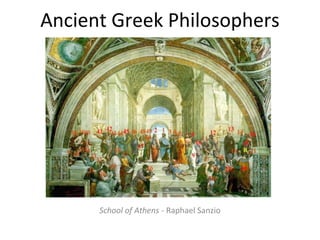
School of Athens - Raphael Sanzio
ANCIENT PHILOSOPHY:
BIRTH OF PHILOSOPHY
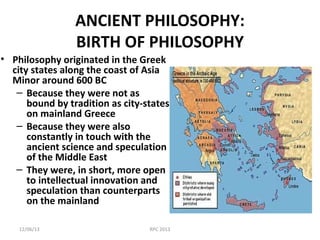
• Philosophy originated in the Greek
city states along the coast of Asia
Minor around 600 BC
– Because they were not as
bound by tradition as city-states
on mainland Greece
– Because they were also
constantly in touch with the
ancient science and speculation
of the Middle East
– They were, in short, more open
to intellectual innovation and
speculation than counterparts
on the mainland
12/06/13

RPC 2013
Philosophical Epochs

Ancient Philosophy

• Ancient Philosophy

12/06/13

RPC 2013
THE PRE-SOCRATICS
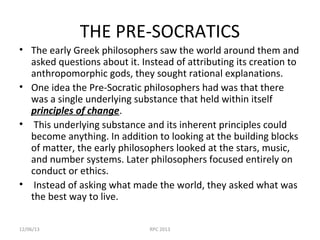
• The early Greek philosophers saw the world around them and
asked questions about it. Instead of attributing its creation to
anthropomorphic gods, they sought rational explanations.
• One idea the Pre-Socratic philosophers had was that there
was a single underlying substance that held within itself
principles of change.
• This underlying substance and its inherent principles could
become anything. In addition to looking at the building blocks
of matter, the early philosophers looked at the stars, music,
and number systems. Later philosophers focused entirely on
conduct or ethics.
• Instead of asking what made the world, they asked what was
the best way to live.
12/06/13

RPC 2013
THE PRE-SOCRATICS
• The Western philosophical tradition began in
ancient Greece in the 6th century BCE. The
first philosophers are called “Presocratics”
which designates that they came before
Socrates.
• The Presocratics were from either the eastern
or western regions of the Greek world.
Athens — home of Socrates, Plato an
Aristotle — is in the central Greek region and
was late in joining the philosophical game.
12/06/13

RPC 2013
• The Presocratic’s most distinguishing feature
is emphasis on questions of physics;
indeed, Aristotle refers
to
them
as
“Investigators of Nature”. Their scientific
interests included mathematics, astronomy,
and biology. As the first philosophers, though,
they emphasized the rational unity of things,
and rejected mythological explanations of the
world.
12/06/13

RPC 2013
Three philosophers of Miletus
believed in a single basic
substance

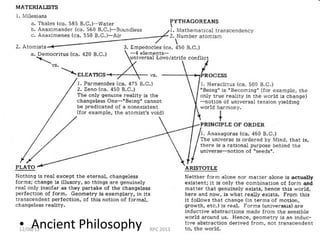
Natural Philosophers
• Thales = water
• Anaximander = divine matter; boundless
• Anaximenes = air
• Parmenedes: all is permanent
• Heraclitus: all is in flux

• Basic elements: air, water, earth, fire
• Empedocles: Source of nature cannot be a single element
• Anaxagoras: seeds ordered by intelligence
Anaximander

• Anaximander thought the principle
of all things was infinity.
• He also said the moon borrowed
its light from the sun, which was
made up of fire.
• He made a globe and, according to
Diogenes Laertes was the first to
draw a map of the inhabited world.
• Anaximander is credited with
inventing the gnomon (pointer) on
the sundial.
12/06/13

RPC 2013
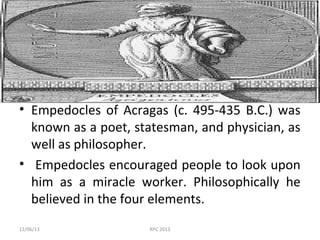
• Empedocles of Acragas (c. 495-435 B.C.) was
known as a poet, statesman, and physician, as
well as philosopher.
• Empedocles encouraged people to look upon
him as a miracle worker. Philosophically he
believed in the four elements.
12/06/13

RPC 2013
• Heraclitus (fl. 69th Olympiad,
504-501 B.C.) is the first
philosopher known to use the
word kosmos for world order,
which he says ever was and
ever will be, not created by
god or man.
• Heraclitus is thought to have
abdicated the throne of
Ephesus in favor of his
brother. He was known as
Weeping Philosopher and
Heraclitus the Obscure.
12/06/13

RPC 2013
• Parmenides (b c. 510 B.C.) was a
Greek philosopher.
• He argued against the existence
of a void, a theory used by later
philosophers in the expression
"nature abhors a vacuum,"
which stimulated experiments to
disprove it.
• Parmenides argued that change
and motion are only delusions.
12/06/13

RPC 2013
The Pythagorean School
• Probably the most famous of the early Greek
philosophers that are known collectively as
the Pre-Socratics is the 6th century B.C.
philosopher Pythagoras, who may have
actually lived and may have invented the
theorem named for him -- or not.

12/06/13

RPC 2013
• Anyone who can recall math classes will
remember the first lessons of plane geometry
that usually start with the Pythagorean
theorem about right-angled triangles:
a²+b²=c². In spite of its name, the Pythagorean
theorem was not discovered by Pythagoras.

12/06/13

RPC 2013
• This shows how Pythagoras’ formulation
immediately led to a new mathematical
problem, namely that of incommensurables.
At his time the concept of irrational numbers
was not known and it is uncertain how
Pythagoras dealt with the problem.
• From Pythagoras we observe that an answer
to a problem in science may give raise to new
questions.
• For each door we open, we find another
closed door behind it.
12/06/13

RPC 2013
• Greek Philosophers
– Pythagoras- universe followed the same laws that
govern music & numbers
• Pythagorean Theorem- determine the length of the
sides of a triangle

12/06/13

RPC 2013

ANCIENT PHILOSOPHY: PRE-SOCRATICS

  • 1.
    Ancient Greek Philosophers Schoolof Athens - Raphael Sanzio
  • 2.
    ANCIENT PHILOSOPHY: BIRTH OFPHILOSOPHY • Philosophy originated in the Greek city states along the coast of Asia Minor around 600 BC – Because they were not as bound by tradition as city-states on mainland Greece – Because they were also constantly in touch with the ancient science and speculation of the Middle East – They were, in short, more open to intellectual innovation and speculation than counterparts on the mainland 12/06/13 RPC 2013
  • 3.
    Philosophical Epochs Ancient Philosophy •Ancient Philosophy 12/06/13 RPC 2013
  • 4.
    THE PRE-SOCRATICS • Theearly Greek philosophers saw the world around them and asked questions about it. Instead of attributing its creation to anthropomorphic gods, they sought rational explanations. • One idea the Pre-Socratic philosophers had was that there was a single underlying substance that held within itself principles of change. • This underlying substance and its inherent principles could become anything. In addition to looking at the building blocks of matter, the early philosophers looked at the stars, music, and number systems. Later philosophers focused entirely on conduct or ethics. • Instead of asking what made the world, they asked what was the best way to live. 12/06/13 RPC 2013
  • 5.
    THE PRE-SOCRATICS • TheWestern philosophical tradition began in ancient Greece in the 6th century BCE. The first philosophers are called “Presocratics” which designates that they came before Socrates. • The Presocratics were from either the eastern or western regions of the Greek world. Athens — home of Socrates, Plato an Aristotle — is in the central Greek region and was late in joining the philosophical game. 12/06/13 RPC 2013
  • 6.
    • The Presocratic’smost distinguishing feature is emphasis on questions of physics; indeed, Aristotle refers to them as “Investigators of Nature”. Their scientific interests included mathematics, astronomy, and biology. As the first philosophers, though, they emphasized the rational unity of things, and rejected mythological explanations of the world. 12/06/13 RPC 2013
  • 7.
    Three philosophers ofMiletus believed in a single basic substance Natural Philosophers • Thales = water • Anaximander = divine matter; boundless • Anaximenes = air • Parmenedes: all is permanent • Heraclitus: all is in flux • Basic elements: air, water, earth, fire • Empedocles: Source of nature cannot be a single element • Anaxagoras: seeds ordered by intelligence
  • 8.
    Anaximander • Anaximander thoughtthe principle of all things was infinity. • He also said the moon borrowed its light from the sun, which was made up of fire. • He made a globe and, according to Diogenes Laertes was the first to draw a map of the inhabited world. • Anaximander is credited with inventing the gnomon (pointer) on the sundial. 12/06/13 RPC 2013
  • 9.
    • Empedocles ofAcragas (c. 495-435 B.C.) was known as a poet, statesman, and physician, as well as philosopher. • Empedocles encouraged people to look upon him as a miracle worker. Philosophically he believed in the four elements. 12/06/13 RPC 2013
  • 10.
    • Heraclitus (fl.69th Olympiad, 504-501 B.C.) is the first philosopher known to use the word kosmos for world order, which he says ever was and ever will be, not created by god or man. • Heraclitus is thought to have abdicated the throne of Ephesus in favor of his brother. He was known as Weeping Philosopher and Heraclitus the Obscure. 12/06/13 RPC 2013
  • 11.
    • Parmenides (bc. 510 B.C.) was a Greek philosopher. • He argued against the existence of a void, a theory used by later philosophers in the expression "nature abhors a vacuum," which stimulated experiments to disprove it. • Parmenides argued that change and motion are only delusions. 12/06/13 RPC 2013
  • 12.
    The Pythagorean School •Probably the most famous of the early Greek philosophers that are known collectively as the Pre-Socratics is the 6th century B.C. philosopher Pythagoras, who may have actually lived and may have invented the theorem named for him -- or not. 12/06/13 RPC 2013
  • 13.
    • Anyone whocan recall math classes will remember the first lessons of plane geometry that usually start with the Pythagorean theorem about right-angled triangles: a²+b²=c². In spite of its name, the Pythagorean theorem was not discovered by Pythagoras. 12/06/13 RPC 2013
  • 14.
    • This showshow Pythagoras’ formulation immediately led to a new mathematical problem, namely that of incommensurables. At his time the concept of irrational numbers was not known and it is uncertain how Pythagoras dealt with the problem. • From Pythagoras we observe that an answer to a problem in science may give raise to new questions. • For each door we open, we find another closed door behind it. 12/06/13 RPC 2013
  • 15.
    • Greek Philosophers –Pythagoras- universe followed the same laws that govern music & numbers • Pythagorean Theorem- determine the length of the sides of a triangle 12/06/13 RPC 2013