Hellenistic Greeks Society and Culture of an Empire
Philip of Macedonia Warfare  continued among the city states Finally, Philip of Macedonia conquered the peninsula 338 BCE He was assassinated two years later His son Alexander assumed the throne of Macedonia
Alexander the Great and His Successors Conquered Persia, Asia Minor (Turkey), Egypt, and Syria Military Technology: catapults and battering rams Expansion stopped in India, when an army with elephants induced soldiers to mutiny Alexander died in 323 BCE, probably of  Malaria The empire was divided into three segments Egypt: By the Ptolemy dynasty Persia by the Seleucid rulers Macedonia under Antigonus the One-Eyed
Hellenistic Greece: Main Developments Sculptures made for more realistic human forms, rather then the ideal Drama: melodramatic over the tragic; Meaning: preference of extravagant theatrics over characterization Philosophy: Metaphysics replaced by science and the practical Religion: spread of the mysteries such as Isis from Egypt, Mithra from Persia, Gnosticism Spread Greek classicism to the non-Greek world—including Rome
Philosophies of Hellenistic Greece Overall, became guides of the practical that guided everyday life Neglected the rational methods of investigation according to Plato, Socrates, Aristotle and the pre-Greek philosophers Four schools predominate: Skeptics, Cynics, Epicureans, and Stoics All placed the needs of individuals above that of community or the search for univeral truth
Hellenistic Philosophy: Skeptics and Cynics Skeptics  harked back to the Sophists Denied the possibility of knowing anything for certain Argued therefore for the suspension of all intellectual judgment Cynics  called for renunciation of societal values, conventions, and wealth This renunciation is the key to spiritual satisfaction Cynics anticipate   the asceticism of   a monastic Christianity
Hellenistic Philosophy: Epicureans Opposite of the popular idea “eat, drink, and be merry for tomorrow we die” Epicureans  (following Epicurus) argued that happiness follows from avoiding all physical excess Called for plain living and balance between body and mind—not unlike the Christians Argued that gods played no part in human life Death is nothing but the rearrangement of atoms that made up the body and all nature\
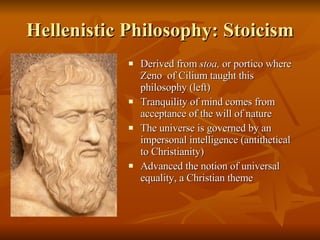
Hellenistic Philosophy: Stoicism Derived from  stoa,  or portico where Zeno  of Cilium taught this philosophy (left) Tranquility of mind comes from acceptance of the will of nature The universe is governed by an impersonal intelligence (antithetical to Christianity) Advanced the notion of universal equality, a Christian theme
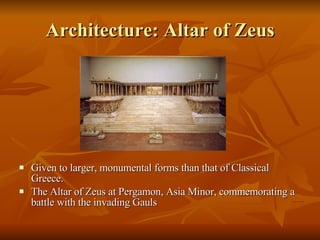
Architecture: Altar of Zeus Given to larger, monumental forms than that of Classical Greece. The Altar of Zeus at Pergamon, Asia Minor, commemorating a battle with the invading Gauls
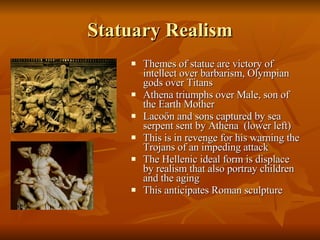
Statuary Realism Themes of statue are victory of intellect over barbarism, Olympian gods over Titans Athena triumphs over Male, son of the Earth Mother Laco őn and sons captured by sea serpent sent by Athena  (lower left) This is in revenge for his warning the Trojans of an impeding attack The Hellenic ideal form is displace by realism that also portray children and the aging This anticipates Roman sculpture
Religious Themes Hellenistic thought also anticipates the Mysteries Some groups worship Isis or Osiris or both from Egypt From Persia came Mithra, God of the Sun in pre-Zoroastian times From Egypt also came Gnosticism, which refers to personal knowledge of the unseen world These themes were adopted later in Rome in along with Christianity as the empire entered decline
Developments in Science and Mathematics Archimedes:  specific gravity; foundations of calculus, compound pulley; mechanical properties of the lever Aristarchus:  Proposes the heliocentric theory of planetary movement Euclid:  basics of plane geometry Hipparchus:  Invents trigonometry; catalogues 805 fixed stars Herophilus:  nervous system; arteries carry blood (not air) from the heart
Conclusion: Significance of Hellenistic Period Expanded the world view of Hellenic Greece to encompass that beyond that culture Created a practical perspective in intellectual life, reflected in everyday concerns Instilled realism in art and sculpture Emphasized the plot over characterization in drama Brought size into architecture Fostered scientific and mathematical innovations Set the foundations for Rome and later Christianity

Hellenistic Greece

  • 1.
    Hellenistic Greeks Societyand Culture of an Empire
  • 2.
    Philip of MacedoniaWarfare continued among the city states Finally, Philip of Macedonia conquered the peninsula 338 BCE He was assassinated two years later His son Alexander assumed the throne of Macedonia
  • 3.
    Alexander the Greatand His Successors Conquered Persia, Asia Minor (Turkey), Egypt, and Syria Military Technology: catapults and battering rams Expansion stopped in India, when an army with elephants induced soldiers to mutiny Alexander died in 323 BCE, probably of Malaria The empire was divided into three segments Egypt: By the Ptolemy dynasty Persia by the Seleucid rulers Macedonia under Antigonus the One-Eyed
  • 4.
    Hellenistic Greece: MainDevelopments Sculptures made for more realistic human forms, rather then the ideal Drama: melodramatic over the tragic; Meaning: preference of extravagant theatrics over characterization Philosophy: Metaphysics replaced by science and the practical Religion: spread of the mysteries such as Isis from Egypt, Mithra from Persia, Gnosticism Spread Greek classicism to the non-Greek world—including Rome
  • 5.
    Philosophies of HellenisticGreece Overall, became guides of the practical that guided everyday life Neglected the rational methods of investigation according to Plato, Socrates, Aristotle and the pre-Greek philosophers Four schools predominate: Skeptics, Cynics, Epicureans, and Stoics All placed the needs of individuals above that of community or the search for univeral truth
  • 6.
    Hellenistic Philosophy: Skepticsand Cynics Skeptics harked back to the Sophists Denied the possibility of knowing anything for certain Argued therefore for the suspension of all intellectual judgment Cynics called for renunciation of societal values, conventions, and wealth This renunciation is the key to spiritual satisfaction Cynics anticipate the asceticism of a monastic Christianity
  • 7.
    Hellenistic Philosophy: EpicureansOpposite of the popular idea “eat, drink, and be merry for tomorrow we die” Epicureans (following Epicurus) argued that happiness follows from avoiding all physical excess Called for plain living and balance between body and mind—not unlike the Christians Argued that gods played no part in human life Death is nothing but the rearrangement of atoms that made up the body and all nature\
  • 8.
    Hellenistic Philosophy: StoicismDerived from stoa, or portico where Zeno of Cilium taught this philosophy (left) Tranquility of mind comes from acceptance of the will of nature The universe is governed by an impersonal intelligence (antithetical to Christianity) Advanced the notion of universal equality, a Christian theme
  • 9.
    Architecture: Altar ofZeus Given to larger, monumental forms than that of Classical Greece. The Altar of Zeus at Pergamon, Asia Minor, commemorating a battle with the invading Gauls
  • 10.
    Statuary Realism Themesof statue are victory of intellect over barbarism, Olympian gods over Titans Athena triumphs over Male, son of the Earth Mother Laco őn and sons captured by sea serpent sent by Athena (lower left) This is in revenge for his warning the Trojans of an impeding attack The Hellenic ideal form is displace by realism that also portray children and the aging This anticipates Roman sculpture
  • 11.
    Religious Themes Hellenisticthought also anticipates the Mysteries Some groups worship Isis or Osiris or both from Egypt From Persia came Mithra, God of the Sun in pre-Zoroastian times From Egypt also came Gnosticism, which refers to personal knowledge of the unseen world These themes were adopted later in Rome in along with Christianity as the empire entered decline
  • 12.
    Developments in Scienceand Mathematics Archimedes: specific gravity; foundations of calculus, compound pulley; mechanical properties of the lever Aristarchus: Proposes the heliocentric theory of planetary movement Euclid: basics of plane geometry Hipparchus: Invents trigonometry; catalogues 805 fixed stars Herophilus: nervous system; arteries carry blood (not air) from the heart
  • 13.
    Conclusion: Significance ofHellenistic Period Expanded the world view of Hellenic Greece to encompass that beyond that culture Created a practical perspective in intellectual life, reflected in everyday concerns Instilled realism in art and sculpture Emphasized the plot over characterization in drama Brought size into architecture Fostered scientific and mathematical innovations Set the foundations for Rome and later Christianity