Objectives
By the endof this presentation, students will be able
to:
• Identify key Pre-Socratic philosophers and their
contributions.
• Understand the shift from mythological to rational
explanations of the universe.
• Analyze how Pre-Socratic ideas influenced later
philosophical and scientific thought.
• Compare and contrast different philosophical
perspectives on the nature of reality.
3.
Pre-Socratic Philosophy
• Pre-Socraticphilosophy refers to the early
Greek thinkers before Socrates (6th–5th
century BCE).
• These philosophers sought natural
explanations for the universe, moving away
from mythological interpretations.
• Key focus areas: metaphysics, cosmology,
and the nature of existence.
4.
Thales of Miletus(c. 624–546 BCE)
•Considered the first philosopher in Western
tradition.
•Proposed that water is the fundamental substance
(arche) of all things.
•Believed in natural causes rather than divine
intervention.
•Used geometry to measure distances and heights.
•Predicted a solar eclipse, demonstrating that natural
events follow patterns.
5.
Anaximander (c. 610–546BCE)
• Suggested that the 'apeiron' (infinite or
boundless) is the source of all things.
• Introduced the idea of evolution and a form
of the scientific method.
• Proposed that the Earth floats freely in space,
without the need for external support.
• Believed that life originated in water and
gradually adapted to land.
6.
Anaximenes (c. 586–526BCE)
• Believed that air (pneuma) is the
fundamental substance.
• Suggested that changes in matter result from
processes of rarefaction and condensation.
• Laid the foundation for later theories on
elements and material transformation.
• Thought that different physical states (solid,
liquid, gas) arise from the density of air.
7.
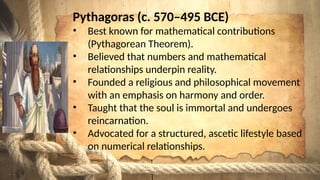
Pythagoras (c. 570–495BCE)
• Best known for mathematical contributions
(Pythagorean Theorem).
• Believed that numbers and mathematical
relationships underpin reality.
• Founded a religious and philosophical movement
with an emphasis on harmony and order.
• Taught that the soul is immortal and undergoes
reincarnation.
• Advocated for a structured, ascetic lifestyle based
on numerical relationships.
8.
Heraclitus (c. 535–475BCE)
• Famous for the idea that "everything flows" (panta
rhei).
• Believed fire is the primary element and symbolizes
constant change.
• Emphasized the unity of opposites (e.g., war and
peace coexist).
• Saw change as the fundamental essence of reality.
• Argued that struggle and conflict drive
transformation in the universe.
9.
Parmenides (c. 515–450BCE)
• Argued that reality is unchanging and that
change is an illusion.
• Introduced the concept that being is one,
eternal, and indivisible.
• His ideas influenced later metaphysical
debates.
• Asserted that human perception is
deceptive and cannot be trusted.
• Believed that reason, rather than sensory
experience, leads to truth.
10.
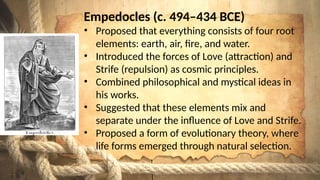
Empedocles (c. 494–434BCE)
• Proposed that everything consists of four root
elements: earth, air, fire, and water.
• Introduced the forces of Love (attraction) and
Strife (repulsion) as cosmic principles.
• Combined philosophical and mystical ideas in
his works.
• Suggested that these elements mix and
separate under the influence of Love and Strife.
• Proposed a form of evolutionary theory, where
life forms emerged through natural selection.
11.
Anaxagoras (c. 500–428BCE)
• Introduced the concept of "nous" (mind) as the
cosmic ordering principle.
• Suggested that everything contains a portion of
everything else.
• His ideas bridged the gap between physical and
metaphysical explanations.
• Proposed that the sun is a massive fiery rock
rather than a divine being.
• His theories contributed to early scientific
thought and astronomy.
12.
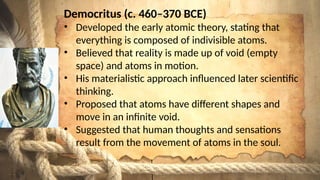
Democritus (c. 460–370BCE)
• Developed the early atomic theory, stating that
everything is composed of indivisible atoms.
• Believed that reality is made up of void (empty
space) and atoms in motion.
• His materialistic approach influenced later scientific
thinking.
• Proposed that atoms have different shapes and
move in an infinite void.
• Suggested that human thoughts and sensations
result from the movement of atoms in the soul.
13.
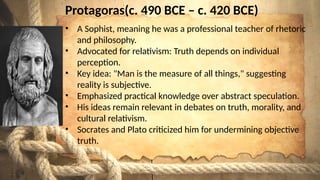
Protagoras(c. 490 BCE– c. 420 BCE)
• A Sophist, meaning he was a professional teacher of rhetoric
and philosophy.
• Advocated for relativism: Truth depends on individual
perception.
• Key idea: "Man is the measure of all things," suggesting
reality is subjective.
• Emphasized practical knowledge over abstract speculation.
• His ideas remain relevant in debates on truth, morality, and
cultural relativism.
• Socrates and Plato criticized him for undermining objective
truth.
14.
Conclusion & Legacyof Pre-Socratic Thought
• Shifted from mythological to rational explanations of the
universe.
• Laid the groundwork for later philosophical traditions,
including Socratic and Platonic thought.
• Influenced science, metaphysics, and ethics in Western
philosophy.
• Their ideas paved the way for scientific inquiry and
logical reasoning.
• Provided alternative perspectives that questioned
traditional religious views.
15.
Discussion Questions
• Howdid Pre-Socratic philosophers change
the way people thought about the world?
• Which philosopher’s ideas do you find
most interesting and why?
Objective-Type Questions
1.Who isconsidered the first Western philosopher? Thales of Miletus
2.What did Anaximenes believe was the fundamental substance of all things? Air
(pneuma)
3.What is Heraclitus’ famous concept about change? Everything flows (panta rhei)
4.Which philosopher introduced the idea of the four root elements? Empedocles
5.What was Pythagoras primarily known for? Numbers
6.Who proposed the concept of 'apeiron' as the origin of everything? Anaximander
7.What principle did Anaxagoras introduce to explain cosmic order? Nous (Mind)
8.What is the main idea behind Democritus' atomic theory? Everything is composed
of indivisible atoms
9.Which Pre-Socratic philosopher believed that reality is unchanging? Parmenides
10.What forces did Empedocles believe governed the mixing and separation of
elements? Love and Strife