By:- Israr K. Raja
Iqra University, Islamabad, Pakistan
Early Ancient Philosophers
 Certain early Greeks from Ionia (Asia Minor)
and southern Italy asked questions about the world
around them.
 Instead of attributing its creation to anthropomorphic
gods, these early philosophers broke tradition and
sought rational explanations.
 Their speculation formed the early basis for science
and natural philosophy.
 Here are 10 of the earliest and most influential ancient
Greek philosophers in chronological order.
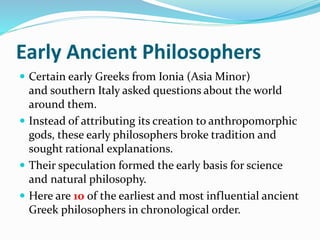
Thales
 The founder of natural
philosophy.
 Thales was a Greek pre-
Socratic
philosopher from the
Ionian city of Miletus (c.
620 - c. 546 B.C.).
 He predicted a solar
eclipse and was
considered one of the
seven ancient sages.
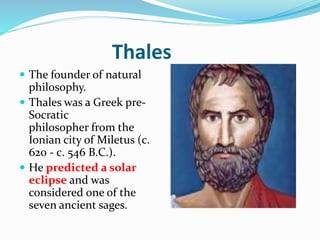
Pythagoras
 Pythagoras was an early
Greek philosopher,
astronomer, and
mathematician known for
the Pythagorean
theorem, which geometry
students use to figure the
hypotenuse of a right
triangle.
 He was also the founder of
a school named for him.
Hypotenuse of a Right Triangle
 The length of
the hypotenuse of a
right triangle can be
found using the
Pythagorean theorem,
which states that the
square of the length of
the hypotenuse equals
the sum of the squares of
the lengths of the other
two sides
Pythagorean Theorem
 In mathematics, the
Pythagorean theorem, also
known as Pythagoras'
theorem, is a fundamental
relation in Euclidean
geometry among the three
sides of a right triangle. It
states that the area of the
square whose side is the
hypotenuse is equal to the
sum of the areas of the
squares on the other two
sides.
Anaximander/æˌnæksɪˈmændər
 Anaximander was a pupil
of Thales.
 He was the first to describe
the original principle of
the universe as apeiron, or
boundless, unlimited or
immense and to use the
term arche for beginning.
 In the Gospel of John, the
first phrase contains the
Greek for "beginning"—the
same word "arche."
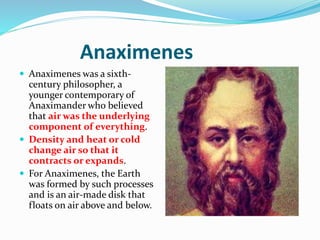
Anaximenes
 Anaximenes was a sixth-
century philosopher, a
younger contemporary of
Anaximander who believed
that air was the underlying
component of everything.
 Density and heat or cold
change air so that it
contracts or expands.
 For Anaximenes, the Earth
was formed by such processes
and is an air-made disk that
floats on air above and below.
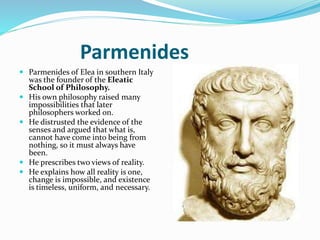
Parmenides
 Parmenides of Elea in southern Italy
was the founder of the Eleatic
School of Philosophy.
 His own philosophy raised many
impossibilities that later
philosophers worked on.
 He distrusted the evidence of the
senses and argued that what is,
cannot have come into being from
nothing, so it must always have
been.
 He prescribes two views of reality.
 He explains how all reality is one,
change is impossible, and existence
is timeless, uniform, and necessary.
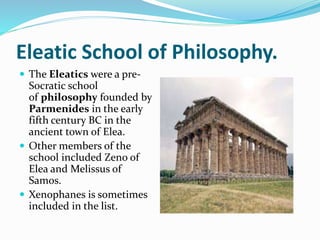
Eleatic School of Philosophy.
 The Eleatics were a pre-
Socratic school
of philosophy founded by
Parmenides in the early
fifth century BC in the
ancient town of Elea.
 Other members of the
school included Zeno of
Elea and Melissus of
Samos.
 Xenophanes is sometimes
included in the list.
Anaxagoras
 Anaxagoras, who was born in
Clazomenae, Asia Minor, around
500 B.C., spent most of his life in
Athens, where he made a place
for philosophy and associated
with Euripides (writer of
tragedies) and Pericles
(Athenian statesman).
 In 430, Anaxagoras was brought
to trial for impiety in Athens
because his philosophy denied
the divinity of all other gods
but his principle, the mind.
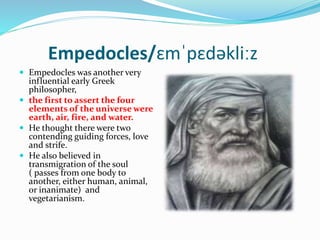
Empedocles/ɛmˈpɛdəkliːz
 Empedocles was another very
influential early Greek
philosopher,
 the first to assert the four
elements of the universe were
earth, air, fire, and water.
 He thought there were two
contending guiding forces, love
and strife.
 He also believed in
transmigration of the soul
( passes from one body to
another, either human, animal,
or inanimate) and
vegetarianism.
Zeno
 Zeno is the greatest figure of the
Eleatic School.
 He is known through the writing
of Aristotle and Simplicius (A.D.
6th C.).
 Zeno presents four arguments
against motion, which are
demonstrated in his famous
paradoxes.
 The paradox referred to as
"Achilles" claims that a faster
runner (Achilles) can never
overtake the tortoise because the
pursuer must always first reach
the spot that the one he seeks to
overtake has just left.
Zeno's Paradox: Achilles and
Tortoise Race
 https://www.youtube.com/watch?v=NCtw5f6XPF4
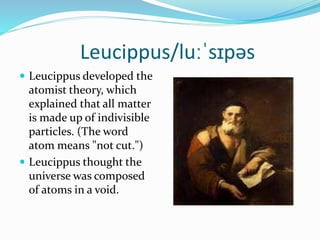
Leucippus/luːˈsɪpəs
 Leucippus developed the
atomist theory, which
explained that all matter
is made up of indivisible
particles. (The word
atom means "not cut.")
 Leucippus thought the
universe was composed
of atoms in a void.
Xenophanes
 Born around 570 B.C.,
 Xenophanes was the founder of
the Eleatic School of philosophy.
 He fled to Sicily where he joined
the Pythagorean School.
 He is known for his satirical
poetry ridiculing polytheism
and the idea that the gods were
portrayed as humans.
 His eternal deity was the world.
 If there was ever a time when
there was nothing, then it was
impossible for anything ever to
have come into being.

Early ancient philosophers

  • 1.
    By:- Israr K.Raja Iqra University, Islamabad, Pakistan
  • 2.
    Early Ancient Philosophers Certain early Greeks from Ionia (Asia Minor) and southern Italy asked questions about the world around them.  Instead of attributing its creation to anthropomorphic gods, these early philosophers broke tradition and sought rational explanations.  Their speculation formed the early basis for science and natural philosophy.  Here are 10 of the earliest and most influential ancient Greek philosophers in chronological order.
  • 3.
    Thales  The founderof natural philosophy.  Thales was a Greek pre- Socratic philosopher from the Ionian city of Miletus (c. 620 - c. 546 B.C.).  He predicted a solar eclipse and was considered one of the seven ancient sages.
  • 4.
    Pythagoras  Pythagoras wasan early Greek philosopher, astronomer, and mathematician known for the Pythagorean theorem, which geometry students use to figure the hypotenuse of a right triangle.  He was also the founder of a school named for him.
  • 5.
    Hypotenuse of aRight Triangle  The length of the hypotenuse of a right triangle can be found using the Pythagorean theorem, which states that the square of the length of the hypotenuse equals the sum of the squares of the lengths of the other two sides
  • 6.
    Pythagorean Theorem  Inmathematics, the Pythagorean theorem, also known as Pythagoras' theorem, is a fundamental relation in Euclidean geometry among the three sides of a right triangle. It states that the area of the square whose side is the hypotenuse is equal to the sum of the areas of the squares on the other two sides.
  • 7.
    Anaximander/æˌnæksɪˈmændər  Anaximander wasa pupil of Thales.  He was the first to describe the original principle of the universe as apeiron, or boundless, unlimited or immense and to use the term arche for beginning.  In the Gospel of John, the first phrase contains the Greek for "beginning"—the same word "arche."
  • 8.
    Anaximenes  Anaximenes wasa sixth- century philosopher, a younger contemporary of Anaximander who believed that air was the underlying component of everything.  Density and heat or cold change air so that it contracts or expands.  For Anaximenes, the Earth was formed by such processes and is an air-made disk that floats on air above and below.
  • 9.
    Parmenides  Parmenides ofElea in southern Italy was the founder of the Eleatic School of Philosophy.  His own philosophy raised many impossibilities that later philosophers worked on.  He distrusted the evidence of the senses and argued that what is, cannot have come into being from nothing, so it must always have been.  He prescribes two views of reality.  He explains how all reality is one, change is impossible, and existence is timeless, uniform, and necessary.
  • 10.
    Eleatic School ofPhilosophy.  The Eleatics were a pre- Socratic school of philosophy founded by Parmenides in the early fifth century BC in the ancient town of Elea.  Other members of the school included Zeno of Elea and Melissus of Samos.  Xenophanes is sometimes included in the list.
  • 11.
    Anaxagoras  Anaxagoras, whowas born in Clazomenae, Asia Minor, around 500 B.C., spent most of his life in Athens, where he made a place for philosophy and associated with Euripides (writer of tragedies) and Pericles (Athenian statesman).  In 430, Anaxagoras was brought to trial for impiety in Athens because his philosophy denied the divinity of all other gods but his principle, the mind.
  • 12.
    Empedocles/ɛmˈpɛdəkliːz  Empedocles wasanother very influential early Greek philosopher,  the first to assert the four elements of the universe were earth, air, fire, and water.  He thought there were two contending guiding forces, love and strife.  He also believed in transmigration of the soul ( passes from one body to another, either human, animal, or inanimate) and vegetarianism.
  • 13.
    Zeno  Zeno isthe greatest figure of the Eleatic School.  He is known through the writing of Aristotle and Simplicius (A.D. 6th C.).  Zeno presents four arguments against motion, which are demonstrated in his famous paradoxes.  The paradox referred to as "Achilles" claims that a faster runner (Achilles) can never overtake the tortoise because the pursuer must always first reach the spot that the one he seeks to overtake has just left.
  • 14.
    Zeno's Paradox: Achillesand Tortoise Race  https://www.youtube.com/watch?v=NCtw5f6XPF4
  • 15.
    Leucippus/luːˈsɪpəs  Leucippus developedthe atomist theory, which explained that all matter is made up of indivisible particles. (The word atom means "not cut.")  Leucippus thought the universe was composed of atoms in a void.
  • 16.
    Xenophanes  Born around570 B.C.,  Xenophanes was the founder of the Eleatic School of philosophy.  He fled to Sicily where he joined the Pythagorean School.  He is known for his satirical poetry ridiculing polytheism and the idea that the gods were portrayed as humans.  His eternal deity was the world.  If there was ever a time when there was nothing, then it was impossible for anything ever to have come into being.