JERLYN MAE S.
QUILIOPE
One of the most unique and wonderful
of Greek inventions was philosophy
Philosophy was the special way
Greeks attempted to make sense out
of the world, in a non-religious way
This means that rather than using
myths and stories to understand the
world, they would use their intelligence
and reasoning skills
“Philo-” means love, and
“-sophia” means wisdom, so
the word “philosophy” really
means “the love of wisdom.”
Basically, philosophy is
thinking about the world and
making sense out of it.
Early Greeks began asking the
question, “What exists?”
They questioned the world
around them and tried to make
sense out of what they saw.
Other, different philosophies were
developed, each of which tried to
make sense out of the world.
Eventually, their ideas built
upon each other until very
complicated philosophies were
developed
These early thinkers were so
influential that their ideas are
still around today, and people
still study them in colleges and
universities
The earliest of Greek
philosophers tried to
answer the question of
what exists by coming up
with a number of different
ideas
The Four Elements
Thales, who lived around 600
BC (nearly 2,600 years ago)
determined that everything
was made up of water, which
he thought was the single
primal element
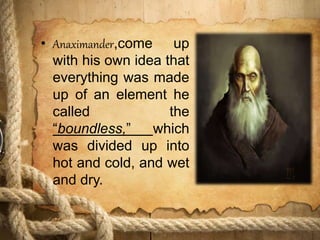
• Anaximander,come up
with his own idea that
everything was made
up of an element he
called the
“boundless,” which
was divided up into
hot and cold, and wet
and dry.
It was these early ideas that
helped later philosophers to
classify the entire world
according to the four
elements: Earth, Air, Fire,
and Water
Mathematics
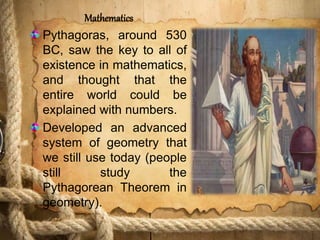
Pythagoras, around 530
BC, saw the key to all of
existence in mathematics,
and thought that the
entire world could be
explained with numbers.
Developed an advanced
system of geometry that
we still use today (people
still study the
Pythagorean Theorem in
geometry).
Atoms
Around 450 BC, there were two
philosophers, Leucippus and
Democritus, both of whom thought that
the world was made up of little particles
that were so small we couldn’t even see
them. They called these particles atoms,
and thought that they made up everything
in the universe.
Eventually, modern science would prove
that these atomic theories were right, even
though they were developed thousands of
years ago
The Sophists
Around 450 BC, philosophers known as Sophists
thought that “man is the measure” of everything.
In other words, they thought that the only things
that matter are human beings and the way we
see the world.
Taught their students that they should use their
reason, or intelligence, in order to succeed in life.
Sophists also believed that there is an important
difference between things that are man-made
versus things that are naturally made, and said
that natural products were better than man-made
ones
Socrates
Socrates, who lived from 469-399 BC, was one of the
most influential philosophers of all time
He disagreed with the sophists because they charged
their students money, but didn’t teach them how to be
ethical
Being ethical means acting in a morally responsible
manner, like doing the right thing, no matter what.
Socrates was one of the first philosophers to ask the
question “What is right and wrong?”
His teaching technique, later called the Socratic
Method, involved asking his students questions and
correcting them, so that they would come up with the
right answers
Socrates
Socrates’ Trial and Death
Welcomed any students into his lectures, and
so he ended up teaching some students that
were enemies of the state
This led some of his enemies in the Greek
government to accuse him of being disloyal to
the Greek democracy
The jury found him guilty and sentenced him to
the death penalty. At the age of 70, Socrates
accepted his punishment, drank a cup of
poison, and died.
PLATO
Socrates didn’t actually write down any of
his philosophies or philosophical teachings
Most of what we know about him is through
the writings of Plato, who lived from 428-
347 BC
Plato was one of Socrates’ most famous
pupils, who continued Socrates’ work by
writing hundreds of profound and complex
dialogues, which illustrated his philosophical
viewpoints
PLATO
The Republic
Most influential book that Plato wrote,
and is still the most widely read
philosophical book of all time
In The Republic, Plato examined the
question “What is justice?” and wrote
hundreds of pages about what the right
type of government should be
Aristotle
Most famous of Plato’s students
was Aristotle, who lived from 384-
322 BC
Instead of focusing on justice, like
Plato, Aristotle wrote about all
types of learning, such as logic,
metaphysics, astronomy, physics,
politics, and poetry
Aristotle
Most influential ideas if Aristotle’s
was that of the Golden Mean,
which was the idea of a middle
ground between good and bad,
and the belief in moderation, or
that people should try to maintain a
balance between two extremes
Greek philosophers all started a new type of
thinking. Rather than believing in myths and
stories, they began searching for the truth of
the world by using their rational thinking.
The ideas of Socrates, Plato, Aristotle, and
hundreds of other Greek philosophers, have
all remained very important in the
development of other new philosophical
ideas, as well as science, astronomy,
physics, medicine, and mathematics
THANK
YOU…

Greek philosophy

  • 1.
  • 2.
    One of themost unique and wonderful of Greek inventions was philosophy Philosophy was the special way Greeks attempted to make sense out of the world, in a non-religious way This means that rather than using myths and stories to understand the world, they would use their intelligence and reasoning skills
  • 3.
    “Philo-” means love,and “-sophia” means wisdom, so the word “philosophy” really means “the love of wisdom.” Basically, philosophy is thinking about the world and making sense out of it.
  • 4.
    Early Greeks beganasking the question, “What exists?” They questioned the world around them and tried to make sense out of what they saw. Other, different philosophies were developed, each of which tried to make sense out of the world.
  • 5.
    Eventually, their ideasbuilt upon each other until very complicated philosophies were developed These early thinkers were so influential that their ideas are still around today, and people still study them in colleges and universities
  • 6.
    The earliest ofGreek philosophers tried to answer the question of what exists by coming up with a number of different ideas
  • 7.
    The Four Elements Thales,who lived around 600 BC (nearly 2,600 years ago) determined that everything was made up of water, which he thought was the single primal element
  • 8.
    • Anaximander,come up withhis own idea that everything was made up of an element he called the “boundless,” which was divided up into hot and cold, and wet and dry.
  • 9.
    It was theseearly ideas that helped later philosophers to classify the entire world according to the four elements: Earth, Air, Fire, and Water
  • 10.
    Mathematics Pythagoras, around 530 BC,saw the key to all of existence in mathematics, and thought that the entire world could be explained with numbers. Developed an advanced system of geometry that we still use today (people still study the Pythagorean Theorem in geometry).
  • 11.
    Atoms Around 450 BC,there were two philosophers, Leucippus and Democritus, both of whom thought that the world was made up of little particles that were so small we couldn’t even see them. They called these particles atoms, and thought that they made up everything in the universe. Eventually, modern science would prove that these atomic theories were right, even though they were developed thousands of years ago
  • 12.
    The Sophists Around 450BC, philosophers known as Sophists thought that “man is the measure” of everything. In other words, they thought that the only things that matter are human beings and the way we see the world. Taught their students that they should use their reason, or intelligence, in order to succeed in life. Sophists also believed that there is an important difference between things that are man-made versus things that are naturally made, and said that natural products were better than man-made ones
  • 13.
    Socrates Socrates, who livedfrom 469-399 BC, was one of the most influential philosophers of all time He disagreed with the sophists because they charged their students money, but didn’t teach them how to be ethical Being ethical means acting in a morally responsible manner, like doing the right thing, no matter what. Socrates was one of the first philosophers to ask the question “What is right and wrong?” His teaching technique, later called the Socratic Method, involved asking his students questions and correcting them, so that they would come up with the right answers
  • 14.
    Socrates Socrates’ Trial andDeath Welcomed any students into his lectures, and so he ended up teaching some students that were enemies of the state This led some of his enemies in the Greek government to accuse him of being disloyal to the Greek democracy The jury found him guilty and sentenced him to the death penalty. At the age of 70, Socrates accepted his punishment, drank a cup of poison, and died.
  • 15.
    PLATO Socrates didn’t actuallywrite down any of his philosophies or philosophical teachings Most of what we know about him is through the writings of Plato, who lived from 428- 347 BC Plato was one of Socrates’ most famous pupils, who continued Socrates’ work by writing hundreds of profound and complex dialogues, which illustrated his philosophical viewpoints
  • 16.
    PLATO The Republic Most influentialbook that Plato wrote, and is still the most widely read philosophical book of all time In The Republic, Plato examined the question “What is justice?” and wrote hundreds of pages about what the right type of government should be
  • 17.
    Aristotle Most famous ofPlato’s students was Aristotle, who lived from 384- 322 BC Instead of focusing on justice, like Plato, Aristotle wrote about all types of learning, such as logic, metaphysics, astronomy, physics, politics, and poetry
  • 18.
    Aristotle Most influential ideasif Aristotle’s was that of the Golden Mean, which was the idea of a middle ground between good and bad, and the belief in moderation, or that people should try to maintain a balance between two extremes
  • 19.
    Greek philosophers allstarted a new type of thinking. Rather than believing in myths and stories, they began searching for the truth of the world by using their rational thinking. The ideas of Socrates, Plato, Aristotle, and hundreds of other Greek philosophers, have all remained very important in the development of other new philosophical ideas, as well as science, astronomy, physics, medicine, and mathematics
  • 20.