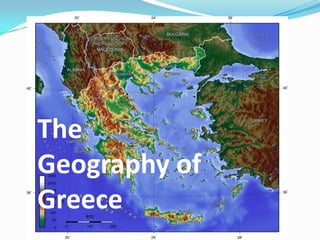
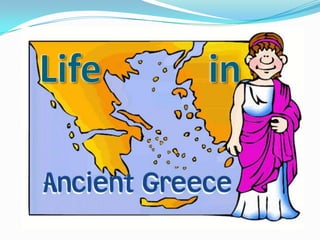
The
Geography of
Greece
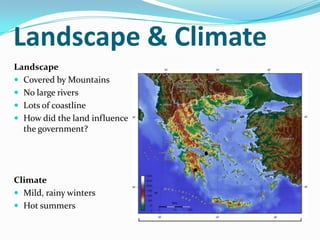
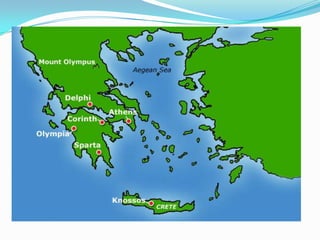
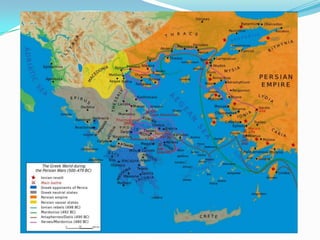
Landscape & Climate
Landscape
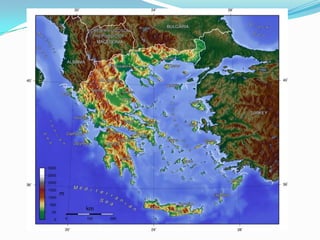
 Covered by Mountains
 No large rivers
 Lots of coastline
 How did the land influence
  the government?


Climate
 Mild, rainy winters
 Hot summers
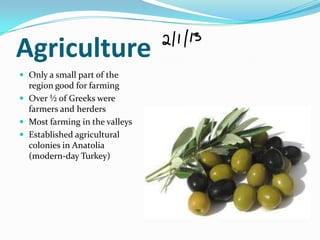
Agriculture
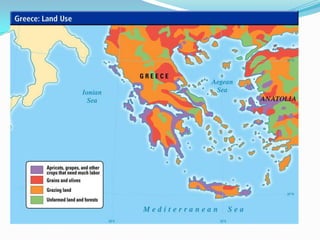
 Only a small part of the
  region good for farming
 Over ½ of Greeks were
  farmers and herders
 Most farming in the valleys
 Established agricultural
  colonies in Anatolia
  (modern-day Turkey)
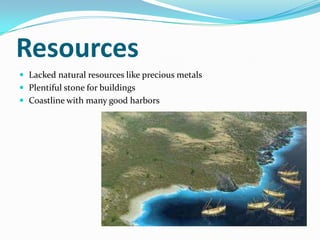
Resources
 Lacked natural resources like precious metals
 Plentiful stone for buildings
 Coastline with many good harbors
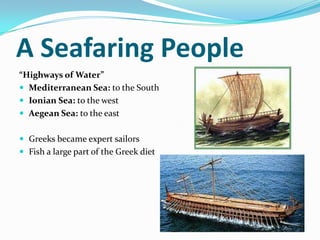
A Seafaring People
“Highways of Water”
 Mediterranean Sea: to the South
 Ionian Sea: to the west
 Aegean Sea: to the east


 Greeks became expert sailors
 Fish a large part of the Greek diet
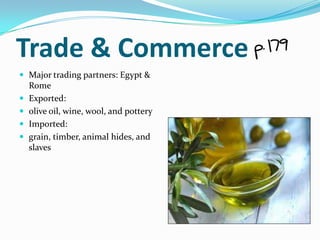
Trade & Commerce
 Major trading partners: Egypt &
    Rome
   Exported:
   olive oil, wine, wool, and pottery
   Imported:
   grain, timber, animal hides, and
    slaves
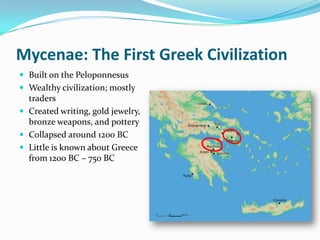
Mycenae: The First Greek Civilization
 Built on the Peloponnesus
 Wealthy civilization; mostly
  traders
 Created writing, gold jewelry,
  bronze weapons, and pottery
 Collapsed around 1200 BC
 Little is known about Greece
  from 1200 BC – 750 BC
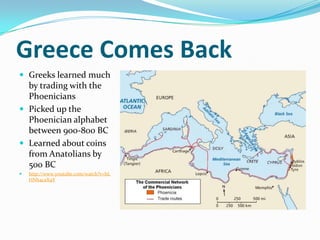
Greece Comes Back
 Greeks learned much
  by trading with the
  Phoenicians
 Picked up the
  Phoenician alphabet
  between 900-800 BC
 Learned about coins
  from Anatolians by
  500 BC
   http://www.youtube.com/watch?v=hL
    HNh4caX4Y
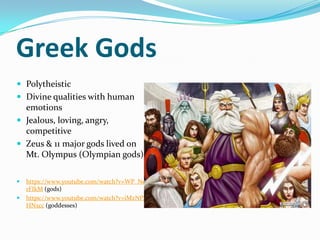
Greek Gods
 Polytheistic
 Divine qualities with human
  emotions
 Jealous, loving, angry,
  competitive
 Zeus & 11 major gods lived on
  Mt. Olympus (Olympian gods)

   https://www.youtube.com/watch?v=WP_Nei
    rFIkM (gods)
   https://www.youtube.com/watch?v=iMzNPE
    HNxcc (goddesses)
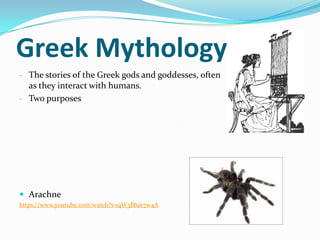
Greek Mythology
- The stories of the Greek gods and goddesses, often
  as they interact with humans.
- Two purposes


 Arachne
https://www.youtube.com/watch?v=qW3Bbav7w4A
Honoring the Gods
 Built statues and temples
 Days were set aside to honor different gods & goddesses
 Festivals held to honor the 12 Olympian gods


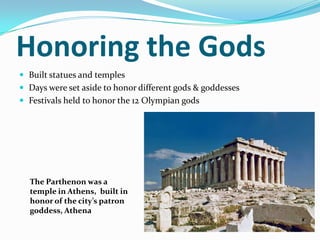
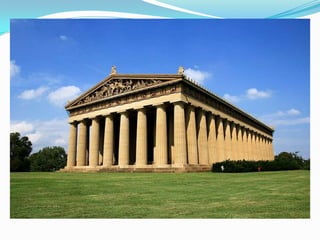
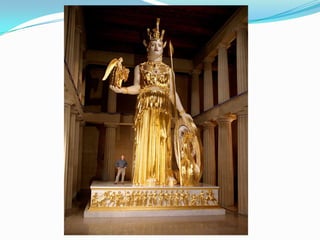
  The Parthenon was a
  temple in Athens, built in
  honor of the city’s patron
  goddess, Athena
The Olympics
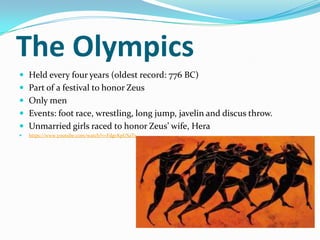
 Held every four years (oldest record: 776 BC)
 Part of a festival to honor Zeus
 Only men
 Events: foot race, wrestling, long jump, javelin and discus throw.
 Unmarried girls raced to honor Zeus’ wife, Hera
   https://www.youtube.com/watch?v=FdgvKpUSaTs
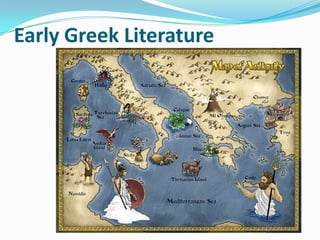
Early Greek Literature
Homer
 Blind poet (c. [about]
    8th Century BC)
   Composed epics
   Oral tradition
   The Iliad
   The Odyssey
   Major influence in
    Western literature
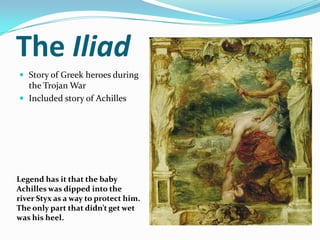
The Iliad
 Story of Greek heroes during
  the Trojan War
 Included story of Achilles


Legend has it that the baby
Achilles was dipped into the
river Styx as a way to protect him.
The only part that didn’t get wet
was his heel.
The Odyssey
 Story of Greek hero Odysseus and his trip home after the Trojan War
 Included the Cyclops and the sirens


 Video – first 12 minutes


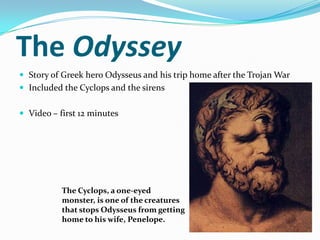
           The Cyclops, a one-eyed
           monster, is one of the creatures
           that stops Odysseus from getting
           home to his wife, Penelope.
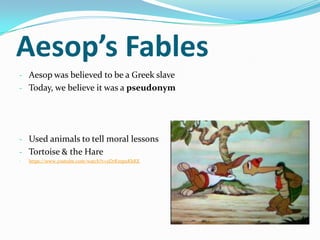
Aesop’s Fables
- Aesop was believed to be a Greek slave
- Today, we believe it was a pseudonym


- Used animals to tell moral lessons
- Tortoise & the Hare
-   https://www.youtube.com/watch?v=2DrKmpuKhKE
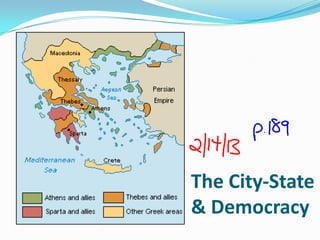
The City-State
& Democracy
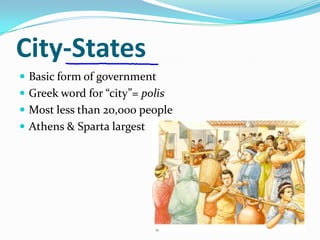
City-States
 Basic form of government
 Greek word for “city”= polis
 Most less than 20,000 people
 Athens & Sparta largest
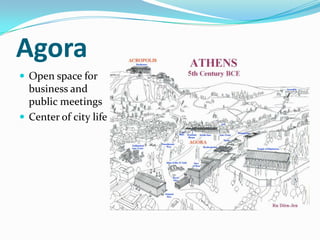
Agora
 Open space for
  business and
  public meetings
 Center of city life
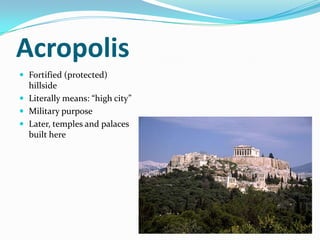
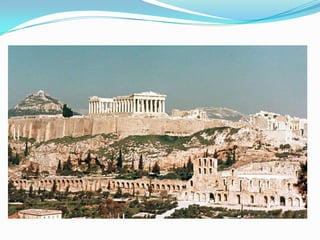
Acropolis
 Fortified (protected)
  hillside
 Literally means: “high city”
 Military purpose
 Later, temples and palaces
  built here
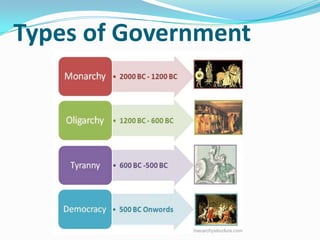
Types of Government
Monarchs & Aristocrats
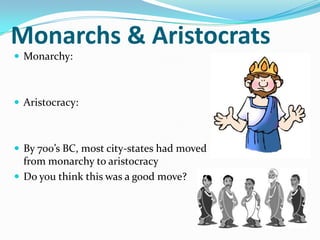
 Monarchy:


 Aristocracy:


 By 700’s BC, most city-states had moved
  from monarchy to aristocracy
 Do you think this was a good move?
Oligarchy
 Oligarchy:


 What is the difference between an aristocracy & an
 oligarchy?
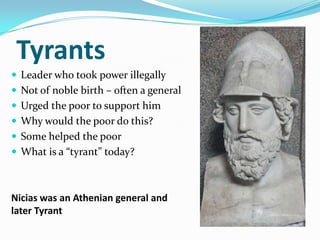
Tyrants
 Leader who took power illegally
 Not of noble birth – often a general
 Urged the poor to support him
 Why would the poor do this?
 Some helped the poor
 What is a “tyrant” today?


Nicias was an Athenian general and
later Tyrant
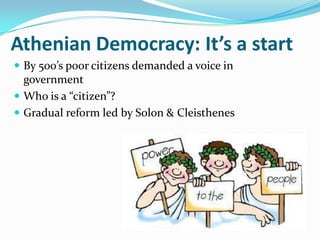
Athenian Democracy: It’s a start
 By 500’s poor citizens demanded a voice in
  government
 Who is a “citizen”?
 Gradual reform led by Solon & Cleisthenes
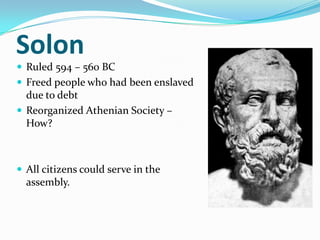
Solon
 Ruled 594 – 560 BC
 Freed people who had been enslaved
  due to debt
 Reorganized Athenian Society –
  How?


 All citizens could serve in the
  assembly.
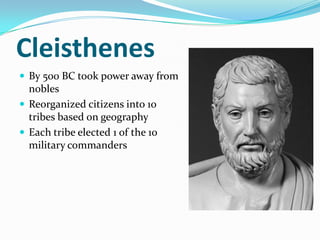
Cleisthenes
 By 500 BC took power away from
  nobles
 Reorganized citizens into 10
  tribes based on geography
 Each tribe elected 1 of the 10
  military commanders
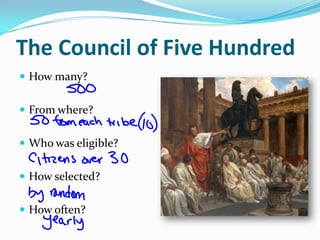
The Council of Five Hundred
 How many?


 From where?


 Who was eligible?


 How selected?


 How often?
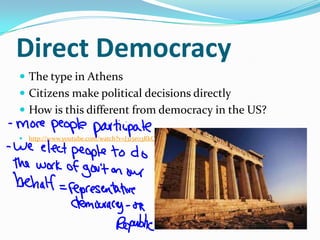
Direct Democracy
 The type in Athens
 Citizens make political decisions directly
 How is this different from democracy in the US?

   http://www.youtube.com/watch?v=J315e03RkOA
How was Athenian Democracy limited?


 Ostracism: the assembly could vote a person out of
 Athens for up to 10 years
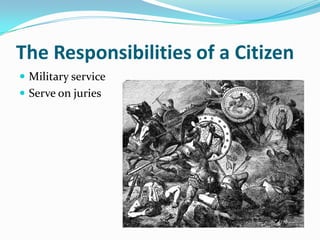
The Responsibilities of a Citizen
 Military service
 Serve on juries
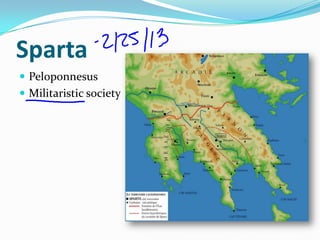
Sparta
 Peloponnesus
 Militaristic society
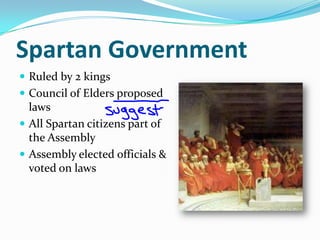
Spartan Government
 Ruled by 2 kings
 Council of Elders proposed
  laws
 All Spartan citizens part of
  the Assembly
 Assembly elected officials &
  voted on laws
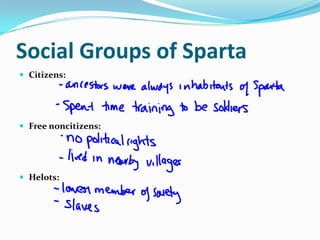
Social Groups of Sparta
 Citizens:


 Free noncitizens:


 Helots:
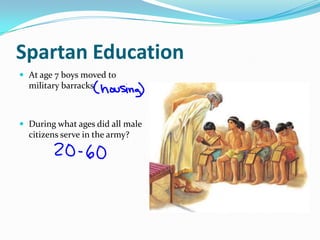
Spartan Education
 At age 7 boys moved to
  military barracks


 During what ages did all male
  citizens serve in the army?
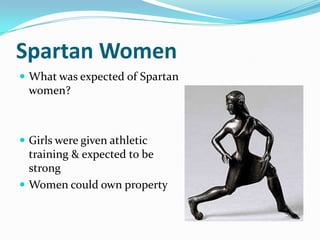
Spartan Women
 What was expected of Spartan
  women?


 Girls were given athletic
  training & expected to be
  strong
 Women could own property
Athenian Society
 What four classes existed in Athens?


 1/3 of population enslaved
 Where did the Athenians find slaves?
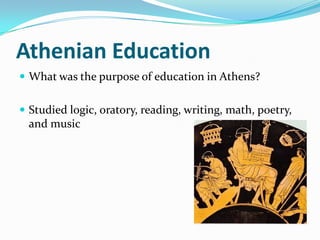
Athenian Education
 What was the purpose of education in Athens?


 Studied logic, oratory, reading, writing, math, poetry,
  and music
Athenian Women
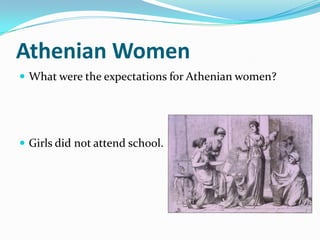
 What were the expectations for Athenian women?


 Girls did not attend school.
The Persian Wars
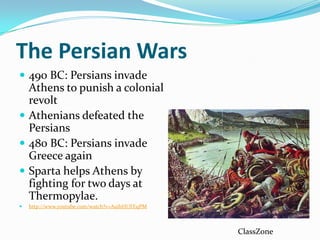
 490 BC: Persians invade
  Athens to punish a colonial
  revolt
 Athenians defeated the
  Persians
 480 BC: Persians invade
  Greece again
 Sparta helps Athens by
  fighting for two days at
  Thermopylae.
   http://www.youtube.com/watch?v=AuihHUFEqPM


                                                 ClassZone
Classical
Greece
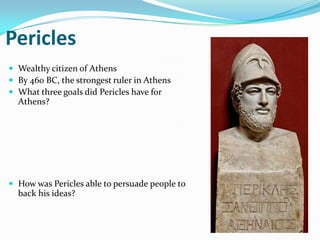
Pericles
 Wealthy citizen of Athens
 By 460 BC, the strongest ruler in Athens
 What three goals did Pericles have for
  Athens?


 How was Pericles able to persuade people to
  back his ideas?
Changing Athenian Democracy
 “Everybody is equal under the law.”


 Should we pay public officials?
Expanding the Empire
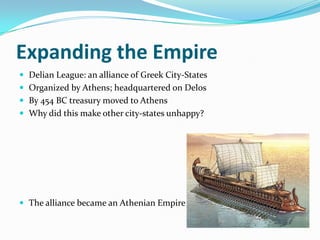
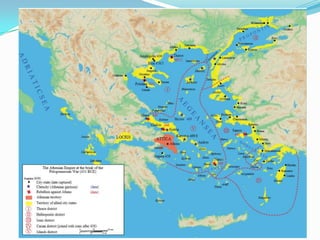
 Delian League: an alliance of Greek City-States
 Organized by Athens; headquartered on Delos
 By 454 BC treasury moved to Athens
 Why did this make other city-states unhappy?


 The alliance became an Athenian Empire
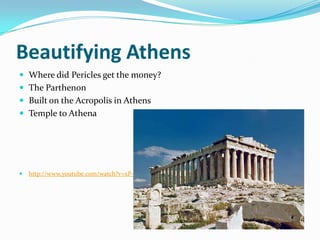
Beautifying Athens
 Where did Pericles get the money?
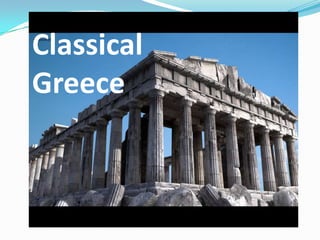
 The Parthenon
 Built on the Acropolis in Athens
 Temple to Athena


   http://www.youtube.com/watch?v=xP-FsX0QW88
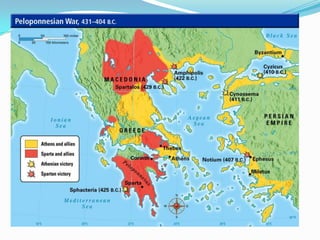
Peloponnesian War
 Why did city-states fear and resent Athens?


 Sparta created the Peloponnesian League as a rival to
  Athens
 431 BC: Sparta declares war on Athens
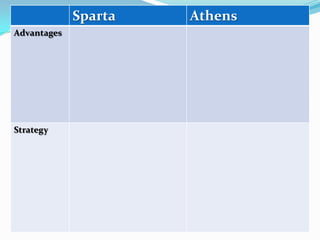
Sparta   Athens
Advantages


Strategy
Peloponnesian War
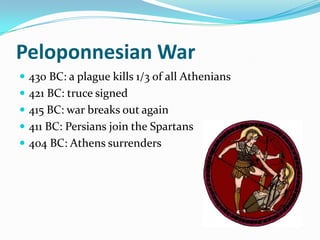
 430 BC: a plague kills 1/3 of all Athenians
 421 BC: truce signed
 415 BC: war breaks out again
 411 BC: Persians join the Spartans
 404 BC: Athens surrenders
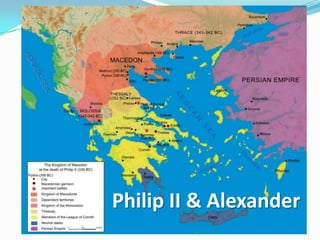
Philip II & Alexander
Philip II
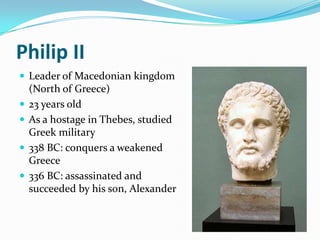
 Leader of Macedonian kingdom
    (North of Greece)
   23 years old
   As a hostage in Thebes, studied
    Greek military
   338 BC: conquers a weakened
    Greece
   336 BC: assassinated and
    succeeded by his son, Alexander
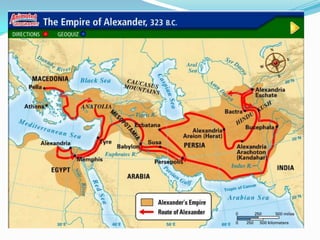
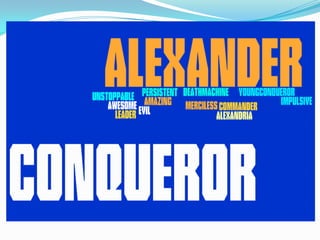
Alexander the Great
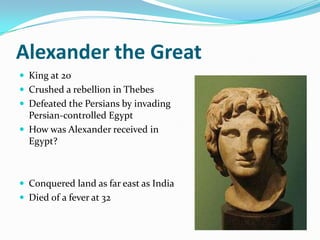
 King at 20
 Crushed a rebellion in Thebes
 Defeated the Persians by invading
  Persian-controlled Egypt
 How was Alexander received in
  Egypt?


 Conquered land as far east as India
 Died of a fever at 32
Legacy of Alexander
 Spread Greek culture and language
 encouraged local cultures to blend with
  Greek
 Hellenistic culture
Alexandria, Egypt
 Founded in 332 BC
 Housed the greatest library of the
  Classical world


 http://www.youtube.com/watch?v=0LsrkWDCvxg
 (2 min mark – 5:50)
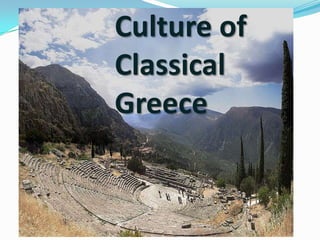
Culture of
Classical
Greece
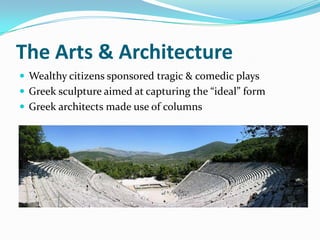
The Arts & Architecture
 Wealthy citizens sponsored tragic & comedic plays
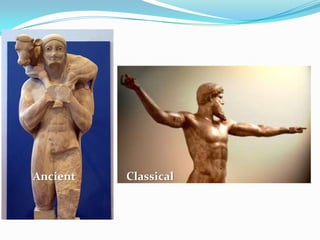
 Greek sculpture aimed at capturing the “ideal” form
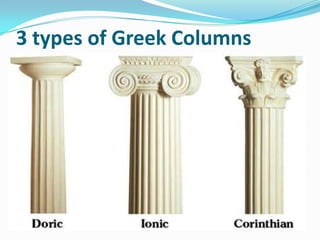
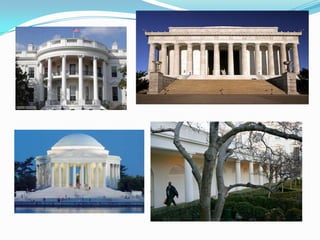
 Greek architects made use of columns
Ancient   Classical
3 types of Greek Columns
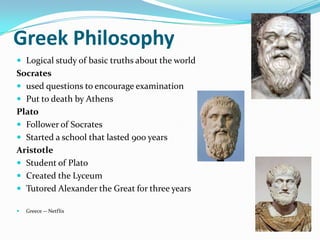
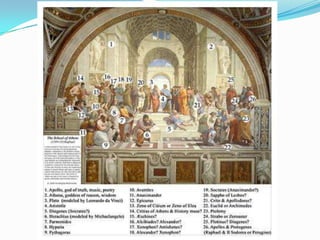
Greek Philosophy
 Logical study of basic truths about the world
Socrates
 used questions to encourage examination
 Put to death by Athens
Plato
 Follower of Socrates
 Started a school that lasted 900 years
Aristotle
 Student of Plato
 Created the Lyceum
 Tutored Alexander the Great for three years

   Greece -- Netflix
Science & Technology
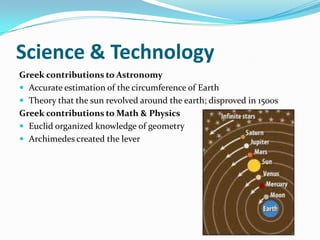
Greek contributions to Astronomy
 Accurate estimation of the circumference of Earth
 Theory that the sun revolved around the earth; disproved in 1500s
Greek contributions to Math & Physics
 Euclid organized knowledge of geometry
 Archimedes created the lever

Ancient greece slide share

  • 2.
  • 3.
    Landscape & Climate Landscape Covered by Mountains  No large rivers  Lots of coastline  How did the land influence the government? Climate  Mild, rainy winters  Hot summers
  • 6.
    Agriculture  Only asmall part of the region good for farming  Over ½ of Greeks were farmers and herders  Most farming in the valleys  Established agricultural colonies in Anatolia (modern-day Turkey)
  • 8.
    Resources  Lacked naturalresources like precious metals  Plentiful stone for buildings  Coastline with many good harbors
  • 9.
    A Seafaring People “Highwaysof Water”  Mediterranean Sea: to the South  Ionian Sea: to the west  Aegean Sea: to the east  Greeks became expert sailors  Fish a large part of the Greek diet
  • 10.
    Trade & Commerce Major trading partners: Egypt & Rome  Exported:  olive oil, wine, wool, and pottery  Imported:  grain, timber, animal hides, and slaves
  • 11.
    Mycenae: The FirstGreek Civilization  Built on the Peloponnesus  Wealthy civilization; mostly traders  Created writing, gold jewelry, bronze weapons, and pottery  Collapsed around 1200 BC  Little is known about Greece from 1200 BC – 750 BC
  • 12.
    Greece Comes Back Greeks learned much by trading with the Phoenicians  Picked up the Phoenician alphabet between 900-800 BC  Learned about coins from Anatolians by 500 BC  http://www.youtube.com/watch?v=hL HNh4caX4Y
  • 14.
    Greek Gods  Polytheistic Divine qualities with human emotions  Jealous, loving, angry, competitive  Zeus & 11 major gods lived on Mt. Olympus (Olympian gods)  https://www.youtube.com/watch?v=WP_Nei rFIkM (gods)  https://www.youtube.com/watch?v=iMzNPE HNxcc (goddesses)
  • 15.
    Greek Mythology - Thestories of the Greek gods and goddesses, often as they interact with humans. - Two purposes  Arachne https://www.youtube.com/watch?v=qW3Bbav7w4A
  • 16.
    Honoring the Gods Built statues and temples  Days were set aside to honor different gods & goddesses  Festivals held to honor the 12 Olympian gods The Parthenon was a temple in Athens, built in honor of the city’s patron goddess, Athena
  • 17.
    The Olympics  Heldevery four years (oldest record: 776 BC)  Part of a festival to honor Zeus  Only men  Events: foot race, wrestling, long jump, javelin and discus throw.  Unmarried girls raced to honor Zeus’ wife, Hera  https://www.youtube.com/watch?v=FdgvKpUSaTs
  • 18.
  • 19.
    Homer  Blind poet(c. [about] 8th Century BC)  Composed epics  Oral tradition  The Iliad  The Odyssey  Major influence in Western literature
  • 20.
    The Iliad  Storyof Greek heroes during the Trojan War  Included story of Achilles Legend has it that the baby Achilles was dipped into the river Styx as a way to protect him. The only part that didn’t get wet was his heel.
  • 21.
    The Odyssey  Storyof Greek hero Odysseus and his trip home after the Trojan War  Included the Cyclops and the sirens  Video – first 12 minutes The Cyclops, a one-eyed monster, is one of the creatures that stops Odysseus from getting home to his wife, Penelope.
  • 22.
    Aesop’s Fables - Aesopwas believed to be a Greek slave - Today, we believe it was a pseudonym - Used animals to tell moral lessons - Tortoise & the Hare - https://www.youtube.com/watch?v=2DrKmpuKhKE
  • 23.
  • 24.
    City-States  Basic formof government  Greek word for “city”= polis  Most less than 20,000 people  Athens & Sparta largest
  • 25.
    Agora  Open spacefor business and public meetings  Center of city life
  • 26.
    Acropolis  Fortified (protected) hillside  Literally means: “high city”  Military purpose  Later, temples and palaces built here
  • 28.
  • 29.
    Monarchs & Aristocrats Monarchy:  Aristocracy:  By 700’s BC, most city-states had moved from monarchy to aristocracy  Do you think this was a good move?
  • 30.
    Oligarchy  Oligarchy:  Whatis the difference between an aristocracy & an oligarchy?
  • 31.
    Tyrants  Leader whotook power illegally  Not of noble birth – often a general  Urged the poor to support him  Why would the poor do this?  Some helped the poor  What is a “tyrant” today? Nicias was an Athenian general and later Tyrant
  • 32.
    Athenian Democracy: It’sa start  By 500’s poor citizens demanded a voice in government  Who is a “citizen”?  Gradual reform led by Solon & Cleisthenes
  • 33.
    Solon  Ruled 594– 560 BC  Freed people who had been enslaved due to debt  Reorganized Athenian Society – How?  All citizens could serve in the assembly.
  • 34.
    Cleisthenes  By 500BC took power away from nobles  Reorganized citizens into 10 tribes based on geography  Each tribe elected 1 of the 10 military commanders
  • 35.
    The Council ofFive Hundred  How many?  From where?  Who was eligible?  How selected?  How often?
  • 36.
    Direct Democracy  Thetype in Athens  Citizens make political decisions directly  How is this different from democracy in the US?  http://www.youtube.com/watch?v=J315e03RkOA
  • 37.
    How was AthenianDemocracy limited?  Ostracism: the assembly could vote a person out of Athens for up to 10 years
  • 38.
    The Responsibilities ofa Citizen  Military service  Serve on juries
  • 39.
  • 40.
    Spartan Government  Ruledby 2 kings  Council of Elders proposed laws  All Spartan citizens part of the Assembly  Assembly elected officials & voted on laws
  • 41.
    Social Groups ofSparta  Citizens:  Free noncitizens:  Helots:
  • 42.
    Spartan Education  Atage 7 boys moved to military barracks  During what ages did all male citizens serve in the army?
  • 43.
    Spartan Women  Whatwas expected of Spartan women?  Girls were given athletic training & expected to be strong  Women could own property
  • 44.
    Athenian Society  Whatfour classes existed in Athens?  1/3 of population enslaved  Where did the Athenians find slaves?
  • 45.
    Athenian Education  Whatwas the purpose of education in Athens?  Studied logic, oratory, reading, writing, math, poetry, and music
  • 46.
    Athenian Women  Whatwere the expectations for Athenian women?  Girls did not attend school.
  • 48.
    The Persian Wars 490 BC: Persians invade Athens to punish a colonial revolt  Athenians defeated the Persians  480 BC: Persians invade Greece again  Sparta helps Athens by fighting for two days at Thermopylae.  http://www.youtube.com/watch?v=AuihHUFEqPM ClassZone
  • 49.
  • 50.
    Pericles  Wealthy citizenof Athens  By 460 BC, the strongest ruler in Athens  What three goals did Pericles have for Athens?  How was Pericles able to persuade people to back his ideas?
  • 51.
    Changing Athenian Democracy “Everybody is equal under the law.”  Should we pay public officials?
  • 52.
    Expanding the Empire Delian League: an alliance of Greek City-States  Organized by Athens; headquartered on Delos  By 454 BC treasury moved to Athens  Why did this make other city-states unhappy?  The alliance became an Athenian Empire
  • 54.
    Beautifying Athens  Wheredid Pericles get the money?  The Parthenon  Built on the Acropolis in Athens  Temple to Athena  http://www.youtube.com/watch?v=xP-FsX0QW88
  • 57.
    Peloponnesian War  Whydid city-states fear and resent Athens?  Sparta created the Peloponnesian League as a rival to Athens  431 BC: Sparta declares war on Athens
  • 58.
    Sparta Athens Advantages Strategy
  • 59.
    Peloponnesian War  430BC: a plague kills 1/3 of all Athenians  421 BC: truce signed  415 BC: war breaks out again  411 BC: Persians join the Spartans  404 BC: Athens surrenders
  • 60.
    Philip II &Alexander
  • 61.
    Philip II  Leaderof Macedonian kingdom (North of Greece)  23 years old  As a hostage in Thebes, studied Greek military  338 BC: conquers a weakened Greece  336 BC: assassinated and succeeded by his son, Alexander
  • 62.
    Alexander the Great King at 20  Crushed a rebellion in Thebes  Defeated the Persians by invading Persian-controlled Egypt  How was Alexander received in Egypt?  Conquered land as far east as India  Died of a fever at 32
  • 64.
    Legacy of Alexander Spread Greek culture and language  encouraged local cultures to blend with Greek  Hellenistic culture Alexandria, Egypt  Founded in 332 BC  Housed the greatest library of the Classical world  http://www.youtube.com/watch?v=0LsrkWDCvxg  (2 min mark – 5:50)
  • 66.
  • 67.
    The Arts &Architecture  Wealthy citizens sponsored tragic & comedic plays  Greek sculpture aimed at capturing the “ideal” form  Greek architects made use of columns
  • 68.
    Ancient Classical
  • 69.
    3 types ofGreek Columns
  • 74.
    Greek Philosophy  Logicalstudy of basic truths about the world Socrates  used questions to encourage examination  Put to death by Athens Plato  Follower of Socrates  Started a school that lasted 900 years Aristotle  Student of Plato  Created the Lyceum  Tutored Alexander the Great for three years  Greece -- Netflix
  • 77.
    Science & Technology Greekcontributions to Astronomy  Accurate estimation of the circumference of Earth  Theory that the sun revolved around the earth; disproved in 1500s Greek contributions to Math & Physics  Euclid organized knowledge of geometry  Archimedes created the lever