Renaissance Notes

          #

Textbook Pages 352 -377
• Economic effects of the Crusades
• Increased demand for Middle Eastern products
• Stimulated productions of goods to trade in
  Middle Eastern markets
• Encouraged the use of credit and banking
• Important economic concepts
• Church rule against usury and the banks’
  practice of charging interest helped to secularize
  northern Italy
• Letters of credit served to expand the supply of
  money and expedite trade
• New accounting and bookkeeping practices (use
  of Arabic Numerals) were introduced
• Florence, Venice, and Genoa
• Had access to trade routes connecting
  Europe with Middle Eastern markets
• Served as trading centers for the
  distribution of goods to northern Europe
• Were initially independent city-states
  governed as republics
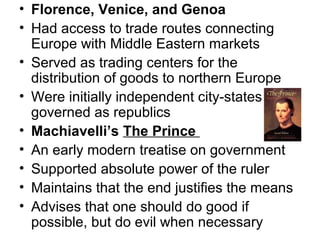
• Machiavelli’s The Prince
• An early modern treatise on government
• Supported absolute power of the ruler
• Maintains that the end justifies the means
• Advises that one should do good if
  possible, but do evil when necessary
• Medieval art and literature focused on the Church
  and salvation; Renaissance art and literature
  focused on individuals and worldly matters, along
  with Christianity
• Artistic and literary creativity
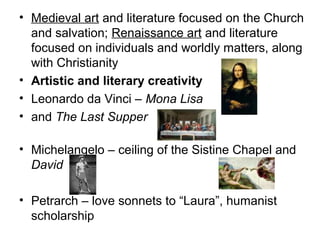
• Leonardo da Vinci – Mona Lisa
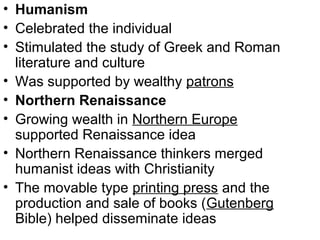
• and The Last Supper

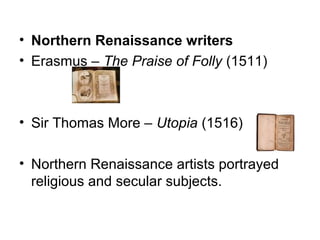
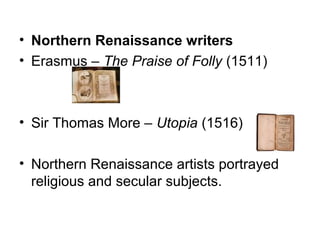
• Michelangelo – ceiling of the Sistine Chapel and
  David

• Petrarch – love sonnets to “Laura”, humanist
  scholarship
• Humanism
• Celebrated the individual
• Stimulated the study of Greek and Roman
  literature and culture
• Was supported by wealthy patrons
• Northern Renaissance
• Growing wealth in Northern Europe
  supported Renaissance idea
• Northern Renaissance thinkers merged
  humanist ideas with Christianity
• The movable type printing press and the
  production and sale of books (Gutenberg
  Bible) helped disseminate ideas
• Northern Renaissance writers
• Erasmus – The Praise of Folly (1511)


• Sir Thomas More – Utopia (1516)

• Northern Renaissance artists portrayed
  religious and secular subjects.
• Northern Renaissance writers
• Erasmus – The Praise of Folly (1511)


• Sir Thomas More – Utopia (1516)

• Northern Renaissance artists portrayed
  religious and secular subjects.

Renaissance Notes pwrpt

  • 1.
    Renaissance Notes # Textbook Pages 352 -377
  • 2.
    • Economic effectsof the Crusades • Increased demand for Middle Eastern products • Stimulated productions of goods to trade in Middle Eastern markets • Encouraged the use of credit and banking • Important economic concepts • Church rule against usury and the banks’ practice of charging interest helped to secularize northern Italy • Letters of credit served to expand the supply of money and expedite trade • New accounting and bookkeeping practices (use of Arabic Numerals) were introduced
  • 3.
    • Florence, Venice,and Genoa • Had access to trade routes connecting Europe with Middle Eastern markets • Served as trading centers for the distribution of goods to northern Europe • Were initially independent city-states governed as republics • Machiavelli’s The Prince • An early modern treatise on government • Supported absolute power of the ruler • Maintains that the end justifies the means • Advises that one should do good if possible, but do evil when necessary
  • 4.
    • Medieval artand literature focused on the Church and salvation; Renaissance art and literature focused on individuals and worldly matters, along with Christianity • Artistic and literary creativity • Leonardo da Vinci – Mona Lisa • and The Last Supper • Michelangelo – ceiling of the Sistine Chapel and David • Petrarch – love sonnets to “Laura”, humanist scholarship
  • 5.
    • Humanism • Celebratedthe individual • Stimulated the study of Greek and Roman literature and culture • Was supported by wealthy patrons • Northern Renaissance • Growing wealth in Northern Europe supported Renaissance idea • Northern Renaissance thinkers merged humanist ideas with Christianity • The movable type printing press and the production and sale of books (Gutenberg Bible) helped disseminate ideas
  • 6.
    • Northern Renaissancewriters • Erasmus – The Praise of Folly (1511) • Sir Thomas More – Utopia (1516) • Northern Renaissance artists portrayed religious and secular subjects.
  • 7.
    • Northern Renaissancewriters • Erasmus – The Praise of Folly (1511) • Sir Thomas More – Utopia (1516) • Northern Renaissance artists portrayed religious and secular subjects.