   
   Cities grew along the banks of two
    rivers
   Isolated culture due to geography
   Civilization developed with few
    outside influences
   Borders:
     o East: Yellow Sea, East China Sea,
       Pacific Ocean
     o West: Taklimakan Desert
     o North: Gobi Desert
     o Southwest: Himalayan Mountains


                                           Gobi Desert is a cold desert.
Two River Systems
 Flow toward the Pac. Ocean
 Chang Jiang (Yangtze): central
   China
 Huang He (Yellow): northern
   China
 North China Plain
    o Land between the rivers
    o Rich farmland
    o Center of Chinese Civilization
Varied Climate
 Like the US
 West: dry
 Northeast: cold winters; warm summers
 Southeast: mild winters; hot, rainy summers


   What crops are grown in China?
Chinese & US Climates:
A Comparison
   1766 BC: dynasty established
   Claimed to have the
    permission of the gods
   Controlled portion of the North
    China Plain
   Made war with nomadic people
   Treated parents & ancestors
    with great respect
   No strong central gov’t; family
    members ruled distant lands
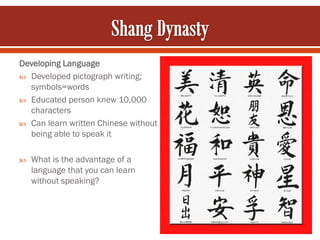
Developing Language
 Developed pictograph writing;
  symbols=words
 Educated person knew 10,000
  characters
 Can learn written Chinese without
  being able to speak it

   What is the advantage of a
    language that you can learn
    without speaking?
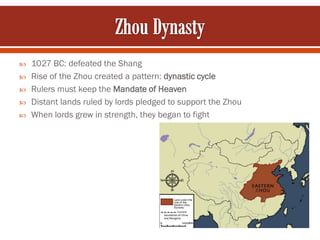
   1027 BC: defeated the Shang
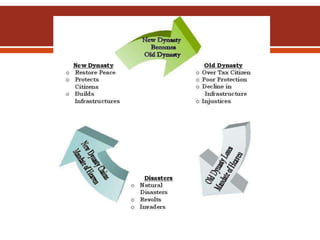
   Rise of the Zhou created a pattern: dynastic cycle
   Rulers must keep the Mandate of Heaven
   Distant lands ruled by lords pledged to support the Zhou
   When lords grew in strength, they began to fight
   Powerful gov’t with strict laws will keep order
   People will only do good if forced to
   Harsh punishments needed to make people afraid to do
    wrong
   Shang Yang: those who fail to
    report lawbreakers should be
    punished
   Under Legalism, books were
    burned and those who
    questioned the gov’t were
    arrested
   Confucius (551-479 BC)
   Order can be kept if everyone has
    respect for each other
   Leaders should serve as good
    examples
   Lower members of society should obey
    those above them
   Ideas collected in a book: Analects
   Each relationship has its own duties and code of conduct

   Father and son
   Elder brother and younger brother
   Husband and wife
   Friend and friend
   Ruler and subject

   What is the nature of these relationships?
   Filial piety: treating parents
    and elders with respect
   Authority should be
    respected

   Confucianism eventually
    adopted by Chinese rulers
   Guiding force that shaped
    Chinese culture
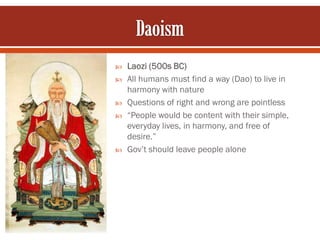
   Laozi (500s BC)
   All humans must find a way (Dao) to live in
    harmony with nature
   Questions of right and wrong are pointless
   “People would be content with their simple,
    everyday lives, in harmony, and free of
    desire.”
   Gov’t should leave people alone
   Yin (black): cold, dark, and mysterious
   Yang (white): warm, bright, and light
   Both forces complement each other
   Each changes & evolves
   Started by Shi Huangdi
   Lasted from 221 – 202 BC
   Unified China after warring-states
    period
   Legalistic ruler
   Conquered neighbors and
    expanded the empire
   Forced nobles to live at
    capital
   Built highways and irrigation
    projects to unite China
   Began linking existing
    defensive walls, starting the
    Great Wall of China
   Huangdi died in 210 BC
   Son took over, but was
    quickly overthrown
   202 BC – 220 AD
   Liu Bang first emperor
   Lowered taxes and punishments
    less harsh
   Created a bureaucracy to help
    run the government
   Created a test based on
    Confucianism for these scholar-
    officials
   Liu Bang died in 195 BC
   Succeeded by his wife, Empress Lu
   She ruled on half of their young son, whom she outlived
   She continued to rule by putting infants on the throne
   Upon her death in 180 BC, all members of her family were put to death
   Wudi ruled from 141-87 BC
   “Martial Emperor” used war to
    expand the empire
   Conquered northern Vietnam
    and northern Korea
   Chased nomadic invaders out
    of northern China
   Conquered people were
    encouraged to assimilate
   Most people worked as farmers
   Farmers lived in small villages near their land
   Rich farmers had oxen to plow their lands
   South: rice
   North: wheat
   Families had personal vegetable gardens
   Meat and fish were expensive
   Centers of trade, education, and government
   Merchants, government workers, craftspeople
   Problems of modern cities: crowded, street gangs
   http://www.youtube.com/watch?v=VS7pKZJ3zPs
   During the Han dynasty, only the Chinese knew how to
    make silk.
   Desired luxury item
   Roads linking China to Eurasian were built to trade silk
   One of the first global trading networks
   Cities sprouted up around the trail.
   Goods leaving China: silk, paper, jade, pottery
   Goods coming to China: sesame seeds, oil, metals, precious
    stones, Central Asian horses
   Silk Roads also brought ideas
    and customs to and from China
    (cultural diffusion)
   During the Han dynasty, Buddhist
    missionaries from India brought
    Buddhism to China
   Buddhism gained many followers
    after the fall of the Han. Why?

   http://www.youtube.com/watch?v=vfe-eNq-Qyg
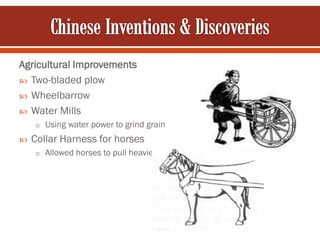
Agricultural Improvements
 Two-bladed plow
 Wheelbarrow
 Water Mills
    o Using water power to grind grain
   Collar Harness for horses
    o Allowed horses to pull heavier loads
Paper
 105 AD
 Made from old rags, tree bark, and fibers from hemp
 How did the invention of paper help the Chinese people?
Silk
 For 3,000 years, only the Chinese knew how to make
 Used to get silver and gold from the west
 At one time one pound of silk = one pound of gold


   How much is a pound of gold worth today?
   $24,522.77

Ancient china

  • 1.
  • 2.
    Cities grew along the banks of two rivers  Isolated culture due to geography  Civilization developed with few outside influences  Borders: o East: Yellow Sea, East China Sea, Pacific Ocean o West: Taklimakan Desert o North: Gobi Desert o Southwest: Himalayan Mountains Gobi Desert is a cold desert.
  • 3.
    Two River Systems Flow toward the Pac. Ocean  Chang Jiang (Yangtze): central China  Huang He (Yellow): northern China  North China Plain o Land between the rivers o Rich farmland o Center of Chinese Civilization
  • 7.
    Varied Climate  Likethe US  West: dry  Northeast: cold winters; warm summers  Southeast: mild winters; hot, rainy summers  What crops are grown in China?
  • 9.
    Chinese & USClimates: A Comparison
  • 10.
    1766 BC: dynasty established  Claimed to have the permission of the gods  Controlled portion of the North China Plain  Made war with nomadic people  Treated parents & ancestors with great respect  No strong central gov’t; family members ruled distant lands
  • 11.
    Developing Language  Developedpictograph writing; symbols=words  Educated person knew 10,000 characters  Can learn written Chinese without being able to speak it  What is the advantage of a language that you can learn without speaking?
  • 12.
    1027 BC: defeated the Shang  Rise of the Zhou created a pattern: dynastic cycle  Rulers must keep the Mandate of Heaven  Distant lands ruled by lords pledged to support the Zhou  When lords grew in strength, they began to fight
  • 14.
    Powerful gov’t with strict laws will keep order  People will only do good if forced to  Harsh punishments needed to make people afraid to do wrong
  • 15.
    Shang Yang: those who fail to report lawbreakers should be punished  Under Legalism, books were burned and those who questioned the gov’t were arrested
  • 16.
    Confucius (551-479 BC)  Order can be kept if everyone has respect for each other  Leaders should serve as good examples  Lower members of society should obey those above them  Ideas collected in a book: Analects
  • 17.
    Each relationship has its own duties and code of conduct  Father and son  Elder brother and younger brother  Husband and wife  Friend and friend  Ruler and subject  What is the nature of these relationships?
  • 18.
    Filial piety: treating parents and elders with respect  Authority should be respected  Confucianism eventually adopted by Chinese rulers  Guiding force that shaped Chinese culture
  • 19.
    Laozi (500s BC)  All humans must find a way (Dao) to live in harmony with nature  Questions of right and wrong are pointless  “People would be content with their simple, everyday lives, in harmony, and free of desire.”  Gov’t should leave people alone
  • 20.
    Yin (black): cold, dark, and mysterious  Yang (white): warm, bright, and light  Both forces complement each other  Each changes & evolves
  • 21.
    Started by Shi Huangdi  Lasted from 221 – 202 BC  Unified China after warring-states period  Legalistic ruler  Conquered neighbors and expanded the empire
  • 23.
    Forced nobles to live at capital  Built highways and irrigation projects to unite China  Began linking existing defensive walls, starting the Great Wall of China  Huangdi died in 210 BC  Son took over, but was quickly overthrown
  • 24.
    202 BC – 220 AD  Liu Bang first emperor  Lowered taxes and punishments less harsh  Created a bureaucracy to help run the government  Created a test based on Confucianism for these scholar- officials
  • 25.
    Liu Bang died in 195 BC  Succeeded by his wife, Empress Lu  She ruled on half of their young son, whom she outlived  She continued to rule by putting infants on the throne  Upon her death in 180 BC, all members of her family were put to death
  • 26.
    Wudi ruled from 141-87 BC  “Martial Emperor” used war to expand the empire  Conquered northern Vietnam and northern Korea  Chased nomadic invaders out of northern China  Conquered people were encouraged to assimilate
  • 28.
    Most people worked as farmers  Farmers lived in small villages near their land  Rich farmers had oxen to plow their lands  South: rice  North: wheat  Families had personal vegetable gardens  Meat and fish were expensive
  • 29.
    Centers of trade, education, and government  Merchants, government workers, craftspeople  Problems of modern cities: crowded, street gangs  http://www.youtube.com/watch?v=VS7pKZJ3zPs
  • 30.
    During the Han dynasty, only the Chinese knew how to make silk.  Desired luxury item  Roads linking China to Eurasian were built to trade silk  One of the first global trading networks
  • 32.
    Cities sprouted up around the trail.  Goods leaving China: silk, paper, jade, pottery  Goods coming to China: sesame seeds, oil, metals, precious stones, Central Asian horses
  • 33.
    Silk Roads also brought ideas and customs to and from China (cultural diffusion)  During the Han dynasty, Buddhist missionaries from India brought Buddhism to China  Buddhism gained many followers after the fall of the Han. Why?  http://www.youtube.com/watch?v=vfe-eNq-Qyg
  • 35.
    Agricultural Improvements  Two-bladedplow  Wheelbarrow  Water Mills o Using water power to grind grain  Collar Harness for horses o Allowed horses to pull heavier loads
  • 36.
    Paper  105 AD Made from old rags, tree bark, and fibers from hemp  How did the invention of paper help the Chinese people?
  • 37.
    Silk  For 3,000years, only the Chinese knew how to make  Used to get silver and gold from the west  At one time one pound of silk = one pound of gold  How much is a pound of gold worth today?  $24,522.77