Ancient China
• Geographic barriers isolate China
– Deserts and high mountain ranges
– Rainforests divide China from
southeast Asia
– Pacific Ocean to the east
• Civilization emerges in Huang River
valley
– “River of Sorrows”
Shang Dynasty
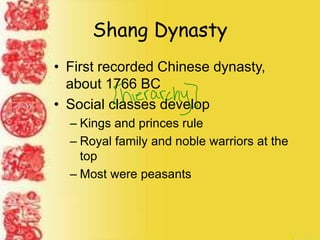
• First recorded Chinese dynasty,
about 1766 BC
• Social classes develop
– Kings and princes rule
– Royal family and noble warriors at the
top
– Most were peasants
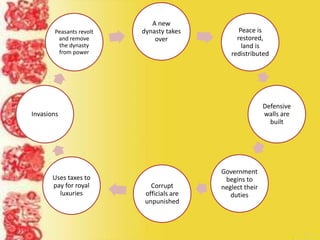
A new
dynasty takes
over
Peace is
restored,
land is
redistributed
Defensive
walls are
built
Government
begins to
neglect their
duties
Corrupt
officials are
unpunished
Uses taxes to
pay for royal
luxuries
Invasions
Peasants revolt
and remove
the dynasty
from power
Dynastic cycle
• The rise and the fall of dynasties in
China
– Zhou overthrew Shang about 1766 BC
• Dynasties needed the Mandate of
Heaven
• Disaster meant that a dynasty lost
the favor of heaven
– Zhou ends in 256 BC
Confucius
• A brilliant
scholar and
teacher
• Taught that
relationships
shape behavior
• Confucianism
influences one-
third of the
world’s
population
5 key relationships
• Ruler to subject, parent to child,
husband to wife, older brother to
younger brother, friend to friend
• Filial piety (respect for parents)
Achievements
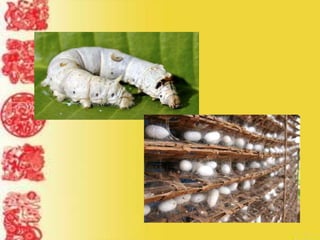
• Invented silk-making
– Most valuable export
• Created the first books
• Developed a complex writing system
– Writing as an art form (calligraphy)
• Improved bronze technology
Feudalism
• Under the Zhou dynasty China became
a feudal state
• System of gov’t in which local lords
governed their own lands but owed
military service and support to the ruler
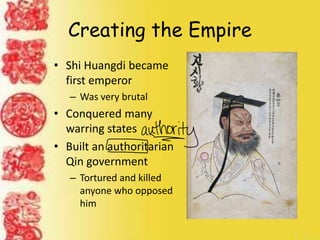
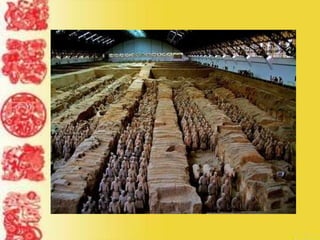
Creating the Empire
• Shi Huangdi became
first emperor
– Was very brutal
• Conquered many
warring states
• Built an authoritarian
Qin government
– Tortured and killed
anyone who opposed
him
Unity
• The feudal state was replaced with 36
military districts
• Created a money economy
• United Chinese writing
• Repaired roads and canals for travel
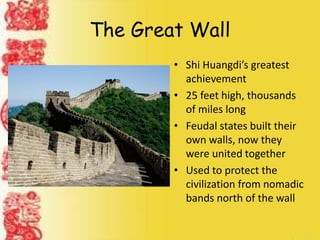
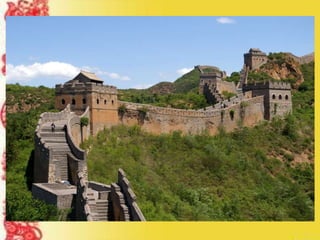
The Great Wall
• Shi Huangdi’s greatest
achievement
• 25 feet high, thousands
of miles long
• Feudal states built their
own walls, now they
were united together
• Used to protect the
civilization from nomadic
bands north of the wall
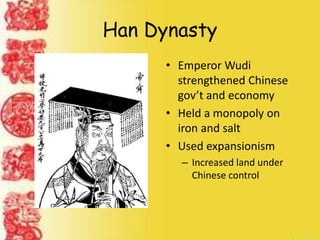
Han Dynasty
• Emperor Wudi
strengthened Chinese
gov’t and economy
• Held a monopoly on
iron and salt
• Used expansionism
– Increased land under
Chinese control
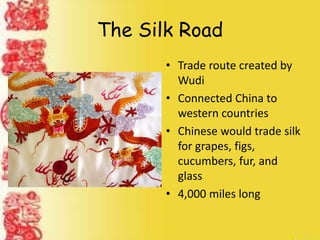
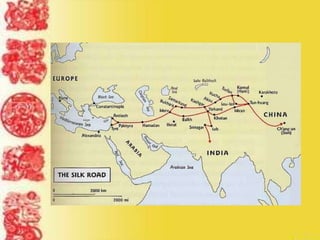
The Silk Road
• Trade route created by
Wudi
• Connected China to
western countries
• Chinese would trade silk
for grapes, figs,
cucumbers, fur, and
glass
• 4,000 miles long
End of the Han dynasty
• Han dynasty collapsed after the
peasants revolted
• The emperors could no longer control
powerful warlords
• After 400 years of unity, China broke
into several kingdoms
• Invaders poured over the Great Wall
and settled in China

Ancient_China.pptx

  • 2.
    Ancient China • Geographicbarriers isolate China – Deserts and high mountain ranges – Rainforests divide China from southeast Asia – Pacific Ocean to the east • Civilization emerges in Huang River valley – “River of Sorrows”
  • 3.
    Shang Dynasty • Firstrecorded Chinese dynasty, about 1766 BC • Social classes develop – Kings and princes rule – Royal family and noble warriors at the top – Most were peasants
  • 4.
    A new dynasty takes over Peaceis restored, land is redistributed Defensive walls are built Government begins to neglect their duties Corrupt officials are unpunished Uses taxes to pay for royal luxuries Invasions Peasants revolt and remove the dynasty from power
  • 5.
    Dynastic cycle • Therise and the fall of dynasties in China – Zhou overthrew Shang about 1766 BC • Dynasties needed the Mandate of Heaven • Disaster meant that a dynasty lost the favor of heaven – Zhou ends in 256 BC
  • 6.
    Confucius • A brilliant scholarand teacher • Taught that relationships shape behavior • Confucianism influences one- third of the world’s population
  • 7.
    5 key relationships •Ruler to subject, parent to child, husband to wife, older brother to younger brother, friend to friend • Filial piety (respect for parents)
  • 8.
    Achievements • Invented silk-making –Most valuable export • Created the first books • Developed a complex writing system – Writing as an art form (calligraphy) • Improved bronze technology
  • 9.
    Feudalism • Under theZhou dynasty China became a feudal state • System of gov’t in which local lords governed their own lands but owed military service and support to the ruler
  • 10.
    Creating the Empire •Shi Huangdi became first emperor – Was very brutal • Conquered many warring states • Built an authoritarian Qin government – Tortured and killed anyone who opposed him
  • 13.
    Unity • The feudalstate was replaced with 36 military districts • Created a money economy • United Chinese writing • Repaired roads and canals for travel
  • 14.
    The Great Wall •Shi Huangdi’s greatest achievement • 25 feet high, thousands of miles long • Feudal states built their own walls, now they were united together • Used to protect the civilization from nomadic bands north of the wall
  • 16.
    Han Dynasty • EmperorWudi strengthened Chinese gov’t and economy • Held a monopoly on iron and salt • Used expansionism – Increased land under Chinese control
  • 17.
    The Silk Road •Trade route created by Wudi • Connected China to western countries • Chinese would trade silk for grapes, figs, cucumbers, fur, and glass • 4,000 miles long
  • 20.
    End of theHan dynasty • Han dynasty collapsed after the peasants revolted • The emperors could no longer control powerful warlords • After 400 years of unity, China broke into several kingdoms • Invaders poured over the Great Wall and settled in China