Dr.P.SINDHU
CHINESE CIVILIZATION
Geographical Background
• Like other civilization Chinese civilization also
flourished on the banks of the two rivers –
Hwang-ho & Yang-tse-kiang.
• These rivers made land – fertile.
• Agricultural prosperity led to the evolution of
Chinese civilization.
• Some times, flood of Hwang-ho caused –
damage to life & property. Thus, it was called
-- “the sorrow of China”.
• East – Pacific Ocean
• West – Tibetan Plateu
• North - Mountain ranges of Tine Shan & Altai
and Plateu of Mongolia.
• South – great Himalayan mountains & forests
of Burma.
• These surrounding isolate China & immuned
from all kinds of external influences.
Political History
• China consisted of city-states.
• Powerful dynasties emerge & ruled – the
Shang dynasty (1750-1125 BC); the Chu
dynasty (1125-250 BC); The Tsin dynasty; the
Han dynasty & The Sui dynasty.
Feudal System
• From 10th cen. to 220 BC – China not
organized under one administration.
• Feudal lords, ruled different parts –
constantly at wars. No peace & order.
• Agriculture – main occupation.
• Women engaged in spinning & weaving and
they were skilled in the art of silk weaving.
• They learnt the use of gold from India.
• Besides, silver, iron & bronze were used.
• Peoples also prepared earthen pots & tiles.
• People made trade with Turks & Mongols and
others.
• Coins were in circulation.
Emperor Shi-Hwang-ti
• About 220 BC feudal system came to an end
& Shi-Hwang-ti founded the first empire.
• He was the feudal lord & brought all the city-
states under his control.
• He connected whole of his empire – roads.
• He disguised & visited throughout the
country.
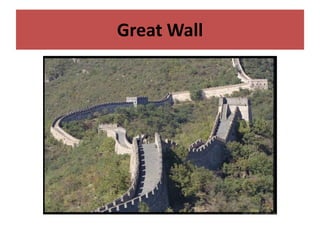
• Shi-Hwang-ti first constructed – Great Wall of
China.
• It was constructed to prevent – Huna invaders.
• It was built of bricks & 10 years to be
completed.
• 1,800 miles long, from 15 to 20 feet high and 20
feet broad.
• 20,000 towers of 40 feet high constructed – an
interval of 100 yards.
Great Wall
• Besides, 1,000 small towers – constructed.
• He earned unpopularity – because people to
work without wages & engaged criminals to
work.
• Secondly, caused the destruction of all books –
ancient China – rendered harm to Chinese
Civilization.
• Literature must start afresh from his reign –
cause of destruction – except medicine, fortune-
telling & agriculture books.
Han Dynasty
• After Shi-Hwang-ti, his son ruled China from 210
BC.
• The Han dynasty came to power & ruled for 400
years.
• Liu Pang – founded the empire.
• Wang Mang – another important ruler introduced
many socialistic reforms.
• He introduced national university.
• His policy opposed by wealthy people &
murdered him.
• Han rulers fought with Tartars, Hunas &
Koreans.
• They had close contact with Persians &
Greeks.
• Chinese civilization reached highest stage –
Han dynasty.
• Next Sui dynasty & then Tang dynasty ruled
upto 907 AD – this period compared with
Elizabethan Era of England.
Contributions of Chinese
Civilization
Art of Learning & Literature
Art of Writings & Learning
• Chinese developed own art of writing.
• Beginning used pictures to express –
thoughts.
• Later, pictures converted to signs – this way
script developed.
• They wrote on the thin slips of bamboos or
wood with pens made of bamboos.
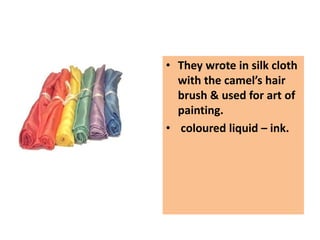
• They wrote in silk cloth
with the camel’s hair
brush & used for art of
painting.
• coloured liquid – ink.
Invention of Paper
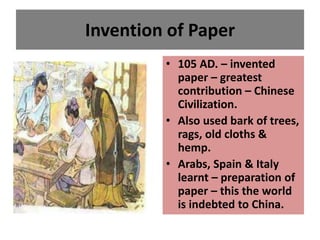
• 105 AD. – invented
paper – greatest
contribution – Chinese
Civilization.
• Also used bark of trees,
rags, old cloths &
hemp.
• Arabs, Spain & Italy
learnt – preparation of
paper – this the world
is indebted to China.
Literature
• Large number of books written – wooden or bamboo
slips.
• Shi-Hwang-ti destroyed many books, but Tang ruler
revived literature & made rapid progress, therefore
this age compared – Elizabethan Age of England.
• Great writers – Lipo & Tufu born this period.
• “Song of the Farmers”, “The Song of the Felictious”, &
“Five Classics” – important books of ancient China.
• Writings of Confucius & Lao-tse enriched – Chinese
philosophy
Other Innovation
Industrial Art
• They excelled in various art & workers in
gold, silver, iron, bronze, ivory & wood.
• They prepared earthen potteries.
• 6th & 7th cen. Porcelain vessels produced.
• Famous for silk clothes – great demand in
Roman world.
• They also knew – manufacture of glass.
Other Innovations
• First invented – Marine Compass for the
sailors.
• The use of gun powder.
• Another discovery – tea as a drink & during
18th cent. Europeans used tea, getting idea
from China.
• A kind of wine (popular drink) – prepared out
of grapes & imported to Europe.
• Sun dial – used for measurement of time &
during Han’s it was replaced by water clock.
• They divided a day into twelve & also
prepared calendar to count days & months.
Medicine
• There was a progress in the field of medicine.
• They had deep knowledge in many diseases.
• Great invention – Anaesthesia for surgical
operations.
• They had knowledge – arithmetic & geometry.
• For commercial – used metal coins.
Art & Architecture
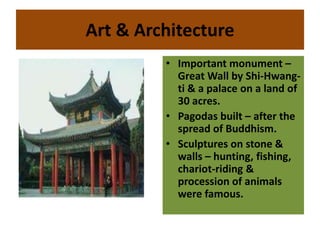
• Important monument –
Great Wall by Shi-Hwang-
ti & a palace on a land of
30 acres.
• Pagodas built – after the
spread of Buddhism.
• Sculptures on stone &
walls – hunting, fishing,
chariot-riding &
procession of animals
were famous.
Significance of Chinese Society
• Society divided – four classes.
• The Mandarins or learned class, the
Cultivators, the Artisans & the Merchants.
• One could not become Mandarin by birth –
but, by education.
• There was no place for soldiers in the society.
Philosophy
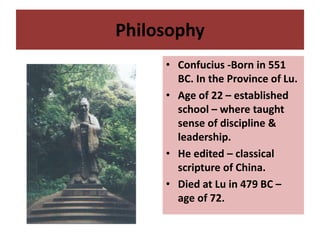
• Confucius -Born in 551
BC. In the Province of Lu.
• Age of 22 – established
school – where taught
sense of discipline &
leadership.
• He edited – classical
scripture of China.
• Died at Lu in 479 BC –
age of 72.
Lao-Tse
• Another philosopher influence the people –
Lao-Tse. Contemporary of Confucius.
• Born in 600 BC. – Province of Henan. Early
name – Li.
• He raised the voice against the degeneration
of the people.
• Many protest raised – he wrote "Tao-ti-King”.
• His teachings – Taoism.

Chinese civilization

  • 1.
  • 2.
    Geographical Background • Likeother civilization Chinese civilization also flourished on the banks of the two rivers – Hwang-ho & Yang-tse-kiang. • These rivers made land – fertile. • Agricultural prosperity led to the evolution of Chinese civilization. • Some times, flood of Hwang-ho caused – damage to life & property. Thus, it was called -- “the sorrow of China”.
  • 3.
    • East –Pacific Ocean • West – Tibetan Plateu • North - Mountain ranges of Tine Shan & Altai and Plateu of Mongolia. • South – great Himalayan mountains & forests of Burma. • These surrounding isolate China & immuned from all kinds of external influences.
  • 4.
    Political History • Chinaconsisted of city-states. • Powerful dynasties emerge & ruled – the Shang dynasty (1750-1125 BC); the Chu dynasty (1125-250 BC); The Tsin dynasty; the Han dynasty & The Sui dynasty.
  • 5.
    Feudal System • From10th cen. to 220 BC – China not organized under one administration. • Feudal lords, ruled different parts – constantly at wars. No peace & order. • Agriculture – main occupation. • Women engaged in spinning & weaving and they were skilled in the art of silk weaving. • They learnt the use of gold from India.
  • 6.
    • Besides, silver,iron & bronze were used. • Peoples also prepared earthen pots & tiles. • People made trade with Turks & Mongols and others. • Coins were in circulation.
  • 7.
    Emperor Shi-Hwang-ti • About220 BC feudal system came to an end & Shi-Hwang-ti founded the first empire. • He was the feudal lord & brought all the city- states under his control. • He connected whole of his empire – roads. • He disguised & visited throughout the country.
  • 8.
    • Shi-Hwang-ti firstconstructed – Great Wall of China. • It was constructed to prevent – Huna invaders. • It was built of bricks & 10 years to be completed. • 1,800 miles long, from 15 to 20 feet high and 20 feet broad. • 20,000 towers of 40 feet high constructed – an interval of 100 yards.
  • 9.
  • 10.
    • Besides, 1,000small towers – constructed. • He earned unpopularity – because people to work without wages & engaged criminals to work. • Secondly, caused the destruction of all books – ancient China – rendered harm to Chinese Civilization. • Literature must start afresh from his reign – cause of destruction – except medicine, fortune- telling & agriculture books.
  • 11.
    Han Dynasty • AfterShi-Hwang-ti, his son ruled China from 210 BC. • The Han dynasty came to power & ruled for 400 years. • Liu Pang – founded the empire. • Wang Mang – another important ruler introduced many socialistic reforms. • He introduced national university. • His policy opposed by wealthy people & murdered him.
  • 12.
    • Han rulersfought with Tartars, Hunas & Koreans. • They had close contact with Persians & Greeks. • Chinese civilization reached highest stage – Han dynasty. • Next Sui dynasty & then Tang dynasty ruled upto 907 AD – this period compared with Elizabethan Era of England.
  • 13.
  • 14.
    Art of Writings& Learning • Chinese developed own art of writing. • Beginning used pictures to express – thoughts. • Later, pictures converted to signs – this way script developed. • They wrote on the thin slips of bamboos or wood with pens made of bamboos.
  • 15.
    • They wrotein silk cloth with the camel’s hair brush & used for art of painting. • coloured liquid – ink.
  • 16.
    Invention of Paper •105 AD. – invented paper – greatest contribution – Chinese Civilization. • Also used bark of trees, rags, old cloths & hemp. • Arabs, Spain & Italy learnt – preparation of paper – this the world is indebted to China.
  • 17.
    Literature • Large numberof books written – wooden or bamboo slips. • Shi-Hwang-ti destroyed many books, but Tang ruler revived literature & made rapid progress, therefore this age compared – Elizabethan Age of England. • Great writers – Lipo & Tufu born this period. • “Song of the Farmers”, “The Song of the Felictious”, & “Five Classics” – important books of ancient China. • Writings of Confucius & Lao-tse enriched – Chinese philosophy
  • 18.
  • 19.
    Industrial Art • Theyexcelled in various art & workers in gold, silver, iron, bronze, ivory & wood. • They prepared earthen potteries. • 6th & 7th cen. Porcelain vessels produced. • Famous for silk clothes – great demand in Roman world. • They also knew – manufacture of glass.
  • 20.
    Other Innovations • Firstinvented – Marine Compass for the sailors. • The use of gun powder. • Another discovery – tea as a drink & during 18th cent. Europeans used tea, getting idea from China. • A kind of wine (popular drink) – prepared out of grapes & imported to Europe.
  • 21.
    • Sun dial– used for measurement of time & during Han’s it was replaced by water clock. • They divided a day into twelve & also prepared calendar to count days & months.
  • 22.
    Medicine • There wasa progress in the field of medicine. • They had deep knowledge in many diseases. • Great invention – Anaesthesia for surgical operations. • They had knowledge – arithmetic & geometry. • For commercial – used metal coins.
  • 23.
    Art & Architecture •Important monument – Great Wall by Shi-Hwang- ti & a palace on a land of 30 acres. • Pagodas built – after the spread of Buddhism. • Sculptures on stone & walls – hunting, fishing, chariot-riding & procession of animals were famous.
  • 24.
    Significance of ChineseSociety • Society divided – four classes. • The Mandarins or learned class, the Cultivators, the Artisans & the Merchants. • One could not become Mandarin by birth – but, by education. • There was no place for soldiers in the society.
  • 25.
    Philosophy • Confucius -Bornin 551 BC. In the Province of Lu. • Age of 22 – established school – where taught sense of discipline & leadership. • He edited – classical scripture of China. • Died at Lu in 479 BC – age of 72.
  • 26.
    Lao-Tse • Another philosopherinfluence the people – Lao-Tse. Contemporary of Confucius. • Born in 600 BC. – Province of Henan. Early name – Li. • He raised the voice against the degeneration of the people. • Many protest raised – he wrote "Tao-ti-King”. • His teachings – Taoism.