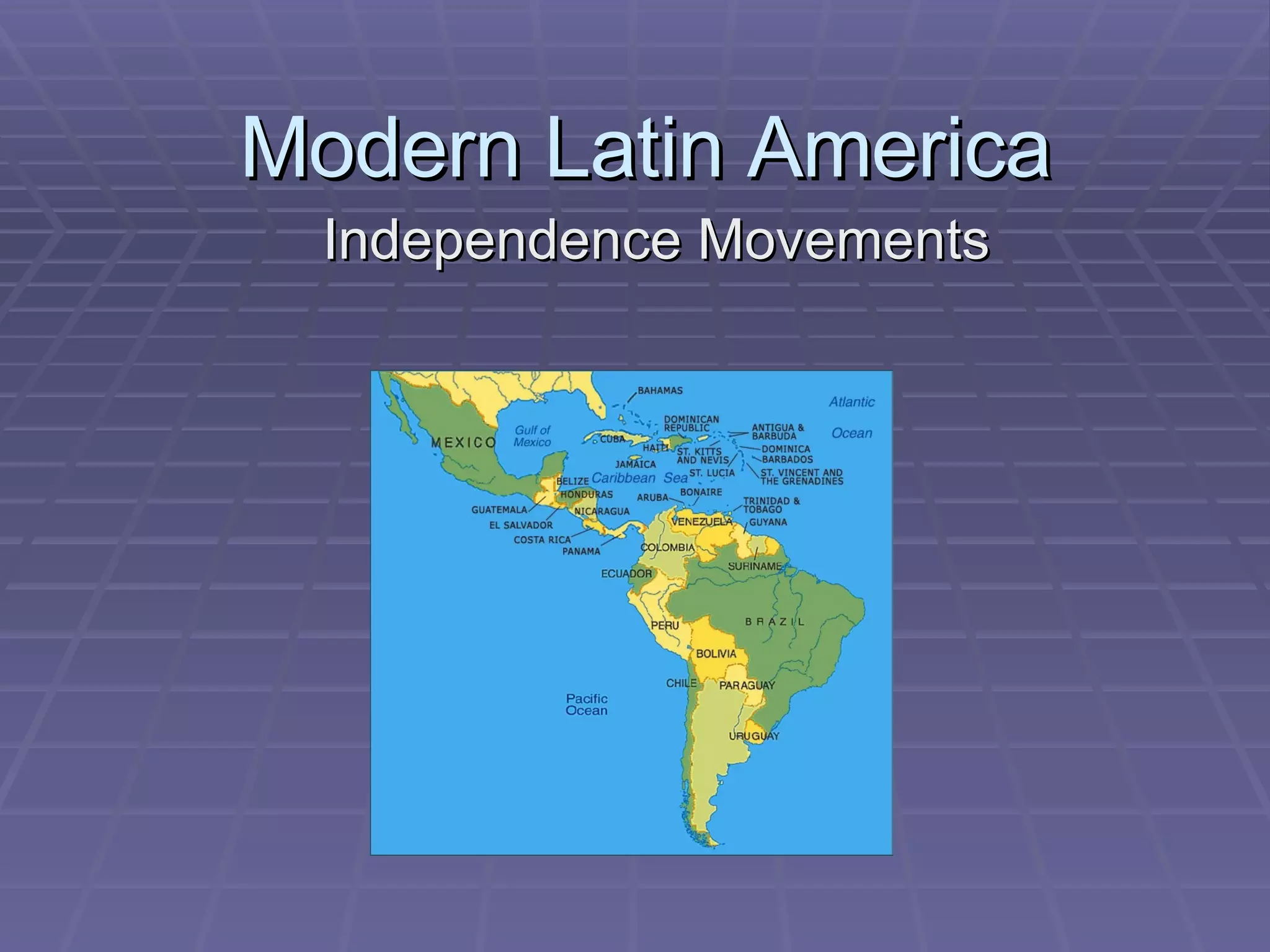
Modern Latin America Independence Movements
Background In the late 1700’s, Enlightenment and Revolutionary ideas spread from Europe and the United States Educated Latin Americans read works by Enlightenment philosophers The success of the French and American revolutions set an example  Bu the 1790’s colonies would begin to fight for independence as well as other rights and freedoms
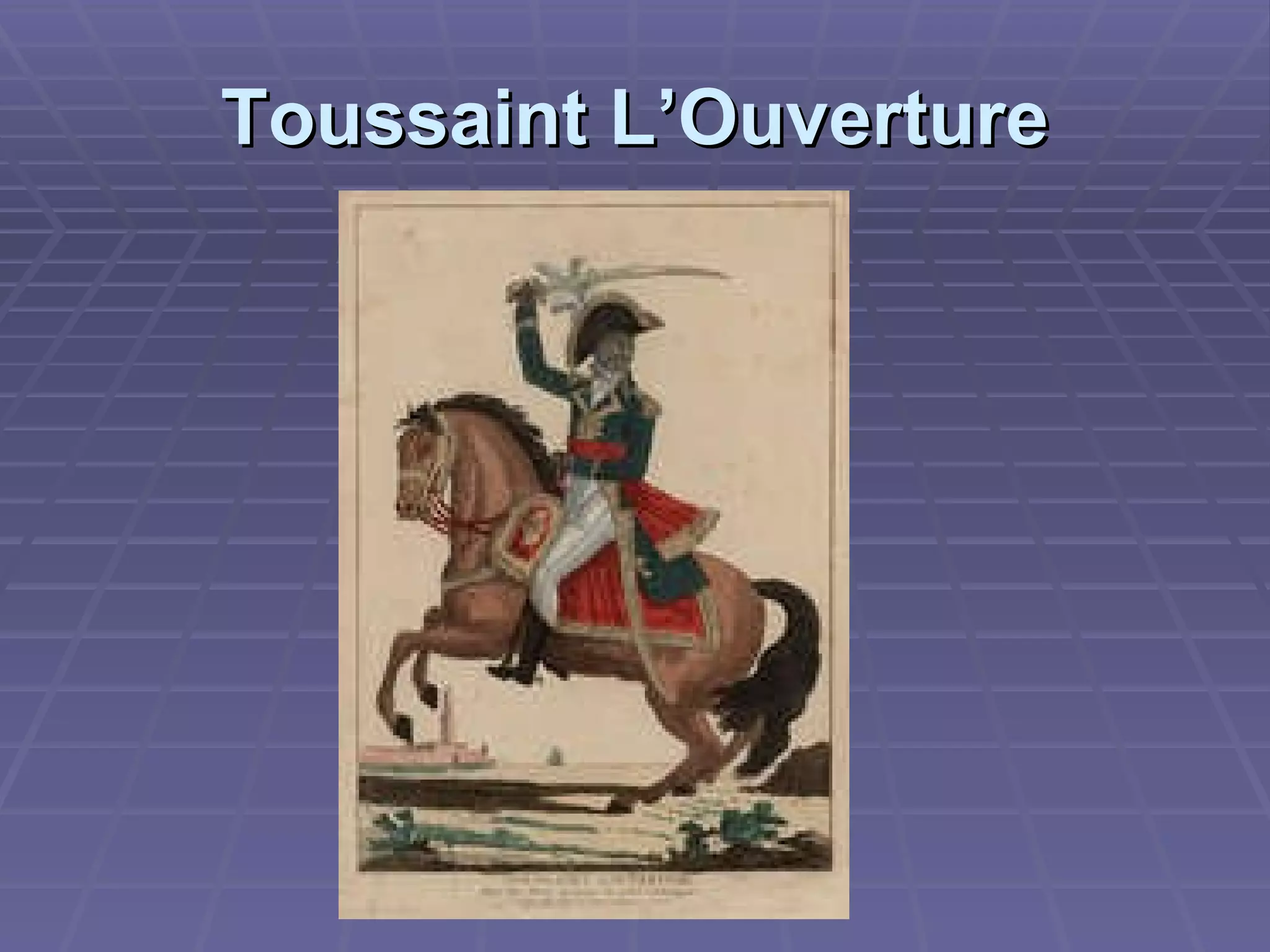
Toussaint L’Ouverture The French colony of Haiti was the first to revolt against colonial rule French planters owned large sugar plantations where thousands of enslaved Africans worked under terrible conditions In 1791, a self educated former slave familiar with the works of the enlightenment, wanted to lead his people to victory Toussaint was an effective military leader and gained control over much of the island In 1802, Napoleon sent an army to Haiti and captured Toussaint Yellow fever took a heavy toll on the French In 1804, Haiti declared independence
Toussaint L’Ouverture
Simon Bolivar Led resistance movements against the Spanish in South America Bolivar became an admirer of enlightenment ideas and the French Revolution during a stay in Europe He was also inspired by the French Revolution Bolivar became one of the great nationalist leaders of Latin America In 1810, Bolivar began his military campaign against the Spanish in Venezuela, Ecuador, Peru, and Bolivia and eventually won independence over the next twelve years He then joined forces with Jose de San Martin and defeated the Spanish in Argentina and Chile
Simon Bolivar
Unrest in Latin America Argentina – Juan Peron, a former army colonel, came to power in 1946. Peron gained popularity by boosting wages, strengthening labor unions, and starting welfare programs Peron’s government was repressive and his economic policies led to huge debts He lost power to in 1955 In the 1970’s the government of Argentina began a program of state terrorism in came to be called the  “dirty war” 20,000 people simply disappeared  Democracy was restored to Argentina in 1983 by holding elections
Unrest in Latin America Nicaragua – from 1936-1979, the Somoza family led a repressive government in Nicaragua The family had close ties to the United States because of their anti-communist stance In 1979, the Sandinistas, a group that included both nationalists and communists overthrew the Somoza government The Sandinistas set up a government under the leadership of Daniel Ortega Many in the government were socialists and communists  Ties grew closer with Cuba, a communist nation led by Fidel Castro following the Cuban Revolution of 1959 In the 1980’s, the Sandinistas faced opposition from the contras, a counter-revolutionary group The United States supported the Contras and a civil war developed, leading to many deaths and devastating the economy
Unrest in Latin America Mexico – there have been periods of unrest in Mexico for the past fifty years Causes: 1.  Large gap between rich and poor, rich against reform Population explosion and not enough land to grow food High rates of unemployment Slums in urban areas
NAFTA NAFTA – North American Free Trade Agreement A plan that allowed for free trade to take place between the United States, Canada, and Mexico Many hoped the plan would bring prosperity to Mexico’s economy, and some improvements have been made
Panama Panama – in the late 1980’s the US suspected Panama leader Manuel Noriega of helping criminal gangs smuggle drugs into the States.  The United States invaded Panama and arrested Noriega Panama Canal – Canal that shortens voyages between the Atlantic and Pacific.  In 1977, United States signed a treaty that would turn control over to Panama in the year 2000.  Panama now has control over the canal.
Panama Canal
Panama Canal
Economic Issues Agriculture – Many nations rely on cash crops and have not grown enough staple crops like corn and wheat to feed their people Population – continues to grow leaving many unemployed and living in poverty Debt – lacking capital (money) Latin American nations often have to borrow money, paying back high interest loans  Deforestation – Many countries have relied on income from their rare and precious trees used as lumber, depleting the rain forests, especially along the Amazon river basin
Amazon Rainforest

Modern Latin America

  • 1.
    Modern Latin AmericaIndependence Movements
  • 2.
    Background In thelate 1700’s, Enlightenment and Revolutionary ideas spread from Europe and the United States Educated Latin Americans read works by Enlightenment philosophers The success of the French and American revolutions set an example Bu the 1790’s colonies would begin to fight for independence as well as other rights and freedoms
  • 3.
    Toussaint L’Ouverture TheFrench colony of Haiti was the first to revolt against colonial rule French planters owned large sugar plantations where thousands of enslaved Africans worked under terrible conditions In 1791, a self educated former slave familiar with the works of the enlightenment, wanted to lead his people to victory Toussaint was an effective military leader and gained control over much of the island In 1802, Napoleon sent an army to Haiti and captured Toussaint Yellow fever took a heavy toll on the French In 1804, Haiti declared independence
  • 4.
  • 5.
    Simon Bolivar Ledresistance movements against the Spanish in South America Bolivar became an admirer of enlightenment ideas and the French Revolution during a stay in Europe He was also inspired by the French Revolution Bolivar became one of the great nationalist leaders of Latin America In 1810, Bolivar began his military campaign against the Spanish in Venezuela, Ecuador, Peru, and Bolivia and eventually won independence over the next twelve years He then joined forces with Jose de San Martin and defeated the Spanish in Argentina and Chile
  • 6.
  • 7.
    Unrest in LatinAmerica Argentina – Juan Peron, a former army colonel, came to power in 1946. Peron gained popularity by boosting wages, strengthening labor unions, and starting welfare programs Peron’s government was repressive and his economic policies led to huge debts He lost power to in 1955 In the 1970’s the government of Argentina began a program of state terrorism in came to be called the “dirty war” 20,000 people simply disappeared Democracy was restored to Argentina in 1983 by holding elections
  • 8.
    Unrest in LatinAmerica Nicaragua – from 1936-1979, the Somoza family led a repressive government in Nicaragua The family had close ties to the United States because of their anti-communist stance In 1979, the Sandinistas, a group that included both nationalists and communists overthrew the Somoza government The Sandinistas set up a government under the leadership of Daniel Ortega Many in the government were socialists and communists Ties grew closer with Cuba, a communist nation led by Fidel Castro following the Cuban Revolution of 1959 In the 1980’s, the Sandinistas faced opposition from the contras, a counter-revolutionary group The United States supported the Contras and a civil war developed, leading to many deaths and devastating the economy
  • 9.
    Unrest in LatinAmerica Mexico – there have been periods of unrest in Mexico for the past fifty years Causes: 1. Large gap between rich and poor, rich against reform Population explosion and not enough land to grow food High rates of unemployment Slums in urban areas
  • 10.
    NAFTA NAFTA –North American Free Trade Agreement A plan that allowed for free trade to take place between the United States, Canada, and Mexico Many hoped the plan would bring prosperity to Mexico’s economy, and some improvements have been made
  • 11.
    Panama Panama –in the late 1980’s the US suspected Panama leader Manuel Noriega of helping criminal gangs smuggle drugs into the States. The United States invaded Panama and arrested Noriega Panama Canal – Canal that shortens voyages between the Atlantic and Pacific. In 1977, United States signed a treaty that would turn control over to Panama in the year 2000. Panama now has control over the canal.
  • 12.
  • 13.
  • 14.
    Economic Issues Agriculture– Many nations rely on cash crops and have not grown enough staple crops like corn and wheat to feed their people Population – continues to grow leaving many unemployed and living in poverty Debt – lacking capital (money) Latin American nations often have to borrow money, paying back high interest loans Deforestation – Many countries have relied on income from their rare and precious trees used as lumber, depleting the rain forests, especially along the Amazon river basin
  • 15.