

Recommended
More Related Content
What's hot
What's hot (20)
Similar to Chinese History Overview: Three Fundamentals, Geography, Antiquity
Similar to Chinese History Overview: Three Fundamentals, Geography, Antiquity (20)
Recently uploaded
Recently uploaded (20)
Chinese History Overview: Three Fundamentals, Geography, Antiquity
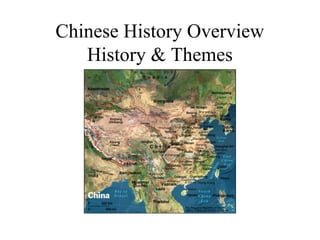
- 1. Chinese History Overview History & Themes
- 2. Three Fundamentals • China is land. • China is time. • China is people.
- 3. Geography Matters • China tilts down from west to east. • Sown lands & steppe lands • North & South Dry & wet Wheat/barley & rice • Authority & pacified • Simplicity & luxury
- 4. China’s Antiquity • Antiquity is part of Chinese identity. • 50,000 years ago - modern humans • Local Neolithic Cultures • 6000 years ago - Banpo - women’s power, pottery marks • Yangshao Culture - farming • Longshan Culture - walled communities
- 5. Multiple Origins • Old Theory – Northerners created Chinese culture. • Many different of Bronze Age cultures • Yangshao & Longshan (Yellow River) • Sanxingdui (Sichuan) • Majiabang & Liangzhu (Lower Yangzi River) • Dawenkou (East Coast) • Qujialing (Middle Yangzi)
- 6. The Main Current The Shang Dynasty 1800 BCE - 1045 BCE • Rises from Longshan Culture in North China • Silk technology • Walled cities - centers of administration • Ancestor worship & shamanism • Bronze technology • First writing
- 7. The Feudal Age The Zhou Dynasty 1045 BCE - 256 BCE • The Mandate of Heaven • Chariots & Crossbows • Cast Iron & Mass Production • Coins • One Hundred Schools - Confucianism, Daoism, Legalism, Logicians, Yin- Yang
- 8. Empire The Qin Dynasty 221 BCE - 206 BCE • The First Emperor - Qin Shi Huangdi • Legalism - efficient government but does not provide legitimacy • Reduces regional autonomy - taxes, army, writing, measurement • Centralized bureaucracy • Mass enslavement
- 9. The Han Dynasty 206 BCE - 220 CE • Qin Legalism blends with Han Confucianism - legitimating • Technology & arts - paper, porcelain, water mills, distillation • The Silk Route • Buddhism from India via central Asia • Most Chinese are Han people.
- 10. Unity & Disunity • China takes unity as the norm. • Europe takes disunity as the norm. • Disunity was often very creative in China.
- 11. The Cosmopolitan Empire The Tang Dynasty 618 CE - 907 CE • The Golden Age - poetry, painting, calligraphy • Capital at Chang’an - international trade hub, largest city in the world • Wu Zetian - only female emperor ever • Buddhism dominant
- 12. China’s Mature Imperial System The Song Dynasty 960 CE – 1276 CE • Mature imperial system of government • Knowledge = Power • Exam System • Commercial Revolution - paper money • Industrial Evolution - iron, coal • Printing presses • Neo-Confucianism as religion • Foot Binding
- 13. Wider Influences The Mongols • Violent conquest by Central Asians • Pax Mongolica: peaceful exchange of goods and ideas across Asia and Europe • Unable to manage huge Chinese population for long
- 14. The Last Native Dynasty The Ming Dynasty 1276 CE - 1644 CE • Suspicion & Intrigue • Zheng He’s Voyages • Economy contracted. • Secluded empire • Imperial capital moved to Beijing. • The great novels • The Great Wall
- 15. The Last Emperors The Qing Dynasty 1644 CE - 1911 CE • The second major foreign dynasty • Better organized than the Mongol government • Strong and wealthy into the 1800s • Western imperial powers • Western merchants & gunboats • Missionaries • Rebellions - Tai Ping & many others • Opium Wars
- 16. The Twentieth Century • Republic of China ~ 1911 to 1949 • Warlord Era • Japanese Invasion & World War Two • Chinese Civil War • 1949 People’s Republic of China (PRC) - Mao Zedong • 1966 - 1976 Cultural Revolution • 1978+ Deng Xiaoping’s Reforms
- 17. The Twenty-First Century • “Socialism with Chinese Characteristics” • World’s fasting- growing modern economy • Many social issues