Ancient China
• Geographic barriers isolate China
– Deserts and high mountain ranges
– Rainforests divide China from southeast
Asia
– Pacific Ocean to the east
• Civilization emerges in Huang River
valley
– “River of Sorrows”
Shang Dynasty
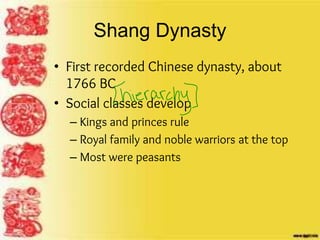
• First recorded Chinese dynasty, about
1766 BC
• Social classes develop
– Kings and princes rule
– Royal family and noble warriors at the top
– Most were peasants
Dynastic cycle
• The rise and the fall of dynasties in
China
– Zhou overthrew Shang about 1766 BC
• Dynasties needed the Mandate of
Heaven
• Disaster meant that a dynasty lost the
favor of heaven
– Zhou ends in 256 BC
Confucius
• A brilliant scholar
and teacher
• Taught that
relationships
shape behavior
• Confucianism
influences one-
third of the
world’s
population
5 key relationships
• Ruler to subject, parent to child,
husband to wife, older brother to
younger brother, friend to friend
• Filial piety (respect for parents)
Achievements
• Invented silk-making
– Most valuable export
• Created the first books
• Developed a complex writing system
– Writing as an art form (calligraphy)
• Improved bronze technology
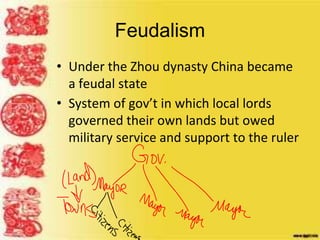
Feudalism
• Under the Zhou dynasty China became
a feudal state
• System of gov’t in which local lords
governed their own lands but owed
military service and support to the ruler
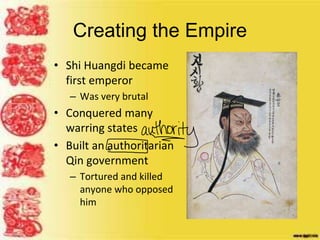
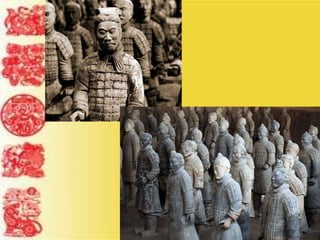
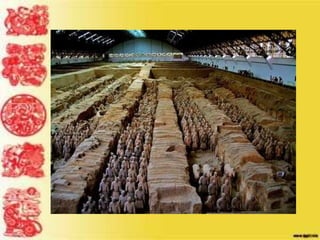
Creating the Empire
• Shi Huangdi became
first emperor
– Was very brutal
• Conquered many
warring states
• Built an authoritarian
Qin government
– Tortured and killed
anyone who opposed
him
Unity
• The feudal state was replaced with 36
military districts
• Created a money economy
• United Chinese writing
• Repaired roads and canals for travel
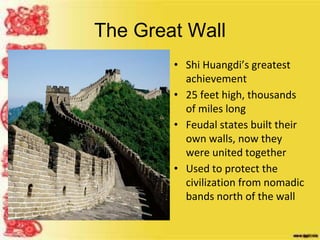
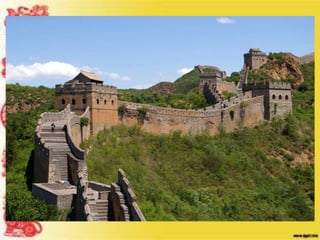
The Great Wall
• Shi Huangdi’s greatest
achievement
• 25 feet high, thousands
of miles long
• Feudal states built their
own walls, now they
were united together
• Used to protect the
civilization from nomadic
bands north of the wall
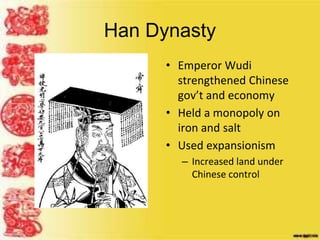
Han Dynasty
• Emperor Wudi
strengthened Chinese
gov’t and economy
• Held a monopoly on
iron and salt
• Used expansionism
– Increased land under
Chinese control
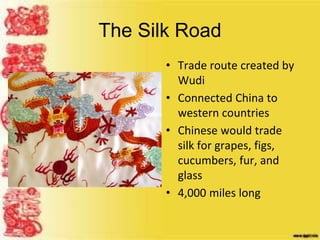
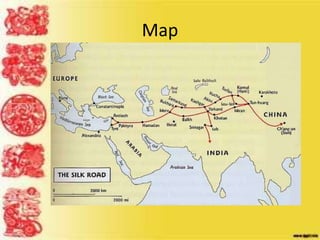
The Silk Road
• Trade route created by
Wudi
• Connected China to
western countries
• Chinese would trade
silk for grapes, figs,
cucumbers, fur, and
glass
• 4,000 miles long
Map
End of the Han dynasty
• Han dynasty collapsed after the
peasants revolted
• The emperors could no longer control
powerful warlords
• After 400 years of unity, China broke
into several kingdoms
• Invaders poured over the Great Wall
and settled in China
Sources
www/ducksturs.com
HISTORY.com

Ancient_China.pptx

  • 2.
    Ancient China • Geographicbarriers isolate China – Deserts and high mountain ranges – Rainforests divide China from southeast Asia – Pacific Ocean to the east • Civilization emerges in Huang River valley – “River of Sorrows”
  • 3.
    Shang Dynasty • Firstrecorded Chinese dynasty, about 1766 BC • Social classes develop – Kings and princes rule – Royal family and noble warriors at the top – Most were peasants
  • 4.
    Dynastic cycle • Therise and the fall of dynasties in China – Zhou overthrew Shang about 1766 BC • Dynasties needed the Mandate of Heaven • Disaster meant that a dynasty lost the favor of heaven – Zhou ends in 256 BC
  • 5.
    Confucius • A brilliantscholar and teacher • Taught that relationships shape behavior • Confucianism influences one- third of the world’s population
  • 6.
    5 key relationships •Ruler to subject, parent to child, husband to wife, older brother to younger brother, friend to friend • Filial piety (respect for parents)
  • 7.
    Achievements • Invented silk-making –Most valuable export • Created the first books • Developed a complex writing system – Writing as an art form (calligraphy) • Improved bronze technology
  • 8.
    Feudalism • Under theZhou dynasty China became a feudal state • System of gov’t in which local lords governed their own lands but owed military service and support to the ruler
  • 9.
    Creating the Empire •Shi Huangdi became first emperor – Was very brutal • Conquered many warring states • Built an authoritarian Qin government – Tortured and killed anyone who opposed him
  • 12.
    Unity • The feudalstate was replaced with 36 military districts • Created a money economy • United Chinese writing • Repaired roads and canals for travel
  • 13.
    The Great Wall •Shi Huangdi’s greatest achievement • 25 feet high, thousands of miles long • Feudal states built their own walls, now they were united together • Used to protect the civilization from nomadic bands north of the wall
  • 15.
    Han Dynasty • EmperorWudi strengthened Chinese gov’t and economy • Held a monopoly on iron and salt • Used expansionism – Increased land under Chinese control
  • 16.
    The Silk Road •Trade route created by Wudi • Connected China to western countries • Chinese would trade silk for grapes, figs, cucumbers, fur, and glass • 4,000 miles long
  • 17.
  • 18.
    End of theHan dynasty • Han dynasty collapsed after the peasants revolted • The emperors could no longer control powerful warlords • After 400 years of unity, China broke into several kingdoms • Invaders poured over the Great Wall and settled in China
  • 19.