
PHYSIOLOGY OF HEARING Crisbert I. Cualteros, M.D.
 
acoustics Sound   –  a change in pressure (particle displacement)within an elastic medium  -  wave form - emanates from a vibrating system - travels faster in denser medium Intensity   – refers to the strength of the sound;  the  - psychoacoustic equivalent of intensity is  loudness
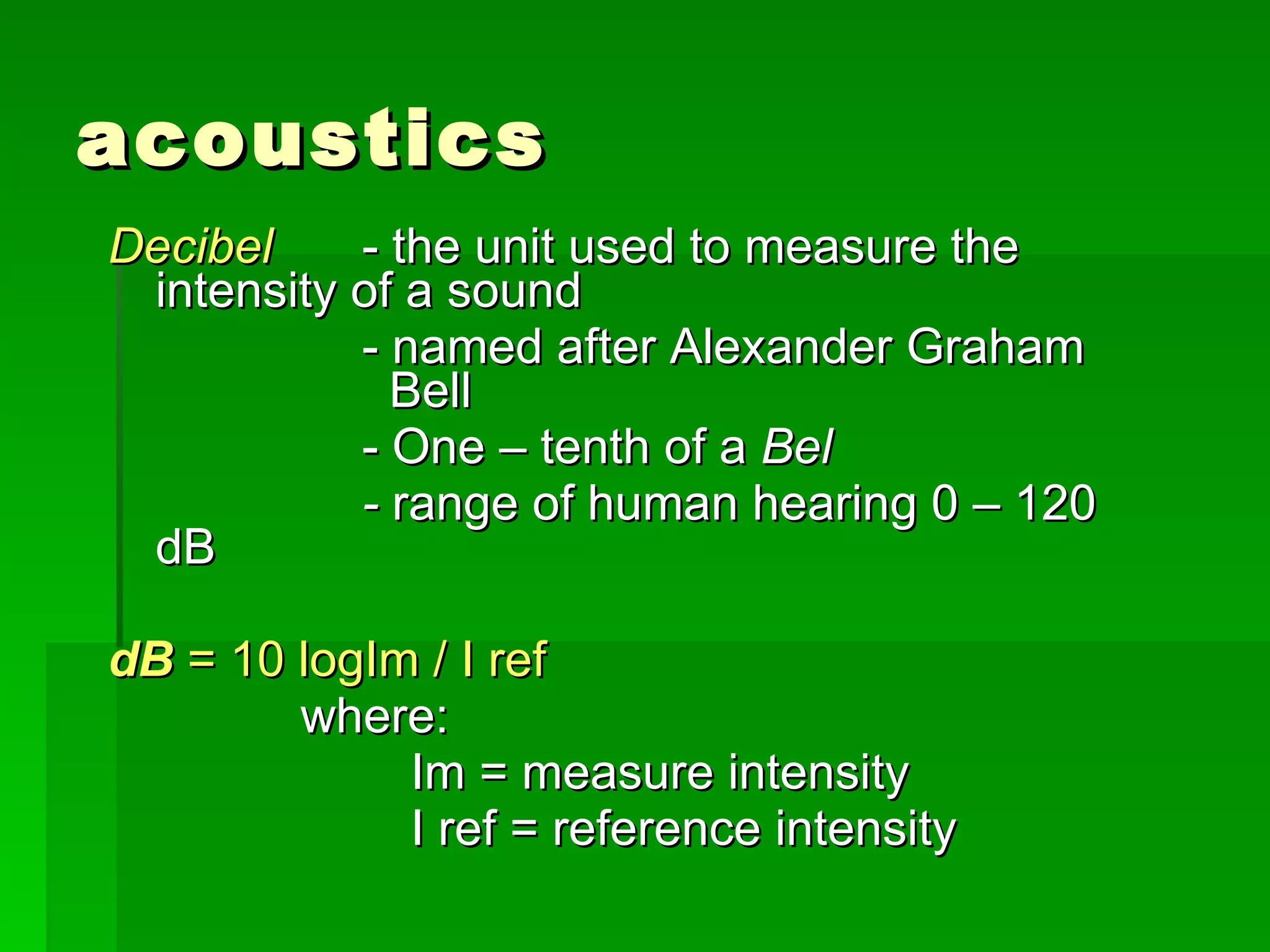
acoustics Decibel   - the unit used to measure the intensity of a sound - named after Alexander Graham    Bell - One – tenth of a  Bel -  range of human hearing 0 – 120 dB dB  = 10 logIm / I ref where: Im = measure intensity I ref = reference intensity
acoustics The decibel scale has the following characteristics: 1. It is logarithmic and incorporates a ratio 2. It is not linear (i.e., an increase from 1 to 3 dB  is not equal to an increase from 5 to 7 dB) 3. It is a relative measure (i.e., 0 dB does not  indicate the absence of sound) 4. It is expressed with different reference levels
acoustics Frequency  – refers to the number of cycles (complete oscillations) of a vibrating body per unit of time; the psychoacoustic equivalent of frequency is  pitch.
acoustics Hertz (Hz)  – unit used to measure frequency - formerly called cycles per second    or cps - the human ear is capable of    hearing from 20 – 20,000 Hz
acoustics Pure tone  – a single frequency sound; rarely occur in nature Complex sound  – has more than one frequency Noise  – an aperiodic complex sound
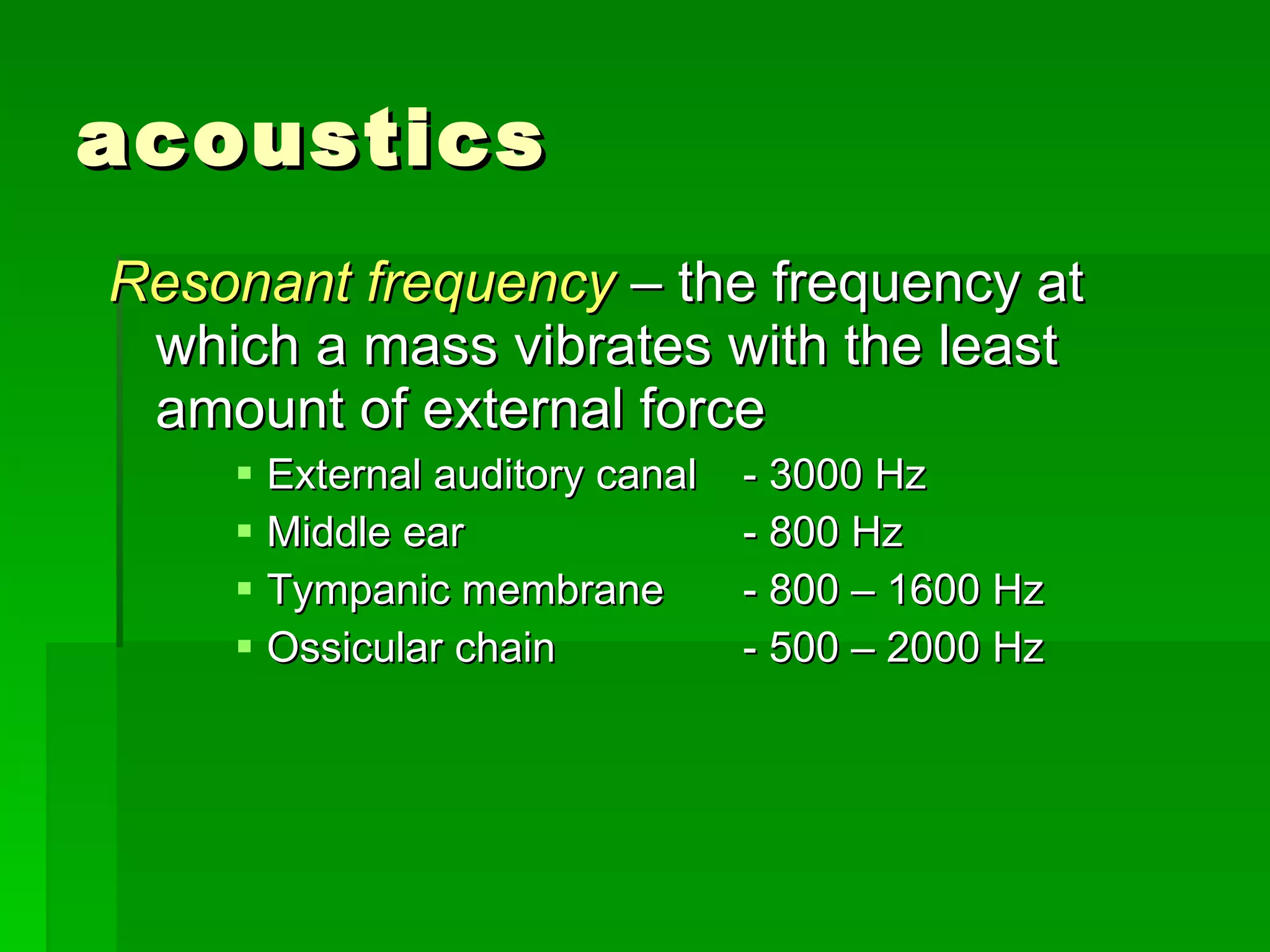
acoustics Resonant frequency  – the frequency at which a mass vibrates with the least amount of external force External auditory canal - 3000 Hz Middle ear - 800 Hz Tympanic membrane - 800 – 1600 Hz Ossicular chain - 500 – 2000 Hz
PROPERTIES OF SOUND Sound External auditory canal
EXTERNAL EAR - funnel-shaped   “collector”  of sounds  - localization  pinna
EXTERNAL EAR - directs sound waves - 2 to 4 kHz - 10 to 15 dB - total occlusion  hearing loss  not more than 40 dB - earplugs / earmuffs  attenuate  sound <30 dB External auditory canal
EXTERNAL EAR - monaural hearing - binaural hearing cannot localize sounds localize sounds
sound EAC middle ear
MIDDLE EAR air-filled - 1 to 2 cc
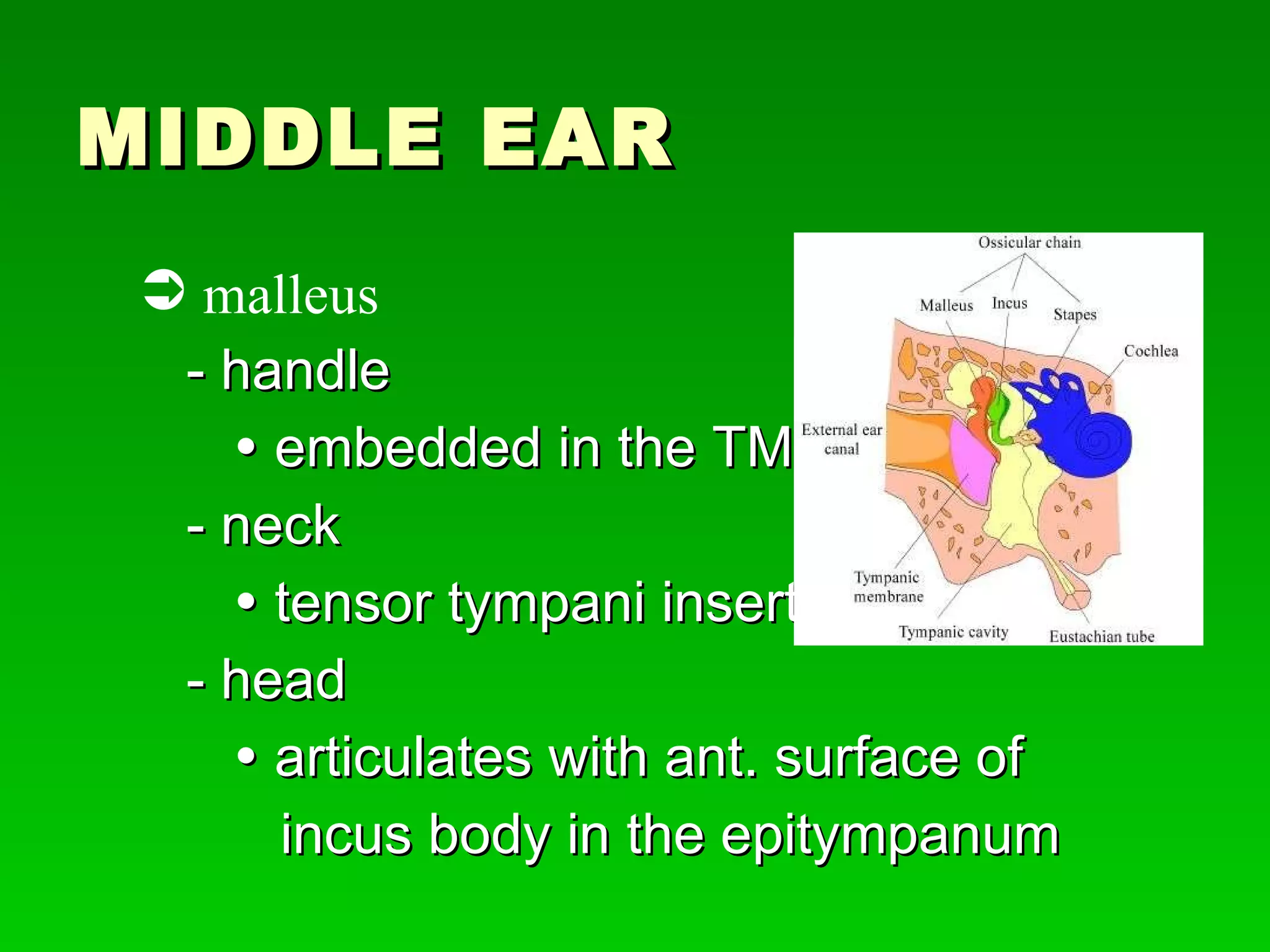
MIDDLE EAR - handle    embedded in the TM - neck    tensor tympani inserts - head     articulates with ant. surface of  incus body in the epitympanum malleus
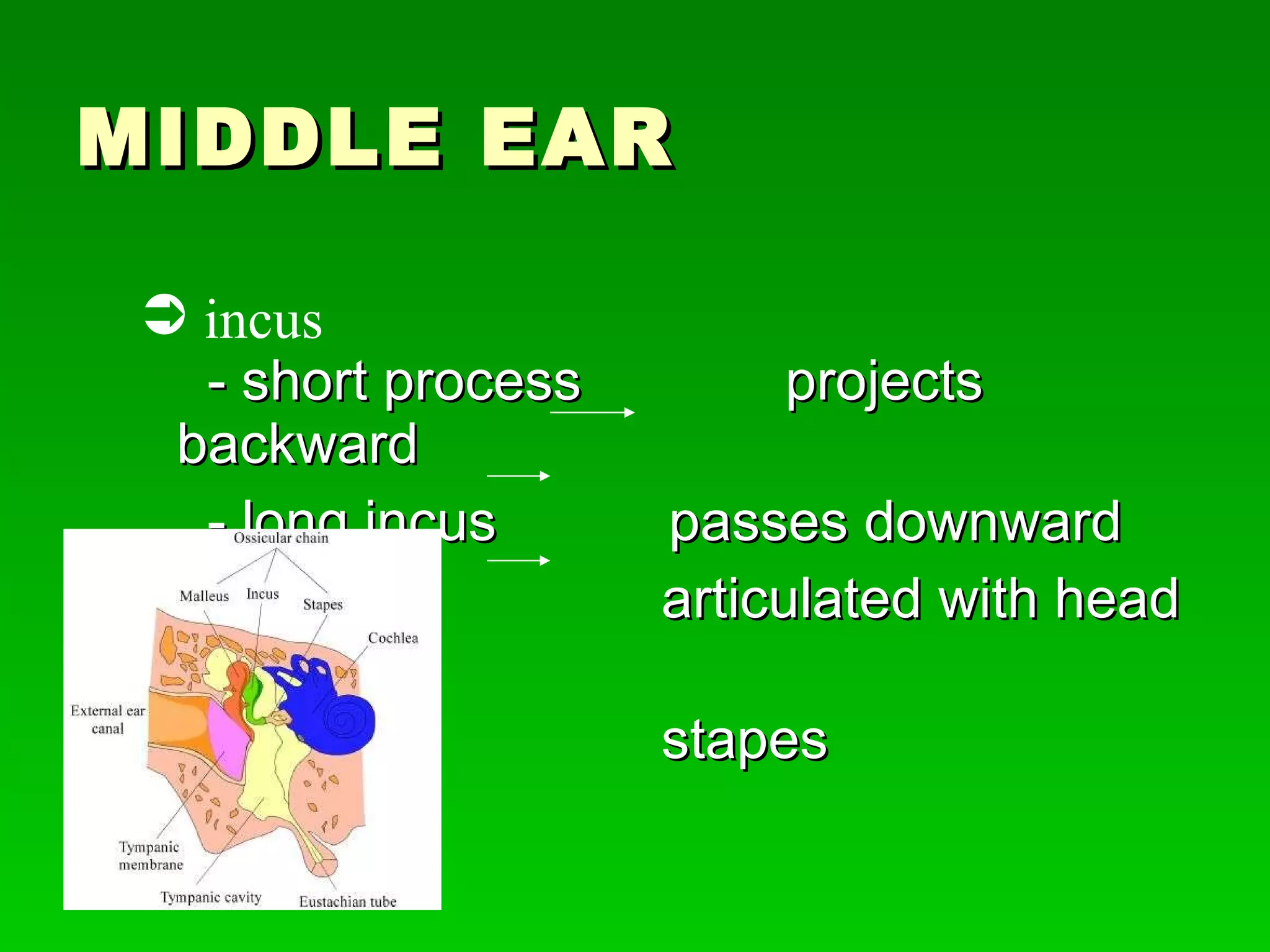
MIDDLE EAR - short process  projects backward - long incus  passes downward articulated with head of  stapes incus
MIDDLE EAR - oval window    inner ear stapes
-  axis of rotation:     line from short process of incus to neck of malleus   MIDDLE EAR
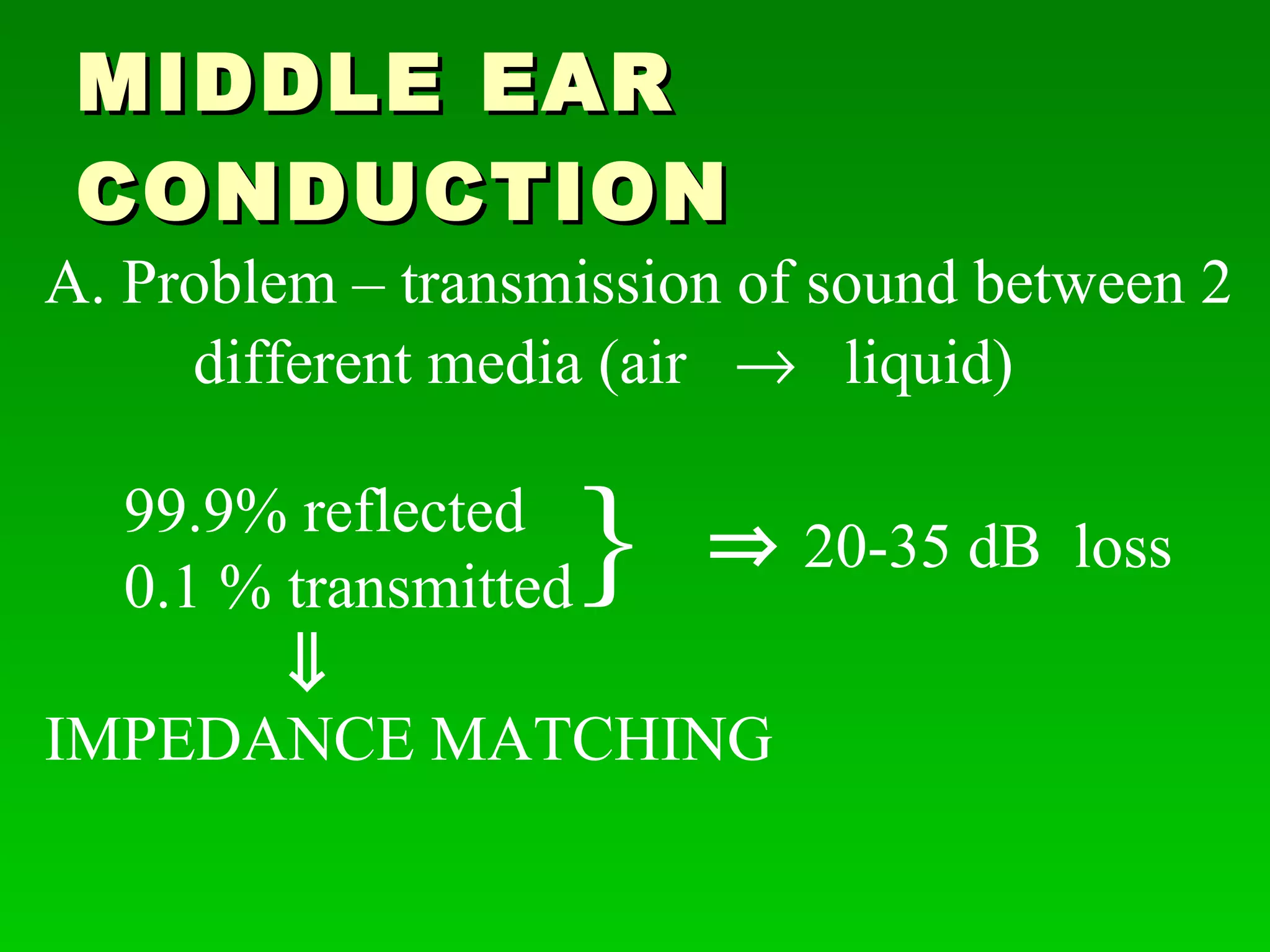
MIDDLE EAR CONDUCTION A. Problem – transmission of sound between 2   99.9% reflected 0.1 % transmitted   IMPEDANCE MATCHING 20-35 dB  loss      different media (air     liquid)
MIDDLE EAR CONDUCTION B:  TRANSDUCER MECHANISM 1. ratio of drum/ footplate area   vibrating TM  55 sq. mm.  foot plate  3.5 sq. mm.  = 17  (25 to 30 dB) ______________ ______________ =
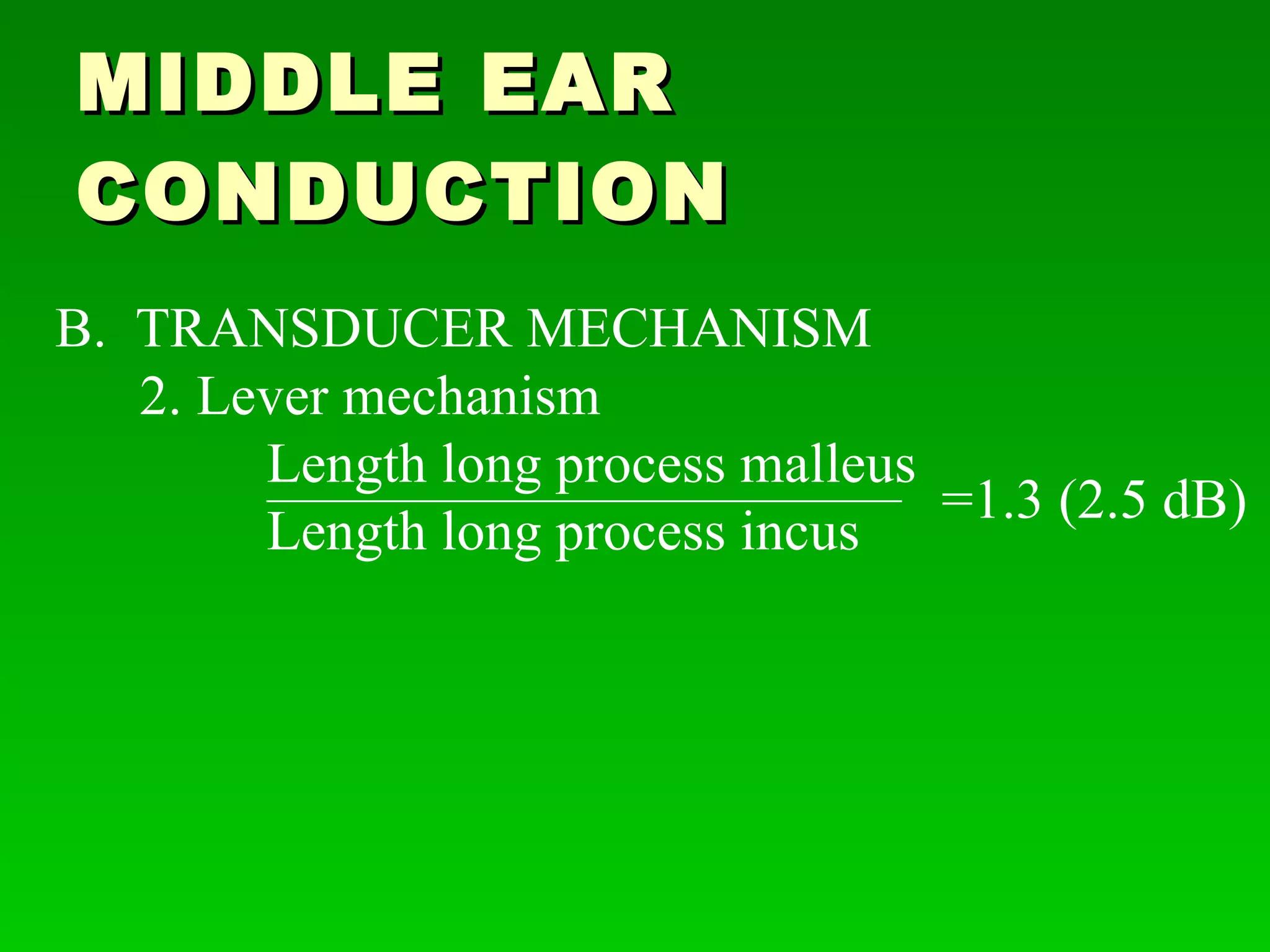
MIDDLE EAR CONDUCTION B.  TRANSDUCER MECHANISM 2. Lever mechanism Length long process malleus Length long process incus ______________________________ =1.3 (2.5 dB)
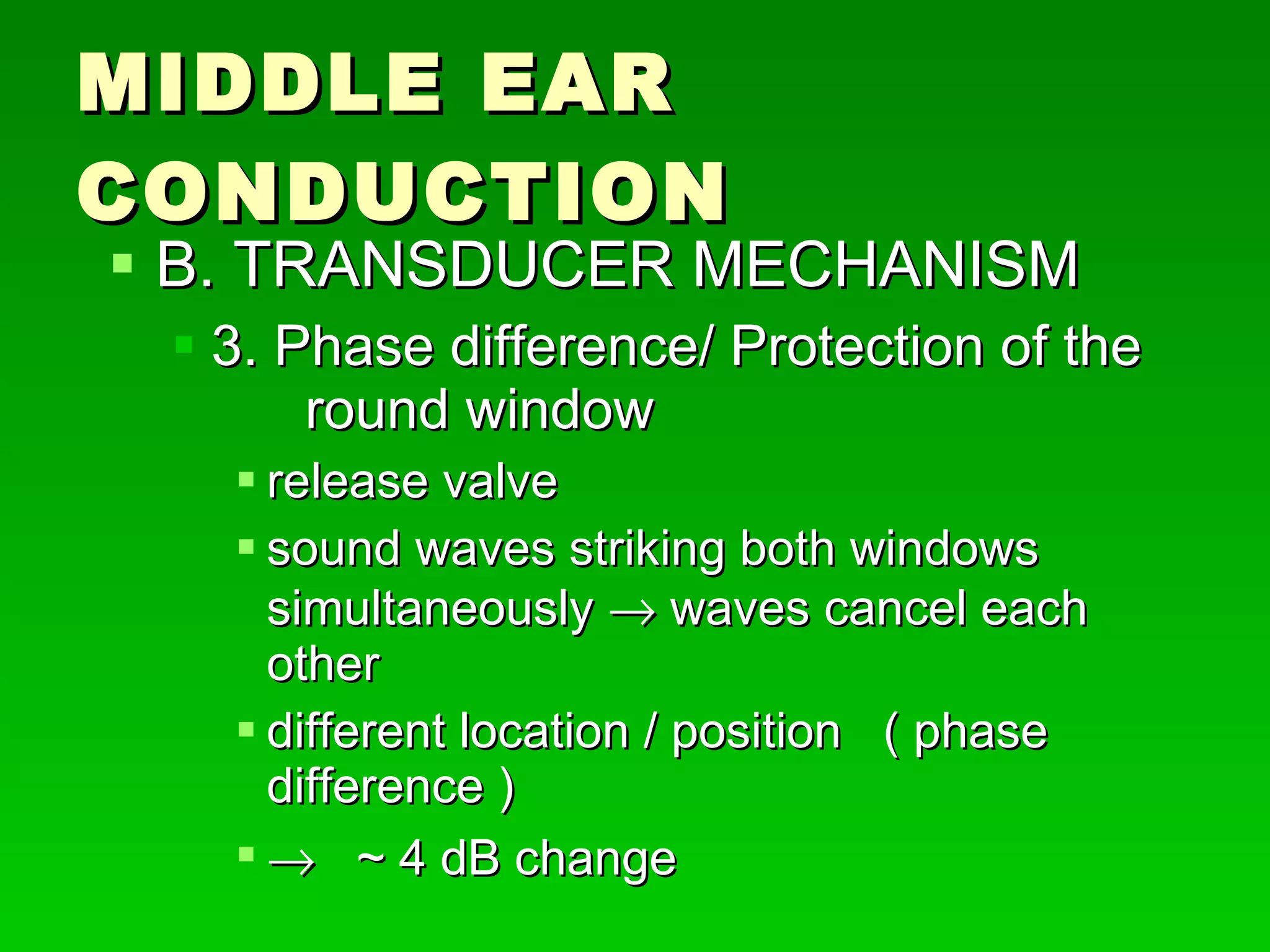
MIDDLE EAR CONDUCTION B. TRANSDUCER MECHANISM 3. Phase difference/ Protection of the  round window release valve  sound waves striking both windows  simultaneously    waves cancel each other  different location / position  ( phase difference )     ~ 4 dB change
MIDDLE EAR CONDUCTION B.  TRANSDUCER MECHANISM 4. Natural resonance and efficiency of the outer   and middle ear (500 to 3000 Hz)
MIDDLE EAR CONDUCTION B.  TRANSDUCER MECHANISM 5. shape of the tympanic membrane Curved cone
Middle ear conduction
INTRINSIC MUSCLES OF THE MIDDLE EAR Tensor Tympani Stapedius
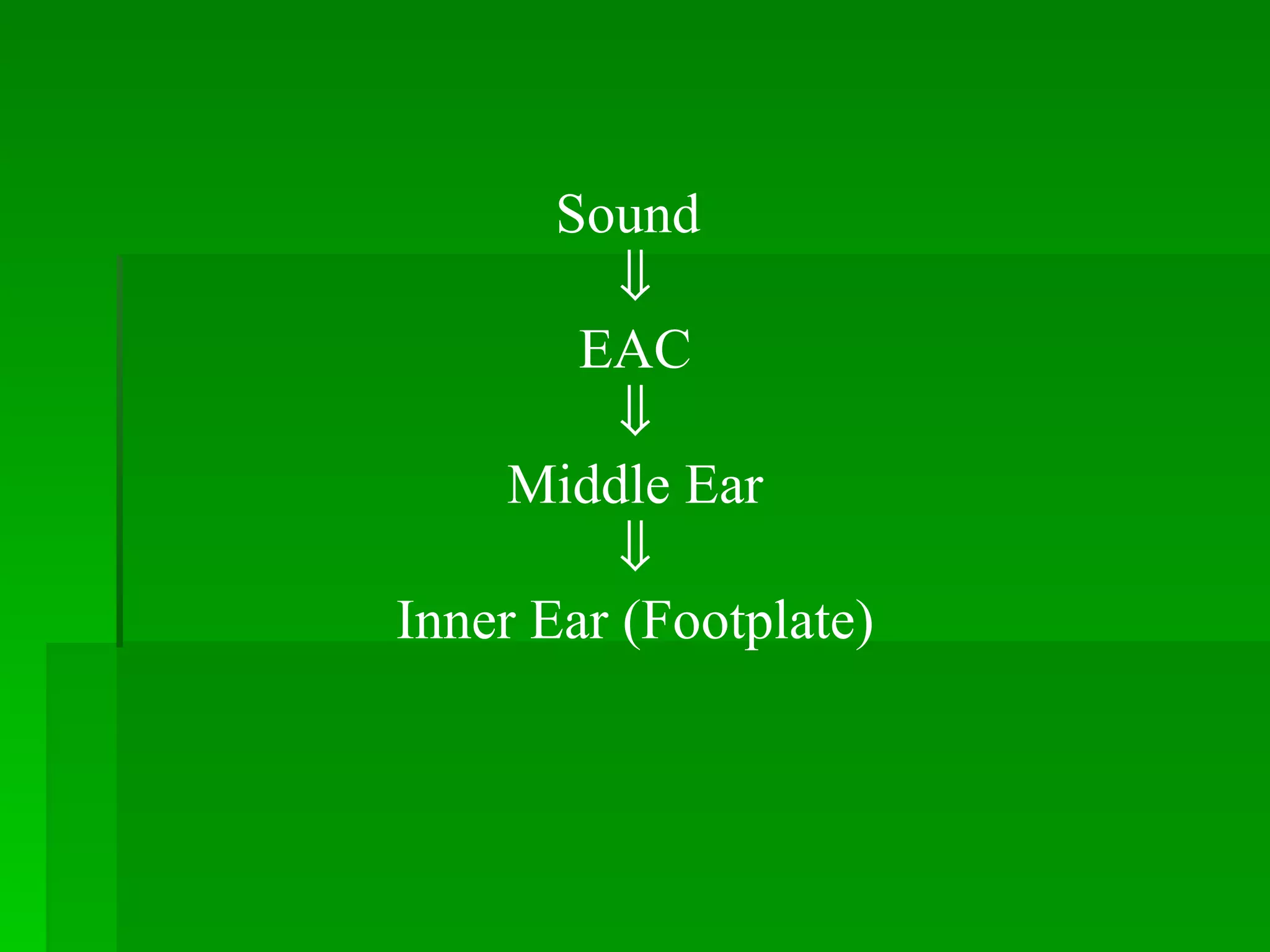
Sound   EAC  Middle Ear  Inner Ear (Footplate)  
INNER EAR CONDUCTION The Stapes moves back and forth at the oval  window     fluid displacement within the cochlea These waves cause up and down displacement of  the basilar membrane which then pivots around the osseous lamina
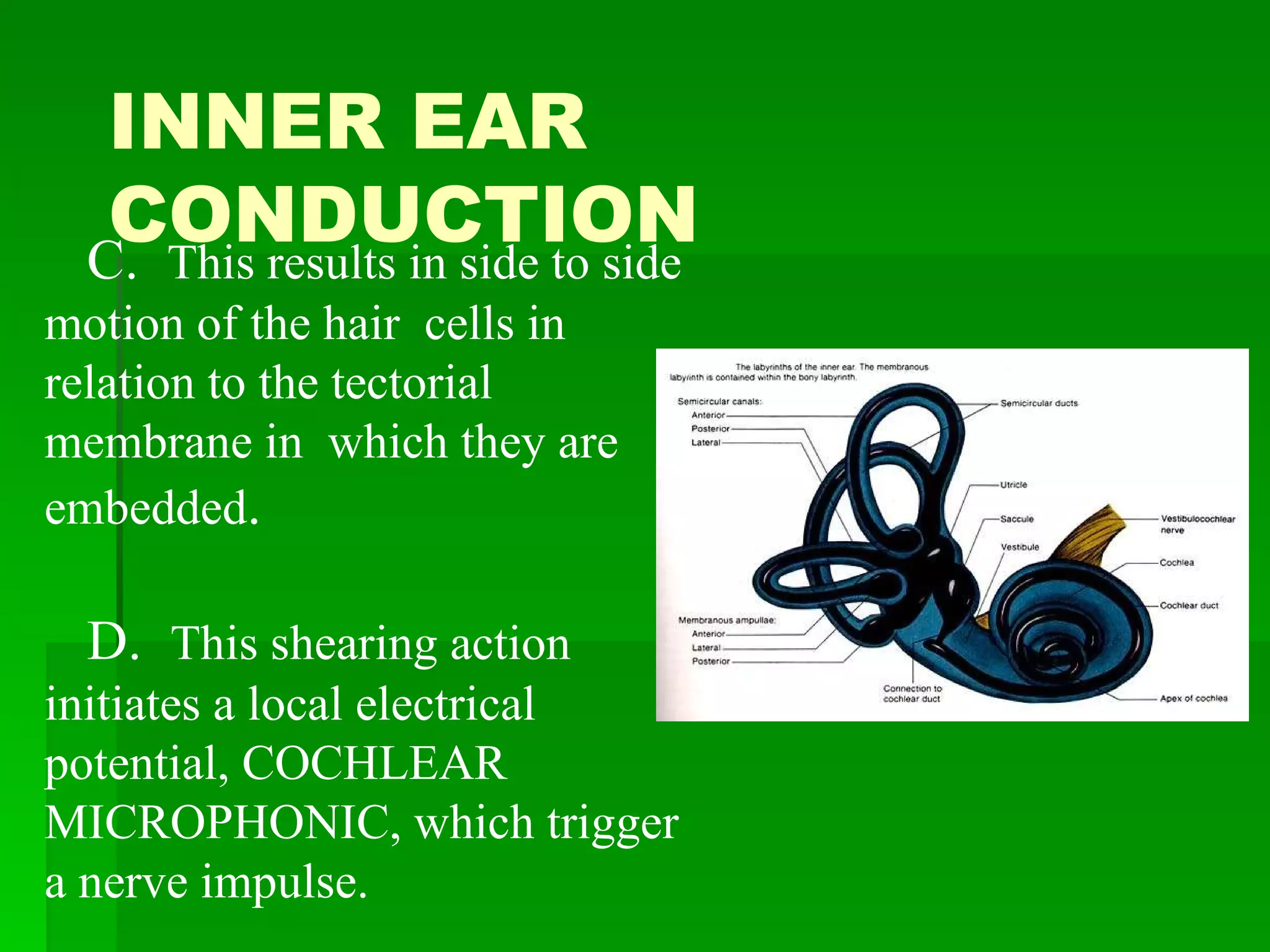
INNER EAR CONDUCTION C.  This results in side to side motion of the hair  cells in relation to the tectorial membrane in  which they are embedded . D.  This shearing action initiates a local electrical potential, COCHLEAR MICROPHONIC, which trigger a nerve impulse.
INNER EAR CONDUCTION E.  Portion of cochlear stimulated High Frequency     Lower hair cells Low Frequency   Apical cells F.  Loudness - number of elements firing
BONE CONDUCTION Conductive mechanism of ME may be  by-passed; natural structures stimulated directly through bone conduction Principle behind tuning fork tests
Conscious auditory pathway
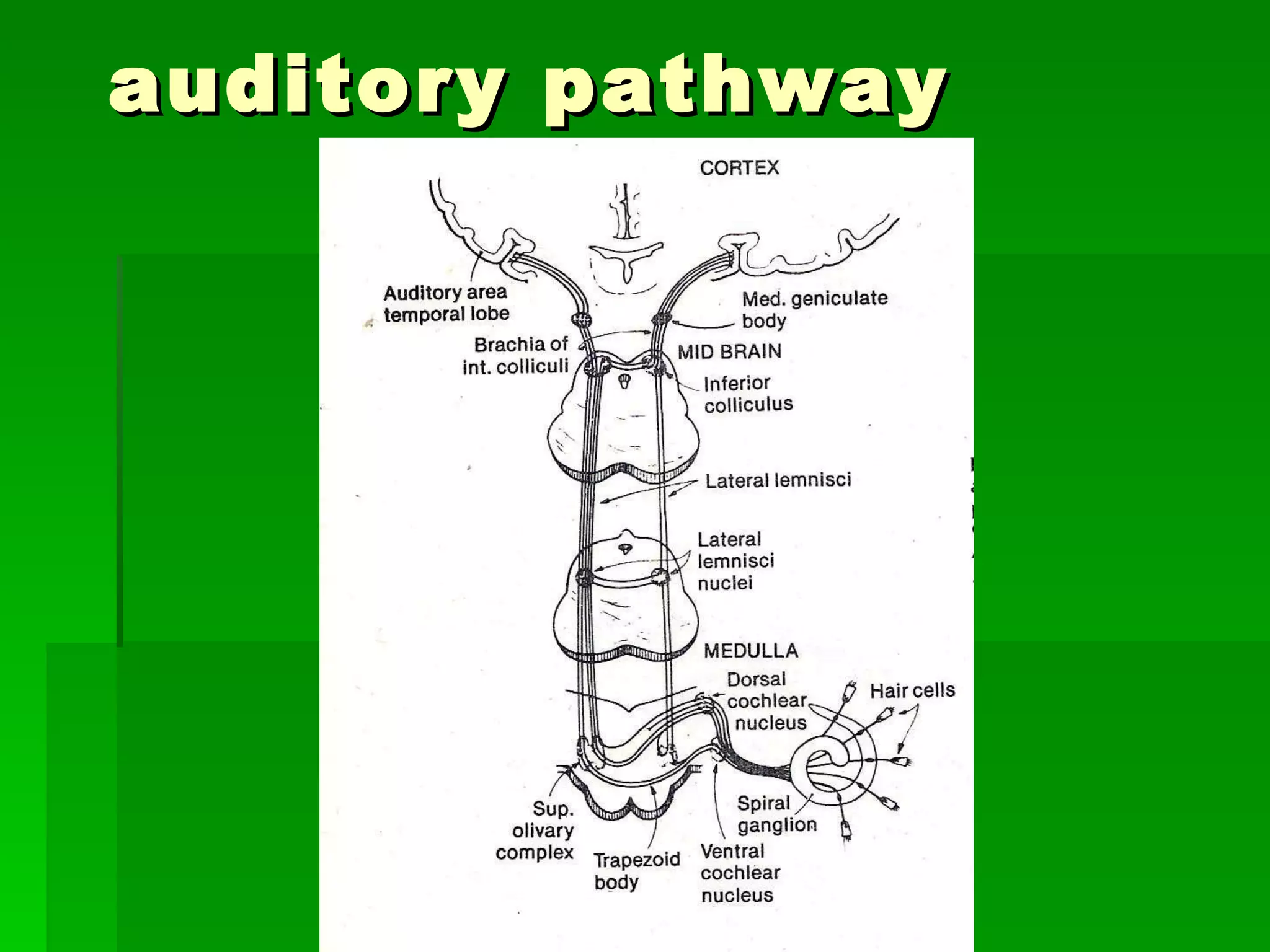
Auditory pathway Sound  EAC Middle ear Inner ear eighth nerve  lateral lemniscus   (medulla) Dorsal & ventral nuclei Inferior colliculus Medial geniculate body (thalamus)   Auditory cortex
auditory pathway
salamat! Pls visit:   http://crisbertcualteros.page.tl

Physiology Of Hearing

  • 1.
    PHYSIOLOGY OF HEARINGCrisbert I. Cualteros, M.D.
  • 2.
  • 3.
    acoustics Sound – a change in pressure (particle displacement)within an elastic medium - wave form - emanates from a vibrating system - travels faster in denser medium Intensity – refers to the strength of the sound; the - psychoacoustic equivalent of intensity is loudness
  • 4.
    acoustics Decibel - the unit used to measure the intensity of a sound - named after Alexander Graham Bell - One – tenth of a Bel - range of human hearing 0 – 120 dB dB = 10 logIm / I ref where: Im = measure intensity I ref = reference intensity
  • 5.
    acoustics The decibelscale has the following characteristics: 1. It is logarithmic and incorporates a ratio 2. It is not linear (i.e., an increase from 1 to 3 dB is not equal to an increase from 5 to 7 dB) 3. It is a relative measure (i.e., 0 dB does not indicate the absence of sound) 4. It is expressed with different reference levels
  • 6.
    acoustics Frequency – refers to the number of cycles (complete oscillations) of a vibrating body per unit of time; the psychoacoustic equivalent of frequency is pitch.
  • 7.
    acoustics Hertz (Hz) – unit used to measure frequency - formerly called cycles per second or cps - the human ear is capable of hearing from 20 – 20,000 Hz
  • 8.
    acoustics Pure tone – a single frequency sound; rarely occur in nature Complex sound – has more than one frequency Noise – an aperiodic complex sound
  • 9.
    acoustics Resonant frequency – the frequency at which a mass vibrates with the least amount of external force External auditory canal - 3000 Hz Middle ear - 800 Hz Tympanic membrane - 800 – 1600 Hz Ossicular chain - 500 – 2000 Hz
  • 10.
    PROPERTIES OF SOUNDSound External auditory canal
  • 11.
    EXTERNAL EAR -funnel-shaped “collector” of sounds - localization pinna
  • 12.
    EXTERNAL EAR -directs sound waves - 2 to 4 kHz - 10 to 15 dB - total occlusion hearing loss not more than 40 dB - earplugs / earmuffs attenuate sound <30 dB External auditory canal
  • 13.
    EXTERNAL EAR -monaural hearing - binaural hearing cannot localize sounds localize sounds
  • 14.
  • 15.
  • 16.
    MIDDLE EAR -handle  embedded in the TM - neck  tensor tympani inserts - head  articulates with ant. surface of incus body in the epitympanum malleus
  • 17.
    MIDDLE EAR -short process projects backward - long incus passes downward articulated with head of stapes incus
  • 18.
    MIDDLE EAR -oval window  inner ear stapes
  • 19.
    - axisof rotation:  line from short process of incus to neck of malleus MIDDLE EAR
  • 20.
    MIDDLE EAR CONDUCTIONA. Problem – transmission of sound between 2   99.9% reflected 0.1 % transmitted   IMPEDANCE MATCHING 20-35 dB loss    different media (air  liquid)
  • 21.
    MIDDLE EAR CONDUCTIONB: TRANSDUCER MECHANISM 1. ratio of drum/ footplate area   vibrating TM 55 sq. mm. foot plate 3.5 sq. mm. = 17 (25 to 30 dB) ______________ ______________ =
  • 22.
    MIDDLE EAR CONDUCTIONB. TRANSDUCER MECHANISM 2. Lever mechanism Length long process malleus Length long process incus ______________________________ =1.3 (2.5 dB)
  • 23.
    MIDDLE EAR CONDUCTIONB. TRANSDUCER MECHANISM 3. Phase difference/ Protection of the round window release valve sound waves striking both windows simultaneously  waves cancel each other different location / position ( phase difference )  ~ 4 dB change
  • 24.
    MIDDLE EAR CONDUCTIONB. TRANSDUCER MECHANISM 4. Natural resonance and efficiency of the outer and middle ear (500 to 3000 Hz)
  • 25.
    MIDDLE EAR CONDUCTIONB. TRANSDUCER MECHANISM 5. shape of the tympanic membrane Curved cone
  • 26.
  • 27.
    INTRINSIC MUSCLES OFTHE MIDDLE EAR Tensor Tympani Stapedius
  • 28.
    Sound EAC  Middle Ear  Inner Ear (Footplate)  
  • 29.
    INNER EAR CONDUCTIONThe Stapes moves back and forth at the oval window  fluid displacement within the cochlea These waves cause up and down displacement of the basilar membrane which then pivots around the osseous lamina
  • 30.
    INNER EAR CONDUCTIONC. This results in side to side motion of the hair cells in relation to the tectorial membrane in which they are embedded . D. This shearing action initiates a local electrical potential, COCHLEAR MICROPHONIC, which trigger a nerve impulse.
  • 31.
    INNER EAR CONDUCTIONE. Portion of cochlear stimulated High Frequency  Lower hair cells Low Frequency  Apical cells F. Loudness - number of elements firing
  • 32.
    BONE CONDUCTION Conductivemechanism of ME may be by-passed; natural structures stimulated directly through bone conduction Principle behind tuning fork tests
  • 33.
  • 34.
    Auditory pathway Sound EAC Middle ear Inner ear eighth nerve lateral lemniscus (medulla) Dorsal & ventral nuclei Inferior colliculus Medial geniculate body (thalamus) Auditory cortex
  • 35.
  • 36.
    salamat! Pls visit: http://crisbertcualteros.page.tl