• The Organ of Corti
It rests on top of the basilar
membrane. It sets inside the scala
media (cochlear duct) and contains
the inner and outer hair cells and of
course the tectorial membrane.
• The Organ of Corti
• This is where the electrical
  “language” is transmitted
  between the brain and received
  sound stimulation.
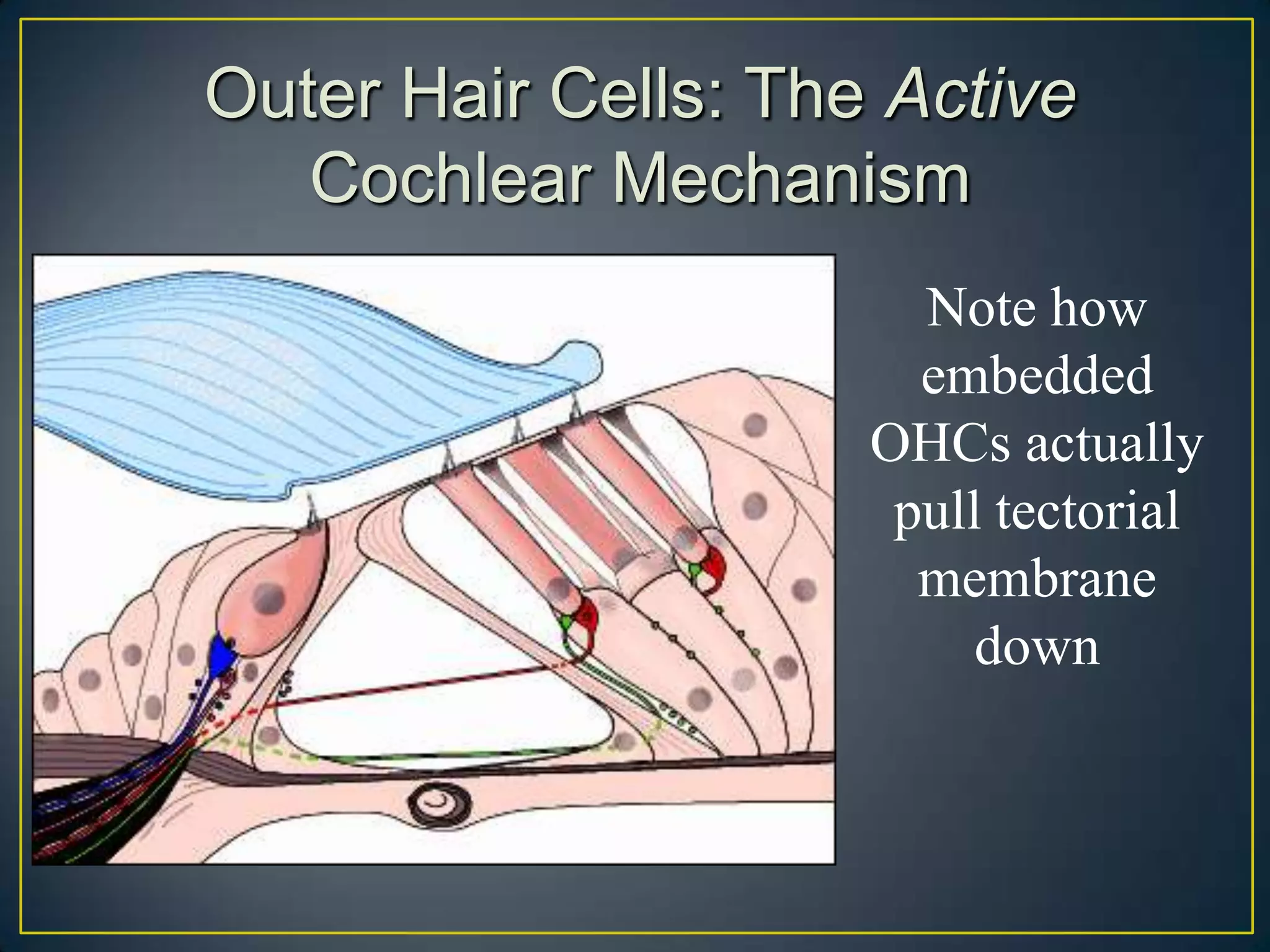
Outer Hair Cells: The Active
   Cochlear Mechanism
                       Note how
                       embedded
                     OHCs actually
                      pull tectorial
                       membrane
                          down
• Outer Hair Cells
• There are approximately 12,000
  outer hair cells. They have the
  appearance of test tubes and
  mostly receive efferent information
  from the brain.
• Outer Hair Cells
• Not only do they react to
  information received from the brain
  but they also receive “chemical
  messages” from inside the cochlea
  which tell them to either elongate
  or shrink (like pistons).
• Outer Hair Cells
• The net effect of their mechanical
  action is to change the mechanical
  properties of the basilar membrane
  at specific spots.
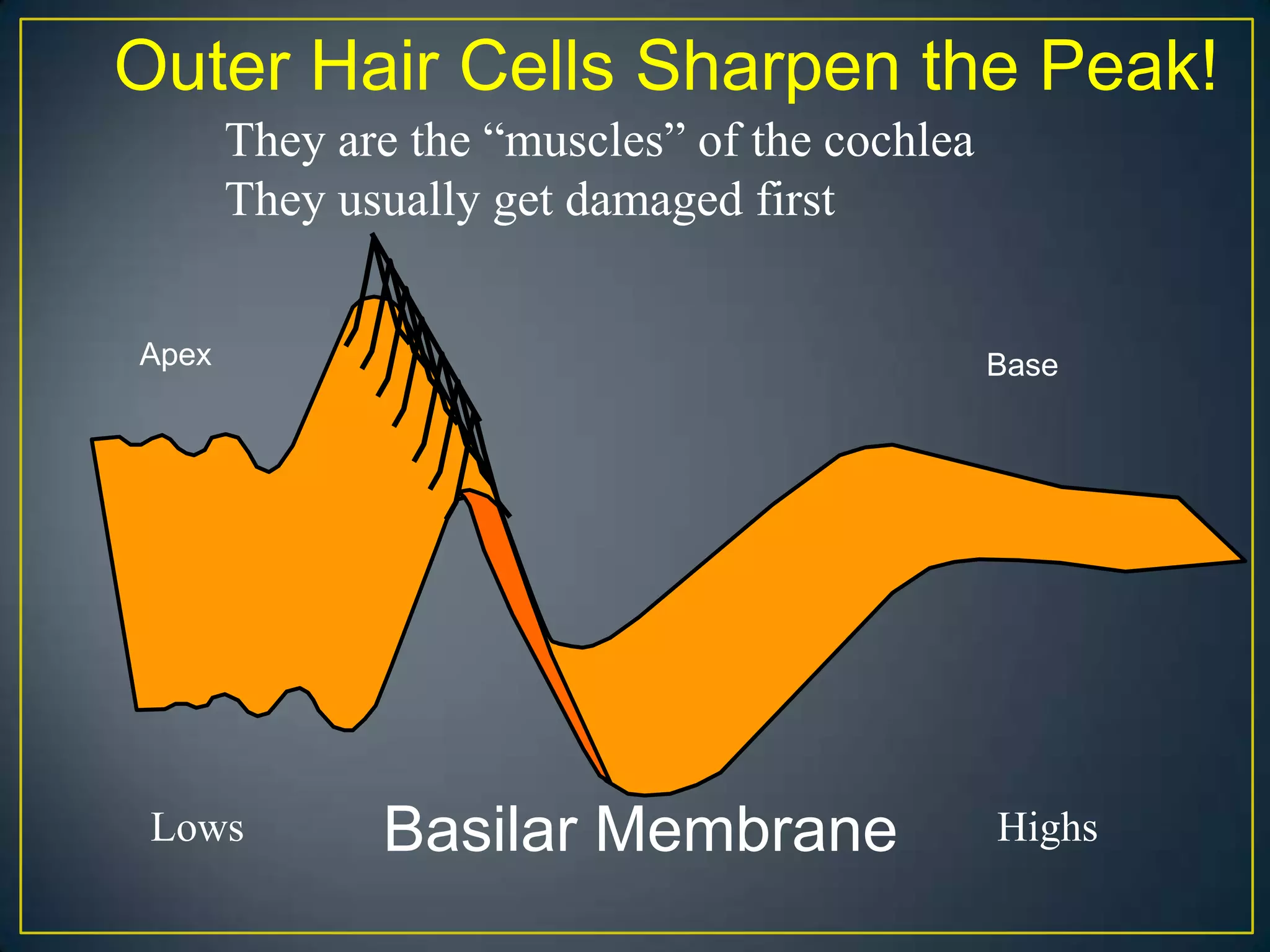
Outer Hair Cells Sharpen the Peak!
       They are the “muscles” of the cochlea
       They usually get damaged first


Apex                                           Base


 Lows         Basilar Membrane                 Highs
• Outer Hair Cells
• They play a very significant role in
  the reception of soft sounds.
• Without outer hair cells, we would
  have approximately forty to sixty
  decibels of sensorineural hearing
  loss.
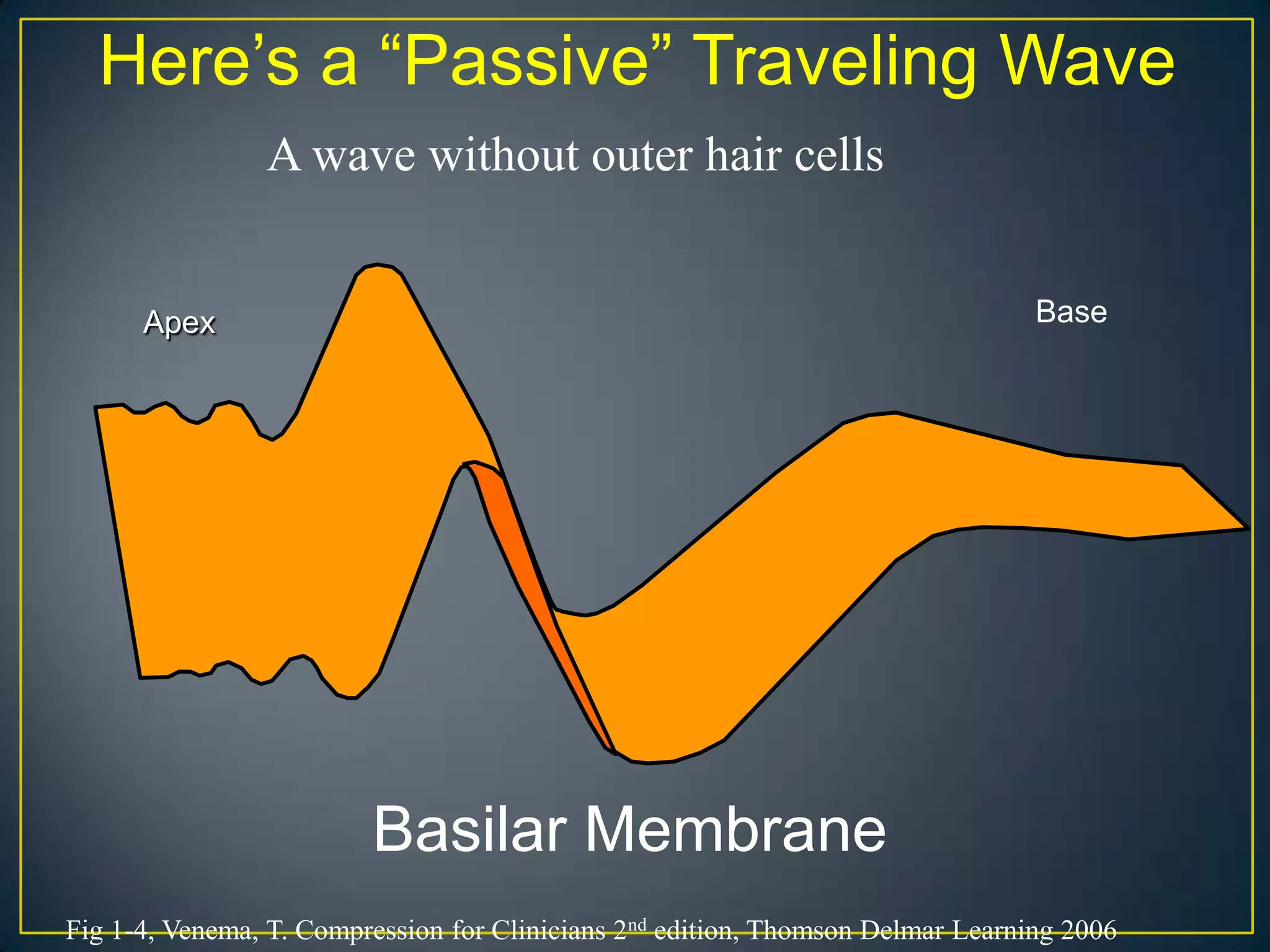
Here’s a “Passive” Traveling Wave
                A wave without outer hair cells


      Apex                                                                       Base


                         Basilar Membrane
Fig 1-4, Venema, T. Compression for Clinicians 2nd edition, Thomson Delmar Learning 2006
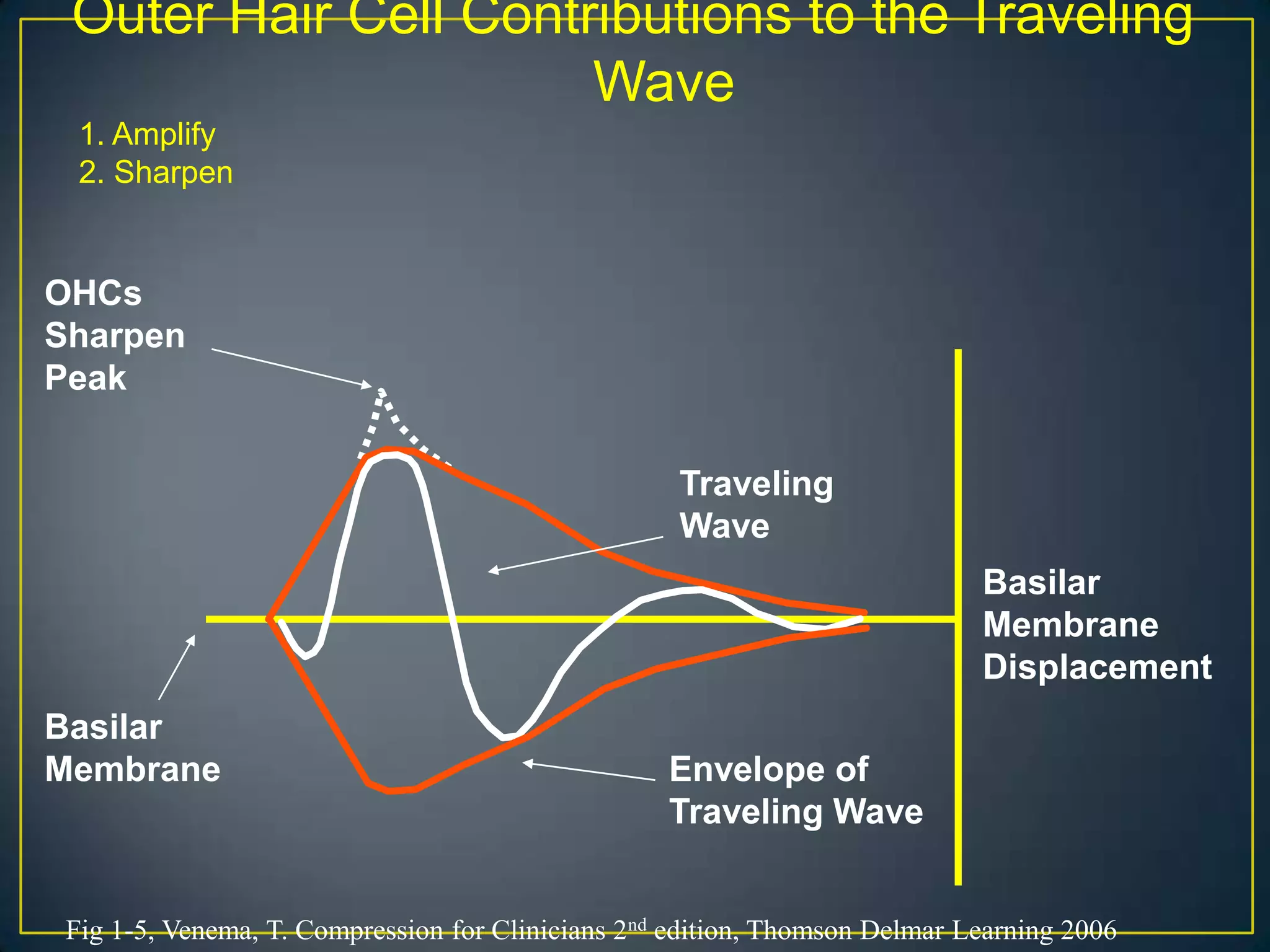
Outer Hair Cell Contributions to the Traveling
                      Wave
  1. Amplify
  2. Sharpen


OHCs
Sharpen
Peak

                                                    Traveling
                                                    Wave
                                                                             Basilar
                                                                             Membrane
                                                                             Displacement
Basilar
Membrane                                           Envelope of
                                                   Traveling Wave


 Fig 1-5, Venema, T. Compression for Clinicians 2nd edition, Thomson Delmar Learning 2006
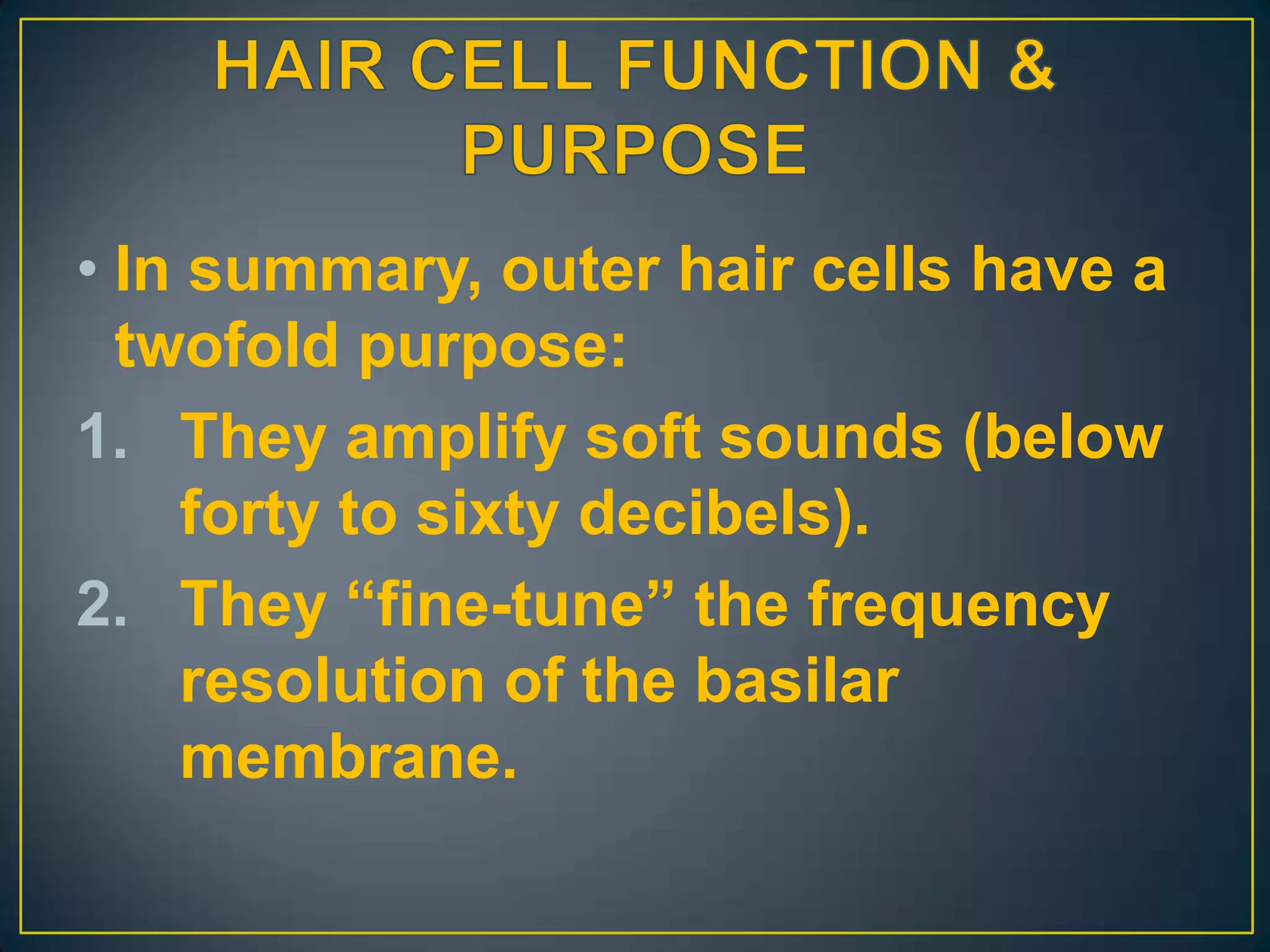
• In summary, outer hair cells have a
  twofold purpose:
1. They amplify soft sounds (below
     forty to sixty decibels).
2. They “fine-tune” the frequency
     resolution of the basilar
     membrane.
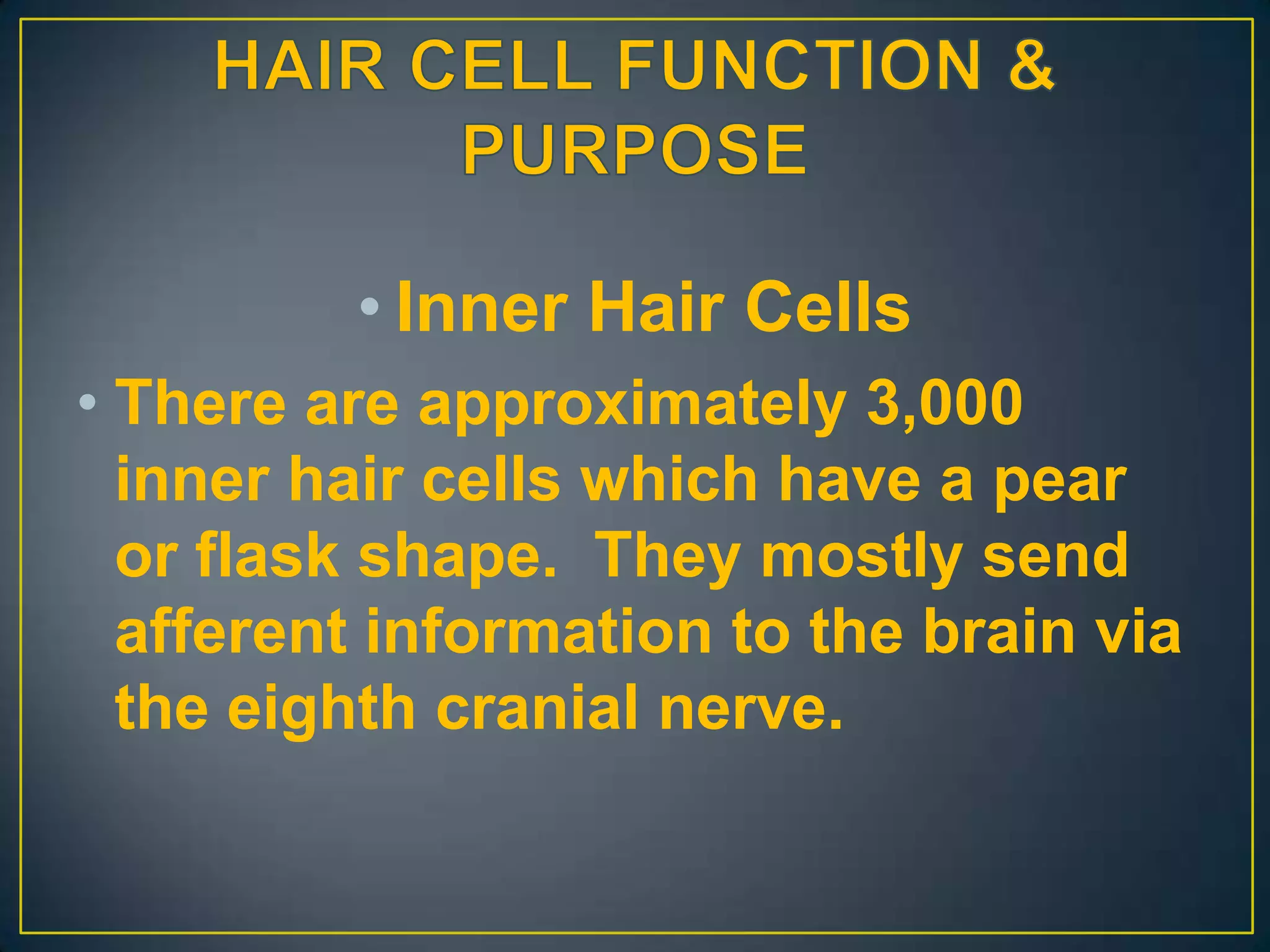
• Inner Hair Cells
• There are approximately 3,000
  inner hair cells which have a pear
  or flask shape. They mostly send
  afferent information to the brain via
  the eighth cranial nerve.
• Inner hair cells
• More specifically, the 3,000 hair
  cells stimulate approximately
  30,000 eighth cranial nerve fibers.
  This occurs from each cochlea.
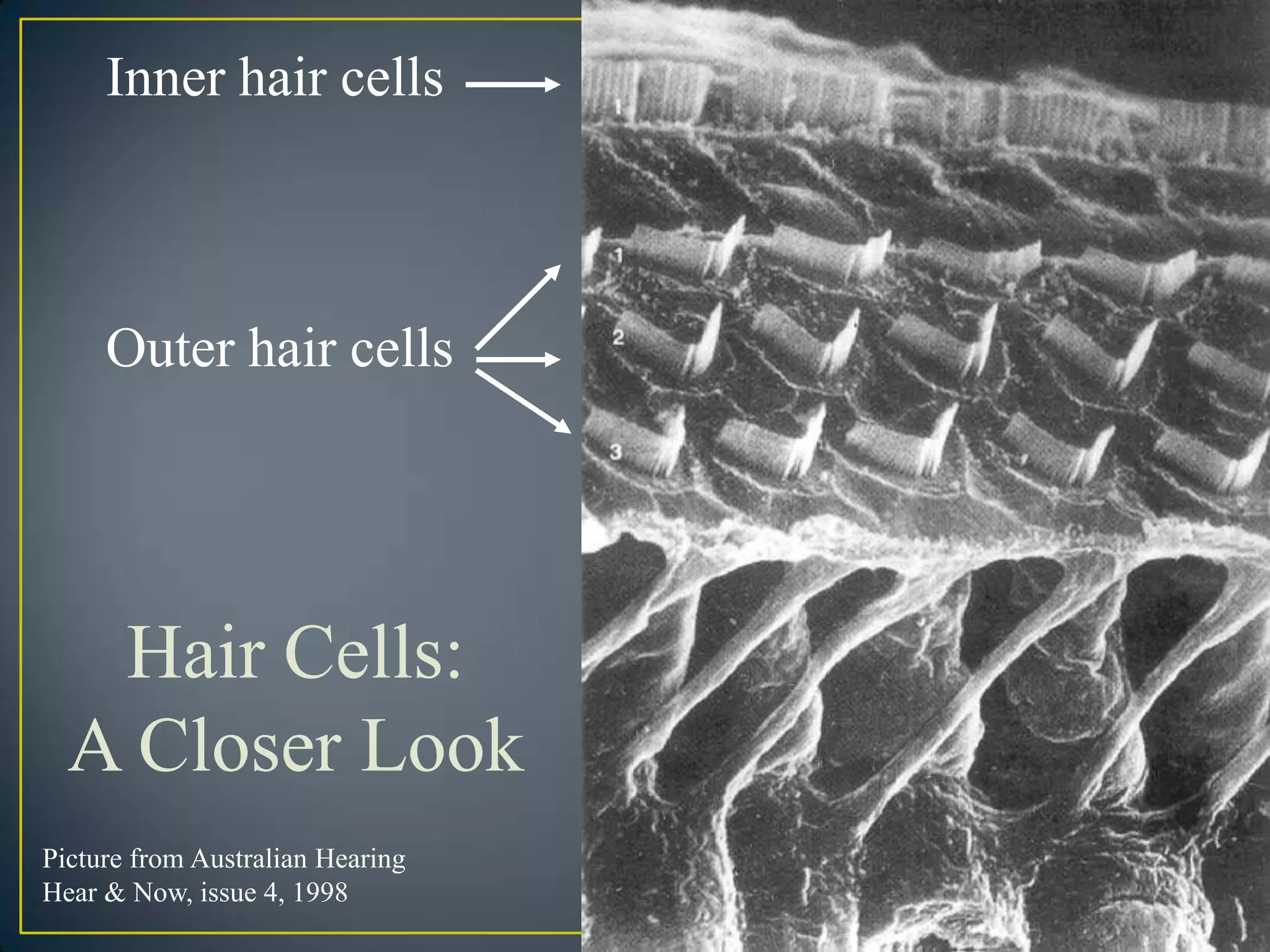
Inner hair cells


     Outer hair cells


   Hair Cells:
  A Closer Look
Picture from Australian Hearing
Hear & Now, issue 4, 1998
• Hearing instruments cannot
  sharpen the peaks of the traveling
  wave. They will only increase the
  amplitude (size) of the wave.
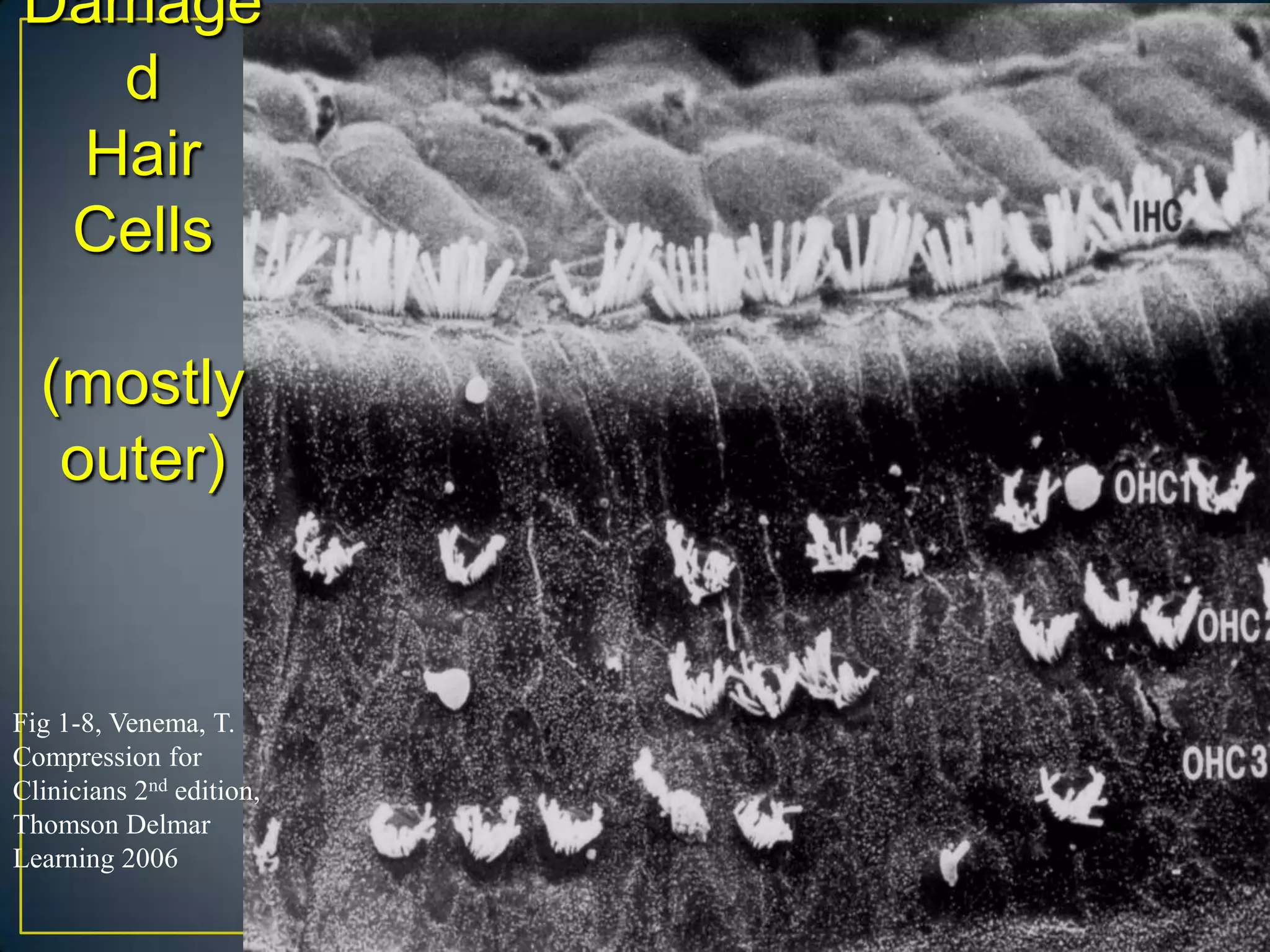
• With more outer hair cells missing
  less resolution may be received by
  the brain—especially when noise is
  introduced.
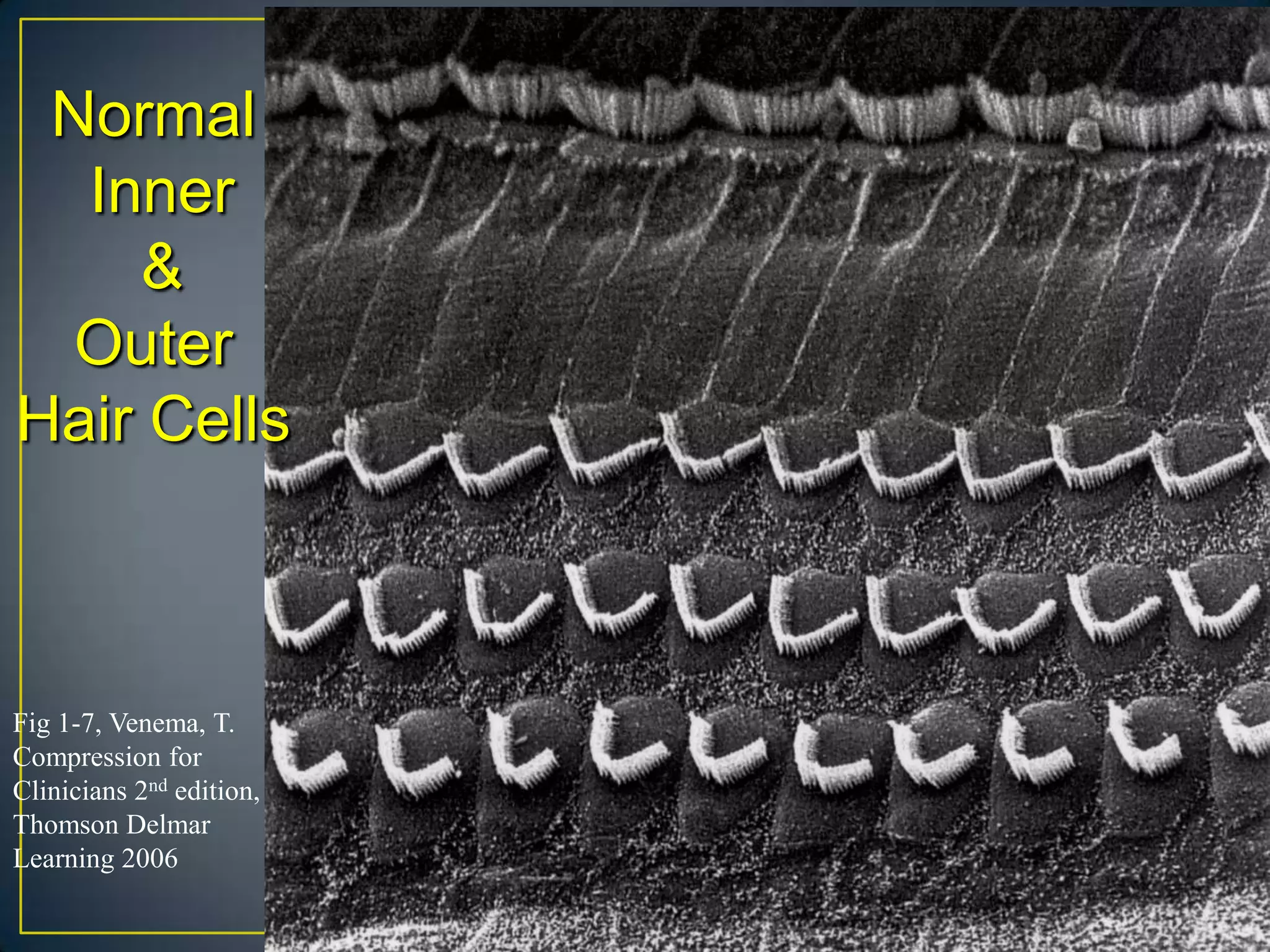
Normal
  Inner
     &
  Outer
Hair Cells


Fig 1-7, Venema, T.
Compression for
Clinicians 2nd edition,
Thomson Delmar
Learning 2006
Damage
  d
 Hair
 Cells

  (mostly
   outer)


Fig 1-8, Venema, T.
Compression for
Clinicians 2nd edition,
Thomson Delmar
Learning 2006
• We will discuss more next week
  regarding reduced hair cell
  function and hearing
  instrument performance.

Hair cell function and purpose

  • 1.
    • The Organof Corti It rests on top of the basilar membrane. It sets inside the scala media (cochlear duct) and contains the inner and outer hair cells and of course the tectorial membrane.
  • 2.
    • The Organof Corti • This is where the electrical “language” is transmitted between the brain and received sound stimulation.
  • 3.
    Outer Hair Cells:The Active Cochlear Mechanism Note how embedded OHCs actually pull tectorial membrane down
  • 4.
    • Outer HairCells • There are approximately 12,000 outer hair cells. They have the appearance of test tubes and mostly receive efferent information from the brain.
  • 5.
    • Outer HairCells • Not only do they react to information received from the brain but they also receive “chemical messages” from inside the cochlea which tell them to either elongate or shrink (like pistons).
  • 6.
    • Outer HairCells • The net effect of their mechanical action is to change the mechanical properties of the basilar membrane at specific spots.
  • 7.
    Outer Hair CellsSharpen the Peak! They are the “muscles” of the cochlea They usually get damaged first Apex Base Lows Basilar Membrane Highs
  • 8.
    • Outer HairCells • They play a very significant role in the reception of soft sounds. • Without outer hair cells, we would have approximately forty to sixty decibels of sensorineural hearing loss.
  • 9.
    Here’s a “Passive”Traveling Wave A wave without outer hair cells Apex Base Basilar Membrane Fig 1-4, Venema, T. Compression for Clinicians 2nd edition, Thomson Delmar Learning 2006
  • 10.
    Outer Hair CellContributions to the Traveling Wave 1. Amplify 2. Sharpen OHCs Sharpen Peak Traveling Wave Basilar Membrane Displacement Basilar Membrane Envelope of Traveling Wave Fig 1-5, Venema, T. Compression for Clinicians 2nd edition, Thomson Delmar Learning 2006
  • 11.
    • In summary,outer hair cells have a twofold purpose: 1. They amplify soft sounds (below forty to sixty decibels). 2. They “fine-tune” the frequency resolution of the basilar membrane.
  • 12.
    • Inner HairCells • There are approximately 3,000 inner hair cells which have a pear or flask shape. They mostly send afferent information to the brain via the eighth cranial nerve.
  • 13.
    • Inner haircells • More specifically, the 3,000 hair cells stimulate approximately 30,000 eighth cranial nerve fibers. This occurs from each cochlea.
  • 14.
    Inner hair cells Outer hair cells Hair Cells: A Closer Look Picture from Australian Hearing Hear & Now, issue 4, 1998
  • 15.
    • Hearing instrumentscannot sharpen the peaks of the traveling wave. They will only increase the amplitude (size) of the wave. • With more outer hair cells missing less resolution may be received by the brain—especially when noise is introduced.
  • 16.
    Normal Inner & Outer Hair Cells Fig 1-7, Venema, T. Compression for Clinicians 2nd edition, Thomson Delmar Learning 2006
  • 17.
    Damage d Hair Cells (mostly outer) Fig 1-8, Venema, T. Compression for Clinicians 2nd edition, Thomson Delmar Learning 2006
  • 18.
    • We willdiscuss more next week regarding reduced hair cell function and hearing instrument performance.