1
ANATOMY AND PHYSIOLOGY OF
THE EAR
2
Main Components of the
Hearing Mechanism:
 Outer Ear
 Middle Ear
 Inner Ear
 Central Auditory Nervous System
3
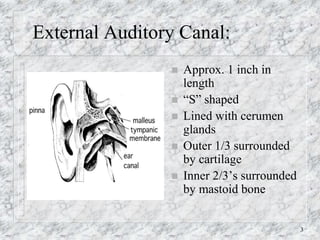
External Auditory Canal:
 Approx. 1 inch in
length
 “S” shaped
 Lined with cerumen
glands
 Outer 1/3 surrounded
by cartilage
 Inner 2/3’s surrounded
by mastoid bone
4
Mastoid Process
 Bony ridge behind the
auricle
 Provides support to
the external ear and
posterior wall of the
middle ear cavity
5
Tympanic Membrane:
 Thin membrane
 Forms boundary
between outer and
middle ear
 Vibrates in response to
sound
 Changes acoustical
energy into
mechanical energy
6
The Ossicles:
 A: Malleus
 B: Incus
 C: Stapes
– Smallest bones in the body
– Acts as a lever system
– Footplate of stapes enters oval
window of the cochlea
 Stapedius Muscle
– Connects stapes to wall of middle
ear
– Contracts in response to loud
sounds (called the Acoustic Reflex)
7
Eustachian Tube
(AKA: “The Equalizer”)
 Lined with mucous
membrane
 Connects middle ear to
nasopharynx
 “Equalizes” air
pressure
8
Structures of the Inner Ear
 Cochlea
– Snail shaped organ with a
series of fluid-filled tunnels
– Converts mechanical energy
to electrical energy
9
Organ Of Corti:
 The end organ of
hearing
 Contains stereocilia
and hair cells.
10
Hair Cells:
 Frequency specific
– High pitches= base of
cochlea
– Low pitches= apex of
cochlea
11
Vestibular System
 Consists of three semi-
circular canals
 Shares fluid with the
cochlea
 Controls balance
12
Central Auditory System
 VIIIth Cranial nerve or “Auditory Nerve”
– Carries signals from cochlea to brain
 Auditory Cortex
– Temporal lobe of the brain where sound is
perceived and analyzed
13
How Sound Travels Through
The Ear...
1. Acoustic energy, in the form of sound waves, is channeled into the ear canal by
the pinna
2. Sound waves hit the tympanic membrane and cause it to vibrate, like a drum,
changing it into mechanical energy
3. The malleus, which is attached to the tympanic membrane, starts the ossicles into
motion
4. The stapes moves in and out of the oval window of the cochlea creating a fluid
motion
5. The fluid movement causes membranes in the Organ of Corti to shear against
the hair cells
6. This creates an electrical signal which is sent up the Auditory Nerve to the brain
The brain interprets it as sound!
The central auditory pathways
Landmarks:
Auditory nerve
Cochlear nucleus
Superior olivary
complex
Lateral lemniscus
Inferior colliculus
Medial geniculate
body
The auditory nerve
VIII cranial nerve
Bipolar neurons
Cell bodies from these neurons lie
right outside the cochlea and form
the spiral ganglion
One end innervates the individual
inner and outer HCs of the cochlea
and the other end synapses with
the neurons of the cochlear
nucleus
The auditory nerve
Auditory Portion--30,000 fibers
Vestibular Portion--20,000 fibers
Evidence of tonotopic organization
Spiral Ganglion
Cell bodies of the first order neurons
Bipolar
Cerebello-Pontine angle--where the cerebellum, medulla
oblongota and pons meet
The auditory nerve
Evidence of
tonotopic
organization
The auditory nerve
The individual fibers pass from the
modiolus of the cochlea through the
internal auditory meatus, which exits at
the base of the brain
The IAM also carries fibers from the
utricle, saccule, and semicircular
canals that form the vestibular portion
of the VIII nerve
The vestibular and auditory portions of
the VIII N. separate at the
cerebellopontine angle
The branch of the facial nerve that
courses through the middle ear also
exits here
The cochlear nucleus
Two major parts
Dorsal and ventral
Tonotopic organization
“must-synapse” station--second
order fibers
Preserves, but does not enhance,
information received from the
auditory nerve
Superior Olivary Complex
 Most of the fibers from the cochlear nuclei cross and
project to the contralateral SOC
 Plays a role in the acoustic reflex
 Analyzes intensity and time-of-arrival differences
between the two ears to help with localization tasks
The superior olivery complex
Most (about 80%) of the fibers from
the cochlear nuclei cross and
project to the contralateral SOC
via the trapezoid body
Evidence of tonotopic organization
Plays a major role in the acoustic
reflex
Analyzes intensity and time-of-
arrival differences between the
two ears to help with
localization/lateralization tasks
The lateral lemniscus
Highway of
axons that
arise from the
SOC and
terminate in
the midbrain
The lateral lemniscus
Tonotopic organization is evident
Nuclei within the lateral lemniscus
have a large proportion of cells
that are sensitive to interaural
time differences, binaural
input, and interaural intensity
differences
The inferior colliculus
“must-synapse” station
at the level of the
midbrain
Highly tonotopic
First evidence of
neurons that are
sensitive to sound
duration
Active in binaural
processing
Auditory Cortex
Areas of auditory reception are in the temproal lobes on
both sides of the cerebral cortex in an area called the
superior temporal gyrus or Heschl’s gyrus
The medial geniculate body
Located in the auditory
thalamus
Last subcortical relay in the
pathway
Evidence of tonotopic
organization
Very active in localization and
lateralization
The medial geniculate body
Pathways of neurons
projecting from the medial
geniculate to cortical areas
The human brainstem
Structures:
Cochlear nuclei (1)
Lateral lemnisci (2)
Inferior colliculi (3)
Superior colliculi (4)
Medial geniculates (6)
Auditory thalmi (7)
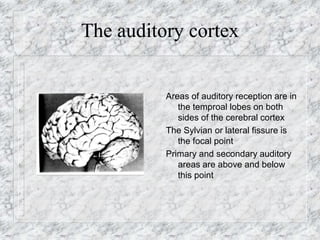
The auditory cortex
Areas of auditory reception are in
the temproal lobes on both
sides of the cerebral cortex
The Sylvian or lateral fissure is
the focal point
Primary and secondary auditory
areas are above and below
this point
Central Auditory Pathways

Ear.ppt

  • 1.
  • 2.
    2 Main Components ofthe Hearing Mechanism:  Outer Ear  Middle Ear  Inner Ear  Central Auditory Nervous System
  • 3.
    3 External Auditory Canal: Approx. 1 inch in length  “S” shaped  Lined with cerumen glands  Outer 1/3 surrounded by cartilage  Inner 2/3’s surrounded by mastoid bone
  • 4.
    4 Mastoid Process  Bonyridge behind the auricle  Provides support to the external ear and posterior wall of the middle ear cavity
  • 5.
    5 Tympanic Membrane:  Thinmembrane  Forms boundary between outer and middle ear  Vibrates in response to sound  Changes acoustical energy into mechanical energy
  • 6.
    6 The Ossicles:  A:Malleus  B: Incus  C: Stapes – Smallest bones in the body – Acts as a lever system – Footplate of stapes enters oval window of the cochlea  Stapedius Muscle – Connects stapes to wall of middle ear – Contracts in response to loud sounds (called the Acoustic Reflex)
  • 7.
    7 Eustachian Tube (AKA: “TheEqualizer”)  Lined with mucous membrane  Connects middle ear to nasopharynx  “Equalizes” air pressure
  • 8.
    8 Structures of theInner Ear  Cochlea – Snail shaped organ with a series of fluid-filled tunnels – Converts mechanical energy to electrical energy
  • 9.
    9 Organ Of Corti: The end organ of hearing  Contains stereocilia and hair cells.
  • 10.
    10 Hair Cells:  Frequencyspecific – High pitches= base of cochlea – Low pitches= apex of cochlea
  • 11.
    11 Vestibular System  Consistsof three semi- circular canals  Shares fluid with the cochlea  Controls balance
  • 12.
    12 Central Auditory System VIIIth Cranial nerve or “Auditory Nerve” – Carries signals from cochlea to brain  Auditory Cortex – Temporal lobe of the brain where sound is perceived and analyzed
  • 13.
    13 How Sound TravelsThrough The Ear... 1. Acoustic energy, in the form of sound waves, is channeled into the ear canal by the pinna 2. Sound waves hit the tympanic membrane and cause it to vibrate, like a drum, changing it into mechanical energy 3. The malleus, which is attached to the tympanic membrane, starts the ossicles into motion 4. The stapes moves in and out of the oval window of the cochlea creating a fluid motion 5. The fluid movement causes membranes in the Organ of Corti to shear against the hair cells 6. This creates an electrical signal which is sent up the Auditory Nerve to the brain The brain interprets it as sound!
  • 14.
    The central auditorypathways Landmarks: Auditory nerve Cochlear nucleus Superior olivary complex Lateral lemniscus Inferior colliculus Medial geniculate body
  • 15.
    The auditory nerve VIIIcranial nerve Bipolar neurons Cell bodies from these neurons lie right outside the cochlea and form the spiral ganglion One end innervates the individual inner and outer HCs of the cochlea and the other end synapses with the neurons of the cochlear nucleus
  • 16.
    The auditory nerve AuditoryPortion--30,000 fibers Vestibular Portion--20,000 fibers Evidence of tonotopic organization Spiral Ganglion Cell bodies of the first order neurons Bipolar Cerebello-Pontine angle--where the cerebellum, medulla oblongota and pons meet
  • 17.
    The auditory nerve Evidenceof tonotopic organization
  • 18.
    The auditory nerve Theindividual fibers pass from the modiolus of the cochlea through the internal auditory meatus, which exits at the base of the brain The IAM also carries fibers from the utricle, saccule, and semicircular canals that form the vestibular portion of the VIII nerve The vestibular and auditory portions of the VIII N. separate at the cerebellopontine angle The branch of the facial nerve that courses through the middle ear also exits here
  • 19.
    The cochlear nucleus Twomajor parts Dorsal and ventral Tonotopic organization “must-synapse” station--second order fibers Preserves, but does not enhance, information received from the auditory nerve
  • 20.
    Superior Olivary Complex Most of the fibers from the cochlear nuclei cross and project to the contralateral SOC  Plays a role in the acoustic reflex  Analyzes intensity and time-of-arrival differences between the two ears to help with localization tasks
  • 21.
    The superior oliverycomplex Most (about 80%) of the fibers from the cochlear nuclei cross and project to the contralateral SOC via the trapezoid body Evidence of tonotopic organization Plays a major role in the acoustic reflex Analyzes intensity and time-of- arrival differences between the two ears to help with localization/lateralization tasks
  • 22.
    The lateral lemniscus Highwayof axons that arise from the SOC and terminate in the midbrain
  • 23.
    The lateral lemniscus Tonotopicorganization is evident Nuclei within the lateral lemniscus have a large proportion of cells that are sensitive to interaural time differences, binaural input, and interaural intensity differences
  • 24.
    The inferior colliculus “must-synapse”station at the level of the midbrain Highly tonotopic First evidence of neurons that are sensitive to sound duration Active in binaural processing
  • 25.
    Auditory Cortex Areas ofauditory reception are in the temproal lobes on both sides of the cerebral cortex in an area called the superior temporal gyrus or Heschl’s gyrus
  • 26.
    The medial geniculatebody Located in the auditory thalamus Last subcortical relay in the pathway Evidence of tonotopic organization Very active in localization and lateralization
  • 27.
    The medial geniculatebody Pathways of neurons projecting from the medial geniculate to cortical areas
  • 28.
    The human brainstem Structures: Cochlearnuclei (1) Lateral lemnisci (2) Inferior colliculi (3) Superior colliculi (4) Medial geniculates (6) Auditory thalmi (7)
  • 29.
    The auditory cortex Areasof auditory reception are in the temproal lobes on both sides of the cerebral cortex The Sylvian or lateral fissure is the focal point Primary and secondary auditory areas are above and below this point
  • 30.