CRANIAL NERVES
• There are 12 pairs of cranial nerves.-
• The first two pairs (I and II) arise from the forebrain.
• The next ten pairs arise from the brainstem.
• Cranial nerves are designated by Roman numerals.- They play crucial
roles in sensory and motor functions of the head and neck.
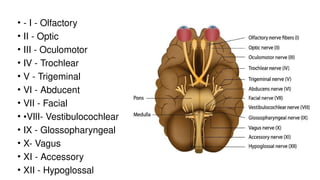
• - I - Olfactory
• II - Optic
• III - Oculomotor
• IV - Trochlear
• V - Trigeminal
• VI - Abducent
• VII - Facial
• •VIlI- Vestibulocochlear
• IX - Glossopharyngeal
• X- Vagus
• XI - Accessory
• XII - Hypoglossal
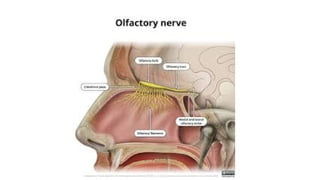
1. OLFACTORY NERVE
• It is sensory nerve
• Carries impulses for sense of smell
• ORIGIN: olfactory epithelium
• OPENING IN SKULL: opens in cribriform plate of ethmoid bone
to receptors in roof of nasal cavity.
• Attaches to cerebrum.
Anosmia - Loss of olfactory fibres with ageing.
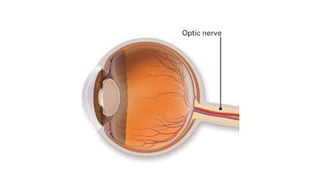
2. OPTIC NERVE
• It is sensory nerve.
• it carry impulses for vision.
• Origin: Back of eye ball/ retina of eye.
• Opening to skull: Optic canal and from there it converge to
• form optic chiasm.
• Attaches to diencephalon.
• Reflexes generated by this nerve are light reflex by lateral geniculate body,
visual reflex & corneal reflex by blinking of eyes.
• Lesion leads to total blindness of one eye, hemianopia(partial
• lesion of optic chiasma on its lateral side.
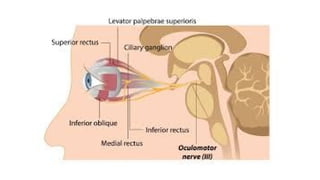
3. OCULOMOTOR NERVE
• It is motor nerve.
• • Function:
• raises the upper eyelid.
• turn eye ball upward, downward & medially.
• constricts pupil.
• accommodates the eye
• The later two functions are parasympathetically controlled.
• Parasympathetic cell bodies are in ciliary ganglia.
• Origin: anterior surface of midbrain.
• Opening in skull: Superior orbital fissure.
• Lesion leads to drooping of the upper eyelid (ptosis) due to paralysis of levator palpebrae superioris
muscle.
• Conditions effecting oculomotor nerve are diabetes, aneurysm, tumor, trauma, inflammation&
vascular disease
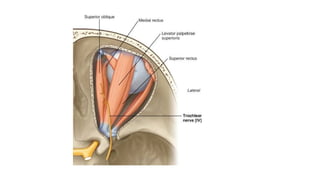
4. TROCHLEAR NERVE
• It is motor nerve.
• Function: Assisting in turning eyeball downward and o Origin:
Posterior surface of the midbrain & innervate
• superior oblique muscle.
• Opening to the Skull: Superior orbital fissure.
• Attaches to midbrain.
Lesion is due to aneurysm of internal carotid artery & vascular
lesion of dorsal part of midbrain.
• Patient complains of double vision on looking downward.
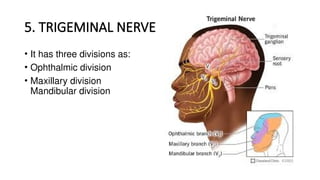
5. TRIGEMINAL NERVE
• It has three divisions as:
• Ophthalmic division
• Maxillary division
Mandibular division
5.1 OPTHALMIC DIVISION
• It is sensory.
• Function:
• cornea, skin of forehead, scalp,eyelids, nose, also mucous
membrane of paranasal sinuses & nasal cavity.
• Origin: Anterior aspect of pons. o Opening in skull: Superior
orbital fissure. o Exit orbit through supra orbital foramen.
• In lesion of this nerve cornea & conjunctiva will be insensitive
• to touch.
5.2 MAXILLARY NERVE
• It is sensory nerve.
• Function:
• skin of face over maxilla.
• Teeth of upper jaw.
• Mucous membrane of nose, the maxillary sinus & palate.
• Origin: Anterior aspect of pons. o Opening in skull: Foramen
rotundum o Exit through infraorbital foramen.
5.3 MANDIBULAR NERVE
•Component: a. Motor
•Function:
Muscles of mastication
•Mylohyoid
•Anterior belly of digastric
•Tensor veli palatine o Tensor tympani
•Origin: Anterior aspect of the pons
•Opening to the Skull: Foramen ovale
Mandibular nerve (sensory)
• Component: b. Sensory
• Function:
• Skin of cheek
• Skin over mandible and side of head
• Teeth of lower iaw and TMJ
• Mucous membrane of mouth and anterior part of tongue
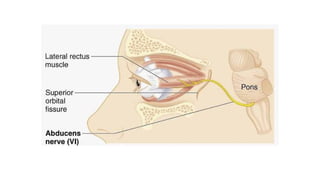
6. ABDUCENT NERVE
• It is motor nerve
• Function: Lateral rectus muscle turns eyeball laterally
• Origin: Anterior Surface of hindbrain between pons and
• medulla
• Opening to the Skull: Superior orbital fissure o Fibers leaves the inferior
pons & enter orbit via superior
• orbital fissure.
• Patient can't turn the eye laterally.
• Lesions include damage due to head injuries, cavernous sinus thrombosis
or aneurysm of internal carotid artery & vascular lesions of pons.
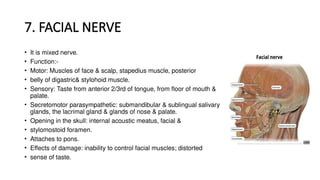
7. FACIAL NERVE
• It is mixed nerve.
• Function:-
• Motor: Muscles of face & scalp, stapedius muscle, posterior
• belly of digastric& stylohoid muscle.
• Sensory: Taste from anterior 2/3rd of tongue, from floor of mouth &
palate.
• Secretomotor parasympathetic: submandibular & sublingual salivary
glands, the lacrimal gland & glands of nose & palate.
• Opening in the skull: internal acoustic meatus, facial &
• stylomostoid foramen.
• Attaches to pons.
• Effects of damage: inability to control facial muscles; distorted
• sense of taste.
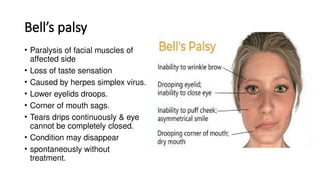
Bell’s palsy
• Paralysis of facial muscles of
affected side
• Loss of taste sensation
• Caused by herpes simplex virus.
• Lower eyelids droops.
• Corner of mouth sags.
• Tears drips continuously & eye
cannot be completely closed.
• Condition may disappear
• spontaneously without
treatment.
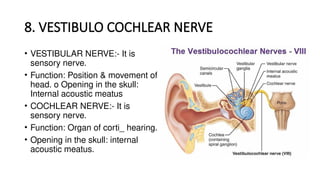
8. VESTIBULO COCHLEAR NERVE
• VESTIBULAR NERVE:- It is
sensory nerve.
• Function: Position & movement of
head. o Opening in the skull:
Internal acoustic meatus
• COCHLEAR NERVE:- It is
sensory nerve.
• Function: Organ of corti_ hearing.
• Opening in the skull: internal
acoustic meatus.
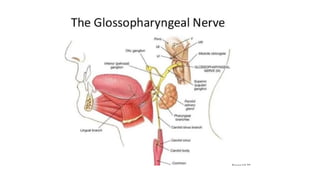
9. Glossopharyngeal Nerve
• It is mixed nerve.
• Function:-
• Motor: Stylopharyngeus muscle assists swallowing. o Secretomotor
parasympathetic: parotid salivary gland.
• Sensory: general sensation & taste from posterior 1/3of tongue &
pharynx, carotid sinus & carotid body (chemoreceptor).
• Opening in the skull: Jugular foramen.
• It attaches to medulla oblongata.
• Clinical tests: gag reflex, swallowing, and coughing
• Effects of damage: difficulty swallowing
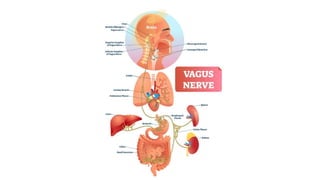
10. VAGUS NERVE
• It is mixed nerve.
• Nick name: Wanderer.
• Function:-
• Motor & sensory: Heart & great thoracic blood vessels, larynx, trachea,
bronchi & lungs, alimentary tract from pharynx to splenic flexure of colon,
liver. kidneys & pancreas.
• Opening in the skull: Jugular foramen.
• Effects of damage: hoarseness or loss of voice; dysphagia, cardiovascular
problems, digestive problems, urinary incontinence, deafness, palatal
function, gag reflex, spastic dysarthria.
• Gag Reflex:
• A normal reflex consisting of elevation of the palate, retraction of the
tongue, and contraction of the throat muscles.
Branches of vagus nerve
• Auricular nerve
• Pharyngeal nerve
• Superior laryngeal nerve
• Superior cervical cardiac branches of vagus nerve
• Inferior cervical cardiac branch
• Recurrent laryngeal nerve
• Thoracic cardiac branches
• Branches to the pulmonary plexus
• Branches to the esophageal plexus
• Anterior vagal trunk o Posterior vagal trunk
11. ACCESSORY NERVE
• it is motor nerve.
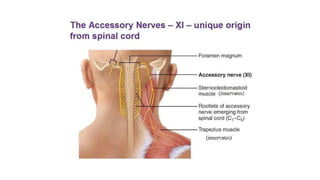
• Formed from cranial root emerging from medulla & a spinal root arising from
the superior region of spinal cord.
• Function: swallowing; head, neck, and shoulder movements.
• Opening in the skull: Jugular foramen.
• Spinal root passes upward into cranium via the foramen
• magnum.
• 6 Accessory nerve leaves the foramen via the jugular foramen.
• Clinical tests: rotate head and shrug shoulders against resistance
• Effects of damage: impaired movement of head, neck, and shoulders; paralysis
of sternocleidomastoid
12. HYPOGLOSSAL NERVE
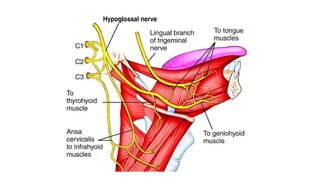
• It is motor nerve.
• Function:- Muscles of tongue (except palatoglossus) controlling its shape
& movement.
• Opening in the skull: Hypoglossal canal. o Innervates both extrinsic &
intrinsic muscles of
tongue.
• Clinical test: tongue function
• Effects of damage: difficulty in speech and swallowing; atrophy of tongue;
inability to stick out (protrude) tongue
• Lesions occur from demyelinating diseases & vascular accidents.
THANKYOU

cranial nerves presentation by Dr Ela kinra

  • 1.
  • 2.
    • There are12 pairs of cranial nerves.- • The first two pairs (I and II) arise from the forebrain. • The next ten pairs arise from the brainstem. • Cranial nerves are designated by Roman numerals.- They play crucial roles in sensory and motor functions of the head and neck.
  • 3.
    • - I- Olfactory • II - Optic • III - Oculomotor • IV - Trochlear • V - Trigeminal • VI - Abducent • VII - Facial • •VIlI- Vestibulocochlear • IX - Glossopharyngeal • X- Vagus • XI - Accessory • XII - Hypoglossal
  • 4.
    1. OLFACTORY NERVE •It is sensory nerve • Carries impulses for sense of smell • ORIGIN: olfactory epithelium • OPENING IN SKULL: opens in cribriform plate of ethmoid bone to receptors in roof of nasal cavity. • Attaches to cerebrum. Anosmia - Loss of olfactory fibres with ageing.
  • 6.
    2. OPTIC NERVE •It is sensory nerve. • it carry impulses for vision. • Origin: Back of eye ball/ retina of eye. • Opening to skull: Optic canal and from there it converge to • form optic chiasm. • Attaches to diencephalon. • Reflexes generated by this nerve are light reflex by lateral geniculate body, visual reflex & corneal reflex by blinking of eyes. • Lesion leads to total blindness of one eye, hemianopia(partial • lesion of optic chiasma on its lateral side.
  • 8.
    3. OCULOMOTOR NERVE •It is motor nerve. • • Function: • raises the upper eyelid. • turn eye ball upward, downward & medially. • constricts pupil. • accommodates the eye • The later two functions are parasympathetically controlled. • Parasympathetic cell bodies are in ciliary ganglia. • Origin: anterior surface of midbrain. • Opening in skull: Superior orbital fissure. • Lesion leads to drooping of the upper eyelid (ptosis) due to paralysis of levator palpebrae superioris muscle. • Conditions effecting oculomotor nerve are diabetes, aneurysm, tumor, trauma, inflammation& vascular disease
  • 10.
    4. TROCHLEAR NERVE •It is motor nerve. • Function: Assisting in turning eyeball downward and o Origin: Posterior surface of the midbrain & innervate • superior oblique muscle. • Opening to the Skull: Superior orbital fissure. • Attaches to midbrain. Lesion is due to aneurysm of internal carotid artery & vascular lesion of dorsal part of midbrain. • Patient complains of double vision on looking downward.
  • 12.
    5. TRIGEMINAL NERVE •It has three divisions as: • Ophthalmic division • Maxillary division Mandibular division
  • 13.
    5.1 OPTHALMIC DIVISION •It is sensory. • Function: • cornea, skin of forehead, scalp,eyelids, nose, also mucous membrane of paranasal sinuses & nasal cavity. • Origin: Anterior aspect of pons. o Opening in skull: Superior orbital fissure. o Exit orbit through supra orbital foramen. • In lesion of this nerve cornea & conjunctiva will be insensitive • to touch.
  • 14.
    5.2 MAXILLARY NERVE •It is sensory nerve. • Function: • skin of face over maxilla. • Teeth of upper jaw. • Mucous membrane of nose, the maxillary sinus & palate. • Origin: Anterior aspect of pons. o Opening in skull: Foramen rotundum o Exit through infraorbital foramen.
  • 15.
    5.3 MANDIBULAR NERVE •Component:a. Motor •Function: Muscles of mastication •Mylohyoid •Anterior belly of digastric •Tensor veli palatine o Tensor tympani •Origin: Anterior aspect of the pons •Opening to the Skull: Foramen ovale
  • 16.
    Mandibular nerve (sensory) •Component: b. Sensory • Function: • Skin of cheek • Skin over mandible and side of head • Teeth of lower iaw and TMJ • Mucous membrane of mouth and anterior part of tongue
  • 17.
    6. ABDUCENT NERVE •It is motor nerve • Function: Lateral rectus muscle turns eyeball laterally • Origin: Anterior Surface of hindbrain between pons and • medulla • Opening to the Skull: Superior orbital fissure o Fibers leaves the inferior pons & enter orbit via superior • orbital fissure. • Patient can't turn the eye laterally. • Lesions include damage due to head injuries, cavernous sinus thrombosis or aneurysm of internal carotid artery & vascular lesions of pons.
  • 19.
    7. FACIAL NERVE •It is mixed nerve. • Function:- • Motor: Muscles of face & scalp, stapedius muscle, posterior • belly of digastric& stylohoid muscle. • Sensory: Taste from anterior 2/3rd of tongue, from floor of mouth & palate. • Secretomotor parasympathetic: submandibular & sublingual salivary glands, the lacrimal gland & glands of nose & palate. • Opening in the skull: internal acoustic meatus, facial & • stylomostoid foramen. • Attaches to pons. • Effects of damage: inability to control facial muscles; distorted • sense of taste.
  • 20.
    Bell’s palsy • Paralysisof facial muscles of affected side • Loss of taste sensation • Caused by herpes simplex virus. • Lower eyelids droops. • Corner of mouth sags. • Tears drips continuously & eye cannot be completely closed. • Condition may disappear • spontaneously without treatment.
  • 21.
    8. VESTIBULO COCHLEARNERVE • VESTIBULAR NERVE:- It is sensory nerve. • Function: Position & movement of head. o Opening in the skull: Internal acoustic meatus • COCHLEAR NERVE:- It is sensory nerve. • Function: Organ of corti_ hearing. • Opening in the skull: internal acoustic meatus.
  • 22.
    9. Glossopharyngeal Nerve •It is mixed nerve. • Function:- • Motor: Stylopharyngeus muscle assists swallowing. o Secretomotor parasympathetic: parotid salivary gland. • Sensory: general sensation & taste from posterior 1/3of tongue & pharynx, carotid sinus & carotid body (chemoreceptor). • Opening in the skull: Jugular foramen. • It attaches to medulla oblongata. • Clinical tests: gag reflex, swallowing, and coughing • Effects of damage: difficulty swallowing
  • 24.
    10. VAGUS NERVE •It is mixed nerve. • Nick name: Wanderer. • Function:- • Motor & sensory: Heart & great thoracic blood vessels, larynx, trachea, bronchi & lungs, alimentary tract from pharynx to splenic flexure of colon, liver. kidneys & pancreas. • Opening in the skull: Jugular foramen. • Effects of damage: hoarseness or loss of voice; dysphagia, cardiovascular problems, digestive problems, urinary incontinence, deafness, palatal function, gag reflex, spastic dysarthria. • Gag Reflex: • A normal reflex consisting of elevation of the palate, retraction of the tongue, and contraction of the throat muscles.
  • 26.
    Branches of vagusnerve • Auricular nerve • Pharyngeal nerve • Superior laryngeal nerve • Superior cervical cardiac branches of vagus nerve • Inferior cervical cardiac branch • Recurrent laryngeal nerve • Thoracic cardiac branches • Branches to the pulmonary plexus • Branches to the esophageal plexus • Anterior vagal trunk o Posterior vagal trunk
  • 27.
    11. ACCESSORY NERVE •it is motor nerve. • Formed from cranial root emerging from medulla & a spinal root arising from the superior region of spinal cord. • Function: swallowing; head, neck, and shoulder movements. • Opening in the skull: Jugular foramen. • Spinal root passes upward into cranium via the foramen • magnum. • 6 Accessory nerve leaves the foramen via the jugular foramen. • Clinical tests: rotate head and shrug shoulders against resistance • Effects of damage: impaired movement of head, neck, and shoulders; paralysis of sternocleidomastoid
  • 29.
    12. HYPOGLOSSAL NERVE •It is motor nerve. • Function:- Muscles of tongue (except palatoglossus) controlling its shape & movement. • Opening in the skull: Hypoglossal canal. o Innervates both extrinsic & intrinsic muscles of tongue. • Clinical test: tongue function • Effects of damage: difficulty in speech and swallowing; atrophy of tongue; inability to stick out (protrude) tongue • Lesions occur from demyelinating diseases & vascular accidents.
  • 31.