The Department of Human anatomy
Peripheral nervous
system.
The Cranial Nerves Part - 1
Plan
 The peripheral nervous system-
Structural Organization
 spinal nerves
 cranial nerves
 ganglia
 The peripheral nervous system (PNS) consists
of the nerves and ganglia outside of the
brain and spinal cord. The main function of the
PNS is to connect the central nervous
system (CNS) to the limbs and organs. Unlike
the CNS, the PNS is not protected by the bone
of spine and skull, or by the blood–brain barrier,
leaving it exposed to toxins and mechanical
injuries. The peripheral nervous system is
divided into the somatic nervous system and the
autonomic nervous system.
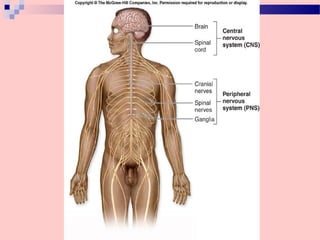
Nervous System: Structural
Organization
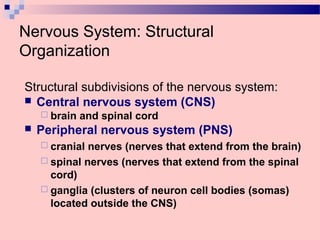
Structural subdivisions of the nervous system:
 Central nervous system (CNS)
 brain and spinal cord
 Peripheral nervous system (PNS)
 cranial nerves (nerves that extend from the brain)
 spinal nerves (nerves that extend from the spinal
cord)
 ganglia (clusters of neuron cell bodies (somas)
located outside the CNS)
Sponsored
Medical Lecture Notes – All Subjects
USMLE Exam (America) – Practice
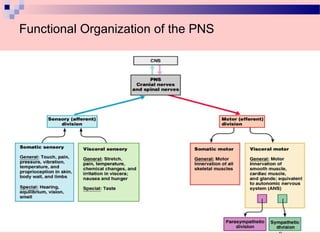
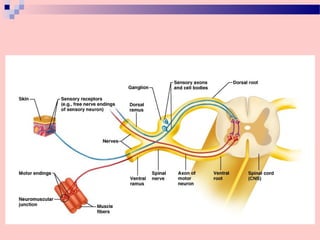
Functional Organization of the PNS
Figure 14.1
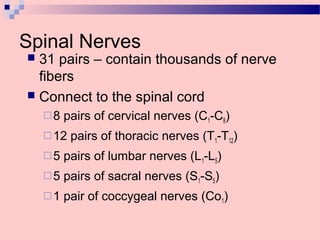
Spinal Nerves
 31 pairs – contain thousands of nerve
fibers
 Connect to the spinal cord
8 pairs of cervical nerves (C1-C8)
12 pairs of thoracic nerves (T1-T12)
5 pairs of lumbar nerves (L1-L5)
5 pairs of sacral nerves (S1-S5)
1 pair of coccygeal nerves (Co1)
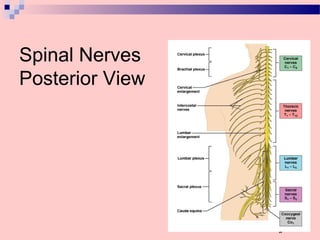
Spinal Nerves
Posterior View
Figure 14.9
Spinal Nerves
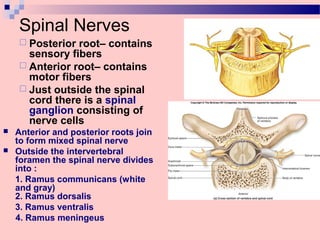
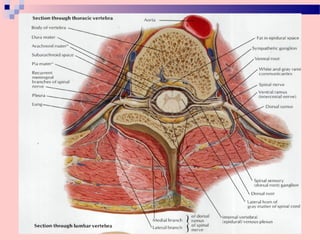
 Posterior root– contains
sensory fibers
 Anterior root– contains
motor fibers
 Just outside the spinal
cord there is a spinal
ganglion consisting of
nerve cells
 Anterior and posterior roots join
to form mixed spinal nerve
 Outside the intervertebral
foramen the spinal nerve divides
into :
1. Ramus communicans (white
and gray)
2. Ramus dorsalis
3. Ramus ventralis
4. Ramus meningeus
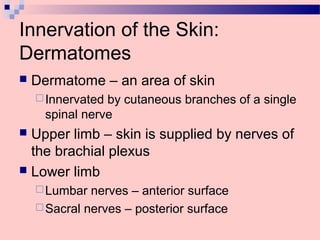
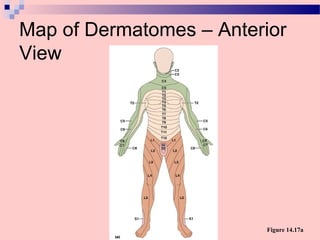
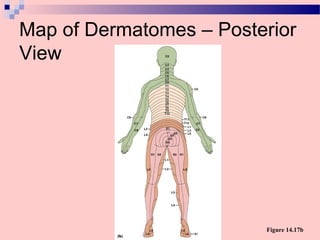
Innervation of the Skin:
Dermatomes
 Dermatome – an area of skin
Innervated by cutaneous branches of a single
spinal nerve
 Upper limb – skin is supplied by nerves of
the brachial plexus
 Lower limb
Lumbar nerves – anterior surface
Sacral nerves – posterior surface
Map of Dermatomes – Anterior
View
Figure 14.17a
Map of Dermatomes – Posterior
View
Figure 14.17b
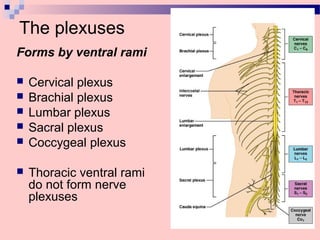
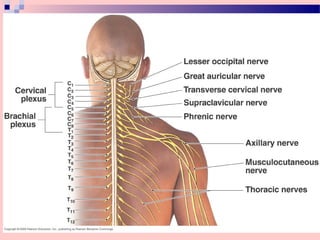
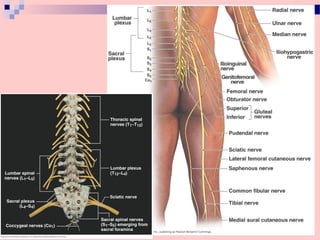
The plexuses
Forms by ventral rami
 Cervical plexus
 Brachial plexus
 Lumbar plexus
 Sacral plexus
 Coccygeal plexus
 Thoracic ventral rami
do not form nerve
plexuses
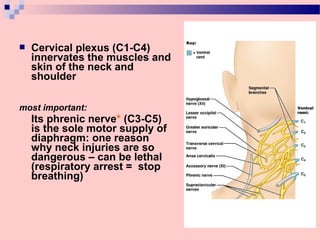
 Cervical plexus (C1-C4)
innervates the muscles and
skin of the neck and
shoulder
most important:
Its phrenic nerve* (C3-C5)
is the sole motor supply of
diaphragm: one reason
why neck injuries are so
dangerous – can be lethal
(respiratory arrest = stop
breathing)
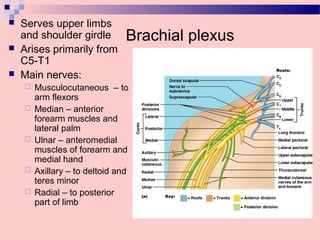
Brachial plexus
 Serves upper limbs
and shoulder girdle
 Arises primarily from
C5-T1
 Main nerves:
 Musculocutaneous – to
arm flexors
 Median – anterior
forearm muscles and
lateral palm
 Ulnar – anteromedial
muscles of forearm and
medial hand
 Axillary – to deltoid and
teres minor
 Radial – to posterior
part of limb
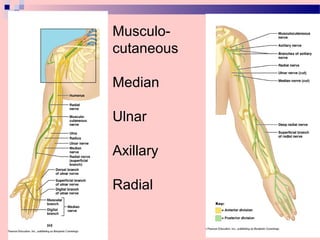
Musculo-
cutaneous
Median
Ulnar
Axillary
Radial
Lumbar plexus
 L1-L4
 Lies within the psoas major muscle
 Innervates anterior and medial muscles of
thigh through femoral and obturator
nerves respectively
 Femoral nerve also innervates skin on
anterior thigh (including quads) and
medial leg
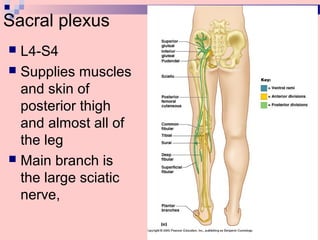
Sacral plexus
 L4-S4
 Supplies muscles
and skin of
posterior thigh
and almost all of
the leg
 Main branch is
the large sciatic
nerve,
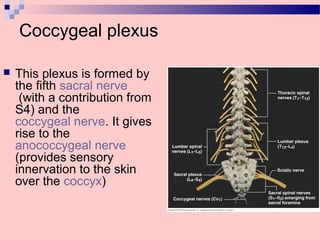
Coccygeal plexus
 This plexus is formed by
the fifth sacral nerve
(with a contribution from
S4) and the
coccygeal nerve. It gives
rise to the
anococcygeal nerve
(provides sensory
innervation to the skin
over the coccyx)
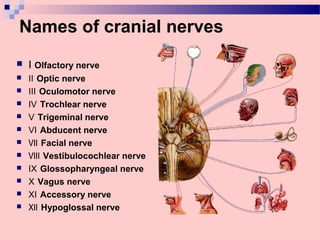
Names of cranial nerves
 Ⅰ Olfactory nerve
 Ⅱ Optic nerve
 Ⅲ Oculomotor nerve
 Ⅳ Trochlear nerve
 Ⅴ Trigeminal nerve
 Ⅵ Abducent nerve
 Ⅶ Facial nerve
 Ⅷ Vestibulocochlear nerve
 Ⅸ Glossopharyngeal nerve
 Ⅹ Vagus nerve
 Ⅺ Accessory nerve
 Ⅻ Hypoglossal nerve
Classification of cranial nerves
 Sensory cranial nerves: contain only afferent (sensory)
fibers
 ⅠOlfactory nerve
 ⅡOptic nerve
 Ⅷ Vestibulocochlear nerve
 Motor cranial nerves: contain only efferent (motor) fibers
 Ⅲ Oculomotor nerve
 Ⅳ Trochlear nerve
 ⅥAbducent nerve
 Ⅺ Accessory nerv
 Ⅻ Hypoglossal nerve
 Mixed nerves: contain both sensory and motor fibers---
 ⅤTrigeminal nerve,
 Ⅶ Facial nerve,
 ⅨGlossopharyngeal nerve
 ⅩVagus nerve
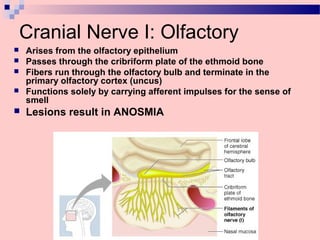
Cranial Nerve I: Olfactory
 Arises from the olfactory epithelium
 Passes through the cribriform plate of the ethmoid bone
 Fibers run through the olfactory bulb and terminate in the
primary olfactory cortex (uncus)
 Functions solely by carrying afferent impulses for the sense of
smell
 Lesions result in ANOSMIA
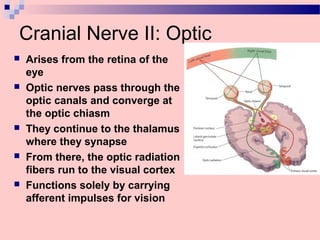
Cranial Nerve II: Optic
 Arises from the retina of the
eye
 Optic nerves pass through the
optic canals and converge at
the optic chiasm
 They continue to the thalamus
where they synapse
 From there, the optic radiation
fibers run to the visual cortex
 Functions solely by carrying
afferent impulses for vision
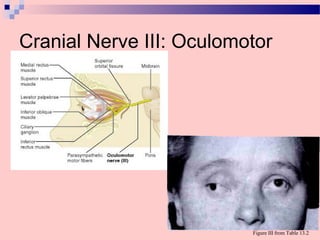
Cranial Nerve III: Oculomotor
 Fibers extend from the ventral midbrain, pass
through the superior orbital fissure, and go to the
extrinsic eye muscles
 Functions in raising the eyelid, directing the
eyeball, constricting the iris, and controlling lens
shape
 The latter 2 functions are parasympathetically
controlled
 Parasympathetic cell bodies are in the ciliary
ganglia
Cranial Nerve III: Oculomotor
Figure III from Table 13.2
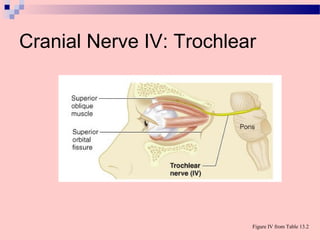
Cranial Nerve IV: Trochlear
 Fibers emerge from the dorsal midbrain
and enter the orbits via the superior orbital
fissures; innervate the superior oblique
muscle
 Primarily a motor nerve that directs the
eyeball
Cranial Nerve IV: Trochlear
Figure IV from Table 13.2
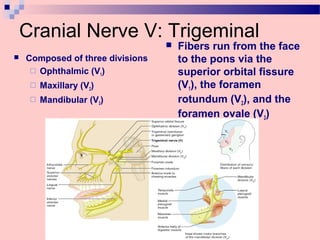
Cranial Nerve V: Trigeminal
 Composed of three divisions
 Ophthalmic (V1)
 Maxillary (V2)
 Mandibular (V3)
 Fibers run from the face
to the pons via the
superior orbital fissure
(V1), the foramen
rotundum (V2), and the
foramen ovale (V3)
 Ophthalmic nerve
 Sensory from the eyes,
conjunctiva and orbital
contents including the
lacrimal gland
 Maxillary nerve
 Sensory branches from
anterior and middle
cranial fossa,
nasopharynx, palate,
nasal cavity, teeth of
the upper jaw, maxillary
sinus, skin of the side
of the nose, lower
eyelid, cheek, upper lip
 Mandibular nerve
 Motor fibers innervate
muscles of mastication,
tensor tympani, anterior
belly of digastric
 Sensory fibres from the
skin of the lower face,
cheek, lower lip, ear,
external auditory
meatus and temporal
region, anterior two
thirds of the tongue,
teeth of the lower jaw,
mastoid air cells,
mucous membrane and
dura in the middle
cranial fossa
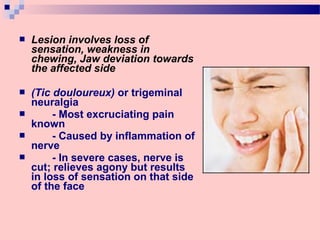
 Lesion involves loss of
sensation, weakness in
chewing, Jaw deviation towards
the affected side
 (Tic douloureux) or trigeminal
neuralgia
 - Most excruciating pain
known
 - Caused by inflammation of
nerve
 - In severe cases, nerve is
cut; relieves agony but results
in loss of sensation on that side
of the face
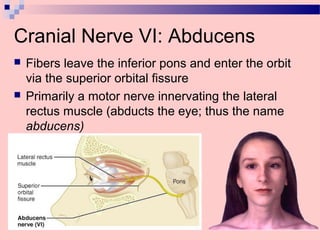
Cranial Nerve VI: Abducens
 Fibers leave the inferior pons and enter the orbit
via the superior orbital fissure
 Primarily a motor nerve innervating the lateral
rectus muscle (abducts the eye; thus the name
abducens)
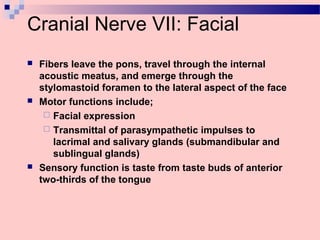
Cranial Nerve VII: Facial
 Fibers leave the pons, travel through the internal
acoustic meatus, and emerge through the
stylomastoid foramen to the lateral aspect of the face
 Motor functions include;
 Facial expression
 Transmittal of parasympathetic impulses to
lacrimal and salivary glands (submandibular and
sublingual glands)
 Sensory function is taste from taste buds of anterior
two-thirds of the tongue
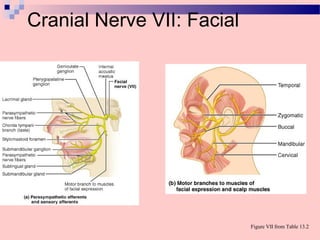
Cranial Nerve VII: Facial
Figure VII from Table 13.2
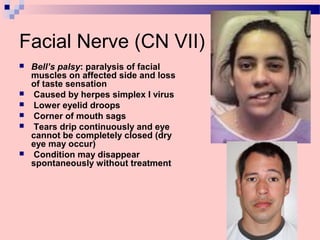
Facial Nerve (CN VII)
 Bell’s palsy: paralysis of facial
muscles on affected side and loss
of taste sensation
 Caused by herpes simplex I virus
 Lower eyelid droops
 Corner of mouth sags
 Tears drip continuously and eye
cannot be completely closed (dry
eye may occur)
 Condition may disappear
spontaneously without treatment
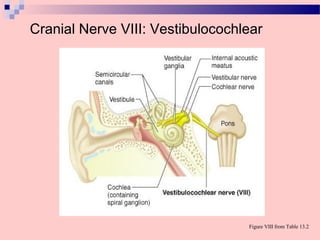
Cranial Nerve VIII:
Vestibulocochlear
 Fibers arise from the hearing and equilibrium
apparatus of the inner ear, pass through the
internal acoustic meatus, and enter the
brainstem at the pons-medulla border
 Two divisions – cochlear (hearing) and
vestibular (balance)
 Functions are solely sensory – equilibrium and
hearing
Cranial Nerve VIII: Vestibulocochlear
Figure VIII from Table 13.2
Cranial Nerve IX:
Glossopharyngeal
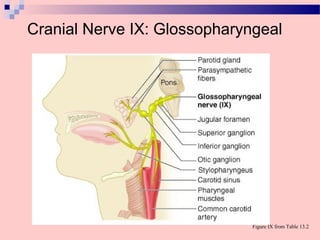
 Fibers emerge from the medulla, leave the skull
via the jugular foramen, and run to the throat
 Nerve IX is a mixed nerve with motor and
sensory functions
 Motor – innervates posterior 1/3 of the tongue
and pharynx, and provides motor fibers to the
parotid salivary gland
 Sensory – fibers conduct taste and general
sensory impulses from the tongue and pharynx
Cranial Nerve IX: Glossopharyngeal
Figure IX from Table 13.2
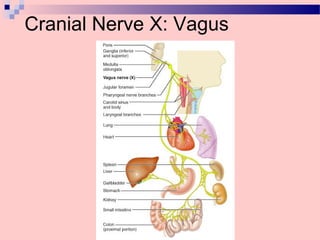
Cranial Nerve X: Vagus
 The only cranial nerve that extends beyond the
head and neck
 Fibers emerge from the medulla via the jugular
foramen
 The vagus is a mixed nerve
 Most motor fibers are parasympathetic fibers to
the heart, lungs, and visceral organs
 Paralysis leads to hoarseness
 Total destruction incompatible with life
Cranial Nerve X: Vagus
Cranial Nerve XI: Accessory
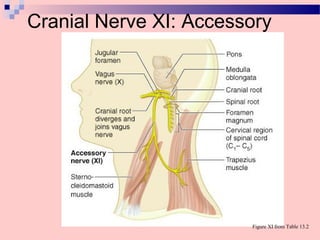
 Formed from a cranial root emerging from the
medulla and a spinal root arising from the
superior region of the spinal cord
 The spinal root passes upward into the
cranium via the foramen magnum
 The accessory nerve leaves the cranium via
the jugular foramen
 Innervates the trapezius and sternocleidomastoid,
which move the head and neck
Cranial Nerve XI: Accessory
Figure XI from Table 13.2
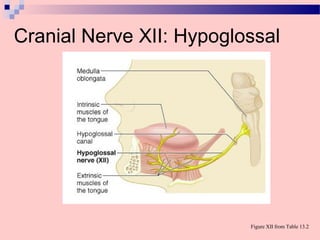
Cranial Nerve XII: Hypoglossal
 Fibers arise from the medulla and exit the
skull via the hypoglossal canal
 Innervates both extrinsic and intrinsic
muscles of the tongue, which contribute to
swallowing and speech
 If damaged, difficulties in speech and swallowing;
inability to protrude tongue
Cranial Nerve XII: Hypoglossal
Figure XII from Table 13.2

Peripheral Nervous System. Cranial Nerves – Part 1

  • 1.
    The Department ofHuman anatomy Peripheral nervous system. The Cranial Nerves Part - 1
  • 2.
    Plan  The peripheralnervous system- Structural Organization  spinal nerves  cranial nerves  ganglia
  • 3.
     The peripheralnervous system (PNS) consists of the nerves and ganglia outside of the brain and spinal cord. The main function of the PNS is to connect the central nervous system (CNS) to the limbs and organs. Unlike the CNS, the PNS is not protected by the bone of spine and skull, or by the blood–brain barrier, leaving it exposed to toxins and mechanical injuries. The peripheral nervous system is divided into the somatic nervous system and the autonomic nervous system.
  • 4.
    Nervous System: Structural Organization Structuralsubdivisions of the nervous system:  Central nervous system (CNS)  brain and spinal cord  Peripheral nervous system (PNS)  cranial nerves (nerves that extend from the brain)  spinal nerves (nerves that extend from the spinal cord)  ganglia (clusters of neuron cell bodies (somas) located outside the CNS)
  • 5.
    Sponsored Medical Lecture Notes– All Subjects USMLE Exam (America) – Practice
  • 7.
    Functional Organization ofthe PNS Figure 14.1
  • 8.
    Spinal Nerves  31pairs – contain thousands of nerve fibers  Connect to the spinal cord 8 pairs of cervical nerves (C1-C8) 12 pairs of thoracic nerves (T1-T12) 5 pairs of lumbar nerves (L1-L5) 5 pairs of sacral nerves (S1-S5) 1 pair of coccygeal nerves (Co1)
  • 9.
  • 10.
    Spinal Nerves  Posteriorroot– contains sensory fibers  Anterior root– contains motor fibers  Just outside the spinal cord there is a spinal ganglion consisting of nerve cells  Anterior and posterior roots join to form mixed spinal nerve  Outside the intervertebral foramen the spinal nerve divides into : 1. Ramus communicans (white and gray) 2. Ramus dorsalis 3. Ramus ventralis 4. Ramus meningeus
  • 13.
    Innervation of theSkin: Dermatomes  Dermatome – an area of skin Innervated by cutaneous branches of a single spinal nerve  Upper limb – skin is supplied by nerves of the brachial plexus  Lower limb Lumbar nerves – anterior surface Sacral nerves – posterior surface
  • 14.
    Map of Dermatomes– Anterior View Figure 14.17a
  • 15.
    Map of Dermatomes– Posterior View Figure 14.17b
  • 16.
    The plexuses Forms byventral rami  Cervical plexus  Brachial plexus  Lumbar plexus  Sacral plexus  Coccygeal plexus  Thoracic ventral rami do not form nerve plexuses
  • 17.
     Cervical plexus(C1-C4) innervates the muscles and skin of the neck and shoulder most important: Its phrenic nerve* (C3-C5) is the sole motor supply of diaphragm: one reason why neck injuries are so dangerous – can be lethal (respiratory arrest = stop breathing)
  • 19.
    Brachial plexus  Servesupper limbs and shoulder girdle  Arises primarily from C5-T1  Main nerves:  Musculocutaneous – to arm flexors  Median – anterior forearm muscles and lateral palm  Ulnar – anteromedial muscles of forearm and medial hand  Axillary – to deltoid and teres minor  Radial – to posterior part of limb
  • 20.
  • 21.
    Lumbar plexus  L1-L4 Lies within the psoas major muscle  Innervates anterior and medial muscles of thigh through femoral and obturator nerves respectively  Femoral nerve also innervates skin on anterior thigh (including quads) and medial leg
  • 23.
    Sacral plexus  L4-S4 Supplies muscles and skin of posterior thigh and almost all of the leg  Main branch is the large sciatic nerve,
  • 24.
    Coccygeal plexus  Thisplexus is formed by the fifth sacral nerve (with a contribution from S4) and the coccygeal nerve. It gives rise to the anococcygeal nerve (provides sensory innervation to the skin over the coccyx)
  • 25.
    Names of cranialnerves  Ⅰ Olfactory nerve  Ⅱ Optic nerve  Ⅲ Oculomotor nerve  Ⅳ Trochlear nerve  Ⅴ Trigeminal nerve  Ⅵ Abducent nerve  Ⅶ Facial nerve  Ⅷ Vestibulocochlear nerve  Ⅸ Glossopharyngeal nerve  Ⅹ Vagus nerve  Ⅺ Accessory nerve  Ⅻ Hypoglossal nerve
  • 26.
    Classification of cranialnerves  Sensory cranial nerves: contain only afferent (sensory) fibers  ⅠOlfactory nerve  ⅡOptic nerve  Ⅷ Vestibulocochlear nerve  Motor cranial nerves: contain only efferent (motor) fibers  Ⅲ Oculomotor nerve  Ⅳ Trochlear nerve  ⅥAbducent nerve  Ⅺ Accessory nerv  Ⅻ Hypoglossal nerve  Mixed nerves: contain both sensory and motor fibers---  ⅤTrigeminal nerve,  Ⅶ Facial nerve,  ⅨGlossopharyngeal nerve  ⅩVagus nerve
  • 27.
    Cranial Nerve I:Olfactory  Arises from the olfactory epithelium  Passes through the cribriform plate of the ethmoid bone  Fibers run through the olfactory bulb and terminate in the primary olfactory cortex (uncus)  Functions solely by carrying afferent impulses for the sense of smell  Lesions result in ANOSMIA
  • 28.
    Cranial Nerve II:Optic  Arises from the retina of the eye  Optic nerves pass through the optic canals and converge at the optic chiasm  They continue to the thalamus where they synapse  From there, the optic radiation fibers run to the visual cortex  Functions solely by carrying afferent impulses for vision
  • 29.
    Cranial Nerve III:Oculomotor  Fibers extend from the ventral midbrain, pass through the superior orbital fissure, and go to the extrinsic eye muscles  Functions in raising the eyelid, directing the eyeball, constricting the iris, and controlling lens shape  The latter 2 functions are parasympathetically controlled  Parasympathetic cell bodies are in the ciliary ganglia
  • 30.
    Cranial Nerve III:Oculomotor Figure III from Table 13.2
  • 31.
    Cranial Nerve IV:Trochlear  Fibers emerge from the dorsal midbrain and enter the orbits via the superior orbital fissures; innervate the superior oblique muscle  Primarily a motor nerve that directs the eyeball
  • 32.
    Cranial Nerve IV:Trochlear Figure IV from Table 13.2
  • 33.
    Cranial Nerve V:Trigeminal  Composed of three divisions  Ophthalmic (V1)  Maxillary (V2)  Mandibular (V3)  Fibers run from the face to the pons via the superior orbital fissure (V1), the foramen rotundum (V2), and the foramen ovale (V3)
  • 34.
     Ophthalmic nerve Sensory from the eyes, conjunctiva and orbital contents including the lacrimal gland  Maxillary nerve  Sensory branches from anterior and middle cranial fossa, nasopharynx, palate, nasal cavity, teeth of the upper jaw, maxillary sinus, skin of the side of the nose, lower eyelid, cheek, upper lip  Mandibular nerve  Motor fibers innervate muscles of mastication, tensor tympani, anterior belly of digastric  Sensory fibres from the skin of the lower face, cheek, lower lip, ear, external auditory meatus and temporal region, anterior two thirds of the tongue, teeth of the lower jaw, mastoid air cells, mucous membrane and dura in the middle cranial fossa
  • 35.
     Lesion involvesloss of sensation, weakness in chewing, Jaw deviation towards the affected side  (Tic douloureux) or trigeminal neuralgia  - Most excruciating pain known  - Caused by inflammation of nerve  - In severe cases, nerve is cut; relieves agony but results in loss of sensation on that side of the face
  • 36.
    Cranial Nerve VI:Abducens  Fibers leave the inferior pons and enter the orbit via the superior orbital fissure  Primarily a motor nerve innervating the lateral rectus muscle (abducts the eye; thus the name abducens)
  • 37.
    Cranial Nerve VII:Facial  Fibers leave the pons, travel through the internal acoustic meatus, and emerge through the stylomastoid foramen to the lateral aspect of the face  Motor functions include;  Facial expression  Transmittal of parasympathetic impulses to lacrimal and salivary glands (submandibular and sublingual glands)  Sensory function is taste from taste buds of anterior two-thirds of the tongue
  • 38.
    Cranial Nerve VII:Facial Figure VII from Table 13.2
  • 39.
    Facial Nerve (CNVII)  Bell’s palsy: paralysis of facial muscles on affected side and loss of taste sensation  Caused by herpes simplex I virus  Lower eyelid droops  Corner of mouth sags  Tears drip continuously and eye cannot be completely closed (dry eye may occur)  Condition may disappear spontaneously without treatment
  • 40.
    Cranial Nerve VIII: Vestibulocochlear Fibers arise from the hearing and equilibrium apparatus of the inner ear, pass through the internal acoustic meatus, and enter the brainstem at the pons-medulla border  Two divisions – cochlear (hearing) and vestibular (balance)  Functions are solely sensory – equilibrium and hearing
  • 41.
    Cranial Nerve VIII:Vestibulocochlear Figure VIII from Table 13.2
  • 42.
    Cranial Nerve IX: Glossopharyngeal Fibers emerge from the medulla, leave the skull via the jugular foramen, and run to the throat  Nerve IX is a mixed nerve with motor and sensory functions  Motor – innervates posterior 1/3 of the tongue and pharynx, and provides motor fibers to the parotid salivary gland  Sensory – fibers conduct taste and general sensory impulses from the tongue and pharynx
  • 43.
    Cranial Nerve IX:Glossopharyngeal Figure IX from Table 13.2
  • 44.
    Cranial Nerve X:Vagus  The only cranial nerve that extends beyond the head and neck  Fibers emerge from the medulla via the jugular foramen  The vagus is a mixed nerve  Most motor fibers are parasympathetic fibers to the heart, lungs, and visceral organs  Paralysis leads to hoarseness  Total destruction incompatible with life
  • 45.
  • 46.
    Cranial Nerve XI:Accessory  Formed from a cranial root emerging from the medulla and a spinal root arising from the superior region of the spinal cord  The spinal root passes upward into the cranium via the foramen magnum  The accessory nerve leaves the cranium via the jugular foramen  Innervates the trapezius and sternocleidomastoid, which move the head and neck
  • 47.
    Cranial Nerve XI:Accessory Figure XI from Table 13.2
  • 48.
    Cranial Nerve XII:Hypoglossal  Fibers arise from the medulla and exit the skull via the hypoglossal canal  Innervates both extrinsic and intrinsic muscles of the tongue, which contribute to swallowing and speech  If damaged, difficulties in speech and swallowing; inability to protrude tongue
  • 49.
    Cranial Nerve XII:Hypoglossal Figure XII from Table 13.2