Anatomy
 The skull and face
 The temporal region
 Infratemporal and pterygopalatine fossae
Done by : Dr. Noor B. Najjar
Scalp
Scalp :
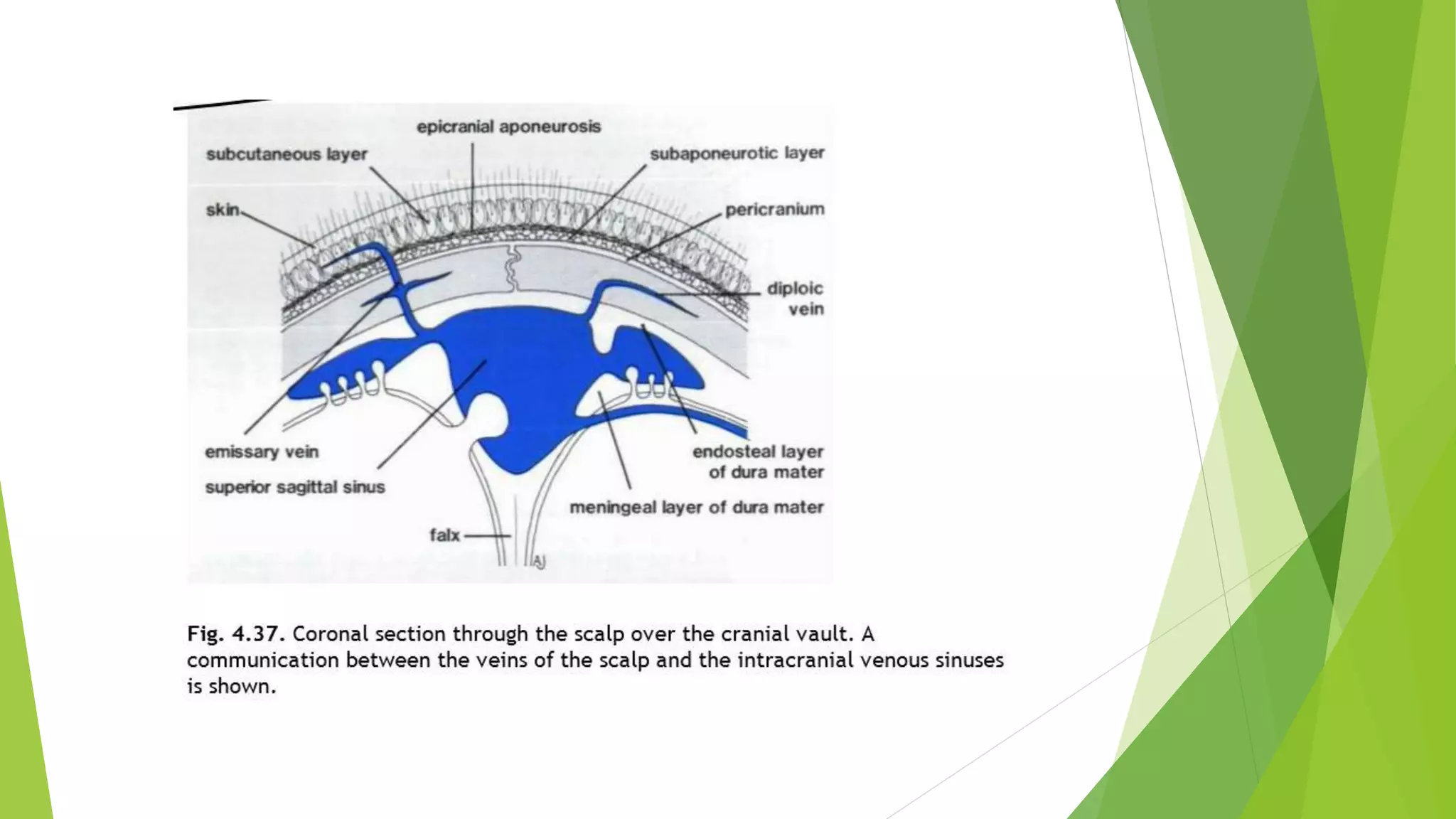
Skin: thick, hair bearing and contains numerous sebaceous gland.
Connective Tissue: fibro-fatty, highly vascular layer, uniting the skin to
underlying aponeurosis of the occiptofrontalis muscle
Aponeurosis ( Epicranial ): thin, tendinous sheet that unites the
occipital and frontal bellies of the occiptofrontalis muscle.
Loose subaponeurotic layer: occupy the subaponeurotic space.Connect
aponeurosis to the pericranium
Pericranium: Periosteum covering outer surface of the skull bones
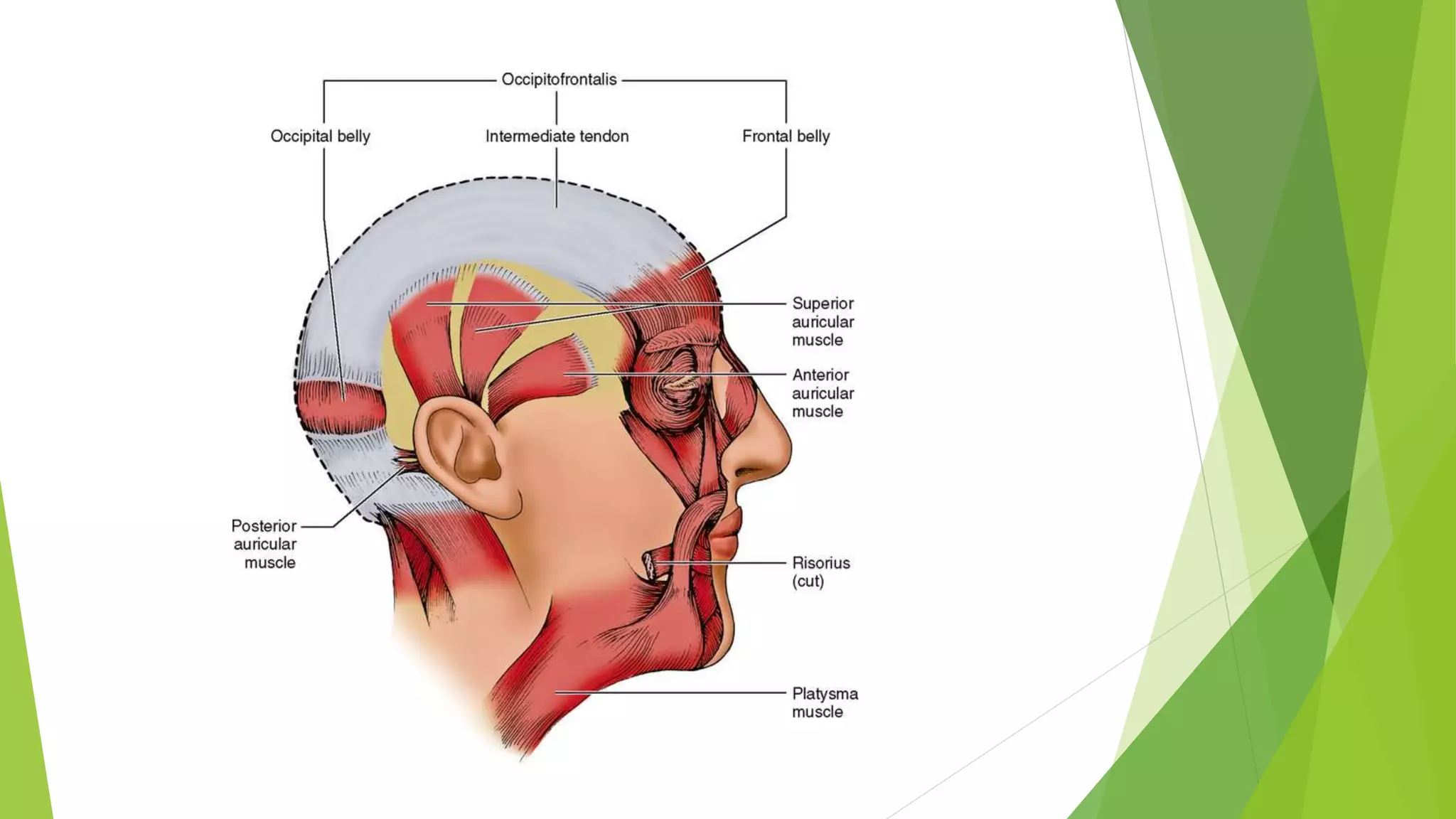
Muscles of the scalp
Occiptofrontalis muscle
Origion: 2 occipital bellies each arise from highest nuchal line on occipital bone
2 Frontal belly arise from the skin of eyebrow.(from anterior lateral margin of the aponeurosis)
Connected over the cranial vault by the epicranial aponeurosis.
Insertion: the skin of the corresponding eyebrow and into the orbicularis oculi muscle
Nerve supply: Occipital belly by Posterior Auricular branch of Facial nerve,
Frontal belly by temporal branch of Facial nerve.
Action: Moving forward or backward first 3 layers of scalp,
frontal belly raise the eyebrow in expression of surprise or horror.
 Epicranial aponeurosis
A sheet of strong connective tissue which covers the vertex of the skull between the occipital
and frontal bellies. It is firmly attached to the skin of the scalp by the dense subcutaneous layer
Laterally it fades out above the ears.
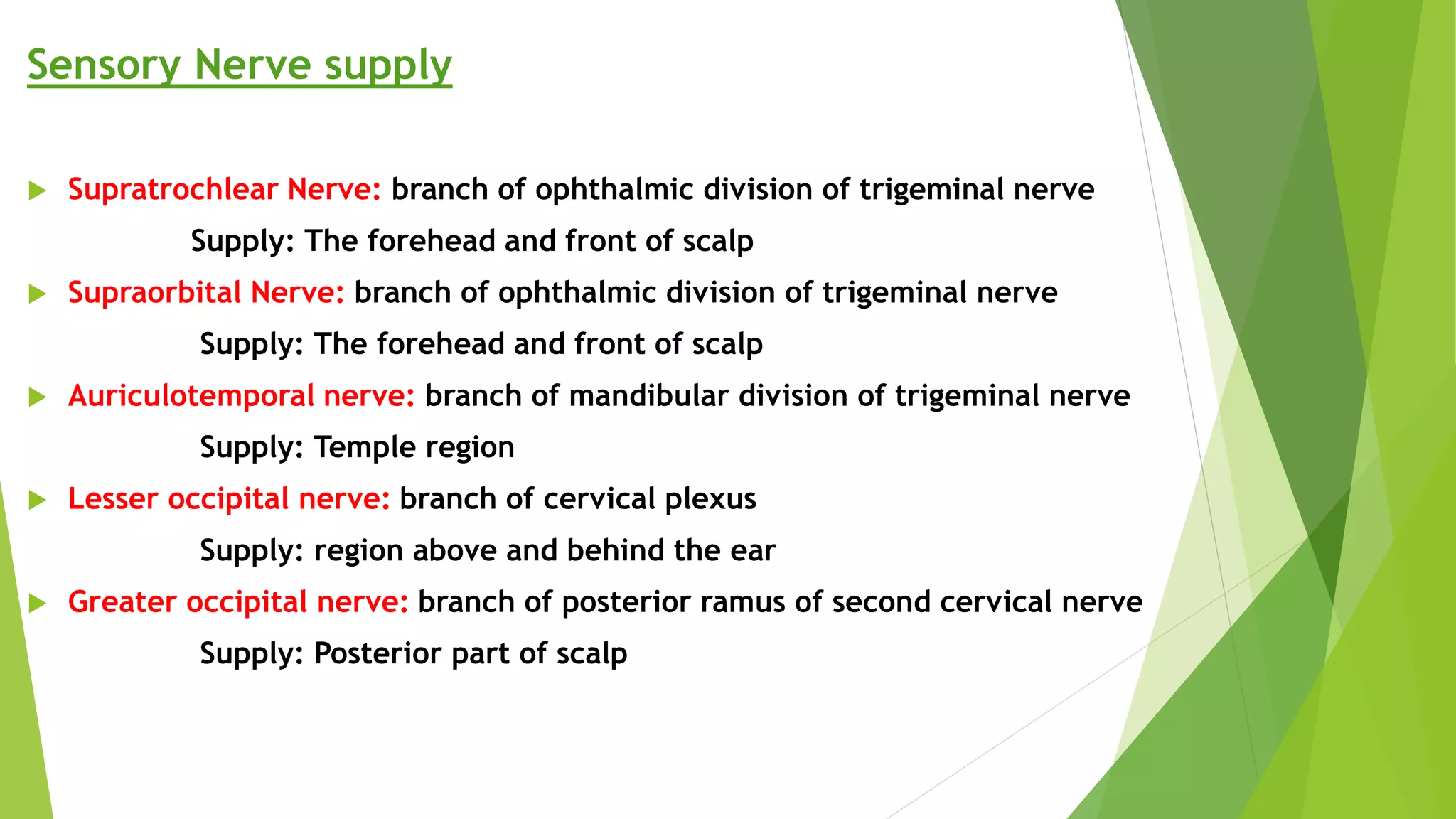
Sensory Nerve supply
 Supratrochlear Nerve: branch of ophthalmic division of trigeminal nerve
Supply: The forehead and front of scalp
 Supraorbital Nerve: branch of ophthalmic division of trigeminal nerve
Supply: The forehead and front of scalp
 Auriculotemporal nerve: branch of mandibular division of trigeminal nerve
Supply: Temple region
 Lesser occipital nerve: branch of cervical plexus
Supply: region above and behind the ear
 Greater occipital nerve: branch of posterior ramus of second cervical nerve
Supply: Posterior part of scalp
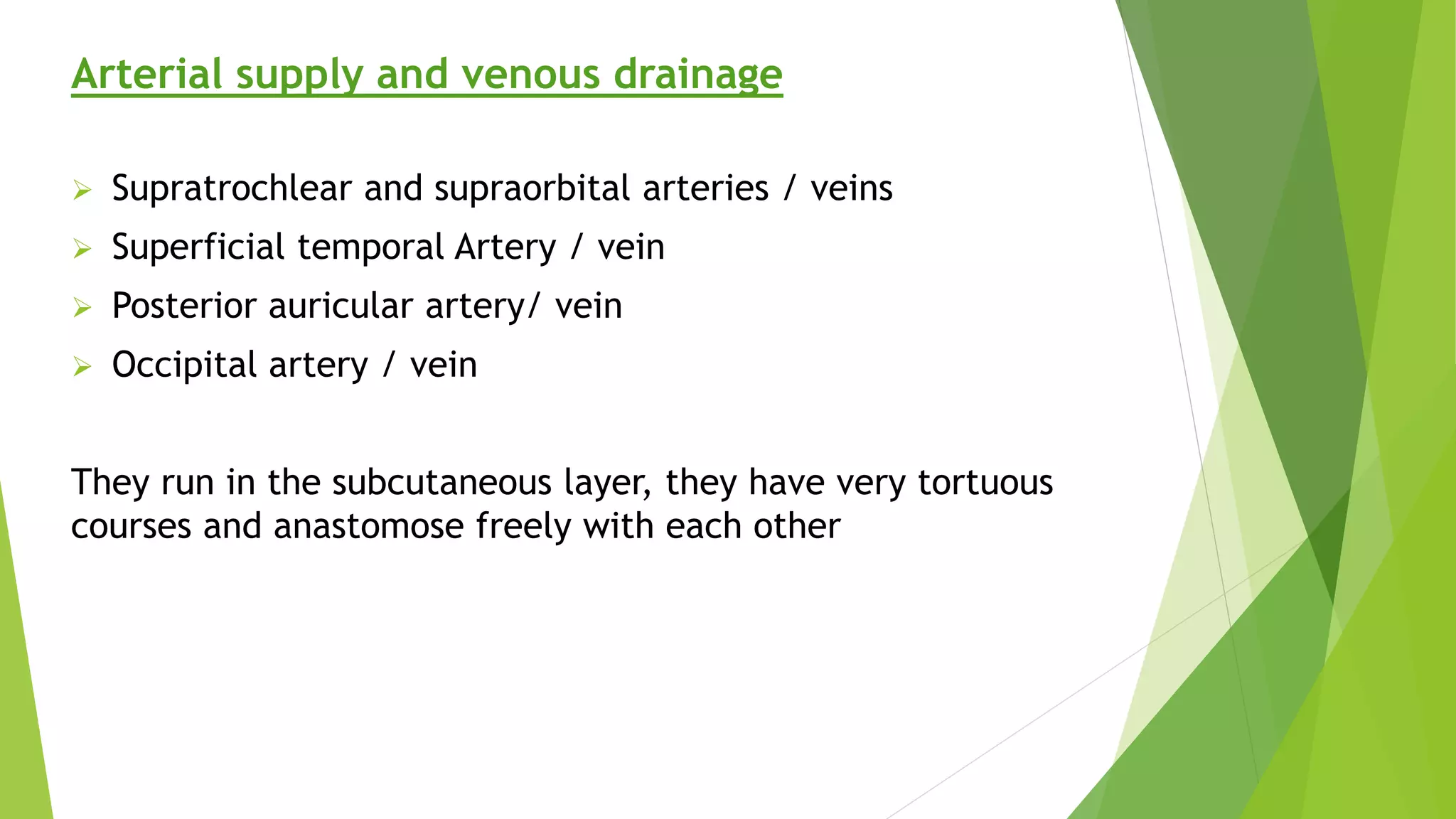
Arterial supply and venous drainage
 Supratrochlear and supraorbital arteries / veins
 Superficial temporal Artery / vein
 Posterior auricular artery/ vein
 Occipital artery / vein
They run in the subcutaneous layer, they have very tortuous
courses and anastomose freely with each other
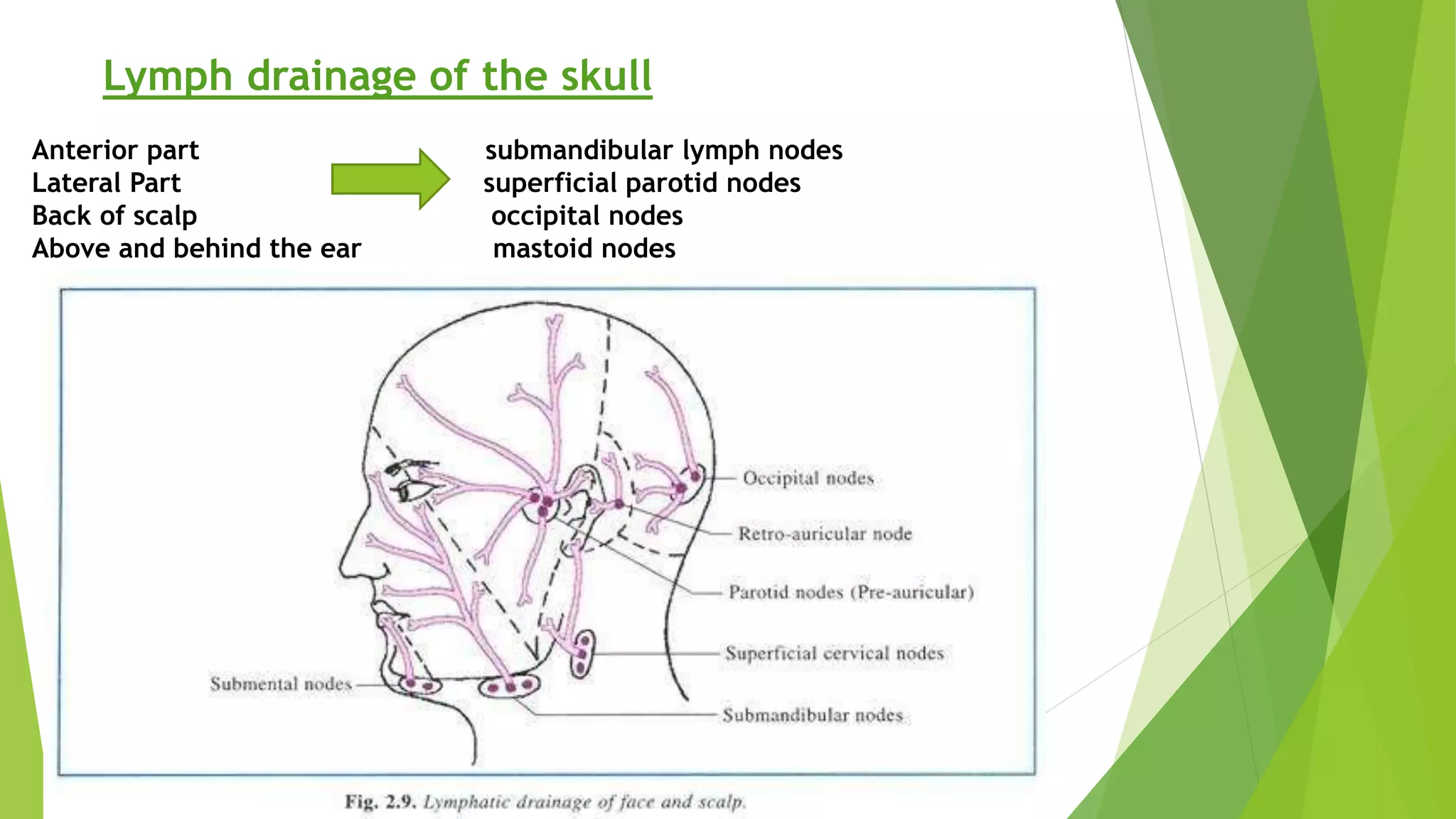
Lymph drainage of the skull
Anterior part submandibular lymph nodes
Lateral Part superficial parotid nodes
Back of scalp occipital nodes
Above and behind the ear mastoid nodes
The Face
 Sensory innervation
Skin of the face is supplied by all branches of trigeminal nerve except area over the
mandible and parotid area which is supplied by greater auricular nerve
Trigeminal Nerve divisions
1. Opthalmic nerve
- lacrimal nerve
- Supraorbital nerve
- Supratrochlear nerve
- Infratrochlear nerve
- External nasal nerve
2. Maxillary Nerve
- Infraorbital nerve
- zygomaticofacial nerve
- Zygomaticotemporal nerve
3. Mandibular nerve
- mental nerve
- Buccal nerve
- Auriculotempoarl nerve
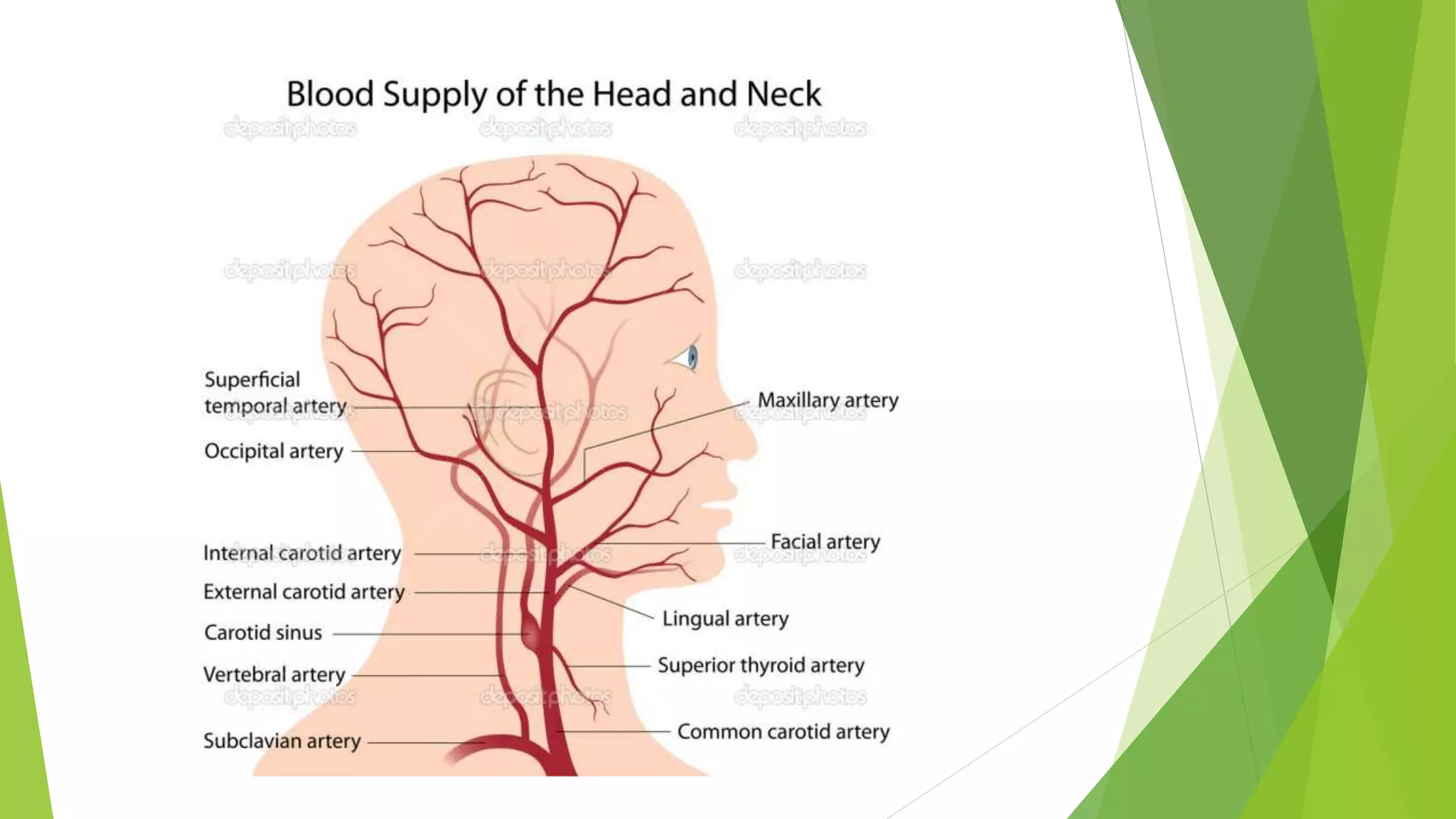
Arterial supply of face
From 2 main vessels : facial and superficial temporal arteries
 Branches of facial artery Branches of temporal arteries
1. submental artery 1.transverse facial artery
2. inferior labial artery
3. superior labial artery
4. lateral nasal artery
 Supraorbital and Supratrochlear arteries branches of ophthalmic artery.
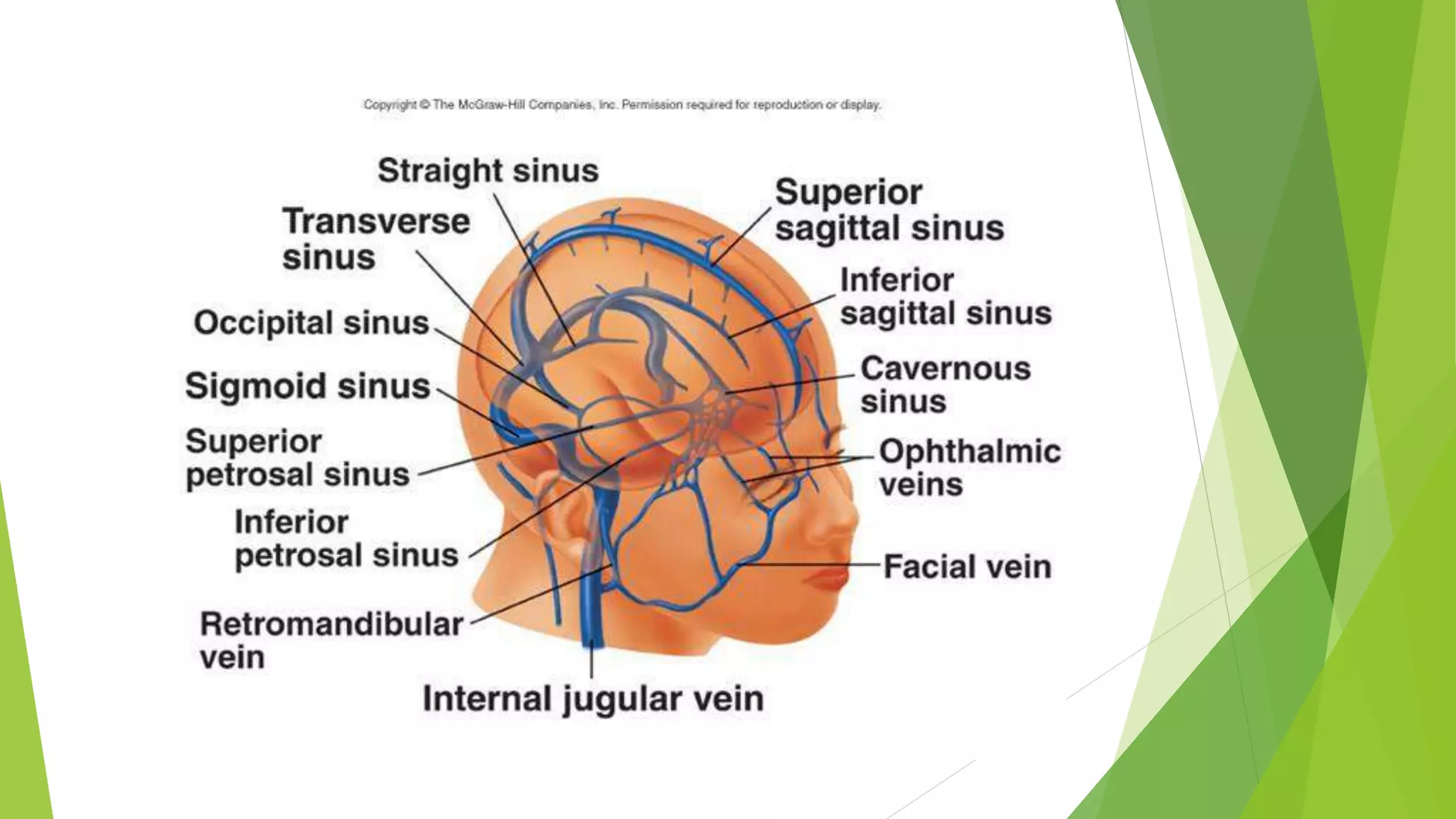
Venous Drainage of the face
 Facial vein
Its formed at the angle of the eye by the union of supraorbital and
supratrochlear veins. It is connected to the superior ophthalamic vein
directly through the supraorbital vein. Connected to cavernous sinus by
superior ophthalamic vein.
Note : This connection is of great importance because it provides path of
spread of infection from the face to the cavernous sinus.
Then the facial vein descend behind the facial artery to the lower margin
of the body of the mandible. It then crosses superficially to the
submandibular gland and is joined by the anterior division retromandibular
vein. The facial vein ends by draining into the internal jugular vein.
 Facial vein receive tributaries from that correspond to
the branches of the facial artery.
 Its joined to the pterygoid venous plexus by the deep
facial vein and to the cavernous sinus by the
superior ophthalmic vein.
 The transverse facial vein joins the superficial
temporal vein with in the parotid gland.
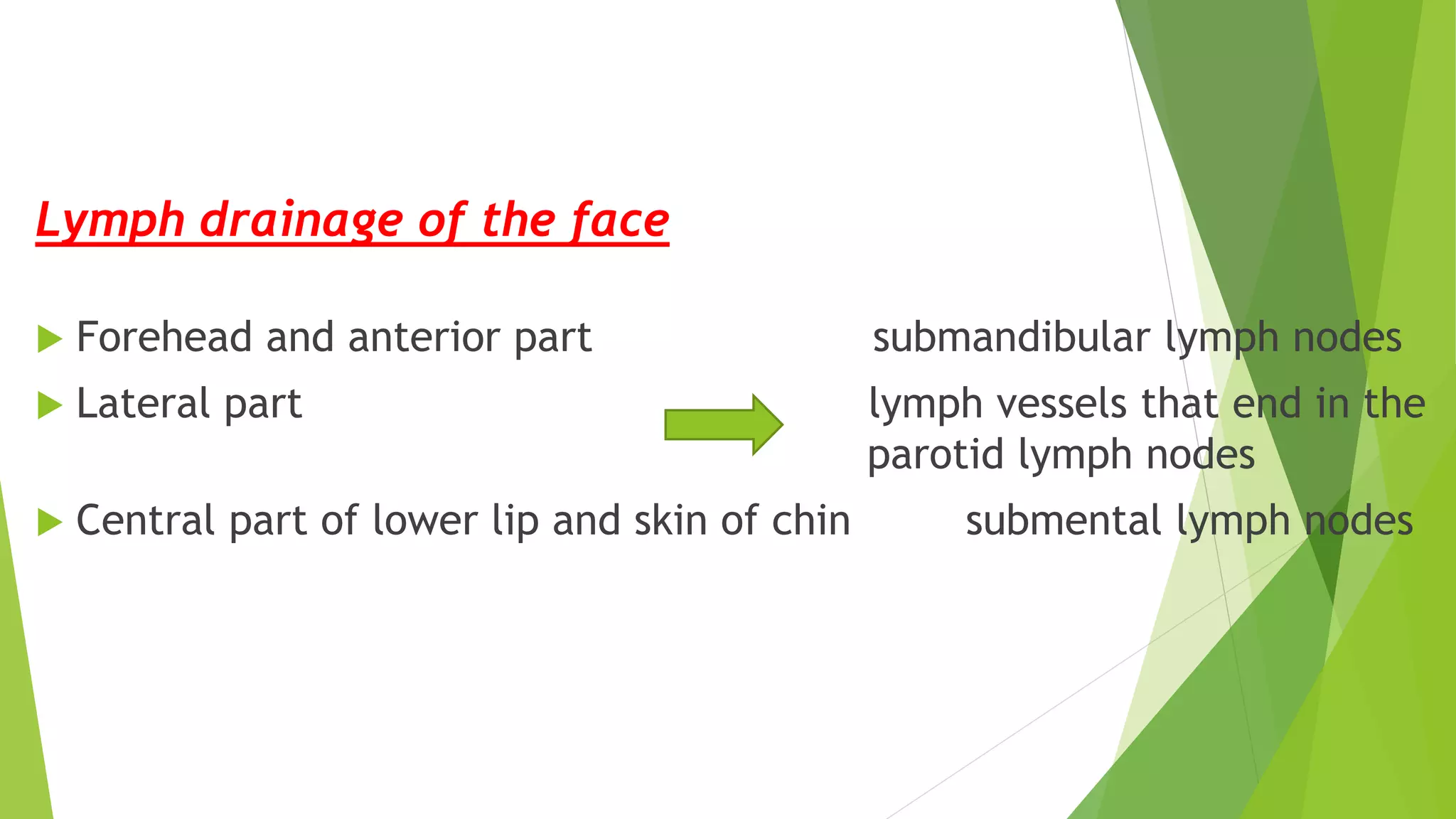
Lymph drainage of the face
 Forehead and anterior part submandibular lymph nodes
 Lateral part lymph vessels that end in the
parotid lymph nodes
 Central part of lower lip and skin of chin submental lymph nodes
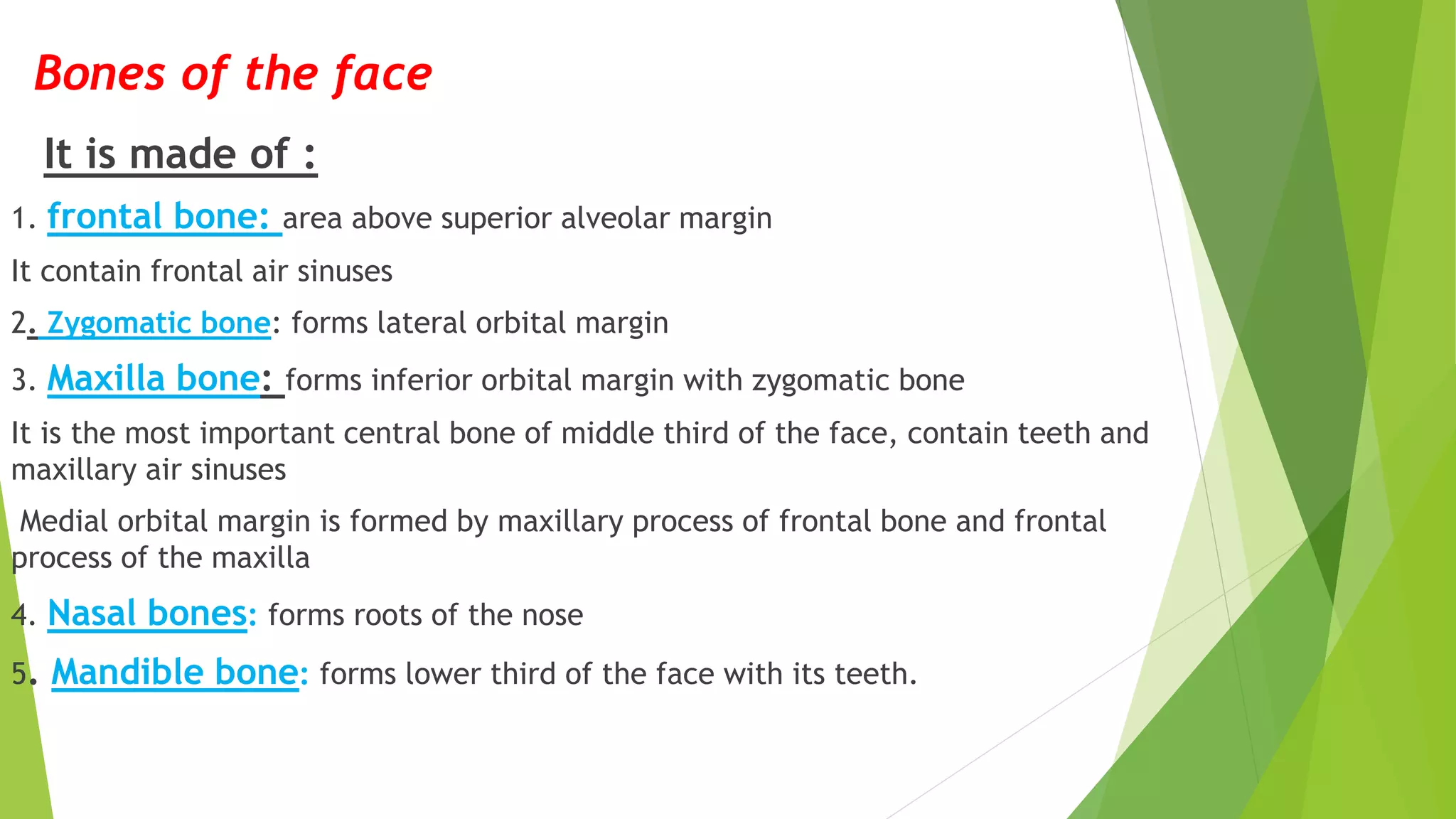
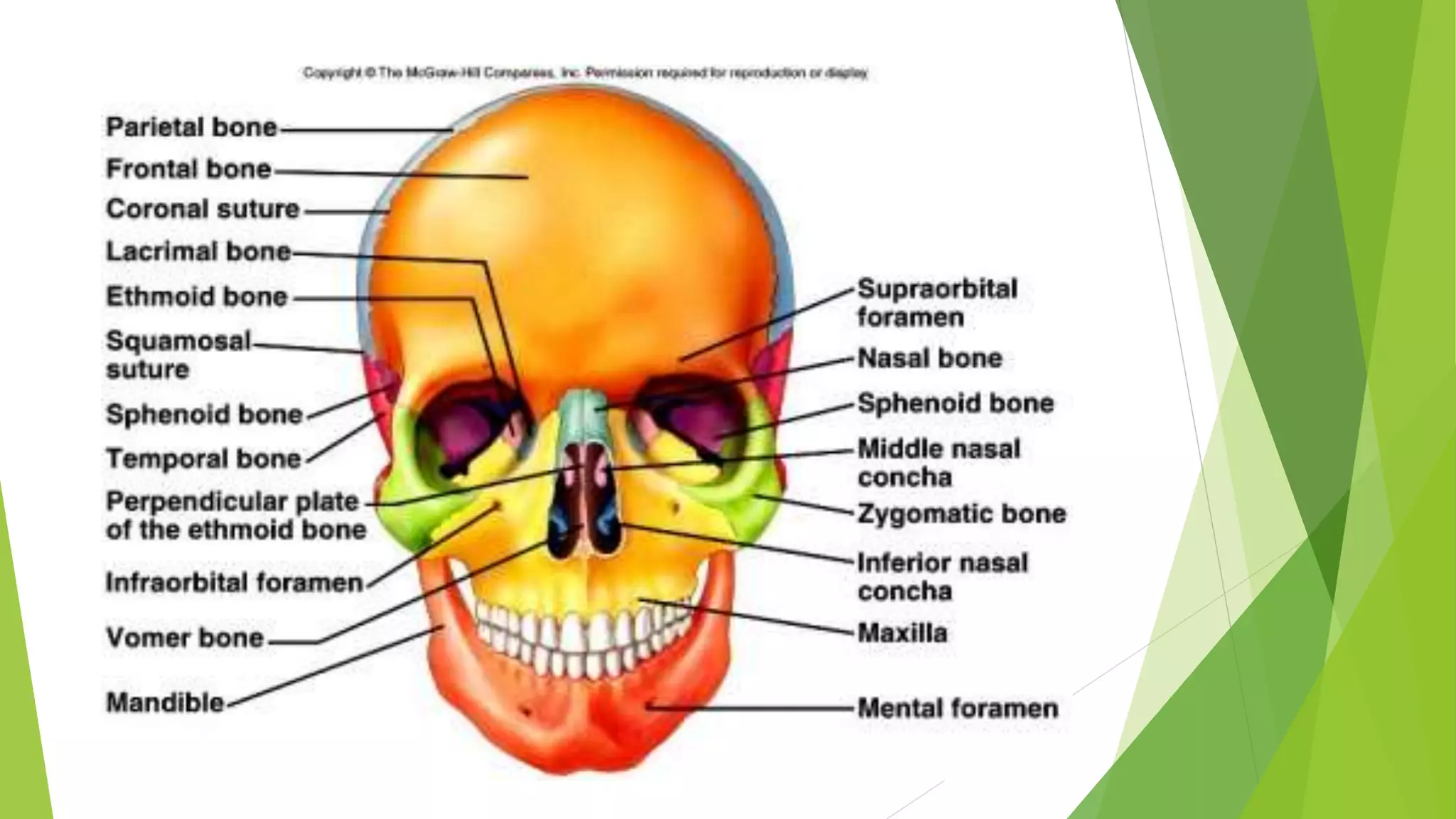
Bones of the face
It is made of :
1. frontal bone: area above superior alveolar margin
It contain frontal air sinuses
2. Zygomatic bone: forms lateral orbital margin
3. Maxilla bone: forms inferior orbital margin with zygomatic bone
It is the most important central bone of middle third of the face, contain teeth and
maxillary air sinuses
Medial orbital margin is formed by maxillary process of frontal bone and frontal
process of the maxilla
4. Nasal bones: forms roots of the nose
5. Mandible bone: forms lower third of the face with its teeth.
Muscles of the face/ superficial muscles
 Are derived from the mesoderm of the second pharyngeal
arch and receive motor innervation from the facial nerve.
 No deep fascia in the face.
 There are several small muscles associated with the
external ears, these are derived from the second pharyngeal
arch and are innervated by the facial nerve. They are
virtually functionless in man.
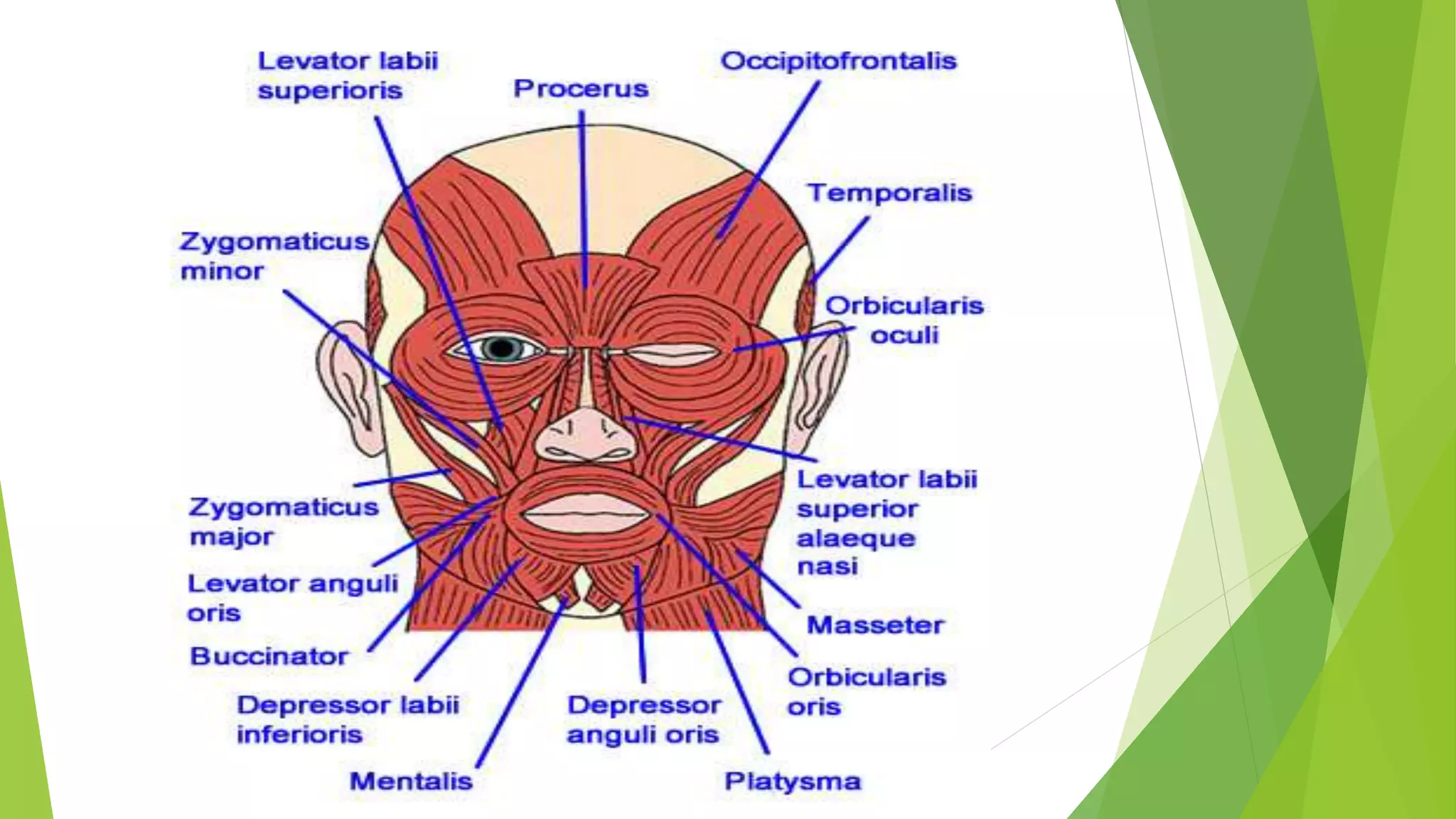
Muscles of facial expression
 Muscles of eye orbit
1.Orbicularis oculi: the sphincter muscle
palpebral part orbital part
origin: medial palpebral ligament medial palpebral ligament and adjoining bone
insertion: lateral palpebral raphe loops return to origin
action: closes eye and dilate lacrimal sac throws skin around orbital into fold to protect the eyeball
nerve supply: Facial nerve facial nerve
2. Levator palpebrae superior: the dilator muscle
3. Occiptofrontalis
 Muscles of nostrils
1. Dilator Naris 2. Compressor naris
origin: Maxilla frontal process of maxilla
Insertion: Ala of nose aponeurosis of bridge of nose
action: widen nasal aperture compress mobile cartilage
nerve supply: Facial nerve facial nerve
 Muscles of lips
Sphincter muscle of the lips
Orbicularis oris
Origin: Near midline on anterior surface of maxilla and mandible and modiolus at angle of mouth
Inserion: Mucous membrane of margin of lips and raphe with buccinator at modiolus
Action: Narrows orifice of mouth, purses lips and puckers lip edges
Nerve: buccal and mandibular branches of the facial nerve
Dilator muscles of the lips
1.Levator labii superioris alaque nasi
2.Levator labii superioris
3. Zygomatic minor
4. Zygomatic major
5.Risoris
6.Levator Anguli oris
7. Depressor anguli oris
8. Depressor labii inferiors
9. Mentalis
arise from bones and fascia
around the oral aperture and
insert into substance of the lip
Supplied by Facial nerve
Muscles of cheeks
 Buccinator Muscle
Origin: From maxilla and mandible adjacent to the molar teeth and from
pterygomandibular raphe and pterygoid hamulus behind the last molar teeth
Nerve: Motor innervation is from the buccal branch of the Facial nerve.
Sensory innervation is supplied by the buccal branch of the mandibular
part of the trigeminal
Action: Compress the cheeks and lips against the teeth (in blowing and
whistling)
 Muscles of Mastication
Derived from mesoderm of first pharyngeal arch
1. Masseter
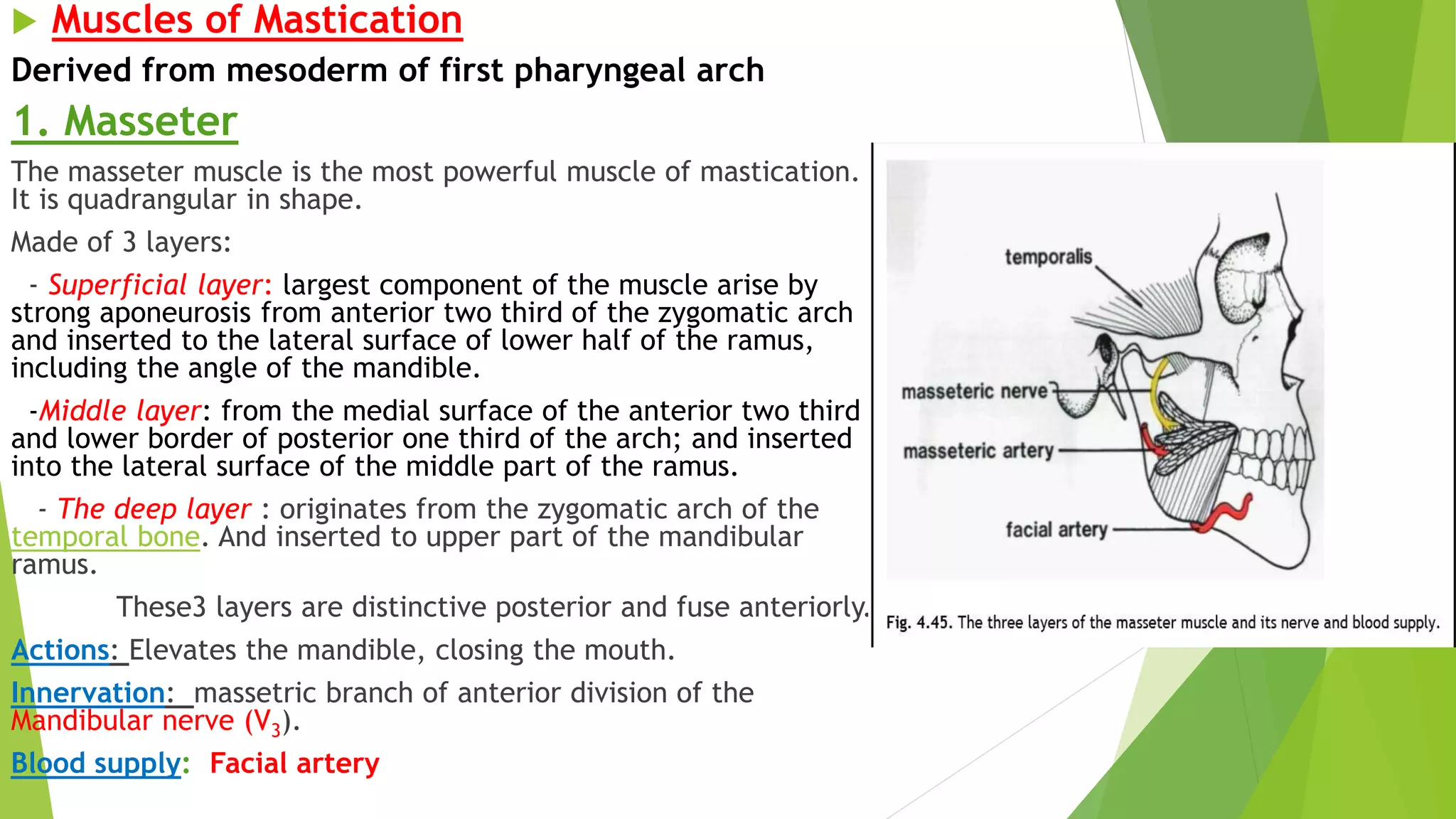
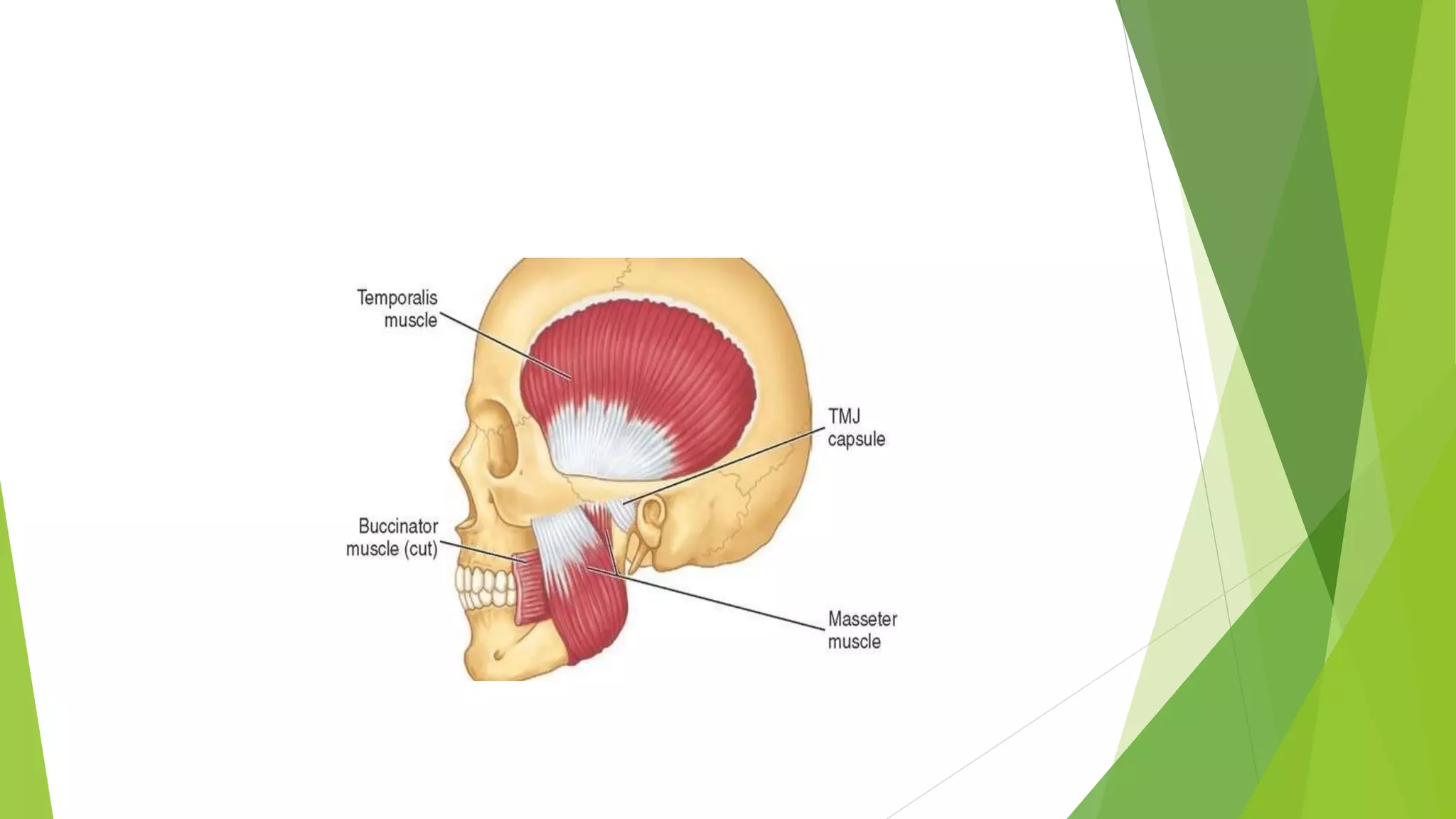
The masseter muscle is the most powerful muscle of mastication.
It is quadrangular in shape.
Made of 3 layers:
- Superficial layer: largest component of the muscle arise by
strong aponeurosis from anterior two third of the zygomatic arch
and inserted to the lateral surface of lower half of the ramus,
including the angle of the mandible.
-Middle layer: from the medial surface of the anterior two third
and lower border of posterior one third of the arch; and inserted
into the lateral surface of the middle part of the ramus.
- The deep layer : originates from the zygomatic arch of the
temporal bone. And inserted to upper part of the mandibular
ramus.
These3 layers are distinctive posterior and fuse anteriorly.
Actions: Elevates the mandible, closing the mouth.
Innervation: massetric branch of anterior division of the
Mandibular nerve (V3).
Blood supply: Facial artery
2. Temporalis muscle
The temporalis muscle originates from the temporal fossa – a
shallow depression on the lateral aspect of the skull. The muscle is
covered by tough fascia, this can harvested surgically, and used to
repair a perforated tympanic membrane (an operation known as a
myringoplasty).
Attachments: Originates from the temporal fossa. It condenses
into a tendon, which inserts onto the coronoid process of the
mandible.
Actions: Elevates the mandible, closing the mouth.
Also retracts the mandible, pulling the jaw posteriorly.
Innervation: Mandibular nerve (V3)
3. Lateral pterygoid
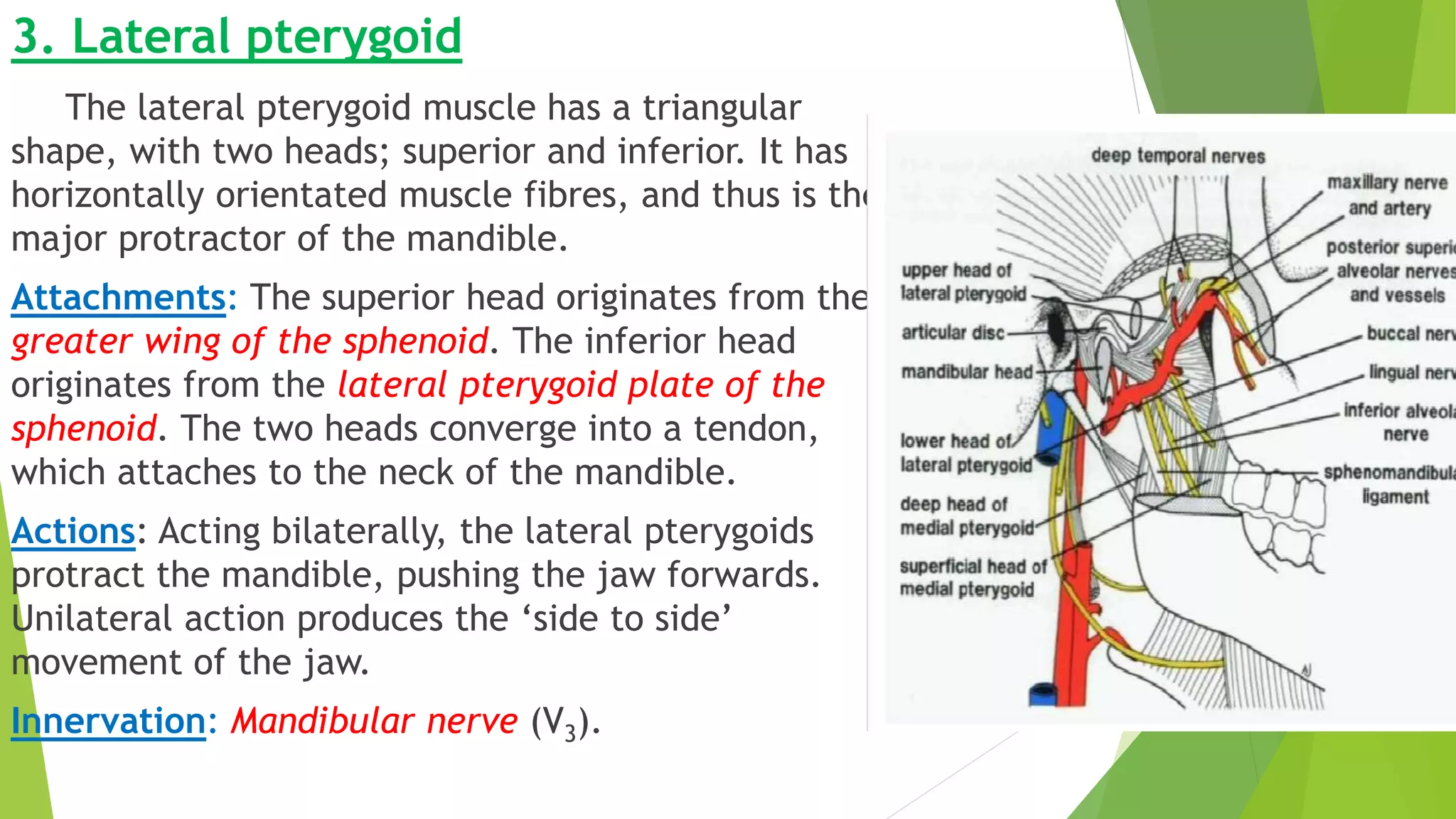
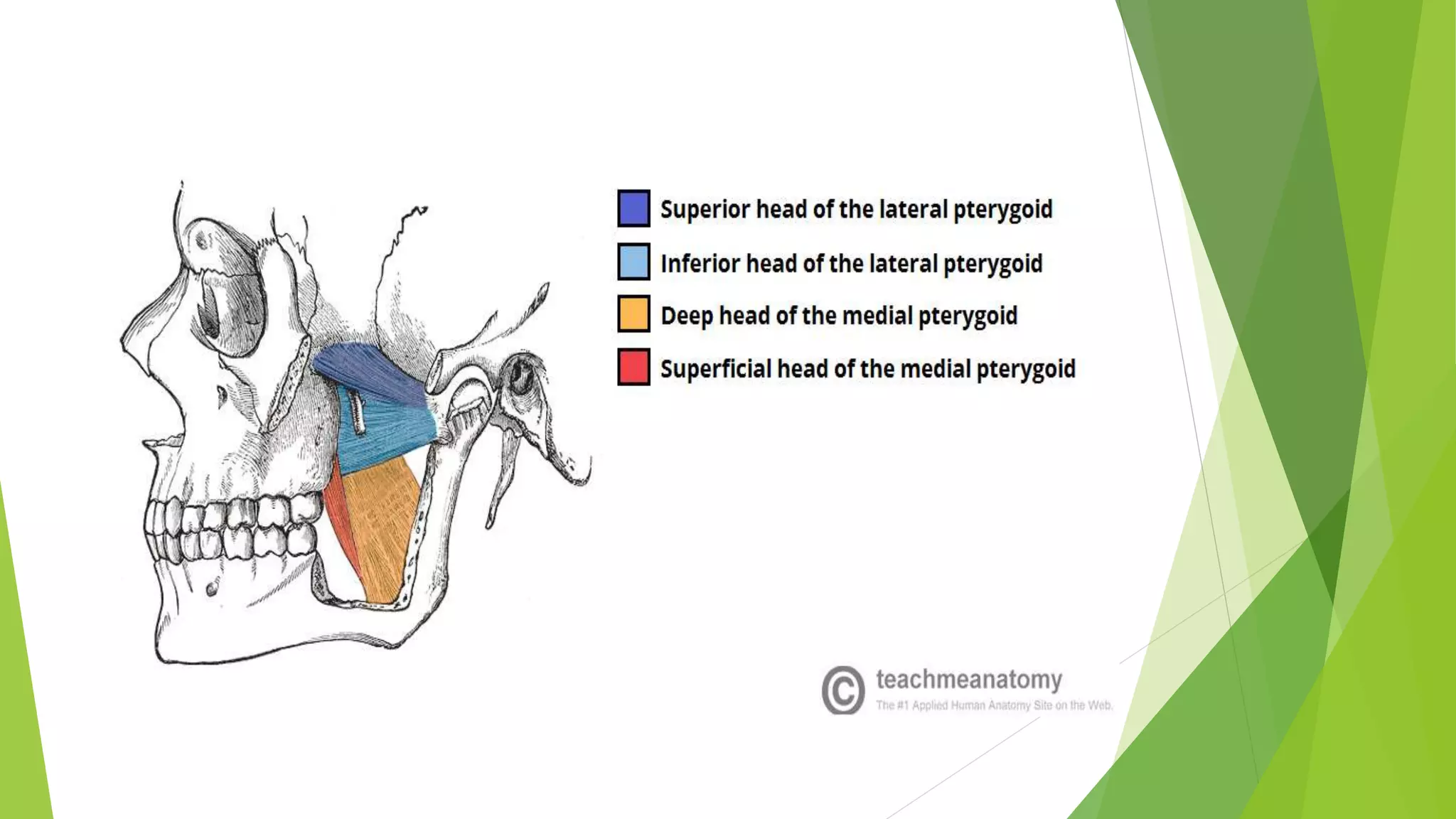
The lateral pterygoid muscle has a triangular
shape, with two heads; superior and inferior. It has
horizontally orientated muscle fibres, and thus is the
major protractor of the mandible.
Attachments: The superior head originates from the
greater wing of the sphenoid. The inferior head
originates from the lateral pterygoid plate of the
sphenoid. The two heads converge into a tendon,
which attaches to the neck of the mandible.
Actions: Acting bilaterally, the lateral pterygoids
protract the mandible, pushing the jaw forwards.
Unilateral action produces the ‘side to side’
movement of the jaw.
Innervation: Mandibular nerve (V3).
4.Medial Pterygoid
The medial pterygoid muscle has a quadrangular shape, with two heads;
deep and superficial. It is located inferiorly to the lateral pterygoid.
Attachments: The superficial head originates from the maxillary tuberisty
and neighbouring part of palatine bone. The deep head originates from the
lateral pterygoid plate of the sphenoid bone. Both parts attach to the
ramus of the mandible, near the angle of mandible.
Actions: Elevates the mandible, closing the mouth
Innervation: Mandibular nerve (V3).
Pterygomandibular space: the gap between the muscle and medial surface
of the ramus above the insertion
Pterygomandibular space and anatomy of
inferior alveolar block
 Pterygomandibular space:
It is a potential space in the head and is paired on each side.
 Contents of the Pterygomandibular space:
 The mandibular division of the trigeminal nerve which divides into
many branches including the Inferior alveolar nerve.
 The inferior alveolar artery and vein.
 The sphenomandibular ligament.
Boundaries of each pterygomandibular space are:
The posterior border of the buccal space anteriorly.
The parotid gland posteriorly.
The lateral pterygoid muscle superiorly.
The inferior border of the mandible (lingual surface) inferiorly.
The medial pterygoid muscle medially (the space is superficial to
medial pterygoid).
The ascending ramus of the mandible laterally (the space is deep to
the ramus of the mandible).
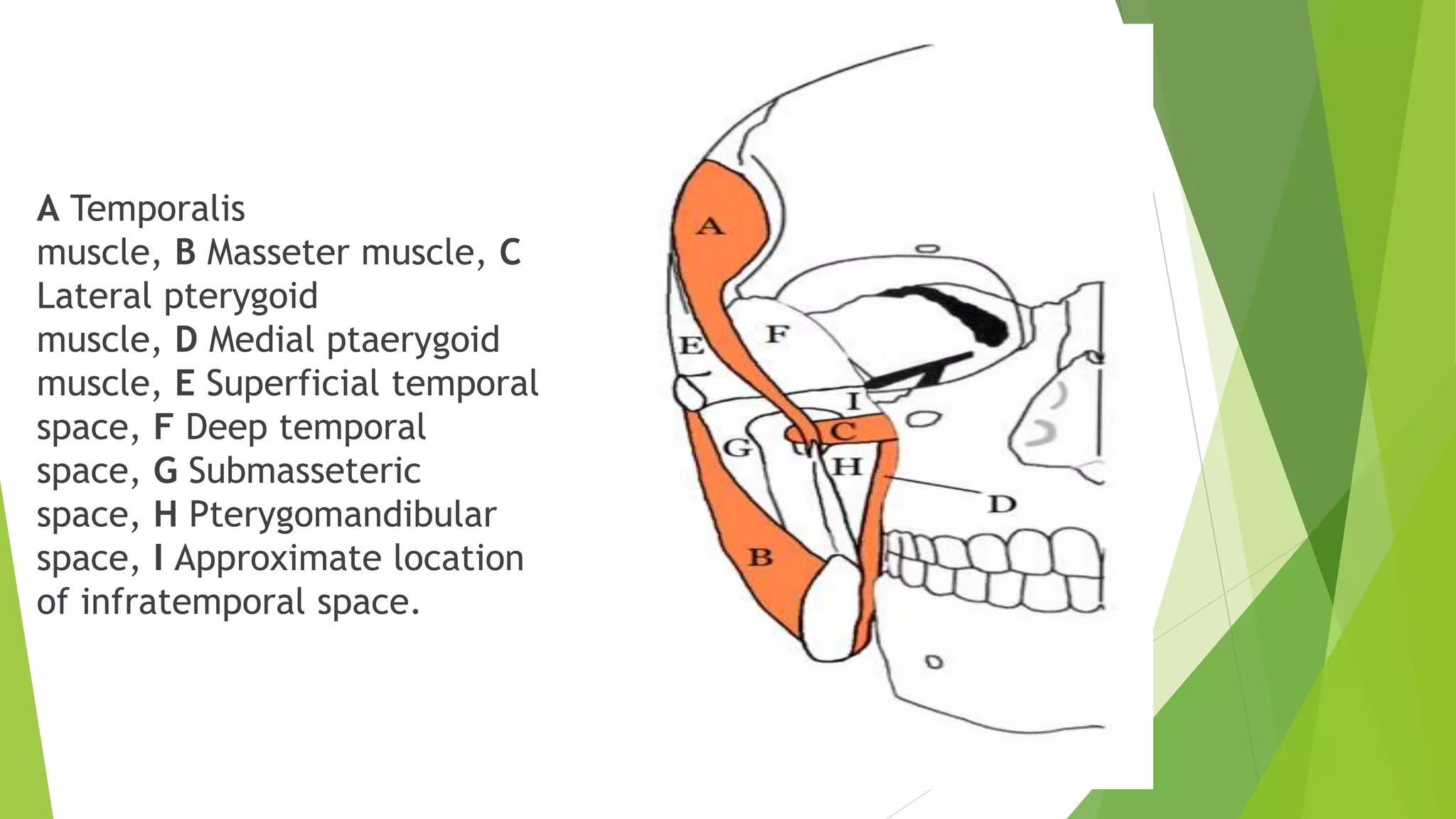
A Temporalis
muscle, B Masseter muscle, C
Lateral pterygoid
muscle, D Medial ptaerygoid
muscle, E Superficial temporal
space, F Deep temporal
space, G Submasseteric
space, H Pterygomandibular
space, I Approximate location
of infratemporal space.
Note: The Only way to anesthetize the mandibular teeth is
to anesthetize the main trunk of inferior alveolar nerve
when it’s in the pterygomandibular space before it enters
the mandibular canal. Because mandibular bone is dense
therefore the local anesthetic can’t diffuse through it.
 Stylohyoid ligament
 The styloid process ossifies in the dorsal part of the cartilage of the second pharyngeal arch.
 The lesser cornu and upper part of the body of the hyoid bone ossify in the ventral part of this
cartilage. The intervening part atrophies but its perichondrium persists as the stylohyoid
ligament, a well defined cord of fibrous tissue which runs from the tip of the styloid process to
the apex of the lesser cornu of the hyoid bone.
 Stylohyoid muscle
Origin: The stylohyoid muscle arises from the posterior surface of the styloid process.
It runs downwards and forwards crossing superficial to the external carotid artery before the
latter structure enters the parotid gland. A short distance above the hyoid bone the muscle divides
into two slips which pass one either side of the intermediate tendon of the digastric muscle to be i
Inserted As 2 tendinous slips that pass on either side of the intermediate tendon of digastric.
Innervation: Facial nerve.
Action: Elevate the hyoid.
 The muscle is derived from the second pharyngeal arch.
 Styloglossus muscle
Origin: from the anterior aspect of the lower part of the styloid process and of the neighbouring part of
the stylohyoid ligament.
 Stylopharyngeus muscle
Origin: Arises from the medial surface of the styloid process. It runs almost vertically downwards,
passes between the internal and external carotid arteries, crosses the lower border of the superior
constrictor muscle and then continues downwards inside the middle constrictor, beneath the pharyngeal
mucous membrane
Insertion: Into the posterior border of the thyroid cartilage and the side wall of the pharynx.
Innervation: The glossopharyngeal nerve.
 Styloid apparatus
The styloid process is a curved bony spine, of variable length, which projects downwards and somewhat
forwards from the inferior surface of the temporal bone and lateral to the internal carotid artery. Its
upper part (the base) is fused with the tympanic plate. Its lower part gives attachment to two ligaments
and three muscles.
Sphenomandibular ligament
 This is a well-developed band of fibrous tissue which extends from the
spine of the sphenoid to the lingula of the mandible and the adjacent
margin of the mandibular foramen.
 As it passes downwards and forwards it is separated from the neck of
the mandible by the maxillary vessels while more inferiorly (in the
pterygomandibular space) it is separated from the ramus of the
mandible by the inferior alveolar nerve and vessels.
 Medially relation: to the pharyngeal wall above and to the medial
pterygoid muscle below.
 The ligament is pierced near to its attachment to the lingula by the
mylohyoid nerve and vessels.
 Developmentally, the sphenomandibular ligament is a remnant of
Meckel's cartilage.
Temporal Region
 Is situated on the side of the head.
 The temporal lobe is one of the four Major lobes of the cerebral cortex in the brain of mammals. The
temporal lobe is located beneath the lateral fissure on both cerebral hemispheres of the brain.
 The temporal lobes are involved in processing sensory input into derived meanings for the appropriate
retention of visual memories, language comprehension.
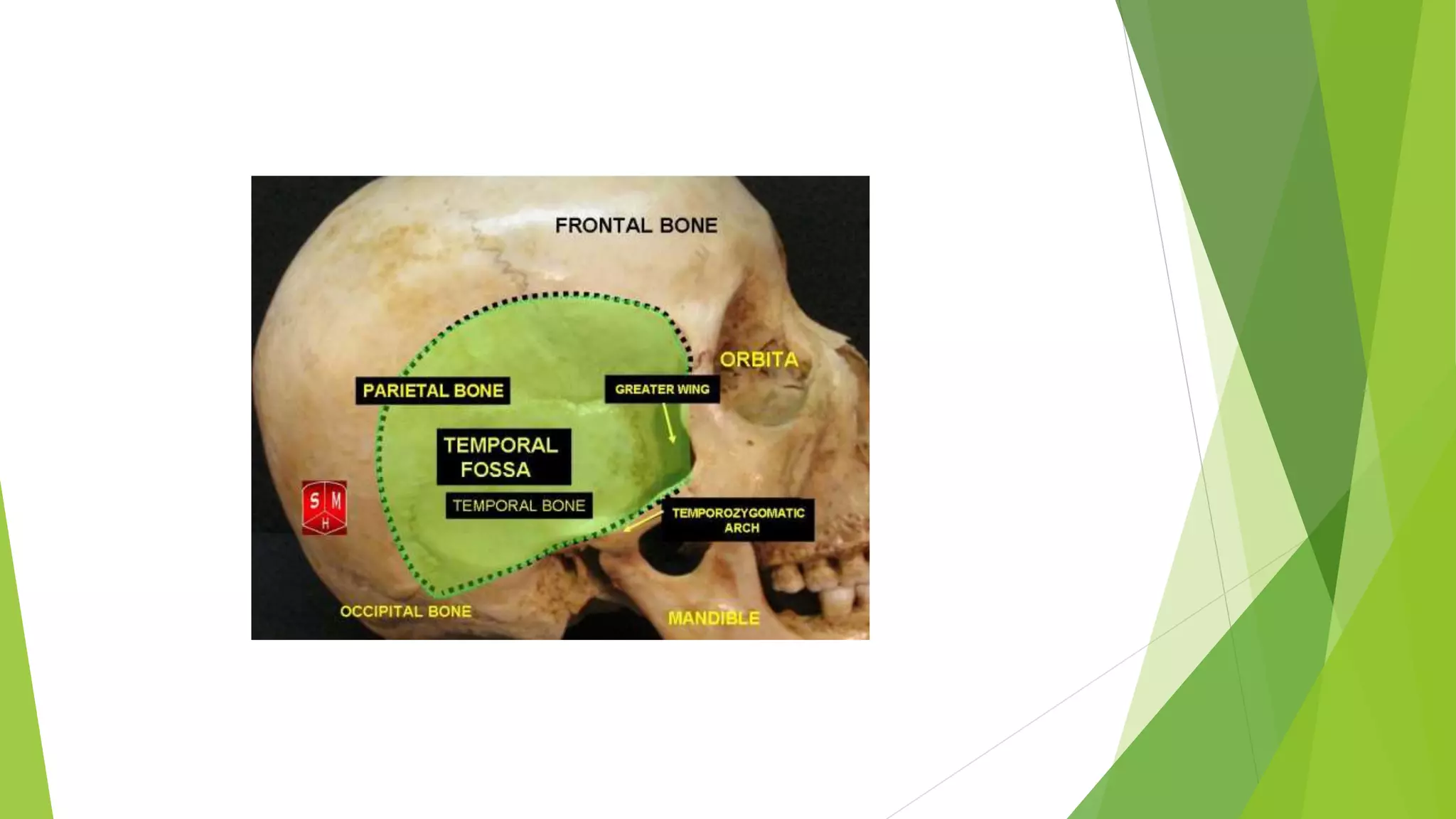
1.Temporal Fossa
 Medial: Frontal bone, Parietal bone, Temporal bone, Sphenoid bone, Occipital bone.
 Lateral: Temporal fascia.
 Anterior: Posterior surface of the frontal process of the zygomatic bone and the posterior surface of
the zygomatic process of the frontal bone.
 Superior: Pair of temporal lines (superior and inferior temporal lines) that arch across the skull from
the zygomatic process of the frontal bone to the supramastoid crest of the temporal bone.
 Inferior: Zygomatic arch laterally and by the infratemporal crest of the greater wing of the sphenoid
medially.
Content:
It is occupied by the temporalis muscle and its covering fascia, the deep temporal
nerves and vessels, the auriclotemporal nerve, and the superficial temporal artery.
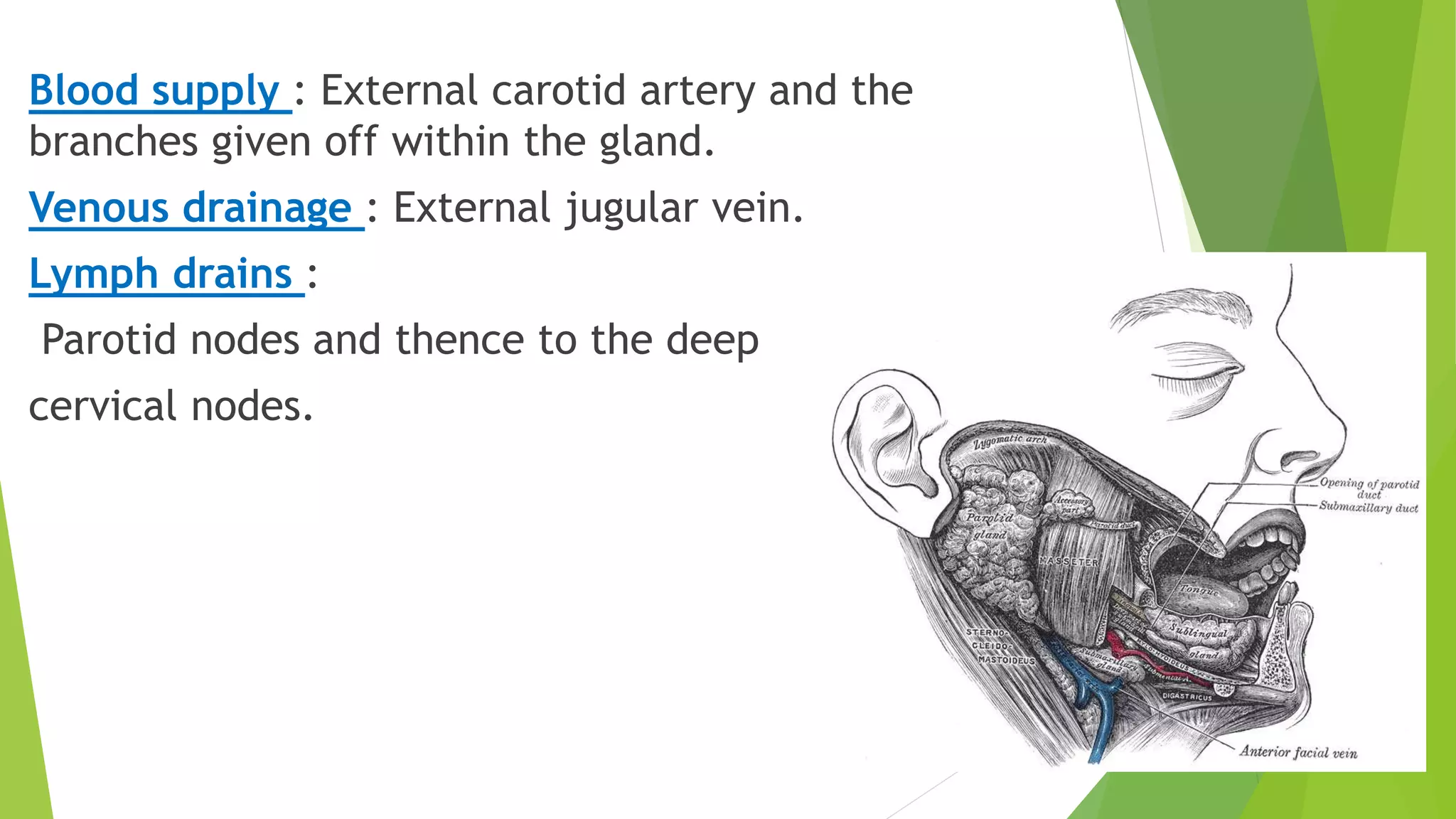
Parotid gland
 The largest of the salivary glands, is mainly serous but contains a few scattered mucous acini.
Location: lies below the external acoustic meatus wedged between the mandibular ramus in front and the
mastoid process and sternocleidomastoid muscle behind.
Structure: facial nerve pass through it and divides it into deep and superficial parts/lobes.
1. Glenoid lobe: Superior margin extend upward behind the TMJ into posterior part of mandibular fossa.
2. Facial process: Anterior margin of the gland extend forward superficial to the masseter muscle.
3. Accessory part of the gland: small part of the facial process may be separate from the main gland.
4. Pterygoid process: Deep part of the gland may extend forward between the medial pterygoid muscle
and the ramus of the mandible.
 Parotid duct: The duct draining the gland begins by the confluence of tributaries within the anterior
part of the gland. It emerges from the anterior border of the gland and runs forwards across masseter
below the accessory part of the gland. At the front edge of masseter it turns medially, pierces buccinator
and opens on the oral surface of the crown of the second upper molar.
Structures within the Parotid gland
Three major non-glandular structures traverse the gland. From deep to superficial these are as
follows
1. External carotid artery enters the gland through the lower part of its posteromedial surface.
Within the gland the artery divides into its two terminal branches - the maxillary artery which
leaves the gland through its anteromedial surface and the superficial temporal artery which leaves
through the upper part of the superficial surface.
2. Retromandibular vein is formed within the gland, by the union of maxillary and superficial
temporal veins. It runs downwards lateral to the external carotid artery and in the lower part of
the gland or after emerging from there splits into anterior and posterior divisions. The posterior
division joins the posterior auricular vein to form the external jugular vein; the anterior division
joins the facial vein.
3. Facial nerve enters the upper part of the posteromedial surface of the gland, runs forwards,
superficial to the retromandibular vein, and divides into five branches which leave the
anteromedial surface of the gland to supply the muscles of facial expression. Connections between
these branches form a network called the parotid plexus. The auriculotemporal nerve, as it passes
behind the temporomandibular joint runs through the glenoid lobe of the parotid gland or within
its covering fascia.
4. Parotid group of lymph nodes.
Innervation
Parasympathetic supply.
The preganglionic fibres begin in the inferior salivatory nucleus in the medulla, leaving
the brainstem in the glossopharyngeal nerve and pass through its tympanic branch, the
tympanic plexus, and the lesser petrosal nerve to the otic ganglion where they synapse with
postganglionic fibres which pass to the gland in the auriculotemporal nerve.
 Stimulation of the parasympathetic innervation leads to the production of copious
saliva rich in mucus and enzymes.
Sympathetic supply
From the superior cervical ganglion of the sympathetic trunk. Postganglionic neurons
travel from the ganglion to the gland in the plexus on the external carotid artery. The
preganglionic neurons which relay in the ganglion begin in the upper thoracic segments of
the spinal cord.
 Stimulation of Sympathetic stimulation results in a reduced secretion of saliva which is
low in organic content.
Note : The facial nerve, which passes through the gland, does not supply it.
Blood supply : External carotid artery and the
branches given off within the gland.
Venous drainage : External jugular vein.
Lymph drains :
Parotid nodes and thence to the deep
cervical nodes.
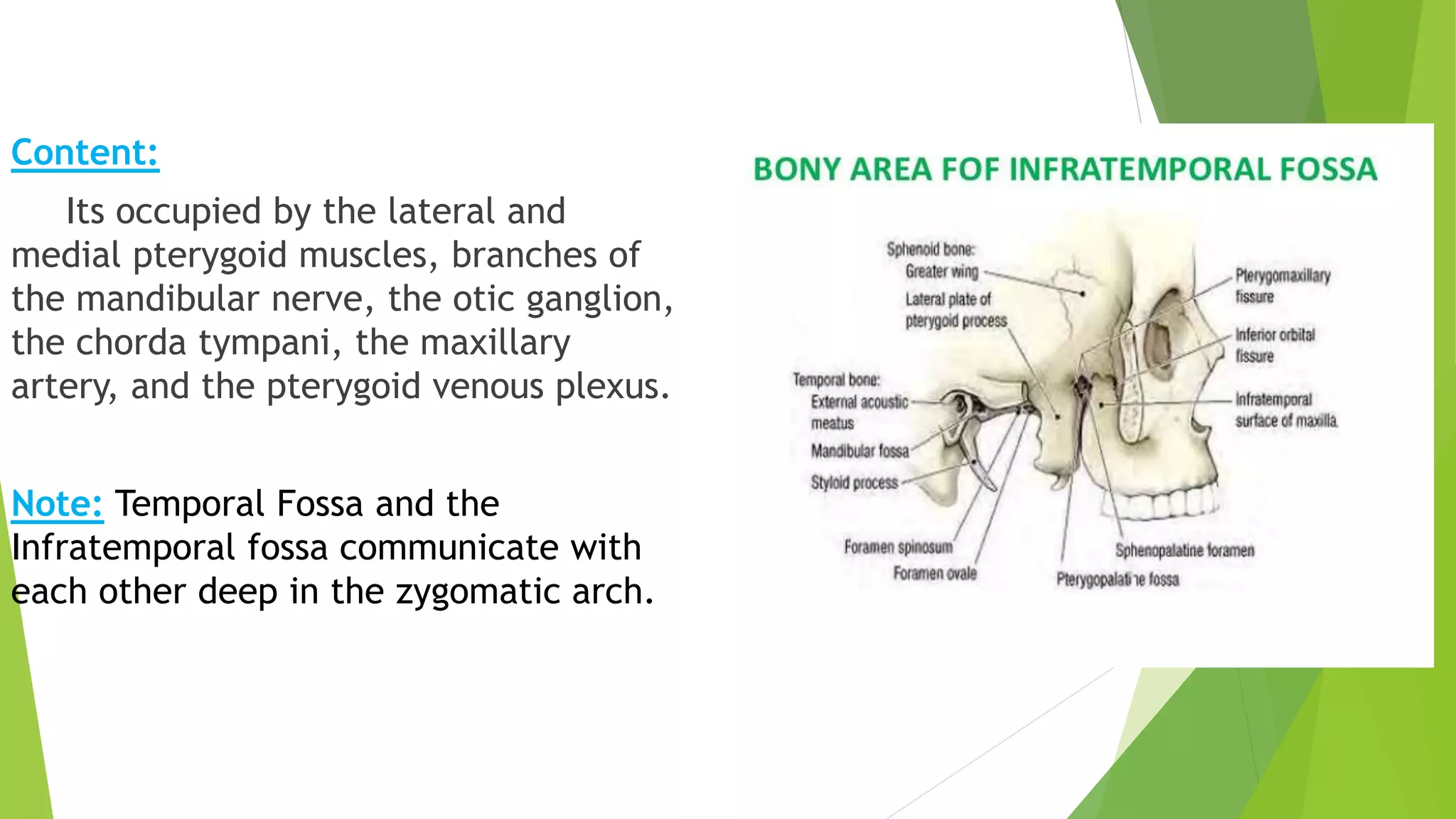
Infratemporal fossa
Is an irregularly shaped cavity, situated below and medial to the zygomatic arch. Boundaries
defined by:
 Anteriorly, by the infratemporal surface of the maxilla and the ridge which descends from its
zygomatic process.
 Posteriorly, by the articular tubercle of the temporal and the spina angularis of the sphenoid.
 Superiorly, by the greater wing of sphenoid below the infratemporal crest, and by the under
surface of the temporal squama, containing the foramen ovale, which transmits the
mandibular branch of the trigeminal nerve, and the foramen spinosum, which transmits the
middle meningeal artery.
 Inferiorly, by the medial pterygoid muscle attaching to the mandible.
 Medially, by the lateral pterygoid plate.
 Laterally, by the ramus of mandilbe, which contains the mandibular foramen , leading to
the mandibular canal through which the inferior alveolar nerve passes. This also contains the
lingula, a triangular piece of bone that overlies the mandibular foramen antero-medially.
Finally, the mylohyoid groove descends obliquely transmitting the mylohyoid nerve the only
motor branch of the posterior division of the trigeminal nerve.
Content:
Its occupied by the lateral and
medial pterygoid muscles, branches of
the mandibular nerve, the otic ganglion,
the chorda tympani, the maxillary
artery, and the pterygoid venous plexus.
Note: Temporal Fossa and the
Infratemporal fossa communicate with
each other deep in the zygomatic arch.
Otic ganglion
 Below foramen ovale
 It receive preganglionic parasympathetic fibers from the inferior salivatory
nucleus via glossopharyngeal nerve and its lesser petrosal branch. These fibers
synapses with postganglionic fibers which pass by communicating branch to
the auriculotemporal nerve and thence to the parotid gland to which they are
secremotor .
 A few postganglionic fibers pass to the main trunk of mandibular nerve to be
distributed through the inferior alveolar and buccal nerves to the mucosa
glands in the lower lip and cheeks.
 It receive sympathetic root from the plexuses on the middle meningeal artery,
this contain postganglionic fibers from the superior cervical ganglion.
 It receive a branch from the nerve to medial pterygoid. These fibers supply
the tensor veli palatini and tensor tympani.
Pterygopalatine fossae/ sphenopalatine fossa
 It is a cone-shaped paired depression deep to the infratemporal fossa and posterior to
the maxilla on each side of the skull, located between the pterygoid process and the
maxillary tuberosity, close to the apex of the orbit. It is the indented area medial to
the pterygomaxillary fissure leading into the sphenopalatine foramen. It
communicates with the nasal and oral cavities, infratemporal fossa, orbit, pharynx,
and middle cranial fossa through eight foramina
It has the following boundaries:
 Anterior: Superomedial part of the infratemporal surface of maxilla.
 Posterior: Root of the pterygoid process and adjoining anterior surface of the greater
wing of sphenoid bone.
 Medial: Perpendicular plate of the palatine bone and its orbital and sphenoidal process
 Lateral: Pterygomaxillary fissure .
 Inferior: Part of the floor is formed by the pyramidal process of the palatine bone.
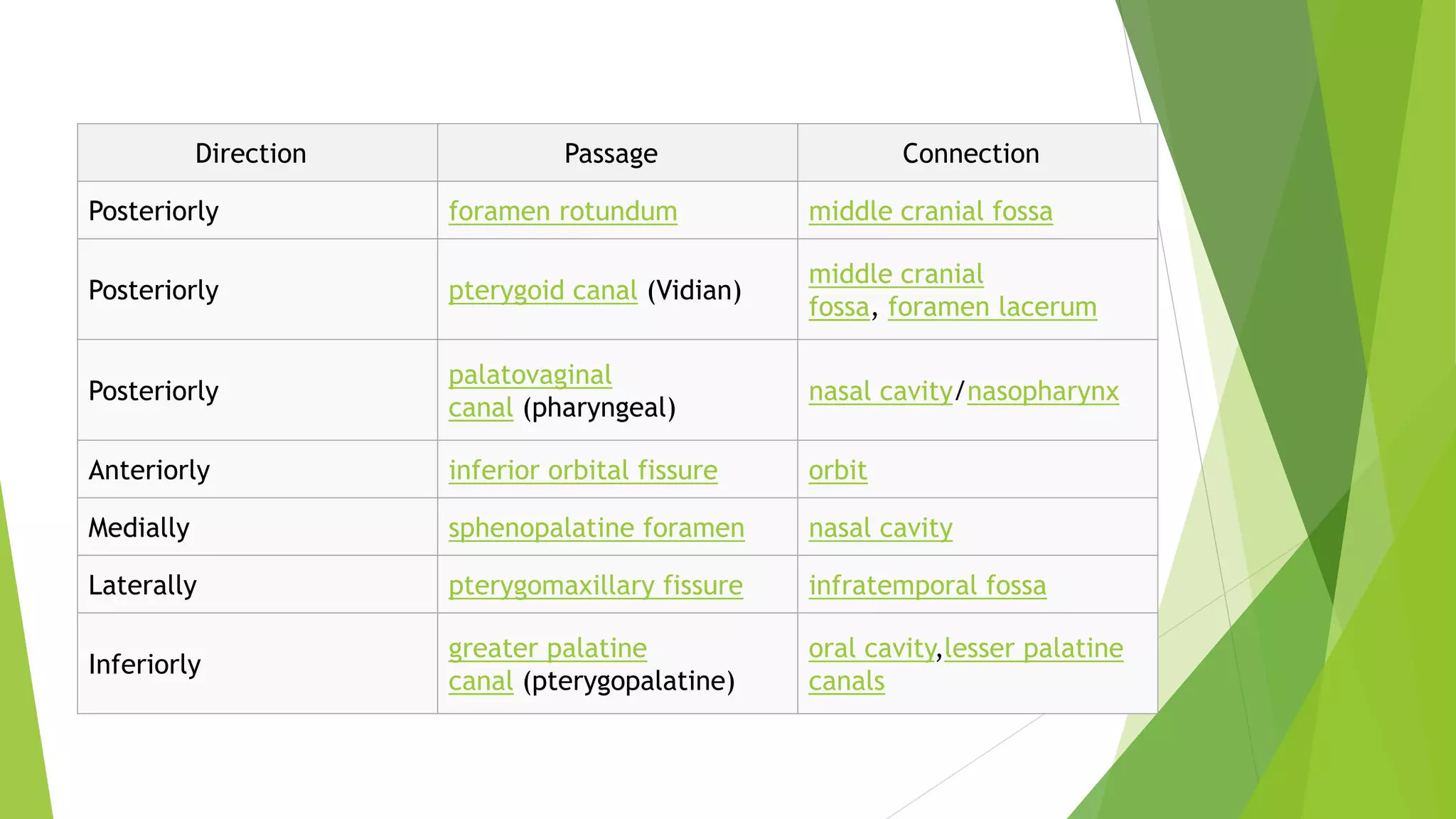
Direction Passage Connection
Posteriorly foramen rotundum middle cranial fossa
Posteriorly pterygoid canal (Vidian)
middle cranial
fossa, foramen lacerum
Posteriorly
palatovaginal
canal (pharyngeal)
nasal cavity/nasopharynx
Anteriorly inferior orbital fissure orbit
Medially sphenopalatine foramen nasal cavity
Laterally pterygomaxillary fissure infratemporal fossa
Inferiorly
greater palatine
canal (pterygopalatine)
oral cavity,lesser palatine
canals
Contents
 The pterygopalatine ganglion suspended by nerve roots from
the Maxillary nerve.
 The terminal third of the Maxillary artery.
 The maxillary nerve (CN V2, the second division of the
trigeminal nerve), with which is the nerve of the pterygoid
canal, a combination of the greater petrosal nerve
(preganglionic parasympathetic) and the deep petroal
nerve (postganglionic sympathetic). To obtain block anesthesia
of the entire second division of the trigeminal nerve, an
intraoral injection can be administered into this area.
1.Pterygopalatine ganglion
• This is located deep within the pterygopalatine fossa close to the sphenopalatine foramen.
• It is a relay station for parasympathetic secretomotor fibres derived from the facial nerve and
destined for the lacrimal gland and the glands of the mucous membranes of the nose, nasopharynx,
paranasal sinuses, palate, and upper lip.
• Most of the fibres are sensory .
• Preganglionic parasympathetic fibres from the superior salivatory nucleus reach the ganglion
through the greater petrosal branch of the facial nerve. This branch fuses with the deep petrosal
nerve from the carotid sympathetic plexus to form the nerve of the pterygoid canal which enters
the pterygopalatine fossa through that canal and unites with the posterior aspect of the ganglion.
• The preganglionic fibres synapse in the ganglion with postganglionic neurons. The latter are
distributed to the glands associated with the mucous membrane of the nose, nasopharynx, and
palate through the nasal, pharyngeal, and palatine branches respectively of the ganglion and to the
lacrimal gland through a complicated pathway comprising the ganglionic branches of the maxillary
nerve, the maxillary nerve itself, its zygomatic and zygomaticotemporal branches, the
communicating branch to the lacrimal nerve and then via the latter nerve to the gland.
 Postganglionic fibres pass to the small glands in the upper lip, upper part of the cheek, and mucous
membrane of the maxillary sinus through the maxillary nerve and its infraorbital continuation.
Postganglionic fibres to the linings of the sphenoidal, ethmoidal, and frontal sinuses run in the small
orbital branches of the pterygopalatine ganglion. The deep petrosal nerve contains postganglionic
sympathetic fibres from the superior cervical ganglion. These are mostly vasoconstrictor in function
and pass through the ganglion without interruption to be distributed in its branches
Branches of the pterygopalatine ganglion
1.Greater palatine nerve leaves the inferior aspect of the ganglion and descends through the greater
palatine canal to emerge through the foramen of the same name on to the oral surface of the hard
palate. It then runs forwards in a groove located approximately halfway between the midline of the
palate and the palatal surface of the posterior teeth to
Supply: The mucous membrane and associated glands of the palate as far forwards as the lateral incisor
region.
The mucous membrane of the posteroinferior quadrant of the lateral wall of the nose.
2. Nasal nerves : Enter the nasal cavity through the sphenopalatine foramen.
Supply :The lateral branches supply the mucous membrane of the posterosuperior quadrant of the lateral
nasal wall.
The medial branches supply the roof and most of the septum.
3.Lesser palatine : also descend in the greater palatine canal but emerge on to the
oral surface of the bony palate through the lesser palatine foramina.
Supply: the mucous membrane of the soft palate and of an area around the
palatine tonsil.
Note: The taste fibres from this region are believed to pass back to the
pterygopalatine ganglion and then travel in the nerve of the pterygoid canal and in
the greater petrosal nerve to the facial nerve.
4.Nasopalatine nerve runs with the medial nasal branches to the septum. It then
turns to run downwards and forwards on the vomer to reach the incisive fossa
through which it passes on to the oral surface of the hard palate.
Supply: small part of the septum and the incisor region of the hard palate
5. Pharyngeal nerve leaves the posterior aspect of the pterygopalatine ganglion
and passes through the palatovaginal canal.
Supply:The mucous membrane of the nasopharynx.
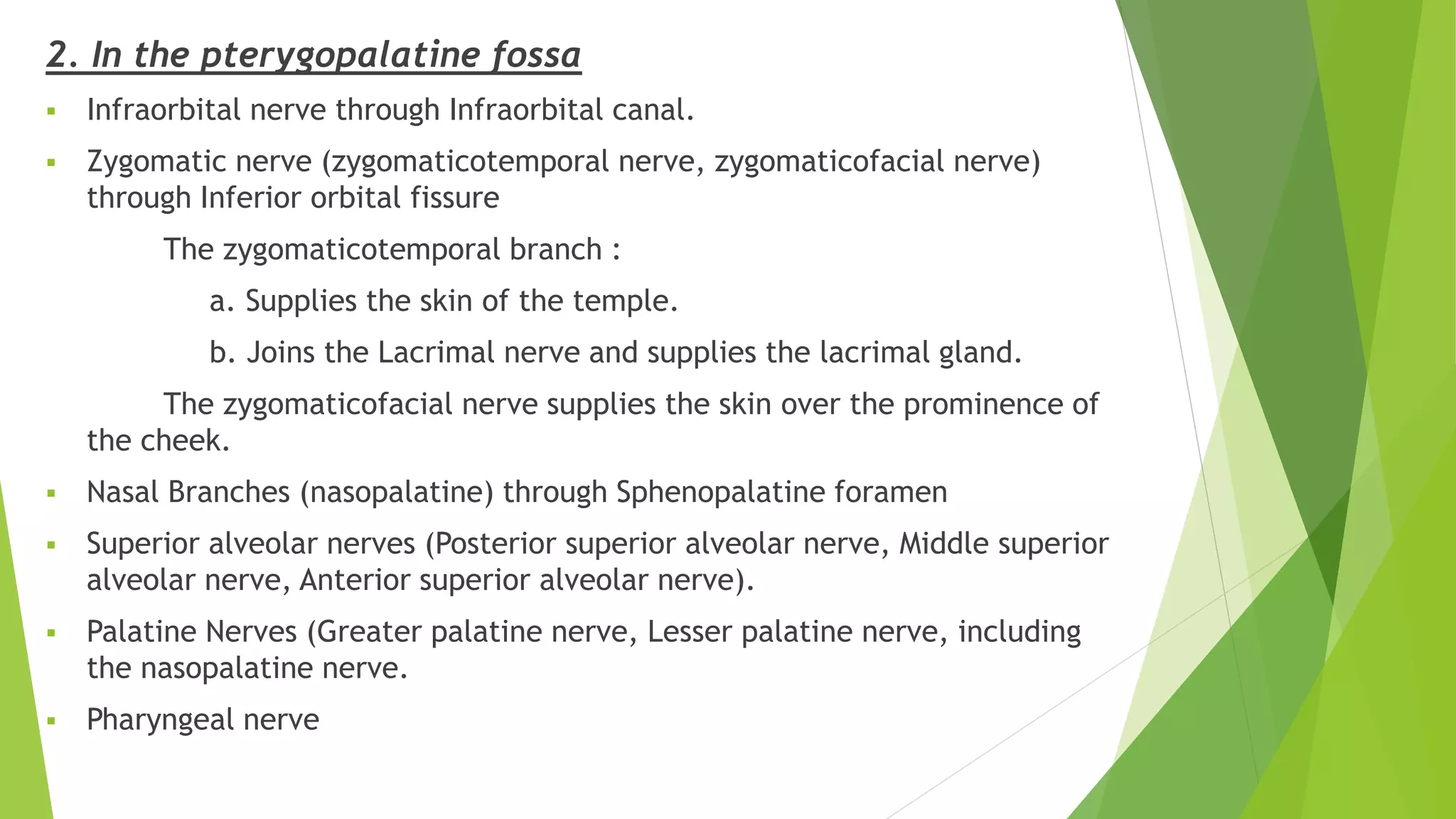
Maxillary Nerve:
 Maxillary nerve is the second of the three branches of the trigeminal nerve.
 It is purely sensory.
 Leaves the skull through foreman Rotundum.
 Recieves sensory innervation from the nose, palate , upper teeth and lower eye
lid.
Branches
 Its branches may be divided into four groups depending on the location it
branches from.
1. In the cranium
Middle meningeal nerve
in the meninges
2. In the pterygopalatine fossa
 Infraorbital nerve through Infraorbital canal.
 Zygomatic nerve (zygomaticotemporal nerve, zygomaticofacial nerve)
through Inferior orbital fissure
The zygomaticotemporal branch :
a. Supplies the skin of the temple.
b. Joins the Lacrimal nerve and supplies the lacrimal gland.
The zygomaticofacial nerve supplies the skin over the prominence of
the cheek.
 Nasal Branches (nasopalatine) through Sphenopalatine foramen
 Superior alveolar nerves (Posterior superior alveolar nerve, Middle superior
alveolar nerve, Anterior superior alveolar nerve).
 Palatine Nerves (Greater palatine nerve, Lesser palatine nerve, including
the nasopalatine nerve.
 Pharyngeal nerve
3. In the infraorbital canal
 Anterior superior alveolar nerve.
 Infraorbital nerve
4.On the face
 Inferior palpebral nerve.
 Superior labial nerve.
 Lateral nasal nerve
Note: The posterior superior alveolar nerves pass through the pterygomaxillary fissure into the
infratemporal fossa.
They then enter the maxilla through the posterior alveolar foramina to supply:
1) The upper molar teeth.
2) The mucous membrane on the buccal surface of the associated alveolar process.
3) The lining of the maxillary sinus.
Posterior superior alveolar block = injecting a local anesthetic solution adjacent to the nerves
as they enter the maxilla.
3.Maxillary artery
 The maxillary artery is the larger of the two terminal branches of the
external carotid artery.
It is divided into three major parts:
 FIRST :
The Mandibular part branches:
A. Deep auricular artery.
B. Anterior tympanic artery.
C. Middle meningeal artery.
D. Inferior alveolar artery which gives off its mylohyoid branch just prior to
entering the mandibular foramen.
E. Accessory meningeal artery.
 SECOND:
The Pterygoid part branches:
A.Masseteric artery.
B.Pterygoid branches
C.Deep temporal arteries (anterior and posterior).
D.Buccal artery
 THIRD:
The Pterygomaxillary part branches:
A. Sphenopalatine artery (Nasopalatine artery is the terminal branch of the
Maxillary artery).
B. Descending palatine artery
C. Infraorbital artery (enters the orbit through inferior orbital fissure).
D. Posterior superior alveolar artery (supplies the upper posterior teeth and
adjacent structures).
E. Artery of pterygoid canal (supplies nasopharynx & tympanic cavity).
F. Pharyngeal artery.
G. Middle superior alveolar artery (a branch of the infraorbital artery).
H. Anterior superior alveolar arteries (a branch of the infraorbital artery).
I. Greater palatine artery
 NOTE: the palatine, nasal, and pharyngeal branches of the third part of
maxillary artery accompany the corresponding branches of the
pterygopalatine ganglion.
 The posterior superior alveolar artery may give rise to a sizeable
buccogingival branch which may anastomose with the infraorbital artery in
the infraorbital region.
 It is usually accompanied by a vein which is a tributary of the facial vein.
 The artery and vein lie immediately adjacent to periosteum, and may be
at risk of being punctured in injections to obtain anaesthesia of the
maxillary teeth.
 The veins accompanying these branches of the maxillary artery emerge
from the pterygopalatine fossa through the pterygomaxillary fissure and
drain into the pterygoid plexus.
The End
Thank You

Anatomy(2) The skull and face The temporal region Infratemporal and pterygopalatine fossae

  • 1.
    Anatomy  The skulland face  The temporal region  Infratemporal and pterygopalatine fossae Done by : Dr. Noor B. Najjar
  • 2.
    Scalp Scalp : Skin: thick,hair bearing and contains numerous sebaceous gland. Connective Tissue: fibro-fatty, highly vascular layer, uniting the skin to underlying aponeurosis of the occiptofrontalis muscle Aponeurosis ( Epicranial ): thin, tendinous sheet that unites the occipital and frontal bellies of the occiptofrontalis muscle. Loose subaponeurotic layer: occupy the subaponeurotic space.Connect aponeurosis to the pericranium Pericranium: Periosteum covering outer surface of the skull bones
  • 4.
    Muscles of thescalp Occiptofrontalis muscle Origion: 2 occipital bellies each arise from highest nuchal line on occipital bone 2 Frontal belly arise from the skin of eyebrow.(from anterior lateral margin of the aponeurosis) Connected over the cranial vault by the epicranial aponeurosis. Insertion: the skin of the corresponding eyebrow and into the orbicularis oculi muscle Nerve supply: Occipital belly by Posterior Auricular branch of Facial nerve, Frontal belly by temporal branch of Facial nerve. Action: Moving forward or backward first 3 layers of scalp, frontal belly raise the eyebrow in expression of surprise or horror.  Epicranial aponeurosis A sheet of strong connective tissue which covers the vertex of the skull between the occipital and frontal bellies. It is firmly attached to the skin of the scalp by the dense subcutaneous layer Laterally it fades out above the ears.
  • 6.
    Sensory Nerve supply Supratrochlear Nerve: branch of ophthalmic division of trigeminal nerve Supply: The forehead and front of scalp  Supraorbital Nerve: branch of ophthalmic division of trigeminal nerve Supply: The forehead and front of scalp  Auriculotemporal nerve: branch of mandibular division of trigeminal nerve Supply: Temple region  Lesser occipital nerve: branch of cervical plexus Supply: region above and behind the ear  Greater occipital nerve: branch of posterior ramus of second cervical nerve Supply: Posterior part of scalp
  • 7.
    Arterial supply andvenous drainage  Supratrochlear and supraorbital arteries / veins  Superficial temporal Artery / vein  Posterior auricular artery/ vein  Occipital artery / vein They run in the subcutaneous layer, they have very tortuous courses and anastomose freely with each other
  • 9.
    Lymph drainage ofthe skull Anterior part submandibular lymph nodes Lateral Part superficial parotid nodes Back of scalp occipital nodes Above and behind the ear mastoid nodes
  • 10.
    The Face  Sensoryinnervation Skin of the face is supplied by all branches of trigeminal nerve except area over the mandible and parotid area which is supplied by greater auricular nerve Trigeminal Nerve divisions 1. Opthalmic nerve - lacrimal nerve - Supraorbital nerve - Supratrochlear nerve - Infratrochlear nerve - External nasal nerve 2. Maxillary Nerve - Infraorbital nerve - zygomaticofacial nerve - Zygomaticotemporal nerve 3. Mandibular nerve - mental nerve - Buccal nerve - Auriculotempoarl nerve
  • 11.
    Arterial supply offace From 2 main vessels : facial and superficial temporal arteries  Branches of facial artery Branches of temporal arteries 1. submental artery 1.transverse facial artery 2. inferior labial artery 3. superior labial artery 4. lateral nasal artery  Supraorbital and Supratrochlear arteries branches of ophthalmic artery.
  • 13.
    Venous Drainage ofthe face  Facial vein Its formed at the angle of the eye by the union of supraorbital and supratrochlear veins. It is connected to the superior ophthalamic vein directly through the supraorbital vein. Connected to cavernous sinus by superior ophthalamic vein. Note : This connection is of great importance because it provides path of spread of infection from the face to the cavernous sinus. Then the facial vein descend behind the facial artery to the lower margin of the body of the mandible. It then crosses superficially to the submandibular gland and is joined by the anterior division retromandibular vein. The facial vein ends by draining into the internal jugular vein.
  • 15.
     Facial veinreceive tributaries from that correspond to the branches of the facial artery.  Its joined to the pterygoid venous plexus by the deep facial vein and to the cavernous sinus by the superior ophthalmic vein.  The transverse facial vein joins the superficial temporal vein with in the parotid gland.
  • 16.
    Lymph drainage ofthe face  Forehead and anterior part submandibular lymph nodes  Lateral part lymph vessels that end in the parotid lymph nodes  Central part of lower lip and skin of chin submental lymph nodes
  • 17.
    Bones of theface It is made of : 1. frontal bone: area above superior alveolar margin It contain frontal air sinuses 2. Zygomatic bone: forms lateral orbital margin 3. Maxilla bone: forms inferior orbital margin with zygomatic bone It is the most important central bone of middle third of the face, contain teeth and maxillary air sinuses Medial orbital margin is formed by maxillary process of frontal bone and frontal process of the maxilla 4. Nasal bones: forms roots of the nose 5. Mandible bone: forms lower third of the face with its teeth.
  • 19.
    Muscles of theface/ superficial muscles  Are derived from the mesoderm of the second pharyngeal arch and receive motor innervation from the facial nerve.  No deep fascia in the face.  There are several small muscles associated with the external ears, these are derived from the second pharyngeal arch and are innervated by the facial nerve. They are virtually functionless in man.
  • 20.
    Muscles of facialexpression  Muscles of eye orbit 1.Orbicularis oculi: the sphincter muscle palpebral part orbital part origin: medial palpebral ligament medial palpebral ligament and adjoining bone insertion: lateral palpebral raphe loops return to origin action: closes eye and dilate lacrimal sac throws skin around orbital into fold to protect the eyeball nerve supply: Facial nerve facial nerve 2. Levator palpebrae superior: the dilator muscle 3. Occiptofrontalis  Muscles of nostrils 1. Dilator Naris 2. Compressor naris origin: Maxilla frontal process of maxilla Insertion: Ala of nose aponeurosis of bridge of nose action: widen nasal aperture compress mobile cartilage nerve supply: Facial nerve facial nerve
  • 21.
     Muscles oflips Sphincter muscle of the lips Orbicularis oris Origin: Near midline on anterior surface of maxilla and mandible and modiolus at angle of mouth Inserion: Mucous membrane of margin of lips and raphe with buccinator at modiolus Action: Narrows orifice of mouth, purses lips and puckers lip edges Nerve: buccal and mandibular branches of the facial nerve Dilator muscles of the lips 1.Levator labii superioris alaque nasi 2.Levator labii superioris 3. Zygomatic minor 4. Zygomatic major 5.Risoris 6.Levator Anguli oris 7. Depressor anguli oris 8. Depressor labii inferiors 9. Mentalis arise from bones and fascia around the oral aperture and insert into substance of the lip Supplied by Facial nerve
  • 23.
    Muscles of cheeks Buccinator Muscle Origin: From maxilla and mandible adjacent to the molar teeth and from pterygomandibular raphe and pterygoid hamulus behind the last molar teeth Nerve: Motor innervation is from the buccal branch of the Facial nerve. Sensory innervation is supplied by the buccal branch of the mandibular part of the trigeminal Action: Compress the cheeks and lips against the teeth (in blowing and whistling)
  • 24.
     Muscles ofMastication Derived from mesoderm of first pharyngeal arch 1. Masseter The masseter muscle is the most powerful muscle of mastication. It is quadrangular in shape. Made of 3 layers: - Superficial layer: largest component of the muscle arise by strong aponeurosis from anterior two third of the zygomatic arch and inserted to the lateral surface of lower half of the ramus, including the angle of the mandible. -Middle layer: from the medial surface of the anterior two third and lower border of posterior one third of the arch; and inserted into the lateral surface of the middle part of the ramus. - The deep layer : originates from the zygomatic arch of the temporal bone. And inserted to upper part of the mandibular ramus. These3 layers are distinctive posterior and fuse anteriorly. Actions: Elevates the mandible, closing the mouth. Innervation: massetric branch of anterior division of the Mandibular nerve (V3). Blood supply: Facial artery
  • 26.
    2. Temporalis muscle Thetemporalis muscle originates from the temporal fossa – a shallow depression on the lateral aspect of the skull. The muscle is covered by tough fascia, this can harvested surgically, and used to repair a perforated tympanic membrane (an operation known as a myringoplasty). Attachments: Originates from the temporal fossa. It condenses into a tendon, which inserts onto the coronoid process of the mandible. Actions: Elevates the mandible, closing the mouth. Also retracts the mandible, pulling the jaw posteriorly. Innervation: Mandibular nerve (V3)
  • 27.
    3. Lateral pterygoid Thelateral pterygoid muscle has a triangular shape, with two heads; superior and inferior. It has horizontally orientated muscle fibres, and thus is the major protractor of the mandible. Attachments: The superior head originates from the greater wing of the sphenoid. The inferior head originates from the lateral pterygoid plate of the sphenoid. The two heads converge into a tendon, which attaches to the neck of the mandible. Actions: Acting bilaterally, the lateral pterygoids protract the mandible, pushing the jaw forwards. Unilateral action produces the ‘side to side’ movement of the jaw. Innervation: Mandibular nerve (V3).
  • 28.
    4.Medial Pterygoid The medialpterygoid muscle has a quadrangular shape, with two heads; deep and superficial. It is located inferiorly to the lateral pterygoid. Attachments: The superficial head originates from the maxillary tuberisty and neighbouring part of palatine bone. The deep head originates from the lateral pterygoid plate of the sphenoid bone. Both parts attach to the ramus of the mandible, near the angle of mandible. Actions: Elevates the mandible, closing the mouth Innervation: Mandibular nerve (V3). Pterygomandibular space: the gap between the muscle and medial surface of the ramus above the insertion
  • 30.
    Pterygomandibular space andanatomy of inferior alveolar block  Pterygomandibular space: It is a potential space in the head and is paired on each side.  Contents of the Pterygomandibular space:  The mandibular division of the trigeminal nerve which divides into many branches including the Inferior alveolar nerve.  The inferior alveolar artery and vein.  The sphenomandibular ligament.
  • 31.
    Boundaries of eachpterygomandibular space are: The posterior border of the buccal space anteriorly. The parotid gland posteriorly. The lateral pterygoid muscle superiorly. The inferior border of the mandible (lingual surface) inferiorly. The medial pterygoid muscle medially (the space is superficial to medial pterygoid). The ascending ramus of the mandible laterally (the space is deep to the ramus of the mandible).
  • 32.
    A Temporalis muscle, BMasseter muscle, C Lateral pterygoid muscle, D Medial ptaerygoid muscle, E Superficial temporal space, F Deep temporal space, G Submasseteric space, H Pterygomandibular space, I Approximate location of infratemporal space.
  • 33.
    Note: The Onlyway to anesthetize the mandibular teeth is to anesthetize the main trunk of inferior alveolar nerve when it’s in the pterygomandibular space before it enters the mandibular canal. Because mandibular bone is dense therefore the local anesthetic can’t diffuse through it.
  • 34.
     Stylohyoid ligament The styloid process ossifies in the dorsal part of the cartilage of the second pharyngeal arch.  The lesser cornu and upper part of the body of the hyoid bone ossify in the ventral part of this cartilage. The intervening part atrophies but its perichondrium persists as the stylohyoid ligament, a well defined cord of fibrous tissue which runs from the tip of the styloid process to the apex of the lesser cornu of the hyoid bone.  Stylohyoid muscle Origin: The stylohyoid muscle arises from the posterior surface of the styloid process. It runs downwards and forwards crossing superficial to the external carotid artery before the latter structure enters the parotid gland. A short distance above the hyoid bone the muscle divides into two slips which pass one either side of the intermediate tendon of the digastric muscle to be i Inserted As 2 tendinous slips that pass on either side of the intermediate tendon of digastric. Innervation: Facial nerve. Action: Elevate the hyoid.  The muscle is derived from the second pharyngeal arch.
  • 35.
     Styloglossus muscle Origin:from the anterior aspect of the lower part of the styloid process and of the neighbouring part of the stylohyoid ligament.  Stylopharyngeus muscle Origin: Arises from the medial surface of the styloid process. It runs almost vertically downwards, passes between the internal and external carotid arteries, crosses the lower border of the superior constrictor muscle and then continues downwards inside the middle constrictor, beneath the pharyngeal mucous membrane Insertion: Into the posterior border of the thyroid cartilage and the side wall of the pharynx. Innervation: The glossopharyngeal nerve.  Styloid apparatus The styloid process is a curved bony spine, of variable length, which projects downwards and somewhat forwards from the inferior surface of the temporal bone and lateral to the internal carotid artery. Its upper part (the base) is fused with the tympanic plate. Its lower part gives attachment to two ligaments and three muscles.
  • 36.
    Sphenomandibular ligament  Thisis a well-developed band of fibrous tissue which extends from the spine of the sphenoid to the lingula of the mandible and the adjacent margin of the mandibular foramen.  As it passes downwards and forwards it is separated from the neck of the mandible by the maxillary vessels while more inferiorly (in the pterygomandibular space) it is separated from the ramus of the mandible by the inferior alveolar nerve and vessels.  Medially relation: to the pharyngeal wall above and to the medial pterygoid muscle below.  The ligament is pierced near to its attachment to the lingula by the mylohyoid nerve and vessels.  Developmentally, the sphenomandibular ligament is a remnant of Meckel's cartilage.
  • 37.
    Temporal Region  Issituated on the side of the head.  The temporal lobe is one of the four Major lobes of the cerebral cortex in the brain of mammals. The temporal lobe is located beneath the lateral fissure on both cerebral hemispheres of the brain.  The temporal lobes are involved in processing sensory input into derived meanings for the appropriate retention of visual memories, language comprehension. 1.Temporal Fossa  Medial: Frontal bone, Parietal bone, Temporal bone, Sphenoid bone, Occipital bone.  Lateral: Temporal fascia.  Anterior: Posterior surface of the frontal process of the zygomatic bone and the posterior surface of the zygomatic process of the frontal bone.  Superior: Pair of temporal lines (superior and inferior temporal lines) that arch across the skull from the zygomatic process of the frontal bone to the supramastoid crest of the temporal bone.  Inferior: Zygomatic arch laterally and by the infratemporal crest of the greater wing of the sphenoid medially. Content: It is occupied by the temporalis muscle and its covering fascia, the deep temporal nerves and vessels, the auriclotemporal nerve, and the superficial temporal artery.
  • 39.
    Parotid gland  Thelargest of the salivary glands, is mainly serous but contains a few scattered mucous acini. Location: lies below the external acoustic meatus wedged between the mandibular ramus in front and the mastoid process and sternocleidomastoid muscle behind. Structure: facial nerve pass through it and divides it into deep and superficial parts/lobes. 1. Glenoid lobe: Superior margin extend upward behind the TMJ into posterior part of mandibular fossa. 2. Facial process: Anterior margin of the gland extend forward superficial to the masseter muscle. 3. Accessory part of the gland: small part of the facial process may be separate from the main gland. 4. Pterygoid process: Deep part of the gland may extend forward between the medial pterygoid muscle and the ramus of the mandible.  Parotid duct: The duct draining the gland begins by the confluence of tributaries within the anterior part of the gland. It emerges from the anterior border of the gland and runs forwards across masseter below the accessory part of the gland. At the front edge of masseter it turns medially, pierces buccinator and opens on the oral surface of the crown of the second upper molar.
  • 40.
    Structures within theParotid gland Three major non-glandular structures traverse the gland. From deep to superficial these are as follows 1. External carotid artery enters the gland through the lower part of its posteromedial surface. Within the gland the artery divides into its two terminal branches - the maxillary artery which leaves the gland through its anteromedial surface and the superficial temporal artery which leaves through the upper part of the superficial surface. 2. Retromandibular vein is formed within the gland, by the union of maxillary and superficial temporal veins. It runs downwards lateral to the external carotid artery and in the lower part of the gland or after emerging from there splits into anterior and posterior divisions. The posterior division joins the posterior auricular vein to form the external jugular vein; the anterior division joins the facial vein. 3. Facial nerve enters the upper part of the posteromedial surface of the gland, runs forwards, superficial to the retromandibular vein, and divides into five branches which leave the anteromedial surface of the gland to supply the muscles of facial expression. Connections between these branches form a network called the parotid plexus. The auriculotemporal nerve, as it passes behind the temporomandibular joint runs through the glenoid lobe of the parotid gland or within its covering fascia. 4. Parotid group of lymph nodes.
  • 41.
    Innervation Parasympathetic supply. The preganglionicfibres begin in the inferior salivatory nucleus in the medulla, leaving the brainstem in the glossopharyngeal nerve and pass through its tympanic branch, the tympanic plexus, and the lesser petrosal nerve to the otic ganglion where they synapse with postganglionic fibres which pass to the gland in the auriculotemporal nerve.  Stimulation of the parasympathetic innervation leads to the production of copious saliva rich in mucus and enzymes. Sympathetic supply From the superior cervical ganglion of the sympathetic trunk. Postganglionic neurons travel from the ganglion to the gland in the plexus on the external carotid artery. The preganglionic neurons which relay in the ganglion begin in the upper thoracic segments of the spinal cord.  Stimulation of Sympathetic stimulation results in a reduced secretion of saliva which is low in organic content. Note : The facial nerve, which passes through the gland, does not supply it.
  • 42.
    Blood supply :External carotid artery and the branches given off within the gland. Venous drainage : External jugular vein. Lymph drains : Parotid nodes and thence to the deep cervical nodes.
  • 43.
    Infratemporal fossa Is anirregularly shaped cavity, situated below and medial to the zygomatic arch. Boundaries defined by:  Anteriorly, by the infratemporal surface of the maxilla and the ridge which descends from its zygomatic process.  Posteriorly, by the articular tubercle of the temporal and the spina angularis of the sphenoid.  Superiorly, by the greater wing of sphenoid below the infratemporal crest, and by the under surface of the temporal squama, containing the foramen ovale, which transmits the mandibular branch of the trigeminal nerve, and the foramen spinosum, which transmits the middle meningeal artery.  Inferiorly, by the medial pterygoid muscle attaching to the mandible.  Medially, by the lateral pterygoid plate.  Laterally, by the ramus of mandilbe, which contains the mandibular foramen , leading to the mandibular canal through which the inferior alveolar nerve passes. This also contains the lingula, a triangular piece of bone that overlies the mandibular foramen antero-medially. Finally, the mylohyoid groove descends obliquely transmitting the mylohyoid nerve the only motor branch of the posterior division of the trigeminal nerve.
  • 44.
    Content: Its occupied bythe lateral and medial pterygoid muscles, branches of the mandibular nerve, the otic ganglion, the chorda tympani, the maxillary artery, and the pterygoid venous plexus. Note: Temporal Fossa and the Infratemporal fossa communicate with each other deep in the zygomatic arch.
  • 45.
    Otic ganglion  Belowforamen ovale  It receive preganglionic parasympathetic fibers from the inferior salivatory nucleus via glossopharyngeal nerve and its lesser petrosal branch. These fibers synapses with postganglionic fibers which pass by communicating branch to the auriculotemporal nerve and thence to the parotid gland to which they are secremotor .  A few postganglionic fibers pass to the main trunk of mandibular nerve to be distributed through the inferior alveolar and buccal nerves to the mucosa glands in the lower lip and cheeks.  It receive sympathetic root from the plexuses on the middle meningeal artery, this contain postganglionic fibers from the superior cervical ganglion.  It receive a branch from the nerve to medial pterygoid. These fibers supply the tensor veli palatini and tensor tympani.
  • 46.
    Pterygopalatine fossae/ sphenopalatinefossa  It is a cone-shaped paired depression deep to the infratemporal fossa and posterior to the maxilla on each side of the skull, located between the pterygoid process and the maxillary tuberosity, close to the apex of the orbit. It is the indented area medial to the pterygomaxillary fissure leading into the sphenopalatine foramen. It communicates with the nasal and oral cavities, infratemporal fossa, orbit, pharynx, and middle cranial fossa through eight foramina It has the following boundaries:  Anterior: Superomedial part of the infratemporal surface of maxilla.  Posterior: Root of the pterygoid process and adjoining anterior surface of the greater wing of sphenoid bone.  Medial: Perpendicular plate of the palatine bone and its orbital and sphenoidal process  Lateral: Pterygomaxillary fissure .  Inferior: Part of the floor is formed by the pyramidal process of the palatine bone.
  • 47.
    Direction Passage Connection Posteriorlyforamen rotundum middle cranial fossa Posteriorly pterygoid canal (Vidian) middle cranial fossa, foramen lacerum Posteriorly palatovaginal canal (pharyngeal) nasal cavity/nasopharynx Anteriorly inferior orbital fissure orbit Medially sphenopalatine foramen nasal cavity Laterally pterygomaxillary fissure infratemporal fossa Inferiorly greater palatine canal (pterygopalatine) oral cavity,lesser palatine canals
  • 48.
    Contents  The pterygopalatineganglion suspended by nerve roots from the Maxillary nerve.  The terminal third of the Maxillary artery.  The maxillary nerve (CN V2, the second division of the trigeminal nerve), with which is the nerve of the pterygoid canal, a combination of the greater petrosal nerve (preganglionic parasympathetic) and the deep petroal nerve (postganglionic sympathetic). To obtain block anesthesia of the entire second division of the trigeminal nerve, an intraoral injection can be administered into this area.
  • 49.
    1.Pterygopalatine ganglion • Thisis located deep within the pterygopalatine fossa close to the sphenopalatine foramen. • It is a relay station for parasympathetic secretomotor fibres derived from the facial nerve and destined for the lacrimal gland and the glands of the mucous membranes of the nose, nasopharynx, paranasal sinuses, palate, and upper lip. • Most of the fibres are sensory . • Preganglionic parasympathetic fibres from the superior salivatory nucleus reach the ganglion through the greater petrosal branch of the facial nerve. This branch fuses with the deep petrosal nerve from the carotid sympathetic plexus to form the nerve of the pterygoid canal which enters the pterygopalatine fossa through that canal and unites with the posterior aspect of the ganglion. • The preganglionic fibres synapse in the ganglion with postganglionic neurons. The latter are distributed to the glands associated with the mucous membrane of the nose, nasopharynx, and palate through the nasal, pharyngeal, and palatine branches respectively of the ganglion and to the lacrimal gland through a complicated pathway comprising the ganglionic branches of the maxillary nerve, the maxillary nerve itself, its zygomatic and zygomaticotemporal branches, the communicating branch to the lacrimal nerve and then via the latter nerve to the gland.
  • 50.
     Postganglionic fibrespass to the small glands in the upper lip, upper part of the cheek, and mucous membrane of the maxillary sinus through the maxillary nerve and its infraorbital continuation. Postganglionic fibres to the linings of the sphenoidal, ethmoidal, and frontal sinuses run in the small orbital branches of the pterygopalatine ganglion. The deep petrosal nerve contains postganglionic sympathetic fibres from the superior cervical ganglion. These are mostly vasoconstrictor in function and pass through the ganglion without interruption to be distributed in its branches Branches of the pterygopalatine ganglion 1.Greater palatine nerve leaves the inferior aspect of the ganglion and descends through the greater palatine canal to emerge through the foramen of the same name on to the oral surface of the hard palate. It then runs forwards in a groove located approximately halfway between the midline of the palate and the palatal surface of the posterior teeth to Supply: The mucous membrane and associated glands of the palate as far forwards as the lateral incisor region. The mucous membrane of the posteroinferior quadrant of the lateral wall of the nose. 2. Nasal nerves : Enter the nasal cavity through the sphenopalatine foramen. Supply :The lateral branches supply the mucous membrane of the posterosuperior quadrant of the lateral nasal wall. The medial branches supply the roof and most of the septum.
  • 51.
    3.Lesser palatine :also descend in the greater palatine canal but emerge on to the oral surface of the bony palate through the lesser palatine foramina. Supply: the mucous membrane of the soft palate and of an area around the palatine tonsil. Note: The taste fibres from this region are believed to pass back to the pterygopalatine ganglion and then travel in the nerve of the pterygoid canal and in the greater petrosal nerve to the facial nerve. 4.Nasopalatine nerve runs with the medial nasal branches to the septum. It then turns to run downwards and forwards on the vomer to reach the incisive fossa through which it passes on to the oral surface of the hard palate. Supply: small part of the septum and the incisor region of the hard palate 5. Pharyngeal nerve leaves the posterior aspect of the pterygopalatine ganglion and passes through the palatovaginal canal. Supply:The mucous membrane of the nasopharynx.
  • 52.
    Maxillary Nerve:  Maxillarynerve is the second of the three branches of the trigeminal nerve.  It is purely sensory.  Leaves the skull through foreman Rotundum.  Recieves sensory innervation from the nose, palate , upper teeth and lower eye lid. Branches  Its branches may be divided into four groups depending on the location it branches from. 1. In the cranium Middle meningeal nerve in the meninges
  • 53.
    2. In thepterygopalatine fossa  Infraorbital nerve through Infraorbital canal.  Zygomatic nerve (zygomaticotemporal nerve, zygomaticofacial nerve) through Inferior orbital fissure The zygomaticotemporal branch : a. Supplies the skin of the temple. b. Joins the Lacrimal nerve and supplies the lacrimal gland. The zygomaticofacial nerve supplies the skin over the prominence of the cheek.  Nasal Branches (nasopalatine) through Sphenopalatine foramen  Superior alveolar nerves (Posterior superior alveolar nerve, Middle superior alveolar nerve, Anterior superior alveolar nerve).  Palatine Nerves (Greater palatine nerve, Lesser palatine nerve, including the nasopalatine nerve.  Pharyngeal nerve
  • 54.
    3. In theinfraorbital canal  Anterior superior alveolar nerve.  Infraorbital nerve 4.On the face  Inferior palpebral nerve.  Superior labial nerve.  Lateral nasal nerve Note: The posterior superior alveolar nerves pass through the pterygomaxillary fissure into the infratemporal fossa. They then enter the maxilla through the posterior alveolar foramina to supply: 1) The upper molar teeth. 2) The mucous membrane on the buccal surface of the associated alveolar process. 3) The lining of the maxillary sinus. Posterior superior alveolar block = injecting a local anesthetic solution adjacent to the nerves as they enter the maxilla.
  • 55.
    3.Maxillary artery  Themaxillary artery is the larger of the two terminal branches of the external carotid artery. It is divided into three major parts:  FIRST : The Mandibular part branches: A. Deep auricular artery. B. Anterior tympanic artery. C. Middle meningeal artery. D. Inferior alveolar artery which gives off its mylohyoid branch just prior to entering the mandibular foramen. E. Accessory meningeal artery.
  • 56.
     SECOND: The Pterygoidpart branches: A.Masseteric artery. B.Pterygoid branches C.Deep temporal arteries (anterior and posterior). D.Buccal artery
  • 57.
     THIRD: The Pterygomaxillarypart branches: A. Sphenopalatine artery (Nasopalatine artery is the terminal branch of the Maxillary artery). B. Descending palatine artery C. Infraorbital artery (enters the orbit through inferior orbital fissure). D. Posterior superior alveolar artery (supplies the upper posterior teeth and adjacent structures). E. Artery of pterygoid canal (supplies nasopharynx & tympanic cavity). F. Pharyngeal artery. G. Middle superior alveolar artery (a branch of the infraorbital artery). H. Anterior superior alveolar arteries (a branch of the infraorbital artery). I. Greater palatine artery
  • 58.
     NOTE: thepalatine, nasal, and pharyngeal branches of the third part of maxillary artery accompany the corresponding branches of the pterygopalatine ganglion.  The posterior superior alveolar artery may give rise to a sizeable buccogingival branch which may anastomose with the infraorbital artery in the infraorbital region.  It is usually accompanied by a vein which is a tributary of the facial vein.  The artery and vein lie immediately adjacent to periosteum, and may be at risk of being punctured in injections to obtain anaesthesia of the maxillary teeth.  The veins accompanying these branches of the maxillary artery emerge from the pterygopalatine fossa through the pterygomaxillary fissure and drain into the pterygoid plexus.
  • 59.