Nerves and the Nervous System 
Oral Implications and Dental Considerations 
 Nerves and how they work 
 Overview of the different Nervous Systems 
 Cranial Nerves 
 Focus on Facial and Trigeminal Nerves 
 Nervous System Disorders 
 Clinical Considerations: Anesthesia 
 Case Study: Multiple Sclerosis
Nerves 
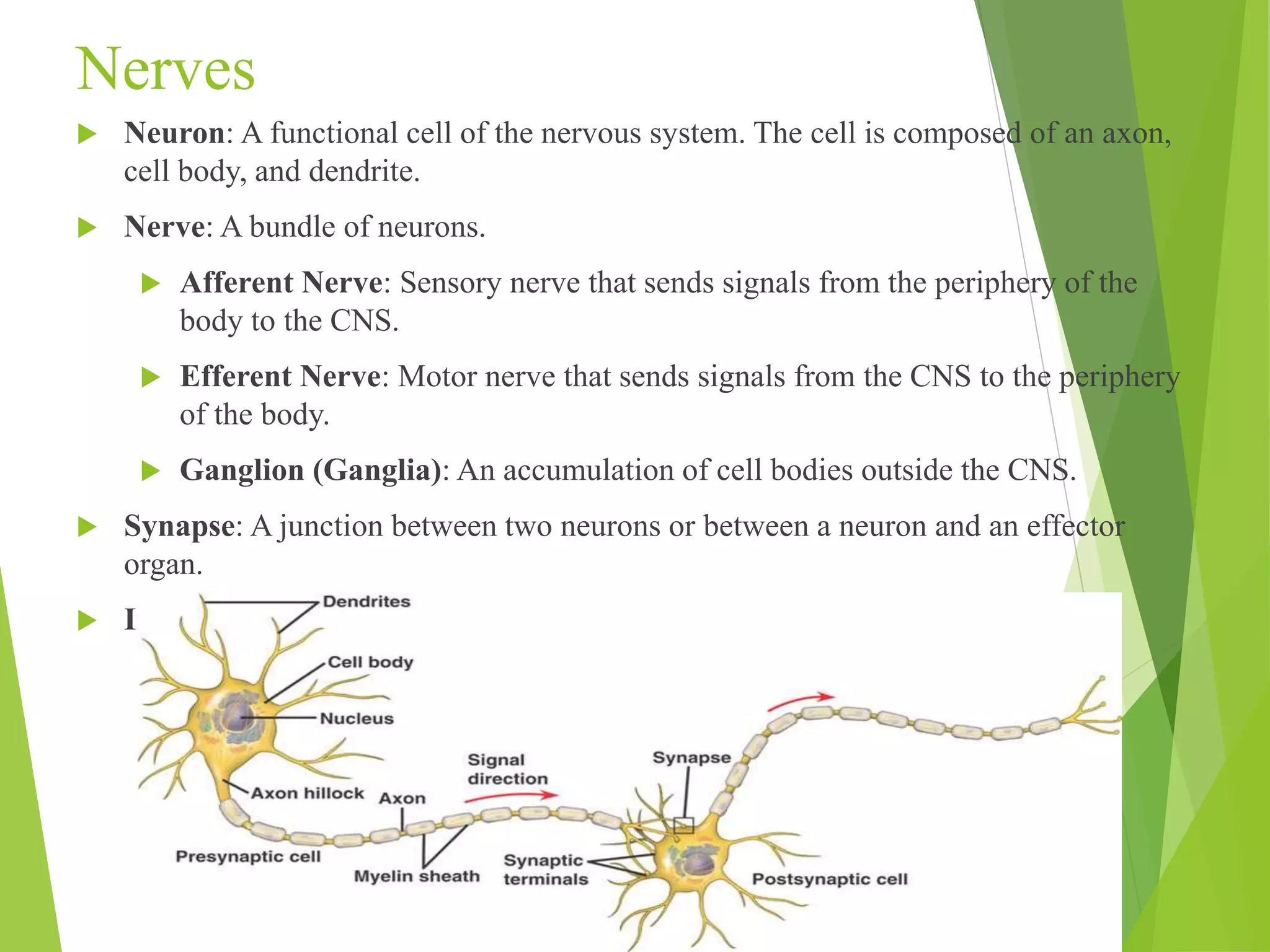
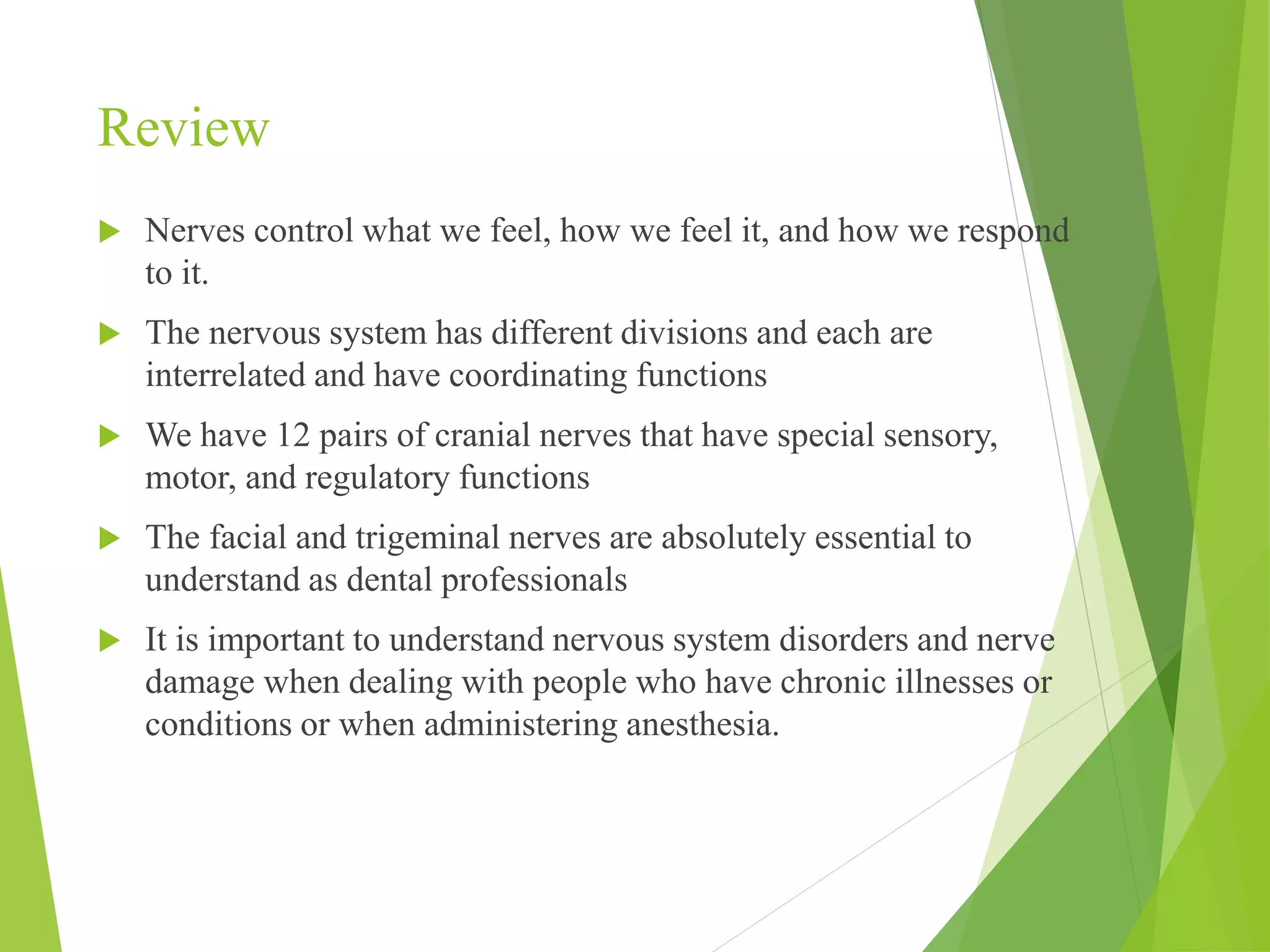
 Neuron: A functional cell of the nervous system. The cell is composed of an axon, 
cell body, and dendrite. 
 Nerve: A bundle of neurons. 
 Afferent Nerve: Sensory nerve that sends signals from the periphery of the 
body to the CNS. 
 Efferent Nerve: Motor nerve that sends signals from the CNS to the periphery 
of the body. 
 Ganglion (Ganglia): An accumulation of cell bodies outside the CNS. 
 Synapse: A junction between two neurons or between a neuron and an effector 
organ. 
 Innervaition: A supply of nerves to a body part.
How Nerves Work 
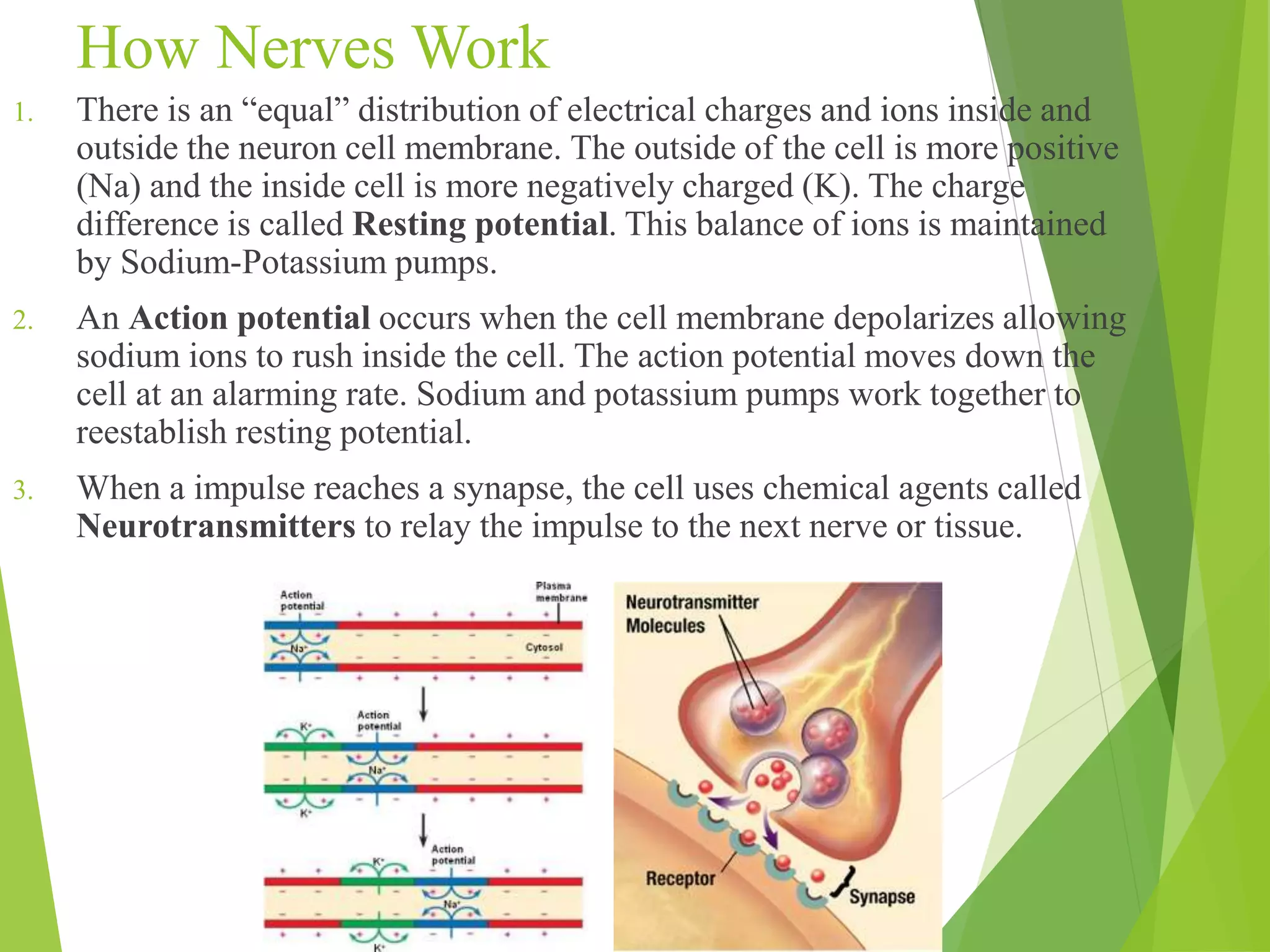
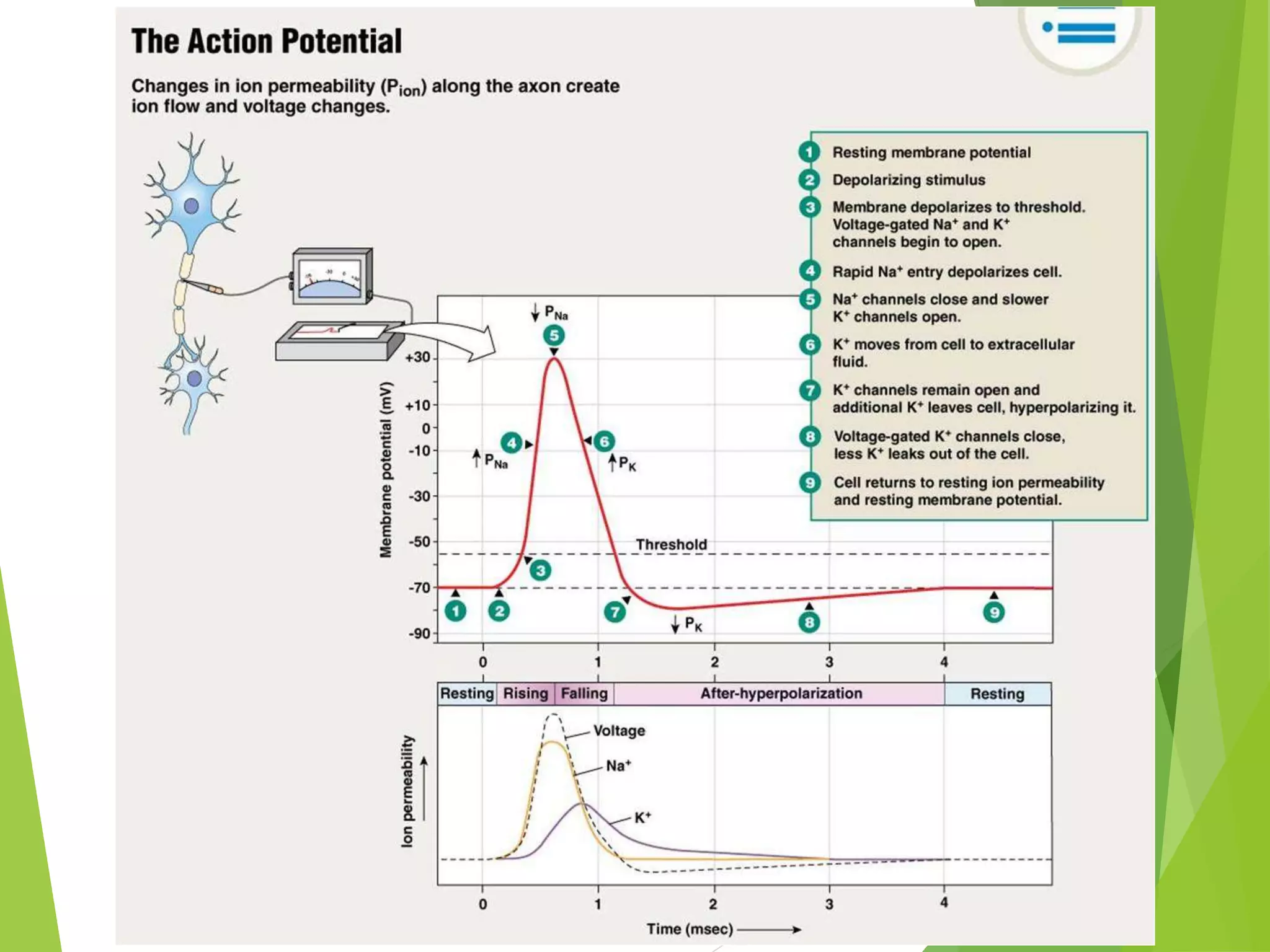
1. There is an “equal” distribution of electrical charges and ions inside and 
outside the neuron cell membrane. The outside of the cell is more positive 
(Na) and the inside cell is more negatively charged (K). The charge 
difference is called Resting potential. This balance of ions is maintained 
by Sodium-Potassium pumps. 
2. An Action potential occurs when the cell membrane depolarizes allowing 
sodium ions to rush inside the cell. The action potential moves down the 
cell at an alarming rate. Sodium and potassium pumps work together to 
reestablish resting potential. 
3. When a impulse reaches a synapse, the cell uses chemical agents called 
Neurotransmitters to relay the impulse to the next nerve or tissue.
Central Nervous System (CNS) 
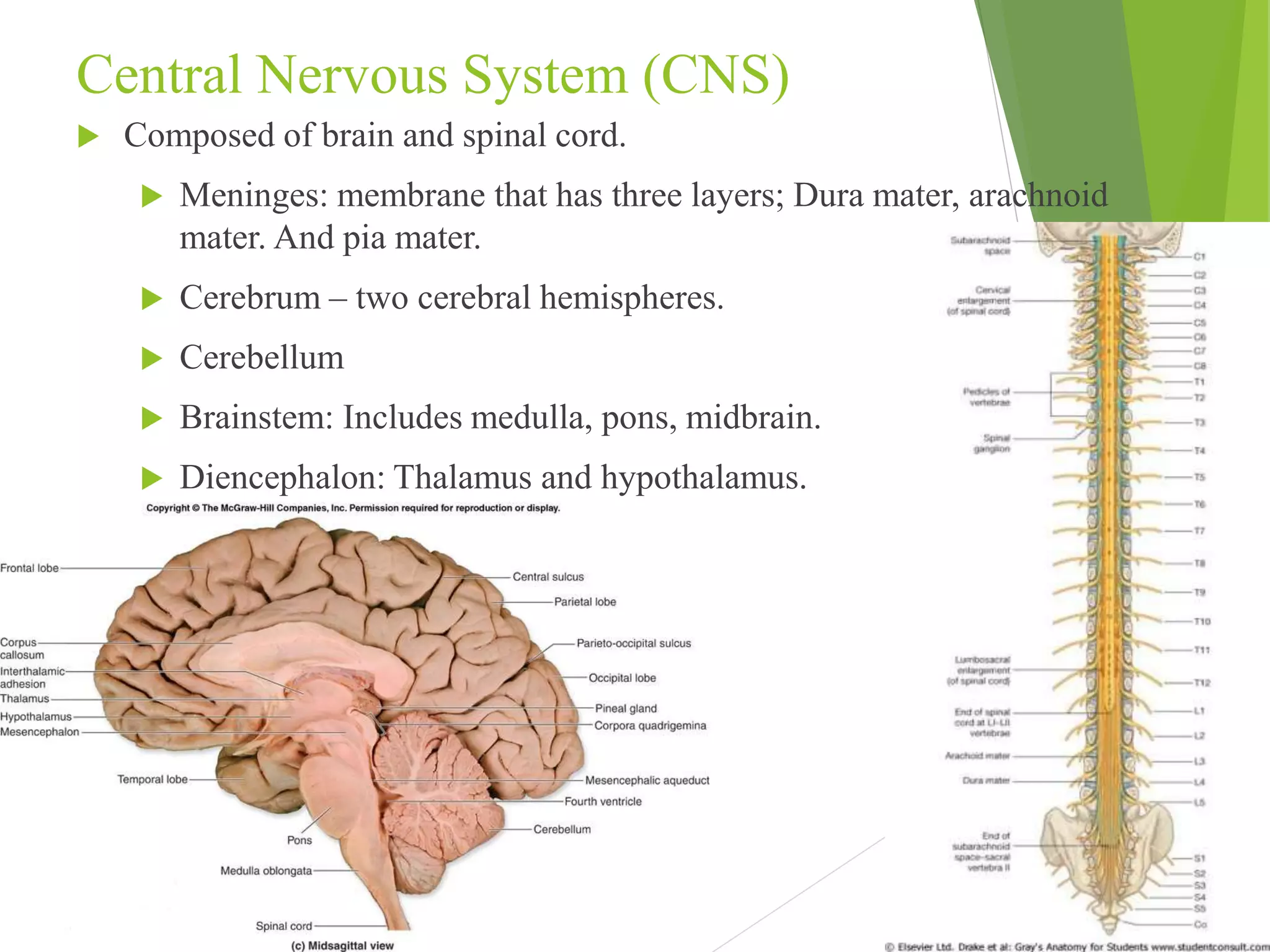
 Composed of brain and spinal cord. 
 Meninges: membrane that has three layers; Dura mater, arachnoid 
mater. And pia mater. 
 Cerebrum – two cerebral hemispheres. 
 Cerebellum 
 Brainstem: Includes medulla, pons, midbrain. 
 Diencephalon: Thalamus and hypothalamus. 
 Surrounded and protected by bone.
Peripheral Nervous System (PNS) 
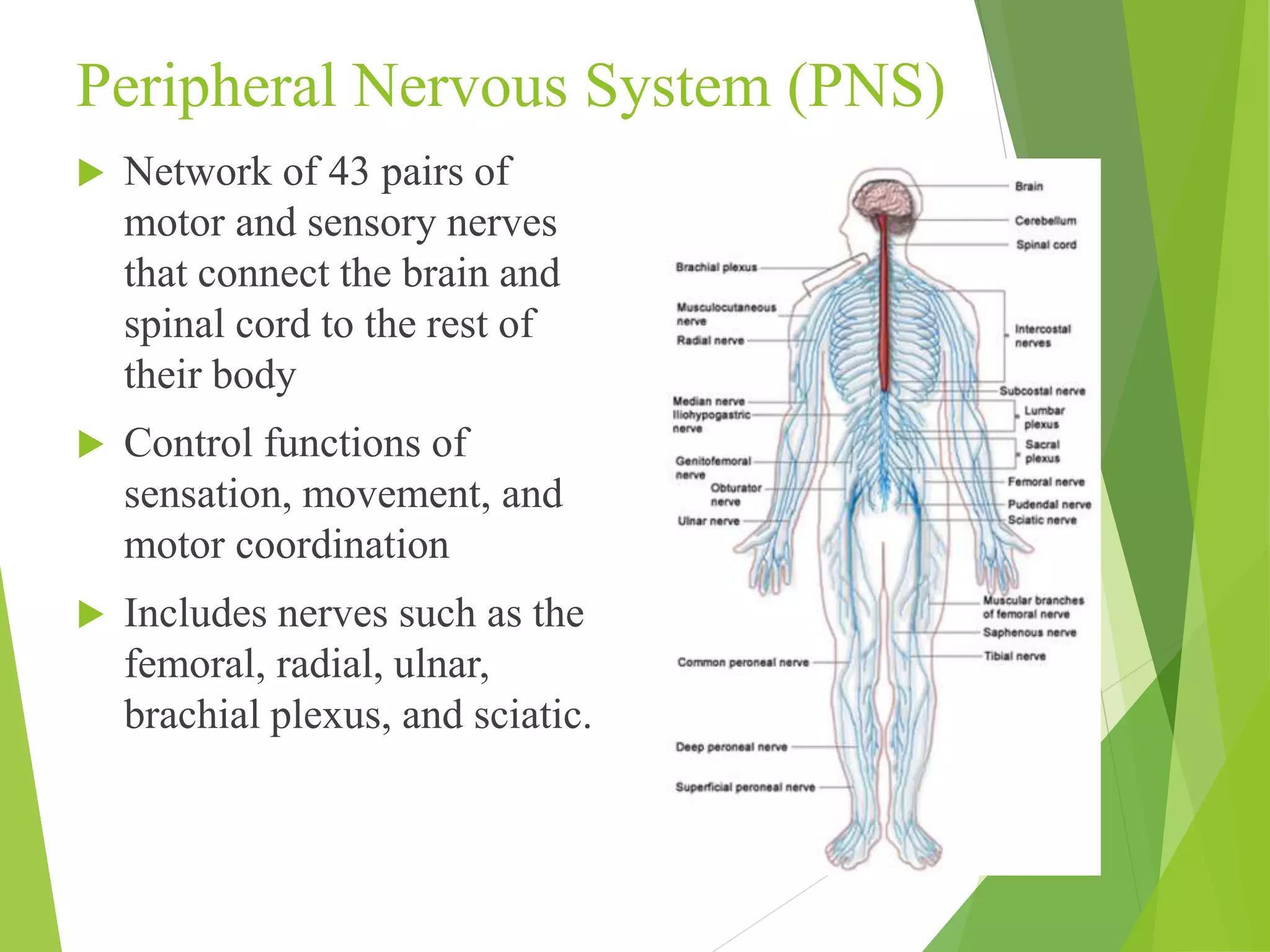
 Network of 43 pairs of 
motor and sensory nerves 
that connect the brain and 
spinal cord to the rest of 
their body 
 Control functions of 
sensation, movement, and 
motor coordination 
 Includes nerves such as the 
femoral, radial, ulnar, 
brachial plexus, and sciatic.
Autonomic Nervous System (ANS) 
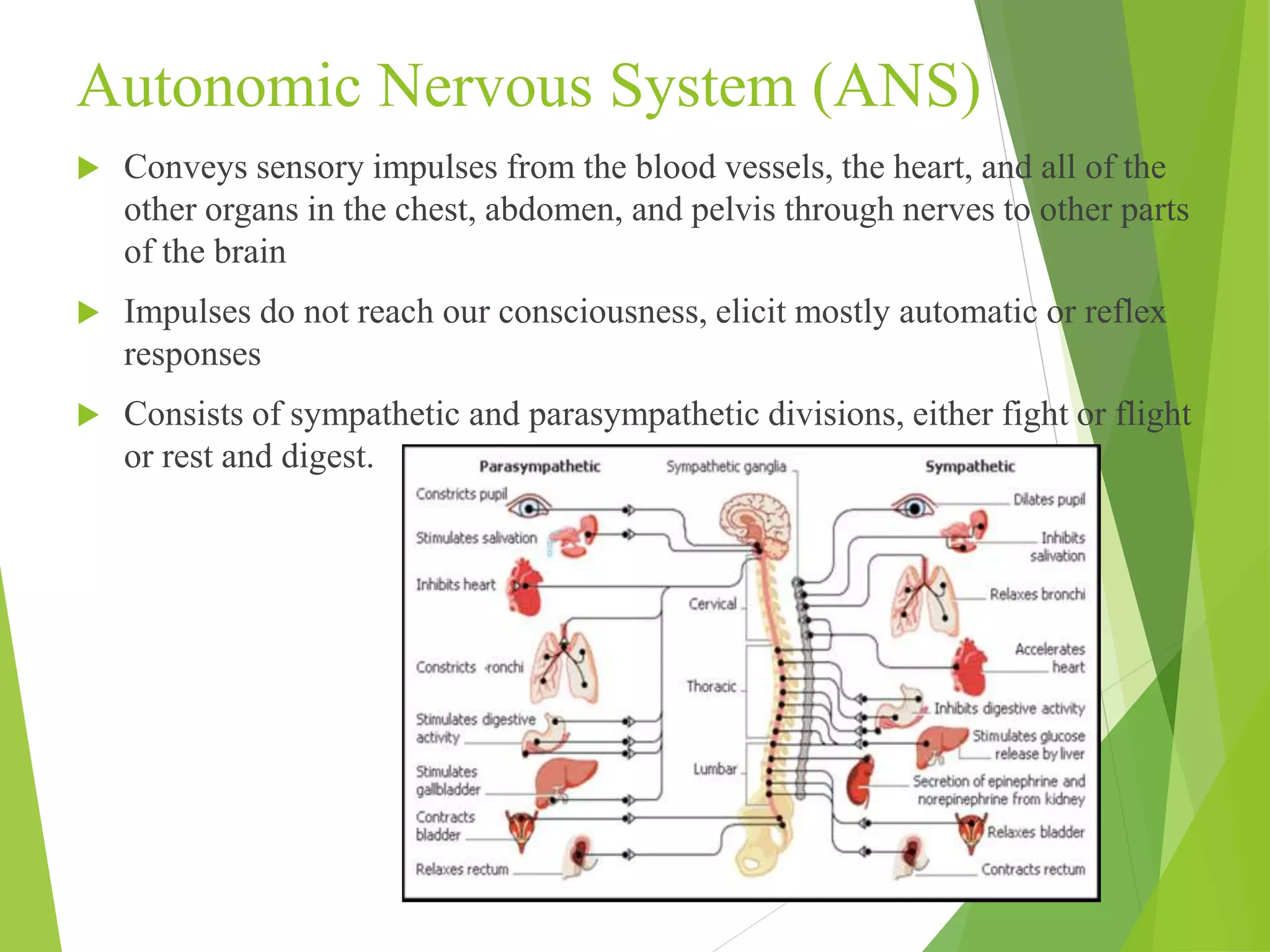
 Conveys sensory impulses from the blood vessels, the heart, and all of the 
other organs in the chest, abdomen, and pelvis through nerves to other parts 
of the brain 
 Impulses do not reach our consciousness, elicit mostly automatic or reflex 
responses 
 Consists of sympathetic and parasympathetic divisions, either fight or flight 
or rest and digest.
Overview of Cranial Nerves 
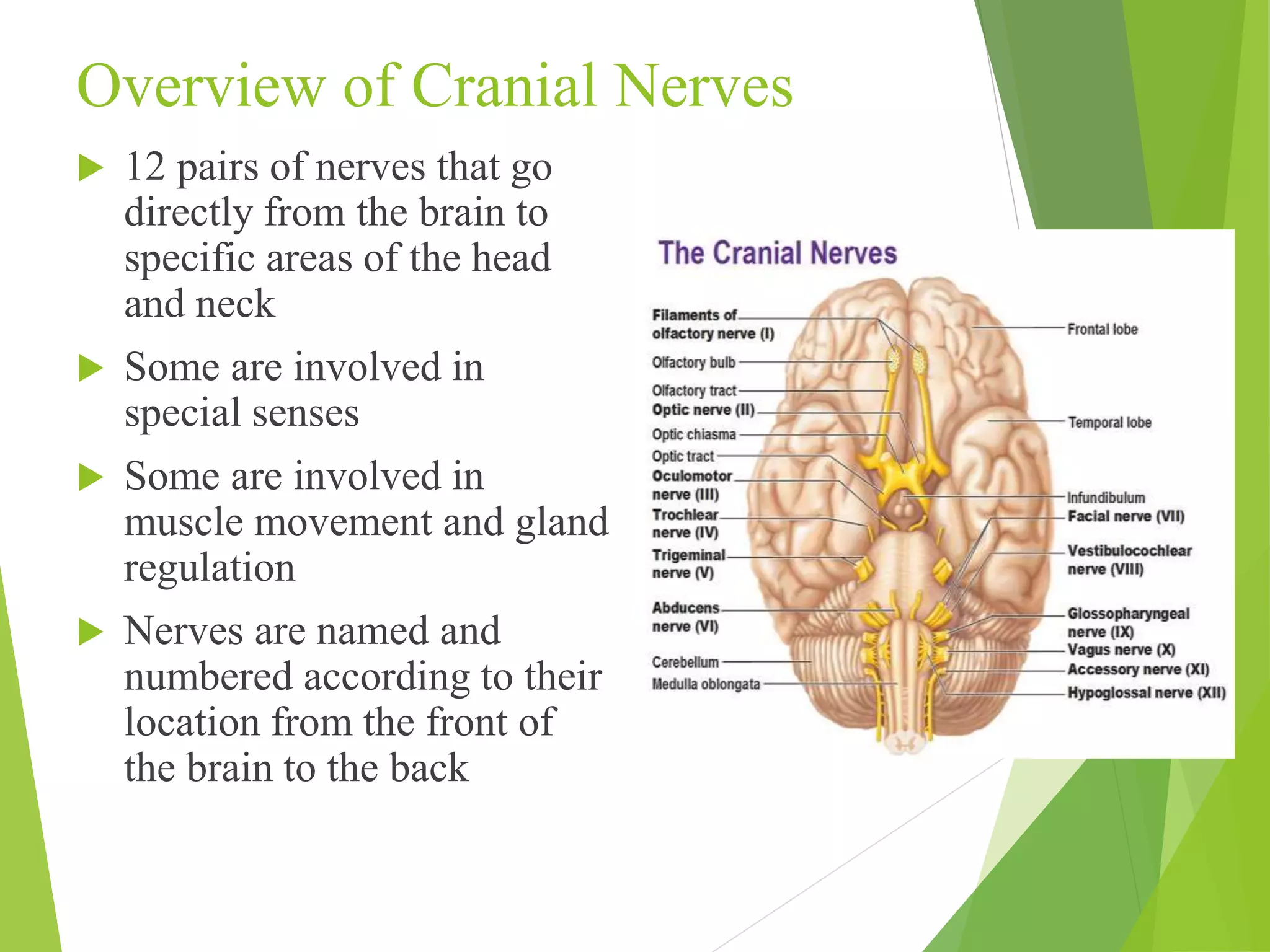
 12 pairs of nerves that go 
directly from the brain to 
specific areas of the head 
and neck 
 Some are involved in 
special senses 
 Some are involved in 
muscle movement and gland 
regulation 
 Nerves are named and 
numbered according to their 
location from the front of 
the brain to the back
Cranial Nerve I/Olfactory Nerve 
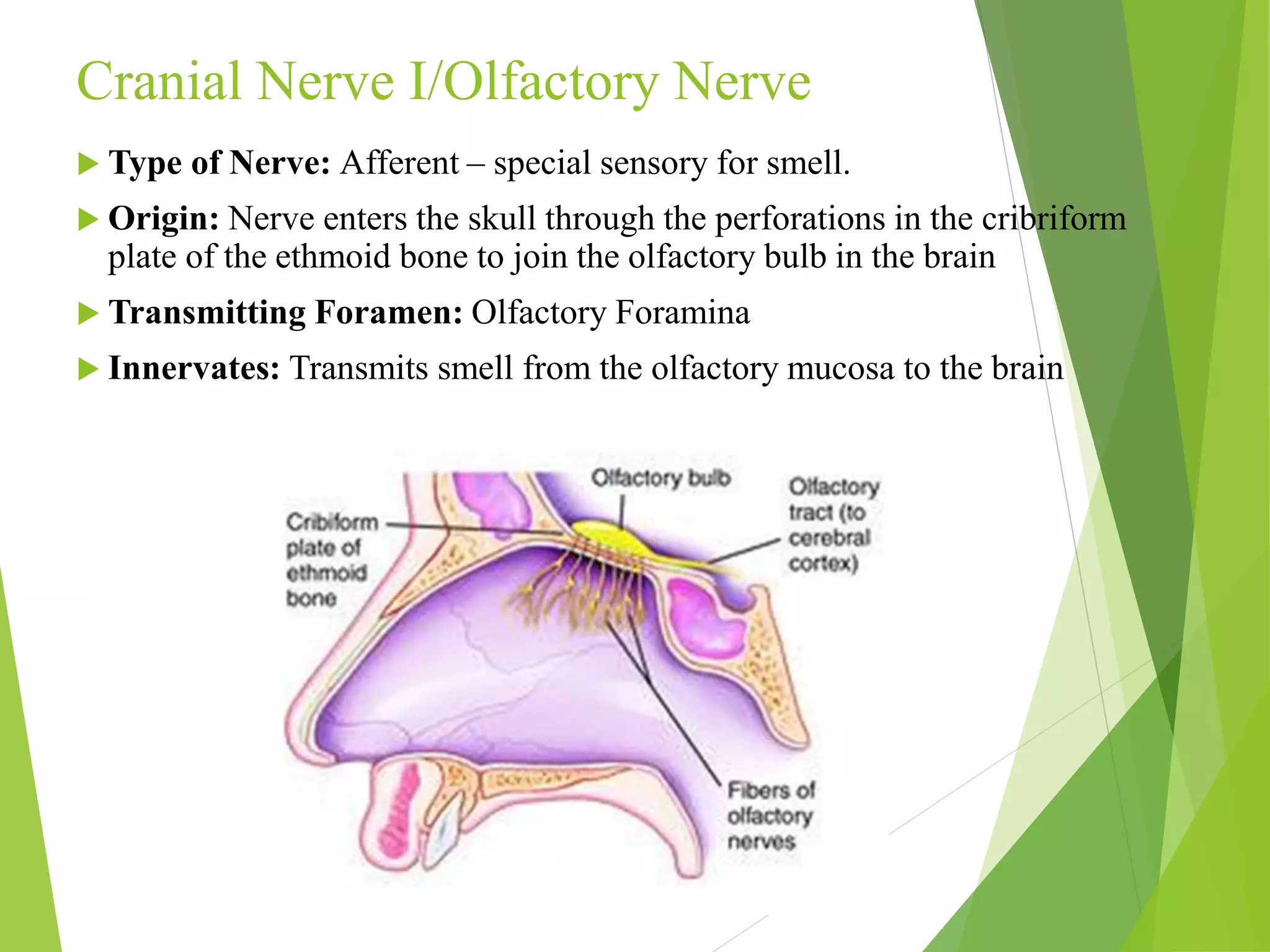
 Type of Nerve: Afferent – special sensory for smell. 
 Origin: Nerve enters the skull through the perforations in the cribriform 
plate of the ethmoid bone to join the olfactory bulb in the brain 
 Transmitting Foramen: Olfactory Foramina 
 Innervates: Transmits smell from the olfactory mucosa to the brain
Cranial Nerve II/Optic Nerve 
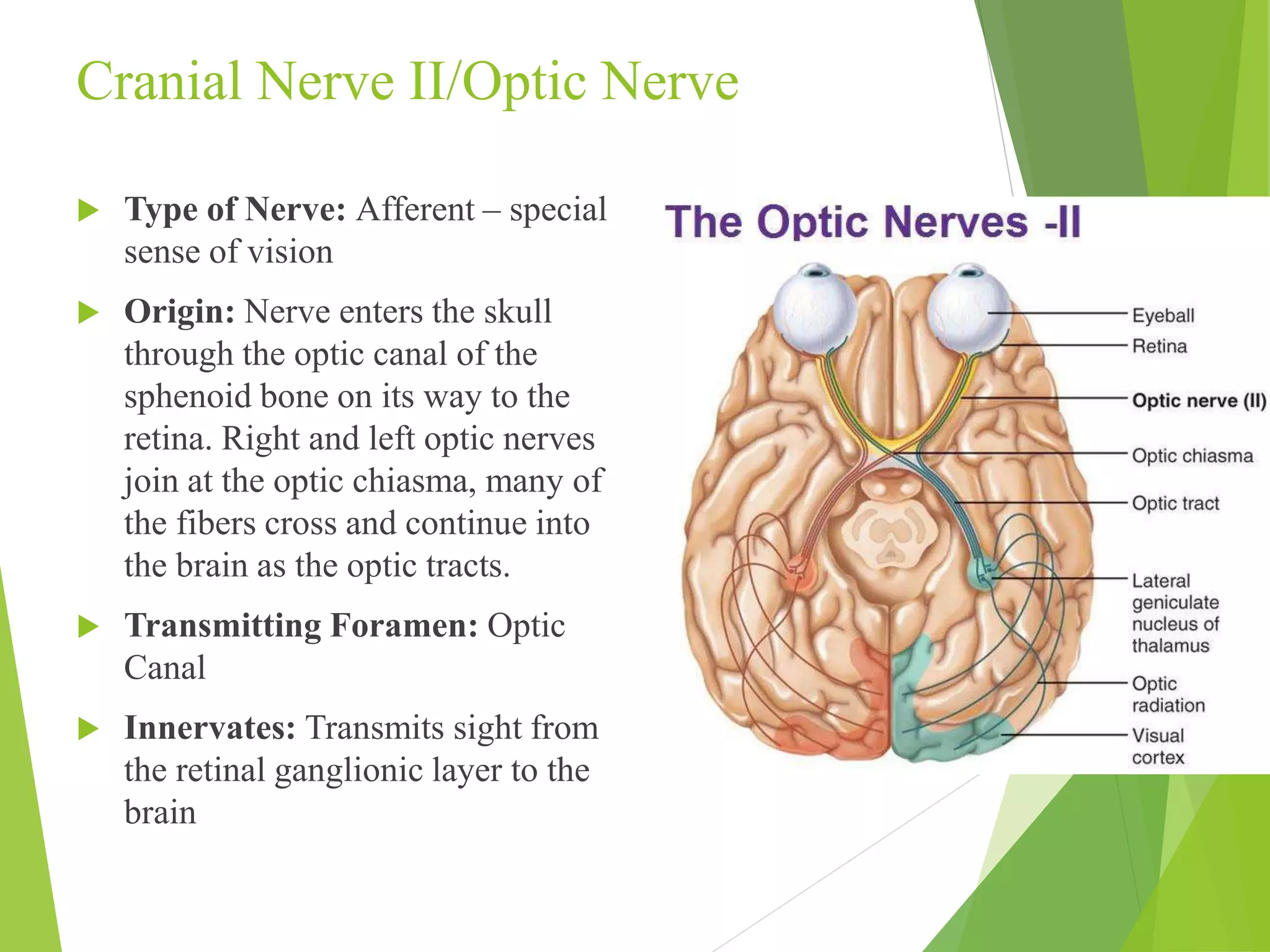
 Type of Nerve: Afferent – special 
sense of vision 
 Origin: Nerve enters the skull 
through the optic canal of the 
sphenoid bone on its way to the 
retina. Right and left optic nerves 
join at the optic chiasma, many of 
the fibers cross and continue into 
the brain as the optic tracts. 
 Transmitting Foramen: Optic 
Canal 
 Innervates: Transmits sight from 
the retinal ganglionic layer to the 
brain
Cranial Nerve III/Oculomotor Nerve 
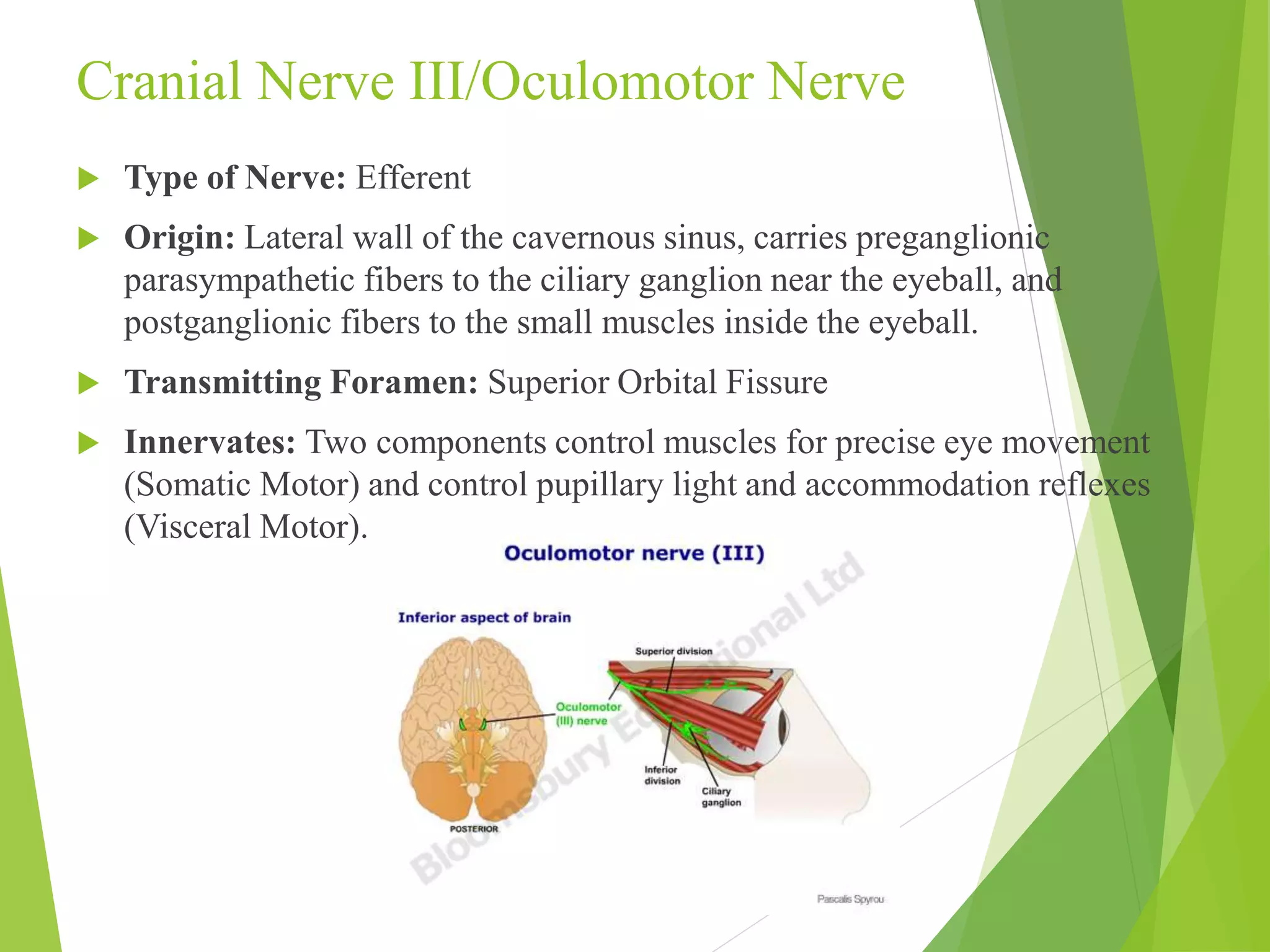
 Type of Nerve: Efferent 
 Origin: Lateral wall of the cavernous sinus, carries preganglionic 
parasympathetic fibers to the ciliary ganglion near the eyeball, and 
postganglionic fibers to the small muscles inside the eyeball. 
 Transmitting Foramen: Superior Orbital Fissure 
 Innervates: Two components control muscles for precise eye movement 
(Somatic Motor) and control pupillary light and accommodation reflexes 
(Visceral Motor).
Cranial Nerve IV/Trochlear Nerve 
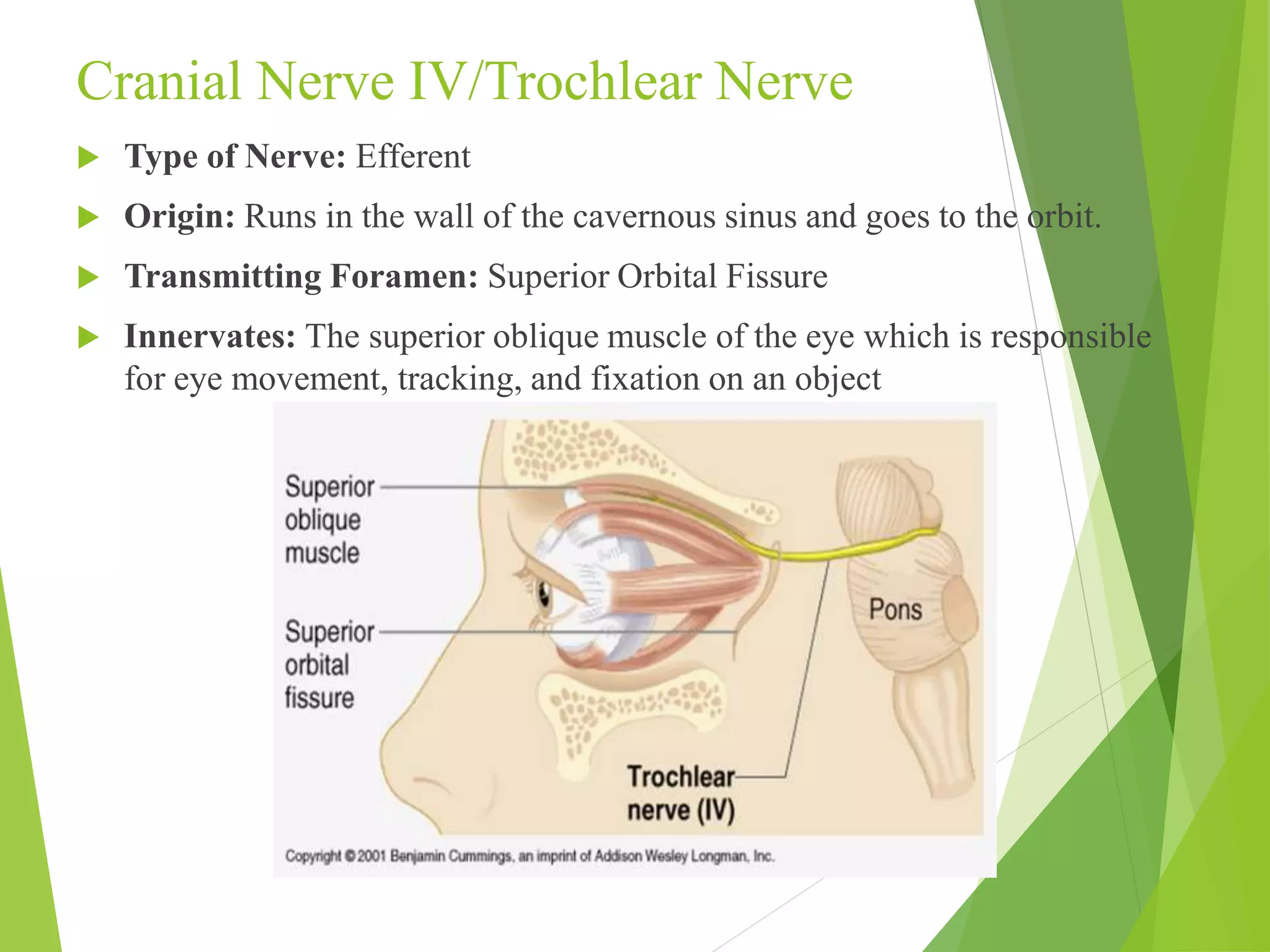
 Type of Nerve: Efferent 
 Origin: Runs in the wall of the cavernous sinus and goes to the orbit. 
 Transmitting Foramen: Superior Orbital Fissure 
 Innervates: The superior oblique muscle of the eye which is responsible 
for eye movement, tracking, and fixation on an object
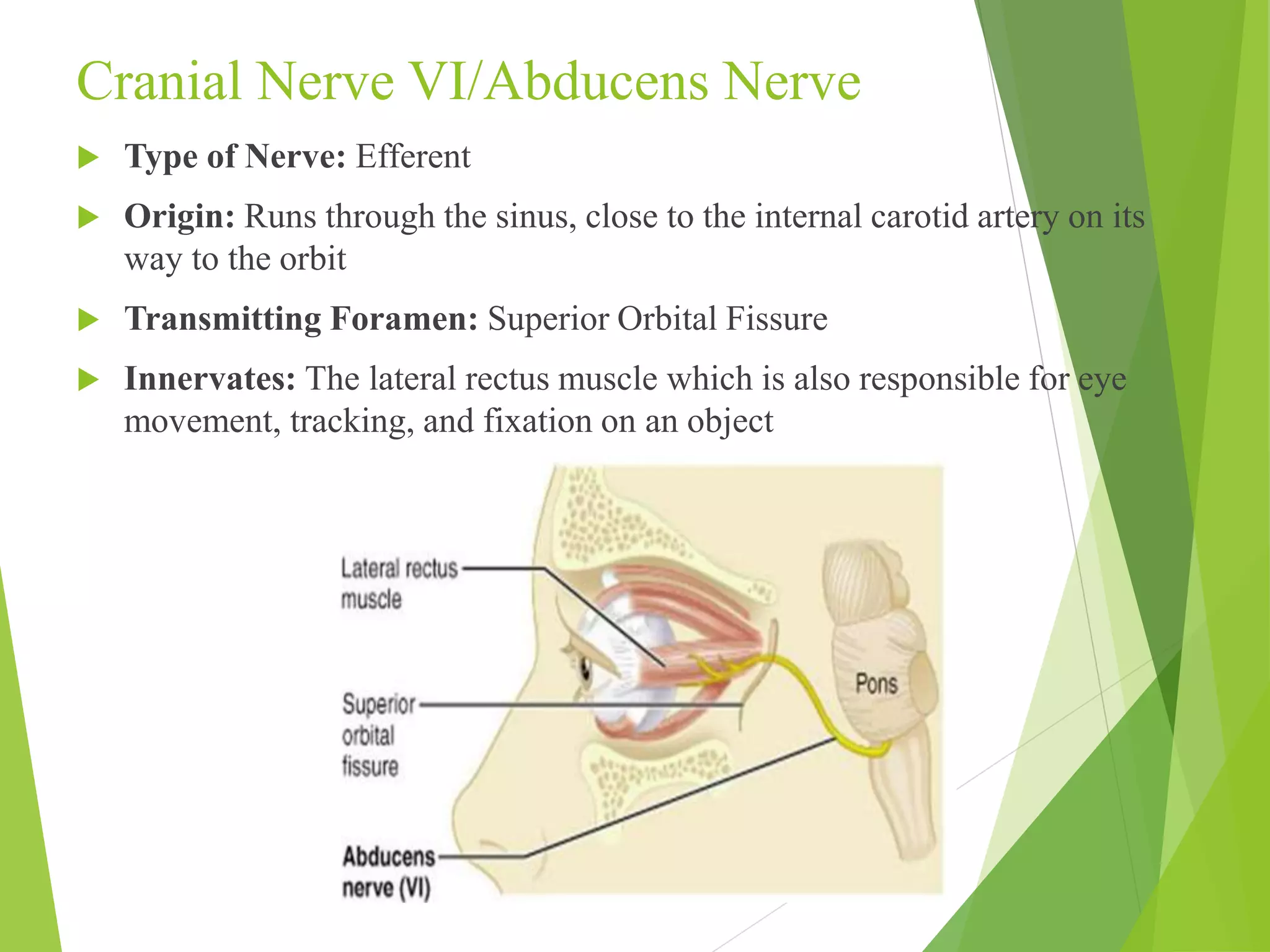
Cranial Nerve VI/Abducens Nerve 
 Type of Nerve: Efferent 
 Origin: Runs through the sinus, close to the internal carotid artery on its 
way to the orbit 
 Transmitting Foramen: Superior Orbital Fissure 
 Innervates: The lateral rectus muscle which is also responsible for eye 
movement, tracking, and fixation on an object
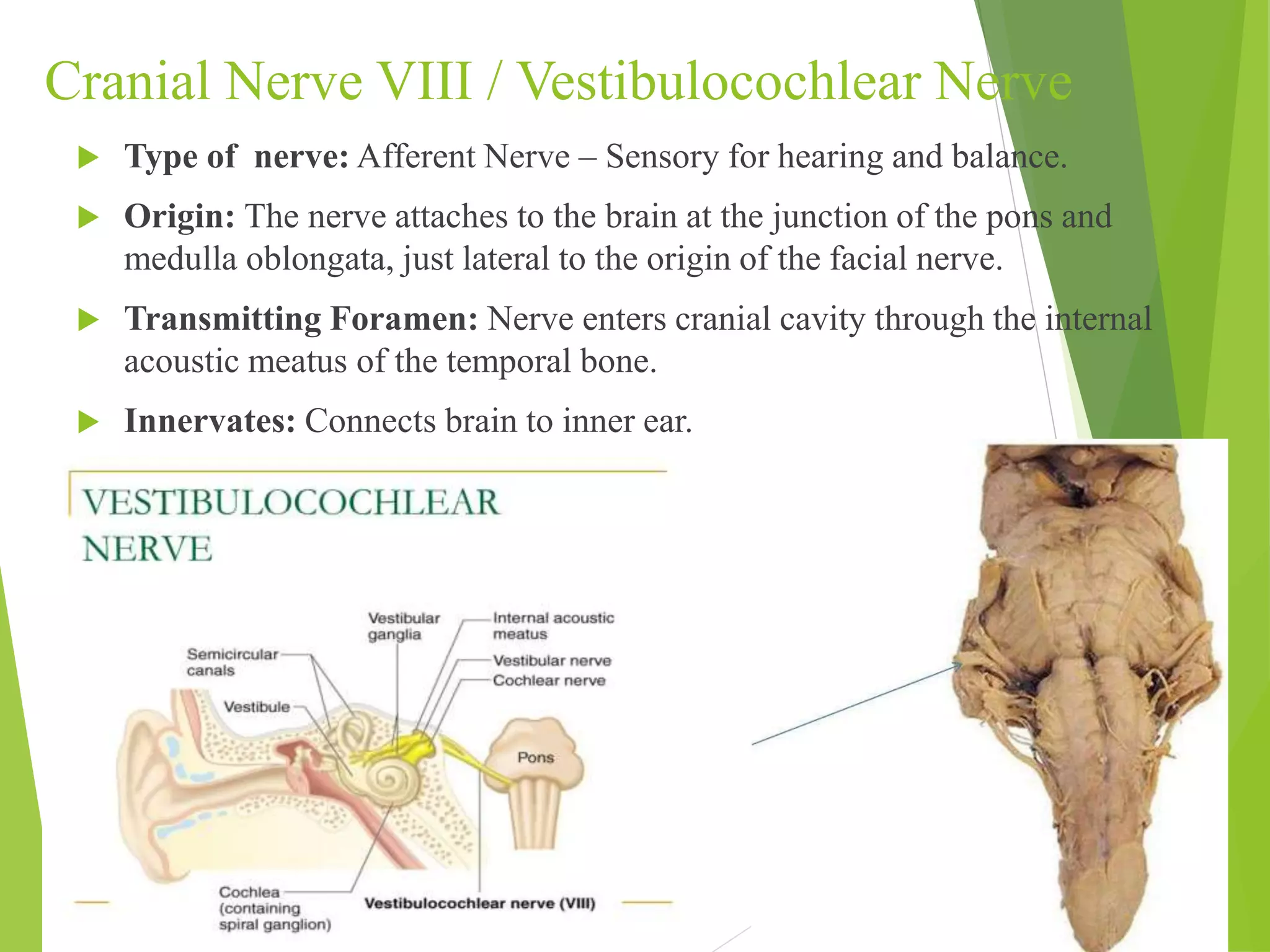
Cranial Nerve VIII / Vestibulocochlear Nerve 
 Type of nerve: Afferent Nerve – Sensory for hearing and balance. 
 Origin: The nerve attaches to the brain at the junction of the pons and 
medulla oblongata, just lateral to the origin of the facial nerve. 
 Transmitting Foramen: Nerve enters cranial cavity through the internal 
acoustic meatus of the temporal bone. 
 Innervates: Connects brain to inner ear.
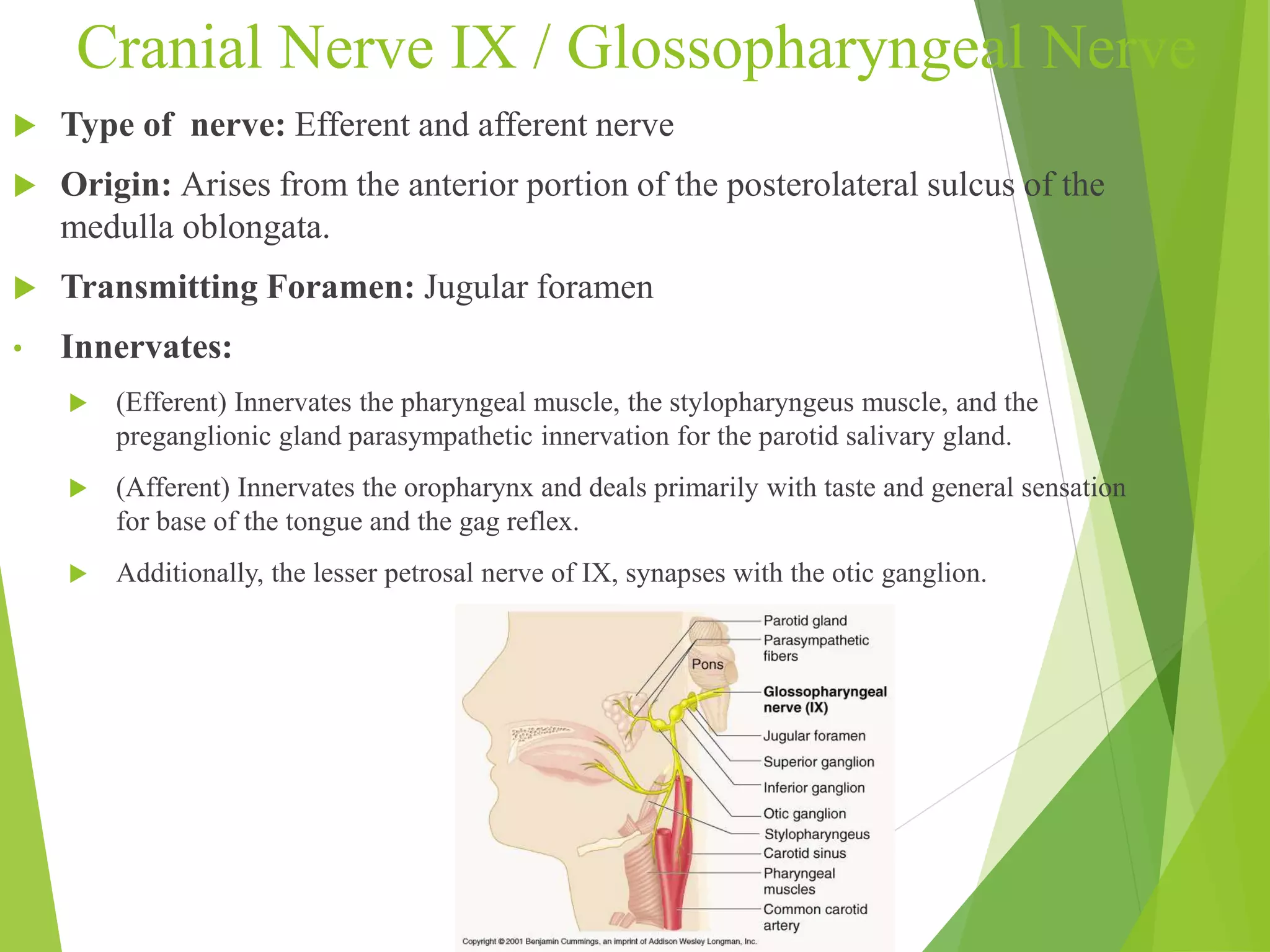
Cranial Nerve IX / Glossopharyngeal Nerve 
 Type of nerve: Efferent and afferent nerve 
 Origin: Arises from the anterior portion of the posterolateral sulcus of the 
medulla oblongata. 
 Transmitting Foramen: Jugular foramen 
• Innervates: 
 (Efferent) Innervates the pharyngeal muscle, the stylopharyngeus muscle, and the 
preganglionic gland parasympathetic innervation for the parotid salivary gland. 
 (Afferent) Innervates the oropharynx and deals primarily with taste and general sensation 
for base of the tongue and the gag reflex. 
 Additionally, the lesser petrosal nerve of IX, synapses with the otic ganglion.
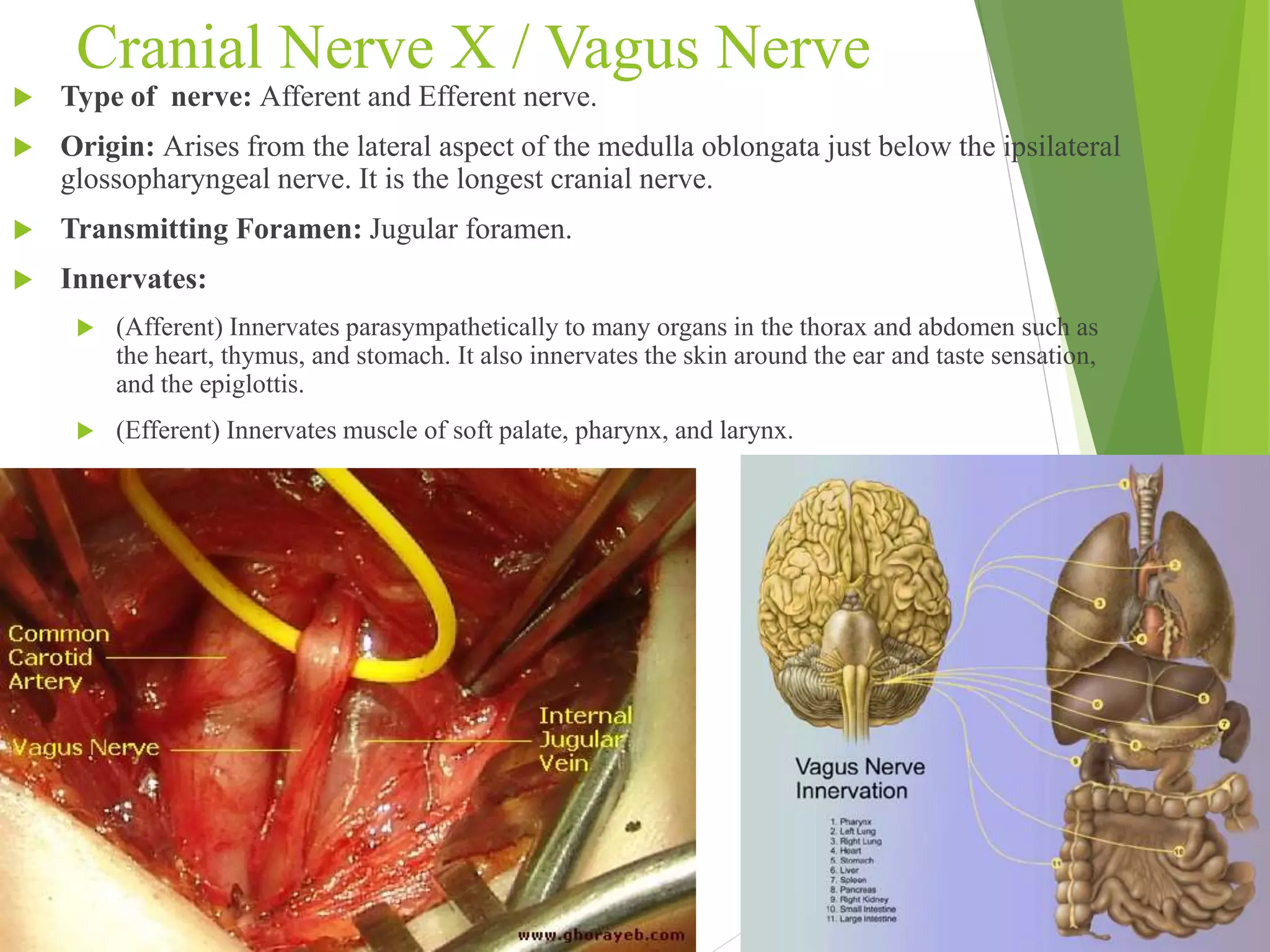
Cranial Nerve X / Vagus Nerve 
 Type of nerve: Afferent and Efferent nerve. 
 Origin: Arises from the lateral aspect of the medulla oblongata just below the ipsilateral 
glossopharyngeal nerve. It is the longest cranial nerve. 
 Transmitting Foramen: Jugular foramen. 
 Innervates: 
 (Afferent) Innervates parasympathetically to many organs in the thorax and abdomen such as 
the heart, thymus, and stomach. It also innervates the skin around the ear and taste sensation, 
and the epiglottis. 
 (Efferent) Innervates muscle of soft palate, pharynx, and larynx.
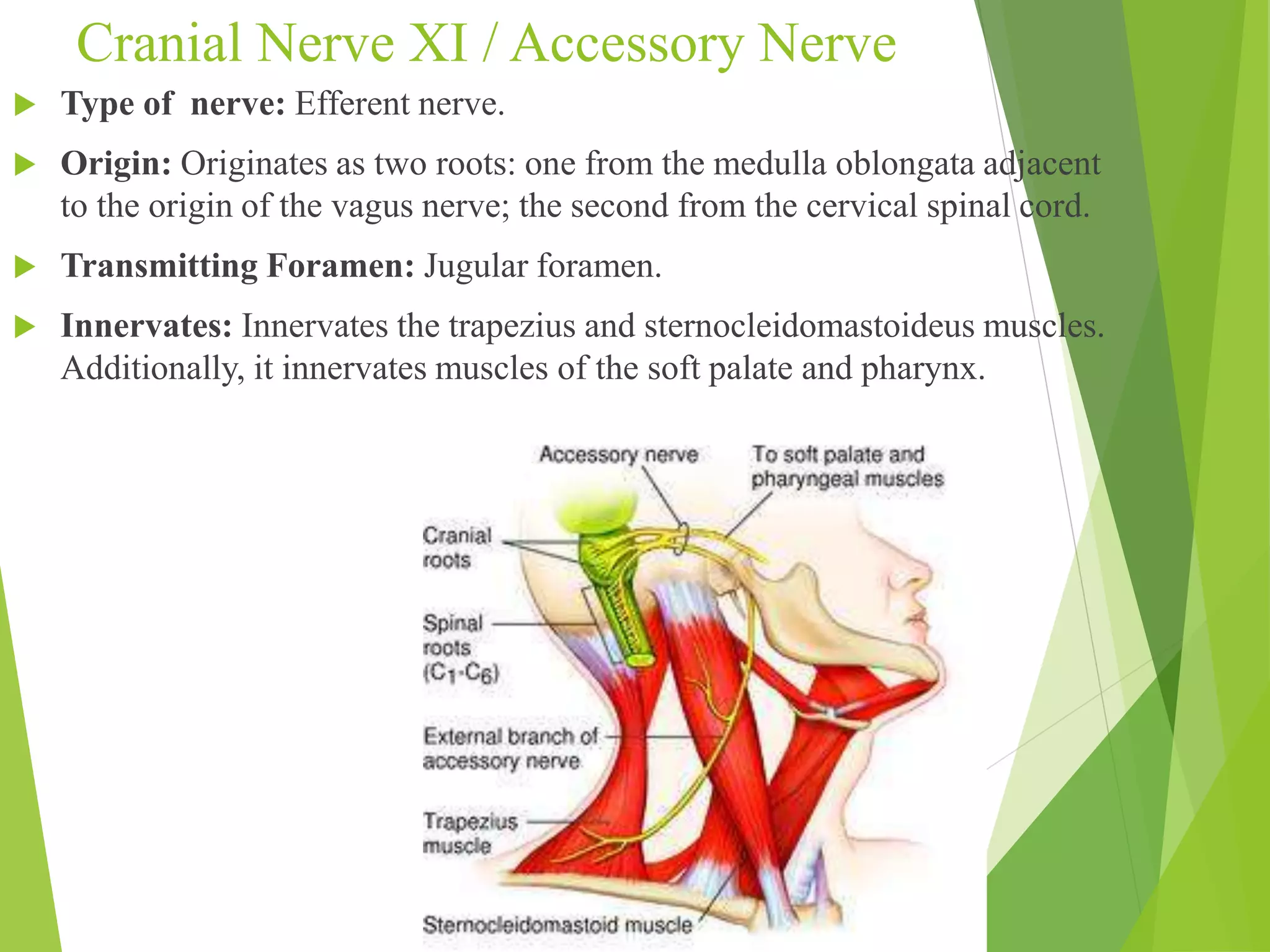
Cranial Nerve XI / Accessory Nerve 
 Type of nerve: Efferent nerve. 
 Origin: Originates as two roots: one from the medulla oblongata adjacent 
to the origin of the vagus nerve; the second from the cervical spinal cord. 
 Transmitting Foramen: Jugular foramen. 
 Innervates: Innervates the trapezius and sternocleidomastoideus muscles. 
Additionally, it innervates muscles of the soft palate and pharynx.
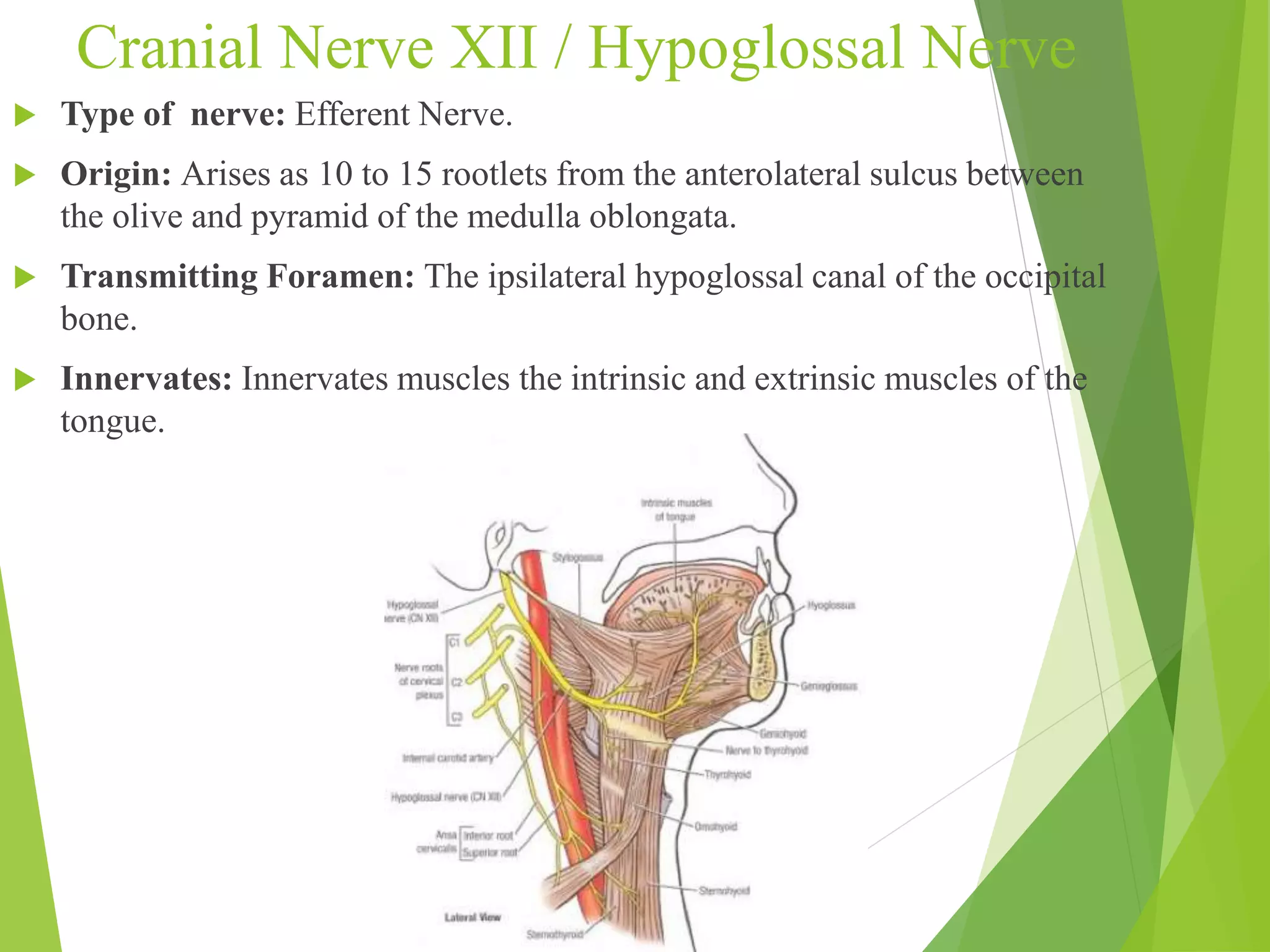
Cranial Nerve XII / Hypoglossal Nerve 
 Type of nerve: Efferent Nerve. 
 Origin: Arises as 10 to 15 rootlets from the anterolateral sulcus between 
the olive and pyramid of the medulla oblongata. 
 Transmitting Foramen: The ipsilateral hypoglossal canal of the occipital 
bone. 
 Innervates: Innervates muscles the intrinsic and extrinsic muscles of the 
tongue.
Cranial Nerve VII/Facial Nerve 
 Type of Nerve: Afferent and Efferent components 
 Origin: The main trunk of the nerve emerges from the skull and gives off two 
branches, the posterior auricular nerve and a branch to the posterior belly of the 
digastric and stylohyoid muscles. It also sends off small efferent branches to 
the stapedius muscle and two other branches to the ear. There are also a 
multitude of smaller nerves that go off into the muscles of the face. 
 Transmitting Foramen: Mainly the Stylomastoid Foramen 
 Branches of the Facial Nerve: 
 Greater Petrosal Nerve 
 Chorda Tympani Nerve 
 Posterior Auricular, Stylohyoid, and Posterior Digastric Nerves 
 Temporal Branch 
 Zygomatic Branch 
 Mandibular Branch 
 Buccal Branch 
 Cervical Branch
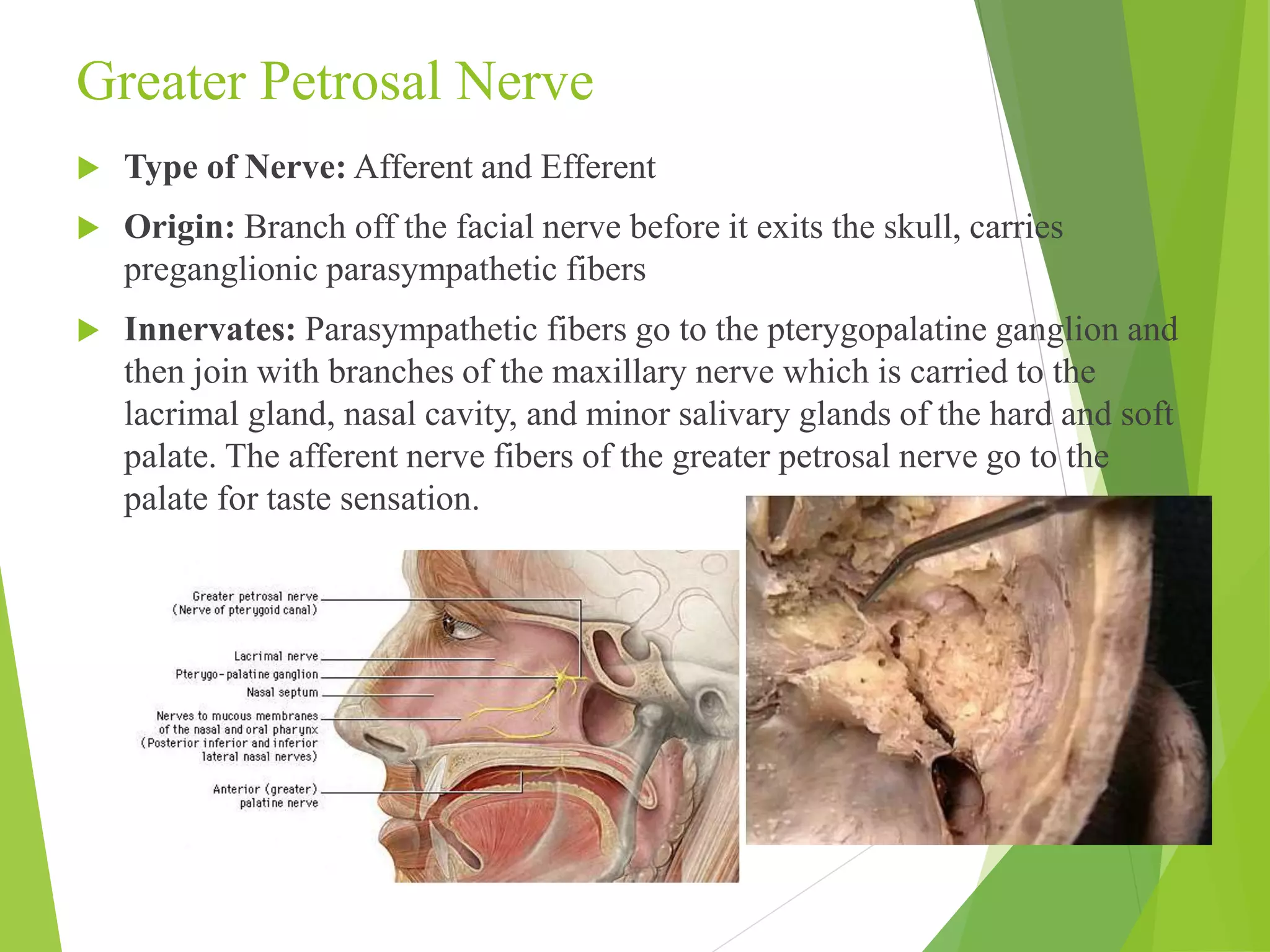
Greater Petrosal Nerve 
 Type of Nerve: Afferent and Efferent 
 Origin: Branch off the facial nerve before it exits the skull, carries 
preganglionic parasympathetic fibers 
 Innervates: Parasympathetic fibers go to the pterygopalatine ganglion and 
then join with branches of the maxillary nerve which is carried to the 
lacrimal gland, nasal cavity, and minor salivary glands of the hard and soft 
palate. The afferent nerve fibers of the greater petrosal nerve go to the 
palate for taste sensation.
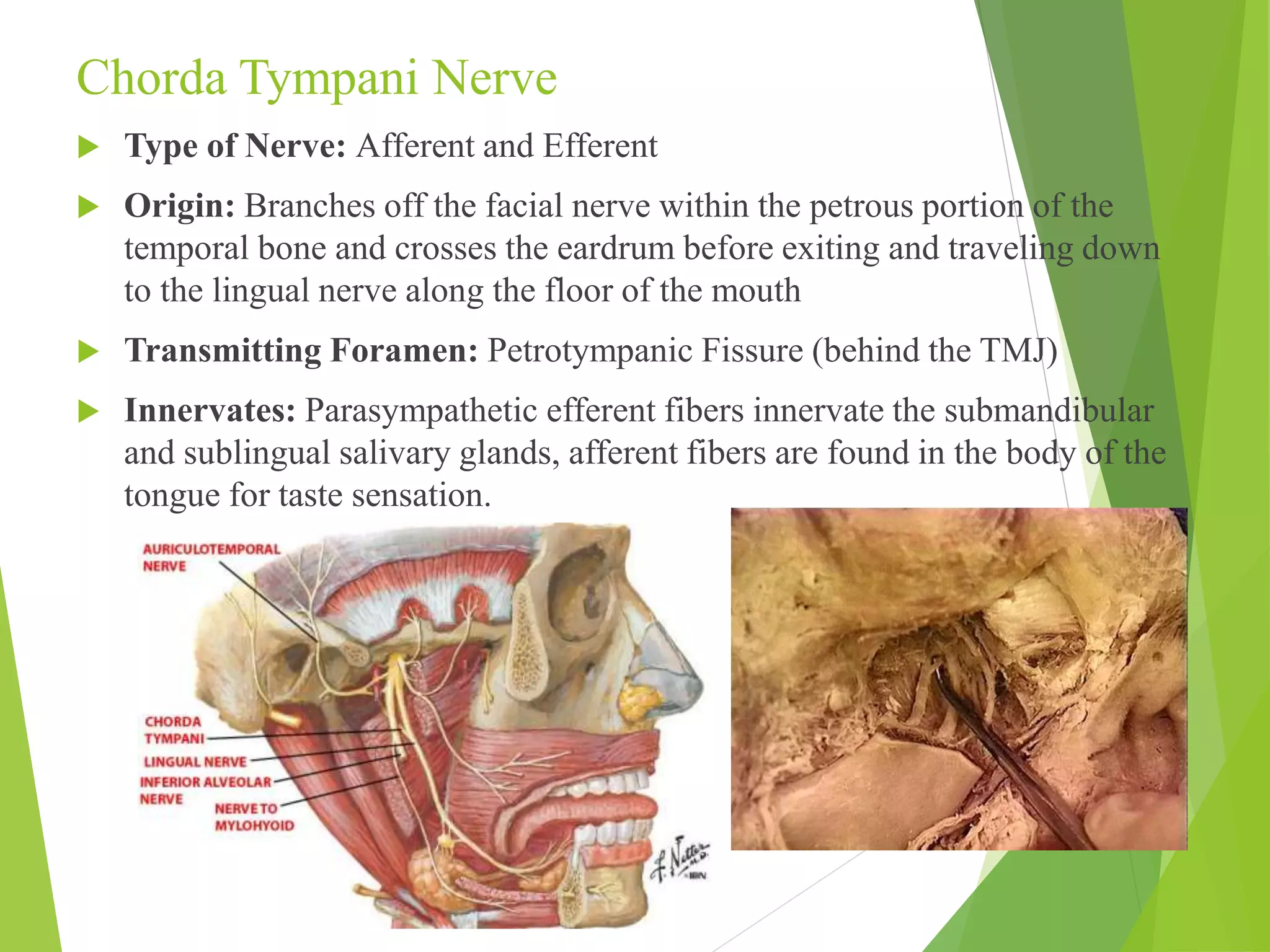
Chorda Tympani Nerve 
 Type of Nerve: Afferent and Efferent 
 Origin: Branches off the facial nerve within the petrous portion of the 
temporal bone and crosses the eardrum before exiting and traveling down 
to the lingual nerve along the floor of the mouth 
 Transmitting Foramen: Petrotympanic Fissure (behind the TMJ) 
 Innervates: Parasympathetic efferent fibers innervate the submandibular 
and sublingual salivary glands, afferent fibers are found in the body of the 
tongue for taste sensation.
Posterior Auricular, Stylohyoid, and Posterior 
Digastric Nerves 
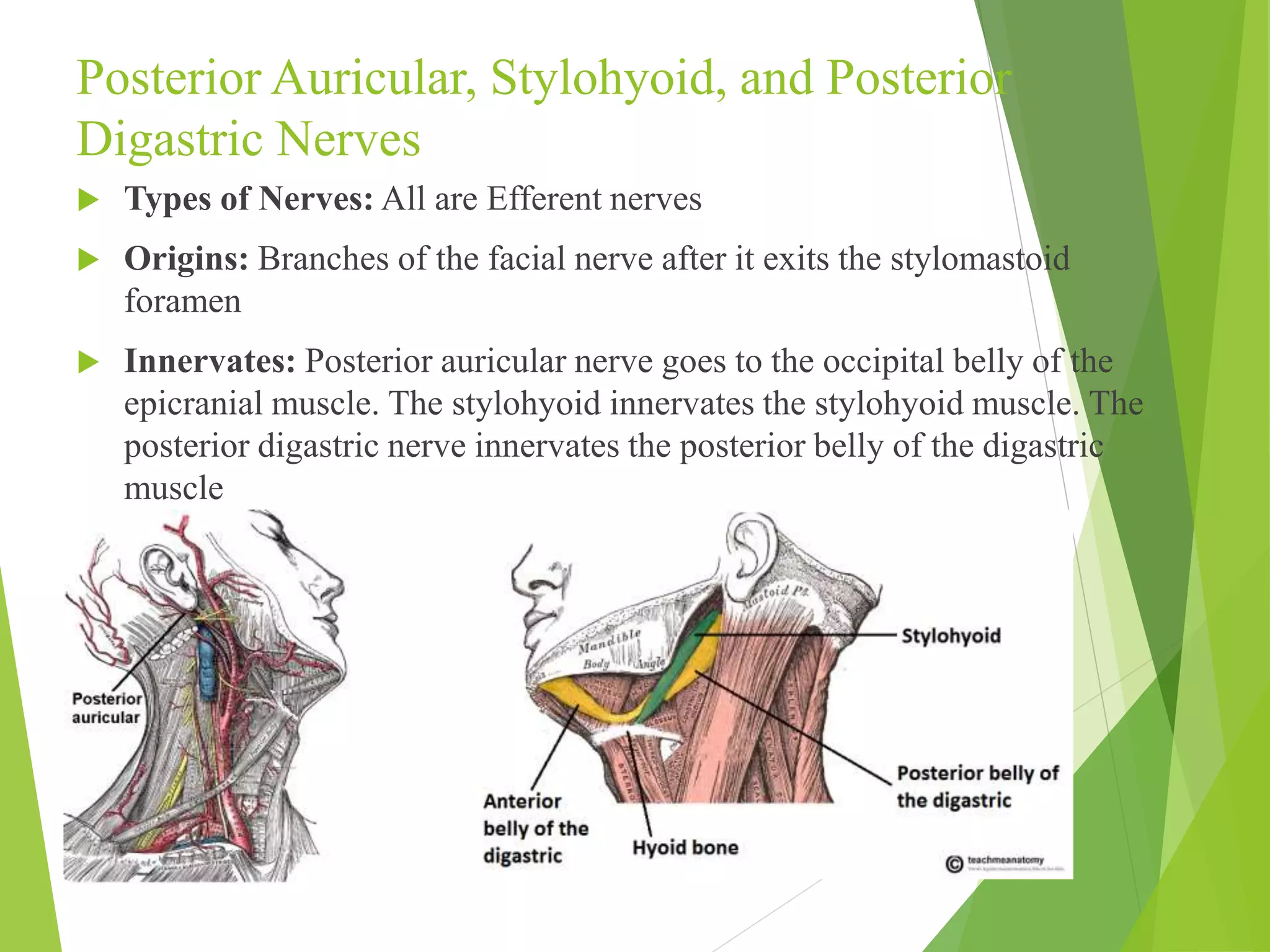
 Types of Nerves: All are Efferent nerves 
 Origins: Branches of the facial nerve after it exits the stylomastoid 
foramen 
 Innervates: Posterior auricular nerve goes to the occipital belly of the 
epicranial muscle. The stylohyoid innervates the stylohyoid muscle. The 
posterior digastric nerve innervates the posterior belly of the digastric 
muscle
Branches to the Muscles of Facial Expression 
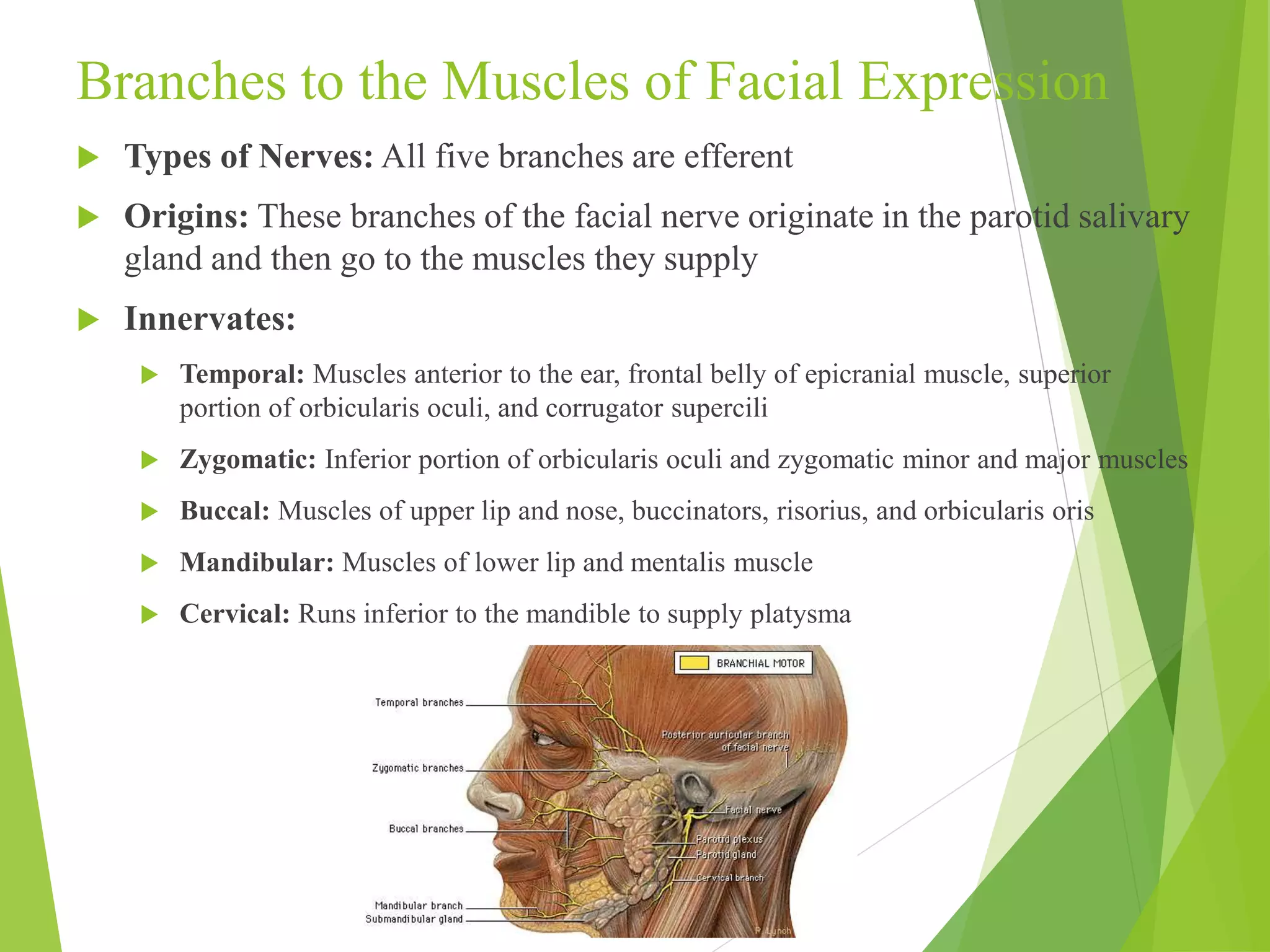
 Types of Nerves: All five branches are efferent 
 Origins: These branches of the facial nerve originate in the parotid salivary 
gland and then go to the muscles they supply 
 Innervates: 
 Temporal: Muscles anterior to the ear, frontal belly of epicranial muscle, superior 
portion of orbicularis oculi, and corrugator supercili 
 Zygomatic: Inferior portion of orbicularis oculi and zygomatic minor and major muscles 
 Buccal: Muscles of upper lip and nose, buccinators, risorius, and orbicularis oris 
 Mandibular: Muscles of lower lip and mentalis muscle 
 Cervical: Runs inferior to the mandible to supply platysma
Cranial Nerve V / Trigeminal Nerve 
 Type of nerve: Efferent and afferent nerve. 
 Afferent - The sensory component is thick. 
 Efferent - The motor component is thin. 
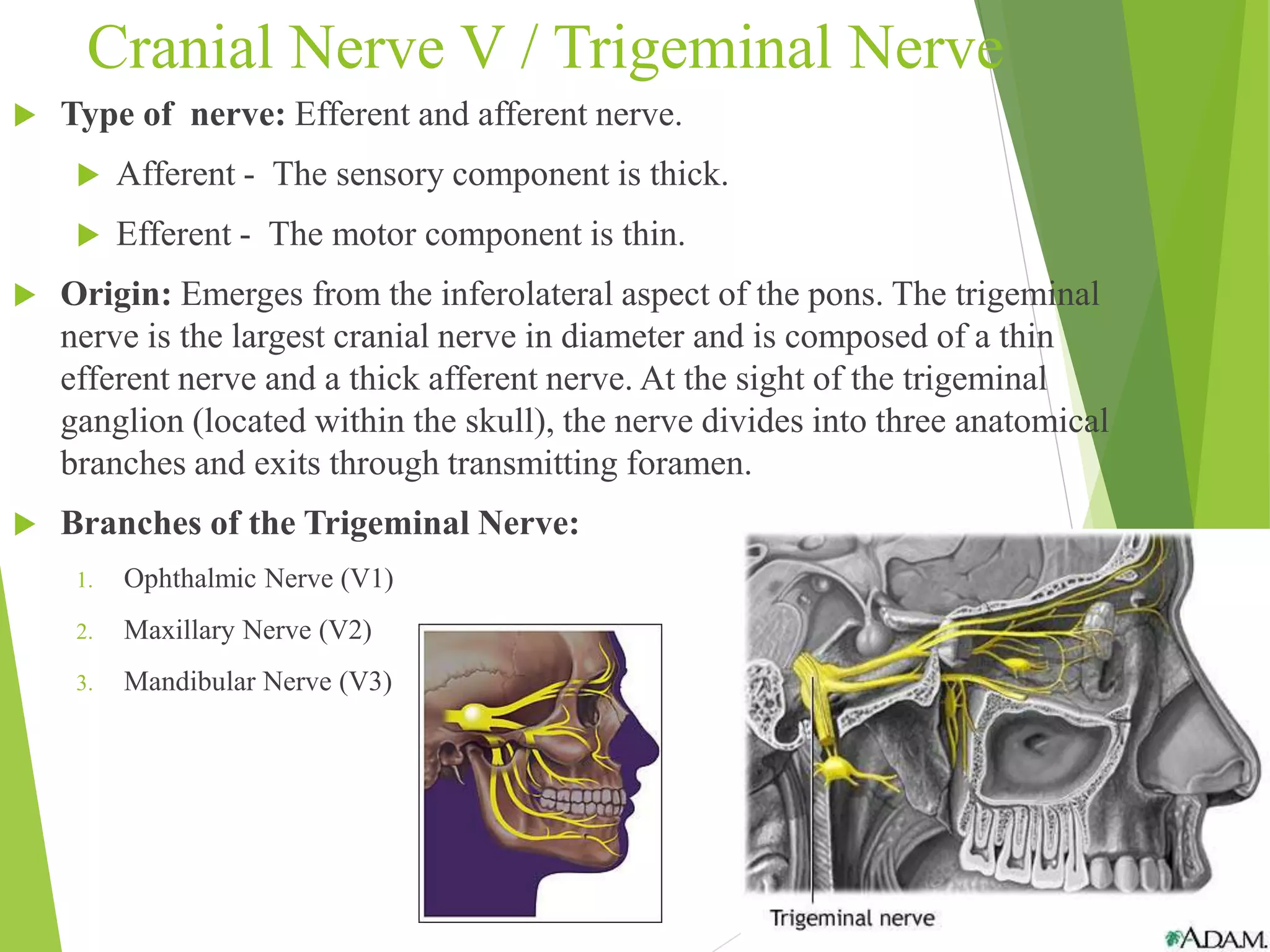
 Origin: Emerges from the inferolateral aspect of the pons. The trigeminal 
nerve is the largest cranial nerve in diameter and is composed of a thin 
efferent nerve and a thick afferent nerve. At the sight of the trigeminal 
ganglion (located within the skull), the nerve divides into three anatomical 
branches and exits through transmitting foramen. 
 Branches of the Trigeminal Nerve: 
1. Ophthalmic Nerve (V1) 
2. Maxillary Nerve (V2) 
3. Mandibular Nerve (V3)
Ophthalmic Nerve (V1) 
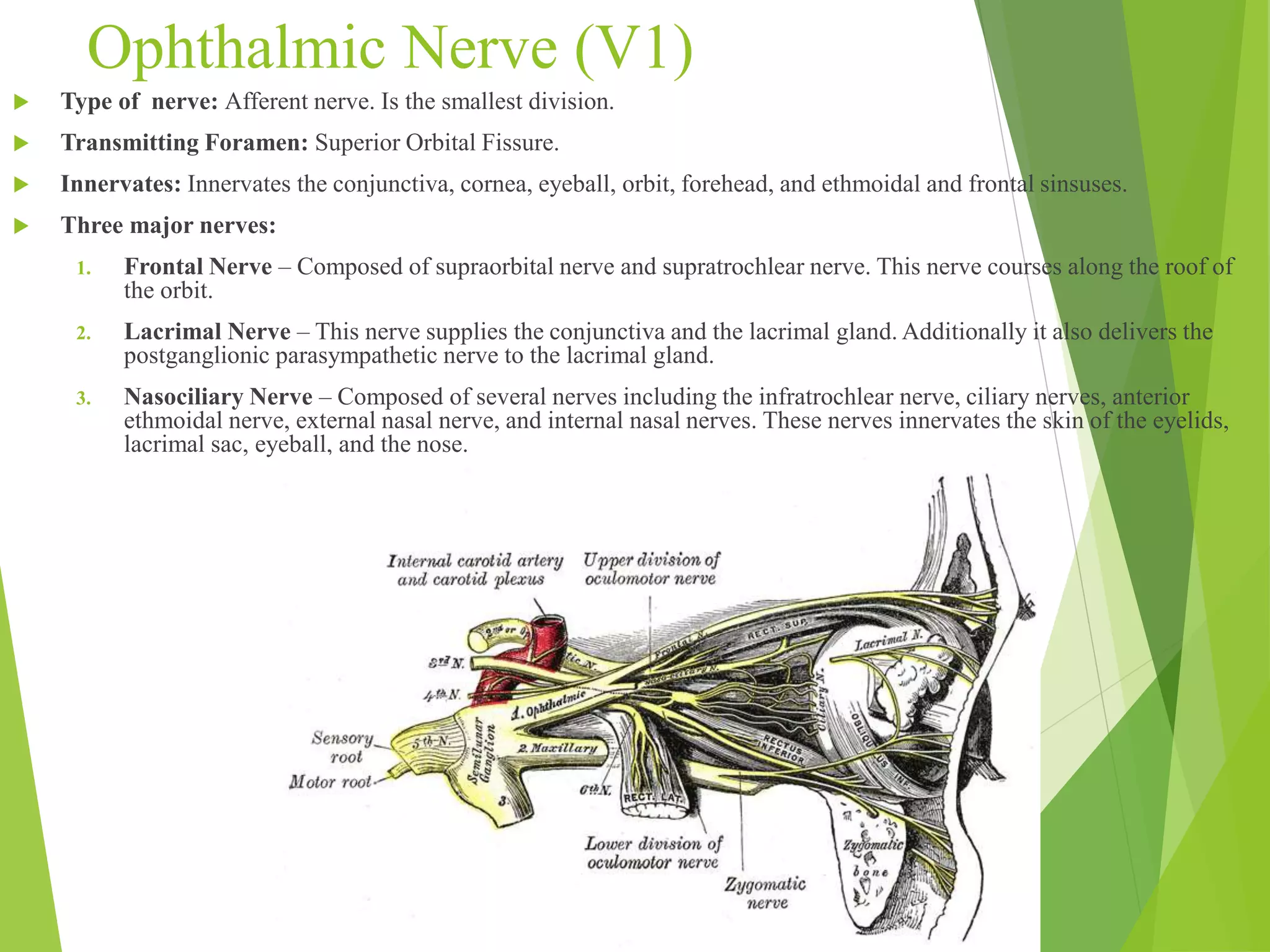
 Type of nerve: Afferent nerve. Is the smallest division. 
 Transmitting Foramen: Superior Orbital Fissure. 
 Innervates: Innervates the conjunctiva, cornea, eyeball, orbit, forehead, and ethmoidal and frontal sinsuses. 
 Three major nerves: 
1. Frontal Nerve – Composed of supraorbital nerve and supratrochlear nerve. This nerve courses along the roof of 
the orbit. 
2. Lacrimal Nerve – This nerve supplies the conjunctiva and the lacrimal gland. Additionally it also delivers the 
postganglionic parasympathetic nerve to the lacrimal gland. 
3. Nasociliary Nerve – Composed of several nerves including the infratrochlear nerve, ciliary nerves, anterior 
ethmoidal nerve, external nasal nerve, and internal nasal nerves. These nerves innervates the skin of the eyelids, 
lacrimal sac, eyeball, and the nose.
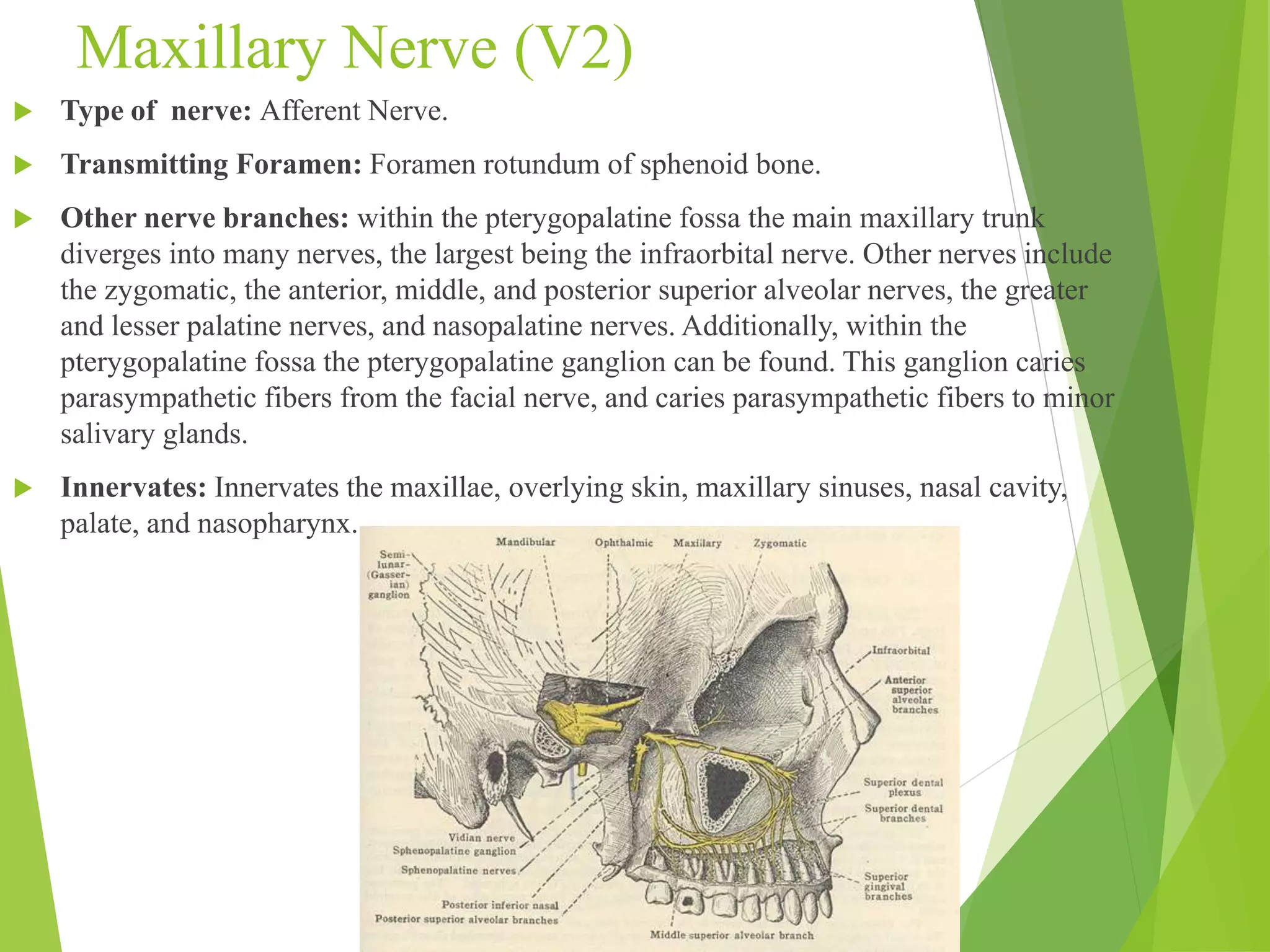
Maxillary Nerve (V2) 
 Type of nerve: Afferent Nerve. 
 Transmitting Foramen: Foramen rotundum of sphenoid bone. 
 Other nerve branches: within the pterygopalatine fossa the main maxillary trunk 
diverges into many nerves, the largest being the infraorbital nerve. Other nerves include 
the zygomatic, the anterior, middle, and posterior superior alveolar nerves, the greater 
and lesser palatine nerves, and nasopalatine nerves. Additionally, within the 
pterygopalatine fossa the pterygopalatine ganglion can be found. This ganglion caries 
parasympathetic fibers from the facial nerve, and caries parasympathetic fibers to minor 
salivary glands. 
 Innervates: Innervates the maxillae, overlying skin, maxillary sinuses, nasal cavity, 
palate, and nasopharynx.
Maxillary Nerve (V2) Continued 
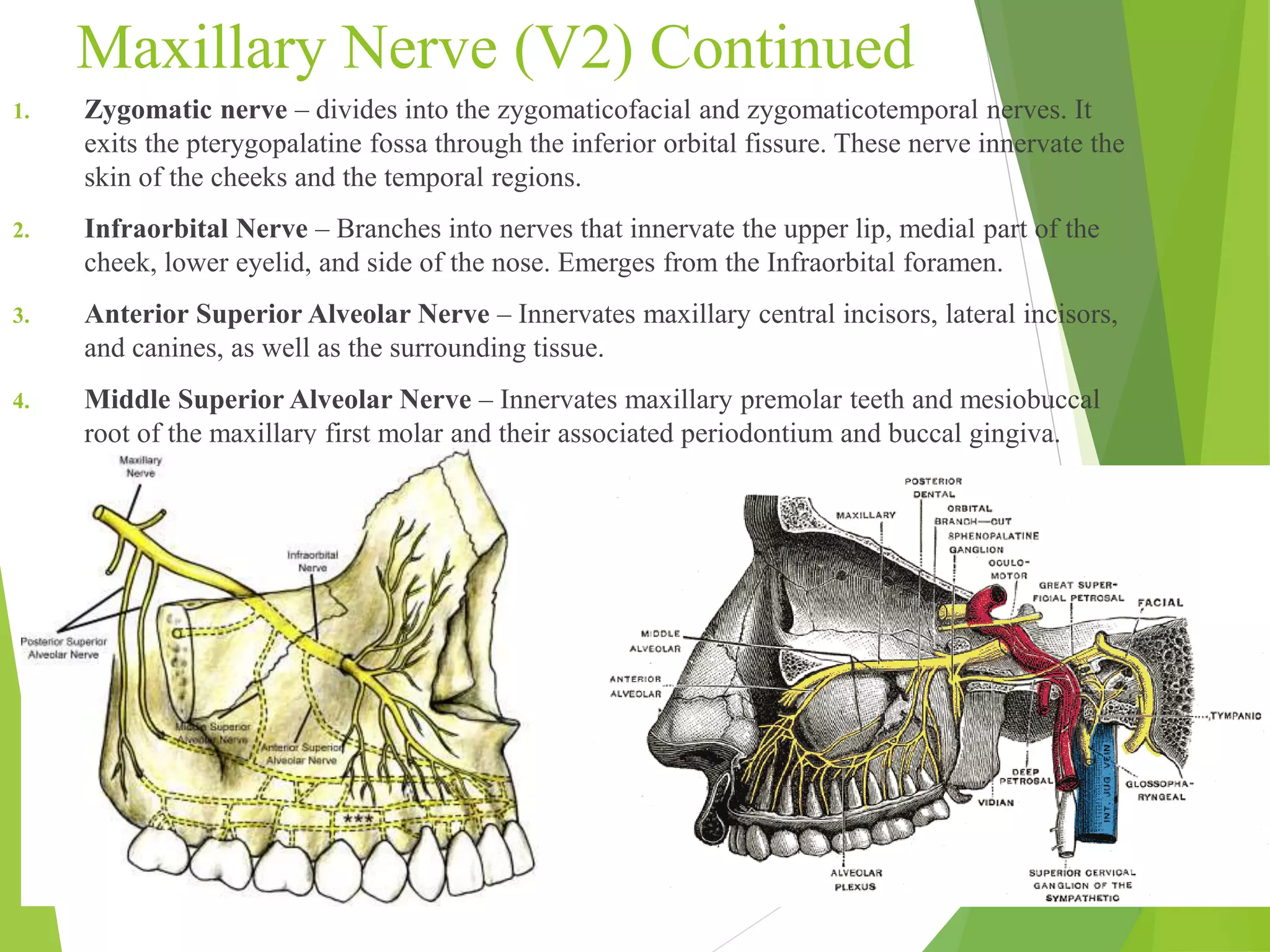
1. Zygomatic nerve – divides into the zygomaticofacial and zygomaticotemporal nerves. It 
exits the pterygopalatine fossa through the inferior orbital fissure. These nerve innervate the 
skin of the cheeks and the temporal regions. 
2. Infraorbital Nerve – Branches into nerves that innervate the upper lip, medial part of the 
cheek, lower eyelid, and side of the nose. Emerges from the Infraorbital foramen. 
3. Anterior Superior Alveolar Nerve – Innervates maxillary central incisors, lateral incisors, 
and canines, as well as the surrounding tissue. 
4. Middle Superior Alveolar Nerve – Innervates maxillary premolar teeth and mesiobuccal 
root of the maxillary first molar and their associated periodontium and buccal gingiva.
Maxillary Nerve (V2) Continued 
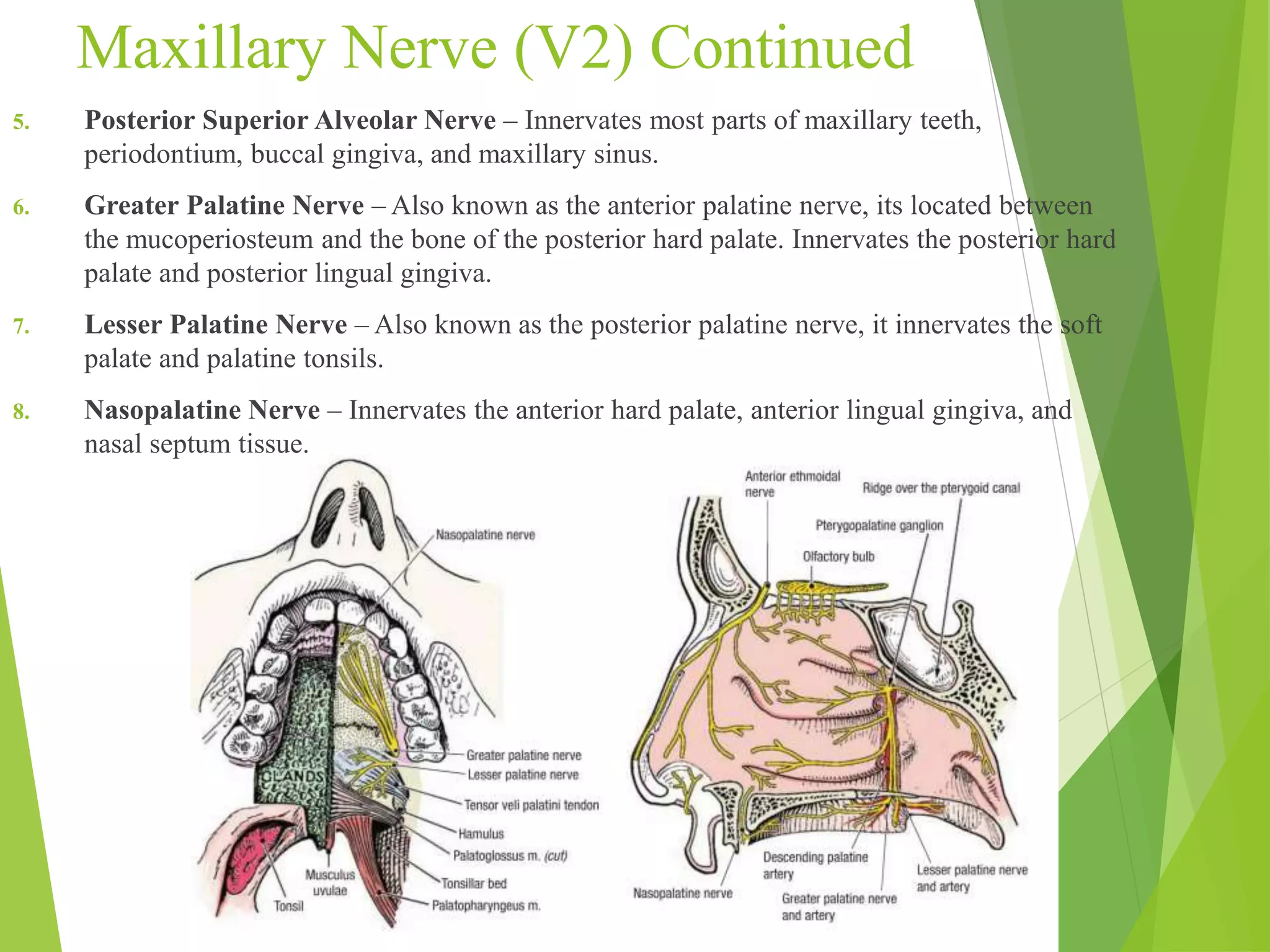
5. Posterior Superior Alveolar Nerve – Innervates most parts of maxillary teeth, 
periodontium, buccal gingiva, and maxillary sinus. 
6. Greater Palatine Nerve – Also known as the anterior palatine nerve, its located between 
the mucoperiosteum and the bone of the posterior hard palate. Innervates the posterior hard 
palate and posterior lingual gingiva. 
7. Lesser Palatine Nerve – Also known as the posterior palatine nerve, it innervates the soft 
palate and palatine tonsils. 
8. Nasopalatine Nerve – Innervates the anterior hard palate, anterior lingual gingiva, and 
nasal septum tissue.
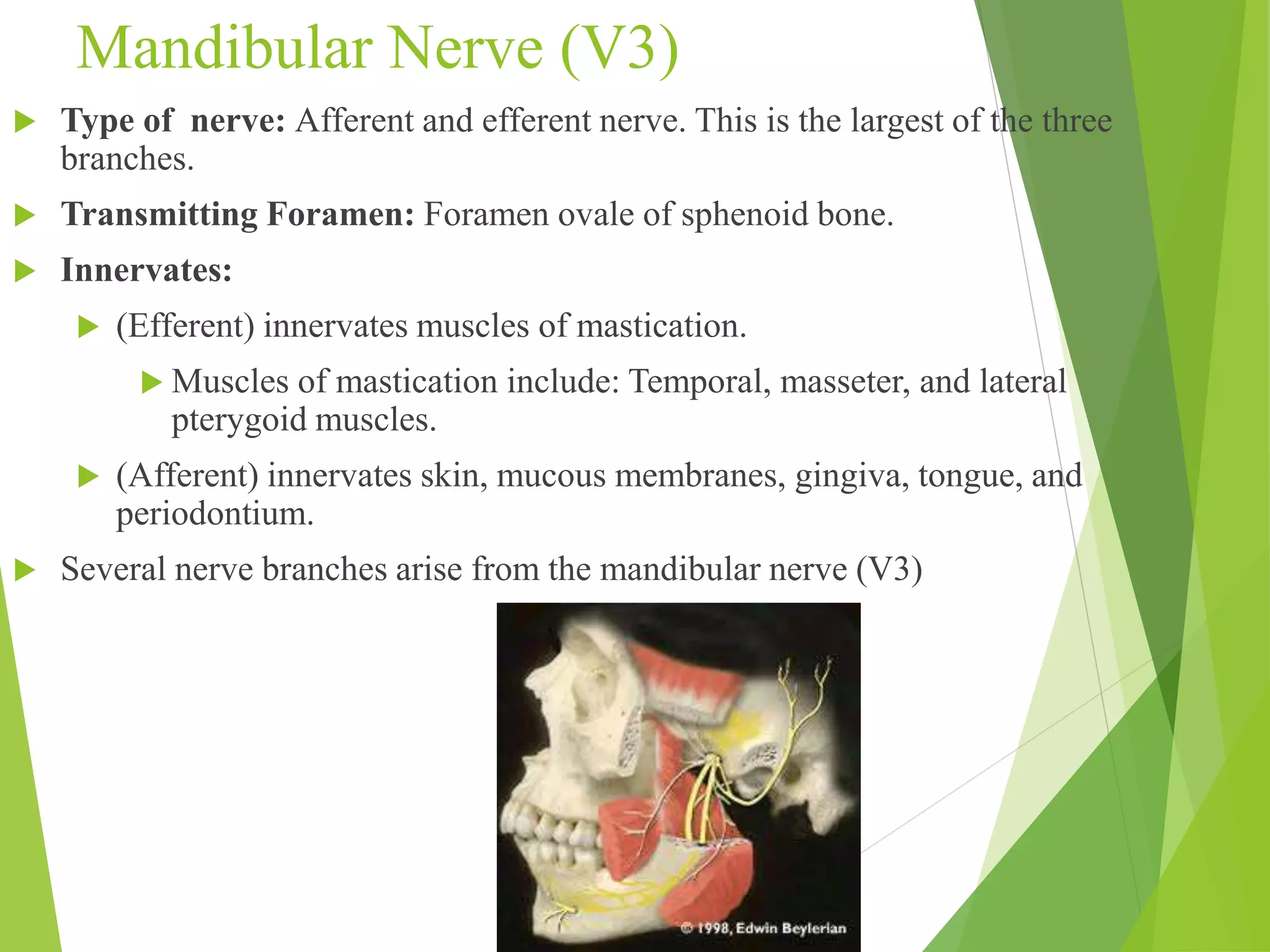
Mandibular Nerve (V3) 
 Type of nerve: Afferent and efferent nerve. This is the largest of the three 
branches. 
 Transmitting Foramen: Foramen ovale of sphenoid bone. 
 Innervates: 
 (Efferent) innervates muscles of mastication. 
 Muscles of mastication include: Temporal, masseter, and lateral 
pterygoid muscles. 
 (Afferent) innervates skin, mucous membranes, gingiva, tongue, and 
periodontium. 
 Several nerve branches arise from the mandibular nerve (V3)
Mandibular Nerve (V3) Continued 
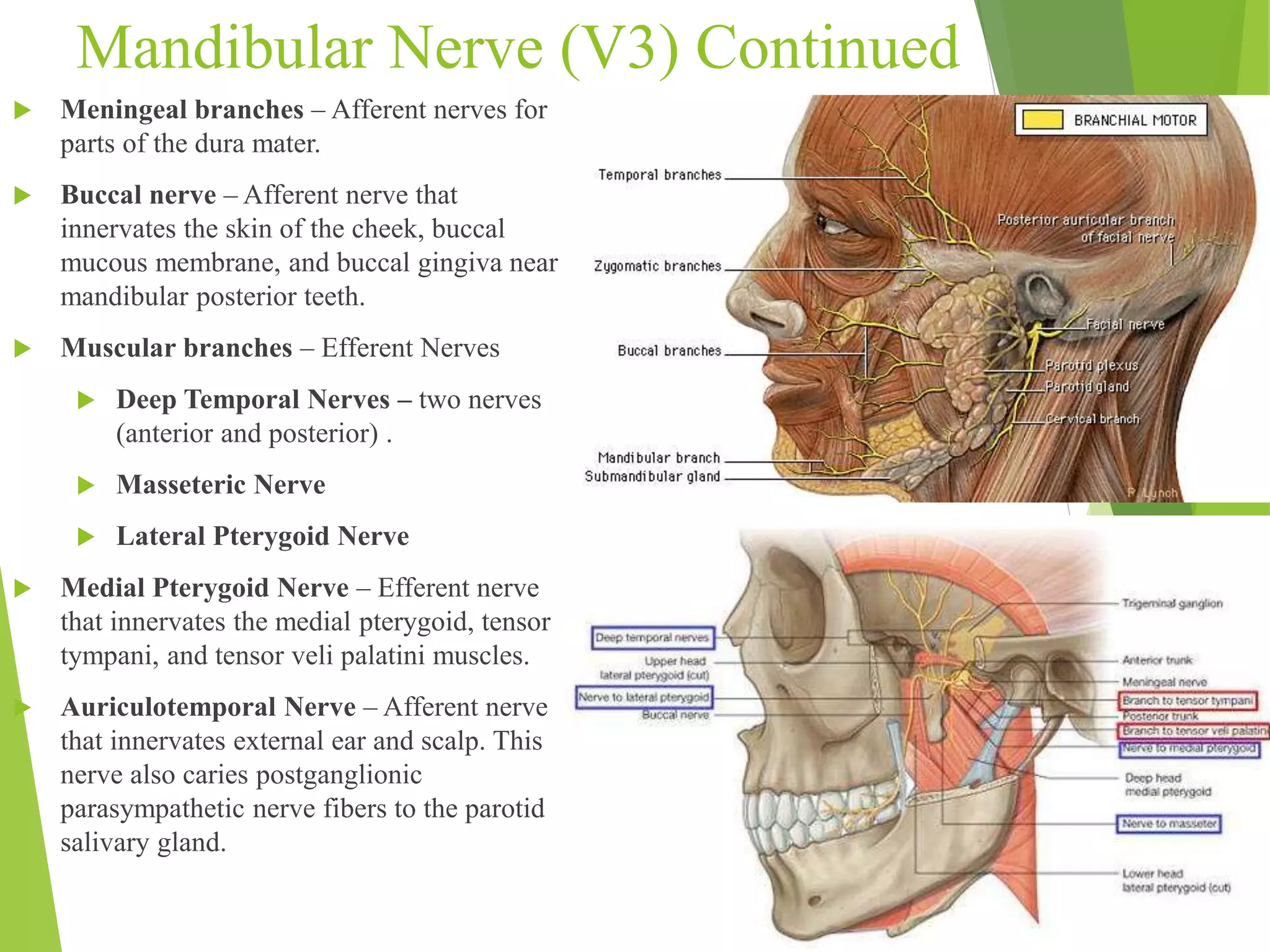
 Meningeal branches – Afferent nerves for 
parts of the dura mater. 
 Buccal nerve – Afferent nerve that 
innervates the skin of the cheek, buccal 
mucous membrane, and buccal gingiva near 
mandibular posterior teeth. 
 Muscular branches – Efferent Nerves 
 Deep Temporal Nerves – two nerves 
(anterior and posterior) . 
 Masseteric Nerve 
 Lateral Pterygoid Nerve 
 Medial Pterygoid Nerve – Efferent nerve 
that innervates the medial pterygoid, tensor 
tympani, and tensor veli palatini muscles. 
 Auriculotemporal Nerve – Afferent nerve 
that innervates external ear and scalp. This 
nerve also caries postganglionic 
parasympathetic nerve fibers to the parotid 
salivary gland.
Mandibular Nerve (V3) Continued 
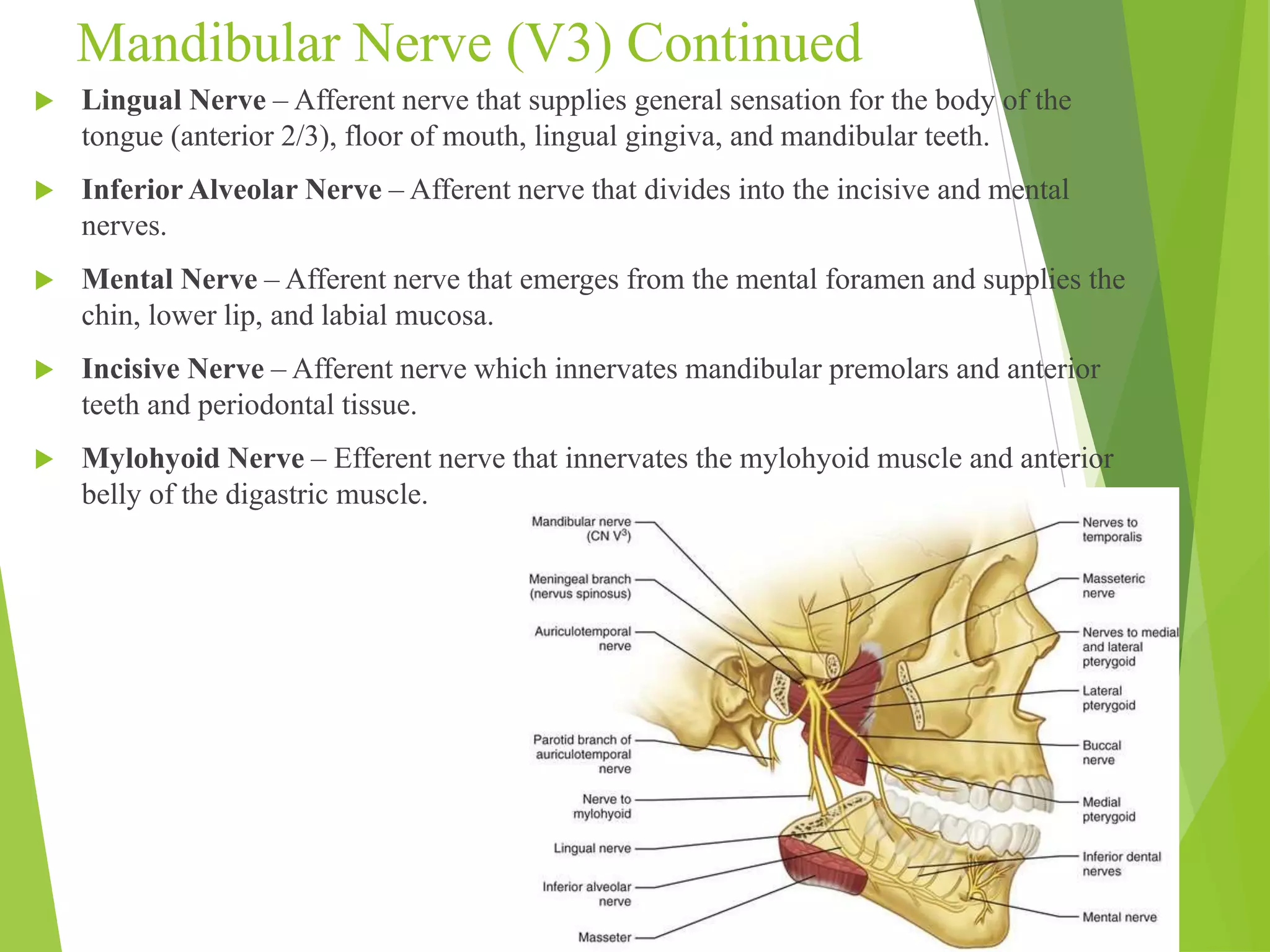
 Lingual Nerve – Afferent nerve that supplies general sensation for the body of the 
tongue (anterior 2/3), floor of mouth, lingual gingiva, and mandibular teeth. 
 Inferior Alveolar Nerve – Afferent nerve that divides into the incisive and mental 
nerves. 
 Mental Nerve – Afferent nerve that emerges from the mental foramen and supplies the 
chin, lower lip, and labial mucosa. 
 Incisive Nerve – Afferent nerve which innervates mandibular premolars and anterior 
teeth and periodontal tissue. 
 Mylohyoid Nerve – Efferent nerve that innervates the mylohyoid muscle and anterior 
belly of the digastric muscle.
Disorders of the Nervous System 
 The nervous system can be damaged by 
trauma, infection, genetic defects, 
degeneration, tumors, autoimmune disease, and 
blood flow disruption 
 Signs of a disorder can be loss of feeling, 
tingling, persistent headaches, memory loss, 
double vision, weakness, tremors, seizures, 
lack of coordination, and change in mental 
ability
Categories of Nervous System Disorders 
 Vascular Disorders: Stroke, transient ischemic attack (TIA), 
subarachnoid hemorrhage, subdural hemorrhage and 
hematoma, and extradural hemorrhage’ 
 Infections: Meningitis, encephalitis, polio, and epidural 
abscess 
 Structural Disorders: Brain or spinal cord injury, Bell's 
palsy, cervical spondylosis, carpal tunnel syndrome, brain or 
spinal cord tumors, peripheral neuropathy, and Guillain-Barré 
syndrome 
 Functional Disorders: Headache, epilepsy, dizziness, and 
neuralgia 
 Degeneration: Parkinson's disease, multiple sclerosis, 
amyotrophic lateral sclerosis (ALS), Huntington's chorea, and 
Alzheimer's disease
Case Study: Oral Implications of MS 
 Multiple Sclerosis is an autoimmune disorder 
that affects about 400,000 people in the U.S. 
 Affects Central Nervous System by damaging 
myelin sheath around the nerves 
 Symptoms may include numbness, tingling, 
weakness, fatigue, dizziness, blurring vision 
 Oral manifestations commonly include 
paresthesia and facial palsy
Case Study: Oral Implications of MS 
 54 year old Caucasian male with MS since the age of 19 
 Healthy gingival tissues with slight xerostomia (due to 
medications), slight bleeding on probing 
 Severe attrition and some hyperkeratinization due to 
bruxism from muscle spasticity 
 Plaque score of 57% with most of it found 
interproximally 
 Very motivated and educated patient who just needed 
slight adjustments for better oral care 
 Showed how to angle brush 45 degrees and floss in a C 
shape for improved plaque removal 
 Every patient is an individual and needs an individual 
treatment plan, help those who have chronic illnesses 
improve their oral health
Review 
 Nerves control what we feel, how we feel it, and how we respond 
to it. 
 The nervous system has different divisions and each are 
interrelated and have coordinating functions 
 We have 12 pairs of cranial nerves that have special sensory, 
motor, and regulatory functions 
 The facial and trigeminal nerves are absolutely essential to 
understand as dental professionals 
 It is important to understand nervous system disorders and nerve 
damage when dealing with people who have chronic illnesses or 
conditions or when administering anesthesia.
References 
Facial Nerve Branches. (n.d.). Retrieved November 10, 2014, from 
http://www.meddean.luc.edu/lumen/MedEd/grossanatomy/h_n/cn/cn1/cnb7 
.htm 
Fatima, S. (n.d.). The Cranial Nerves. Retrieved November 10, 2014, from 
http://tsdocs.org/downloads/CranialNerves.pdf 
Fehrenbach, M. J., Herring, S. W. (2012). Illustrated Anatomy of the Head and 
Neck (4th ed.). St. Louis, Missouri: Elsevier Saunders. 
Hasudungan, A. (2013). Pharmacology – Local Anesthetic, Retrieved from 
http://www.youtube.com/watch?v=K_qjguv2Wtg 
Hines, S., Lynch, P., Stewart, W., & Jaffe, C. (1998, March 22). Cranial Nerves 
- Contents. Retrieved November 10, 2014, from 
http://www.yale.edu/cnerves/contents.html 
Homan, D. P., Shively, M. J. (2008). Fundamental Concepts of Human 
Anatomy. Eden Prairie, Minnesota: Bluedoor, LLC.
References 
Overview of Nervous System Disorders. (n.d.). Retrieved November 10, 
2014, from 
http://www.hopkinsmedicine.org/healthlibrary/conditions/nervous_system 
_disorders/overview_of_nervous_system_disorders_85,P00799/ 
Peripheral Nerve System. (n.d.). Retrieved November 10, 2014, from 
http://www.hopkinsmedicine.org/neurology_neurosurgery/centers_clinics/ 
peripheral_nerve_surgery/conditions/peripheral_nerve_system.html 
Reich, M., & Campbell, P. (2010, January 1). The Oral Implications of MS. 
Retrieved November 10, 2014, from 
http://www.dimensionsofdentalhygiene.com/ddhright.aspx?id=6992 
Rubin, M. (2014, October 1). Overview of the Cranial Nerves. Retrieved 
November 10, 2014, from 
http://www.merckmanuals.com/home/brain_spinal_cord_ 
and_nerve_disorders/cranial_nerve_disorders/overview_of_the_cranial_ne 
rves.html 
Streeten, D. (n.d.). The Autonomic Nervous System. Retrieved November 10, 
2014, from http://www.ndrf.org/ans.html

Nerves and the Nervous System

  • 1.
    Nerves and theNervous System Oral Implications and Dental Considerations  Nerves and how they work  Overview of the different Nervous Systems  Cranial Nerves  Focus on Facial and Trigeminal Nerves  Nervous System Disorders  Clinical Considerations: Anesthesia  Case Study: Multiple Sclerosis
  • 2.
    Nerves  Neuron:A functional cell of the nervous system. The cell is composed of an axon, cell body, and dendrite.  Nerve: A bundle of neurons.  Afferent Nerve: Sensory nerve that sends signals from the periphery of the body to the CNS.  Efferent Nerve: Motor nerve that sends signals from the CNS to the periphery of the body.  Ganglion (Ganglia): An accumulation of cell bodies outside the CNS.  Synapse: A junction between two neurons or between a neuron and an effector organ.  Innervaition: A supply of nerves to a body part.
  • 3.
    How Nerves Work 1. There is an “equal” distribution of electrical charges and ions inside and outside the neuron cell membrane. The outside of the cell is more positive (Na) and the inside cell is more negatively charged (K). The charge difference is called Resting potential. This balance of ions is maintained by Sodium-Potassium pumps. 2. An Action potential occurs when the cell membrane depolarizes allowing sodium ions to rush inside the cell. The action potential moves down the cell at an alarming rate. Sodium and potassium pumps work together to reestablish resting potential. 3. When a impulse reaches a synapse, the cell uses chemical agents called Neurotransmitters to relay the impulse to the next nerve or tissue.
  • 5.
    Central Nervous System(CNS)  Composed of brain and spinal cord.  Meninges: membrane that has three layers; Dura mater, arachnoid mater. And pia mater.  Cerebrum – two cerebral hemispheres.  Cerebellum  Brainstem: Includes medulla, pons, midbrain.  Diencephalon: Thalamus and hypothalamus.  Surrounded and protected by bone.
  • 6.
    Peripheral Nervous System(PNS)  Network of 43 pairs of motor and sensory nerves that connect the brain and spinal cord to the rest of their body  Control functions of sensation, movement, and motor coordination  Includes nerves such as the femoral, radial, ulnar, brachial plexus, and sciatic.
  • 7.
    Autonomic Nervous System(ANS)  Conveys sensory impulses from the blood vessels, the heart, and all of the other organs in the chest, abdomen, and pelvis through nerves to other parts of the brain  Impulses do not reach our consciousness, elicit mostly automatic or reflex responses  Consists of sympathetic and parasympathetic divisions, either fight or flight or rest and digest.
  • 8.
    Overview of CranialNerves  12 pairs of nerves that go directly from the brain to specific areas of the head and neck  Some are involved in special senses  Some are involved in muscle movement and gland regulation  Nerves are named and numbered according to their location from the front of the brain to the back
  • 9.
    Cranial Nerve I/OlfactoryNerve  Type of Nerve: Afferent – special sensory for smell.  Origin: Nerve enters the skull through the perforations in the cribriform plate of the ethmoid bone to join the olfactory bulb in the brain  Transmitting Foramen: Olfactory Foramina  Innervates: Transmits smell from the olfactory mucosa to the brain
  • 10.
    Cranial Nerve II/OpticNerve  Type of Nerve: Afferent – special sense of vision  Origin: Nerve enters the skull through the optic canal of the sphenoid bone on its way to the retina. Right and left optic nerves join at the optic chiasma, many of the fibers cross and continue into the brain as the optic tracts.  Transmitting Foramen: Optic Canal  Innervates: Transmits sight from the retinal ganglionic layer to the brain
  • 11.
    Cranial Nerve III/OculomotorNerve  Type of Nerve: Efferent  Origin: Lateral wall of the cavernous sinus, carries preganglionic parasympathetic fibers to the ciliary ganglion near the eyeball, and postganglionic fibers to the small muscles inside the eyeball.  Transmitting Foramen: Superior Orbital Fissure  Innervates: Two components control muscles for precise eye movement (Somatic Motor) and control pupillary light and accommodation reflexes (Visceral Motor).
  • 12.
    Cranial Nerve IV/TrochlearNerve  Type of Nerve: Efferent  Origin: Runs in the wall of the cavernous sinus and goes to the orbit.  Transmitting Foramen: Superior Orbital Fissure  Innervates: The superior oblique muscle of the eye which is responsible for eye movement, tracking, and fixation on an object
  • 13.
    Cranial Nerve VI/AbducensNerve  Type of Nerve: Efferent  Origin: Runs through the sinus, close to the internal carotid artery on its way to the orbit  Transmitting Foramen: Superior Orbital Fissure  Innervates: The lateral rectus muscle which is also responsible for eye movement, tracking, and fixation on an object
  • 14.
    Cranial Nerve VIII/ Vestibulocochlear Nerve  Type of nerve: Afferent Nerve – Sensory for hearing and balance.  Origin: The nerve attaches to the brain at the junction of the pons and medulla oblongata, just lateral to the origin of the facial nerve.  Transmitting Foramen: Nerve enters cranial cavity through the internal acoustic meatus of the temporal bone.  Innervates: Connects brain to inner ear.
  • 15.
    Cranial Nerve IX/ Glossopharyngeal Nerve  Type of nerve: Efferent and afferent nerve  Origin: Arises from the anterior portion of the posterolateral sulcus of the medulla oblongata.  Transmitting Foramen: Jugular foramen • Innervates:  (Efferent) Innervates the pharyngeal muscle, the stylopharyngeus muscle, and the preganglionic gland parasympathetic innervation for the parotid salivary gland.  (Afferent) Innervates the oropharynx and deals primarily with taste and general sensation for base of the tongue and the gag reflex.  Additionally, the lesser petrosal nerve of IX, synapses with the otic ganglion.
  • 16.
    Cranial Nerve X/ Vagus Nerve  Type of nerve: Afferent and Efferent nerve.  Origin: Arises from the lateral aspect of the medulla oblongata just below the ipsilateral glossopharyngeal nerve. It is the longest cranial nerve.  Transmitting Foramen: Jugular foramen.  Innervates:  (Afferent) Innervates parasympathetically to many organs in the thorax and abdomen such as the heart, thymus, and stomach. It also innervates the skin around the ear and taste sensation, and the epiglottis.  (Efferent) Innervates muscle of soft palate, pharynx, and larynx.
  • 17.
    Cranial Nerve XI/ Accessory Nerve  Type of nerve: Efferent nerve.  Origin: Originates as two roots: one from the medulla oblongata adjacent to the origin of the vagus nerve; the second from the cervical spinal cord.  Transmitting Foramen: Jugular foramen.  Innervates: Innervates the trapezius and sternocleidomastoideus muscles. Additionally, it innervates muscles of the soft palate and pharynx.
  • 18.
    Cranial Nerve XII/ Hypoglossal Nerve  Type of nerve: Efferent Nerve.  Origin: Arises as 10 to 15 rootlets from the anterolateral sulcus between the olive and pyramid of the medulla oblongata.  Transmitting Foramen: The ipsilateral hypoglossal canal of the occipital bone.  Innervates: Innervates muscles the intrinsic and extrinsic muscles of the tongue.
  • 19.
    Cranial Nerve VII/FacialNerve  Type of Nerve: Afferent and Efferent components  Origin: The main trunk of the nerve emerges from the skull and gives off two branches, the posterior auricular nerve and a branch to the posterior belly of the digastric and stylohyoid muscles. It also sends off small efferent branches to the stapedius muscle and two other branches to the ear. There are also a multitude of smaller nerves that go off into the muscles of the face.  Transmitting Foramen: Mainly the Stylomastoid Foramen  Branches of the Facial Nerve:  Greater Petrosal Nerve  Chorda Tympani Nerve  Posterior Auricular, Stylohyoid, and Posterior Digastric Nerves  Temporal Branch  Zygomatic Branch  Mandibular Branch  Buccal Branch  Cervical Branch
  • 20.
    Greater Petrosal Nerve  Type of Nerve: Afferent and Efferent  Origin: Branch off the facial nerve before it exits the skull, carries preganglionic parasympathetic fibers  Innervates: Parasympathetic fibers go to the pterygopalatine ganglion and then join with branches of the maxillary nerve which is carried to the lacrimal gland, nasal cavity, and minor salivary glands of the hard and soft palate. The afferent nerve fibers of the greater petrosal nerve go to the palate for taste sensation.
  • 21.
    Chorda Tympani Nerve  Type of Nerve: Afferent and Efferent  Origin: Branches off the facial nerve within the petrous portion of the temporal bone and crosses the eardrum before exiting and traveling down to the lingual nerve along the floor of the mouth  Transmitting Foramen: Petrotympanic Fissure (behind the TMJ)  Innervates: Parasympathetic efferent fibers innervate the submandibular and sublingual salivary glands, afferent fibers are found in the body of the tongue for taste sensation.
  • 22.
    Posterior Auricular, Stylohyoid,and Posterior Digastric Nerves  Types of Nerves: All are Efferent nerves  Origins: Branches of the facial nerve after it exits the stylomastoid foramen  Innervates: Posterior auricular nerve goes to the occipital belly of the epicranial muscle. The stylohyoid innervates the stylohyoid muscle. The posterior digastric nerve innervates the posterior belly of the digastric muscle
  • 23.
    Branches to theMuscles of Facial Expression  Types of Nerves: All five branches are efferent  Origins: These branches of the facial nerve originate in the parotid salivary gland and then go to the muscles they supply  Innervates:  Temporal: Muscles anterior to the ear, frontal belly of epicranial muscle, superior portion of orbicularis oculi, and corrugator supercili  Zygomatic: Inferior portion of orbicularis oculi and zygomatic minor and major muscles  Buccal: Muscles of upper lip and nose, buccinators, risorius, and orbicularis oris  Mandibular: Muscles of lower lip and mentalis muscle  Cervical: Runs inferior to the mandible to supply platysma
  • 24.
    Cranial Nerve V/ Trigeminal Nerve  Type of nerve: Efferent and afferent nerve.  Afferent - The sensory component is thick.  Efferent - The motor component is thin.  Origin: Emerges from the inferolateral aspect of the pons. The trigeminal nerve is the largest cranial nerve in diameter and is composed of a thin efferent nerve and a thick afferent nerve. At the sight of the trigeminal ganglion (located within the skull), the nerve divides into three anatomical branches and exits through transmitting foramen.  Branches of the Trigeminal Nerve: 1. Ophthalmic Nerve (V1) 2. Maxillary Nerve (V2) 3. Mandibular Nerve (V3)
  • 25.
    Ophthalmic Nerve (V1)  Type of nerve: Afferent nerve. Is the smallest division.  Transmitting Foramen: Superior Orbital Fissure.  Innervates: Innervates the conjunctiva, cornea, eyeball, orbit, forehead, and ethmoidal and frontal sinsuses.  Three major nerves: 1. Frontal Nerve – Composed of supraorbital nerve and supratrochlear nerve. This nerve courses along the roof of the orbit. 2. Lacrimal Nerve – This nerve supplies the conjunctiva and the lacrimal gland. Additionally it also delivers the postganglionic parasympathetic nerve to the lacrimal gland. 3. Nasociliary Nerve – Composed of several nerves including the infratrochlear nerve, ciliary nerves, anterior ethmoidal nerve, external nasal nerve, and internal nasal nerves. These nerves innervates the skin of the eyelids, lacrimal sac, eyeball, and the nose.
  • 26.
    Maxillary Nerve (V2)  Type of nerve: Afferent Nerve.  Transmitting Foramen: Foramen rotundum of sphenoid bone.  Other nerve branches: within the pterygopalatine fossa the main maxillary trunk diverges into many nerves, the largest being the infraorbital nerve. Other nerves include the zygomatic, the anterior, middle, and posterior superior alveolar nerves, the greater and lesser palatine nerves, and nasopalatine nerves. Additionally, within the pterygopalatine fossa the pterygopalatine ganglion can be found. This ganglion caries parasympathetic fibers from the facial nerve, and caries parasympathetic fibers to minor salivary glands.  Innervates: Innervates the maxillae, overlying skin, maxillary sinuses, nasal cavity, palate, and nasopharynx.
  • 27.
    Maxillary Nerve (V2)Continued 1. Zygomatic nerve – divides into the zygomaticofacial and zygomaticotemporal nerves. It exits the pterygopalatine fossa through the inferior orbital fissure. These nerve innervate the skin of the cheeks and the temporal regions. 2. Infraorbital Nerve – Branches into nerves that innervate the upper lip, medial part of the cheek, lower eyelid, and side of the nose. Emerges from the Infraorbital foramen. 3. Anterior Superior Alveolar Nerve – Innervates maxillary central incisors, lateral incisors, and canines, as well as the surrounding tissue. 4. Middle Superior Alveolar Nerve – Innervates maxillary premolar teeth and mesiobuccal root of the maxillary first molar and their associated periodontium and buccal gingiva.
  • 28.
    Maxillary Nerve (V2)Continued 5. Posterior Superior Alveolar Nerve – Innervates most parts of maxillary teeth, periodontium, buccal gingiva, and maxillary sinus. 6. Greater Palatine Nerve – Also known as the anterior palatine nerve, its located between the mucoperiosteum and the bone of the posterior hard palate. Innervates the posterior hard palate and posterior lingual gingiva. 7. Lesser Palatine Nerve – Also known as the posterior palatine nerve, it innervates the soft palate and palatine tonsils. 8. Nasopalatine Nerve – Innervates the anterior hard palate, anterior lingual gingiva, and nasal septum tissue.
  • 29.
    Mandibular Nerve (V3)  Type of nerve: Afferent and efferent nerve. This is the largest of the three branches.  Transmitting Foramen: Foramen ovale of sphenoid bone.  Innervates:  (Efferent) innervates muscles of mastication.  Muscles of mastication include: Temporal, masseter, and lateral pterygoid muscles.  (Afferent) innervates skin, mucous membranes, gingiva, tongue, and periodontium.  Several nerve branches arise from the mandibular nerve (V3)
  • 30.
    Mandibular Nerve (V3)Continued  Meningeal branches – Afferent nerves for parts of the dura mater.  Buccal nerve – Afferent nerve that innervates the skin of the cheek, buccal mucous membrane, and buccal gingiva near mandibular posterior teeth.  Muscular branches – Efferent Nerves  Deep Temporal Nerves – two nerves (anterior and posterior) .  Masseteric Nerve  Lateral Pterygoid Nerve  Medial Pterygoid Nerve – Efferent nerve that innervates the medial pterygoid, tensor tympani, and tensor veli palatini muscles.  Auriculotemporal Nerve – Afferent nerve that innervates external ear and scalp. This nerve also caries postganglionic parasympathetic nerve fibers to the parotid salivary gland.
  • 31.
    Mandibular Nerve (V3)Continued  Lingual Nerve – Afferent nerve that supplies general sensation for the body of the tongue (anterior 2/3), floor of mouth, lingual gingiva, and mandibular teeth.  Inferior Alveolar Nerve – Afferent nerve that divides into the incisive and mental nerves.  Mental Nerve – Afferent nerve that emerges from the mental foramen and supplies the chin, lower lip, and labial mucosa.  Incisive Nerve – Afferent nerve which innervates mandibular premolars and anterior teeth and periodontal tissue.  Mylohyoid Nerve – Efferent nerve that innervates the mylohyoid muscle and anterior belly of the digastric muscle.
  • 32.
    Disorders of theNervous System  The nervous system can be damaged by trauma, infection, genetic defects, degeneration, tumors, autoimmune disease, and blood flow disruption  Signs of a disorder can be loss of feeling, tingling, persistent headaches, memory loss, double vision, weakness, tremors, seizures, lack of coordination, and change in mental ability
  • 33.
    Categories of NervousSystem Disorders  Vascular Disorders: Stroke, transient ischemic attack (TIA), subarachnoid hemorrhage, subdural hemorrhage and hematoma, and extradural hemorrhage’  Infections: Meningitis, encephalitis, polio, and epidural abscess  Structural Disorders: Brain or spinal cord injury, Bell's palsy, cervical spondylosis, carpal tunnel syndrome, brain or spinal cord tumors, peripheral neuropathy, and Guillain-Barré syndrome  Functional Disorders: Headache, epilepsy, dizziness, and neuralgia  Degeneration: Parkinson's disease, multiple sclerosis, amyotrophic lateral sclerosis (ALS), Huntington's chorea, and Alzheimer's disease
  • 34.
    Case Study: OralImplications of MS  Multiple Sclerosis is an autoimmune disorder that affects about 400,000 people in the U.S.  Affects Central Nervous System by damaging myelin sheath around the nerves  Symptoms may include numbness, tingling, weakness, fatigue, dizziness, blurring vision  Oral manifestations commonly include paresthesia and facial palsy
  • 36.
    Case Study: OralImplications of MS  54 year old Caucasian male with MS since the age of 19  Healthy gingival tissues with slight xerostomia (due to medications), slight bleeding on probing  Severe attrition and some hyperkeratinization due to bruxism from muscle spasticity  Plaque score of 57% with most of it found interproximally  Very motivated and educated patient who just needed slight adjustments for better oral care  Showed how to angle brush 45 degrees and floss in a C shape for improved plaque removal  Every patient is an individual and needs an individual treatment plan, help those who have chronic illnesses improve their oral health
  • 37.
    Review  Nervescontrol what we feel, how we feel it, and how we respond to it.  The nervous system has different divisions and each are interrelated and have coordinating functions  We have 12 pairs of cranial nerves that have special sensory, motor, and regulatory functions  The facial and trigeminal nerves are absolutely essential to understand as dental professionals  It is important to understand nervous system disorders and nerve damage when dealing with people who have chronic illnesses or conditions or when administering anesthesia.
  • 38.
    References Facial NerveBranches. (n.d.). Retrieved November 10, 2014, from http://www.meddean.luc.edu/lumen/MedEd/grossanatomy/h_n/cn/cn1/cnb7 .htm Fatima, S. (n.d.). The Cranial Nerves. Retrieved November 10, 2014, from http://tsdocs.org/downloads/CranialNerves.pdf Fehrenbach, M. J., Herring, S. W. (2012). Illustrated Anatomy of the Head and Neck (4th ed.). St. Louis, Missouri: Elsevier Saunders. Hasudungan, A. (2013). Pharmacology – Local Anesthetic, Retrieved from http://www.youtube.com/watch?v=K_qjguv2Wtg Hines, S., Lynch, P., Stewart, W., & Jaffe, C. (1998, March 22). Cranial Nerves - Contents. Retrieved November 10, 2014, from http://www.yale.edu/cnerves/contents.html Homan, D. P., Shively, M. J. (2008). Fundamental Concepts of Human Anatomy. Eden Prairie, Minnesota: Bluedoor, LLC.
  • 39.
    References Overview ofNervous System Disorders. (n.d.). Retrieved November 10, 2014, from http://www.hopkinsmedicine.org/healthlibrary/conditions/nervous_system _disorders/overview_of_nervous_system_disorders_85,P00799/ Peripheral Nerve System. (n.d.). Retrieved November 10, 2014, from http://www.hopkinsmedicine.org/neurology_neurosurgery/centers_clinics/ peripheral_nerve_surgery/conditions/peripheral_nerve_system.html Reich, M., & Campbell, P. (2010, January 1). The Oral Implications of MS. Retrieved November 10, 2014, from http://www.dimensionsofdentalhygiene.com/ddhright.aspx?id=6992 Rubin, M. (2014, October 1). Overview of the Cranial Nerves. Retrieved November 10, 2014, from http://www.merckmanuals.com/home/brain_spinal_cord_ and_nerve_disorders/cranial_nerve_disorders/overview_of_the_cranial_ne rves.html Streeten, D. (n.d.). The Autonomic Nervous System. Retrieved November 10, 2014, from http://www.ndrf.org/ans.html

Editor's Notes

  • #2 What we’re going to talk about today!