Anatomical Directions
Remember
Standard Anatomical Position?
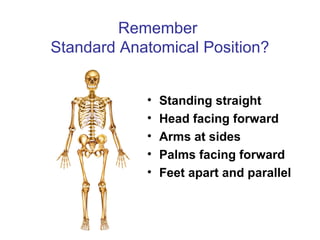
• Standing straight
• Head facing forward
• Arms at sides
• Palms facing forward
• Feet apart and parallel
Remember
Standard Anatomical Position?
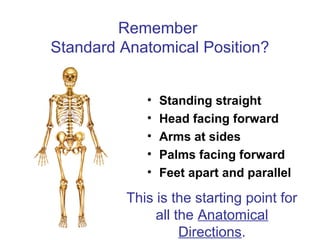
• Standing straight
• Head facing forward
• Arms at sides
• Palms facing forward
• Feet apart and parallel
This is the starting point for
all the Anatomical
Directions.
Anatomical directions are
relative,
which means they describe
directions relative to parts of the
body in Anatomical Position.
Anatomical directions are
relative,
which means they describe
directions relative to parts of the
body in Anatomical Position.
For example:
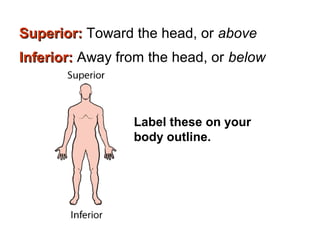
Superior:Superior: Toward the head, or above
Inferior:Inferior: Away from the head, or below
Label these on your
body outline.
Anterior:Anterior: toward the front of the body
(you can also say ventral)
Posterior:Posterior: toward the back of the body
(you can also say dorsal)
Label these on your
body outline. (Draw
arrows if you need to.)
Memory Hint:
Remember that sharks and dolphins have a
dorsal fin on their back side.
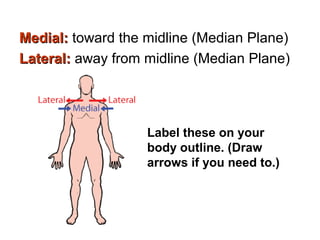
Medial:Medial: toward the midline (Median Plane)
Lateral:Lateral: away from midline (Median Plane)
Label these on your
body outline. (Draw
arrows if you need to.)
Memory Hint for Sports Fans:
Think of a lateral pass, where the player throws
the ball to the side, away from his/her midline.
Intermediate:Intermediate: Between two things.
Example: Your nose is
intermediate to your ears.
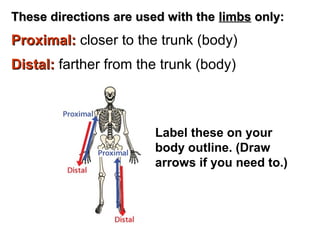
These directions are used with theThese directions are used with the limbslimbs only:only:
Proximal:Proximal: closer to the trunk (body)
Distal:Distal: farther from the trunk (body)
Label these on your
body outline. (Draw
arrows if you need to.)
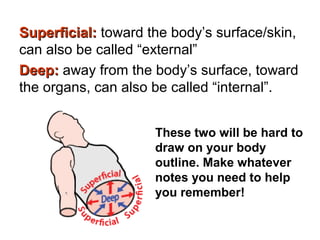
Superficial:Superficial: toward the body’s surface/skin,
can also be called “external”
Deep:Deep: away from the body’s surface, toward
the organs, can also be called “internal”.
These two will be hard to
draw on your body
outline. Make whatever
notes you need to help
you remember!
When you think about the directions
superficial and deep, it helps to think of
wounds, or breaks in the skin.
A small cut, scratch, or scrape is known as a
superficial wound.
A deep wound, however, is dangerous. It is a
hole in the body that will affect structures
under the skin, like muscles, large blood
vessels, and organs. This might be a deep
cut, gunshot wound, or a shark bite.
Let’s check for
understanding!
Take the survey below.

Anatomical directions

  • 1.
  • 2.
    Remember Standard Anatomical Position? •Standing straight • Head facing forward • Arms at sides • Palms facing forward • Feet apart and parallel
  • 3.
    Remember Standard Anatomical Position? •Standing straight • Head facing forward • Arms at sides • Palms facing forward • Feet apart and parallel This is the starting point for all the Anatomical Directions.
  • 4.
    Anatomical directions are relative, whichmeans they describe directions relative to parts of the body in Anatomical Position.
  • 5.
    Anatomical directions are relative, whichmeans they describe directions relative to parts of the body in Anatomical Position. For example:
  • 6.
    Superior:Superior: Toward thehead, or above Inferior:Inferior: Away from the head, or below Label these on your body outline.
  • 7.
    Anterior:Anterior: toward thefront of the body (you can also say ventral) Posterior:Posterior: toward the back of the body (you can also say dorsal) Label these on your body outline. (Draw arrows if you need to.)
  • 8.
    Memory Hint: Remember thatsharks and dolphins have a dorsal fin on their back side.
  • 9.
    Medial:Medial: toward themidline (Median Plane) Lateral:Lateral: away from midline (Median Plane) Label these on your body outline. (Draw arrows if you need to.)
  • 10.
    Memory Hint forSports Fans: Think of a lateral pass, where the player throws the ball to the side, away from his/her midline.
  • 11.
    Intermediate:Intermediate: Between twothings. Example: Your nose is intermediate to your ears.
  • 12.
    These directions areused with theThese directions are used with the limbslimbs only:only: Proximal:Proximal: closer to the trunk (body) Distal:Distal: farther from the trunk (body) Label these on your body outline. (Draw arrows if you need to.)
  • 13.
    Superficial:Superficial: toward thebody’s surface/skin, can also be called “external” Deep:Deep: away from the body’s surface, toward the organs, can also be called “internal”. These two will be hard to draw on your body outline. Make whatever notes you need to help you remember!
  • 14.
    When you thinkabout the directions superficial and deep, it helps to think of wounds, or breaks in the skin. A small cut, scratch, or scrape is known as a superficial wound. A deep wound, however, is dangerous. It is a hole in the body that will affect structures under the skin, like muscles, large blood vessels, and organs. This might be a deep cut, gunshot wound, or a shark bite.
  • 15.