Broken Bones
Broken vs. Fractured
Some people think there is a difference between
a “broken” bone and a “fractured” bone. (Like a
fracture is somehow worse than a break.)
Actually, “fractured” is just a more medically
correct way of saying “broken”.
There are different types of bone fractures.
Ninety percent of all bone fractures are caused
by trauma, like a fall or a vehicle accident.
The bones that are mostly commonly broken are
the long bones (tibia, femur, humerus, radius,
ulna, etc.)
Simple Fracture
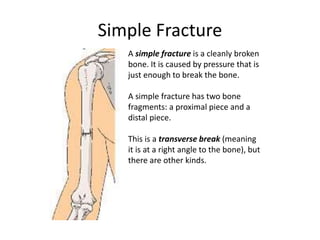
A simple fracture is a cleanly broken
bone. It is caused by pressure that is
just enough to break the bone.
A simple fracture has two bone
fragments: a proximal piece and a
distal piece.
This is a transverse break (meaning
it is at a right angle to the bone), but
there are other kinds.
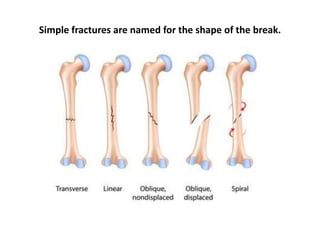
Simple fractures are named for the shape of the break.
Comminuted Fracture
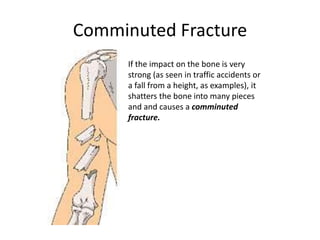
If the impact on the bone is very
strong (as seen in traffic accidents or
a fall from a height, as examples), it
shatters the bone into many pieces
and and causes a comminuted
fracture.
Compound Fracture
Compound fracture is when the skin
and soft tissues around the fracture
are disrupted and the broken bones
are exposed, or when a bone
fragment pierces through these
tissues and are seen outside the
skin. There will be bleeding where
the skin is broken.
Sometimes the bone will slip back
inside and all you will see at the site
of the fracture is a skin wound.
If the skin is not broken, it is called a
“closed” fracture (meaning the skin
is not broken and no bone is poking
out).
Greenstick Fracture
A Greenstick fracture is an
incomplete fracture in which the
bone is bent, but not enough to
break.
This type of injury occurs most often
in children, whose bones are more
flexible than those of adults.
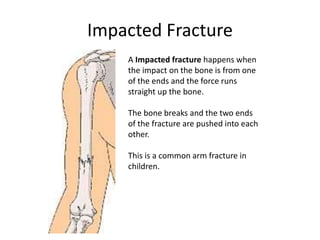
Impacted Fracture
A Impacted fracture happens when
the impact on the bone is from one
of the ends and the force runs
straight up the bone.
The bone breaks and the two ends
of the fracture are pushed into each
other.
This is a common arm fracture in
children.
Stress Fracture
A stress fracture is most
commonly seen in athletes.
This happens when there is
repeated stress on the
bone, from long-distance
running, for example.
Pathological Fracture
A pathological fracture
happens when bone is
diseased or weakened.
The diseased bone breaks
with very light force that
wouldn’t normally break a
bone.
Osteoporosis is a bone
disease that happens when
there is not enough calcium
in bones and they become
fragile.
The End.

Fractured bones

  • 1.
  • 2.
    Broken vs. Fractured Somepeople think there is a difference between a “broken” bone and a “fractured” bone. (Like a fracture is somehow worse than a break.) Actually, “fractured” is just a more medically correct way of saying “broken”.
  • 3.
    There are differenttypes of bone fractures. Ninety percent of all bone fractures are caused by trauma, like a fall or a vehicle accident. The bones that are mostly commonly broken are the long bones (tibia, femur, humerus, radius, ulna, etc.)
  • 4.
    Simple Fracture A simplefracture is a cleanly broken bone. It is caused by pressure that is just enough to break the bone. A simple fracture has two bone fragments: a proximal piece and a distal piece. This is a transverse break (meaning it is at a right angle to the bone), but there are other kinds.
  • 5.
    Simple fractures arenamed for the shape of the break.
  • 6.
    Comminuted Fracture If theimpact on the bone is very strong (as seen in traffic accidents or a fall from a height, as examples), it shatters the bone into many pieces and and causes a comminuted fracture.
  • 7.
    Compound Fracture Compound fractureis when the skin and soft tissues around the fracture are disrupted and the broken bones are exposed, or when a bone fragment pierces through these tissues and are seen outside the skin. There will be bleeding where the skin is broken. Sometimes the bone will slip back inside and all you will see at the site of the fracture is a skin wound. If the skin is not broken, it is called a “closed” fracture (meaning the skin is not broken and no bone is poking out).
  • 8.
    Greenstick Fracture A Greenstickfracture is an incomplete fracture in which the bone is bent, but not enough to break. This type of injury occurs most often in children, whose bones are more flexible than those of adults.
  • 9.
    Impacted Fracture A Impactedfracture happens when the impact on the bone is from one of the ends and the force runs straight up the bone. The bone breaks and the two ends of the fracture are pushed into each other. This is a common arm fracture in children.
  • 10.
    Stress Fracture A stressfracture is most commonly seen in athletes. This happens when there is repeated stress on the bone, from long-distance running, for example.
  • 11.
    Pathological Fracture A pathologicalfracture happens when bone is diseased or weakened. The diseased bone breaks with very light force that wouldn’t normally break a bone. Osteoporosis is a bone disease that happens when there is not enough calcium in bones and they become fragile.
  • 12.