2nd lecture:
anatomical nomenclature
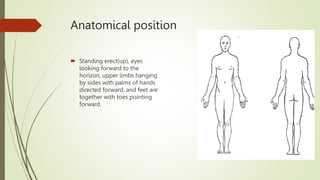
Anatomical position
 Standing erect(up), eyes
looking forward to the
horizon, upper limbs hanging
by sides with palms of hands
directed forward, and feet are
together with toes pointing
forward.
Terms of position/direction
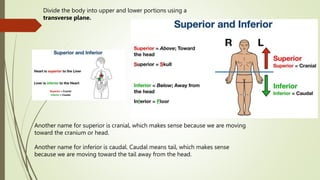
Divide the body into upper and lower portions using a
transverse plane.
Another name for superior is cranial, which makes sense because we are moving
toward the cranium or head.
Another name for inferior is caudal. Caudal means tail, which makes sense
because we are moving toward the tail away from the head.
Midline (median plane or midsagittal plane) is an
imaginary vertical line down the middle of the body, and it
divides the body into equal right and left sections.
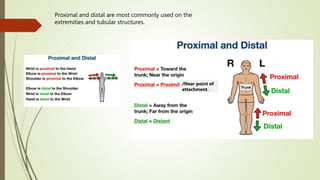
Proximal and distal are most commonly used on the
extremities and tubular structures.
/Near point of
attachment.
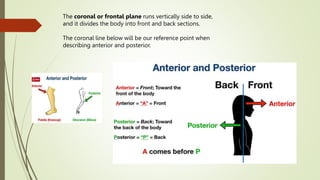
The coronal or frontal plane runs vertically side to side,
and it divides the body into front and back sections.
The coronal line below will be our reference point when
describing anterior and posterior.
 Another name for anterior is ventral, and another name for posterior is dorsal.
 For ventral, you can think of a ventriloquist which literally translates to “stomach talker”.
 We learned in our medical prefix lecture that the prefix “ventri-” refers to the stomach, abdomen, or front of
the body.
 This can help you remember ventral means anterior.
 For dorsal, you can think of the dorsal fin on the back of a fish to help you remember dorsal means posterior.
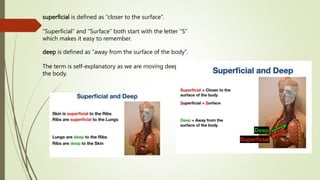
superficial is defined as “closer to the surface”.
“Superficial” and “Surface” both start with the letter “S”
which makes it easy to remember.
deep is defined as “away from the surface of the body”.
The term is self-explanatory as we are moving deeper into
the body.
Division/planes of body
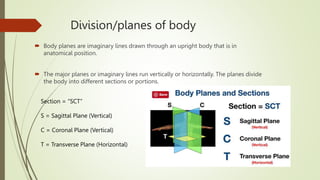
 Body planes are imaginary lines drawn through an upright body that is in
anatomical position.
 The major planes or imaginary lines run vertically or horizontally. The planes divide
the body into different sections or portions.
Section = “SCT”
S = Sagittal Plane (Vertical)
C = Coronal Plane (Vertical)
T = Transverse Plane (Horizontal)
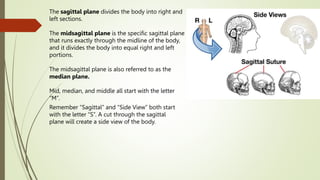
The sagittal plane divides the body into right and
left sections.
The midsagittal plane is the specific sagittal plane
that runs exactly through the midline of the body,
and it divides the body into equal right and left
portions.
The midsagittal plane is also referred to as the
median plane.
Mid, median, and middle all start with the letter
“M”.
Remember “Sagittal” and “Side View” both start
with the letter “S”. A cut through the sagittal
plane will create a side view of the body.
The coronal plane is also called the frontal plane.
divides the body into front (anterior) and back (posterior)
sections.
The “Frontal” plane will give you a “Front View” of the
body as it divides the body into front and back portions.
The transverse plane is also called the axial plane or
horizontal plane, which makes sense because it is a
horizontal line.
Movements
 Anatomical terms of movement are used to describe the actions of muscles upon
the skeleton.
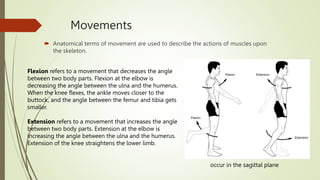
Flexion refers to a movement that decreases the angle
between two body parts. Flexion at the elbow is
decreasing the angle between the ulna and the humerus.
When the knee flexes, the ankle moves closer to the
buttock, and the angle between the femur and tibia gets
smaller.
Extension refers to a movement that increases the angle
between two body parts. Extension at the elbow is
increasing the angle between the ulna and the humerus.
Extension of the knee straightens the lower limb.
occur in the sagittal plane
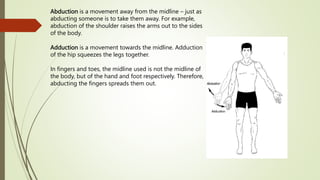
Abduction is a movement away from the midline – just as
abducting someone is to take them away. For example,
abduction of the shoulder raises the arms out to the sides
of the body.
Adduction is a movement towards the midline. Adduction
of the hip squeezes the legs together.
In fingers and toes, the midline used is not the midline of
the body, but of the hand and foot respectively. Therefore,
abducting the fingers spreads them out.
movements at the ankle
Dorsiflexion refers to flexion at the ankle, so that the foot
points more superiorly. Or toes towards face.
Plantarflexion refers extension at the ankle, so that the
foot points inferiorly. toes towards ground.
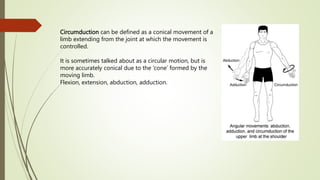
Circumduction can be defined as a conical movement of a
limb extending from the joint at which the movement is
controlled.
It is sometimes talked about as a circular motion, but is
more accurately conical due to the ‘cone’ formed by the
moving limb.
Flexion, extension, abduction, adduction.
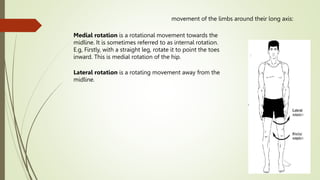
movement of the limbs around their long axis:
Medial rotation is a rotational movement towards the
midline. It is sometimes referred to as internal rotation.
E.g, Firstly, with a straight leg, rotate it to point the toes
inward. This is medial rotation of the hip.
Lateral rotation is a rotating movement away from the
midline.
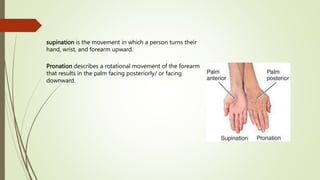
supination is the movement in which a person turns their
hand, wrist, and forearm upward.
Pronation describes a rotational movement of the forearm
that results in the palm facing posteriorly/ or facing
downward.
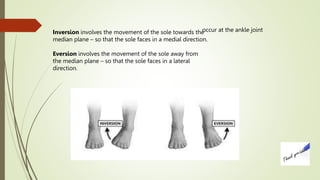
occur at the ankle joint
Inversion involves the movement of the sole towards the
median plane – so that the sole faces in a medial direction.
Eversion involves the movement of the sole away from
the median plane – so that the sole faces in a lateral
direction.

anatomical nomenclature

  • 1.
  • 2.
    Anatomical position  Standingerect(up), eyes looking forward to the horizon, upper limbs hanging by sides with palms of hands directed forward, and feet are together with toes pointing forward.
  • 3.
  • 4.
    Divide the bodyinto upper and lower portions using a transverse plane. Another name for superior is cranial, which makes sense because we are moving toward the cranium or head. Another name for inferior is caudal. Caudal means tail, which makes sense because we are moving toward the tail away from the head.
  • 5.
    Midline (median planeor midsagittal plane) is an imaginary vertical line down the middle of the body, and it divides the body into equal right and left sections.
  • 6.
    Proximal and distalare most commonly used on the extremities and tubular structures. /Near point of attachment.
  • 7.
    The coronal orfrontal plane runs vertically side to side, and it divides the body into front and back sections. The coronal line below will be our reference point when describing anterior and posterior.
  • 8.
     Another namefor anterior is ventral, and another name for posterior is dorsal.  For ventral, you can think of a ventriloquist which literally translates to “stomach talker”.  We learned in our medical prefix lecture that the prefix “ventri-” refers to the stomach, abdomen, or front of the body.  This can help you remember ventral means anterior.  For dorsal, you can think of the dorsal fin on the back of a fish to help you remember dorsal means posterior.
  • 9.
    superficial is definedas “closer to the surface”. “Superficial” and “Surface” both start with the letter “S” which makes it easy to remember. deep is defined as “away from the surface of the body”. The term is self-explanatory as we are moving deeper into the body.
  • 10.
    Division/planes of body Body planes are imaginary lines drawn through an upright body that is in anatomical position.  The major planes or imaginary lines run vertically or horizontally. The planes divide the body into different sections or portions. Section = “SCT” S = Sagittal Plane (Vertical) C = Coronal Plane (Vertical) T = Transverse Plane (Horizontal)
  • 11.
    The sagittal planedivides the body into right and left sections. The midsagittal plane is the specific sagittal plane that runs exactly through the midline of the body, and it divides the body into equal right and left portions. The midsagittal plane is also referred to as the median plane. Mid, median, and middle all start with the letter “M”. Remember “Sagittal” and “Side View” both start with the letter “S”. A cut through the sagittal plane will create a side view of the body.
  • 12.
    The coronal planeis also called the frontal plane. divides the body into front (anterior) and back (posterior) sections. The “Frontal” plane will give you a “Front View” of the body as it divides the body into front and back portions.
  • 13.
    The transverse planeis also called the axial plane or horizontal plane, which makes sense because it is a horizontal line.
  • 14.
    Movements  Anatomical termsof movement are used to describe the actions of muscles upon the skeleton. Flexion refers to a movement that decreases the angle between two body parts. Flexion at the elbow is decreasing the angle between the ulna and the humerus. When the knee flexes, the ankle moves closer to the buttock, and the angle between the femur and tibia gets smaller. Extension refers to a movement that increases the angle between two body parts. Extension at the elbow is increasing the angle between the ulna and the humerus. Extension of the knee straightens the lower limb. occur in the sagittal plane
  • 15.
    Abduction is amovement away from the midline – just as abducting someone is to take them away. For example, abduction of the shoulder raises the arms out to the sides of the body. Adduction is a movement towards the midline. Adduction of the hip squeezes the legs together. In fingers and toes, the midline used is not the midline of the body, but of the hand and foot respectively. Therefore, abducting the fingers spreads them out.
  • 16.
    movements at theankle Dorsiflexion refers to flexion at the ankle, so that the foot points more superiorly. Or toes towards face. Plantarflexion refers extension at the ankle, so that the foot points inferiorly. toes towards ground.
  • 17.
    Circumduction can bedefined as a conical movement of a limb extending from the joint at which the movement is controlled. It is sometimes talked about as a circular motion, but is more accurately conical due to the ‘cone’ formed by the moving limb. Flexion, extension, abduction, adduction.
  • 18.
    movement of thelimbs around their long axis: Medial rotation is a rotational movement towards the midline. It is sometimes referred to as internal rotation. E.g, Firstly, with a straight leg, rotate it to point the toes inward. This is medial rotation of the hip. Lateral rotation is a rotating movement away from the midline.
  • 19.
    supination is themovement in which a person turns their hand, wrist, and forearm upward. Pronation describes a rotational movement of the forearm that results in the palm facing posteriorly/ or facing downward.
  • 20.
    occur at theankle joint Inversion involves the movement of the sole towards the median plane – so that the sole faces in a medial direction. Eversion involves the movement of the sole away from the median plane – so that the sole faces in a lateral direction.