The Muscular System:The Muscular System:
StructureStructure
Muscle tissue is made of special cells
that contract.
Muscle tissue is made of special cells
that contract.
This action is called a contraction.
Muscle tissue is made of special cells
that contract.
This action is called a contraction.
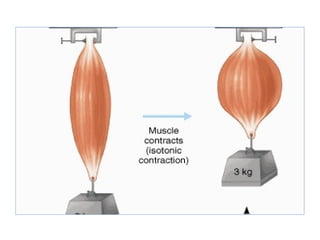
When a muscle contracts, it gets
shorter and wider.
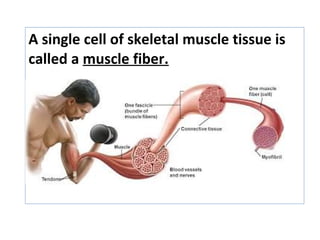
A single cell of skeletal muscle tissue is
called a muscle fiber.
These cells or fibers are very fine.
(1/25,000”)
They can be up to 10” long.
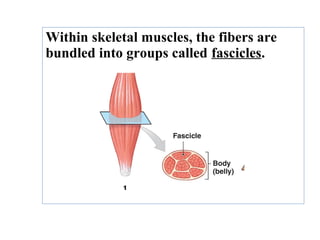
Within skeletal muscles, the fibers are
bundled into groups called fascicles.
Fasicles contain muscle fibers and
the connective tissue that joins
them, called endomysium.
(endo- = “inside of”)
Fasicles are bundled into larger
groups held together with a
connective tissue called
perimysium.
(peri- = “around”)
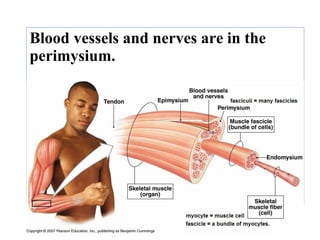
Blood vessels and nerves are in the
perimysium.
Finally, the entire big bundle (a
muscle), is covered in a layer of
connective tissue called the
epimysium.
(epi- = “on the surface”)
This is the surface of the muscle,
which can appear silvery.
The endomysium, perimysium, and
epimysium are made primarily of
collagen.
The endomysium, perimysium, and
epimysium are made primarily of
collagen.
Collagen is the same protein that
gives structure to your skin in the
dermis and gives your bones
resilience.
At each end of the muscle, all of the
connective tissues come together to
form a tendon, or sometimes a broad,
flat sheet of collagen called an
aponeurosis.
At each end of the muscle, all of the
connective tissues come together to
form a tendon, or sometimes a broad,
flat sheet of collagen called an
aponeurosis.
Tendons and aponeuroses (plural)
are how muscles attach to the
skeletal system.
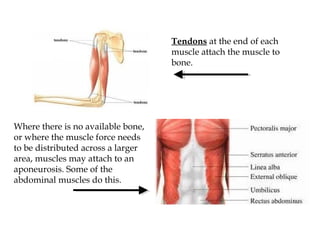
Tendons at the end of each
muscle attach the muscle to
bone.
Where there is no available bone,
or where the muscle force needs
to be distributed across a larger
area, muscles may attach to an
aponeurosis. Some of the
abdominal muscles do this.
The End.

Muscle structure

  • 1.
    The Muscular System:TheMuscular System: StructureStructure
  • 2.
    Muscle tissue ismade of special cells that contract.
  • 3.
    Muscle tissue ismade of special cells that contract. This action is called a contraction.
  • 4.
    Muscle tissue ismade of special cells that contract. This action is called a contraction. When a muscle contracts, it gets shorter and wider.
  • 6.
    A single cellof skeletal muscle tissue is called a muscle fiber.
  • 7.
    These cells orfibers are very fine. (1/25,000”) They can be up to 10” long.
  • 8.
    Within skeletal muscles,the fibers are bundled into groups called fascicles.
  • 9.
    Fasicles contain musclefibers and the connective tissue that joins them, called endomysium. (endo- = “inside of”)
  • 10.
    Fasicles are bundledinto larger groups held together with a connective tissue called perimysium. (peri- = “around”)
  • 11.
    Blood vessels andnerves are in the perimysium.
  • 12.
    Finally, the entirebig bundle (a muscle), is covered in a layer of connective tissue called the epimysium. (epi- = “on the surface”) This is the surface of the muscle, which can appear silvery.
  • 13.
    The endomysium, perimysium,and epimysium are made primarily of collagen.
  • 14.
    The endomysium, perimysium,and epimysium are made primarily of collagen. Collagen is the same protein that gives structure to your skin in the dermis and gives your bones resilience.
  • 15.
    At each endof the muscle, all of the connective tissues come together to form a tendon, or sometimes a broad, flat sheet of collagen called an aponeurosis.
  • 16.
    At each endof the muscle, all of the connective tissues come together to form a tendon, or sometimes a broad, flat sheet of collagen called an aponeurosis. Tendons and aponeuroses (plural) are how muscles attach to the skeletal system.
  • 17.
    Tendons at theend of each muscle attach the muscle to bone. Where there is no available bone, or where the muscle force needs to be distributed across a larger area, muscles may attach to an aponeurosis. Some of the abdominal muscles do this.
  • 18.