Investment InsightsInvestment Insights
Chart Patterns
StockStream LLP
All about investments. © StockStream LLP
Disclaimer
• Trading carries significant risk of losses and may not be suitable for all
investors. Traders should assess these risks either themselves or in
consultation with a financial advisor before investing.
• There is no guarantee that the trading techniques, methods and other
information in this presentation will result in profits. The content in this
presentation in only intended for educational and informational
purposes and not intended as trading recommendation.
• The content of this presentation is subject to change without notice.
• Stockstream Financial Advisory Services LLP or mystockstream.com
will not take any liability or accountability of losses arising from the use
of information in this presentation in any manner.
- 3 -
All about investments. © StockStream LLP
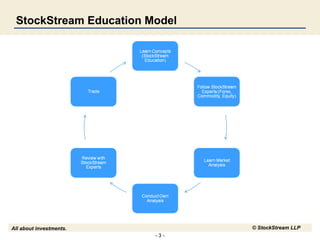
StockStream Education Model
- 4 -
All about investments. © StockStream LLP
Introduction
• Chart patterns are formations that indicate either a reversal or
continuation of a trend.
• These can be used independently or in combination with
other technical indicators to develop trading strategies.
• Some of the common chart patterns are,
o Head and Shoulder
o Double Tops and Bottoms
o Triangles, Wedges
o Flags, Pennants
o Rounded Tops and Bottoms
- 5 -
All about investments. © StockStream LLP
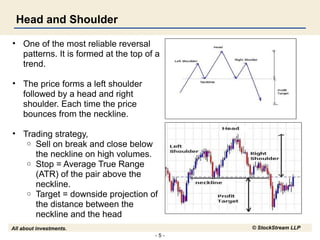
Head and Shoulder
• One of the most reliable reversal
patterns. It is formed at the top of a
trend.
• The price forms a left shoulder
followed by a head and right
shoulder. Each time the price
bounces from the neckline.
• Trading strategy,
o Sell on break and close below
the neckline on high volumes.
o Stop = Average True Range
(ATR) of the pair above the
neckline.
o Target = downside projection of
the distance between the
neckline and the head
- 6 -
All about investments. © StockStream LLP
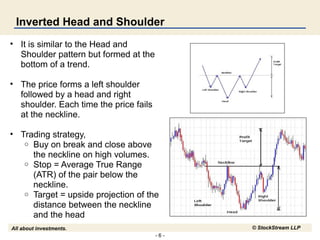
Inverted Head and Shoulder
• It is similar to the Head and
Shoulder pattern but formed at the
bottom of a trend.
• The price forms a left shoulder
followed by a head and right
shoulder. Each time the price fails
at the neckline.
• Trading strategy,
o Buy on break and close above
the neckline on high volumes.
o Stop = Average True Range
(ATR) of the pair below the
neckline.
o Target = upside projection of the
distance between the neckline
and the head
- 7 -
All about investments. © StockStream LLP
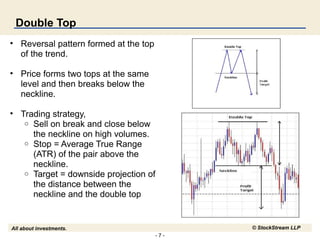
Double Top
• Reversal pattern formed at the top
of the trend.
• Price forms two tops at the same
level and then breaks below the
neckline.
• Trading strategy,
o Sell on break and close below
the neckline on high volumes.
o Stop = Average True Range
(ATR) of the pair above the
neckline.
o Target = downside projection of
the distance between the
neckline and the double top
- 8 -
All about investments. © StockStream LLP
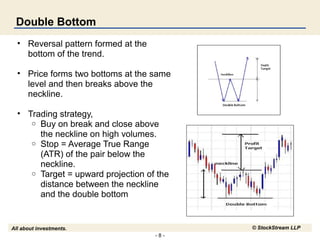
Double Bottom
• Reversal pattern formed at the
bottom of the trend.
• Price forms two bottoms at the same
level and then breaks above the
neckline.
• Trading strategy,
o Buy on break and close above
the neckline on high volumes.
o Stop = Average True Range
(ATR) of the pair below the
neckline.
o Target = upward projection of the
distance between the neckline
and the double bottom
- 9 -
All about investments. © StockStream LLP
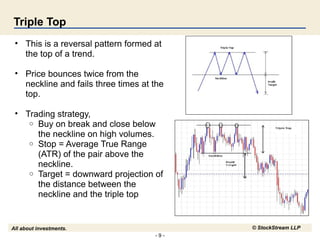
Triple Top
• This is a reversal pattern formed at
the top of a trend.
• Price bounces twice from the
neckline and fails three times at the
top.
• Trading strategy,
o Buy on break and close below
the neckline on high volumes.
o Stop = Average True Range
(ATR) of the pair above the
neckline.
o Target = downward projection of
the distance between the
neckline and the triple top
- 10 -
All about investments. © StockStream LLP
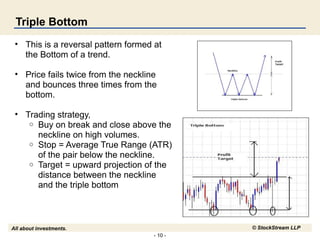
Triple Bottom
• This is a reversal pattern formed at
the Bottom of a trend.
• Price fails twice from the neckline
and bounces three times from the
bottom.
• Trading strategy,
o Buy on break and close above the
neckline on high volumes.
o Stop = Average True Range (ATR)
of the pair below the neckline.
o Target = upward projection of the
distance between the neckline
and the triple bottom
- 11 -
All about investments. © StockStream LLP
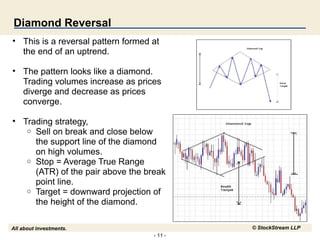
Diamond Reversal
• This is a reversal pattern formed at
the end of an uptrend.
• The pattern looks like a diamond.
Trading volumes increase as prices
diverge and decrease as prices
converge.
• Trading strategy,
o Sell on break and close below
the support line of the diamond
on high volumes.
o Stop = Average True Range
(ATR) of the pair above the break
point line.
o Target = downward projection of
the height of the diamond.
- 12 -
All about investments. © StockStream LLP
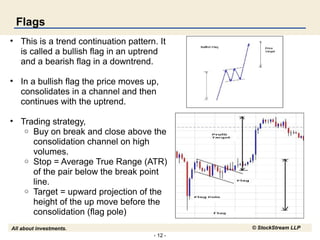
Flags
• This is a trend continuation pattern. It
is called a bullish flag in an uptrend
and a bearish flag in a downtrend.
• In a bullish flag the price moves up,
consolidates in a channel and then
continues with the uptrend.
• Trading strategy,
o Buy on break and close above the
consolidation channel on high
volumes.
o Stop = Average True Range (ATR)
of the pair below the break point
line.
o Target = upward projection of the
height of the up move before the
consolidation (flag pole)
- 13 -
All about investments. © StockStream LLP
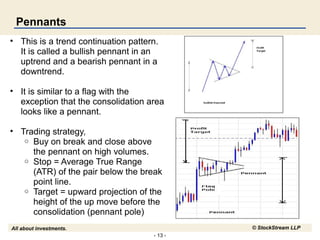
Pennants
• This is a trend continuation pattern.
It is called a bullish pennant in an
uptrend and a bearish pennant in a
downtrend.
• It is similar to a flag with the
exception that the consolidation area
looks like a pennant.
• Trading strategy,
o Buy on break and close above
the pennant on high volumes.
o Stop = Average True Range
(ATR) of the pair below the break
point line.
o Target = upward projection of the
height of the up move before the
consolidation (pennant pole)
- 14 -
All about investments. © StockStream LLP
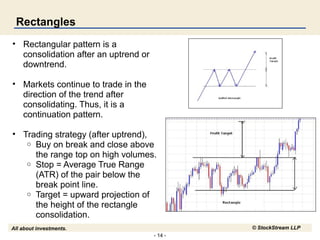
Rectangles
• Rectangular pattern is a
consolidation after an uptrend or
downtrend.
• Markets continue to trade in the
direction of the trend after
consolidating. Thus, it is a
continuation pattern.
• Trading strategy (after uptrend),
o Buy on break and close above
the range top on high volumes.
o Stop = Average True Range
(ATR) of the pair below the
break point line.
o Target = upward projection of
the height of the rectangle
consolidation.
- 15 -
All about investments. © StockStream LLP
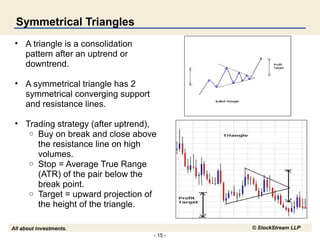
Symmetrical Triangles
• A triangle is a consolidation
pattern after an uptrend or
downtrend.
• A symmetrical triangle has 2
symmetrical converging support
and resistance lines.
• Trading strategy (after uptrend),
o Buy on break and close above
the resistance line on high
volumes.
o Stop = Average True Range
(ATR) of the pair below the
break point.
o Target = upward projection of
the height of the triangle.
- 16 -
All about investments. © StockStream LLP
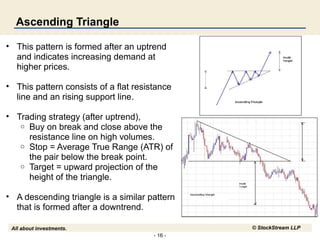
Ascending Triangle
• This pattern is formed after an uptrend
and indicates increasing demand at
higher prices.
• This pattern consists of a flat resistance
line and an rising support line.
• Trading strategy (after uptrend),
o Buy on break and close above the
resistance line on high volumes.
o Stop = Average True Range (ATR) of
the pair below the break point.
o Target = upward projection of the
height of the triangle.
• A descending triangle is a similar pattern
that is formed after a downtrend.
- 17 -
All about investments. © StockStream LLP
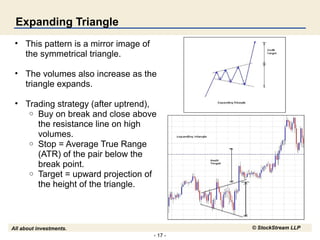
Expanding Triangle
• This pattern is a mirror image of
the symmetrical triangle.
• The volumes also increase as the
triangle expands.
• Trading strategy (after uptrend),
o Buy on break and close above
the resistance line on high
volumes.
o Stop = Average True Range
(ATR) of the pair below the
break point.
o Target = upward projection of
the height of the triangle.
- 18 -
All about investments. © StockStream LLP
Questions
• Visit and register at mystockstream.com
• Follow and interact with StockStream Experts for answers
• StockStream Education
• StockStream Forex
• StockStream Commodity
• StockStream India

Chart patterns

  • 1.
  • 2.
    All about investments.© StockStream LLP Disclaimer • Trading carries significant risk of losses and may not be suitable for all investors. Traders should assess these risks either themselves or in consultation with a financial advisor before investing. • There is no guarantee that the trading techniques, methods and other information in this presentation will result in profits. The content in this presentation in only intended for educational and informational purposes and not intended as trading recommendation. • The content of this presentation is subject to change without notice. • Stockstream Financial Advisory Services LLP or mystockstream.com will not take any liability or accountability of losses arising from the use of information in this presentation in any manner.
  • 3.
    - 3 - Allabout investments. © StockStream LLP StockStream Education Model
  • 4.
    - 4 - Allabout investments. © StockStream LLP Introduction • Chart patterns are formations that indicate either a reversal or continuation of a trend. • These can be used independently or in combination with other technical indicators to develop trading strategies. • Some of the common chart patterns are, o Head and Shoulder o Double Tops and Bottoms o Triangles, Wedges o Flags, Pennants o Rounded Tops and Bottoms
  • 5.
    - 5 - Allabout investments. © StockStream LLP Head and Shoulder • One of the most reliable reversal patterns. It is formed at the top of a trend. • The price forms a left shoulder followed by a head and right shoulder. Each time the price bounces from the neckline. • Trading strategy, o Sell on break and close below the neckline on high volumes. o Stop = Average True Range (ATR) of the pair above the neckline. o Target = downside projection of the distance between the neckline and the head
  • 6.
    - 6 - Allabout investments. © StockStream LLP Inverted Head and Shoulder • It is similar to the Head and Shoulder pattern but formed at the bottom of a trend. • The price forms a left shoulder followed by a head and right shoulder. Each time the price fails at the neckline. • Trading strategy, o Buy on break and close above the neckline on high volumes. o Stop = Average True Range (ATR) of the pair below the neckline. o Target = upside projection of the distance between the neckline and the head
  • 7.
    - 7 - Allabout investments. © StockStream LLP Double Top • Reversal pattern formed at the top of the trend. • Price forms two tops at the same level and then breaks below the neckline. • Trading strategy, o Sell on break and close below the neckline on high volumes. o Stop = Average True Range (ATR) of the pair above the neckline. o Target = downside projection of the distance between the neckline and the double top
  • 8.
    - 8 - Allabout investments. © StockStream LLP Double Bottom • Reversal pattern formed at the bottom of the trend. • Price forms two bottoms at the same level and then breaks above the neckline. • Trading strategy, o Buy on break and close above the neckline on high volumes. o Stop = Average True Range (ATR) of the pair below the neckline. o Target = upward projection of the distance between the neckline and the double bottom
  • 9.
    - 9 - Allabout investments. © StockStream LLP Triple Top • This is a reversal pattern formed at the top of a trend. • Price bounces twice from the neckline and fails three times at the top. • Trading strategy, o Buy on break and close below the neckline on high volumes. o Stop = Average True Range (ATR) of the pair above the neckline. o Target = downward projection of the distance between the neckline and the triple top
  • 10.
    - 10 - Allabout investments. © StockStream LLP Triple Bottom • This is a reversal pattern formed at the Bottom of a trend. • Price fails twice from the neckline and bounces three times from the bottom. • Trading strategy, o Buy on break and close above the neckline on high volumes. o Stop = Average True Range (ATR) of the pair below the neckline. o Target = upward projection of the distance between the neckline and the triple bottom
  • 11.
    - 11 - Allabout investments. © StockStream LLP Diamond Reversal • This is a reversal pattern formed at the end of an uptrend. • The pattern looks like a diamond. Trading volumes increase as prices diverge and decrease as prices converge. • Trading strategy, o Sell on break and close below the support line of the diamond on high volumes. o Stop = Average True Range (ATR) of the pair above the break point line. o Target = downward projection of the height of the diamond.
  • 12.
    - 12 - Allabout investments. © StockStream LLP Flags • This is a trend continuation pattern. It is called a bullish flag in an uptrend and a bearish flag in a downtrend. • In a bullish flag the price moves up, consolidates in a channel and then continues with the uptrend. • Trading strategy, o Buy on break and close above the consolidation channel on high volumes. o Stop = Average True Range (ATR) of the pair below the break point line. o Target = upward projection of the height of the up move before the consolidation (flag pole)
  • 13.
    - 13 - Allabout investments. © StockStream LLP Pennants • This is a trend continuation pattern. It is called a bullish pennant in an uptrend and a bearish pennant in a downtrend. • It is similar to a flag with the exception that the consolidation area looks like a pennant. • Trading strategy, o Buy on break and close above the pennant on high volumes. o Stop = Average True Range (ATR) of the pair below the break point line. o Target = upward projection of the height of the up move before the consolidation (pennant pole)
  • 14.
    - 14 - Allabout investments. © StockStream LLP Rectangles • Rectangular pattern is a consolidation after an uptrend or downtrend. • Markets continue to trade in the direction of the trend after consolidating. Thus, it is a continuation pattern. • Trading strategy (after uptrend), o Buy on break and close above the range top on high volumes. o Stop = Average True Range (ATR) of the pair below the break point line. o Target = upward projection of the height of the rectangle consolidation.
  • 15.
    - 15 - Allabout investments. © StockStream LLP Symmetrical Triangles • A triangle is a consolidation pattern after an uptrend or downtrend. • A symmetrical triangle has 2 symmetrical converging support and resistance lines. • Trading strategy (after uptrend), o Buy on break and close above the resistance line on high volumes. o Stop = Average True Range (ATR) of the pair below the break point. o Target = upward projection of the height of the triangle.
  • 16.
    - 16 - Allabout investments. © StockStream LLP Ascending Triangle • This pattern is formed after an uptrend and indicates increasing demand at higher prices. • This pattern consists of a flat resistance line and an rising support line. • Trading strategy (after uptrend), o Buy on break and close above the resistance line on high volumes. o Stop = Average True Range (ATR) of the pair below the break point. o Target = upward projection of the height of the triangle. • A descending triangle is a similar pattern that is formed after a downtrend.
  • 17.
    - 17 - Allabout investments. © StockStream LLP Expanding Triangle • This pattern is a mirror image of the symmetrical triangle. • The volumes also increase as the triangle expands. • Trading strategy (after uptrend), o Buy on break and close above the resistance line on high volumes. o Stop = Average True Range (ATR) of the pair below the break point. o Target = upward projection of the height of the triangle.
  • 18.
    - 18 - Allabout investments. © StockStream LLP Questions • Visit and register at mystockstream.com • Follow and interact with StockStream Experts for answers • StockStream Education • StockStream Forex • StockStream Commodity • StockStream India