Analysis of Covariance (ANCOVA)
Understanding the Concept,
Assumptions, and Applications
What is ANCOVA?
• - ANCOVA stands for Analysis of Covariance.
• - It combines ANOVA and regression.
• - It adjusts for the effect of covariates to better
assess the impact of independent variables on
a dependent variable.
• - Commonly used in experimental and
observational studies.
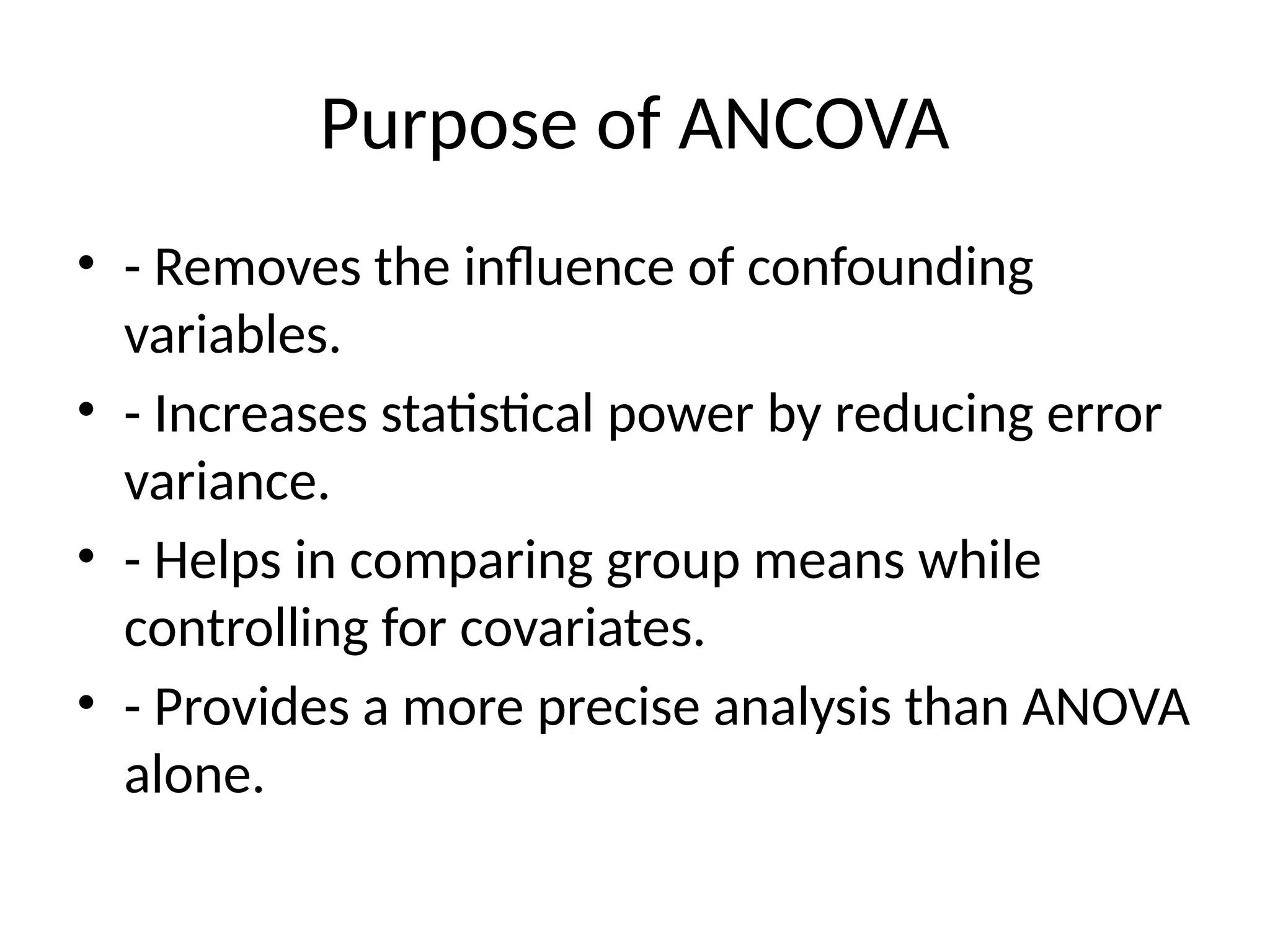
Purpose of ANCOVA
• - Removes the influence of confounding
variables.
• - Increases statistical power by reducing error
variance.
• - Helps in comparing group means while
controlling for covariates.
• - Provides a more precise analysis than ANOVA
alone.
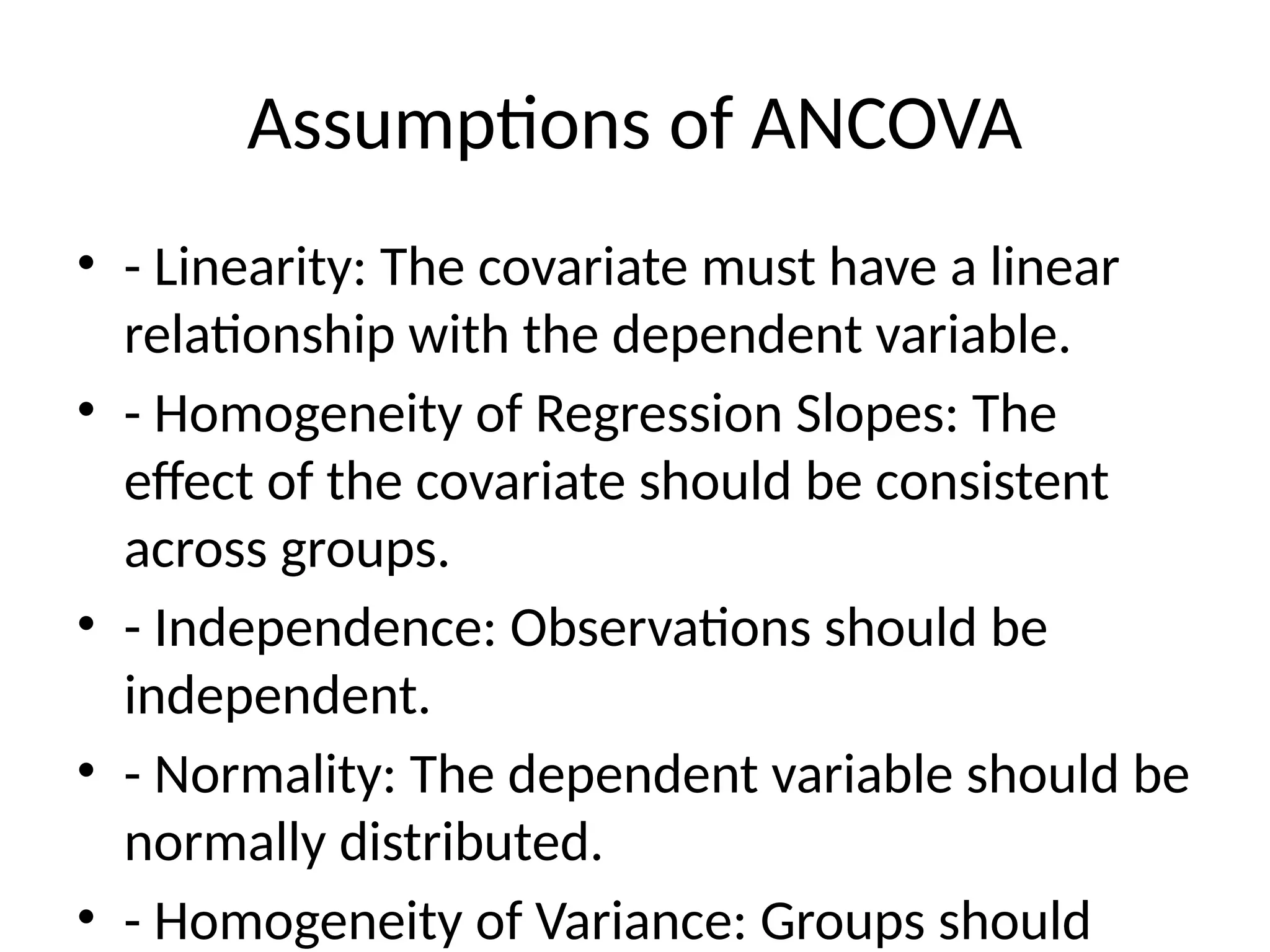
Assumptions of ANCOVA
• - Linearity: The covariate must have a linear
relationship with the dependent variable.
• - Homogeneity of Regression Slopes: The
effect of the covariate should be consistent
across groups.
• - Independence: Observations should be
independent.
• - Normality: The dependent variable should be
normally distributed.
• - Homogeneity of Variance: Groups should
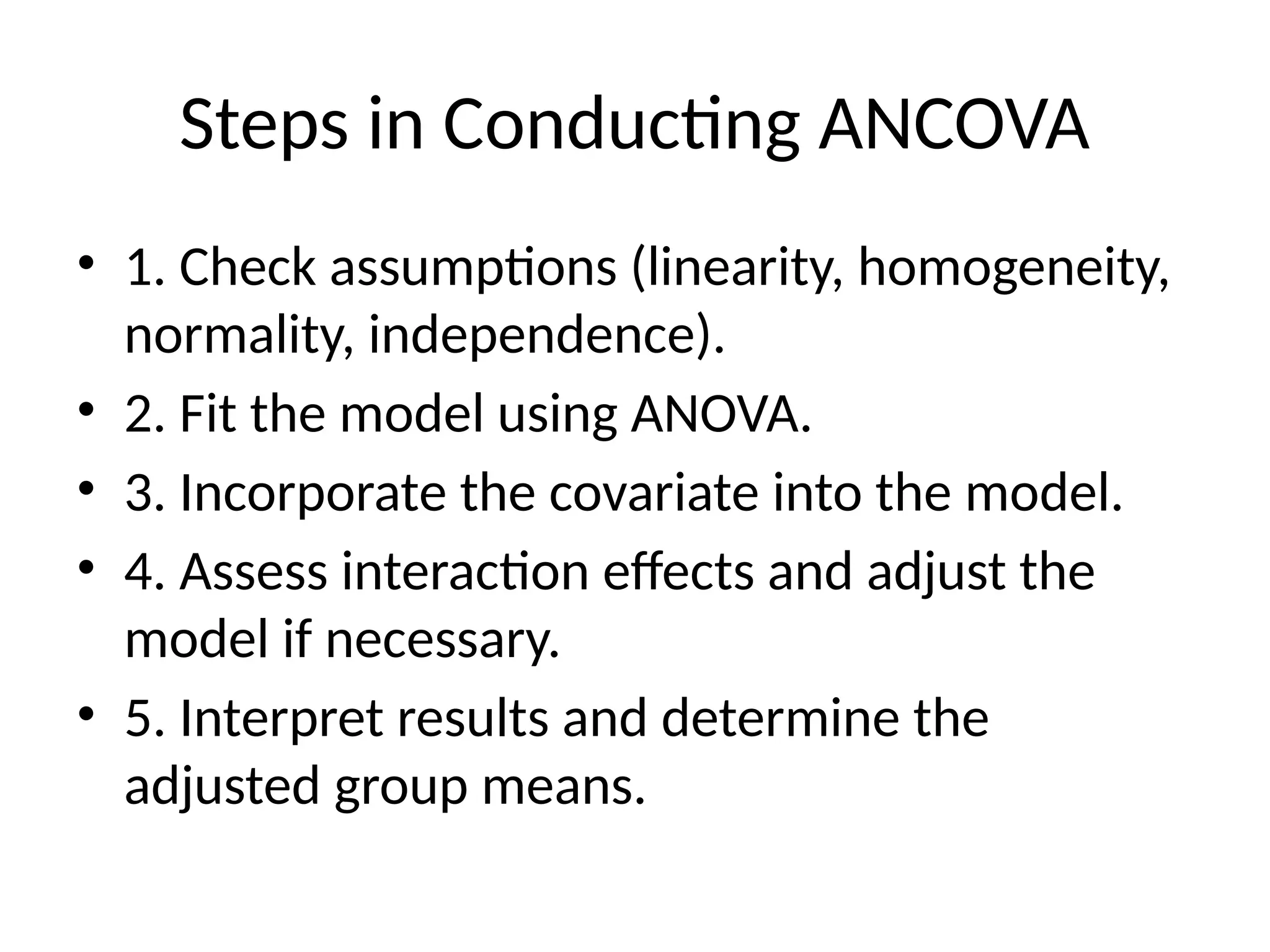
Steps in Conducting ANCOVA
• 1. Check assumptions (linearity, homogeneity,
normality, independence).
• 2. Fit the model using ANOVA.
• 3. Incorporate the covariate into the model.
• 4. Assess interaction effects and adjust the
model if necessary.
• 5. Interpret results and determine the
adjusted group means.
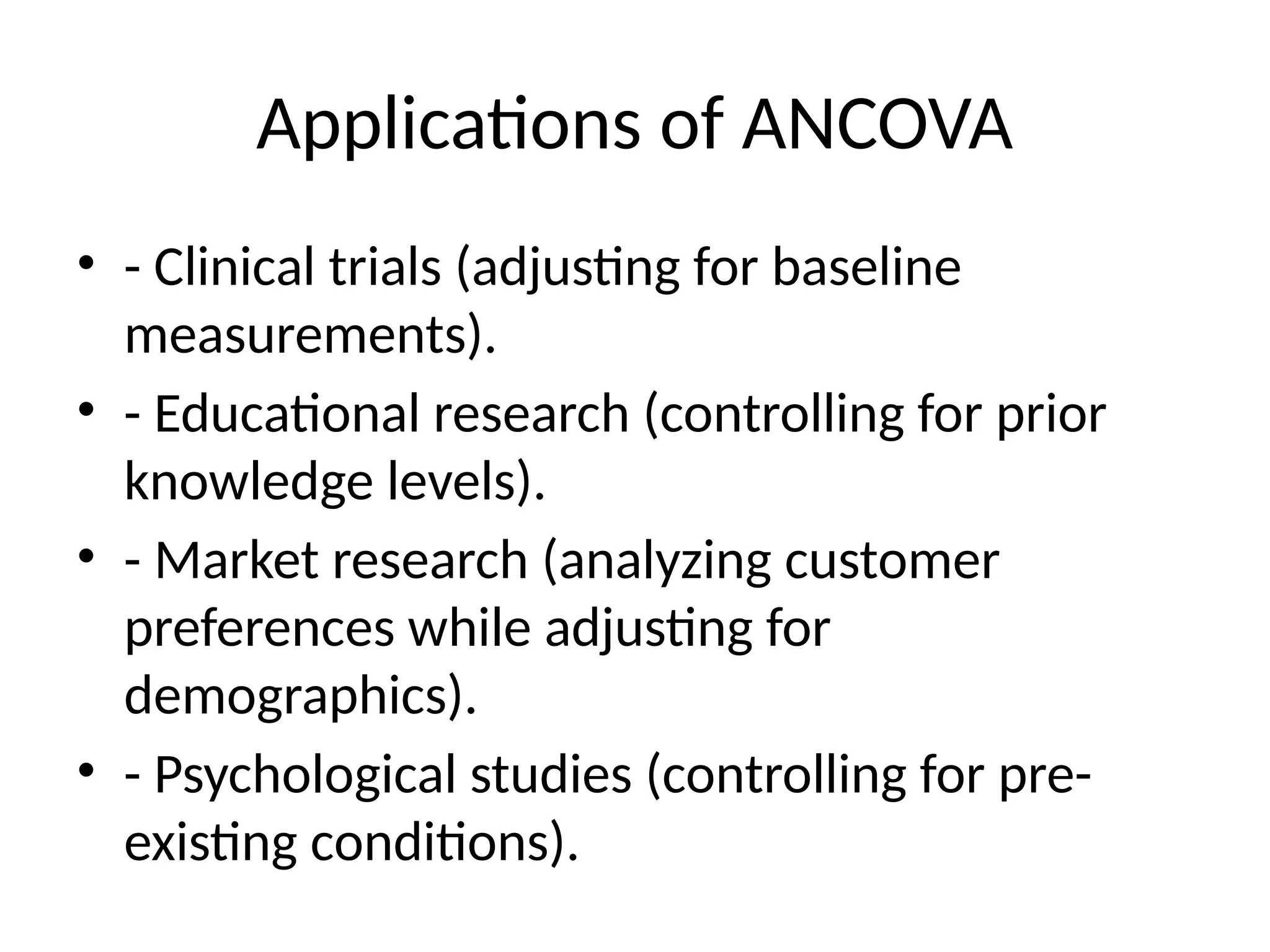
Applications of ANCOVA
• - Clinical trials (adjusting for baseline
measurements).
• - Educational research (controlling for prior
knowledge levels).
• - Market research (analyzing customer
preferences while adjusting for
demographics).
• - Psychological studies (controlling for pre-
existing conditions).
Example of ANCOVA
• Scenario: Studying the effect of a training
program on employee performance while
controlling for prior experience.
• 1. Independent Variable: Training program
(Yes/No).
• 2. Dependent Variable: Employee
performance score.
• 3. Covariate: Years of prior experience.
• 4. ANCOVA helps in determining if training
impacts performance after accounting for
Conclusion
• - ANCOVA is a powerful tool for analyzing
differences while adjusting for covariates.
• - Ensures more accurate comparisons in
research studies.
• - Must check and satisfy all assumptions for
valid results.
• - Widely applied in various scientific and
business fields.
ANCOVA_Presentation.pptx it is on testing ANcova

  • 1.
    Analysis of Covariance(ANCOVA) Understanding the Concept, Assumptions, and Applications
  • 2.
    What is ANCOVA? •- ANCOVA stands for Analysis of Covariance. • - It combines ANOVA and regression. • - It adjusts for the effect of covariates to better assess the impact of independent variables on a dependent variable. • - Commonly used in experimental and observational studies.
  • 3.
    Purpose of ANCOVA •- Removes the influence of confounding variables. • - Increases statistical power by reducing error variance. • - Helps in comparing group means while controlling for covariates. • - Provides a more precise analysis than ANOVA alone.
  • 4.
    Assumptions of ANCOVA •- Linearity: The covariate must have a linear relationship with the dependent variable. • - Homogeneity of Regression Slopes: The effect of the covariate should be consistent across groups. • - Independence: Observations should be independent. • - Normality: The dependent variable should be normally distributed. • - Homogeneity of Variance: Groups should
  • 5.
    Steps in ConductingANCOVA • 1. Check assumptions (linearity, homogeneity, normality, independence). • 2. Fit the model using ANOVA. • 3. Incorporate the covariate into the model. • 4. Assess interaction effects and adjust the model if necessary. • 5. Interpret results and determine the adjusted group means.
  • 6.
    Applications of ANCOVA •- Clinical trials (adjusting for baseline measurements). • - Educational research (controlling for prior knowledge levels). • - Market research (analyzing customer preferences while adjusting for demographics). • - Psychological studies (controlling for pre- existing conditions).
  • 7.
    Example of ANCOVA •Scenario: Studying the effect of a training program on employee performance while controlling for prior experience. • 1. Independent Variable: Training program (Yes/No). • 2. Dependent Variable: Employee performance score. • 3. Covariate: Years of prior experience. • 4. ANCOVA helps in determining if training impacts performance after accounting for
  • 8.
    Conclusion • - ANCOVAis a powerful tool for analyzing differences while adjusting for covariates. • - Ensures more accurate comparisons in research studies. • - Must check and satisfy all assumptions for valid results. • - Widely applied in various scientific and business fields.