 Graphical representation of data is for the
purpose of easier interpretation.
 Facts and figures as such do not catch our
attention unless they are presented in an
interesting way.
 Graphical representation of data is the most
commonly used interesting modes of
presentation.
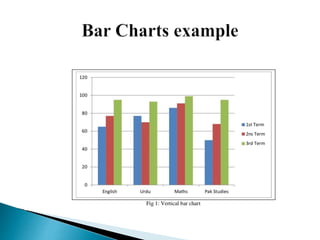
 Bar charts are commonly used graphical
representations of data used to visually display to
compare values.
 They are easy to create and interpret.
 Data for a bar chart are entered in columns.
 Each numeric data value becomes a bar.
 X-axis represents the different categories, the y-axis
does have a scale and indicates the units of
measurement.
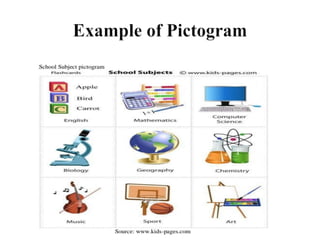
 A pictogram is a kind of graph that uses pictures
instead of bars to represent data under analysis.
 A pictogram may include a symbol plus graphic
elements such as border, back pattern, or color that is
intended to covey specific information.
 Pictograms form a part of our daily lives. They are
used in transport, medication, education, computers.
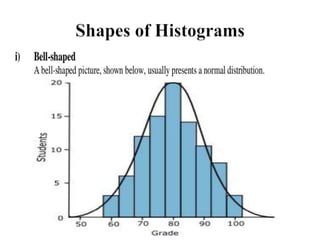
 A histogram is a type of graph that provides a visual
interpretation of numerical data by indicating the
number of data points that lie within the range value.
These range values are called classes.
 A histogram looks similar to bar charts. The height of
the bar corresponds to the relative frequency of the
amount of data in the class. The higher the bar is, the
greater the frequency of the data will bean vice versa.
The main difference between these graphs is the level
of measurement of the data. Bar graphs are used for
data at nominal level of measurement.
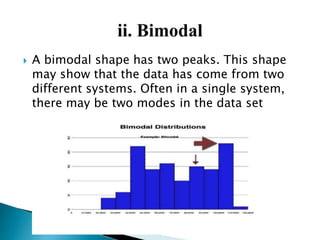
 A bimodal shape has two peaks. This shape
may show that the data has come from two
different systems. Often in a single system,
there may be two modes in the data set
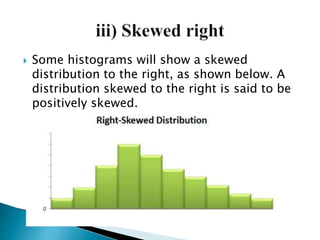
 Some histograms will show a skewed
distribution to the right, as shown below. A
distribution skewed to the right is said to be
positively skewed.
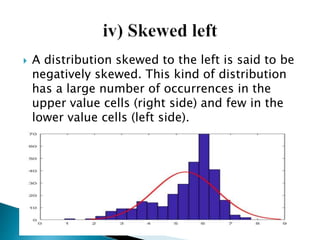
 A distribution skewed to the left is said to be
negatively skewed. This kind of distribution
has a large number of occurrences in the
upper value cells (right side) and few in the
lower value cells (left side).
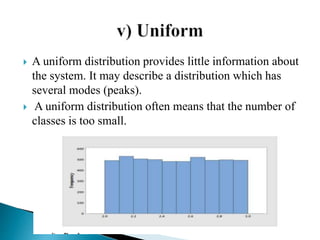
 A uniform distribution provides little information about
the system. It may describe a distribution which has
several modes (peaks).
 A uniform distribution often means that the number of
classes is too small.
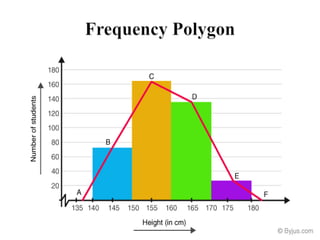
 The frequency polygon is as graph that displays data by
using lines that connect points plotted for the
frequencies.
 This graph is useful for understanding the shape of
distribution.
 A frequency polygon is similar to histogram.
 The difference is that histogram tends to be rectangles
while a frequency polygon resembles a line graph.
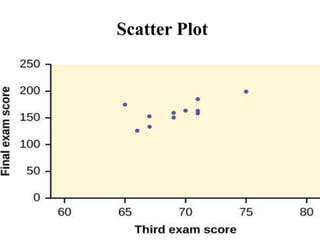
 A scatter plot is used to plot data in XY- plane to show how
much one variable or data set is affected by another.
 It has points that show the relationship between two
variables or two sets of data.
 These points are sometimes called markers and position of
these points depends on the values in the columns sets on
the XY axis.
 Scatter plot gives good visual picture of the relationship or
association between two variables or data sets, and aids to
interpretation of the correlation coefficient or regression
model
 i) When there is paired numerical data.
 ii) When the dependent variable have multiple values
for each value of independent variable.
 iii) When the researcher tries to determine whether the
two variables are related
 A pie chart displays data in an easy pie-slice format
with varying sizes.
 The size of a slice tells how much data exists in one
element.
 The bigger the slice, the more of that particular data
was gathered and vice versa.
 Pie charts are mainly used to show comparison
among various segments of data
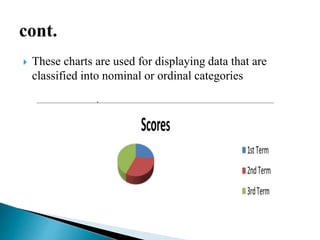
 These charts are used for displaying data that are
classified into nominal or ordinal categories
Statistical Graphics / Exploratory Data Analysis - DAY 2 - 8614 - B.Ed - AIOU

Statistical Graphics / Exploratory Data Analysis - DAY 2 - 8614 - B.Ed - AIOU

  • 2.
     Graphical representationof data is for the purpose of easier interpretation.  Facts and figures as such do not catch our attention unless they are presented in an interesting way.  Graphical representation of data is the most commonly used interesting modes of presentation.
  • 3.
     Bar chartsare commonly used graphical representations of data used to visually display to compare values.  They are easy to create and interpret.  Data for a bar chart are entered in columns.  Each numeric data value becomes a bar.  X-axis represents the different categories, the y-axis does have a scale and indicates the units of measurement.
  • 5.
     A pictogramis a kind of graph that uses pictures instead of bars to represent data under analysis.  A pictogram may include a symbol plus graphic elements such as border, back pattern, or color that is intended to covey specific information.  Pictograms form a part of our daily lives. They are used in transport, medication, education, computers.
  • 7.
     A histogramis a type of graph that provides a visual interpretation of numerical data by indicating the number of data points that lie within the range value. These range values are called classes.  A histogram looks similar to bar charts. The height of the bar corresponds to the relative frequency of the amount of data in the class. The higher the bar is, the greater the frequency of the data will bean vice versa. The main difference between these graphs is the level of measurement of the data. Bar graphs are used for data at nominal level of measurement.
  • 9.
     A bimodalshape has two peaks. This shape may show that the data has come from two different systems. Often in a single system, there may be two modes in the data set
  • 10.
     Some histogramswill show a skewed distribution to the right, as shown below. A distribution skewed to the right is said to be positively skewed.
  • 11.
     A distributionskewed to the left is said to be negatively skewed. This kind of distribution has a large number of occurrences in the upper value cells (right side) and few in the lower value cells (left side).
  • 12.
     A uniformdistribution provides little information about the system. It may describe a distribution which has several modes (peaks).  A uniform distribution often means that the number of classes is too small.
  • 13.
     The frequencypolygon is as graph that displays data by using lines that connect points plotted for the frequencies.  This graph is useful for understanding the shape of distribution.  A frequency polygon is similar to histogram.  The difference is that histogram tends to be rectangles while a frequency polygon resembles a line graph.
  • 15.
     A scatterplot is used to plot data in XY- plane to show how much one variable or data set is affected by another.  It has points that show the relationship between two variables or two sets of data.  These points are sometimes called markers and position of these points depends on the values in the columns sets on the XY axis.  Scatter plot gives good visual picture of the relationship or association between two variables or data sets, and aids to interpretation of the correlation coefficient or regression model
  • 17.
     i) Whenthere is paired numerical data.  ii) When the dependent variable have multiple values for each value of independent variable.  iii) When the researcher tries to determine whether the two variables are related
  • 18.
     A piechart displays data in an easy pie-slice format with varying sizes.  The size of a slice tells how much data exists in one element.  The bigger the slice, the more of that particular data was gathered and vice versa.  Pie charts are mainly used to show comparison among various segments of data
  • 19.
     These chartsare used for displaying data that are classified into nominal or ordinal categories