CE AMPLIFIERS
CE AMPLIFIERS
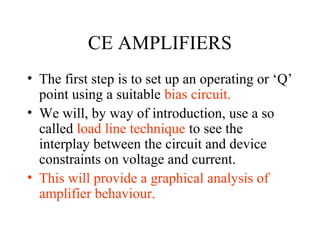
• The first step is to set up an operating or ‘Q’
  point using a suitable bias circuit.
• We will, by way of introduction, use a so
  called load line technique to see the
  interplay between the circuit and device
  constraints on voltage and current.
• This will provide a graphical analysis of
  amplifier behaviour.
CE AMPLIFIERS
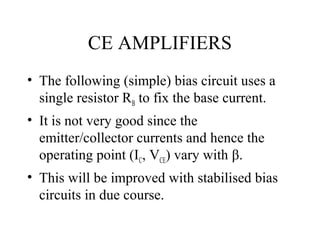
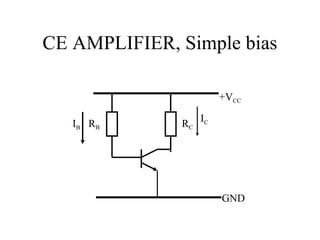
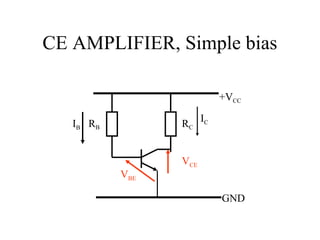
• The following (simple) bias circuit uses a
  single resistor RB to fix the base current.
• It is not very good since the
  emitter/collector currents and hence the
  operating point (IC, VCE) vary with β.
• This will be improved with stabilised bias
  circuits in due course.
CE AMPLIFIER, Simple bias

                      +VCC

   IB R B     RC IC


                      GND
CE AMPLIFIER, Simple bias

                          +VCC

   IB R B         RC IC


                  VCE
            VBE

                          GND
CE AMPLIFIER, Simple bias
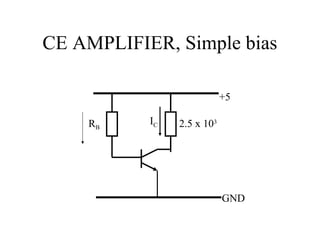
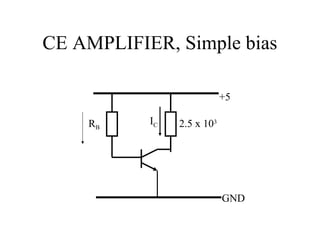
• To enable us to look at a particular
  numerical example we choose the supply
  voltage VCC = 5V and RC = 2.5 kΩ
CE AMPLIFIER, Simple bias

                            +5

    RB     IC   2.5 x 10³


                            GND
CE AMPLIFIER, Simple bias
• In later discussions an a.c. signal (and an
  additional load resistor) will be coupled to the d.c.
  circuit using coupling capacitors.
• The capacitor values are chosen so that their
  impedance (1/ ωC) is negligibly small (zero) at the
  a.c.(signal) frequency (or over the operating
  frequency range).
• A capacitor acts as a short circuit for d.c. and the
  d.c. bias circuit can be designed independently of
  the a.c. source and any ‘a.c. load’.
CE AMPLIFIER, Simple bias

                            +5

    RB     IC   2.5 x 10³


                            GND
CE AMPLIFIER, Simple bias
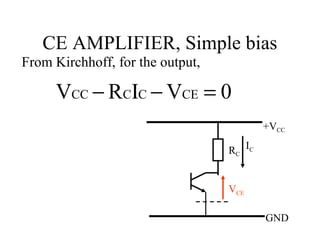
From Kirchhoff, for the output,

     VCC − RCIC − VCE = 0
                                           +VCC

                                  RC I C


                                  VCE

                                           GND
CE AMPLIFIER, Simple bias
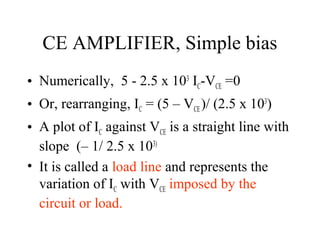
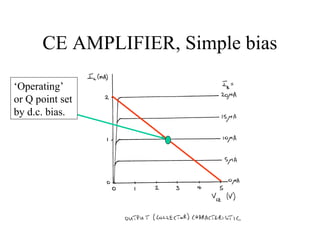
• Numerically, 5 - 2.5 x 10³ IC-VCE =0
• Or, rearranging, IC = (5 – VCE )/ (2.5 x 10³)
• A plot of IC against VCE is a straight line with
  slope (– 1/ 2.5 x 10³)
• It is called a load line and represents the
  variation of IC with VCE imposed by the
  circuit or load.
CE AMPLIFIER, Simple bias
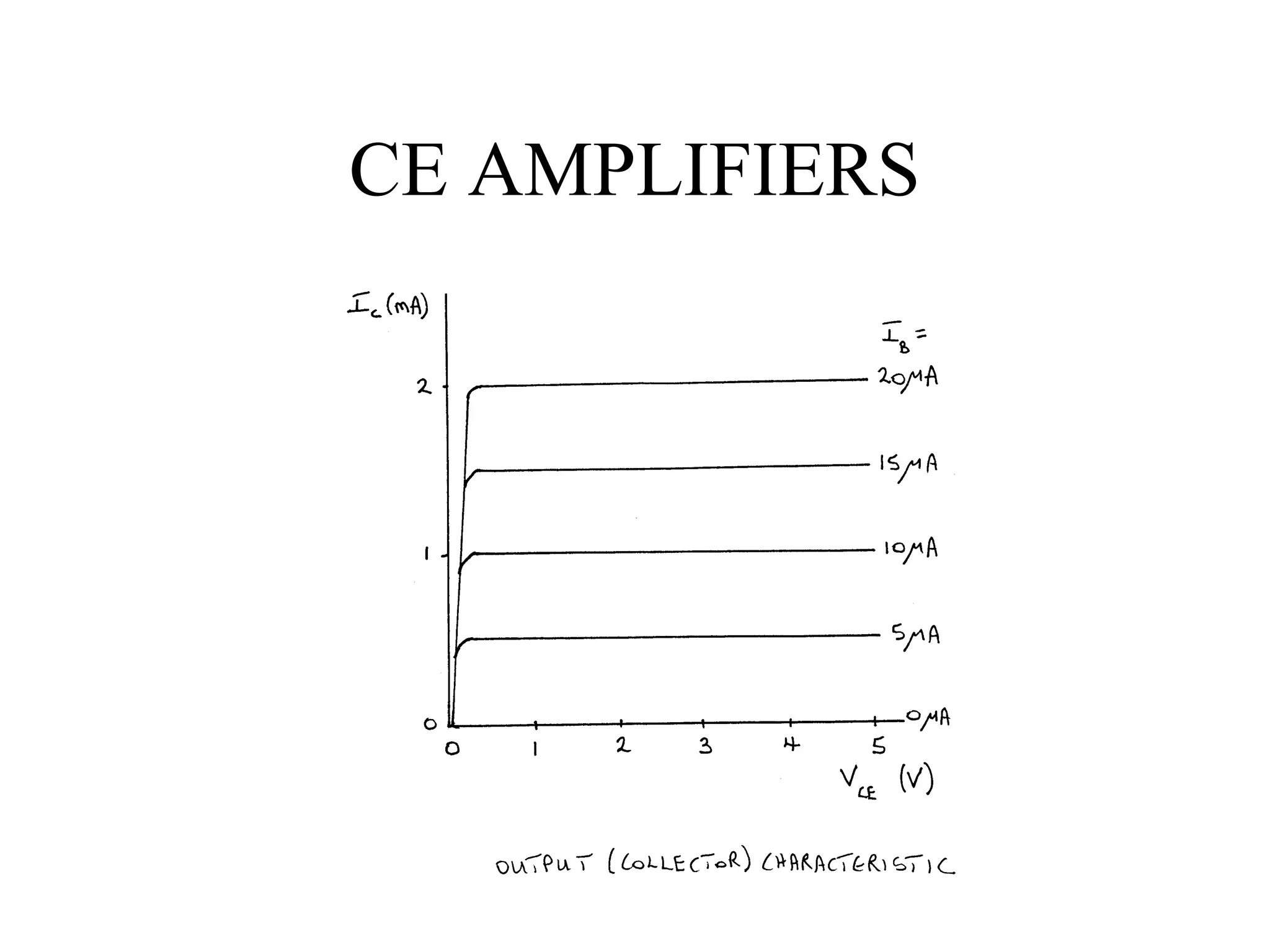
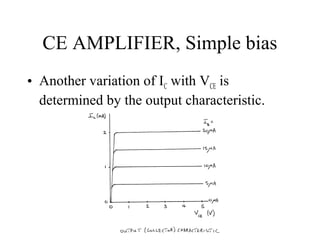
• Another variation of IC with VCE is
  determined by the output characteristic.
CE AMPLIFIER, Simple bias
• Another variation of IC with VCE is
  determined by the output characteristic.
• The two relationships can be solved
  graphically for IC and VCE.
CE AMPLIFIER, Simple bias
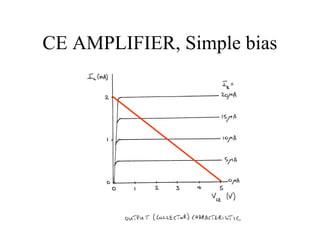
• Thus we calculate three points on the load
  line IC = (5 – VCE )/ (2.5 x 10³) as
  IC =0, VCE =5V
  IC = 1mA, VCE =2.5V
 VCE =0V, IC =5/2500 A = 2mA.
• To enable us to plot it on the output
  characteristic.
CE AMPLIFIER, Simple bias
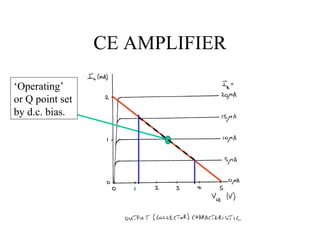
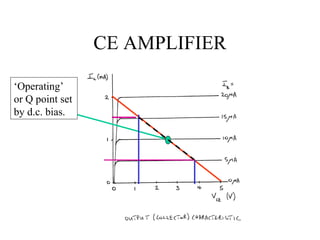
• The region along the load line includes all
  points between saturation and cut-off.
• The base current IB should be chosen to
  maximise the output voltage swing in the
  linear region.
• Bearing in mind that VCE (Sat) ≈ 0.2 V and
  VCE Max = 5V choose the operating (Q) point at
  IB = 10 μA.
CE AMPLIFIER, Simple bias

‘Operating’
or Q point set
by d.c. bias.
CE AMPLIFIER, Simple bias
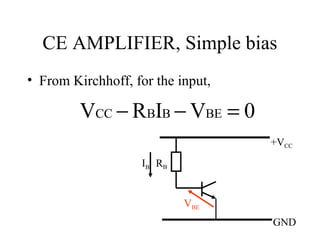
• From Kirchhoff, for the input,

         VCC − RBIB − VBE = 0
                                   +VCC
                   IB RB


                           VBE
                                   GND
CE AMPLIFIER, Simple bias
• Remembering that VBE ~ 0.6 V (the base or
  input characteristic is that of a forward
  biased diode) we can find RB ~ 440 kΩ.
CE AMPLIFIER, Simple bias
• A a.c. signal is superimposed on top of the
  d.c. bias level.
• We are interested in the voltage and current
  gains for this a.c. component.
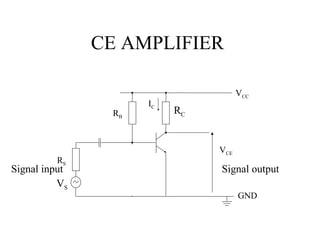
CE AMPLIFIER

                                     VCC
                     IC
                RB        RC
                          RL


                               VCE
         RS
Signal input                   Signal output
          VS
                                     GND
CE AMPLIFIER
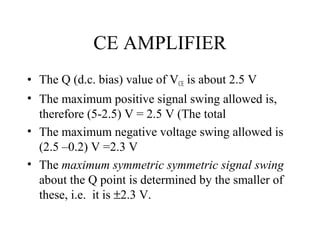
• The Q (d.c. bias) value of VCE is about 2.5 V
• The maximum positive signal swing allowed is,
  therefore (5-2.5) V = 2.5 V (The total
• The maximum negative voltage swing allowed is
  (2.5 –0.2) V =2.3 V
• The maximum symmetric symmetric signal swing
  about the Q point is determined by the smaller of
  these, i.e. it is ±2.3 V.
CE Amplifier
• To find the voltage and current gains using
  the load line method we must use the input
  and output characteristics.
CE Amplifier


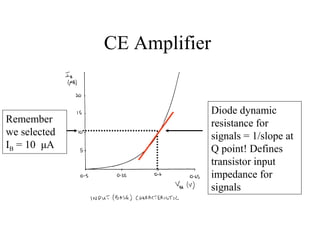
                             Diode dynamic
Remember                     resistance for
we selected                  signals = 1/slope at
IB = 10 μA                   Q point! Defines
                             transistor input
                             impedance for
                             signals
CE Amplifier
• From the input curve we estimate that as I B
  changes by ±5μA about the bias level of
  10μA then the corresponding change in VBE
  is about 0.025 V.
• When iB =5μA, vBE = 0.5875V; when iB
  =15μA, vBE = 0.6125.
                     ∆VBE = 0.025 V
CE Amplifier
• From the output characteristic curve we
  move up and down the load line to estimate
  that as IB changes by ±5μA the
  corresponding change in VCE is about –2.5
  V. (Note the negative sign!)
• When iB =5μA, vCE = 3.75V; when iB =15μA,
  vCE = 1.25V
                        ∆VCE = - 2.5 V
CE Amplifier
• From the input curve we estimate that as I B
  changes by ±5μA about the bias level of
  10μA then the corresponding change in VBE
  is about 0.025 V.
• When iB =5μA, vBE = 0.5875V; when iB
  =15μA, vBE = 0.6125.
                     ∆VBE = 0.025 V
CE AMPLIFIER

‘Operating’
or Q point set
by d.c. bias.
CE Amplifier
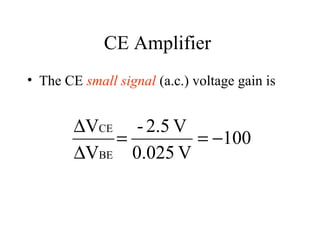
• The CE small signal (a.c.) voltage gain is


        ∆VCE - 2.5 V
            =        = −100
        ∆VBE 0.025 V
CE Amplifier
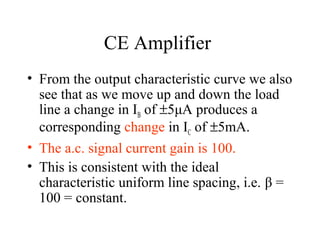
• From the output characteristic curve we also
  see that as we move up and down the load
  line a change in IB of ±5μA produces a
  corresponding change in IC of ±5mA.
• The a.c. signal current gain is 100.
• This is consistent with the ideal
  characteristic uniform line spacing, i.e. β =
  100 = constant.
CE AMPLIFIER

‘Operating’
or Q point set
by d.c. bias.
Ideal CE Amplifier Summary
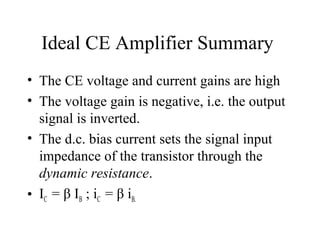
• The CE voltage and current gains are high
• The voltage gain is negative, i.e. the output
  signal is inverted.
• The d.c. bias current sets the signal input
  impedance of the transistor through the
  dynamic resistance.
• IC = β IB ; iC = β iB.
Ideal CE Amplifier Summary
• Two of these statements:
• The d.c. bias current sets the signal input
  impedance of the transistor through the
  dynamic resistance.
• IC = β IB ; iC = β iB.
  will be used to derive our simplified small
  signal equivalent circuit of the BJT. (It is
  simplified because it is based on ideal
  BJTs)
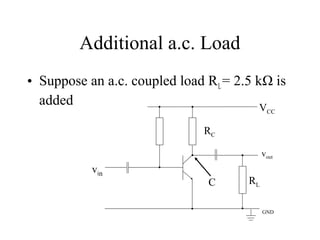
Additional a.c. Load
• Suppose an a.c. coupled load RL = 2.5 kΩ is
  added                                  V  CC


                              RC

                                           vout
           vin
                               C      RL

                                           GND
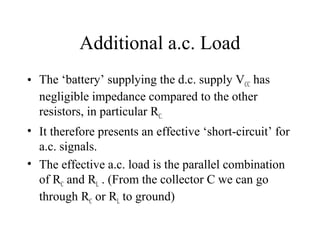
Additional a.c. Load
• The ‘battery’ supplying the d.c. supply VCC has
  negligible impedance compared to the other
  resistors, in particular RC.
• It therefore presents an effective ‘short-circuit’ for
  a.c. signals.
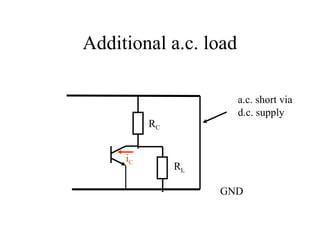
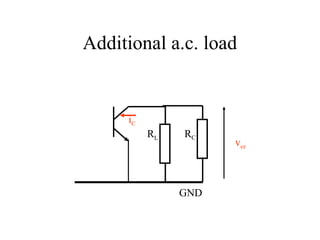
• The effective a.c. load is the parallel combination
  of RC and RL . (From the collector C we can go
  through RC or RL to ground)
Additional a.c. load

                       a.c. short via
                       d.c. supply
          RC


     iC
               RL

                    GND
Additional a.c. load


     iC
          RL   RC
                     vce


               GND
Additional a.c. Load
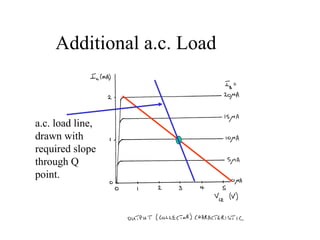
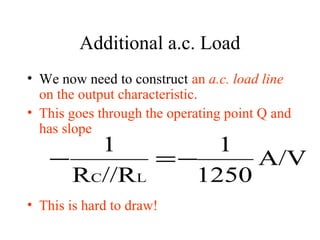
• We now need to construct an a.c. load line
  on the output characteristic.
• This goes through the operating point Q and
  has slope
       1        1
   −        =−     A/V
     RC//RL   1250
• This is hard to draw!
Additional a.c. Load


a.c. load line,
drawn with
required slope
through Q
point.
Additional a.c. Load
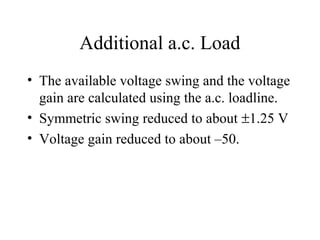
• The available voltage swing and the voltage
  gain are calculated using the a.c. loadline.
• Symmetric swing reduced to about ±1.25 V
• Voltage gain reduced to about –50.
Stabilised Bias Circuits
• These seek to fix the emitter current
  independently of BJT parameter variations,
  principally in β.
• This is best achieved by introducing an
  emitter resistance and setting the base
  voltage via a resistor network (R1, R2) which
  acts as a potential divider (provided I B can
  be assumed small)
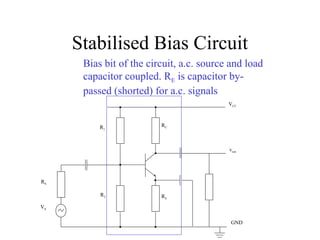
Stabilised Bias Circuit
      Bias bit of the circuit, a.c. source and load
      capacitor coupled. RE is capacitor by-
      passed (shorted) for a.c. signals
                                          VCC


          R1             RC


                                          vout


RS

          R2             RE
VS

                                           GND
Stabilised Bias Circuit
• See handout for a detailed analysis of this
  bias circuit
• We will also look at a worked example of a
  transistor amplifier based on such a
  stabilised bias circuit once we have
  established an a.c. equivalent circuit for the
  transistor.
Stabilised Bias Circuit
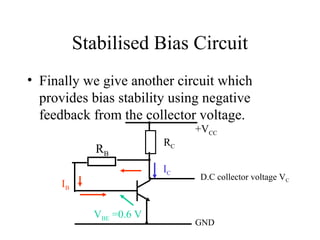
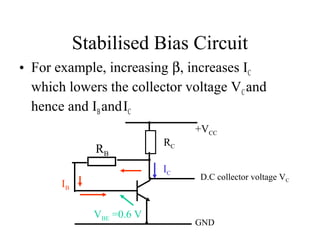
• Finally we give another circuit which
  provides bias stability using negative
  feedback from the collector voltage.
                               +VCC
                          RC
              RB
                          IC
                               D.C collector voltage VC
      IB

             VBE =0.6 V
                               GND
Stabilised Bias Circuit
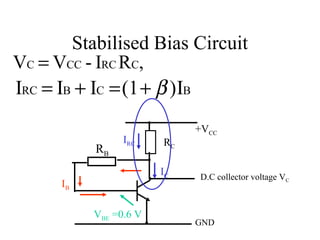
VC = VCC - IRC RC,
IRC = IB + IC = (1 + β )IB
                             +VCC
                 IRC    RC
           RB
                        IC   D.C collector voltage VC
      IB

           VBE =0.6 V
                             GND
Stabilised Bias Circuit

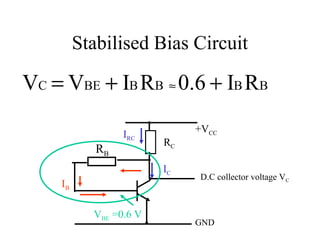
VC = VBE + IB RB ≈ 0.6 + IB RB
                             +VCC
                 IRC
                        RC
            RB
                        IC
                             D.C collector voltage VC
    IB

           VBE =0.6 V
                             GND
Stabilised Bias Circuit
• For example, increasing β, increases IC
  which lowers the collector voltage V C and
  hence and IB and IC
                                +VCC
                           RC
               RB
                           IC
                                D.C collector voltage VC
       IB

              VBE =0.6 V
                                GND

Ce amplifiers

  • 1.
  • 2.
    CE AMPLIFIERS • Thefirst step is to set up an operating or ‘Q’ point using a suitable bias circuit. • We will, by way of introduction, use a so called load line technique to see the interplay between the circuit and device constraints on voltage and current. • This will provide a graphical analysis of amplifier behaviour.
  • 3.
    CE AMPLIFIERS • Thefollowing (simple) bias circuit uses a single resistor RB to fix the base current. • It is not very good since the emitter/collector currents and hence the operating point (IC, VCE) vary with β. • This will be improved with stabilised bias circuits in due course.
  • 4.
    CE AMPLIFIER, Simplebias +VCC IB R B RC IC GND
  • 5.
    CE AMPLIFIER, Simplebias +VCC IB R B RC IC VCE VBE GND
  • 6.
    CE AMPLIFIER, Simplebias • To enable us to look at a particular numerical example we choose the supply voltage VCC = 5V and RC = 2.5 kΩ
  • 7.
    CE AMPLIFIER, Simplebias +5 RB IC 2.5 x 10³ GND
  • 8.
    CE AMPLIFIER, Simplebias • In later discussions an a.c. signal (and an additional load resistor) will be coupled to the d.c. circuit using coupling capacitors. • The capacitor values are chosen so that their impedance (1/ ωC) is negligibly small (zero) at the a.c.(signal) frequency (or over the operating frequency range). • A capacitor acts as a short circuit for d.c. and the d.c. bias circuit can be designed independently of the a.c. source and any ‘a.c. load’.
  • 9.
    CE AMPLIFIER, Simplebias +5 RB IC 2.5 x 10³ GND
  • 10.
    CE AMPLIFIER, Simplebias From Kirchhoff, for the output, VCC − RCIC − VCE = 0 +VCC RC I C VCE GND
  • 11.
    CE AMPLIFIER, Simplebias • Numerically, 5 - 2.5 x 10³ IC-VCE =0 • Or, rearranging, IC = (5 – VCE )/ (2.5 x 10³) • A plot of IC against VCE is a straight line with slope (– 1/ 2.5 x 10³) • It is called a load line and represents the variation of IC with VCE imposed by the circuit or load.
  • 12.
    CE AMPLIFIER, Simplebias • Another variation of IC with VCE is determined by the output characteristic.
  • 13.
    CE AMPLIFIER, Simplebias • Another variation of IC with VCE is determined by the output characteristic. • The two relationships can be solved graphically for IC and VCE.
  • 14.
    CE AMPLIFIER, Simplebias • Thus we calculate three points on the load line IC = (5 – VCE )/ (2.5 x 10³) as IC =0, VCE =5V IC = 1mA, VCE =2.5V VCE =0V, IC =5/2500 A = 2mA. • To enable us to plot it on the output characteristic.
  • 15.
  • 16.
    CE AMPLIFIER, Simplebias • The region along the load line includes all points between saturation and cut-off. • The base current IB should be chosen to maximise the output voltage swing in the linear region. • Bearing in mind that VCE (Sat) ≈ 0.2 V and VCE Max = 5V choose the operating (Q) point at IB = 10 μA.
  • 17.
    CE AMPLIFIER, Simplebias ‘Operating’ or Q point set by d.c. bias.
  • 18.
    CE AMPLIFIER, Simplebias • From Kirchhoff, for the input, VCC − RBIB − VBE = 0 +VCC IB RB VBE GND
  • 19.
    CE AMPLIFIER, Simplebias • Remembering that VBE ~ 0.6 V (the base or input characteristic is that of a forward biased diode) we can find RB ~ 440 kΩ.
  • 20.
    CE AMPLIFIER, Simplebias • A a.c. signal is superimposed on top of the d.c. bias level. • We are interested in the voltage and current gains for this a.c. component.
  • 21.
    CE AMPLIFIER VCC IC RB RC RL VCE RS Signal input Signal output VS GND
  • 22.
    CE AMPLIFIER • TheQ (d.c. bias) value of VCE is about 2.5 V • The maximum positive signal swing allowed is, therefore (5-2.5) V = 2.5 V (The total • The maximum negative voltage swing allowed is (2.5 –0.2) V =2.3 V • The maximum symmetric symmetric signal swing about the Q point is determined by the smaller of these, i.e. it is ±2.3 V.
  • 23.
    CE Amplifier • Tofind the voltage and current gains using the load line method we must use the input and output characteristics.
  • 24.
    CE Amplifier Diode dynamic Remember resistance for we selected signals = 1/slope at IB = 10 μA Q point! Defines transistor input impedance for signals
  • 25.
    CE Amplifier • Fromthe input curve we estimate that as I B changes by ±5μA about the bias level of 10μA then the corresponding change in VBE is about 0.025 V. • When iB =5μA, vBE = 0.5875V; when iB =15μA, vBE = 0.6125. ∆VBE = 0.025 V
  • 26.
    CE Amplifier • Fromthe output characteristic curve we move up and down the load line to estimate that as IB changes by ±5μA the corresponding change in VCE is about –2.5 V. (Note the negative sign!) • When iB =5μA, vCE = 3.75V; when iB =15μA, vCE = 1.25V ∆VCE = - 2.5 V
  • 27.
    CE Amplifier • Fromthe input curve we estimate that as I B changes by ±5μA about the bias level of 10μA then the corresponding change in VBE is about 0.025 V. • When iB =5μA, vBE = 0.5875V; when iB =15μA, vBE = 0.6125. ∆VBE = 0.025 V
  • 28.
    CE AMPLIFIER ‘Operating’ or Qpoint set by d.c. bias.
  • 29.
    CE Amplifier • TheCE small signal (a.c.) voltage gain is ∆VCE - 2.5 V = = −100 ∆VBE 0.025 V
  • 30.
    CE Amplifier • Fromthe output characteristic curve we also see that as we move up and down the load line a change in IB of ±5μA produces a corresponding change in IC of ±5mA. • The a.c. signal current gain is 100. • This is consistent with the ideal characteristic uniform line spacing, i.e. β = 100 = constant.
  • 31.
    CE AMPLIFIER ‘Operating’ or Qpoint set by d.c. bias.
  • 32.
    Ideal CE AmplifierSummary • The CE voltage and current gains are high • The voltage gain is negative, i.e. the output signal is inverted. • The d.c. bias current sets the signal input impedance of the transistor through the dynamic resistance. • IC = β IB ; iC = β iB.
  • 33.
    Ideal CE AmplifierSummary • Two of these statements: • The d.c. bias current sets the signal input impedance of the transistor through the dynamic resistance. • IC = β IB ; iC = β iB. will be used to derive our simplified small signal equivalent circuit of the BJT. (It is simplified because it is based on ideal BJTs)
  • 34.
    Additional a.c. Load •Suppose an a.c. coupled load RL = 2.5 kΩ is added V CC RC vout vin C RL GND
  • 35.
    Additional a.c. Load •The ‘battery’ supplying the d.c. supply VCC has negligible impedance compared to the other resistors, in particular RC. • It therefore presents an effective ‘short-circuit’ for a.c. signals. • The effective a.c. load is the parallel combination of RC and RL . (From the collector C we can go through RC or RL to ground)
  • 36.
    Additional a.c. load a.c. short via d.c. supply RC iC RL GND
  • 37.
    Additional a.c. load iC RL RC vce GND
  • 38.
    Additional a.c. Load •We now need to construct an a.c. load line on the output characteristic. • This goes through the operating point Q and has slope 1 1 − =− A/V RC//RL 1250 • This is hard to draw!
  • 39.
    Additional a.c. Load a.c.load line, drawn with required slope through Q point.
  • 40.
    Additional a.c. Load •The available voltage swing and the voltage gain are calculated using the a.c. loadline. • Symmetric swing reduced to about ±1.25 V • Voltage gain reduced to about –50.
  • 41.
    Stabilised Bias Circuits •These seek to fix the emitter current independently of BJT parameter variations, principally in β. • This is best achieved by introducing an emitter resistance and setting the base voltage via a resistor network (R1, R2) which acts as a potential divider (provided I B can be assumed small)
  • 42.
    Stabilised Bias Circuit Bias bit of the circuit, a.c. source and load capacitor coupled. RE is capacitor by- passed (shorted) for a.c. signals VCC R1 RC vout RS R2 RE VS GND
  • 43.
    Stabilised Bias Circuit •See handout for a detailed analysis of this bias circuit • We will also look at a worked example of a transistor amplifier based on such a stabilised bias circuit once we have established an a.c. equivalent circuit for the transistor.
  • 44.
    Stabilised Bias Circuit •Finally we give another circuit which provides bias stability using negative feedback from the collector voltage. +VCC RC RB IC D.C collector voltage VC IB VBE =0.6 V GND
  • 45.
    Stabilised Bias Circuit VC= VCC - IRC RC, IRC = IB + IC = (1 + β )IB +VCC IRC RC RB IC D.C collector voltage VC IB VBE =0.6 V GND
  • 46.
    Stabilised Bias Circuit VC= VBE + IB RB ≈ 0.6 + IB RB +VCC IRC RC RB IC D.C collector voltage VC IB VBE =0.6 V GND
  • 47.
    Stabilised Bias Circuit •For example, increasing β, increases IC which lowers the collector voltage V C and hence and IB and IC +VCC RC RB IC D.C collector voltage VC IB VBE =0.6 V GND

Editor's Notes

  • #15 Two points define a straight line. It is a good idea to use 3 to plot the line in case of numerical error.