for Performance Assessment
•Give you the tools to design a rubric
-Will need to assess a performance, 9 week assessment
-Show how assessment can help teaching & learning
Rubrics 101
Rubrics 101
•What is a rubric?
•Purposes
•Advantages
•Parts
•Samples
Designing a Rubric (walkthrough the steps)
•Begin with standards (TEKS, national)
•Think about evidence
•Design a performance task
•Write the rubric
•Evaluate
•Handouts
•Web page
http://imet.csus.edu/imet2/nicher/rubric
s/rubric.htm
•Each other and me
•Time
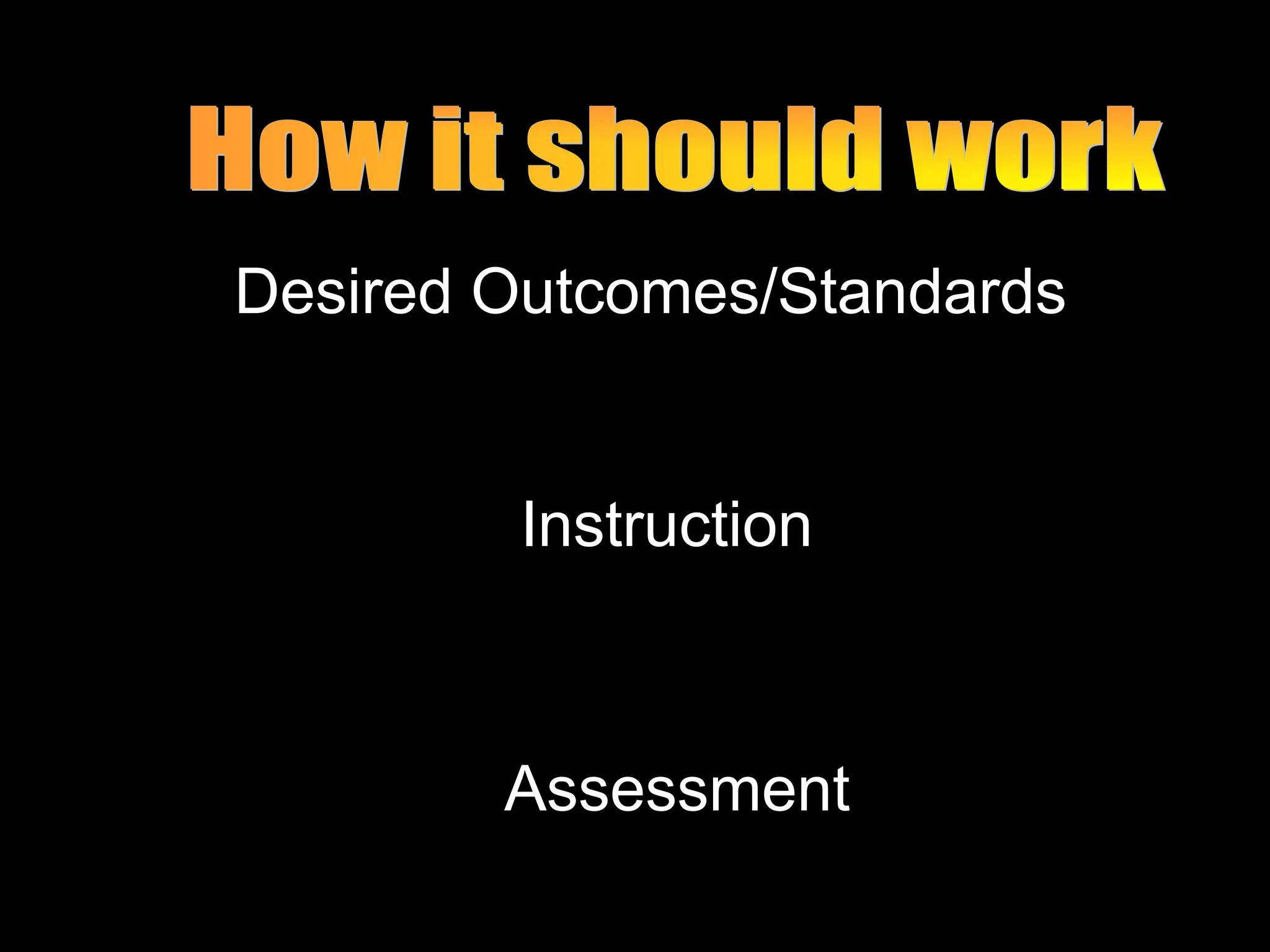
Desired Outcomes/Standards
Instruction
Assessment
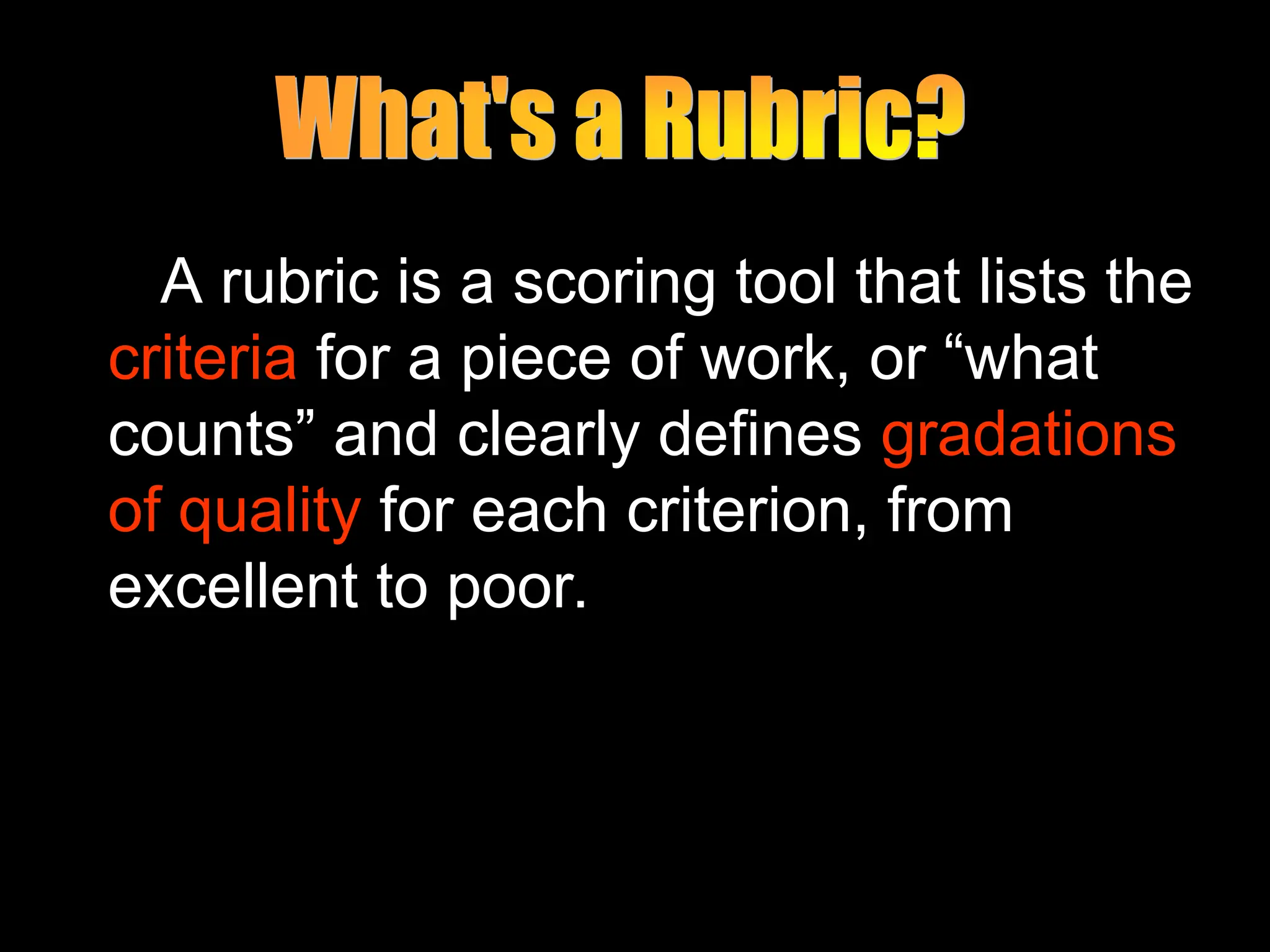
A rubric is a scoring tool that lists the
criteria for a piece of work, or “what
counts” and clearly defines gradations
of quality for each criterion, from
excellent to poor.
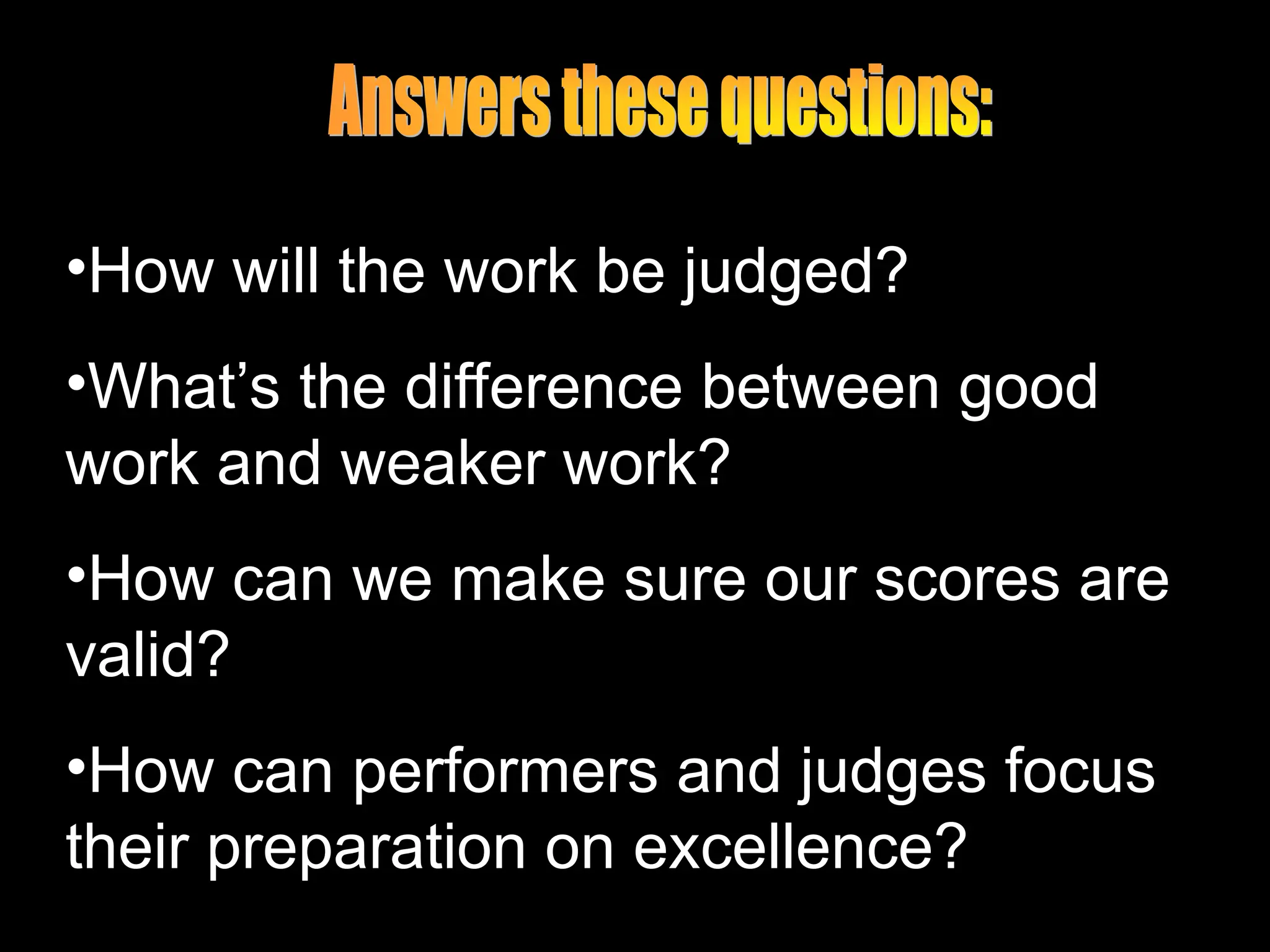
•How will the work be judged?
•What’s the difference between good
work and weaker work?
•How can we make sure our scores are
valid?
•How can performers and judges focus
their preparation on excellence?
A rubric is an authentic
assessment tool which is
particularly useful in assessing
criteria which are complex and
subjective.
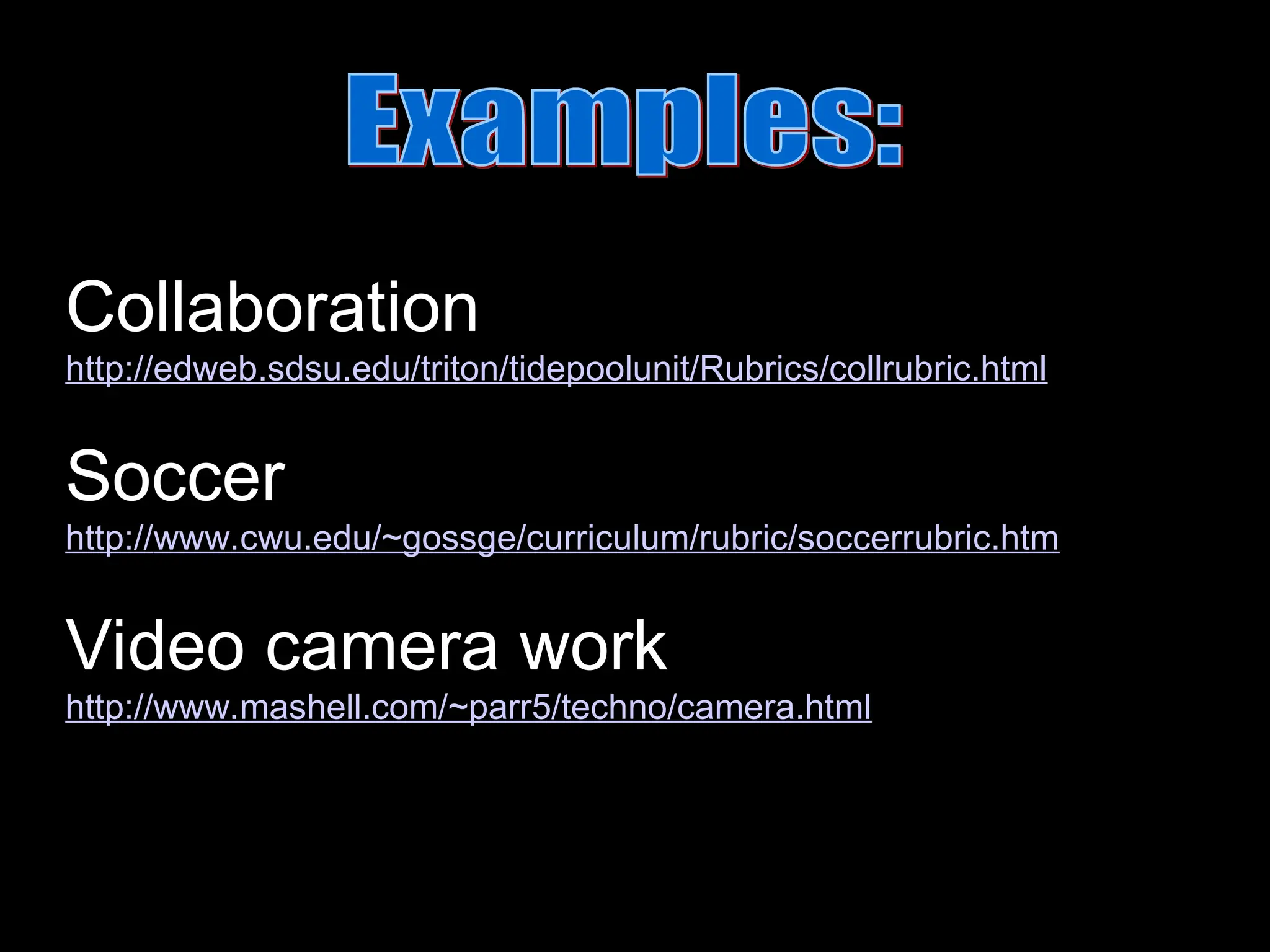
Collaboration
http://edweb.sdsu.edu/triton/tidepoolunit/Rubrics/collrubric.html
Soccer
http://www.cwu.edu/~gossge/curriculum/rubric/soccerrubric.htm
Video camera work
http://www.mashell.com/~parr5/techno/camera.html
Authentic assessment corresponds
as closely as possible to real world
experience. It was originally developed
in the arts and apprenticeship
systems, where assessment has
always been based on performance.
The instructor observes the student in
the process of working on something
real, provides feedback, monitors the
student's use of the feedback, and
adjusts instruction and evaluation
accordingly. Authentic assessment takes
this principle of evaluating real work into
all areas of the curriculum.
Rubrics are said to be an authentic
assessment tool. They are most helpful when
used to evaluate real-life tasks where
students are engaged in solving real-life
problems. They are a formative type of
assessment because they are used before.
during, and after the learning process.
Rubrics:
•Make expectations clear
•Help students judge own work
•Reduce time spent evaluating
•Easy to use and explain
•Make scoring fair and consistent
“Rubrics can improve student
performance, as well as monitor it, by
making teachers' expectations clear
and by showing students how to meet
these expectations. The result is often
marked improvements in the quality of
student work and in learning. Thus, the
most common argument for using
rubrics is they help define "quality."
One student actually didn't like
rubrics for this very reason: "If you
get something wrong," she said, "your
teacher can prove you knew what you
were supposed to do!” (Marcus 1995).
“[Rubrics] provide teachers with
an effective, objective method for
evaluating skills that do not
generally lend themselves to
objective assessment methods”.
“[Rubrics] help students become
more thoughtful judges of the quality
of their own and others' work. When
rubrics are used to guide self- and
peer-assessment, students become
increasingly able to spot and solve
problems in their own and one
another's work…..
“Repeated practice with peer-
assessment, and especially self-
assessment, increases students' sense
of responsibility for their own work
and cuts down on the number of "Am
I done yet?" questions.”
“Rubrics reduce the amount of time
teachers spend evaluating student work.
Teachers tend to find that by the time a
piece has been self- and peer-assessed
according to a rubric, they have little left
to say about it. When they do have
something to say, they can often simply
circle an item in the rubric, rather than
struggle to explain the flaw or strength
they have noticed.”
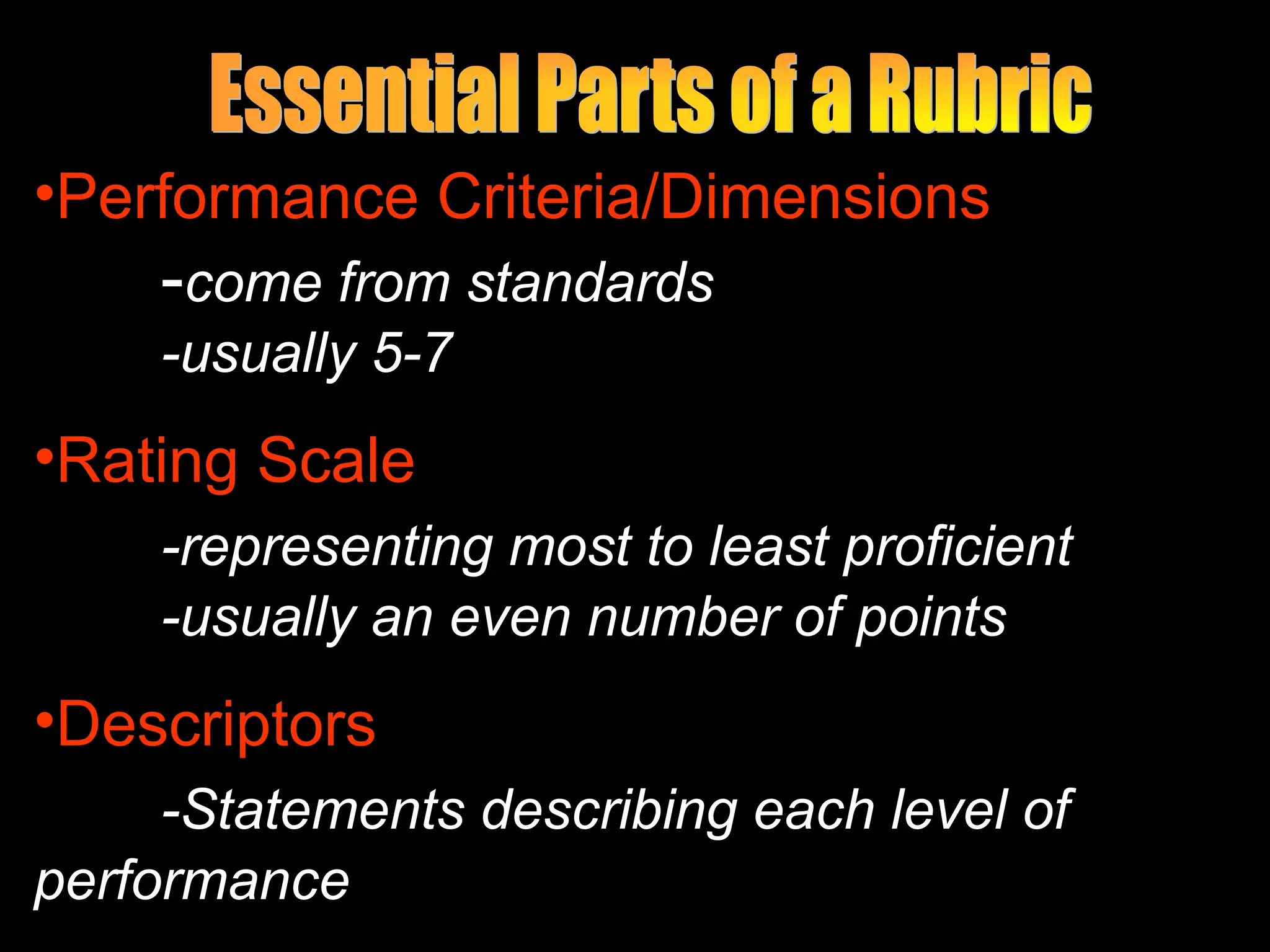
•Performance Criteria/Dimensions
-come from standards
-usually 5-7
•Rating Scale
-representing most to least proficient
-usually an even number of points
•Descriptors
-Statements describing each level of
performance
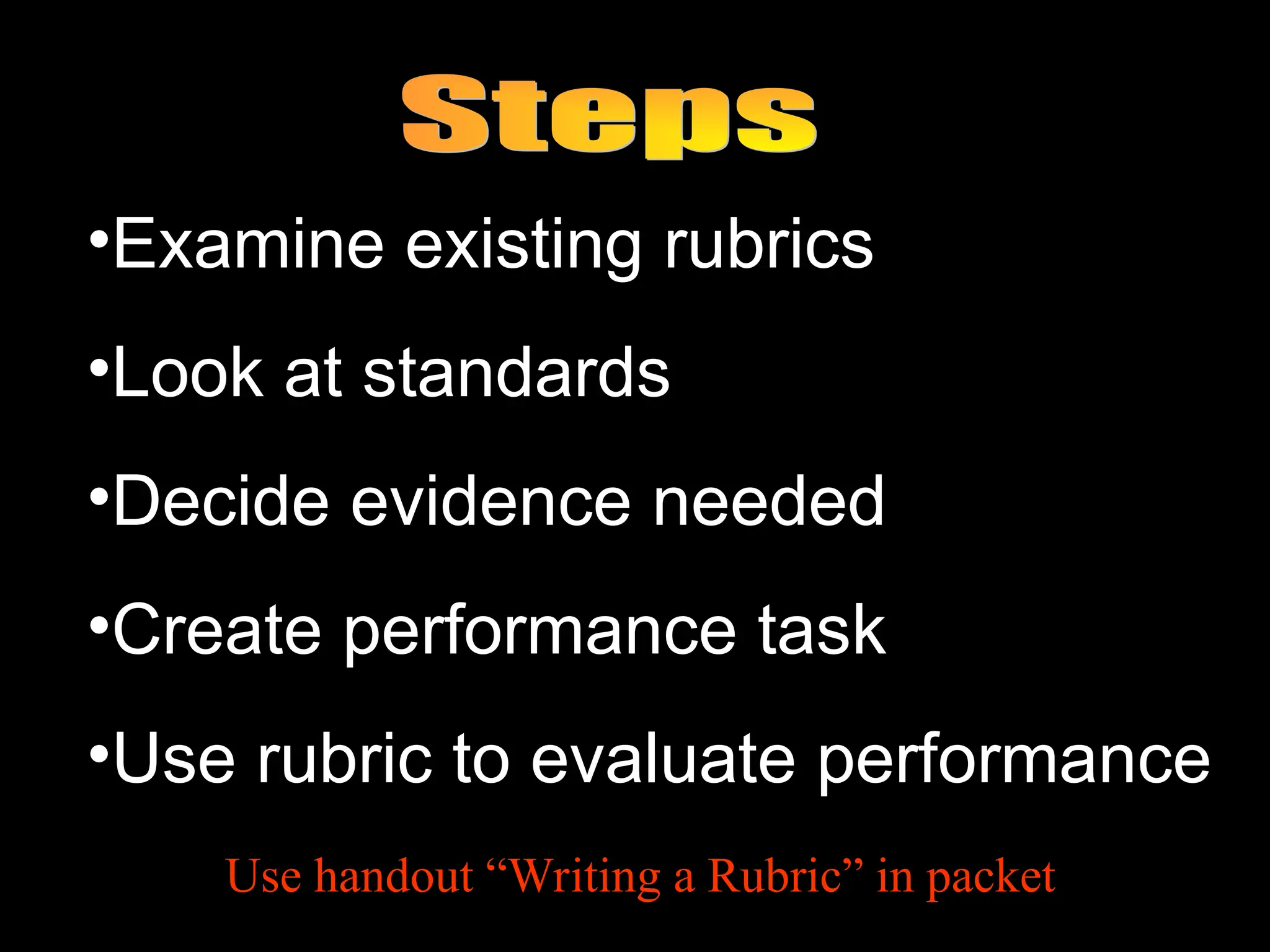
•Examine existing rubrics
•Look at standards
•Decide evidence needed
•Create performance task
•Use rubric to evaluate performance
Use handout “Writing a Rubric” in packet
•TEKS
•National Standards
•Your own desired outcomes/goals
What should students know and be able to do?
How will you know if they know it / can do it?
•What kind of evidence will you
need?
•What does success look like,
sound like?
•List essential attributes
A performance task provides a student
the opportunity to demonstrate his or her
abilities and to apply knowledge and
skills.
-Your driver's road test was a
performance task
-An audition for the school's choir is a
performance task
•Plan and conduct an experiment.
•Write a story, composition, or poem.
•Give an oral report.
•Design and make a videotape.
•Construct a scientific model.
•Program a computer.
•Tutor a classmate.
•Complete an art project………..
•Keep a science journal.
•Interview a scientist.
•Guide classmates on a trip.
•Correspond with a scientific author.
•Graph data.
•Construct a concept map.
•Research information in the
library……
•Draw a chart or diagram.
•Give photo or slide presentations.
•Compose a song.
•Write science questions.
•Record long-term plant growth.
•Care for/keep record of animals.
•Organize a healthy luncheon.
The best performance assessment tasks
are interesting, worthwhile activities
that relate to your instructional
outcomes and allow your students to
demonstrate what they know and can
do.
Does the task truly match the
outcome(s) you're trying to
measure?
The task shouldn't require knowledge and skills that
are irrelevant to the outcome.
Example: If you are trying to measure speaking
skills, asking the students to orally summarize a
difficult science article penalizes those students
who are poor readers or who lack the science
background to understand the article. In that case,
you would not know whether you were measuring
speaking or (in this case) extraneous reading and
science skills.
Is the task a worthwhile use of
instructional time?
Performance assessments may be time-
consuming so that time should be well-spent.
Instead of being an "add-on" to regular
instruction, the assessment should be part of
it.
See Handout, “Effective Performance Tasks”
Can the task be used to measure
several outcomes at once?
If so, the assessment process can be
more efficient, by requiring fewer
assessments overall.
With your colleagues, make a preliminary decision
about:
•the standards your assessment will address
•the criteria of the performance or product to be
assessed.
For example, Illinois students' writing assessments
are scored for focus, support, organization and
conventions. A musical performance might be rated
for intonation, rhythmic accuracy, tone quality, etc.
An oral presentation might be rated for content,
organization, delivery and language.
Art
•Formal elements
- structure
- composition
•Technical
- techniques
- materials
•Sensory elements
-expression
- mood
- emotion
- energy
One technique that may be helpful is to sort
examples of actual student work into three
piles, the very best, the poorest and those in
between. With your colleagues, try to
articulate what makes the good assignments
good.
Your list will probably contain many more
dimensions than you will actually be able to
evaluate for each of your students. Try to
cluster your tentative list of dimensions into
just a few categories or scales.
•Write a definition of each of the dimensions.
•Develop a continuum (scale) for describing
the range of products/performances on each
of the dimensions.
For each of your dimensions, what
characterizes the best possible
performance of the task? This description
will serve as the anchor for each of the
dimensions by defining the highest score
point on your rating scale.
Describe in words the worst
possible product/performance.
This will serve as a description of the
lowest point on your rating scale.
Describe characteristics of
products/performances that fall at the
intermediate points of the rating scale
for each dimension.
Often these points will include some major
or minor flaws that prevent the
product/performance from receiving a
higher rating.
Evaluating your rubric
•Does the rubric relate to the outcome(s)
being measured? Does it address anything
extraneous?
•Does the rubric cover important dimensions
of student performance?
•Do the criteria reflect current conceptions of
"excellence" in the field?
•Are the categories or scales well-defined?
•Is there a clear basis for assigning scores
at each scale point?
•Can the rubric be applied consistently by
different scorers?
•Can the rubric be understood by students
and parents?
•Is the rubric developmentally appropriate?
•Can the rubric be applied to a variety of
tasks?
•Is the rubric fair and free from bias?
•Is the rubric useful, feasible, manageable
and practical?
Let’s look at
See handout…
“A rubric can be a powerful
communications tool. When it is shared
among teachers, students and parents, the
rubric communicates in concrete and
observable terms what the school values
most. It provides a means for you and
your colleagues to clarify your vision of
excellence and convey that vision to your
students…..
It can also provide a rationale for
assigning grades to subjectively scored
assessments. Sharing the rubric with
students is vital—and only fair—if we
expect them to do their best possible work.
An additional benefit of sharing the rubric
is that it empowers students to critically
evaluate their own work.” Heidi Andrade, 1995
•Web Page
-Sample Rubrics
-Online Rubric Creators
-Software to download
-Articles for further information
rubricpp-131007133301-phpapp0pppppppppppppppppp1.ppt

rubricpp-131007133301-phpapp0pppppppppppppppppp1.ppt

  • 1.
  • 2.
    •Give you thetools to design a rubric -Will need to assess a performance, 9 week assessment -Show how assessment can help teaching & learning
  • 3.
    Rubrics 101 Rubrics 101 •Whatis a rubric? •Purposes •Advantages •Parts •Samples
  • 4.
    Designing a Rubric(walkthrough the steps) Designing a Rubric (walkthrough the steps) •Begin with standards (TEKS, national) •Think about evidence •Design a performance task •Write the rubric •Evaluate
  • 5.
  • 6.
  • 7.
    A rubric isa scoring tool that lists the criteria for a piece of work, or “what counts” and clearly defines gradations of quality for each criterion, from excellent to poor.
  • 8.
    •How will thework be judged? •What’s the difference between good work and weaker work? •How can we make sure our scores are valid? •How can performers and judges focus their preparation on excellence?
  • 9.
    A rubric isan authentic assessment tool which is particularly useful in assessing criteria which are complex and subjective.
  • 10.
  • 11.
    Authentic assessment corresponds asclosely as possible to real world experience. It was originally developed in the arts and apprenticeship systems, where assessment has always been based on performance.
  • 12.
    The instructor observesthe student in the process of working on something real, provides feedback, monitors the student's use of the feedback, and adjusts instruction and evaluation accordingly. Authentic assessment takes this principle of evaluating real work into all areas of the curriculum.
  • 13.
    Rubrics are saidto be an authentic assessment tool. They are most helpful when used to evaluate real-life tasks where students are engaged in solving real-life problems. They are a formative type of assessment because they are used before. during, and after the learning process.
  • 14.
    Rubrics: •Make expectations clear •Helpstudents judge own work •Reduce time spent evaluating •Easy to use and explain •Make scoring fair and consistent
  • 15.
    “Rubrics can improvestudent performance, as well as monitor it, by making teachers' expectations clear and by showing students how to meet these expectations. The result is often marked improvements in the quality of student work and in learning. Thus, the most common argument for using rubrics is they help define "quality."
  • 16.
    One student actuallydidn't like rubrics for this very reason: "If you get something wrong," she said, "your teacher can prove you knew what you were supposed to do!” (Marcus 1995).
  • 17.
    “[Rubrics] provide teacherswith an effective, objective method for evaluating skills that do not generally lend themselves to objective assessment methods”.
  • 18.
    “[Rubrics] help studentsbecome more thoughtful judges of the quality of their own and others' work. When rubrics are used to guide self- and peer-assessment, students become increasingly able to spot and solve problems in their own and one another's work…..
  • 19.
    “Repeated practice withpeer- assessment, and especially self- assessment, increases students' sense of responsibility for their own work and cuts down on the number of "Am I done yet?" questions.”
  • 20.
    “Rubrics reduce theamount of time teachers spend evaluating student work. Teachers tend to find that by the time a piece has been self- and peer-assessed according to a rubric, they have little left to say about it. When they do have something to say, they can often simply circle an item in the rubric, rather than struggle to explain the flaw or strength they have noticed.”
  • 21.
    •Performance Criteria/Dimensions -come fromstandards -usually 5-7 •Rating Scale -representing most to least proficient -usually an even number of points •Descriptors -Statements describing each level of performance
  • 22.
    •Examine existing rubrics •Lookat standards •Decide evidence needed •Create performance task •Use rubric to evaluate performance Use handout “Writing a Rubric” in packet
  • 23.
    •TEKS •National Standards •Your owndesired outcomes/goals What should students know and be able to do?
  • 24.
    How will youknow if they know it / can do it? •What kind of evidence will you need? •What does success look like, sound like? •List essential attributes
  • 25.
    A performance taskprovides a student the opportunity to demonstrate his or her abilities and to apply knowledge and skills. -Your driver's road test was a performance task -An audition for the school's choir is a performance task
  • 26.
    •Plan and conductan experiment. •Write a story, composition, or poem. •Give an oral report. •Design and make a videotape. •Construct a scientific model. •Program a computer. •Tutor a classmate. •Complete an art project………..
  • 27.
    •Keep a sciencejournal. •Interview a scientist. •Guide classmates on a trip. •Correspond with a scientific author. •Graph data. •Construct a concept map. •Research information in the library……
  • 28.
    •Draw a chartor diagram. •Give photo or slide presentations. •Compose a song. •Write science questions. •Record long-term plant growth. •Care for/keep record of animals. •Organize a healthy luncheon.
  • 29.
    The best performanceassessment tasks are interesting, worthwhile activities that relate to your instructional outcomes and allow your students to demonstrate what they know and can do.
  • 30.
    Does the tasktruly match the outcome(s) you're trying to measure? The task shouldn't require knowledge and skills that are irrelevant to the outcome. Example: If you are trying to measure speaking skills, asking the students to orally summarize a difficult science article penalizes those students who are poor readers or who lack the science background to understand the article. In that case, you would not know whether you were measuring speaking or (in this case) extraneous reading and science skills.
  • 31.
    Is the taska worthwhile use of instructional time? Performance assessments may be time- consuming so that time should be well-spent. Instead of being an "add-on" to regular instruction, the assessment should be part of it. See Handout, “Effective Performance Tasks”
  • 32.
    Can the taskbe used to measure several outcomes at once? If so, the assessment process can be more efficient, by requiring fewer assessments overall.
  • 33.
    With your colleagues,make a preliminary decision about: •the standards your assessment will address •the criteria of the performance or product to be assessed. For example, Illinois students' writing assessments are scored for focus, support, organization and conventions. A musical performance might be rated for intonation, rhythmic accuracy, tone quality, etc. An oral presentation might be rated for content, organization, delivery and language.
  • 34.
    Art •Formal elements - structure -composition •Technical - techniques - materials •Sensory elements -expression - mood - emotion - energy
  • 35.
    One technique thatmay be helpful is to sort examples of actual student work into three piles, the very best, the poorest and those in between. With your colleagues, try to articulate what makes the good assignments good. Your list will probably contain many more dimensions than you will actually be able to evaluate for each of your students. Try to cluster your tentative list of dimensions into just a few categories or scales.
  • 36.
    •Write a definitionof each of the dimensions. •Develop a continuum (scale) for describing the range of products/performances on each of the dimensions. For each of your dimensions, what characterizes the best possible performance of the task? This description will serve as the anchor for each of the dimensions by defining the highest score point on your rating scale.
  • 37.
    Describe in wordsthe worst possible product/performance. This will serve as a description of the lowest point on your rating scale.
  • 38.
    Describe characteristics of products/performancesthat fall at the intermediate points of the rating scale for each dimension. Often these points will include some major or minor flaws that prevent the product/performance from receiving a higher rating.
  • 39.
    Evaluating your rubric •Doesthe rubric relate to the outcome(s) being measured? Does it address anything extraneous? •Does the rubric cover important dimensions of student performance? •Do the criteria reflect current conceptions of "excellence" in the field? •Are the categories or scales well-defined?
  • 40.
    •Is there aclear basis for assigning scores at each scale point? •Can the rubric be applied consistently by different scorers? •Can the rubric be understood by students and parents?
  • 41.
    •Is the rubricdevelopmentally appropriate? •Can the rubric be applied to a variety of tasks? •Is the rubric fair and free from bias? •Is the rubric useful, feasible, manageable and practical?
  • 42.
  • 43.
    “A rubric canbe a powerful communications tool. When it is shared among teachers, students and parents, the rubric communicates in concrete and observable terms what the school values most. It provides a means for you and your colleagues to clarify your vision of excellence and convey that vision to your students…..
  • 44.
    It can alsoprovide a rationale for assigning grades to subjectively scored assessments. Sharing the rubric with students is vital—and only fair—if we expect them to do their best possible work. An additional benefit of sharing the rubric is that it empowers students to critically evaluate their own work.” Heidi Andrade, 1995
  • 45.
    •Web Page -Sample Rubrics -OnlineRubric Creators -Software to download -Articles for further information