TEACHING MATERIALS & STUDENT
PROGRESS ASSESMENT
Dr. Azidah Abu Ziden
School Of Educational Studies
We l e a d
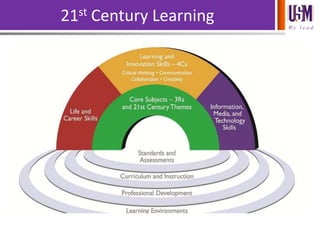
21st Century Learning
We l e a d
TEACHING MATERIALS
We l e a d
INTRODUCTION
• We know that students learn best when they
are truly engaged in what they are learning,
when they have the opportunity to explore,
debate, discuss, examine, defend, and
experiment with the concepts and skills they
are ready to learn.
We l e a d
TEACHING MATERIALS
In e-learning
• What are teaching materials?
• How to prepare teaching materials?
• What type of teaching materials are suitable
for your course?
• How to enhance your teaching materials?
We l e a d
Students learn best when instruction is:
1. Appropriately Challenging
• Students learn best when they start at their
current level of understanding and are challenged
• The student's background knowledge and current
skill level are more important.
• Use a variety of data (assessment scores,
classroom performance, etc.) to identify what
each student is ready to work on and plan
instruction accordingly, modifying content or
activities as needed.
We l e a d
Students learn best when instruction is:
2. Based on Real-World Problems and Situations
• Students need to understand how the skills and
concepts they are learning fit into their lives.
When will they need to use decimals? How does
democracy affect them? How will they benefit
from being able to better understand what they
read? Connect the skills and concepts to things
that already know. Make them relevant.
We l e a d
Students learn best when instruction is:
3. Purposeful
• You (and your students) should be able to
explain the purpose of each activity or
assignments. Why is it worth spending time
on? What are they expected to learn?
We l e a d
Students learn best when instruction is:
• Meaningful and Interesting
• Don’t wait until sometime before begin the
"fun" activities. We know that these activities
are the ones that students love, that they
remember.
We l e a d
• WHAT I DO IN MY COURSE?
We l e a d
Remember!!
• No one instructional method will work for all
students, for all teachers, or in all subject
areas. Think of these ideas as places to start in
figuring out what works most effectively for
you and your students.
We l e a d
STUDENT PROGRESS ASSESMENT
We l e a d
ASSESSMENT
• "Assessment" can refer to end-of-unit tests or
projects, quizzes and graded class assignments as
well as informal progress checks throughout each
dayWide variety of possibilities, including:Use of
different checklists or rubrics, or similar rubrics
with adapted scales
• Use of different tests/assessments
• Adapt existing test/assessment so that specific
parts of the test only have to be completed by
specific groups of students
We l e a d
ASSESSMENT
• Allow a student to respond to test questions
orally instead of in writing, or typing on a
computer instead of writing by hand
• Allow a student to respond by demonstrating
the skill
• Assess what is most important for the
student to know.
We l e a d
ASSESMENT
• PREPARING ASSESMENT
– What is the goal?
• MONITOR PROGRESS
– How to
• ADAPT CONTENT
– What to adapt?
– How to adapt?
We l e a d
MEANS OF ASSESMENT
• In what authentic, relevant ways will students
show how to apply the skills and concepts
they've learned?
– Projects, demonstrations (how to do this in
elearning? )
• Application in other classes and subjects
We l e a d
MEANS OF ASSESMENT
• How will the students show what skills and
concepts they've learned?
– Online assignments, tests & quiz
– Online formative assessment strategies (frequent
progress monitoring)
• Online discussions
• Chat
• Uploading files
• Embedding files/videos
We l e a d
ONLINE QUIZ in ELEARN
• WHY QUIZ?
–Demonstrating Understanding
–Students self check
–Gauge student Performance
–Makes Learning Fun!
• FEATURES
• HOW TO USE
We l e a d
• WHAT I DO IN MY COURSE???
We l e a d
QUESTIONS???

Teaching Materials & Student Progress Assesment

  • 1.
    TEACHING MATERIALS &STUDENT PROGRESS ASSESMENT Dr. Azidah Abu Ziden School Of Educational Studies
  • 2.
    We l ea d 21st Century Learning
  • 3.
    We l ea d TEACHING MATERIALS
  • 4.
    We l ea d INTRODUCTION • We know that students learn best when they are truly engaged in what they are learning, when they have the opportunity to explore, debate, discuss, examine, defend, and experiment with the concepts and skills they are ready to learn.
  • 5.
    We l ea d TEACHING MATERIALS In e-learning • What are teaching materials? • How to prepare teaching materials? • What type of teaching materials are suitable for your course? • How to enhance your teaching materials?
  • 6.
    We l ea d Students learn best when instruction is: 1. Appropriately Challenging • Students learn best when they start at their current level of understanding and are challenged • The student's background knowledge and current skill level are more important. • Use a variety of data (assessment scores, classroom performance, etc.) to identify what each student is ready to work on and plan instruction accordingly, modifying content or activities as needed.
  • 7.
    We l ea d Students learn best when instruction is: 2. Based on Real-World Problems and Situations • Students need to understand how the skills and concepts they are learning fit into their lives. When will they need to use decimals? How does democracy affect them? How will they benefit from being able to better understand what they read? Connect the skills and concepts to things that already know. Make them relevant.
  • 8.
    We l ea d Students learn best when instruction is: 3. Purposeful • You (and your students) should be able to explain the purpose of each activity or assignments. Why is it worth spending time on? What are they expected to learn?
  • 9.
    We l ea d Students learn best when instruction is: • Meaningful and Interesting • Don’t wait until sometime before begin the "fun" activities. We know that these activities are the ones that students love, that they remember.
  • 10.
    We l ea d • WHAT I DO IN MY COURSE?
  • 11.
    We l ea d Remember!! • No one instructional method will work for all students, for all teachers, or in all subject areas. Think of these ideas as places to start in figuring out what works most effectively for you and your students.
  • 12.
    We l ea d STUDENT PROGRESS ASSESMENT
  • 13.
    We l ea d ASSESSMENT • "Assessment" can refer to end-of-unit tests or projects, quizzes and graded class assignments as well as informal progress checks throughout each dayWide variety of possibilities, including:Use of different checklists or rubrics, or similar rubrics with adapted scales • Use of different tests/assessments • Adapt existing test/assessment so that specific parts of the test only have to be completed by specific groups of students
  • 14.
    We l ea d ASSESSMENT • Allow a student to respond to test questions orally instead of in writing, or typing on a computer instead of writing by hand • Allow a student to respond by demonstrating the skill • Assess what is most important for the student to know.
  • 15.
    We l ea d ASSESMENT • PREPARING ASSESMENT – What is the goal? • MONITOR PROGRESS – How to • ADAPT CONTENT – What to adapt? – How to adapt?
  • 16.
    We l ea d MEANS OF ASSESMENT • In what authentic, relevant ways will students show how to apply the skills and concepts they've learned? – Projects, demonstrations (how to do this in elearning? ) • Application in other classes and subjects
  • 17.
    We l ea d MEANS OF ASSESMENT • How will the students show what skills and concepts they've learned? – Online assignments, tests & quiz – Online formative assessment strategies (frequent progress monitoring) • Online discussions • Chat • Uploading files • Embedding files/videos
  • 18.
    We l ea d ONLINE QUIZ in ELEARN • WHY QUIZ? –Demonstrating Understanding –Students self check –Gauge student Performance –Makes Learning Fun! • FEATURES • HOW TO USE
  • 19.
    We l ea d • WHAT I DO IN MY COURSE???
  • 20.
    We l ea d QUESTIONS???