Using Assessment  to  Drive Instruction
 
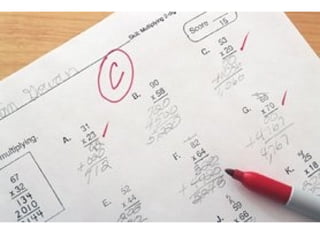
Too often, educational tests, grades, and report cards are treated by teachers as autopsies when they should be viewed as physicals.   (Reeves 2000, 10)
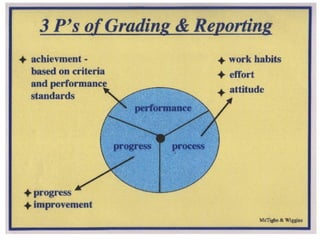
Principles of Effective Grading & Reporting It’s unwise to over-grade student work


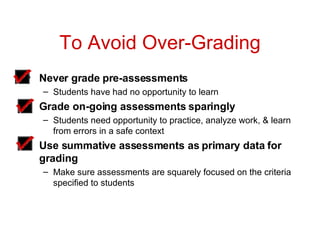
To Avoid Over-Grading Never grade pre-assessments Students have had no opportunity to learn Grade on-going assessments sparingly Students need opportunity to practice, analyze work, & learn from errors in a safe context Use summative assessments as primary data for grading Make sure assessments are squarely focused on the criteria specified to students
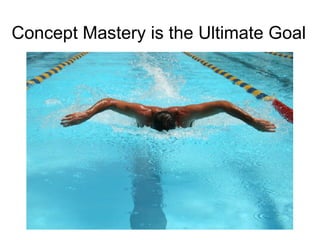
Concept Mastery is the Ultimate Goal
 
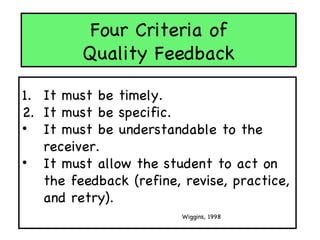
Four Criteria of Quality Feedback It must be timely. It must be specific. It must be understandable to the receiver. It must allow the student to act on the feedback (refine, revise, practice, and retry). Wiggins, 1998
 
 
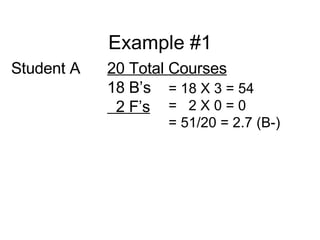
Example #1 Student A 20 Total Courses 18 B’s     2 F’s = 18 X 3 = 54 =  2 X 0 = 0 = 51/20 = 2.7 (B-)
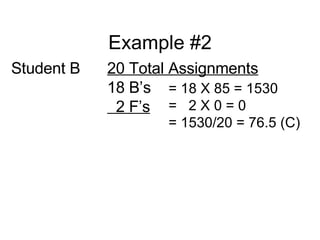
Example #2 Student B 20 Total Assignments 18 B’s     2 F’s = 18 X 85 = 1530 =  2 X 0 = 0 = 1530/20 = 76.5 (C)
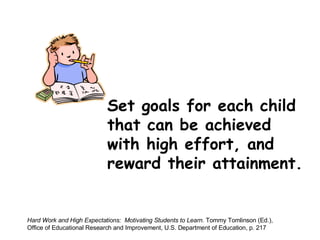
Set goals for each child that can be achieved  with high effort, and  reward their attainment. Hard Work and High Expectations:  Motivating Students to Learn . Tommy Tomlinson (Ed.),  Office of Educational Research and Improvement, U.S. Department of Education, p. 217
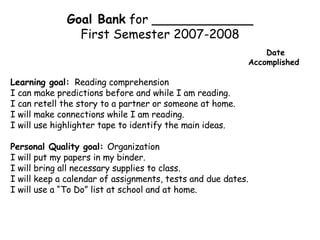
Goal Bank  for _____________ First Semester 2007-2008 Date    Accomplished Learning goal:   Reading comprehension I can make predictions before and while I am reading. I can retell the story to a partner or someone at home. I will make connections while I am reading. I will use highlighter tape to identify the main ideas. Personal Quality goal:  Organization I will put my papers in my binder. I will bring all necessary supplies to class. I will keep a calendar of assignments, tests and due dates. I will use a “To Do” list at school and at home.
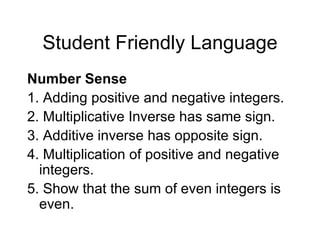
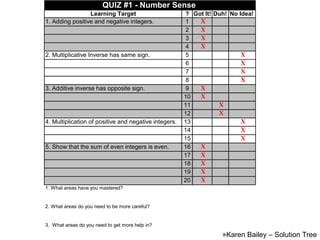
Student Friendly Language Number Sense 1. Adding positive and negative integers. 2. Multiplicative Inverse has same sign.  3. Additive inverse has opposite sign. 4. Multiplication of positive and negative integers. 5. Show that the sum of even integers is even.
Karen Bailey – Solution Tree
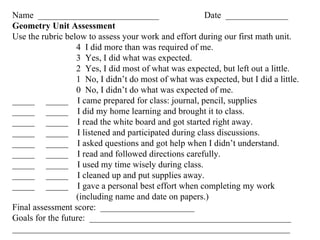
Name  ___________________________ Date  ______________ Geometry Unit Assessment Use the rubric below to assess your work and effort during our first math unit. 4  I did more than was required of me. 3  Yes, I did what was expected. 2  Yes, I did most of what was expected, but left out a little. 1  No, I didn’t do most of what was expected, but I did a little. 0  No, I didn’t do what was expected of me. _____  _____  I came prepared for class: journal, pencil, supplies _____  _____  I did my home learning and brought it to class. _____  _____  I read the white board and got started right away. _____  _____  I listened and participated during class discussions. _____  _____  I asked questions and got help when I didn’t understand. _____  _____  I read and followed directions carefully. _____  _____  I used my time wisely during class. _____  _____  I cleaned up and put supplies away.  _____  _____  I gave a personal best effort when completing my work  (including name and date on papers.) Final assessment score:  _____________________ Goals for the future:  _____________________________________________ ______________________________________________________________
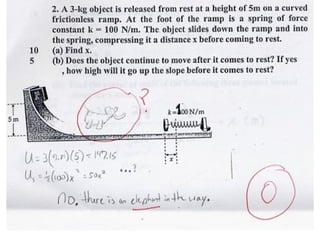
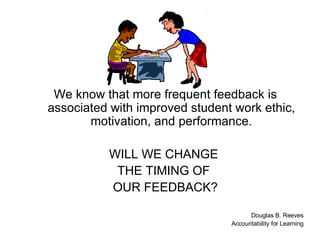
We know that more frequent feedback is associated with improved student work ethic, motivation, and performance. WILL WE CHANGE  THE TIMING OF  OUR FEEDBACK? Douglas B. Reeves Accountability for Learning
 
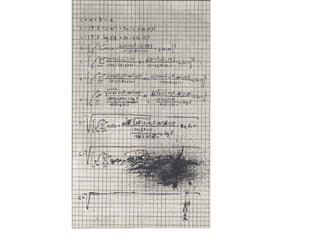
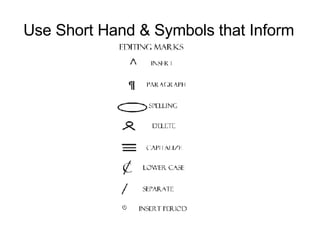
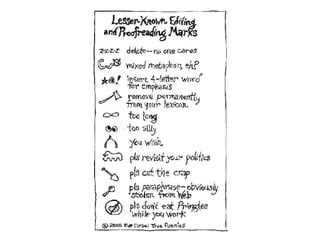
Use Short Hand & Symbols that Inform
 
Student Awareness  & Early Intervention are Best
4. Jigsaw Check : (Review/ Assessment) Teacher assigns students to groups of 5-6 Teacher gives each student a question card, posing a Key understanding question Students read their question to group Scorecard Keeper records # of students for each question who are: Really sure Pretty sure Foggy clueless Students scramble to groups with same question they have/prepare solid answer Go back to original groups, share answers Re-read questions Re-do scoreboard Report before and after scoreboards Assessment Strategies to Support Success
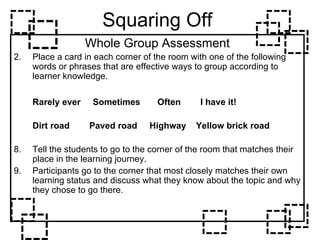
Squaring Off Whole Group Assessment Place a card in each corner of the room with one of the following words or phrases that are effective ways to group according to learner knowledge. Rarely ever  Sometimes  Often  I have it! Dirt road  Paved road  Highway  Yellow brick road Tell the students to go to the corner of the room that matches their place in the learning journey. Participants go to the corner that most closely matches their own learning status and discuss what they know about the topic and why they chose to go there.
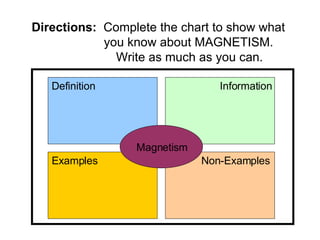
Directions:   Complete the chart to show what  you know about MAGNETISM.    Write as much as you can. Definition Information Examples Non-Examples Magnetism
Exit Cards Explain the difference between simile and metaphor. Give some examples of each as part of your explanation.
Exit Cards List 3 things you learned today 2 things you’d like to learn more about 1 question you still have

Assessment

  • 1.
    Using Assessment to Drive Instruction
  • 2.
  • 3.
    Too often, educationaltests, grades, and report cards are treated by teachers as autopsies when they should be viewed as physicals. (Reeves 2000, 10)
  • 4.
    Principles of EffectiveGrading & Reporting It’s unwise to over-grade student work
  • 5.
  • 6.
  • 7.
  • 8.
  • 9.
    To Avoid Over-GradingNever grade pre-assessments Students have had no opportunity to learn Grade on-going assessments sparingly Students need opportunity to practice, analyze work, & learn from errors in a safe context Use summative assessments as primary data for grading Make sure assessments are squarely focused on the criteria specified to students
  • 10.
    Concept Mastery isthe Ultimate Goal
  • 11.
  • 12.
    Four Criteria ofQuality Feedback It must be timely. It must be specific. It must be understandable to the receiver. It must allow the student to act on the feedback (refine, revise, practice, and retry). Wiggins, 1998
  • 13.
  • 14.
  • 15.
    Example #1 StudentA 20 Total Courses 18 B’s 2 F’s = 18 X 3 = 54 = 2 X 0 = 0 = 51/20 = 2.7 (B-)
  • 16.
    Example #2 StudentB 20 Total Assignments 18 B’s 2 F’s = 18 X 85 = 1530 = 2 X 0 = 0 = 1530/20 = 76.5 (C)
  • 17.
    Set goals foreach child that can be achieved with high effort, and reward their attainment. Hard Work and High Expectations: Motivating Students to Learn . Tommy Tomlinson (Ed.), Office of Educational Research and Improvement, U.S. Department of Education, p. 217
  • 18.
    Goal Bank for _____________ First Semester 2007-2008 Date Accomplished Learning goal: Reading comprehension I can make predictions before and while I am reading. I can retell the story to a partner or someone at home. I will make connections while I am reading. I will use highlighter tape to identify the main ideas. Personal Quality goal: Organization I will put my papers in my binder. I will bring all necessary supplies to class. I will keep a calendar of assignments, tests and due dates. I will use a “To Do” list at school and at home.
  • 19.
    Student Friendly LanguageNumber Sense 1. Adding positive and negative integers. 2. Multiplicative Inverse has same sign. 3. Additive inverse has opposite sign. 4. Multiplication of positive and negative integers. 5. Show that the sum of even integers is even.
  • 20.
    Karen Bailey –Solution Tree
  • 21.
    Name ___________________________Date ______________ Geometry Unit Assessment Use the rubric below to assess your work and effort during our first math unit. 4 I did more than was required of me. 3 Yes, I did what was expected. 2 Yes, I did most of what was expected, but left out a little. 1 No, I didn’t do most of what was expected, but I did a little. 0 No, I didn’t do what was expected of me. _____ _____ I came prepared for class: journal, pencil, supplies _____ _____ I did my home learning and brought it to class. _____ _____ I read the white board and got started right away. _____ _____ I listened and participated during class discussions. _____ _____ I asked questions and got help when I didn’t understand. _____ _____ I read and followed directions carefully. _____ _____ I used my time wisely during class. _____ _____ I cleaned up and put supplies away. _____ _____ I gave a personal best effort when completing my work (including name and date on papers.) Final assessment score: _____________________ Goals for the future: _____________________________________________ ______________________________________________________________
  • 22.
    We know thatmore frequent feedback is associated with improved student work ethic, motivation, and performance. WILL WE CHANGE THE TIMING OF OUR FEEDBACK? Douglas B. Reeves Accountability for Learning
  • 23.
  • 24.
    Use Short Hand& Symbols that Inform
  • 25.
  • 26.
    Student Awareness & Early Intervention are Best
  • 27.
    4. Jigsaw Check: (Review/ Assessment) Teacher assigns students to groups of 5-6 Teacher gives each student a question card, posing a Key understanding question Students read their question to group Scorecard Keeper records # of students for each question who are: Really sure Pretty sure Foggy clueless Students scramble to groups with same question they have/prepare solid answer Go back to original groups, share answers Re-read questions Re-do scoreboard Report before and after scoreboards Assessment Strategies to Support Success
  • 28.
    Squaring Off WholeGroup Assessment Place a card in each corner of the room with one of the following words or phrases that are effective ways to group according to learner knowledge. Rarely ever Sometimes Often I have it! Dirt road Paved road Highway Yellow brick road Tell the students to go to the corner of the room that matches their place in the learning journey. Participants go to the corner that most closely matches their own learning status and discuss what they know about the topic and why they chose to go there.
  • 29.
    Directions: Complete the chart to show what you know about MAGNETISM. Write as much as you can. Definition Information Examples Non-Examples Magnetism
  • 30.
    Exit Cards Explainthe difference between simile and metaphor. Give some examples of each as part of your explanation.
  • 31.
    Exit Cards List3 things you learned today 2 things you’d like to learn more about 1 question you still have