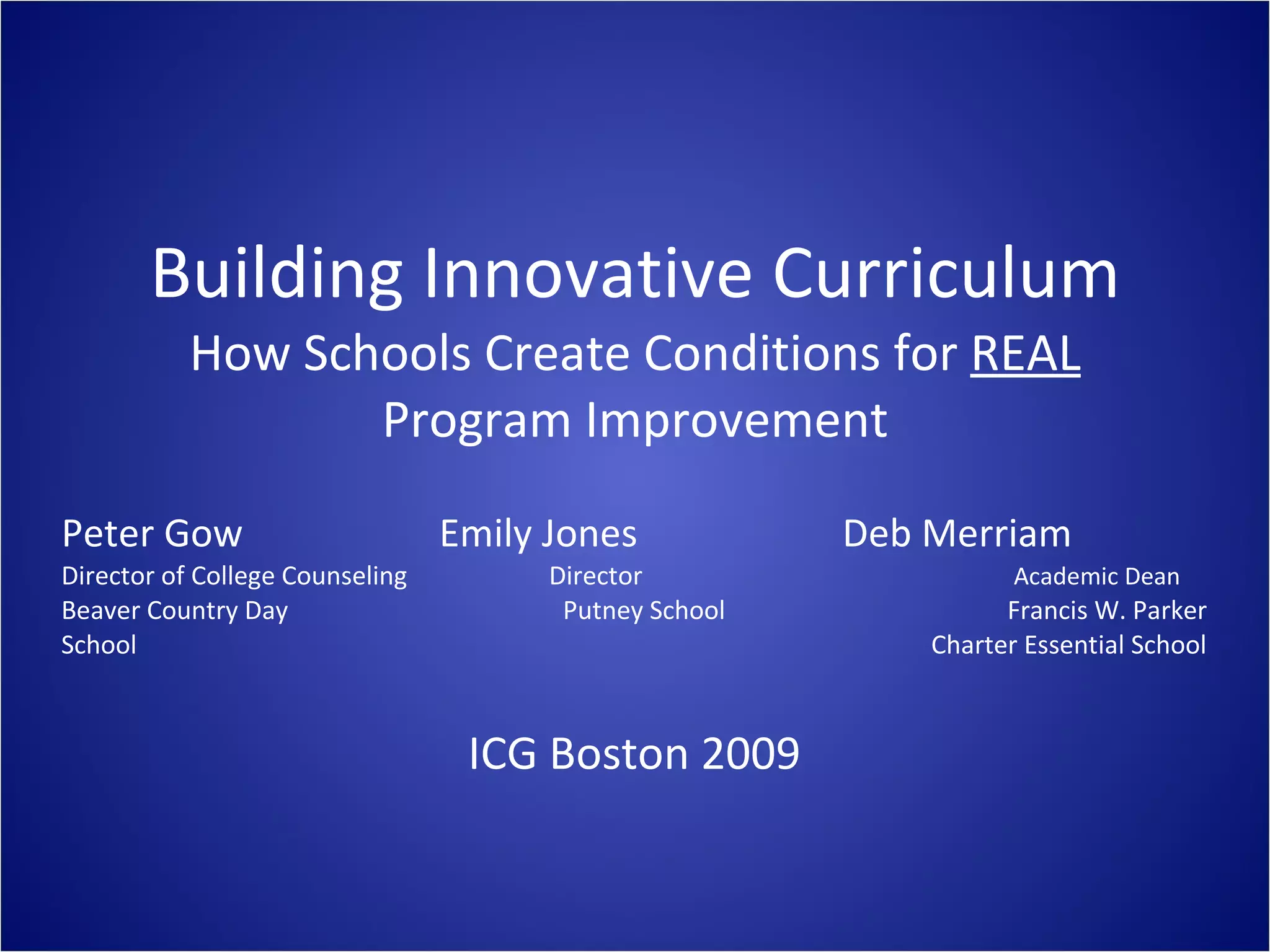
Building Innovative Curriculum How Schools Create Conditions for  REAL  Program Improvement Peter Gow   Emily Jones    Deb Merriam Director of College Counseling   Director   Academic Dean Beaver Country Day   Putney School   Francis W. Parker School     Charter Essential School ICG Boston 2009
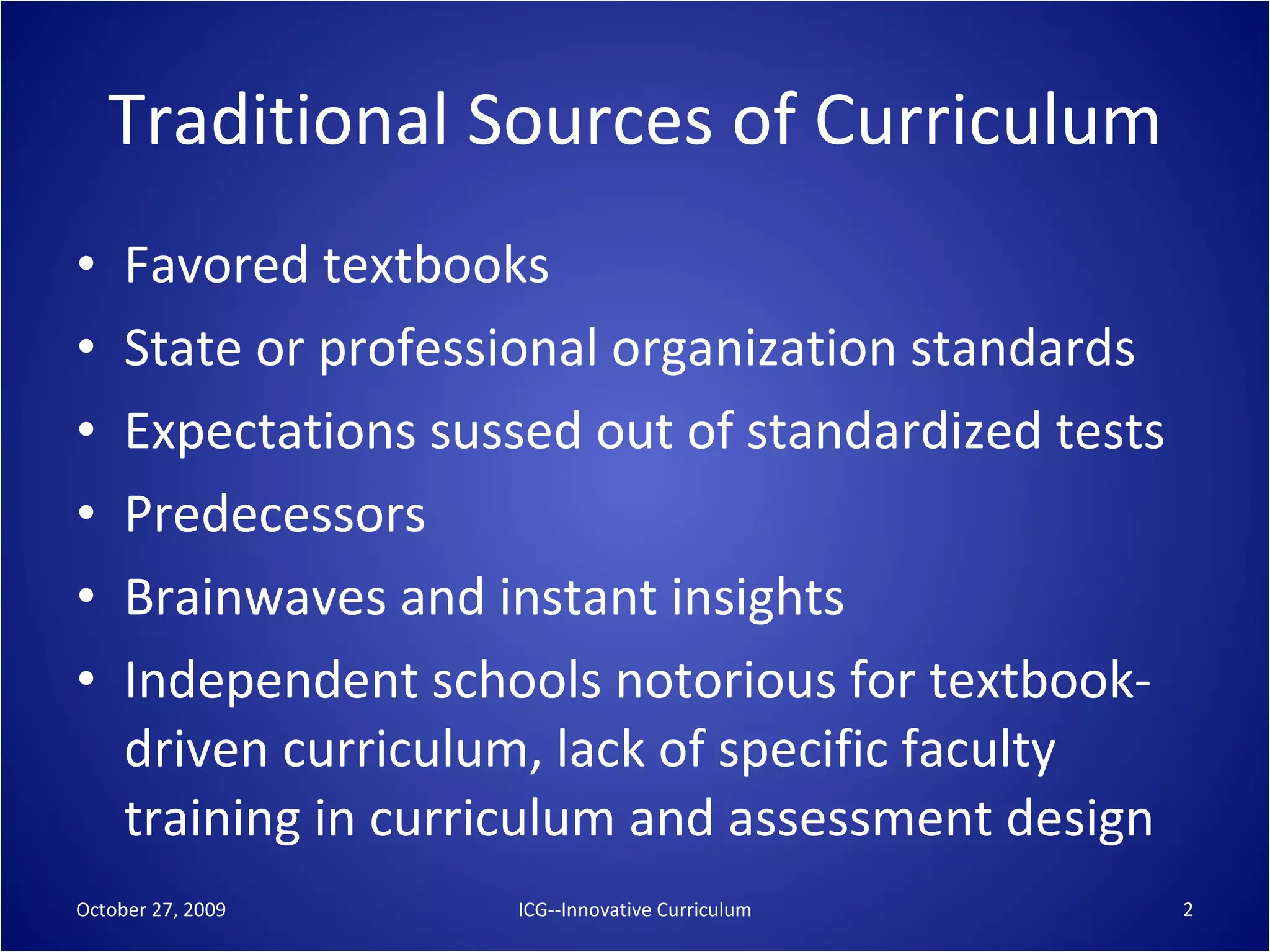
Traditional Sources of Curriculum Favored textbooks State or professional organization standards Expectations sussed out of standardized tests Predecessors Brainwaves and instant insights Independent schools notorious for textbook-driven curriculum, lack of specific faculty training in curriculum and assessment design October 27, 2009 ICG--Innovative Curriculum
The Question How can schools can develop a culture of curriculum development that includes the entire faculty, and how can a shared vision inspire everyone in the community?  October 27, 2009 ICG--Innovative Curriculum
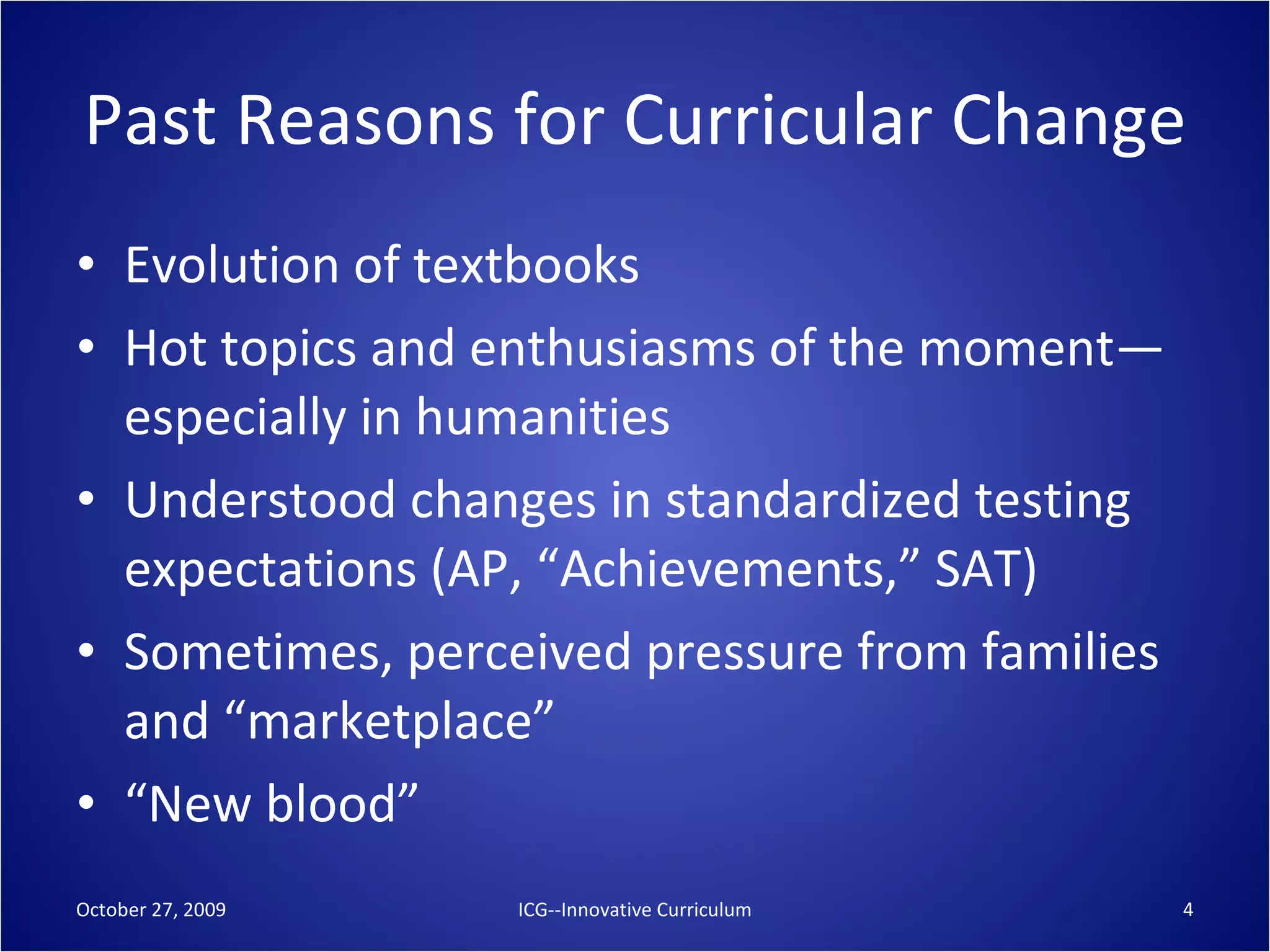
Past Reasons for Curricular Change Evolution of textbooks Hot topics and enthusiasms of the moment—especially in humanities Understood changes in standardized testing expectations (AP, “Achievements,” SAT) Sometimes, perceived pressure from families and “marketplace” “ New blood” October 27, 2009 ICG--Innovative Curriculum
Curriculum Since the 1980s Informed by new understandings of development, intelligence and cognition (Gardner, Sternberg, a host of others) Builds on foundational work of Piaget, Erikson, Bruner, Kohlberg, Perkins et al. Assessment-driven, intentionally designed (“backwards design”); debt to Sizer and Coalition Understanding-based: Wiggins (Understanding by Design), Project Zero (Teaching for Understanding) Project-based, problem-based, “authentic,” experiential, multigenre October 27, 2009 ICG--Innovative Curriculum
Institutional Pre-conditions A sense of need—preferably a desire to move forward educationally A culture of professional respect A truly shared understanding of institutional mission, values, and aims Ideally a professional development program already keyed to this understanding October 27, 2009 ICG--Innovative Curriculum
Needed: An Over-arching Idea (along with the school mission, of course) Change must be developed under a single comprehensible rubric: “21 st -century learning,” UbD, TfU, Coalition principles Idea must compel faculty, either as goal or means (stimulating/engaging for them, keep desks full, teach the kids you want to be teaching, it’ll be better—or even easier) Idea must be accessible to families and students, as well October 27, 2009 ICG--Innovative Curriculum
Steps to Change Develop professional culture based on shared purposes and shared understandings of how children learn Create conditions that maximize faculty interaction and conversation around professional and pedagogical matters Create climate of mutual trust between aims of institution (administration and governors) and role of faculty in achieving these aims Acknowledge that change is hard October 27, 2009 ICG--Innovative Curriculum
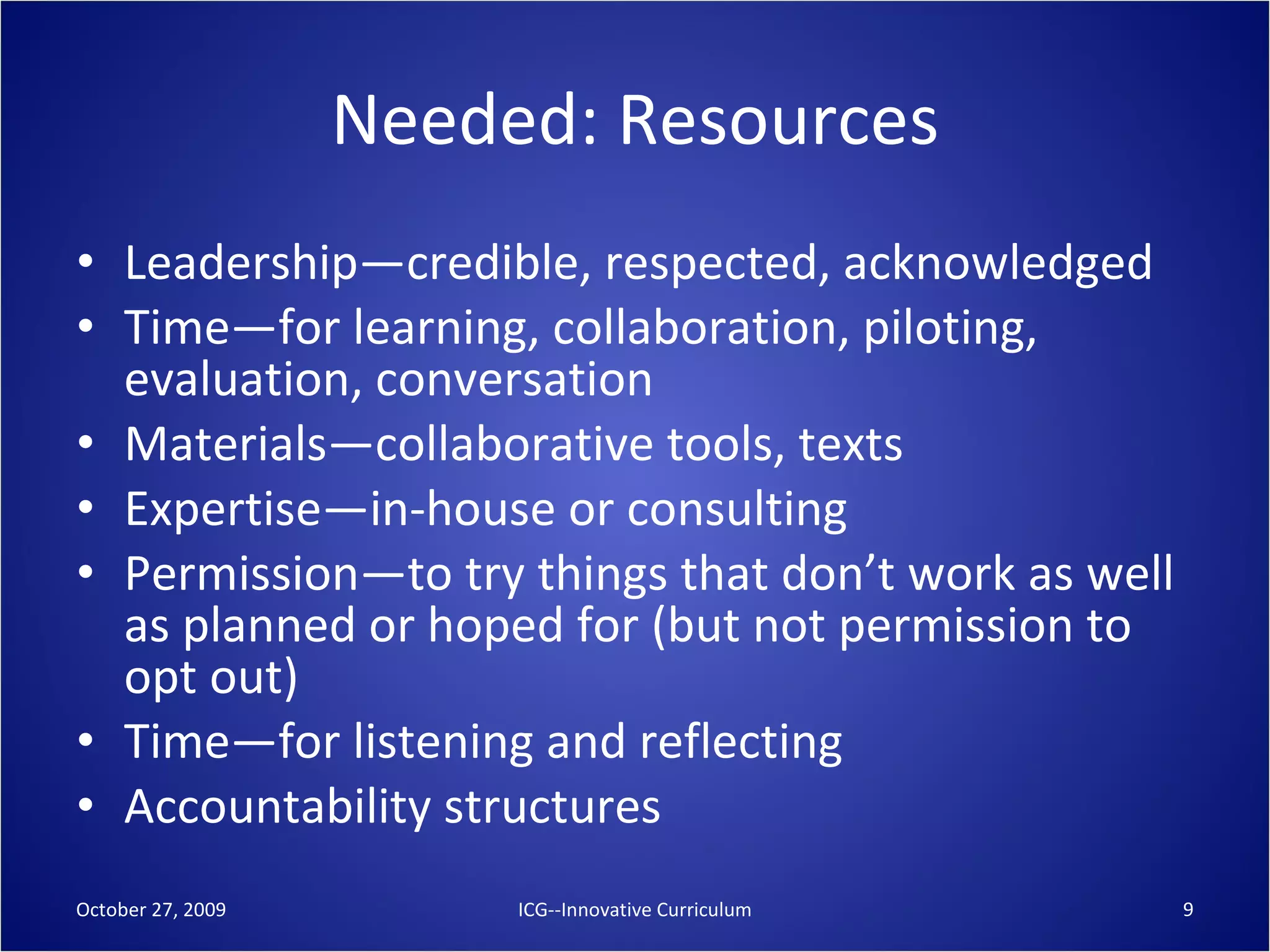
Needed: Resources Leadership—credible, respected, acknowledged Time—for learning, collaboration, piloting, evaluation, conversation Materials—collaborative tools, texts Expertise—in-house or consulting Permission—to try things that don’t work as well as planned or hoped for (but not permission to opt out) Time—for listening and reflecting Accountability structures October 27, 2009 ICG--Innovative Curriculum
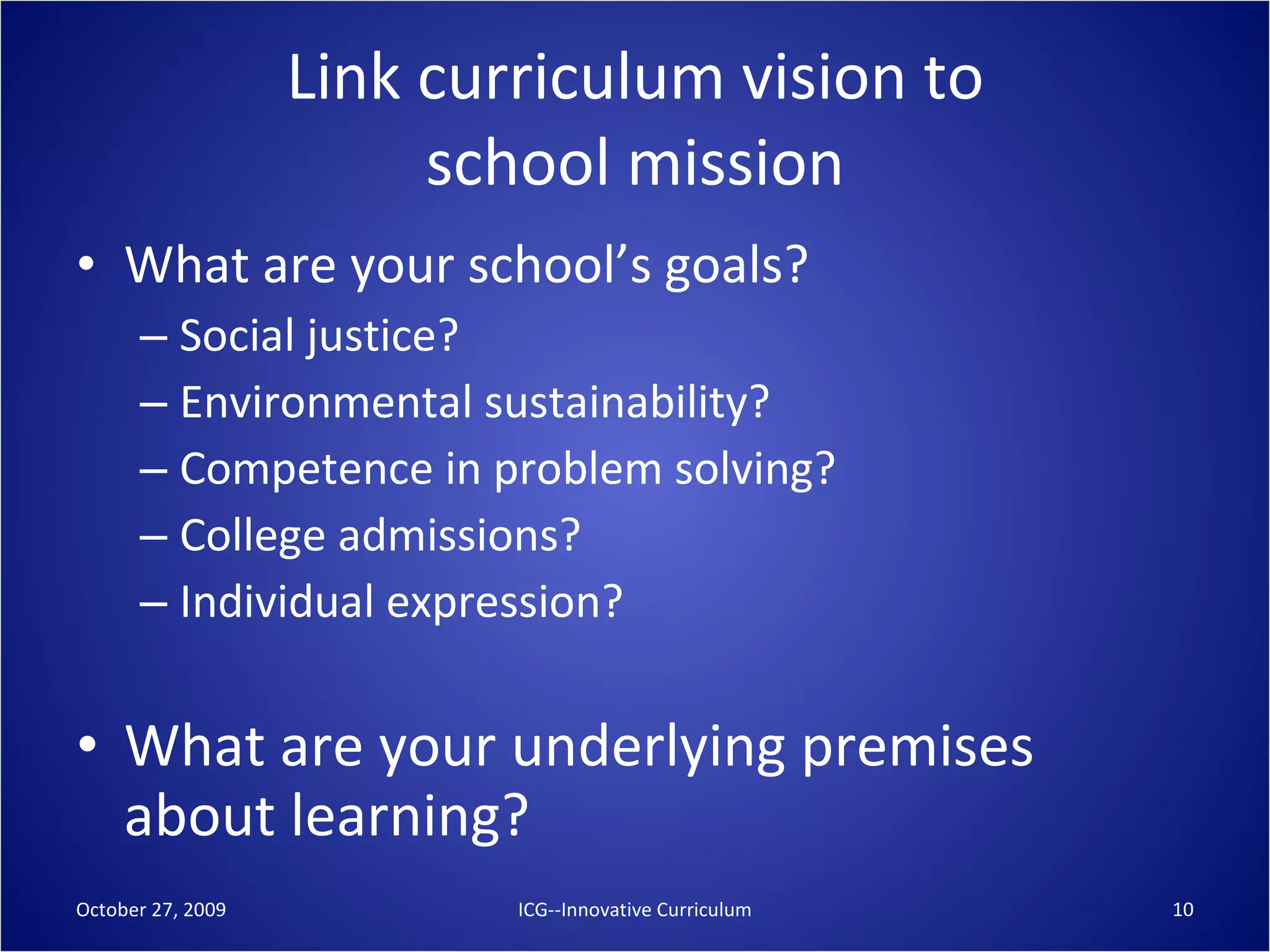
Link curriculum vision to school mission What are your school’s goals? Social justice? Environmental sustainability? Competence in problem solving? College admissions? Individual expression? What are your underlying premises about learning? October 27, 2009 ICG--Innovative Curriculum
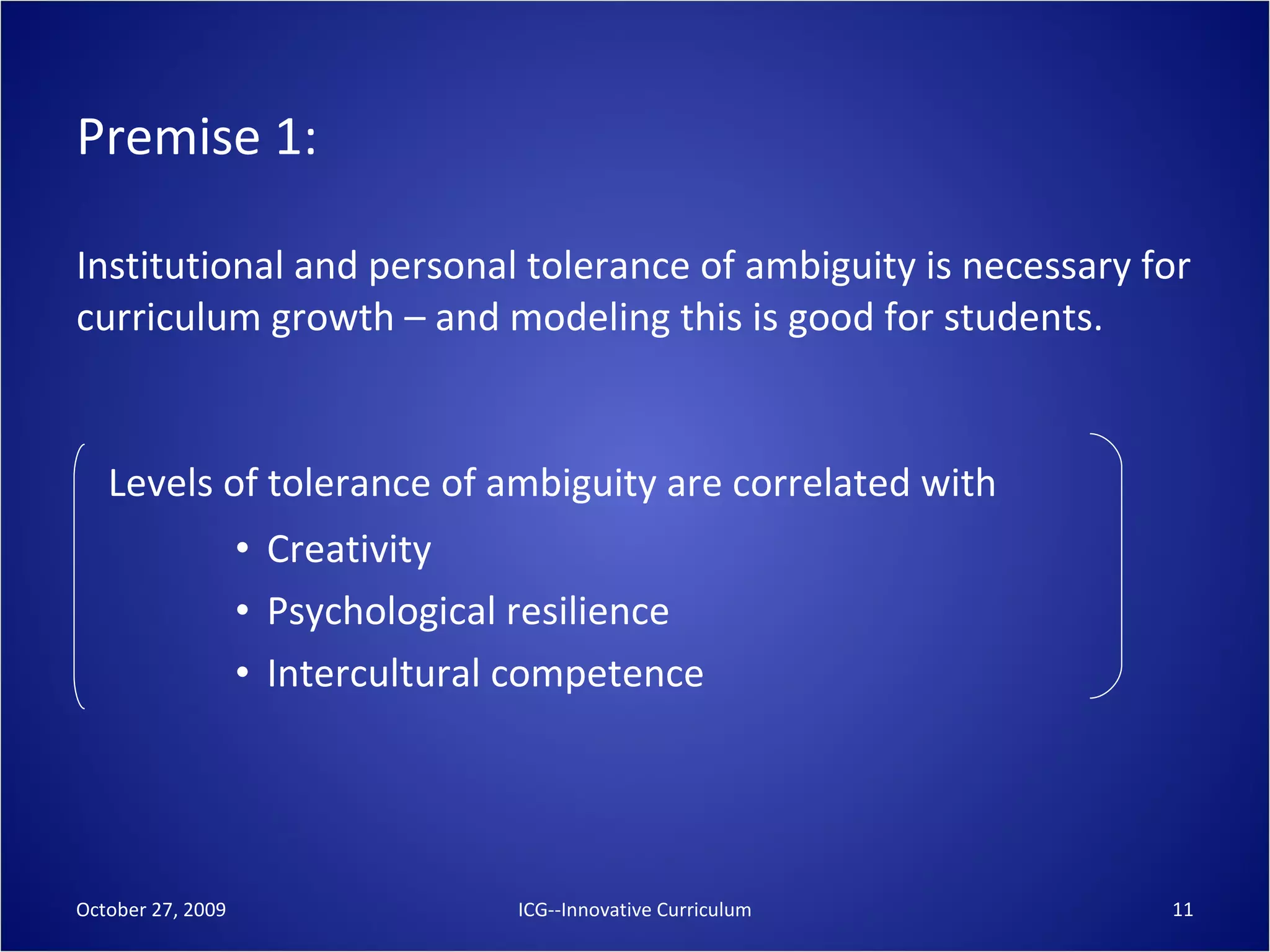
Premise 1:  Institutional and personal tolerance of ambiguity is necessary for curriculum growth – and modeling this is good for students. Levels of tolerance of ambiguity are correlated with   Creativity Psychological resilience Intercultural competence October 27, 2009 ICG--Innovative Curriculum
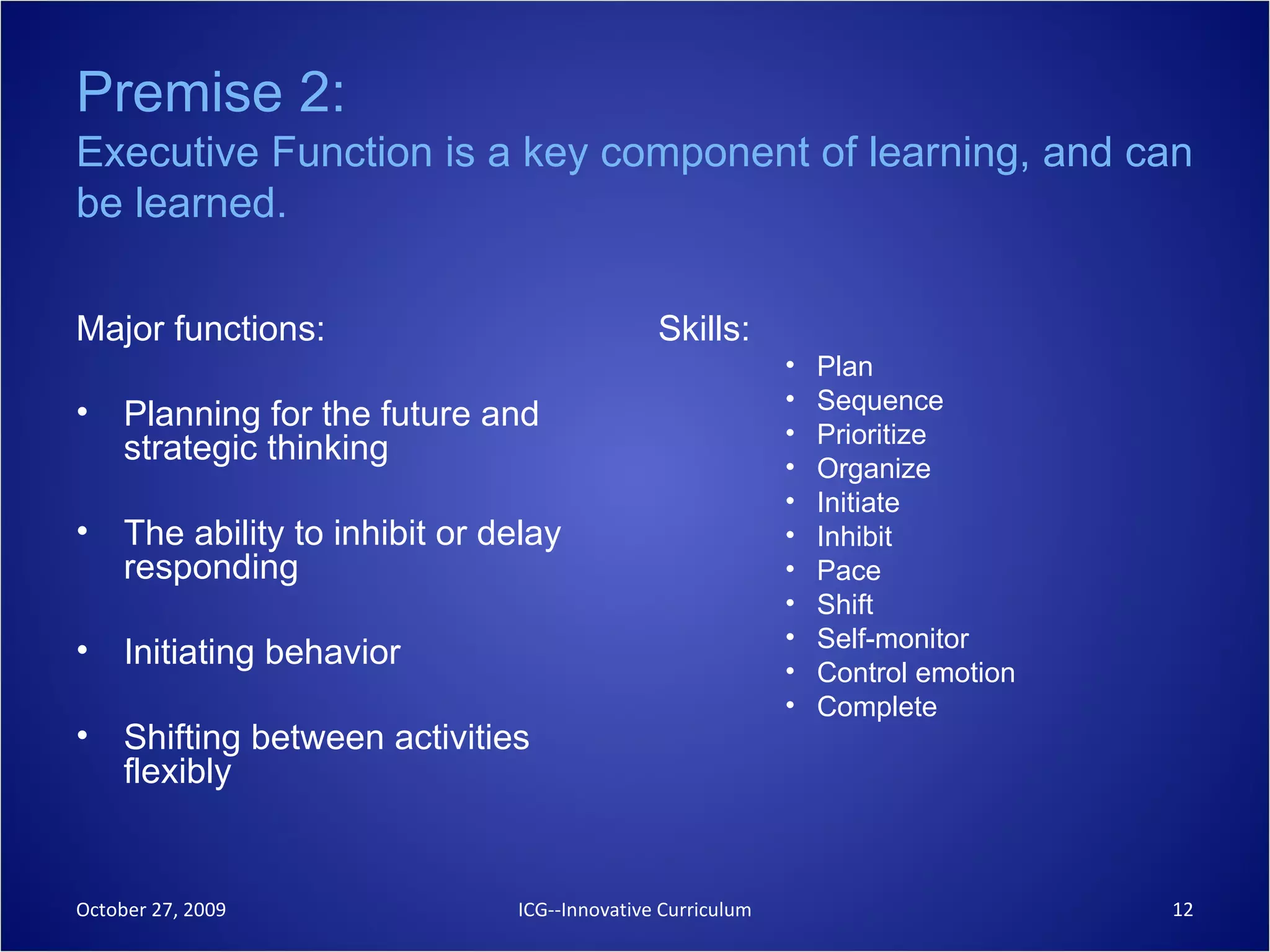
Premise 2:   Executive Function is a key component of learning, and can be learned. Major functions: Planning for the future and strategic thinking  The ability to inhibit or delay responding  Initiating behavior Shifting between activities flexibly  Skills: Plan  Sequence  Prioritize  Organize  Initiate  Inhibit  Pace  Shift  Self-monitor  Control emotion Complete October 27, 2009 ICG--Innovative Curriculum
Premise 3: The tradition of separating the study of humanity (the social sciences and humanities) from the study of the rest of the world (the natural sciences) is at least partly to blame for our inability to think intelligently about how we live on the planet. “ The greatest enterprise of the mind has always been and always will be the attempted linkage of the sciences and the humanities.”    E.O. Wilson October 27, 2009 ICG--Innovative Curriculum
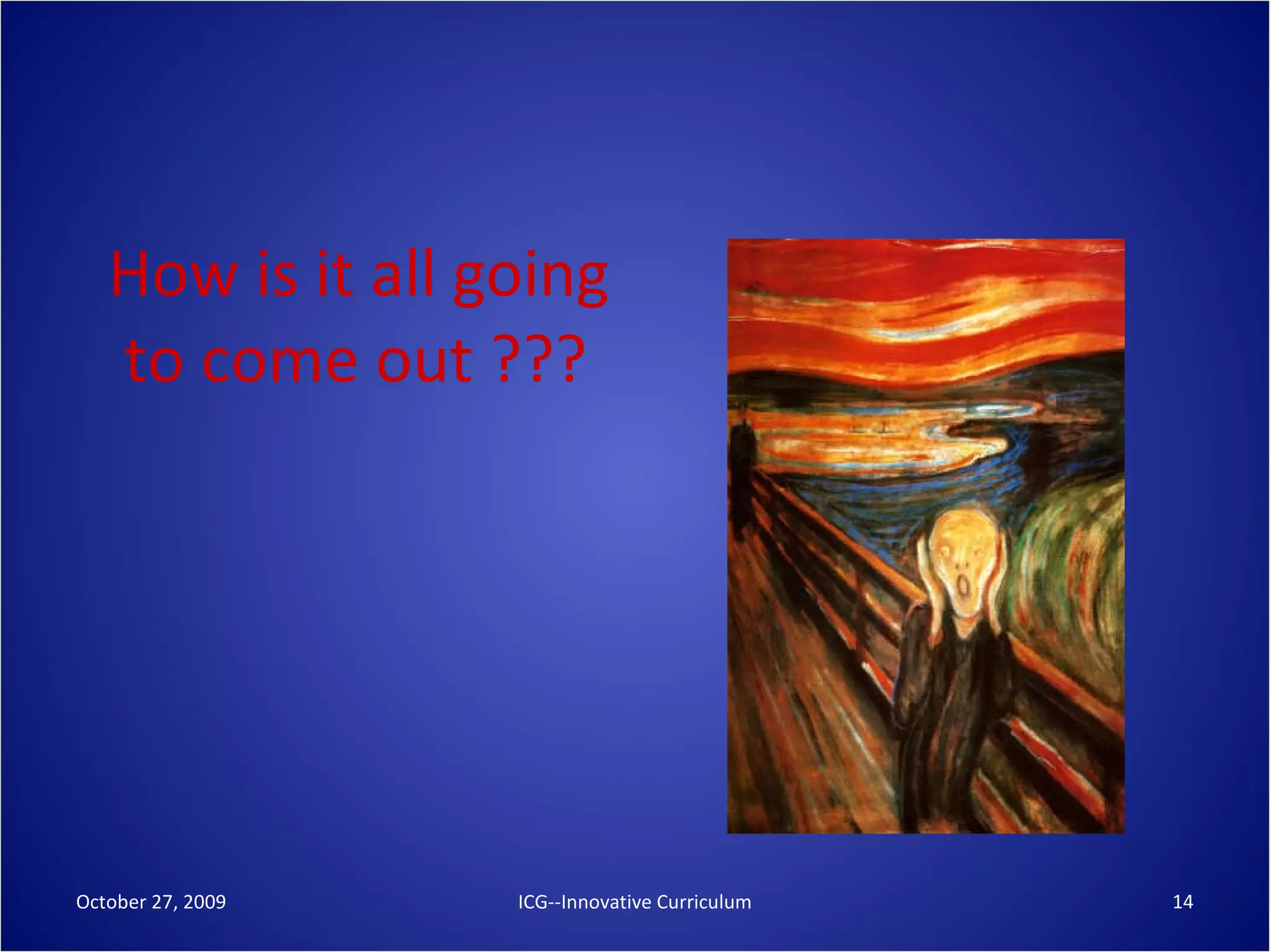
How is it all going to come out ??? October 27, 2009 ICG--Innovative Curriculum
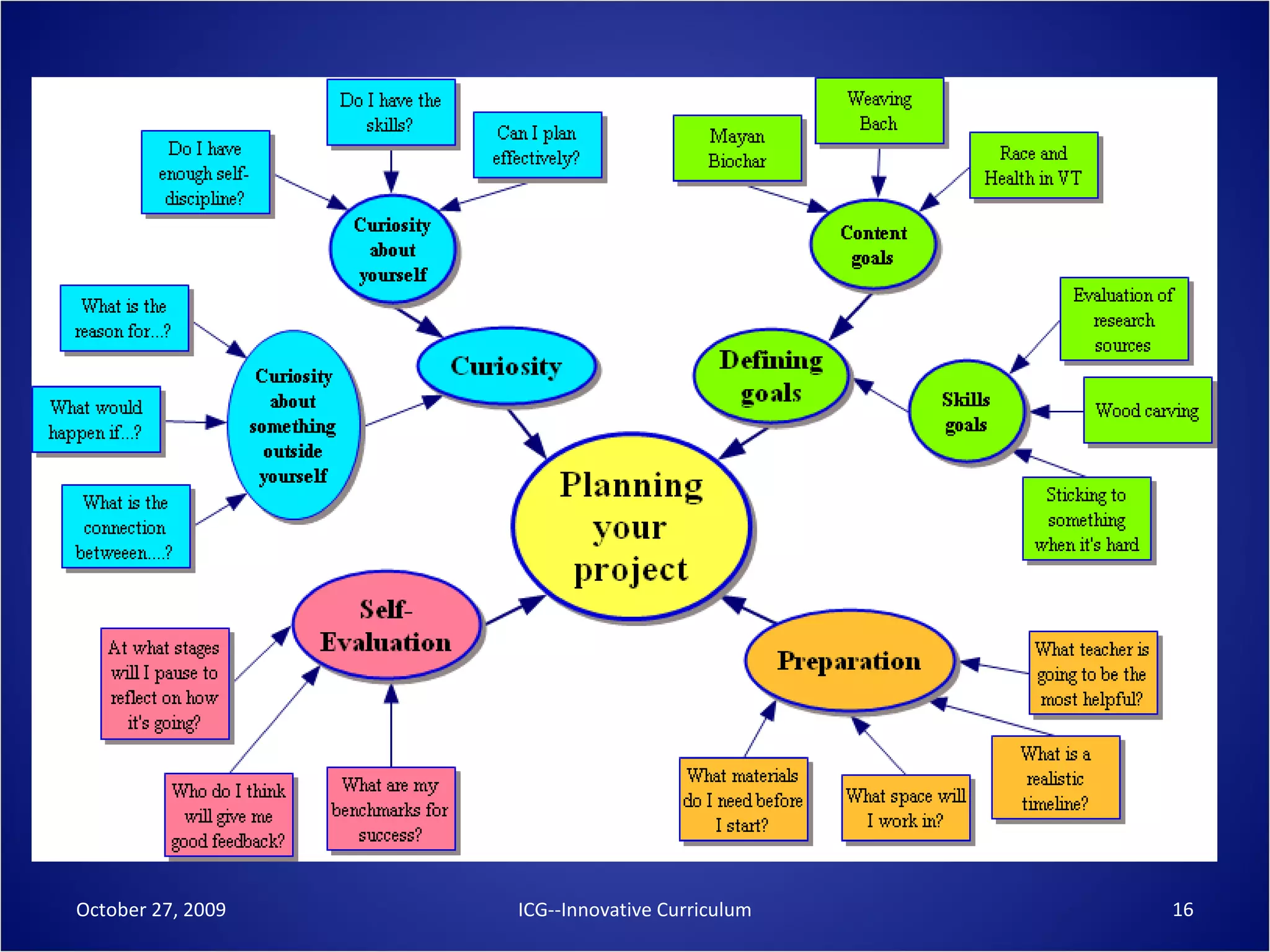
Project based learning Allows for interdisciplinary (non-disciplinary) learning Teaches and assesses executive function Requires, and models, tolerance of ambiguity “ There is no discipline in the world so severe as the discipline of experience subjected to the tests of intelligent development and direction” ~ John Dewey October 27, 2009 ICG--Innovative Curriculum
October 27, 2009 ICG--Innovative Curriculum
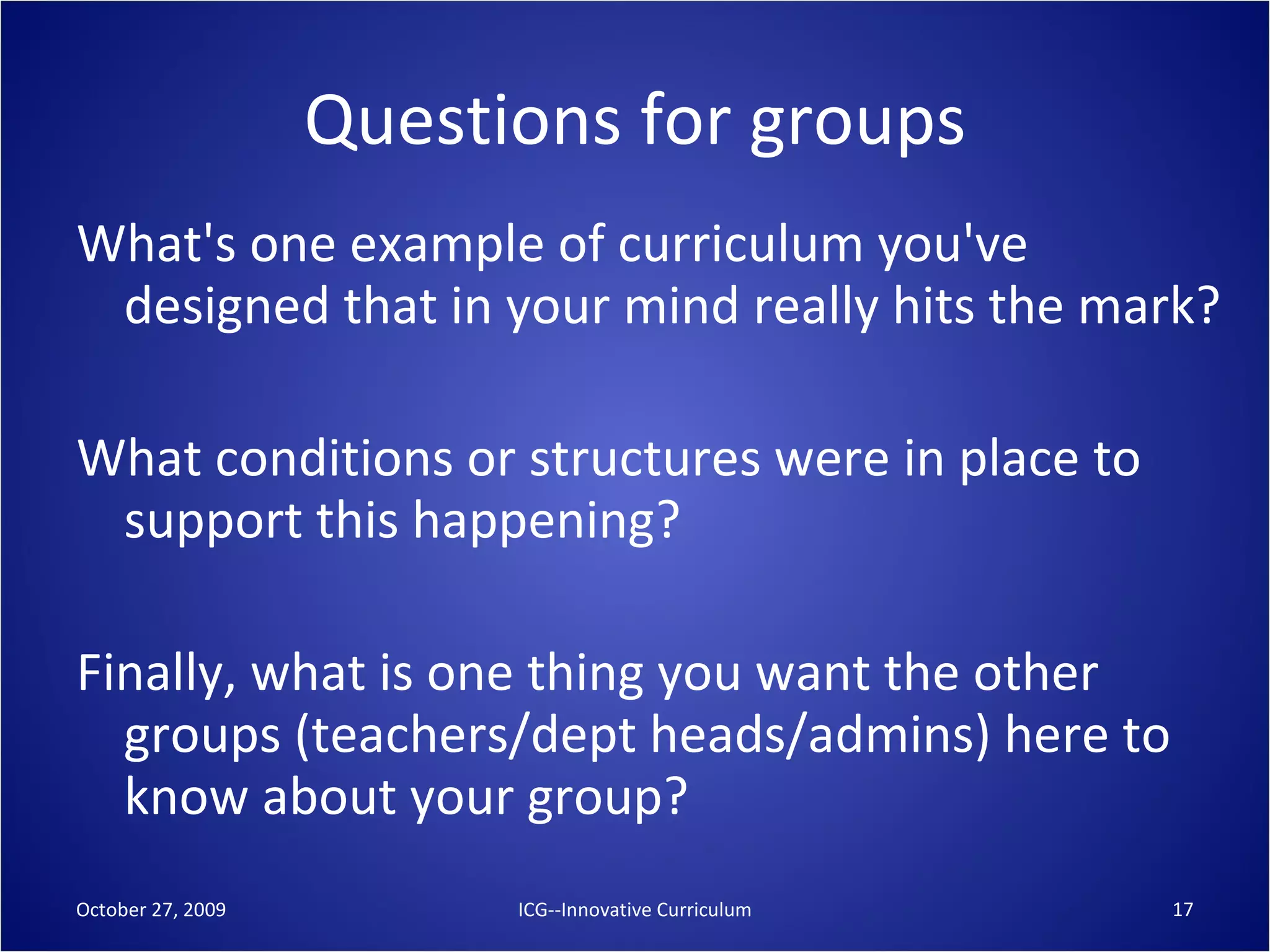
Questions for groups What's one example of curriculum you've designed that in your mind really hits the mark? What conditions or structures were in place to support this happening? Finally, what is one thing you want the other groups (teachers/dept heads/admins) here to know about your group? October 27, 2009 ICG--Innovative Curriculum

Building Innovative Curriculum

  • 1.
    Building Innovative CurriculumHow Schools Create Conditions for REAL Program Improvement Peter Gow Emily Jones Deb Merriam Director of College Counseling Director Academic Dean Beaver Country Day Putney School Francis W. Parker School Charter Essential School ICG Boston 2009
  • 2.
    Traditional Sources ofCurriculum Favored textbooks State or professional organization standards Expectations sussed out of standardized tests Predecessors Brainwaves and instant insights Independent schools notorious for textbook-driven curriculum, lack of specific faculty training in curriculum and assessment design October 27, 2009 ICG--Innovative Curriculum
  • 3.
    The Question Howcan schools can develop a culture of curriculum development that includes the entire faculty, and how can a shared vision inspire everyone in the community? October 27, 2009 ICG--Innovative Curriculum
  • 4.
    Past Reasons forCurricular Change Evolution of textbooks Hot topics and enthusiasms of the moment—especially in humanities Understood changes in standardized testing expectations (AP, “Achievements,” SAT) Sometimes, perceived pressure from families and “marketplace” “ New blood” October 27, 2009 ICG--Innovative Curriculum
  • 5.
    Curriculum Since the1980s Informed by new understandings of development, intelligence and cognition (Gardner, Sternberg, a host of others) Builds on foundational work of Piaget, Erikson, Bruner, Kohlberg, Perkins et al. Assessment-driven, intentionally designed (“backwards design”); debt to Sizer and Coalition Understanding-based: Wiggins (Understanding by Design), Project Zero (Teaching for Understanding) Project-based, problem-based, “authentic,” experiential, multigenre October 27, 2009 ICG--Innovative Curriculum
  • 6.
    Institutional Pre-conditions Asense of need—preferably a desire to move forward educationally A culture of professional respect A truly shared understanding of institutional mission, values, and aims Ideally a professional development program already keyed to this understanding October 27, 2009 ICG--Innovative Curriculum
  • 7.
    Needed: An Over-archingIdea (along with the school mission, of course) Change must be developed under a single comprehensible rubric: “21 st -century learning,” UbD, TfU, Coalition principles Idea must compel faculty, either as goal or means (stimulating/engaging for them, keep desks full, teach the kids you want to be teaching, it’ll be better—or even easier) Idea must be accessible to families and students, as well October 27, 2009 ICG--Innovative Curriculum
  • 8.
    Steps to ChangeDevelop professional culture based on shared purposes and shared understandings of how children learn Create conditions that maximize faculty interaction and conversation around professional and pedagogical matters Create climate of mutual trust between aims of institution (administration and governors) and role of faculty in achieving these aims Acknowledge that change is hard October 27, 2009 ICG--Innovative Curriculum
  • 9.
    Needed: Resources Leadership—credible,respected, acknowledged Time—for learning, collaboration, piloting, evaluation, conversation Materials—collaborative tools, texts Expertise—in-house or consulting Permission—to try things that don’t work as well as planned or hoped for (but not permission to opt out) Time—for listening and reflecting Accountability structures October 27, 2009 ICG--Innovative Curriculum
  • 10.
    Link curriculum visionto school mission What are your school’s goals? Social justice? Environmental sustainability? Competence in problem solving? College admissions? Individual expression? What are your underlying premises about learning? October 27, 2009 ICG--Innovative Curriculum
  • 11.
    Premise 1: Institutional and personal tolerance of ambiguity is necessary for curriculum growth – and modeling this is good for students. Levels of tolerance of ambiguity are correlated with Creativity Psychological resilience Intercultural competence October 27, 2009 ICG--Innovative Curriculum
  • 12.
    Premise 2: Executive Function is a key component of learning, and can be learned. Major functions: Planning for the future and strategic thinking The ability to inhibit or delay responding Initiating behavior Shifting between activities flexibly Skills: Plan Sequence Prioritize Organize Initiate Inhibit Pace Shift Self-monitor Control emotion Complete October 27, 2009 ICG--Innovative Curriculum
  • 13.
    Premise 3: Thetradition of separating the study of humanity (the social sciences and humanities) from the study of the rest of the world (the natural sciences) is at least partly to blame for our inability to think intelligently about how we live on the planet. “ The greatest enterprise of the mind has always been and always will be the attempted linkage of the sciences and the humanities.” E.O. Wilson October 27, 2009 ICG--Innovative Curriculum
  • 14.
    How is itall going to come out ??? October 27, 2009 ICG--Innovative Curriculum
  • 15.
    Project based learningAllows for interdisciplinary (non-disciplinary) learning Teaches and assesses executive function Requires, and models, tolerance of ambiguity “ There is no discipline in the world so severe as the discipline of experience subjected to the tests of intelligent development and direction” ~ John Dewey October 27, 2009 ICG--Innovative Curriculum
  • 16.
    October 27, 2009ICG--Innovative Curriculum
  • 17.
    Questions for groupsWhat's one example of curriculum you've designed that in your mind really hits the mark? What conditions or structures were in place to support this happening? Finally, what is one thing you want the other groups (teachers/dept heads/admins) here to know about your group? October 27, 2009 ICG--Innovative Curriculum