Mississippi Department of Education Common Core State Standards and Assessments  Mathematics and English/Language Arts Lynn J. House, Ph.D. Deputy State Superintendent
What is the CCSS Initiative? An initiative of the National Governors Association (NGA) and the Council of Chief State School Officers (CCSSO) A significant and historic opportunity for states to collectively develop and adopt a core set of academic standards in Mathematics and English/Language Arts
Why is this initiative important? Provides  consistency  across states Allows for  equal access  Prepares students to  compete globally Allows for more  focused professional development Allows for the development of a  common assessment Provides the opportunity to  compare and evaluate  policies that affect student achievement  across states
What are the Common Core  State Standards (CCSS)? Fewer, clearer, and higher Aligned with  college and work expectations Rigorous content requiring  higher-order thinking  and  application of knowledge Internationally benchmarked   Evidence-and/or research-based
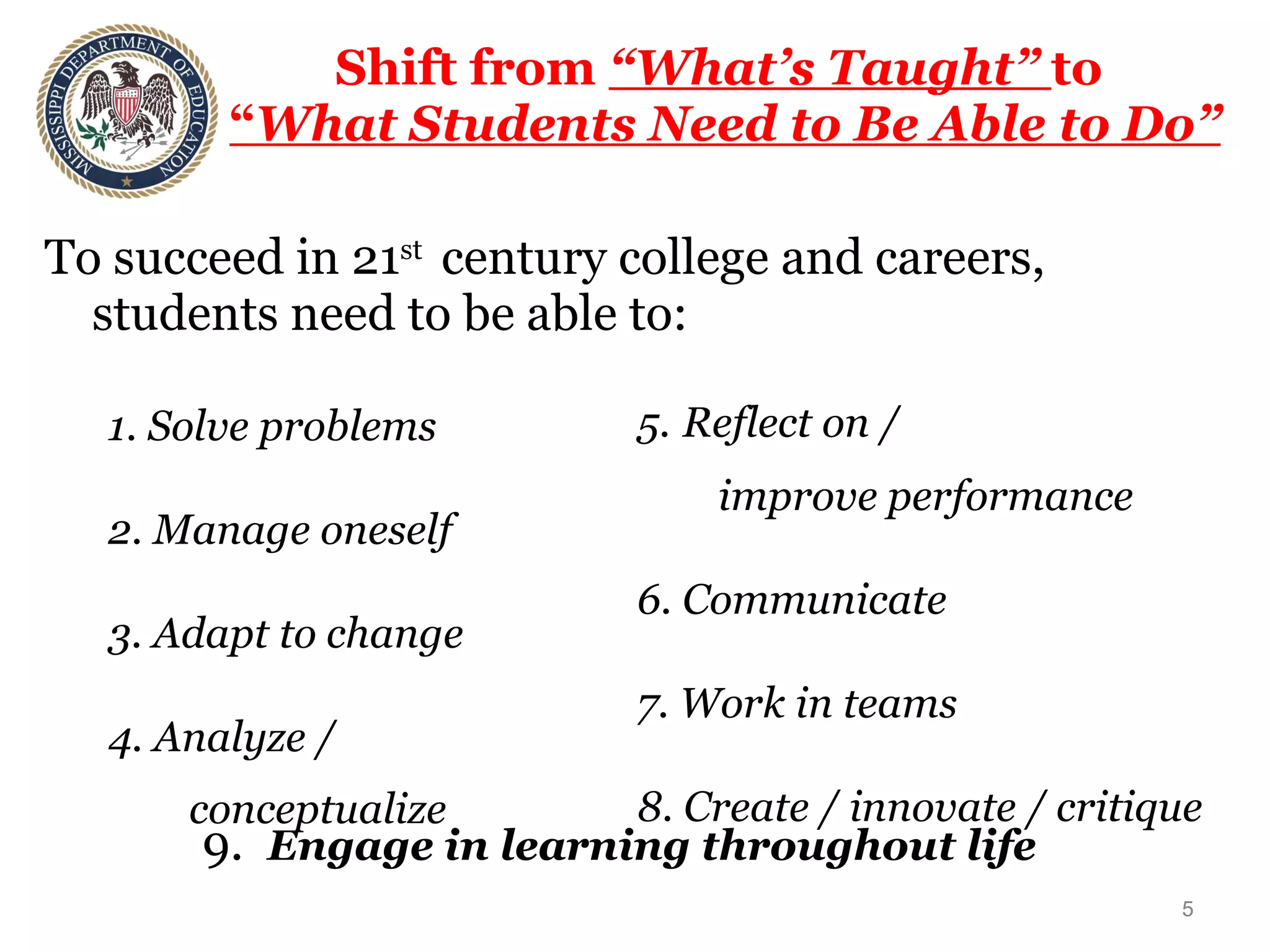
Shift from  “What’s Taught”  to  “ What Students Need to Be Able to Do” To succeed in 21 st  century college and careers, students need to be able to: 1. Solve problems 2. Manage oneself 3. Adapt to change 4. Analyze /  conceptualize 5.   Reflect on /  improve performance 6. Communicate 7. Work in teams 8. Create / innovate / critique 9.  Engage in learning throughout life
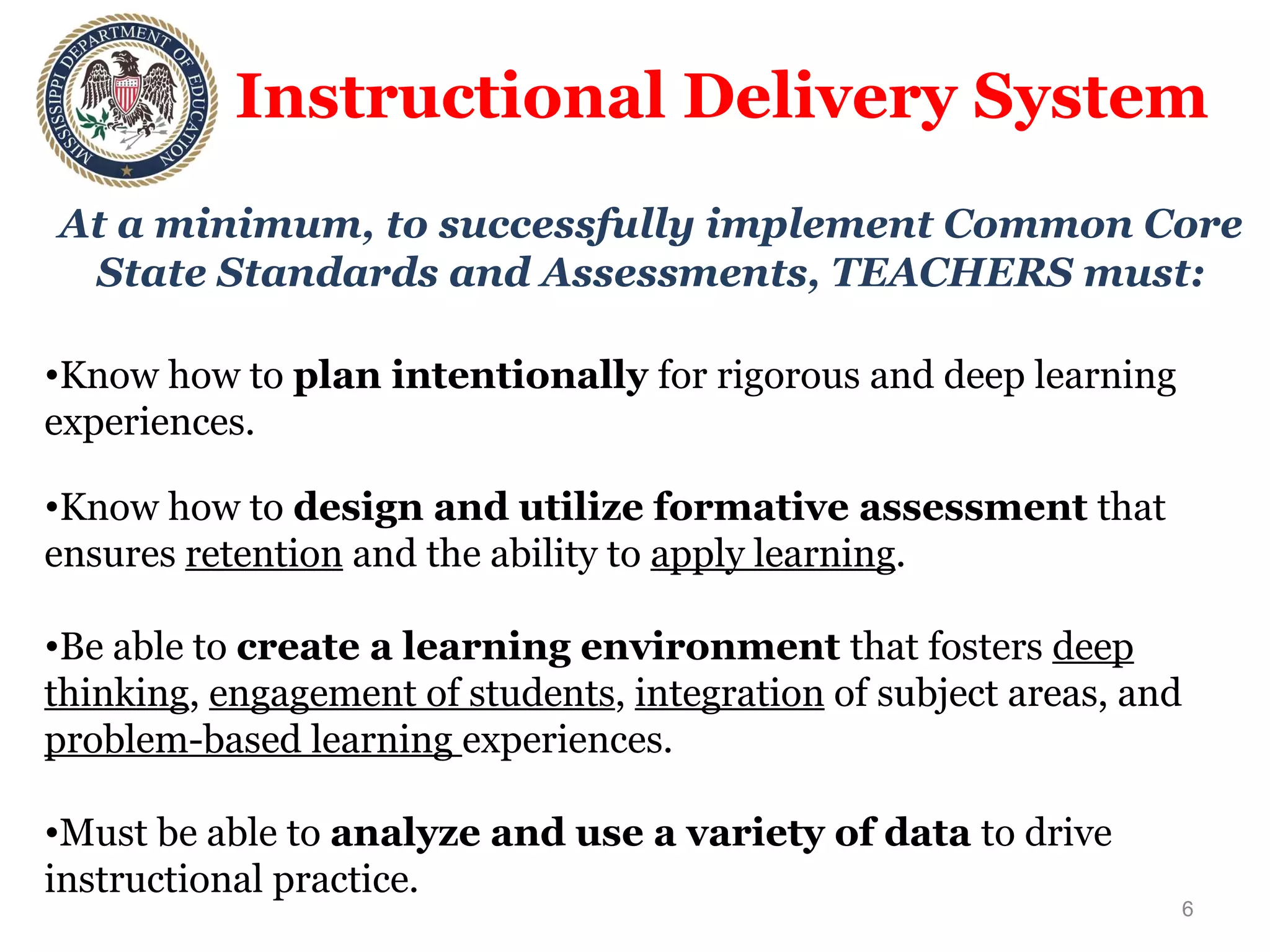
Instructional Delivery System At a minimum, to successfully implement Common Core State Standards and Assessments, TEACHERS must: Know how to  plan intentionally  for rigorous and deep learning experiences. Know how to  design and utilize formative assessment  that ensures  retention  and the ability to  apply learning . Be able to  create a learning environment  that fosters  deep thinking ,  engagement of students ,  integration  of subject areas, and  problem-based learning  experiences.  Must be able to  analyze and use a variety of data  to drive instructional practice. Must embrace  continuous professional learning.
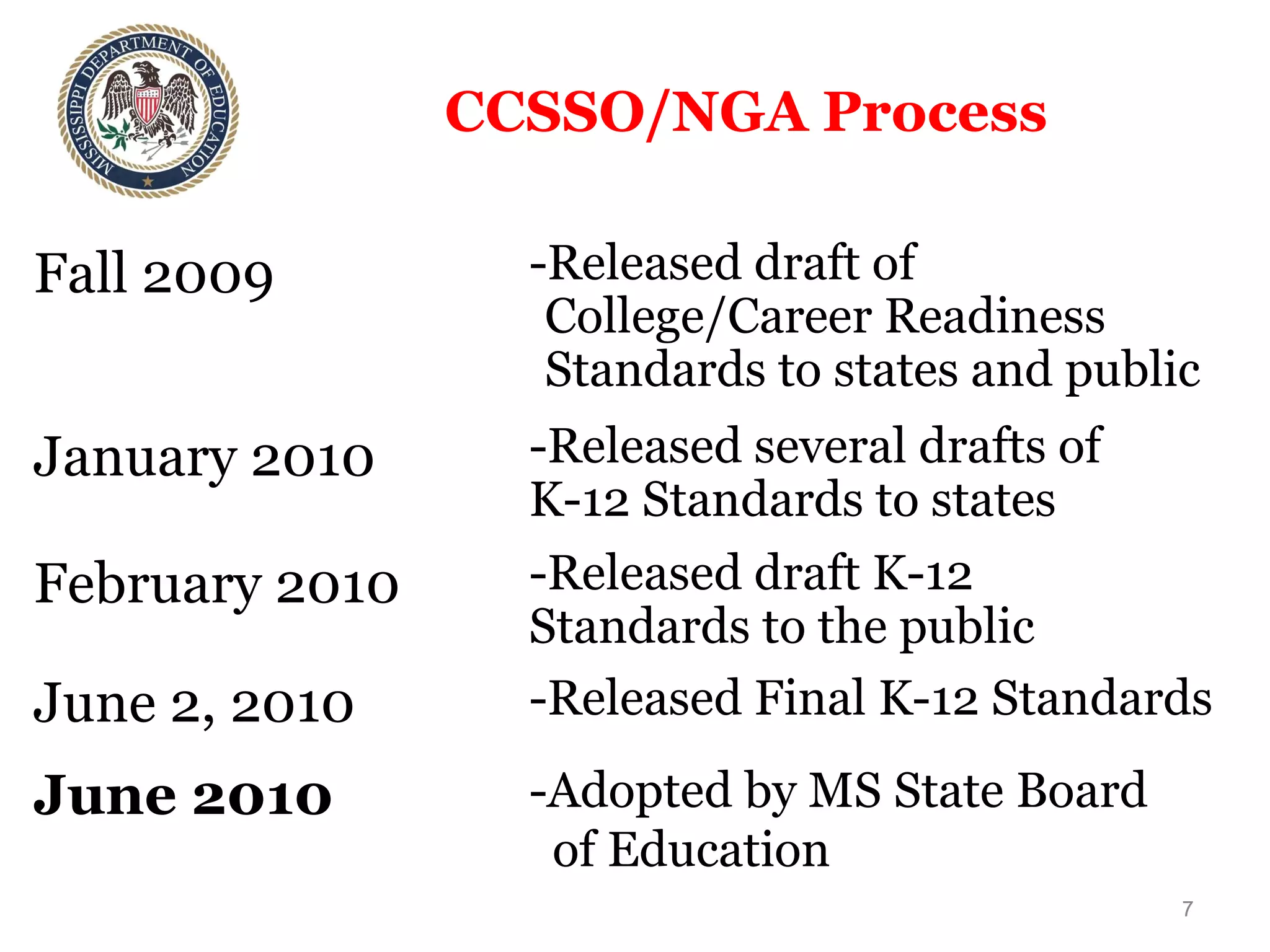
CCSSO/NGA Process Fall 2009 -Released draft of College/Career Readiness Standards to states and public January 2010 -Released several drafts of K-12 Standards to states  February 2010  -Released draft K-12 Standards to the public  June 2, 2010  -Released Final K-12 Standards June 2010 -Adopted by MS State Board of Education
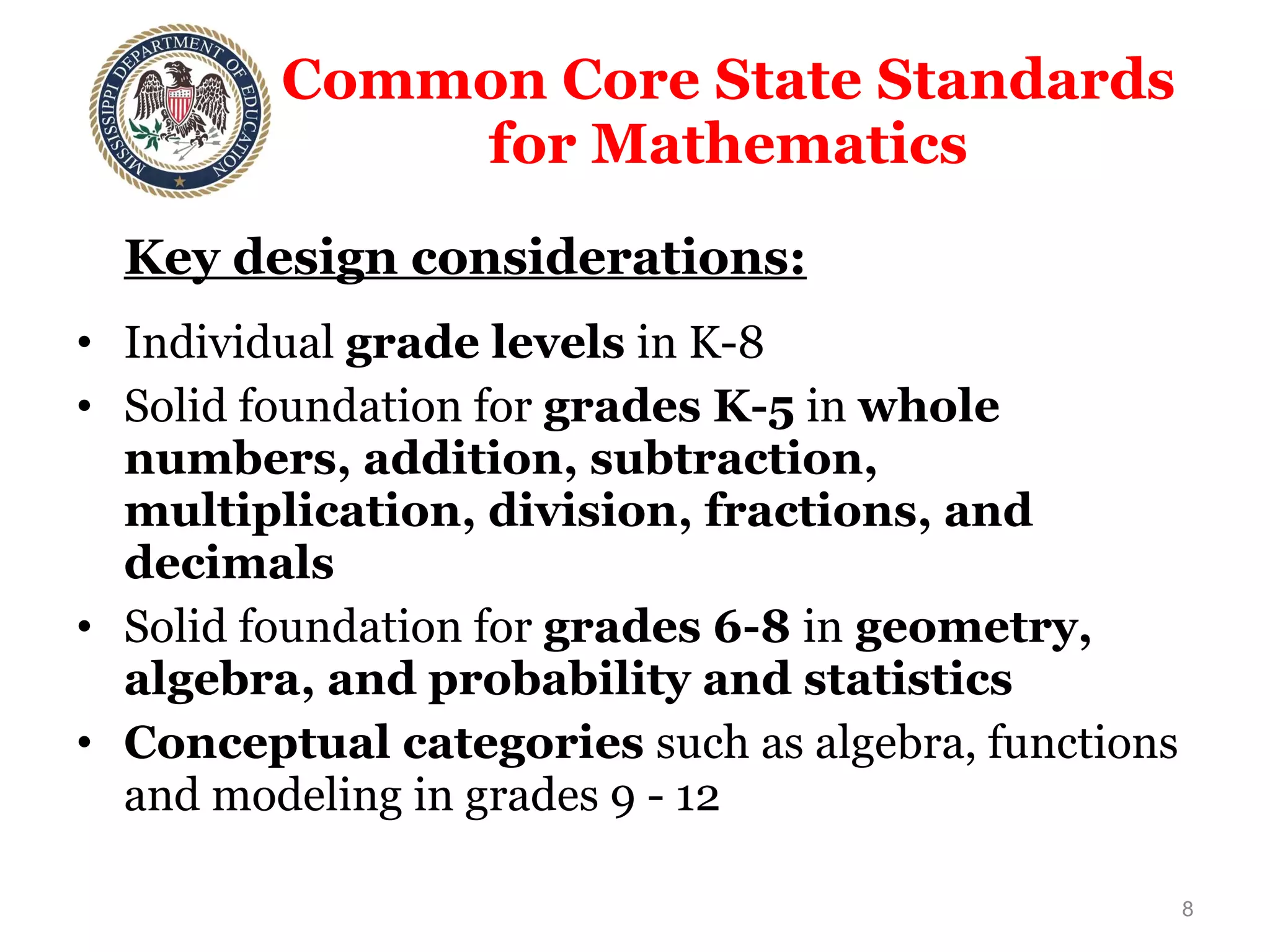
Common Core State Standards  for Mathematics  Key design considerations: Individual  grade levels  in K-8 Solid foundation for  grades K-5  in  whole numbers, addition, subtraction, multiplication, division, fractions, and decimals Solid foundation for  grades 6-8  in  geometry, algebra, and probability and statistics Conceptual categories  such as algebra, functions and modeling in grades 9 - 12
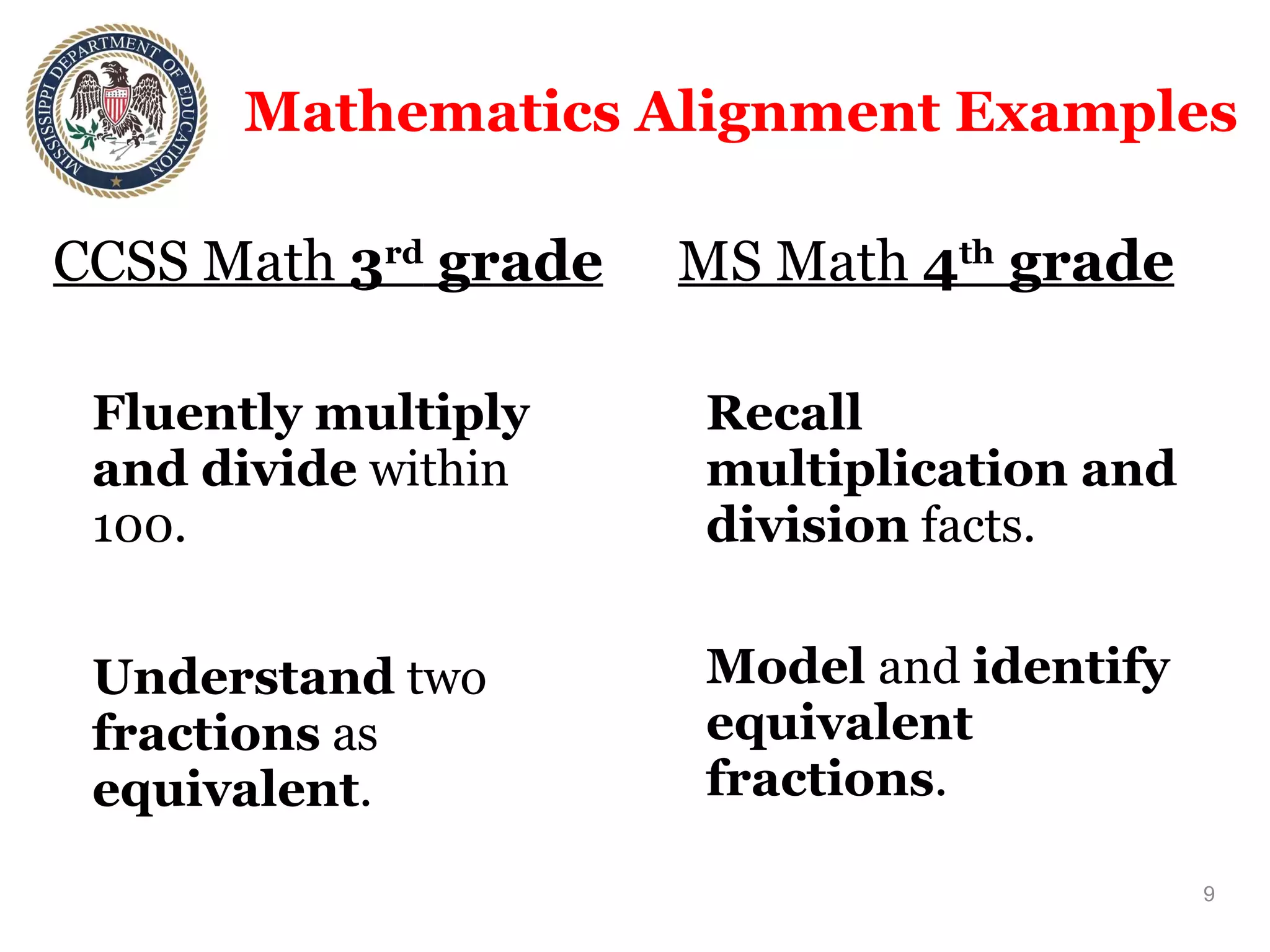
Mathematics Alignment Examples CCSS Math  3 rd  grade Fluently multiply and divide  within 100. Understand  two  fractions  as  equivalent . MS Math  4 th  grade Recall multiplication and division  facts. Model  and  identify   equivalent fractions .
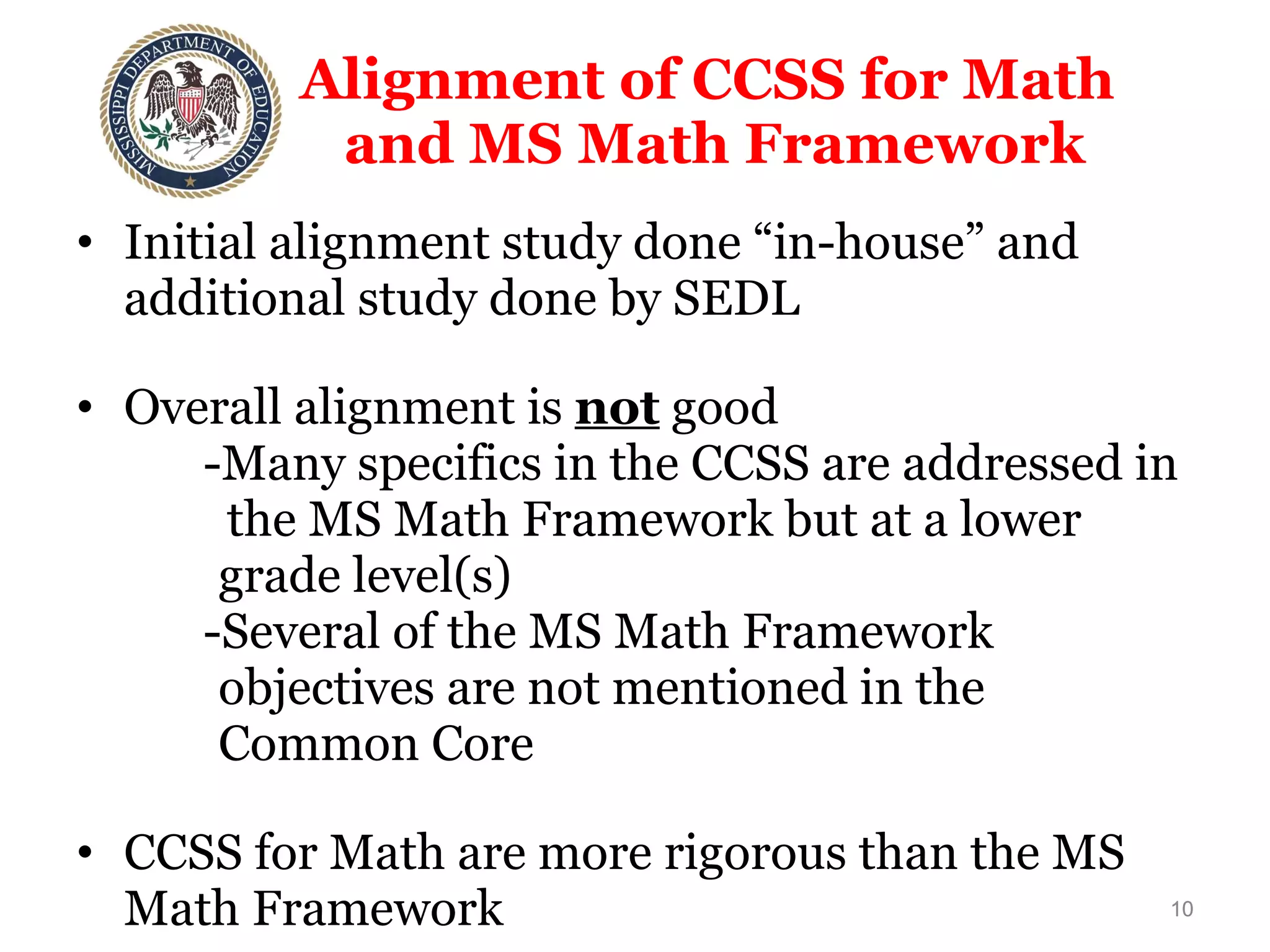
Alignment of CCSS for Math  and MS Math Framework Initial alignment study done “in-house” and additional study done by SEDL Overall alignment is  not  good  -Many specifics in the CCSS are addressed in    the MS Math Framework but at a lower  grade level(s) -Several of the MS Math Framework  objectives are not mentioned in the  Common Core CCSS for Math are more rigorous than the MS Math Framework
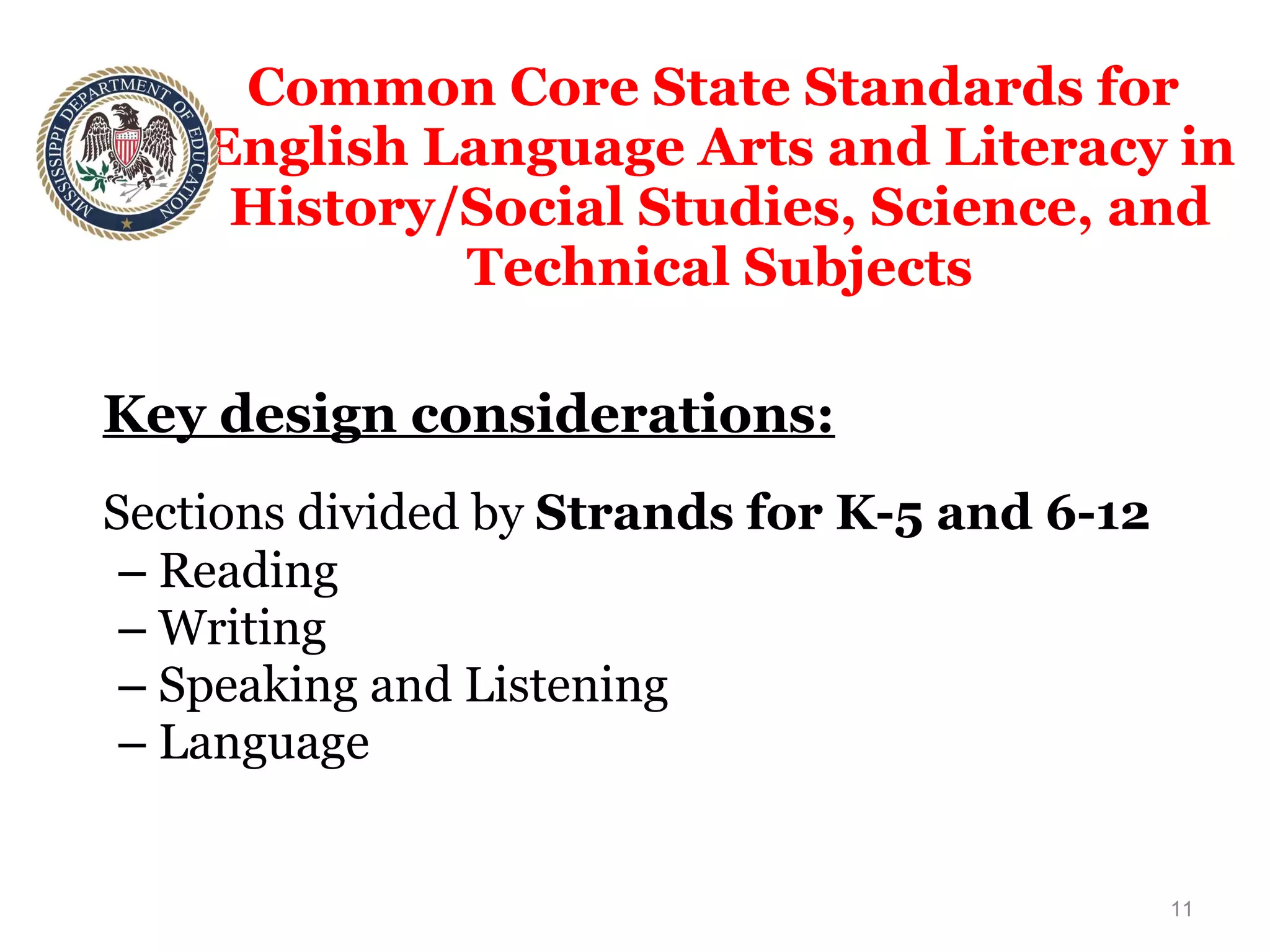
Common Core State Standards for  English Language Arts and Literacy in History/Social Studies, Science, and Technical Subjects Key design considerations: Sections divided by  Strands for K-5 and 6-12 Reading  Writing Speaking and Listening Language
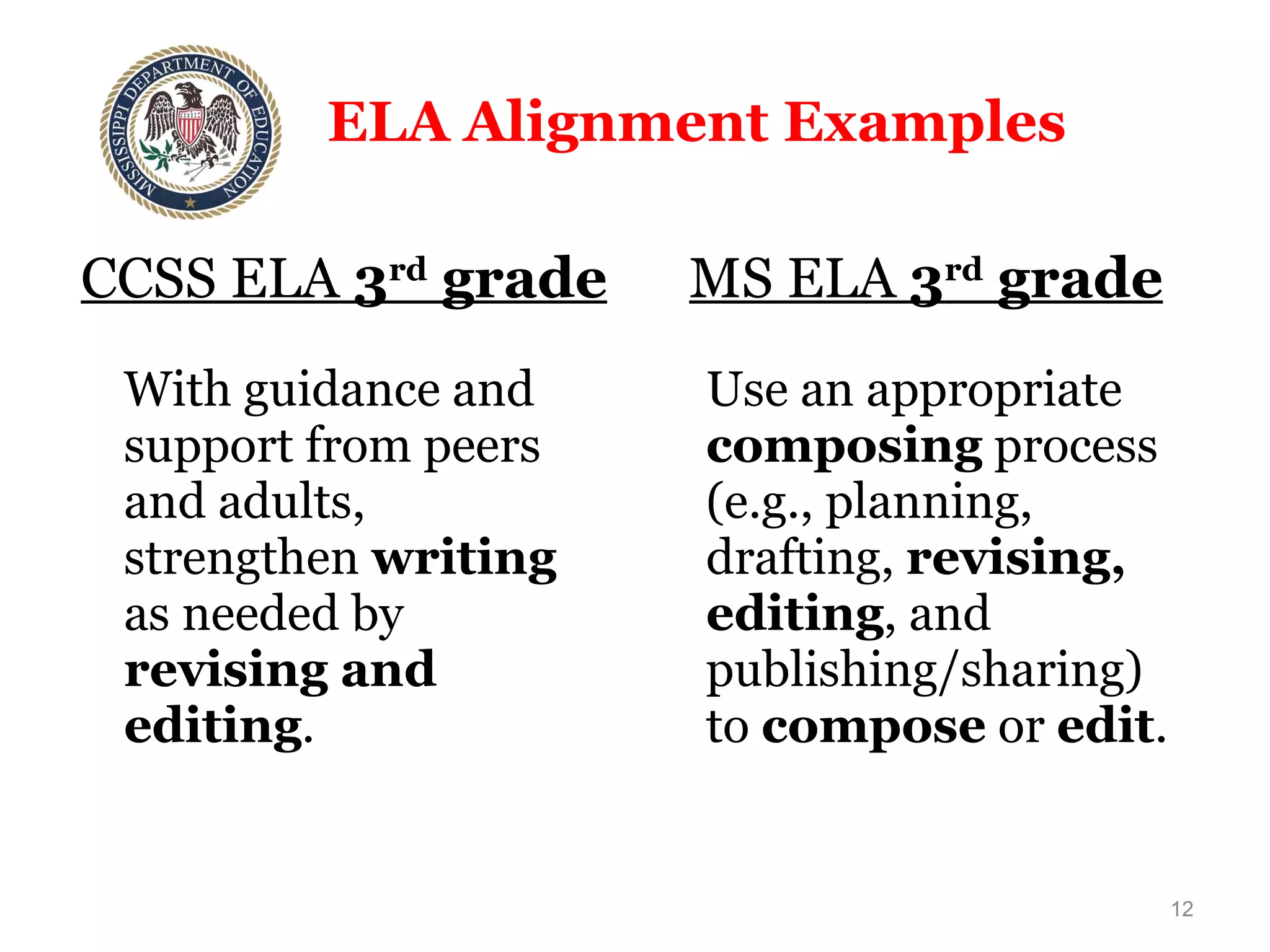
ELA Alignment Examples  CCSS ELA  3 rd  grade With guidance and support from peers and adults, strengthen  writing  as needed by  revising and editing . MS ELA  3 rd  grade Use an appropriate  composing  process (e.g., planning, drafting,  revising, editing , and publishing/sharing) to  compose  or  edit .
Alignment of CCSS  English Language Arts (ELA)  and MS ELA Initial alignment study done “in-house” and additional study done by SEDL Overall alignment  is   good  -Few specifics in the CCSS are not addressed  in the MS ELA Framework or not addressed  at the same grade level  -Many of the MS ELA Framework  objectives and sub-objectives are not    mentioned in the Common Core Rigor is comparable
RttT Assessment Proposals The Process: Proposals were due from multi-state consortia on June 23, 2010 Awards were made in September, 2010 New Consortia tests to replace current state NCLB tests in 2014-2015 Two Comprehensive Assessment Proposals Funded: Partnership for Assessment of Readiness for College and Careers  (PARCC)  26 states, 31 million students K-12 SMARTER Balanced Assessment Consortium ( SBAC) 31 states, 21 million students K-12 Note: 12 states currently in both and 6 states in neither Center for K – 12  Assessment & Performance Management at ETS
RTTT Assessment Program Requirements Build upon  shared standards  for college/career readiness; Measure  individual growth  as well as proficiency; Measure the extent each student is on track, at each grade level tested, toward college/career readiness by high school completion, and provide information that is useful in informing: Teaching, learning, and program i mprovemen t; Determinations of  school effectiveness ; Determinations of  educator effectiveness  for use in evaluations and provision of support to teachers/principals;  Determinations of  individual student college/career readiness , through high school exit decisions, college   course placement into credit-bearing classes, and/or college entrance. Center for K – 12  Assessment & Performance Management at ETS
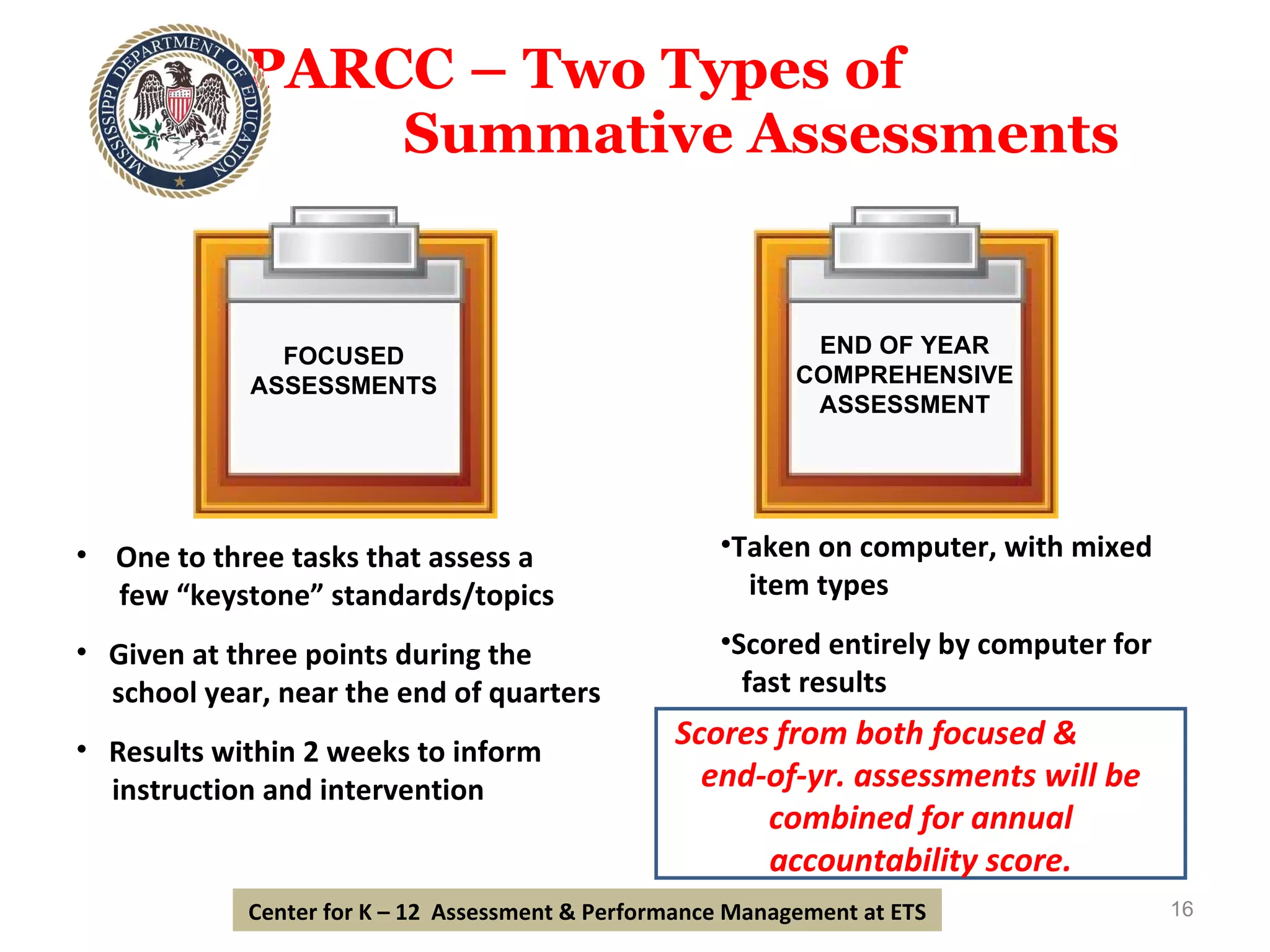
PARCC – Two Types of  Summative Assessments One to three tasks that assess a few “keystone” standards/topics Given at three points during the  school year, near the end of quarters Results within 2 weeks to inform instruction and intervention Taken on computer, with mixed  item types Scored entirely by computer for fast results Scores from both focused &  end-of-yr. assessments will be combined for annual accountability score. Center for K – 12  Assessment & Performance Management at ETS FOCUSED ASSESSMENTS END OF YEAR COMPREHENSIVE ASSESSMENT
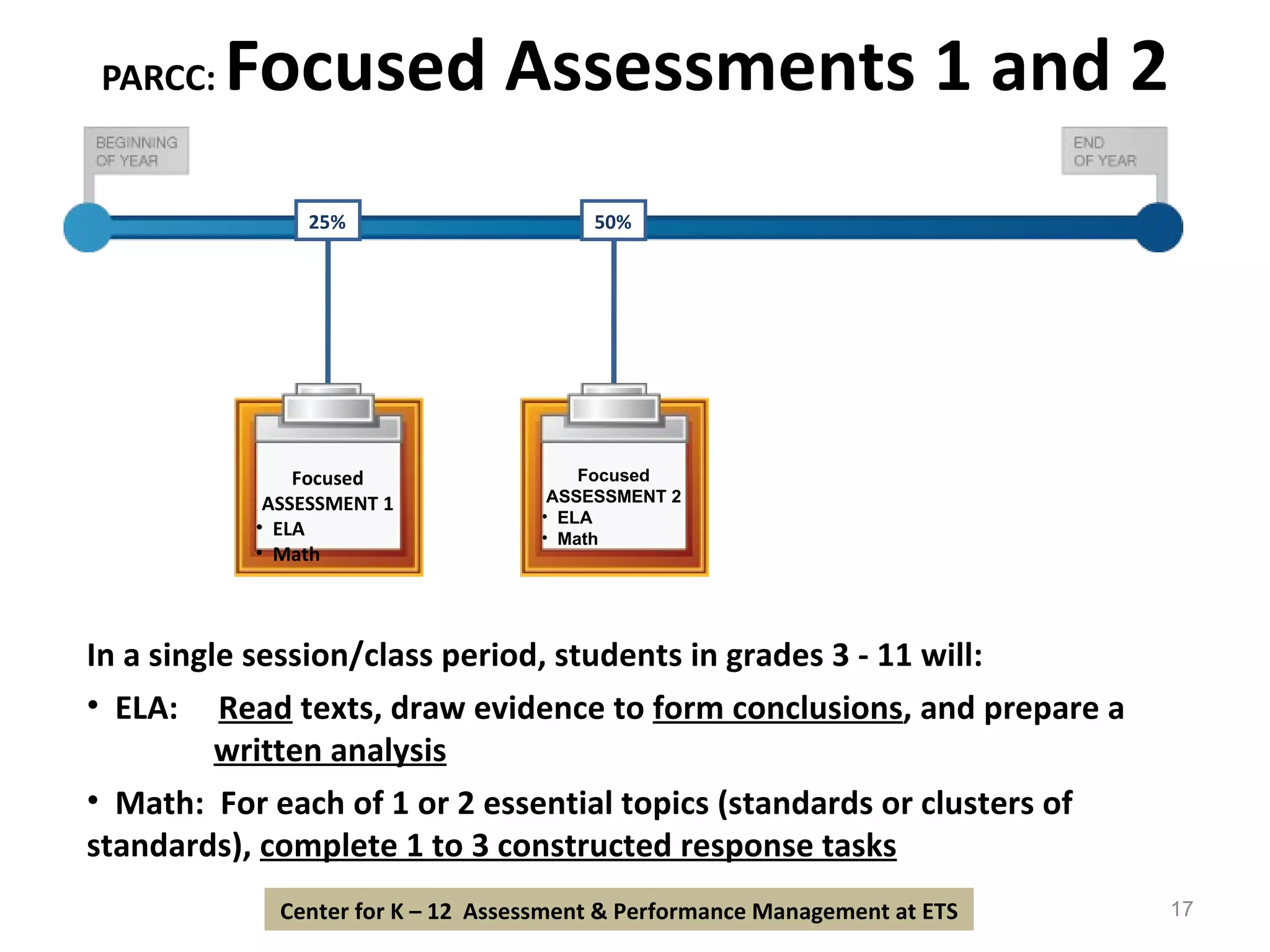
PARCC:  Focused Assessments 1 and 2 In a single session/class period, students in grades 3 - 11 will: ELA:  Read  texts, draw evidence to  form conclusions , and prepare a  written analysis Math:  For each of 1 or 2 essential topics (standards or clusters of  standards),  complete 1 to 3 constructed response tasks Center for K – 12  Assessment & Performance Management at ETS 25% Focused ASSESSMENT 1 ELA Math 50% Focused ASSESSMENT 2 ELA Math
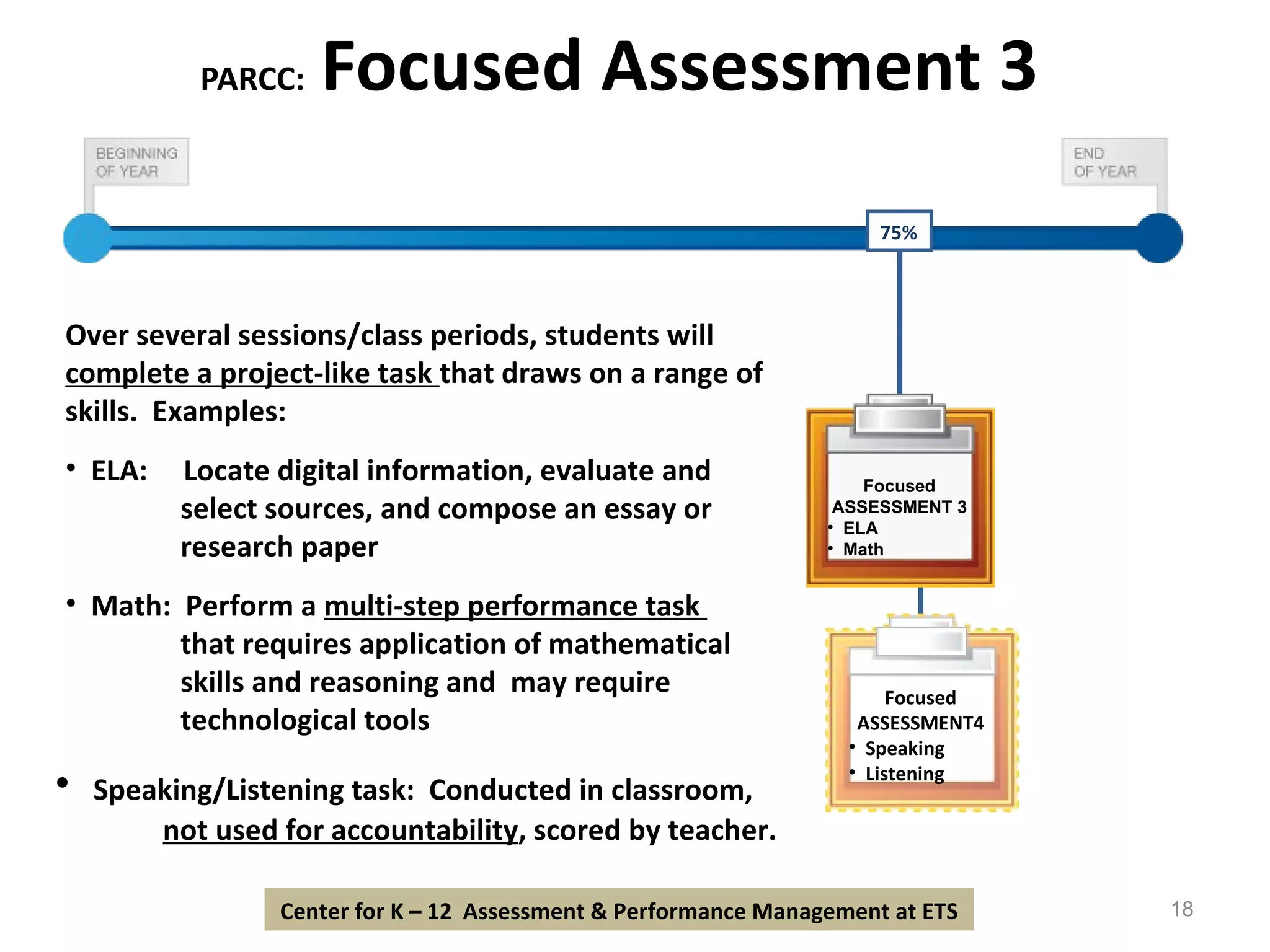
PARCC:  Focused Assessment 3 Over several sessions/class periods, students will  complete a project-like task  that draws on a range of skills.  Examples: ELA:  Locate digital information, evaluate and select sources, and compose an essay or  research paper Math:  Perform a  multi-step performance task  that requires application of mathematical skills and reasoning and  may require  technological tools Speaking/Listening task:  Conducted in classroom, not used for accountability , scored by teacher. Center for K – 12  Assessment & Performance Management at ETS Focused ASSESSMENT4 Speaking Listening 75% Focused ASSESSMENT 3 ELA Math
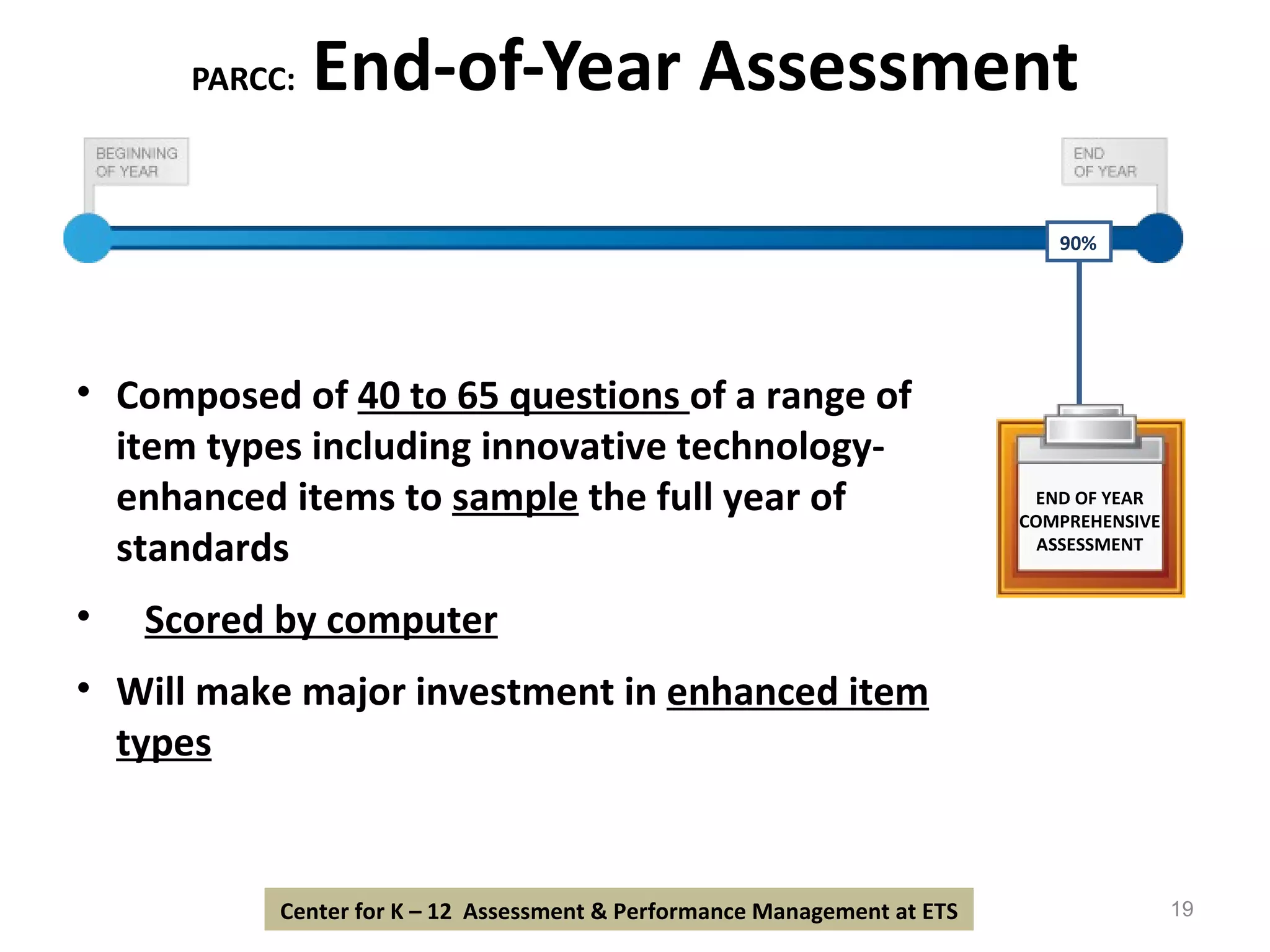
PARCC:  End-of-Year Assessment Composed of  40 to 65 questions  of a range of  item types including innovative technology-enhanced items to  sample  the full year of standards Scored by computer Will make major investment in  enhanced item types Center for K – 12  Assessment & Performance Management at ETS 90% END OF YEAR COMPREHENSIVE ASSESSMENT
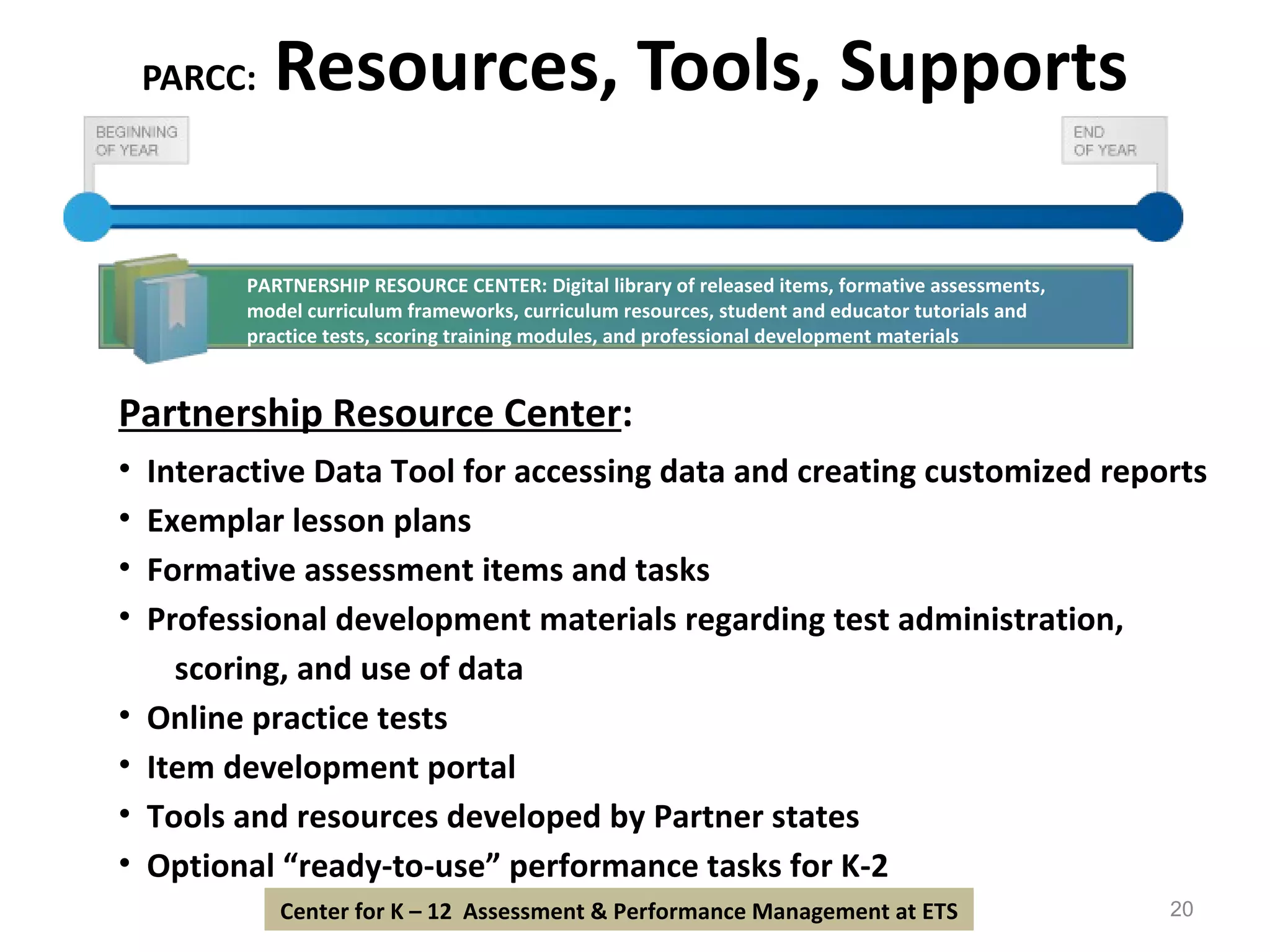
PARCC:  Resources, Tools, Supports Partnership Resource Center : Interactive Data Tool for accessing data and creating customized reports Exemplar lesson plans Formative assessment items and tasks Professional development materials regarding test administration, scoring, and use of data Online practice tests Item development portal Tools and resources developed by Partner states Optional “ready-to-use” performance tasks for K-2 Center for K – 12  Assessment & Performance Management at ETS PARTNERSHIP RESOURCE CENTER: Digital library of released items, formative assessments, model curriculum frameworks, curriculum resources, student and educator tutorials and practice tests, scoring training modules, and professional development materials
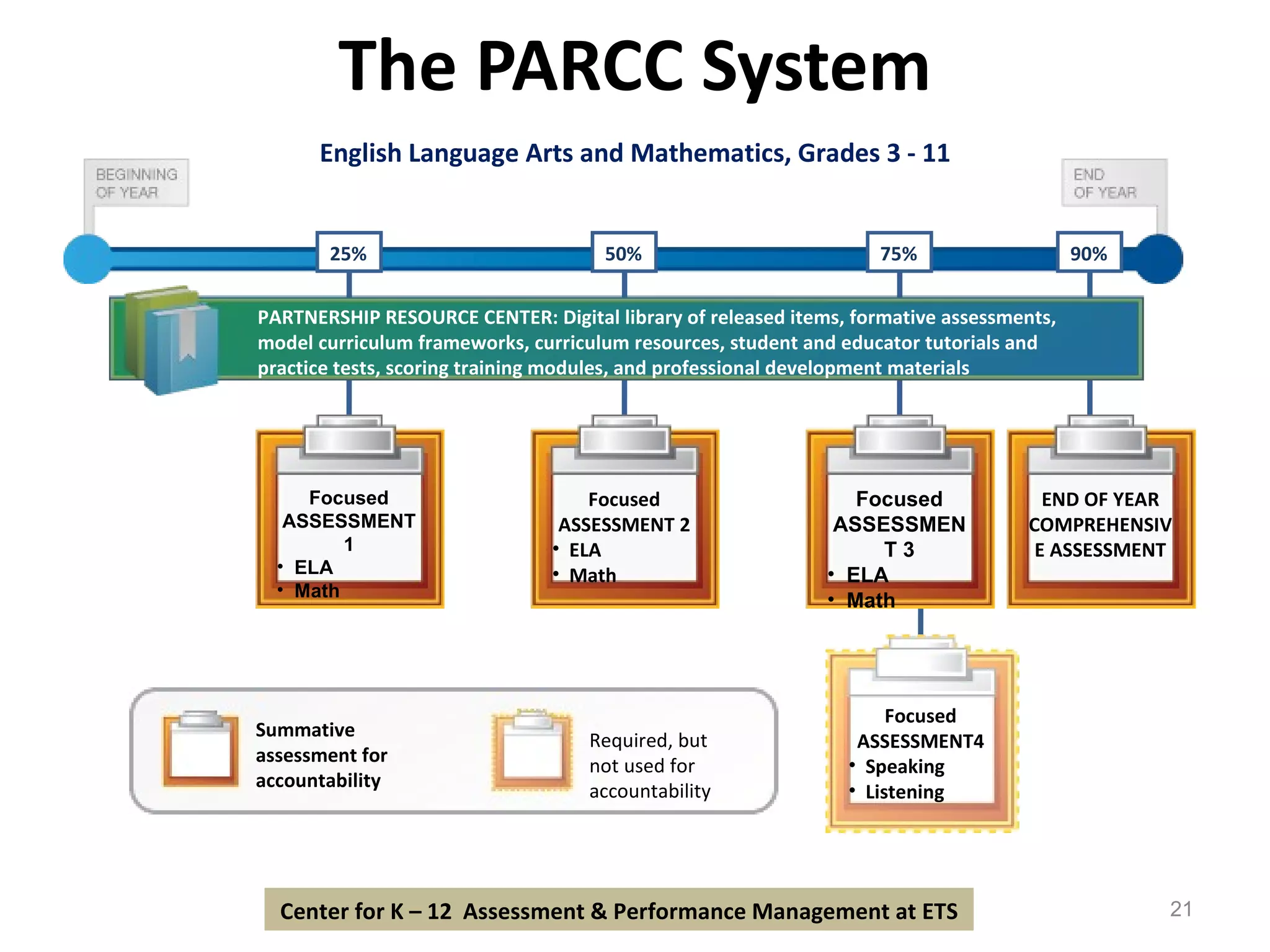
The PARCC System English Language Arts and Mathematics, Grades 3 - 11 Center for K – 12  Assessment & Performance Management at ETS Focused ASSESSMENT4 Speaking Listening 25% Focused ASSESSMENT 1 ELA Math 50% Focused ASSESSMENT 2 ELA Math 90% END OF YEAR COMPREHENSIVE ASSESSMENT 75% Focused ASSESSMENT 3 ELA Math PARTNERSHIP RESOURCE CENTER: Digital library of released items, formative assessments, model curriculum frameworks, curriculum resources, student and educator tutorials and practice tests, scoring training modules, and professional development materials Summative assessment for accountability Required, but  not used for accountability
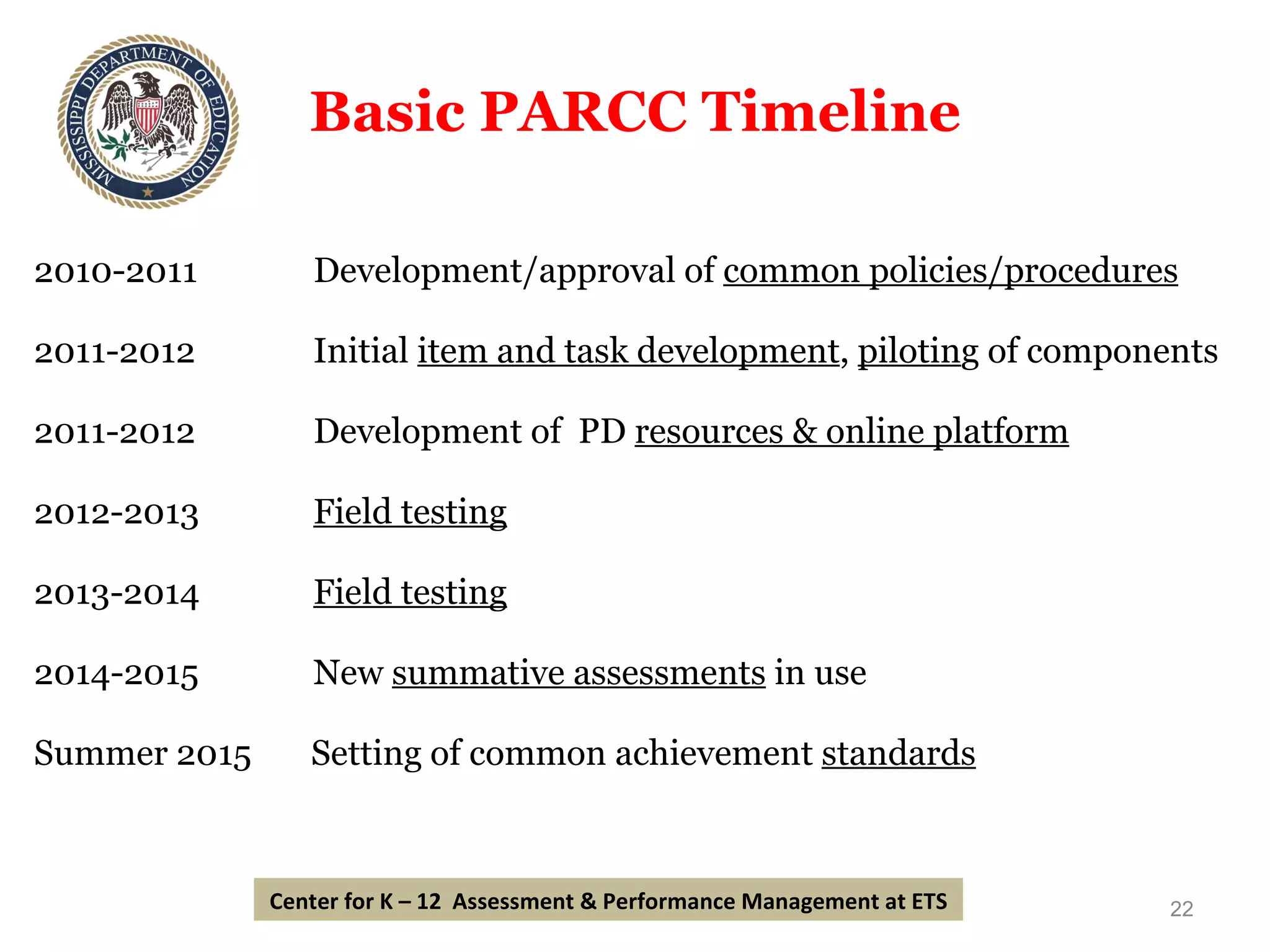
Basic PARCC Timeline 2010-2011   Development/approval of  common policies/procedures 2011-2012   Initial  item and task development ,  pilotin g of components 2011-2012   Development of  PD  resources & online platform 2012-2013   Field testing 2013-2014   Field testing 2014-2015   New  summative assessments  in use Summer 2015  Setting of common achievement  standards Center for K – 12  Assessment & Performance Management at ETS
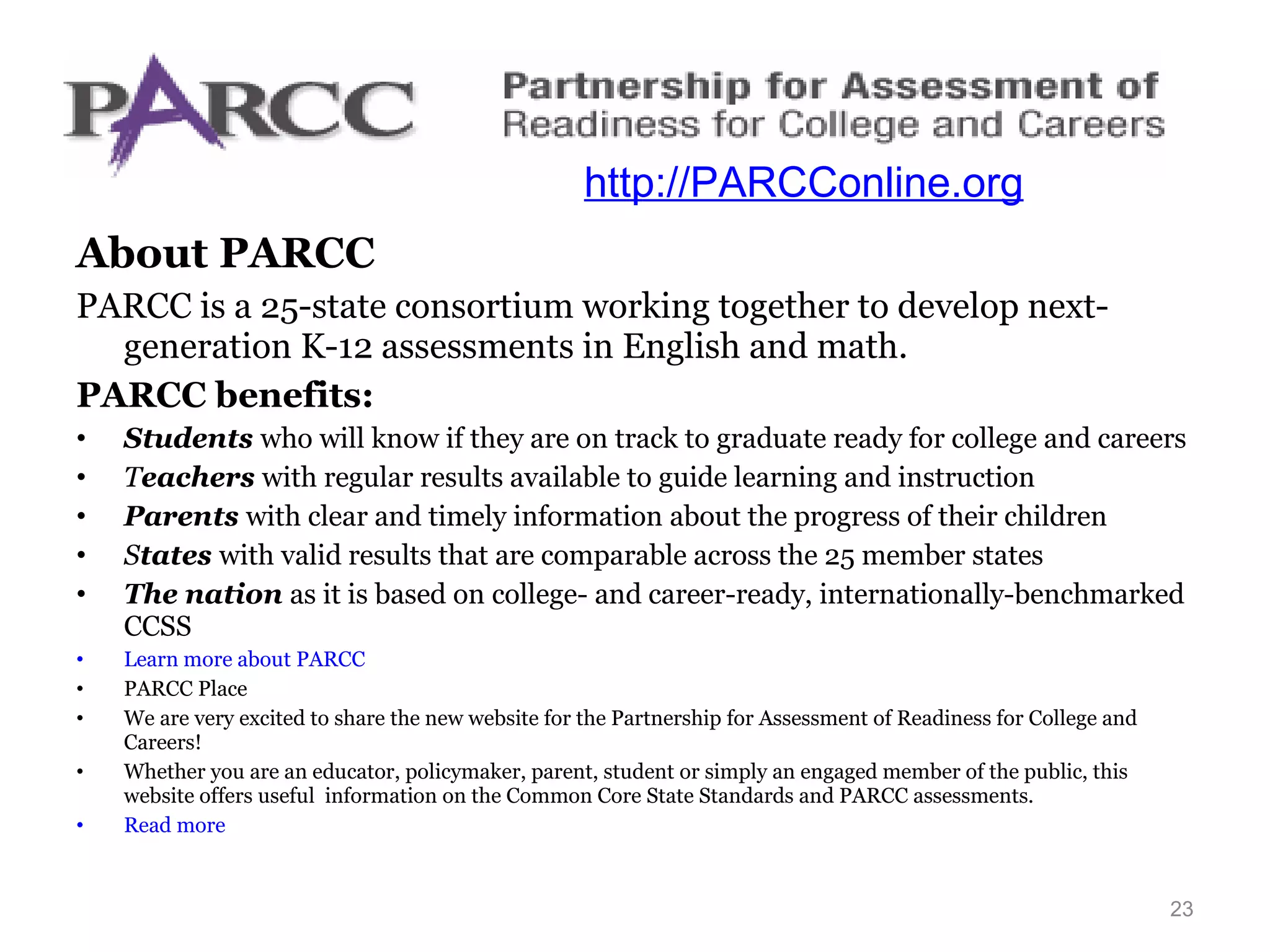
http://parcconline.org/ About PARCC  PARCC is a 25-state consortium working together to develop next-generation K-12 assessments in English and math.   PARCC benefits: Students  who will know if they are on track to graduate ready for college and careers T eachers  with regular results available to guide learning and instruction Parents  with clear and timely information about the progress of their children S tates  with valid results that are comparable across the 25 member states The nation  as it is based on college- and career-ready, internationally-benchmarked CCSS Learn more about PARCC PARCC Place  We are very excited to share the new website for the Partnership for Assessment of Readiness for College and Careers! Whether you are an educator, policymaker, parent, student or simply an engaged member of the public, this website offers useful  information on the Common Core State Standards and PARCC assessments. Read more http://PARCConline.org
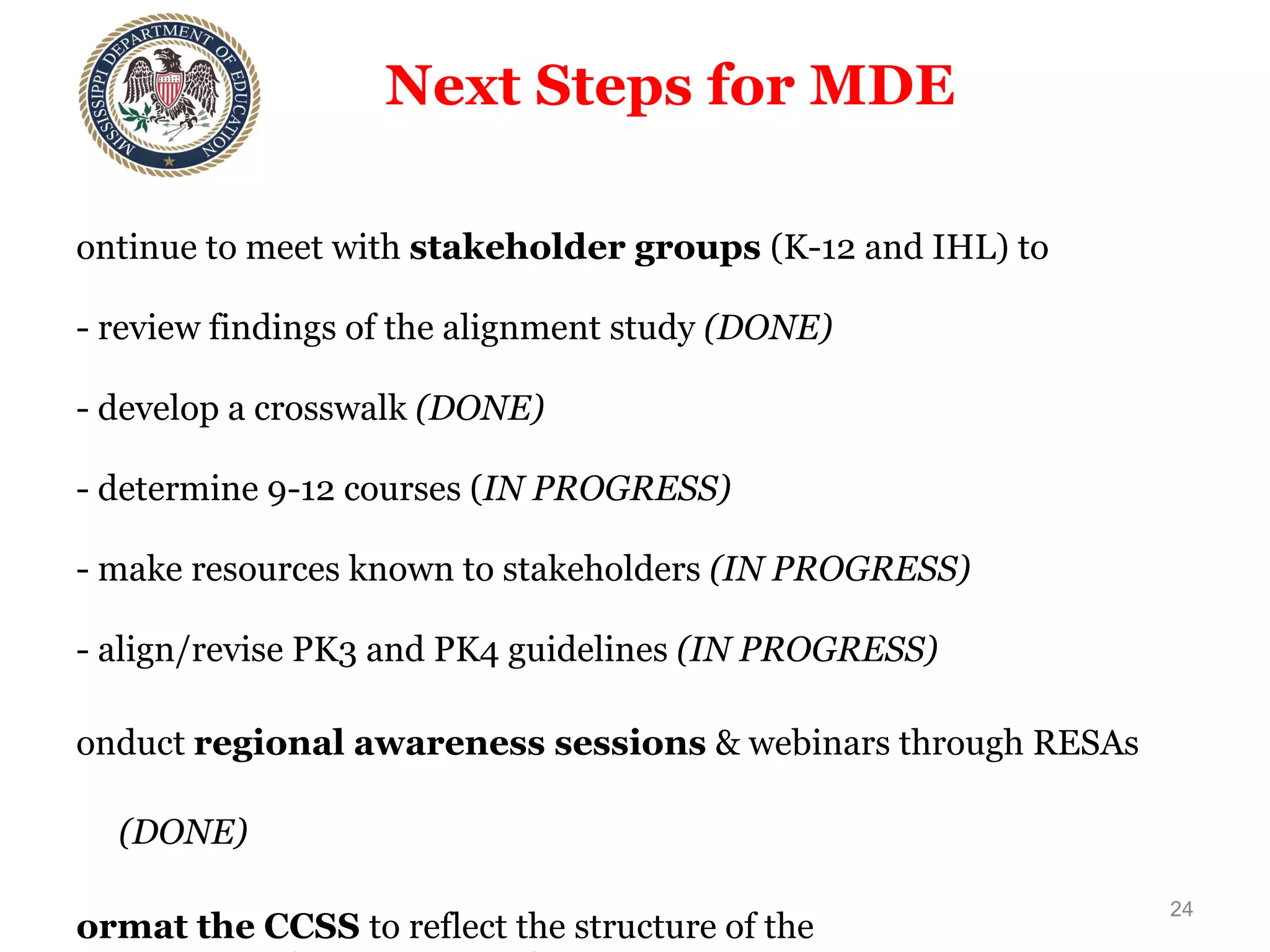
Next Steps for MDE  Continue to meet with  stakeholder groups  (K-12 and IHL) to - review findings of the alignment study  (DONE) - develop a crosswalk  (DONE) - determine 9-12 courses ( IN PROGRESS) - make resources known to stakeholders  (IN PROGRESS) - align/revise PK3 and PK4 guidelines  (IN PROGRESS) Conduct  regional awareness sessions  & webinars through RESAs  (DONE) Format the CCSS  to reflect the structure of the  MS Curriculum Frameworks (TBD) Revise/develop instructional materials  (suggested teaching strategies, resources, & assessment aids) and  offer training  (TBD) Conduct  Train-the-Trainer  Sessions  (IN PROGRESS) Determine which  policies/procedures  need adjustment  (TBD) Plan transition  to new assessments  (IN PROGRESS) Continue  working with PARCC  to implement assessments  (IN PROGRESS)
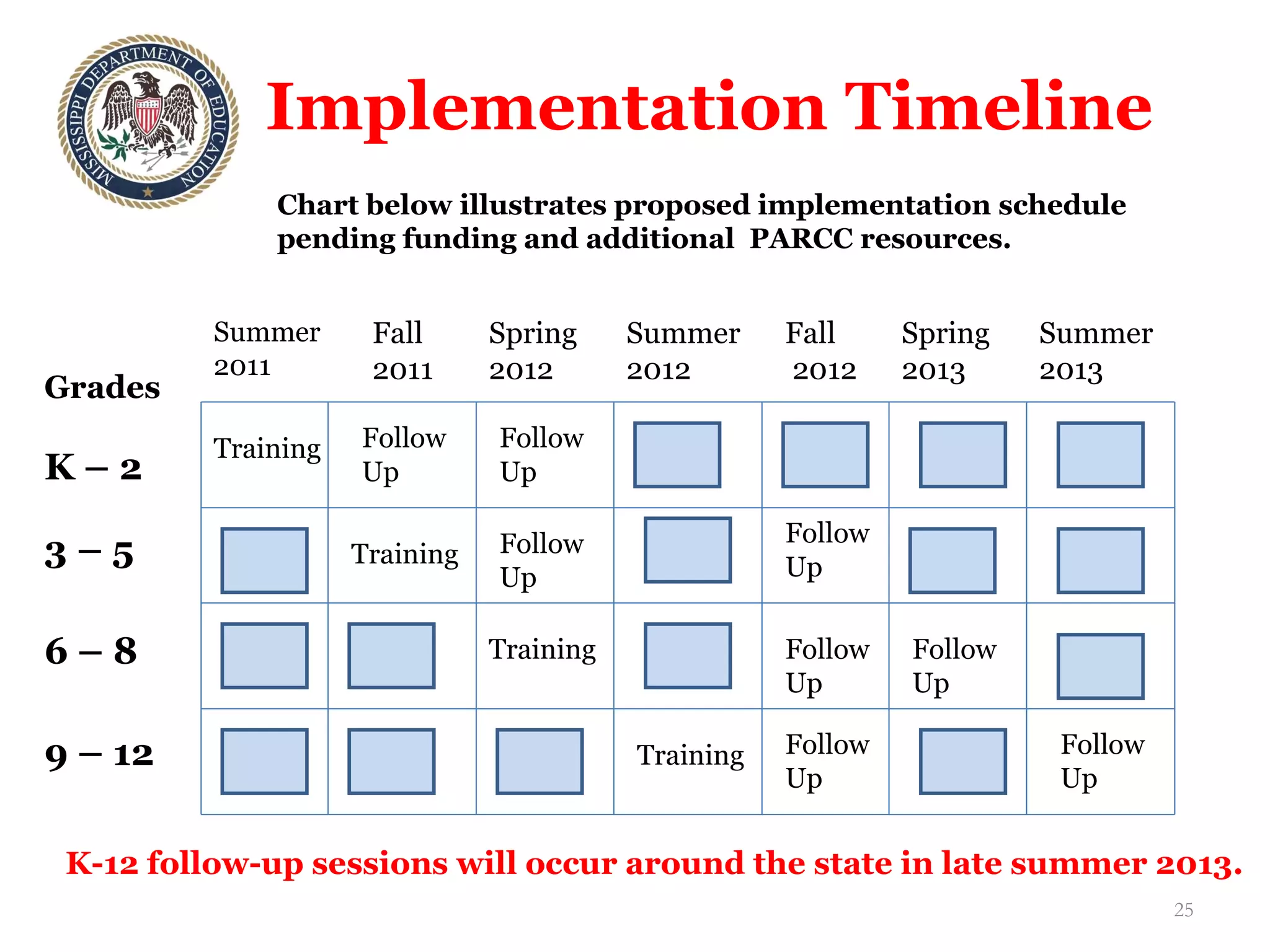
Implementation Timeline Grades K – 2 3 – 5 6 – 8 9 – 12 Training Follow Up Training Follow  Up Summer 2011 Fall  2011 Spring 2012 Fall 2012 Spring  2013 Summer 2012 K-12 follow-up sessions will occur around the state in late summer 2013. Chart below illustrates proposed implementation schedule  pending funding and additional  PARCC resources. Training Follow  Up Follow  Up Training Follow  Up Follow  Up Summer  2013 Follow  Up Follow  Up
Common Core Website  List of Resources www.corestandards.org  (Key Resources) Reaching Higher: the Common Core State Standards Validation Committee Summary of Public Feedback for K-12 Standards Summary of Public Feedback for College and Career Readiness Standards Common Core State Standards Criteria Common Core State Standards Considerations Joint International Benchmarking Report Key Points of the English Language Arts Standards Key Points of the Math Standards Cont.
Common Core Website  List of Resources 9. Frequently Asked Question 10. Myths vs. Facts 11. Common Core Standards PowerPoint-March 2010 12. Common Core State Standards Webinar (PowerPoint presentation) June 30, 2010   www.mde.k12.ms.us  (Hot Topics) 13.  CCSS MASA Powerpoint, October 2010 14. CCSS Powerpoint and Webinar, November 30, 2010 15. Common Core State Standards Initiative: Key Resources
Questions??
Trecina Green Bureau Director Curriculum and Instruction Mississippi Department of Education [email_address] 601-359-2586 [email_address] Contact Information Common Core Website  http://www.corestandards.org/ MDE Website www.mde.k12.ms.us   (hot topics)

Common Core State Standards

  • 1.
    Mississippi Department ofEducation Common Core State Standards and Assessments Mathematics and English/Language Arts Lynn J. House, Ph.D. Deputy State Superintendent
  • 2.
    What is theCCSS Initiative? An initiative of the National Governors Association (NGA) and the Council of Chief State School Officers (CCSSO) A significant and historic opportunity for states to collectively develop and adopt a core set of academic standards in Mathematics and English/Language Arts
  • 3.
    Why is thisinitiative important? Provides consistency across states Allows for equal access Prepares students to compete globally Allows for more focused professional development Allows for the development of a common assessment Provides the opportunity to compare and evaluate policies that affect student achievement across states
  • 4.
    What are theCommon Core State Standards (CCSS)? Fewer, clearer, and higher Aligned with college and work expectations Rigorous content requiring higher-order thinking and application of knowledge Internationally benchmarked Evidence-and/or research-based
  • 5.
    Shift from “What’s Taught” to “ What Students Need to Be Able to Do” To succeed in 21 st century college and careers, students need to be able to: 1. Solve problems 2. Manage oneself 3. Adapt to change 4. Analyze / conceptualize 5. Reflect on / improve performance 6. Communicate 7. Work in teams 8. Create / innovate / critique 9. Engage in learning throughout life
  • 6.
    Instructional Delivery SystemAt a minimum, to successfully implement Common Core State Standards and Assessments, TEACHERS must: Know how to plan intentionally for rigorous and deep learning experiences. Know how to design and utilize formative assessment that ensures retention and the ability to apply learning . Be able to create a learning environment that fosters deep thinking , engagement of students , integration of subject areas, and problem-based learning experiences. Must be able to analyze and use a variety of data to drive instructional practice. Must embrace continuous professional learning.
  • 7.
    CCSSO/NGA Process Fall2009 -Released draft of College/Career Readiness Standards to states and public January 2010 -Released several drafts of K-12 Standards to states February 2010 -Released draft K-12 Standards to the public June 2, 2010 -Released Final K-12 Standards June 2010 -Adopted by MS State Board of Education
  • 8.
    Common Core StateStandards for Mathematics Key design considerations: Individual grade levels in K-8 Solid foundation for grades K-5 in whole numbers, addition, subtraction, multiplication, division, fractions, and decimals Solid foundation for grades 6-8 in geometry, algebra, and probability and statistics Conceptual categories such as algebra, functions and modeling in grades 9 - 12
  • 9.
    Mathematics Alignment ExamplesCCSS Math 3 rd grade Fluently multiply and divide within 100. Understand two fractions as equivalent . MS Math 4 th grade Recall multiplication and division facts. Model and identify equivalent fractions .
  • 10.
    Alignment of CCSSfor Math and MS Math Framework Initial alignment study done “in-house” and additional study done by SEDL Overall alignment is not good -Many specifics in the CCSS are addressed in the MS Math Framework but at a lower grade level(s) -Several of the MS Math Framework objectives are not mentioned in the Common Core CCSS for Math are more rigorous than the MS Math Framework
  • 11.
    Common Core StateStandards for English Language Arts and Literacy in History/Social Studies, Science, and Technical Subjects Key design considerations: Sections divided by Strands for K-5 and 6-12 Reading Writing Speaking and Listening Language
  • 12.
    ELA Alignment Examples CCSS ELA 3 rd grade With guidance and support from peers and adults, strengthen writing as needed by revising and editing . MS ELA 3 rd grade Use an appropriate composing process (e.g., planning, drafting, revising, editing , and publishing/sharing) to compose or edit .
  • 13.
    Alignment of CCSS English Language Arts (ELA) and MS ELA Initial alignment study done “in-house” and additional study done by SEDL Overall alignment is good -Few specifics in the CCSS are not addressed in the MS ELA Framework or not addressed at the same grade level -Many of the MS ELA Framework objectives and sub-objectives are not mentioned in the Common Core Rigor is comparable
  • 14.
    RttT Assessment ProposalsThe Process: Proposals were due from multi-state consortia on June 23, 2010 Awards were made in September, 2010 New Consortia tests to replace current state NCLB tests in 2014-2015 Two Comprehensive Assessment Proposals Funded: Partnership for Assessment of Readiness for College and Careers (PARCC) 26 states, 31 million students K-12 SMARTER Balanced Assessment Consortium ( SBAC) 31 states, 21 million students K-12 Note: 12 states currently in both and 6 states in neither Center for K – 12 Assessment & Performance Management at ETS
  • 15.
    RTTT Assessment ProgramRequirements Build upon shared standards for college/career readiness; Measure individual growth as well as proficiency; Measure the extent each student is on track, at each grade level tested, toward college/career readiness by high school completion, and provide information that is useful in informing: Teaching, learning, and program i mprovemen t; Determinations of school effectiveness ; Determinations of educator effectiveness for use in evaluations and provision of support to teachers/principals; Determinations of individual student college/career readiness , through high school exit decisions, college course placement into credit-bearing classes, and/or college entrance. Center for K – 12 Assessment & Performance Management at ETS
  • 16.
    PARCC – TwoTypes of Summative Assessments One to three tasks that assess a few “keystone” standards/topics Given at three points during the school year, near the end of quarters Results within 2 weeks to inform instruction and intervention Taken on computer, with mixed item types Scored entirely by computer for fast results Scores from both focused & end-of-yr. assessments will be combined for annual accountability score. Center for K – 12 Assessment & Performance Management at ETS FOCUSED ASSESSMENTS END OF YEAR COMPREHENSIVE ASSESSMENT
  • 17.
    PARCC: FocusedAssessments 1 and 2 In a single session/class period, students in grades 3 - 11 will: ELA: Read texts, draw evidence to form conclusions , and prepare a written analysis Math: For each of 1 or 2 essential topics (standards or clusters of standards), complete 1 to 3 constructed response tasks Center for K – 12 Assessment & Performance Management at ETS 25% Focused ASSESSMENT 1 ELA Math 50% Focused ASSESSMENT 2 ELA Math
  • 18.
    PARCC: FocusedAssessment 3 Over several sessions/class periods, students will complete a project-like task that draws on a range of skills. Examples: ELA: Locate digital information, evaluate and select sources, and compose an essay or research paper Math: Perform a multi-step performance task that requires application of mathematical skills and reasoning and may require technological tools Speaking/Listening task: Conducted in classroom, not used for accountability , scored by teacher. Center for K – 12 Assessment & Performance Management at ETS Focused ASSESSMENT4 Speaking Listening 75% Focused ASSESSMENT 3 ELA Math
  • 19.
    PARCC: End-of-YearAssessment Composed of 40 to 65 questions of a range of item types including innovative technology-enhanced items to sample the full year of standards Scored by computer Will make major investment in enhanced item types Center for K – 12 Assessment & Performance Management at ETS 90% END OF YEAR COMPREHENSIVE ASSESSMENT
  • 20.
    PARCC: Resources,Tools, Supports Partnership Resource Center : Interactive Data Tool for accessing data and creating customized reports Exemplar lesson plans Formative assessment items and tasks Professional development materials regarding test administration, scoring, and use of data Online practice tests Item development portal Tools and resources developed by Partner states Optional “ready-to-use” performance tasks for K-2 Center for K – 12 Assessment & Performance Management at ETS PARTNERSHIP RESOURCE CENTER: Digital library of released items, formative assessments, model curriculum frameworks, curriculum resources, student and educator tutorials and practice tests, scoring training modules, and professional development materials
  • 21.
    The PARCC SystemEnglish Language Arts and Mathematics, Grades 3 - 11 Center for K – 12 Assessment & Performance Management at ETS Focused ASSESSMENT4 Speaking Listening 25% Focused ASSESSMENT 1 ELA Math 50% Focused ASSESSMENT 2 ELA Math 90% END OF YEAR COMPREHENSIVE ASSESSMENT 75% Focused ASSESSMENT 3 ELA Math PARTNERSHIP RESOURCE CENTER: Digital library of released items, formative assessments, model curriculum frameworks, curriculum resources, student and educator tutorials and practice tests, scoring training modules, and professional development materials Summative assessment for accountability Required, but not used for accountability
  • 22.
    Basic PARCC Timeline2010-2011 Development/approval of common policies/procedures 2011-2012 Initial item and task development , pilotin g of components 2011-2012 Development of PD resources & online platform 2012-2013 Field testing 2013-2014 Field testing 2014-2015 New summative assessments in use Summer 2015 Setting of common achievement standards Center for K – 12 Assessment & Performance Management at ETS
  • 23.
    http://parcconline.org/ About PARCC PARCC is a 25-state consortium working together to develop next-generation K-12 assessments in English and math.  PARCC benefits: Students who will know if they are on track to graduate ready for college and careers T eachers with regular results available to guide learning and instruction Parents with clear and timely information about the progress of their children S tates with valid results that are comparable across the 25 member states The nation as it is based on college- and career-ready, internationally-benchmarked CCSS Learn more about PARCC PARCC Place We are very excited to share the new website for the Partnership for Assessment of Readiness for College and Careers! Whether you are an educator, policymaker, parent, student or simply an engaged member of the public, this website offers useful  information on the Common Core State Standards and PARCC assessments. Read more http://PARCConline.org
  • 24.
    Next Steps forMDE Continue to meet with stakeholder groups (K-12 and IHL) to - review findings of the alignment study (DONE) - develop a crosswalk (DONE) - determine 9-12 courses ( IN PROGRESS) - make resources known to stakeholders (IN PROGRESS) - align/revise PK3 and PK4 guidelines (IN PROGRESS) Conduct regional awareness sessions & webinars through RESAs (DONE) Format the CCSS to reflect the structure of the MS Curriculum Frameworks (TBD) Revise/develop instructional materials (suggested teaching strategies, resources, & assessment aids) and offer training (TBD) Conduct Train-the-Trainer Sessions (IN PROGRESS) Determine which policies/procedures need adjustment (TBD) Plan transition to new assessments (IN PROGRESS) Continue working with PARCC to implement assessments (IN PROGRESS)
  • 25.
    Implementation Timeline GradesK – 2 3 – 5 6 – 8 9 – 12 Training Follow Up Training Follow Up Summer 2011 Fall 2011 Spring 2012 Fall 2012 Spring 2013 Summer 2012 K-12 follow-up sessions will occur around the state in late summer 2013. Chart below illustrates proposed implementation schedule pending funding and additional PARCC resources. Training Follow Up Follow Up Training Follow Up Follow Up Summer 2013 Follow Up Follow Up
  • 26.
    Common Core Website List of Resources www.corestandards.org (Key Resources) Reaching Higher: the Common Core State Standards Validation Committee Summary of Public Feedback for K-12 Standards Summary of Public Feedback for College and Career Readiness Standards Common Core State Standards Criteria Common Core State Standards Considerations Joint International Benchmarking Report Key Points of the English Language Arts Standards Key Points of the Math Standards Cont.
  • 27.
    Common Core Website List of Resources 9. Frequently Asked Question 10. Myths vs. Facts 11. Common Core Standards PowerPoint-March 2010 12. Common Core State Standards Webinar (PowerPoint presentation) June 30, 2010   www.mde.k12.ms.us (Hot Topics) 13. CCSS MASA Powerpoint, October 2010 14. CCSS Powerpoint and Webinar, November 30, 2010 15. Common Core State Standards Initiative: Key Resources
  • 28.
  • 29.
    Trecina Green BureauDirector Curriculum and Instruction Mississippi Department of Education [email_address] 601-359-2586 [email_address] Contact Information Common Core Website http://www.corestandards.org/ MDE Website www.mde.k12.ms.us (hot topics)

Editor's Notes

  • #2 Thank you for participating in this important conference and for playing such critical roles in raising the bar on student achievement in your communities and states. The following presentation is an overview of the of American Recovery and Reinvestment Act K-12 grants at the U.S. Department of Education in the context of our overall vision for strengthening our school systems throughout the nation.