EVALUATION RUBRICS Gonna make your life sooooo easy!! © 2009 Peter Gow per Creative Commons;  use must be attributed
What is a RUBRIC, anyhow? It’s a set of clearly stated criteria by which a piece of work will be evaluated It sets forth a clear description of levels of performance, from EXCELLENT down to some version of “unacceptable” It’s a tool for giving students clear feedback on work It’s a tool for helping you evaluate work efficiently and in a meaningful way Rubrics--Peter Gow 2009
What does a RUBRIC look like? They come in many forms—here are some examples, and check out the handout packet Some are highly detailed descriptive rubrics; others are really just scoring guides Most are a kind of table—performance categories on one axis, performance levels on the other You just have to poke around (in the packet, on the web) to find a design or two that meets your needs. Try a few out; tailor your own. Rubrics--Peter Gow 2009
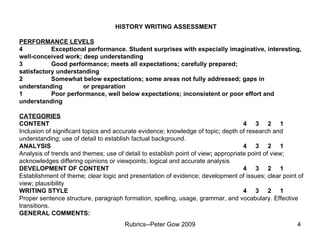
HISTORY WRITING ASSESSMENT PERFORMANCE LEVELS 4 Exceptional performance. Student surprises with especially imaginative, interesting,  well-conceived work; deep understanding 3 Good performance; meets all expectations; carefully prepared;  satisfactory understanding 2 Somewhat below expectations; some areas not fully addressed; gaps in understanding  or preparation 1 Poor performance, well below expectations; inconsistent or poor effort and  understanding CATEGORIES CONTENT 4  3  2  1  Inclusion of significant topics and accurate evidence; knowledge of topic; depth of research and understanding; use of detail to establish factual background. ANALYSIS 4  3  2  1  Analysis of trends and themes; use of detail to establish point of view ;  appropriate point of view; acknowledges differing opinions or viewpoints; logical and accurate analysis  DEVELOPMENT OF CONTENT 4  3  2  1  Establishment of theme; clear logic and presentation of evidence; development of issues; clear point of view; plausibility WRITING STYLE 4  3  2  1  Proper sentence structure, paragraph formation, spelling, usage, grammar, and vocabulary. Effective transitions. GENERAL COMMENTS: Rubrics--Peter Gow 2009
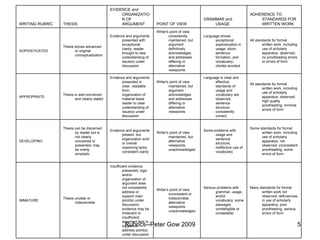
Rubrics--Peter Gow 2009 WRITING RUBRIC  THESIS EVIDENCE and ORGANIZATION OF ARGUMENT POINT OF VIEW GRAMMAR and USAGE ADHERENCE TO STANDARDS FOR WRITTEN WORK SOPHISTICATED Thesis shows advanced or original conceptualization Evidence and arguments presented with exceptional clarity; reader brought to new understanding of issue(s) under discussion Writer's point of view consistently maintained, but argument definitively acknowledges and addresses differing or alternative viewpoints Language shows exceptional sophistication in usage, idiom, sentence formation, and vocabulary; clichés avoided All standards for formal written work, including use of scholarly apparatus, observed; no proofreading errors or errors of form APPROPRIATE Thesis is well-conceived and clearly stated Evidence and arguments presented in clear, readable form; organization of material leads reader to clear understanding of issue(s) under discussion Writer's point of view maintained, but argument acknowledges and addresses differing or alternative viewpoints Language is clear and effective; standards of usage and vocabulary are observed; sentence structure consistently correct All standards for formal written work, including use of scholarly apparatus, observed; high quality proofreading; minimal errors of form DEVELOPING Thesis can be discerned by reader but is not clearly conceived or presented; may be overly simplistic Evidence and arguments present, but organization and/or overall reasoning lacks consistent clarity Writer's point of view maintained, but alternative viewpoints unacknowledged Some problems with usage and sentence structure; ineffective use of vocabulary Some standards for formal written work, including use of scholarly apparatus, not observed; inconsistent proofreading; some errors of form IMMATURE Thesis unclear or indiscernible Insufficient evidence presented; logic and/or organization of argument does not consistently address or support main point(s) under discussion; evidence may be irrelevant or insufficient; argument fails to support or address point(s) under discussion  Writer's point of view inconsistent or indiscernible; alternative viewpoints unacknowledged Serious problems with grammar, usage, and/or vocabulary; some passages unintelligible or unreadable Many standards for formal written work not observed; deficiencies in use of scholarly apparatus; poor proofreading; serious errors of form
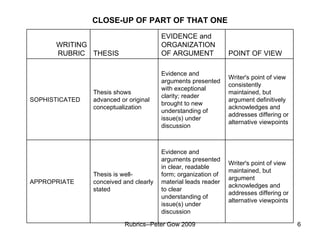
CLOSE-UP OF PART OF THAT ONE Rubrics--Peter Gow 2009 WRITING RUBRIC  THESIS EVIDENCE and ORGANIZATION OF ARGUMENT POINT OF VIEW SOPHISTICATED Thesis shows advanced or original conceptualization Evidence and arguments presented with exceptional clarity; reader brought to new understanding of issue(s) under discussion Writer's point of view consistently maintained, but argument definitively acknowledges and addresses differing or alternative viewpoints APPROPRIATE Thesis is well-conceived and clearly stated Evidence and arguments presented in clear, readable form; organization of material leads reader to clear understanding of issue(s) under discussion Writer's point of view maintained, but argument acknowledges and addresses differing or alternative viewpoints
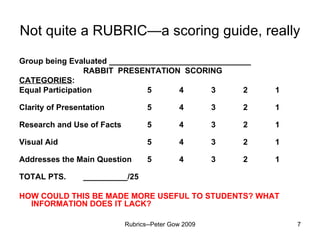
Not quite a RUBRIC—a scoring guide, really Group being Evaluated ________________________________ RABBIT  PRESENTATION  SCORING CATEGORIES : Equal Participation 5 4 3 2 1 Clarity of Presentation 5 4 3 2 1 Research and Use of Facts 5 4 3 2 1 Visual Aid 5 4 3 2 1 Addresses the Main Question 5 4 3 2 1 TOTAL PTS. __________/25 HOW COULD THIS BE MADE MORE USEFUL TO STUDENTS? WHAT INFORMATION DOES IT LACK? Rubrics--Peter Gow 2009
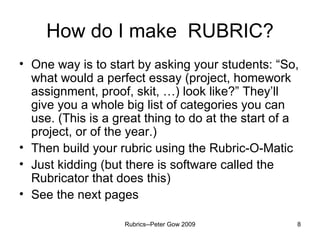
How do I make  RUBRIC? One way is to start by asking your students: “So, what would a perfect essay (project, homework assignment, proof, skit, …) look like?” They’ll give you a whole big list of categories you can use. (This is a great thing to do at the start of a project, or of the year.) Then build your rubric using the Rubric-O-Matic Just kidding (but there is software called the Rubricator that does this) See the next pages Rubrics--Peter Gow 2009
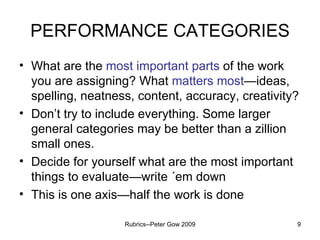
PERFORMANCE CATEGORIES What are the  most important parts  of the work you are assigning? What  matters most —ideas, spelling, neatness, content, accuracy, creativity? Don’t try to include everything. Some larger general categories may be better than a zillion small ones. Decide for yourself what are the most important things to evaluate—write  ´ em down This is one axis—half the work is done Rubrics--Peter Gow 2009
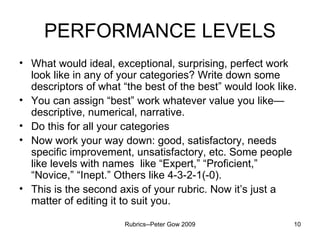
PERFORMANCE LEVELS What would ideal, exceptional, surprising, perfect work look like in any of your categories? Write down some descriptors of what “the best of the best” would look like. You can assign “best” work whatever value you like—descriptive, numerical, narrative. Do this for all your categories Now work your way down: good, satisfactory, needs specific improvement, unsatisfactory, etc. Some people like levels with names  like “Expert,” “Proficient,” “Novice,” “Inept.” Others like 4-3-2-1(-0). This is the second axis of your rubric. Now it’s just a matter of editing it to suit you. Rubrics--Peter Gow 2009
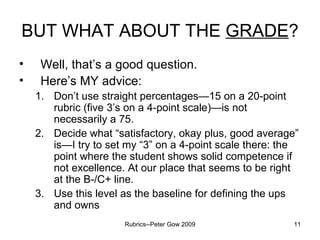
BUT WHAT ABOUT THE  GRADE ? Well, that’s a good question. Here’s MY advice: Don’t use straight percentages—15 on a 20-point rubric (five 3’s on a 4-point scale)—is not necessarily a 75. Decide what “satisfactory, okay plus, good average” is—I try to set my “3” on a 4-point scale there: the point where the student shows solid competence if not excellence. At our place that seems to be right at the B-/C+ line. Use this level as the baseline for defining the ups and owns Rubrics--Peter Gow 2009
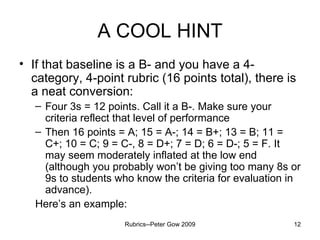
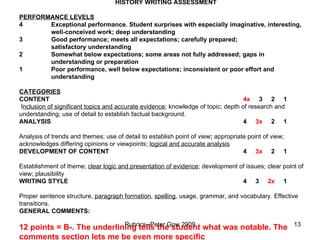
A COOL HINT If that baseline is a B- and you have a 4- category, 4-point rubric (16 points total), there is a neat conversion: Four 3s = 12 points. Call it a B-. Make sure your criteria reflect that level of performance Then 16 points = A; 15 = A-; 14 = B+; 13 = B; 11 = C+; 10 = C; 9 = C-, 8 = D+; 7 = D; 6 = D-; 5 = F. It may seem moderately inflated at the low end (although you probably won’t be giving too many 8s or 9s to students who know the criteria for evaluation in advance). Here’s an example:  Rubrics--Peter Gow 2009
HISTORY WRITING ASSESSMENT PERFORMANCE LEVELS 4 Exceptional performance. Student surprises with especially imaginative, interesting,  well-conceived work; deep understanding 3 Good performance; meets all expectations; carefully prepared;  satisfactory understanding 2 Somewhat below expectations; some areas not fully addressed; gaps in  understanding or preparation 1 Poor performance, well below expectations; inconsistent or poor effort and  understanding CATEGORIES CONTENT 4x   3  2  1  I nclusion of significant topics and accurate evidence ; knowledge of topic; depth of research and understanding; use of detail to establish factual background. ANALYSIS 4  3x   2  1  Analysis of trends and themes; use of detail to establish point of view ;  appropriate point of view; acknowledges differing opinions or viewpoints;  logical and accurate analysis   DEVELOPMENT OF CONTENT 4  3x   2  1  Establishment of theme;  clear logic and presentation of evidence ; development of issues; clear point of view; plausibility WRITING STYLE 4  3  2x  1  Proper sentence structure,  paragraph formation ,  spelling , usage, grammar, and vocabulary. Effective transitions. GENERAL COMMENTS: 12 points = B-. The underlining tells the student what was notable. The comments section lets me be even more specific Rubrics--Peter Gow 2009
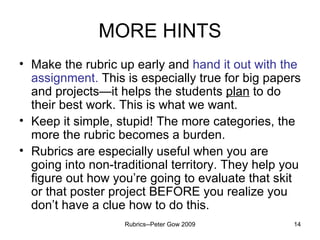
MORE HINTS Make the rubric up early and  hand it out with the assignment.  This is especially true for big papers and projects—it helps the students  plan  to do their best work. This is what we want. Keep it simple, stupid! The more categories, the more the rubric becomes a burden. Rubrics are especially useful when you are going into non-traditional territory. They help you figure out how you’re going to evaluate that skit or that poster project BEFORE you realize you don’t have a clue how to do this. Rubrics--Peter Gow 2009
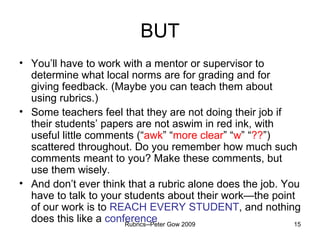
BUT You’ll have to work with a mentor or supervisor to determine what local norms are for grading and for giving feedback. (Maybe you can teach them about using rubrics.) Some teachers feel that they are not doing their job if their students’ papers are not aswim in red ink, with useful little comments (“ awk ” “ more clear ” “ w ” “ ?? ”) scattered throughout. Do you remember how much such comments meant to you? Make these comments, but use them wisely. And don’t ever think that a rubric alone does the job. You have to talk to your students about their work—the point of our work is to  REACH EVERY STUDENT , and nothing does this like a  conference Rubrics--Peter Gow 2009
LAST HINT You may find that making the rubric is a lot of work at first. If you need help, google “geometry test rubric” or “Spanish rubric” or the like, and you’ll find all the help you need. These things are neither rocket science nor new, and so there are plenty of examples out there. There’s even www.rubrics4teachers.com  Rubrics--Peter Gow 2009

Evaluation Rubrics

  • 1.
    EVALUATION RUBRICS Gonnamake your life sooooo easy!! © 2009 Peter Gow per Creative Commons; use must be attributed
  • 2.
    What is aRUBRIC, anyhow? It’s a set of clearly stated criteria by which a piece of work will be evaluated It sets forth a clear description of levels of performance, from EXCELLENT down to some version of “unacceptable” It’s a tool for giving students clear feedback on work It’s a tool for helping you evaluate work efficiently and in a meaningful way Rubrics--Peter Gow 2009
  • 3.
    What does aRUBRIC look like? They come in many forms—here are some examples, and check out the handout packet Some are highly detailed descriptive rubrics; others are really just scoring guides Most are a kind of table—performance categories on one axis, performance levels on the other You just have to poke around (in the packet, on the web) to find a design or two that meets your needs. Try a few out; tailor your own. Rubrics--Peter Gow 2009
  • 4.
    HISTORY WRITING ASSESSMENTPERFORMANCE LEVELS 4 Exceptional performance. Student surprises with especially imaginative, interesting, well-conceived work; deep understanding 3 Good performance; meets all expectations; carefully prepared; satisfactory understanding 2 Somewhat below expectations; some areas not fully addressed; gaps in understanding or preparation 1 Poor performance, well below expectations; inconsistent or poor effort and understanding CATEGORIES CONTENT 4 3 2 1 Inclusion of significant topics and accurate evidence; knowledge of topic; depth of research and understanding; use of detail to establish factual background. ANALYSIS 4 3 2 1 Analysis of trends and themes; use of detail to establish point of view ; appropriate point of view; acknowledges differing opinions or viewpoints; logical and accurate analysis DEVELOPMENT OF CONTENT 4 3 2 1 Establishment of theme; clear logic and presentation of evidence; development of issues; clear point of view; plausibility WRITING STYLE 4 3 2 1 Proper sentence structure, paragraph formation, spelling, usage, grammar, and vocabulary. Effective transitions. GENERAL COMMENTS: Rubrics--Peter Gow 2009
  • 5.
    Rubrics--Peter Gow 2009WRITING RUBRIC  THESIS EVIDENCE and ORGANIZATION OF ARGUMENT POINT OF VIEW GRAMMAR and USAGE ADHERENCE TO STANDARDS FOR WRITTEN WORK SOPHISTICATED Thesis shows advanced or original conceptualization Evidence and arguments presented with exceptional clarity; reader brought to new understanding of issue(s) under discussion Writer's point of view consistently maintained, but argument definitively acknowledges and addresses differing or alternative viewpoints Language shows exceptional sophistication in usage, idiom, sentence formation, and vocabulary; clichés avoided All standards for formal written work, including use of scholarly apparatus, observed; no proofreading errors or errors of form APPROPRIATE Thesis is well-conceived and clearly stated Evidence and arguments presented in clear, readable form; organization of material leads reader to clear understanding of issue(s) under discussion Writer's point of view maintained, but argument acknowledges and addresses differing or alternative viewpoints Language is clear and effective; standards of usage and vocabulary are observed; sentence structure consistently correct All standards for formal written work, including use of scholarly apparatus, observed; high quality proofreading; minimal errors of form DEVELOPING Thesis can be discerned by reader but is not clearly conceived or presented; may be overly simplistic Evidence and arguments present, but organization and/or overall reasoning lacks consistent clarity Writer's point of view maintained, but alternative viewpoints unacknowledged Some problems with usage and sentence structure; ineffective use of vocabulary Some standards for formal written work, including use of scholarly apparatus, not observed; inconsistent proofreading; some errors of form IMMATURE Thesis unclear or indiscernible Insufficient evidence presented; logic and/or organization of argument does not consistently address or support main point(s) under discussion; evidence may be irrelevant or insufficient; argument fails to support or address point(s) under discussion Writer's point of view inconsistent or indiscernible; alternative viewpoints unacknowledged Serious problems with grammar, usage, and/or vocabulary; some passages unintelligible or unreadable Many standards for formal written work not observed; deficiencies in use of scholarly apparatus; poor proofreading; serious errors of form
  • 6.
    CLOSE-UP OF PARTOF THAT ONE Rubrics--Peter Gow 2009 WRITING RUBRIC  THESIS EVIDENCE and ORGANIZATION OF ARGUMENT POINT OF VIEW SOPHISTICATED Thesis shows advanced or original conceptualization Evidence and arguments presented with exceptional clarity; reader brought to new understanding of issue(s) under discussion Writer's point of view consistently maintained, but argument definitively acknowledges and addresses differing or alternative viewpoints APPROPRIATE Thesis is well-conceived and clearly stated Evidence and arguments presented in clear, readable form; organization of material leads reader to clear understanding of issue(s) under discussion Writer's point of view maintained, but argument acknowledges and addresses differing or alternative viewpoints
  • 7.
    Not quite aRUBRIC—a scoring guide, really Group being Evaluated ________________________________ RABBIT PRESENTATION SCORING CATEGORIES : Equal Participation 5 4 3 2 1 Clarity of Presentation 5 4 3 2 1 Research and Use of Facts 5 4 3 2 1 Visual Aid 5 4 3 2 1 Addresses the Main Question 5 4 3 2 1 TOTAL PTS. __________/25 HOW COULD THIS BE MADE MORE USEFUL TO STUDENTS? WHAT INFORMATION DOES IT LACK? Rubrics--Peter Gow 2009
  • 8.
    How do Imake RUBRIC? One way is to start by asking your students: “So, what would a perfect essay (project, homework assignment, proof, skit, …) look like?” They’ll give you a whole big list of categories you can use. (This is a great thing to do at the start of a project, or of the year.) Then build your rubric using the Rubric-O-Matic Just kidding (but there is software called the Rubricator that does this) See the next pages Rubrics--Peter Gow 2009
  • 9.
    PERFORMANCE CATEGORIES Whatare the most important parts of the work you are assigning? What matters most —ideas, spelling, neatness, content, accuracy, creativity? Don’t try to include everything. Some larger general categories may be better than a zillion small ones. Decide for yourself what are the most important things to evaluate—write ´ em down This is one axis—half the work is done Rubrics--Peter Gow 2009
  • 10.
    PERFORMANCE LEVELS Whatwould ideal, exceptional, surprising, perfect work look like in any of your categories? Write down some descriptors of what “the best of the best” would look like. You can assign “best” work whatever value you like—descriptive, numerical, narrative. Do this for all your categories Now work your way down: good, satisfactory, needs specific improvement, unsatisfactory, etc. Some people like levels with names like “Expert,” “Proficient,” “Novice,” “Inept.” Others like 4-3-2-1(-0). This is the second axis of your rubric. Now it’s just a matter of editing it to suit you. Rubrics--Peter Gow 2009
  • 11.
    BUT WHAT ABOUTTHE GRADE ? Well, that’s a good question. Here’s MY advice: Don’t use straight percentages—15 on a 20-point rubric (five 3’s on a 4-point scale)—is not necessarily a 75. Decide what “satisfactory, okay plus, good average” is—I try to set my “3” on a 4-point scale there: the point where the student shows solid competence if not excellence. At our place that seems to be right at the B-/C+ line. Use this level as the baseline for defining the ups and owns Rubrics--Peter Gow 2009
  • 12.
    A COOL HINTIf that baseline is a B- and you have a 4- category, 4-point rubric (16 points total), there is a neat conversion: Four 3s = 12 points. Call it a B-. Make sure your criteria reflect that level of performance Then 16 points = A; 15 = A-; 14 = B+; 13 = B; 11 = C+; 10 = C; 9 = C-, 8 = D+; 7 = D; 6 = D-; 5 = F. It may seem moderately inflated at the low end (although you probably won’t be giving too many 8s or 9s to students who know the criteria for evaluation in advance). Here’s an example: Rubrics--Peter Gow 2009
  • 13.
    HISTORY WRITING ASSESSMENTPERFORMANCE LEVELS 4 Exceptional performance. Student surprises with especially imaginative, interesting, well-conceived work; deep understanding 3 Good performance; meets all expectations; carefully prepared; satisfactory understanding 2 Somewhat below expectations; some areas not fully addressed; gaps in understanding or preparation 1 Poor performance, well below expectations; inconsistent or poor effort and understanding CATEGORIES CONTENT 4x 3 2 1 I nclusion of significant topics and accurate evidence ; knowledge of topic; depth of research and understanding; use of detail to establish factual background. ANALYSIS 4 3x 2 1 Analysis of trends and themes; use of detail to establish point of view ; appropriate point of view; acknowledges differing opinions or viewpoints; logical and accurate analysis DEVELOPMENT OF CONTENT 4 3x 2 1 Establishment of theme; clear logic and presentation of evidence ; development of issues; clear point of view; plausibility WRITING STYLE 4 3 2x 1 Proper sentence structure, paragraph formation , spelling , usage, grammar, and vocabulary. Effective transitions. GENERAL COMMENTS: 12 points = B-. The underlining tells the student what was notable. The comments section lets me be even more specific Rubrics--Peter Gow 2009
  • 14.
    MORE HINTS Makethe rubric up early and hand it out with the assignment. This is especially true for big papers and projects—it helps the students plan to do their best work. This is what we want. Keep it simple, stupid! The more categories, the more the rubric becomes a burden. Rubrics are especially useful when you are going into non-traditional territory. They help you figure out how you’re going to evaluate that skit or that poster project BEFORE you realize you don’t have a clue how to do this. Rubrics--Peter Gow 2009
  • 15.
    BUT You’ll haveto work with a mentor or supervisor to determine what local norms are for grading and for giving feedback. (Maybe you can teach them about using rubrics.) Some teachers feel that they are not doing their job if their students’ papers are not aswim in red ink, with useful little comments (“ awk ” “ more clear ” “ w ” “ ?? ”) scattered throughout. Do you remember how much such comments meant to you? Make these comments, but use them wisely. And don’t ever think that a rubric alone does the job. You have to talk to your students about their work—the point of our work is to REACH EVERY STUDENT , and nothing does this like a conference Rubrics--Peter Gow 2009
  • 16.
    LAST HINT Youmay find that making the rubric is a lot of work at first. If you need help, google “geometry test rubric” or “Spanish rubric” or the like, and you’ll find all the help you need. These things are neither rocket science nor new, and so there are plenty of examples out there. There’s even www.rubrics4teachers.com  Rubrics--Peter Gow 2009