Ann Robertson
How it all started…
Tonight’s presentation 
What is CLIL? 
How to CLIL (a very quick example!) 
 Benefits and challenges 
Questions?
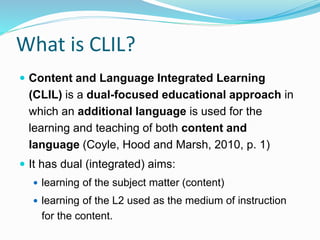
What is CLIL? 
 Content and Language Integrated Learning 
(CLIL) is a dual-focused educational approach in 
which an additional language is used for the 
learning and teaching of both content and 
language (Coyle, Hood and Marsh, 2010, p. 1) 
 It has dual (integrated) aims: 
 learning of the subject matter (content) 
 learning of the L2 used as the medium of instruction 
for the content.
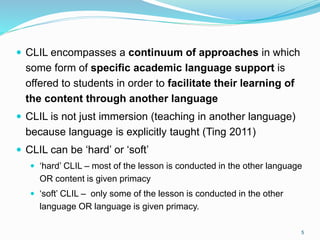
 CLIL encompasses a continuum of approaches in which 
some form of specific academic language support is 
offered to students in order to facilitate their learning of 
the content through another language 
 CLIL is not just immersion (teaching in another language) 
because language is explicitly taught (Ting 2011) 
 CLIL can be ‘hard’ or ‘soft’ 
 ‘hard’ CLIL – most of the lesson is conducted in the other language 
OR content is given primacy 
 ‘soft’ CLIL – only some of the lesson is conducted in the other 
language OR language is given primacy. 
5
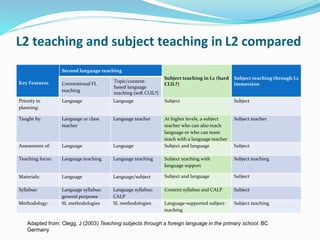
L2 teaching and subject teaching in L2 compared 
Key Features 
Second language teaching 
Subject teaching in L2 (hard 
CLIL?) 
Subject teaching through L2 
Topic/content-based 
Conventional FL immersion 
language 
teaching 
teaching (soft CLIL?) 
Priority in 
planning: 
Language Language Subject Subject 
Taught by: Language or class 
teacher 
Language teacher At higher levels, a subject 
teacher who can also teach 
language or who can team 
teach with a language teacher 
Subject teacher 
Assessment of: Language Language Subject and language Subject 
Teaching focus: Language teaching Language teaching Subject teaching with 
language support 
Subject teaching 
Materials: Language Language/subject Subject and language Subject 
Syllabus: Language syllabus: 
general purposes 
Language syllabus: 
CALP 
Content syllabus and CALP Subject 
Methodology: SL methodologies SL methodologies Language-supported subject-teaching 
Subject teaching 
Adapted from: Clegg, J (2003) Teaching subjects through a foreign language in the primary school. BC 
Germany
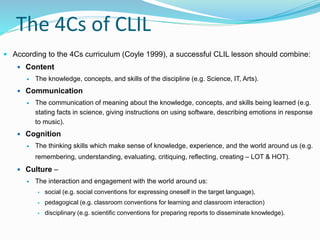
The 4Cs of CLIL 
 According to the 4Cs curriculum (Coyle 1999), a successful CLIL lesson should combine: 
 Content 
 The knowledge, concepts, and skills of the discipline (e.g. Science, IT, Arts). 
 Communication 
 The communication of meaning about the knowledge, concepts, and skills being learned (e.g. 
stating facts in science, giving instructions on using software, describing emotions in response 
to music). 
 Cognition 
 The thinking skills which make sense of knowledge, experience, and the world around us (e.g. 
remembering, understanding, evaluating, critiquing, reflecting, creating – LOT & HOT). 
 Culture – 
 The interaction and engagement with the world around us: 
 social (e.g. social conventions for expressing oneself in the target language), 
 pedagogical (e.g. classroom conventions for learning and classroom interaction) 
 disciplinary (e.g. scientific conventions for preparing reports to disseminate knowledge).
States of matter
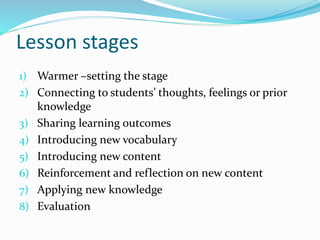
Lesson stages 
1) Warmer –setting the stage 
2) Connecting to students’ thoughts, feelings or prior 
knowledge 
3) Sharing learning outcomes 
4) Introducing new vocabulary 
5) Introducing new content 
6) Reinforcement and reflection on new content 
7) Applying new knowledge 
8) Evaluation
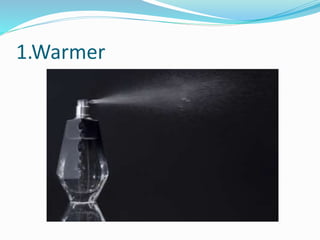
1.Warmer
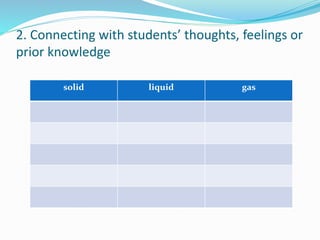
2. Connecting with students’ thoughts, feelings or 
prior knowledge 
solid liquid gas
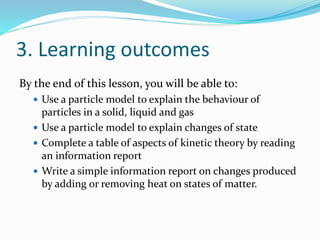
3. Learning outcomes 
By the end of this lesson, you will be able to: 
 Use a particle model to explain the behaviour of 
particles in a solid, liquid and gas 
 Use a particle model to explain changes of state 
 Complete a table of aspects of kinetic theory by reading 
an information report 
 Write a simple information report on changes produced 
by adding or removing heat on states of matter.
4. Introducing key vocabulary 
 Pair work – matching
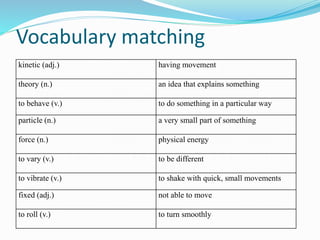
Vocabulary matching 
kinetic (adj.) having movement 
theory (n.) an idea that explains something 
to behave (v.) to do something in a particular way 
particle (n.) a very small part of something 
force (n.) physical energy 
to vary (v.) to be different 
to vibrate (v.) to shake with quick, small movements 
fixed (adj.) not able to move 
to roll (v.) to turn smoothly
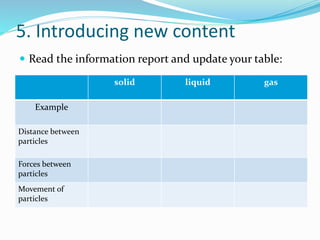
5. Introducing new content 
 Read the information report and update your table: 
solid liquid gas 
Example 
Distance between 
particles 
Forces between 
particles 
Movement of 
particles
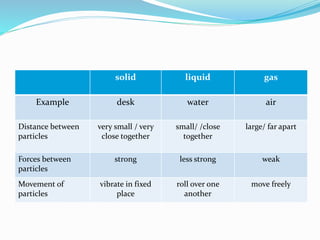
solid liquid gas 
Example desk water air 
Distance between 
particles 
very small / very 
close together 
small/ /close 
together 
large/ far apart 
Forces between 
particles 
strong less strong weak 
Movement of 
particles 
vibrate in fixed 
place 
roll over one 
another 
move freely
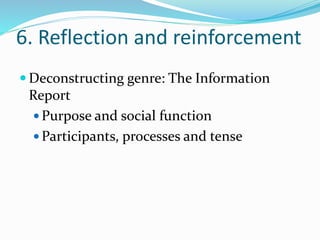
6. Reflection and reinforcement 
Deconstructing genre: The Information 
Report 
 Purpose and social function 
Participants, processes and tense
6. Reflection and reinforcement 
Make groups of six to eight. 
 At the teacher’s instruction, work with your 
team mates to demonstrate a state of matter.
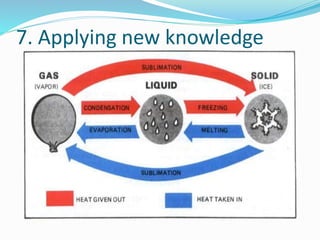
7. Applying new knowledge
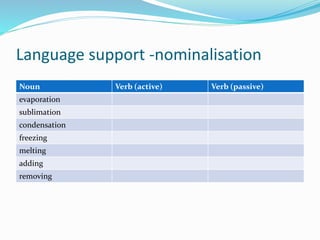
Language support -nominalisation 
Noun Verb (active) Verb (passive) 
evaporation 
sublimation 
condensation 
freezing 
melting 
adding 
removing
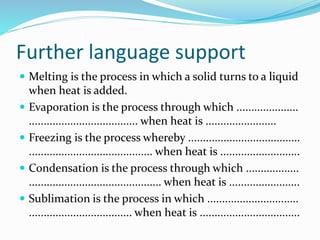
Further language support 
 Melting is the process in which a solid turns to a liquid 
when heat is added. 
 Evaporation is the process through which ..................... 
..................................... when heat is ........................ 
 Freezing is the process whereby ...................................... 
.......................................... when heat is ........................... 
 Condensation is the process through which .................. 
............................................. when heat is ........................ 
 Sublimation is the process in which ............................... 
................................... when heat is ..................................
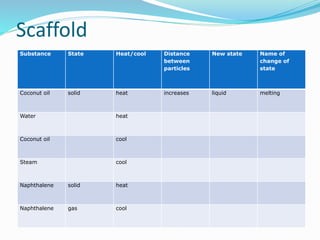
Scaffold 
Substance State Heat/cool Distance 
between 
particles 
New state Name of 
change of 
state 
Coconut oil solid heat increases liquid melting 
Water heat 
Coconut oil cool 
Steam cool 
Naphthalene solid heat 
Naphthalene gas cool
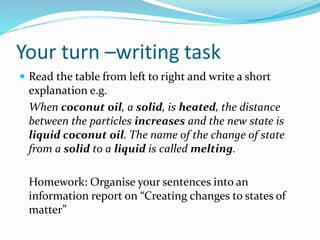
Your turn –writing task 
 Read the table from left to right and write a short 
explanation e.g. 
When coconut oil, a solid, is heated, the distance 
between the particles increases and the new state is 
liquid coconut oil. The name of the change of state 
from a solid to a liquid is called melting. 
Homework: Organise your sentences into an 
information report on “Creating changes to states of 
matter”
8.Evaluation 
 Ask students to read some of their sentences aloud. 
 Review of homework in the following lesson
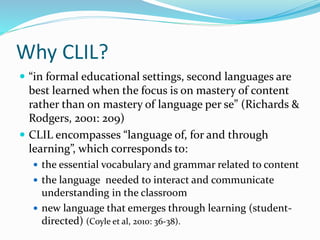
Why CLIL? 
 “in formal educational settings, second languages are 
best learned when the focus is on mastery of content 
rather than on mastery of language per se” (Richards & 
Rodgers, 2001: 209) 
 CLIL encompasses “language of, for and through 
learning”, which corresponds to: 
 the essential vocabulary and grammar related to content 
 the language needed to interact and communicate 
understanding in the classroom 
 new language that emerges through learning (student-directed) 
(Coyle et al, 2010: 36-38).
 Students need to develop not only “Basic Interpersonal 
Communicative Skills” (BICS) i.e. “skills needed for 
social, conversational situations” but also “Cognitive 
Academic Language Proficiency” (CALP), i.e. the 
abstract and formal language needed for academic 
study (Cummins, cited in Bentley, 2010: 8)
Challenges 
 Teacher competencies – content AND language 
 Cognitive demands on students may cause anxiety and 
demotivation stemming from fear of failure > 
 emphasis on short-term learning goals to build student 
confidence; 
 provision of support within their ZPD (Vygotsky, 1978); 
pair and group work; 
 role of teacher as facilitator rather than knower 
 modification and scaffolding of authentic materials 
= HARD WORK FOR TEACHERS
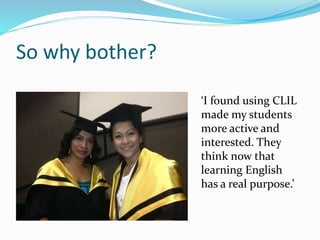
So why bother? 
‘I found using CLIL 
made my students 
more active and 
interested. They 
think now that 
learning English 
has a real purpose.’
References 
Bentley, K. (2010). The TKT Course CLIL Module. 
Cambridge: CUP 
Coyle, D., Hood, P., and Marsh., D. (2010). CLIL: Content 
and Language Integrated Learning. Cambridge: CUP. 
Mehisto, P., Frigols, M. & Marsh, D. (2008). Uncovering 
CLIL. UK: Macmillan. 
Richards, J.C. and Rodgers, T.S.(2001). Approaches and 
Methods in Language Teaching (2nd ed.) New York: 
Cambridge University Press. 
Ting, Y. T. (2011). CLIL… not only not immersion but also 
more than the sum of its parts. ELT Journal, 65(3), 314- 
317.

An introduction to content and language integrated learning

  • 1.
  • 2.
    How it allstarted…
  • 3.
    Tonight’s presentation Whatis CLIL? How to CLIL (a very quick example!)  Benefits and challenges Questions?
  • 4.
    What is CLIL?  Content and Language Integrated Learning (CLIL) is a dual-focused educational approach in which an additional language is used for the learning and teaching of both content and language (Coyle, Hood and Marsh, 2010, p. 1)  It has dual (integrated) aims:  learning of the subject matter (content)  learning of the L2 used as the medium of instruction for the content.
  • 5.
     CLIL encompassesa continuum of approaches in which some form of specific academic language support is offered to students in order to facilitate their learning of the content through another language  CLIL is not just immersion (teaching in another language) because language is explicitly taught (Ting 2011)  CLIL can be ‘hard’ or ‘soft’  ‘hard’ CLIL – most of the lesson is conducted in the other language OR content is given primacy  ‘soft’ CLIL – only some of the lesson is conducted in the other language OR language is given primacy. 5
  • 6.
    L2 teaching andsubject teaching in L2 compared Key Features Second language teaching Subject teaching in L2 (hard CLIL?) Subject teaching through L2 Topic/content-based Conventional FL immersion language teaching teaching (soft CLIL?) Priority in planning: Language Language Subject Subject Taught by: Language or class teacher Language teacher At higher levels, a subject teacher who can also teach language or who can team teach with a language teacher Subject teacher Assessment of: Language Language Subject and language Subject Teaching focus: Language teaching Language teaching Subject teaching with language support Subject teaching Materials: Language Language/subject Subject and language Subject Syllabus: Language syllabus: general purposes Language syllabus: CALP Content syllabus and CALP Subject Methodology: SL methodologies SL methodologies Language-supported subject-teaching Subject teaching Adapted from: Clegg, J (2003) Teaching subjects through a foreign language in the primary school. BC Germany
  • 7.
    The 4Cs ofCLIL  According to the 4Cs curriculum (Coyle 1999), a successful CLIL lesson should combine:  Content  The knowledge, concepts, and skills of the discipline (e.g. Science, IT, Arts).  Communication  The communication of meaning about the knowledge, concepts, and skills being learned (e.g. stating facts in science, giving instructions on using software, describing emotions in response to music).  Cognition  The thinking skills which make sense of knowledge, experience, and the world around us (e.g. remembering, understanding, evaluating, critiquing, reflecting, creating – LOT & HOT).  Culture –  The interaction and engagement with the world around us:  social (e.g. social conventions for expressing oneself in the target language),  pedagogical (e.g. classroom conventions for learning and classroom interaction)  disciplinary (e.g. scientific conventions for preparing reports to disseminate knowledge).
  • 8.
  • 9.
    Lesson stages 1)Warmer –setting the stage 2) Connecting to students’ thoughts, feelings or prior knowledge 3) Sharing learning outcomes 4) Introducing new vocabulary 5) Introducing new content 6) Reinforcement and reflection on new content 7) Applying new knowledge 8) Evaluation
  • 10.
  • 11.
    2. Connecting withstudents’ thoughts, feelings or prior knowledge solid liquid gas
  • 12.
    3. Learning outcomes By the end of this lesson, you will be able to:  Use a particle model to explain the behaviour of particles in a solid, liquid and gas  Use a particle model to explain changes of state  Complete a table of aspects of kinetic theory by reading an information report  Write a simple information report on changes produced by adding or removing heat on states of matter.
  • 13.
    4. Introducing keyvocabulary  Pair work – matching
  • 14.
    Vocabulary matching kinetic(adj.) having movement theory (n.) an idea that explains something to behave (v.) to do something in a particular way particle (n.) a very small part of something force (n.) physical energy to vary (v.) to be different to vibrate (v.) to shake with quick, small movements fixed (adj.) not able to move to roll (v.) to turn smoothly
  • 15.
    5. Introducing newcontent  Read the information report and update your table: solid liquid gas Example Distance between particles Forces between particles Movement of particles
  • 16.
    solid liquid gas Example desk water air Distance between particles very small / very close together small/ /close together large/ far apart Forces between particles strong less strong weak Movement of particles vibrate in fixed place roll over one another move freely
  • 17.
    6. Reflection andreinforcement Deconstructing genre: The Information Report  Purpose and social function Participants, processes and tense
  • 18.
    6. Reflection andreinforcement Make groups of six to eight.  At the teacher’s instruction, work with your team mates to demonstrate a state of matter.
  • 19.
    7. Applying newknowledge
  • 20.
    Language support -nominalisation Noun Verb (active) Verb (passive) evaporation sublimation condensation freezing melting adding removing
  • 21.
    Further language support  Melting is the process in which a solid turns to a liquid when heat is added.  Evaporation is the process through which ..................... ..................................... when heat is ........................  Freezing is the process whereby ...................................... .......................................... when heat is ...........................  Condensation is the process through which .................. ............................................. when heat is ........................  Sublimation is the process in which ............................... ................................... when heat is ..................................
  • 22.
    Scaffold Substance StateHeat/cool Distance between particles New state Name of change of state Coconut oil solid heat increases liquid melting Water heat Coconut oil cool Steam cool Naphthalene solid heat Naphthalene gas cool
  • 23.
    Your turn –writingtask  Read the table from left to right and write a short explanation e.g. When coconut oil, a solid, is heated, the distance between the particles increases and the new state is liquid coconut oil. The name of the change of state from a solid to a liquid is called melting. Homework: Organise your sentences into an information report on “Creating changes to states of matter”
  • 24.
    8.Evaluation  Askstudents to read some of their sentences aloud.  Review of homework in the following lesson
  • 25.
    Why CLIL? “in formal educational settings, second languages are best learned when the focus is on mastery of content rather than on mastery of language per se” (Richards & Rodgers, 2001: 209)  CLIL encompasses “language of, for and through learning”, which corresponds to:  the essential vocabulary and grammar related to content  the language needed to interact and communicate understanding in the classroom  new language that emerges through learning (student-directed) (Coyle et al, 2010: 36-38).
  • 26.
     Students needto develop not only “Basic Interpersonal Communicative Skills” (BICS) i.e. “skills needed for social, conversational situations” but also “Cognitive Academic Language Proficiency” (CALP), i.e. the abstract and formal language needed for academic study (Cummins, cited in Bentley, 2010: 8)
  • 27.
    Challenges  Teachercompetencies – content AND language  Cognitive demands on students may cause anxiety and demotivation stemming from fear of failure >  emphasis on short-term learning goals to build student confidence;  provision of support within their ZPD (Vygotsky, 1978); pair and group work;  role of teacher as facilitator rather than knower  modification and scaffolding of authentic materials = HARD WORK FOR TEACHERS
  • 28.
    So why bother? ‘I found using CLIL made my students more active and interested. They think now that learning English has a real purpose.’
  • 29.
    References Bentley, K.(2010). The TKT Course CLIL Module. Cambridge: CUP Coyle, D., Hood, P., and Marsh., D. (2010). CLIL: Content and Language Integrated Learning. Cambridge: CUP. Mehisto, P., Frigols, M. & Marsh, D. (2008). Uncovering CLIL. UK: Macmillan. Richards, J.C. and Rodgers, T.S.(2001). Approaches and Methods in Language Teaching (2nd ed.) New York: Cambridge University Press. Ting, Y. T. (2011). CLIL… not only not immersion but also more than the sum of its parts. ELT Journal, 65(3), 314- 317.