PRINCIPLES OF LANGUAGE LEARNING AND TEACHING
BY KARINA PÉREZ
LANGUAGE ACQUISITION
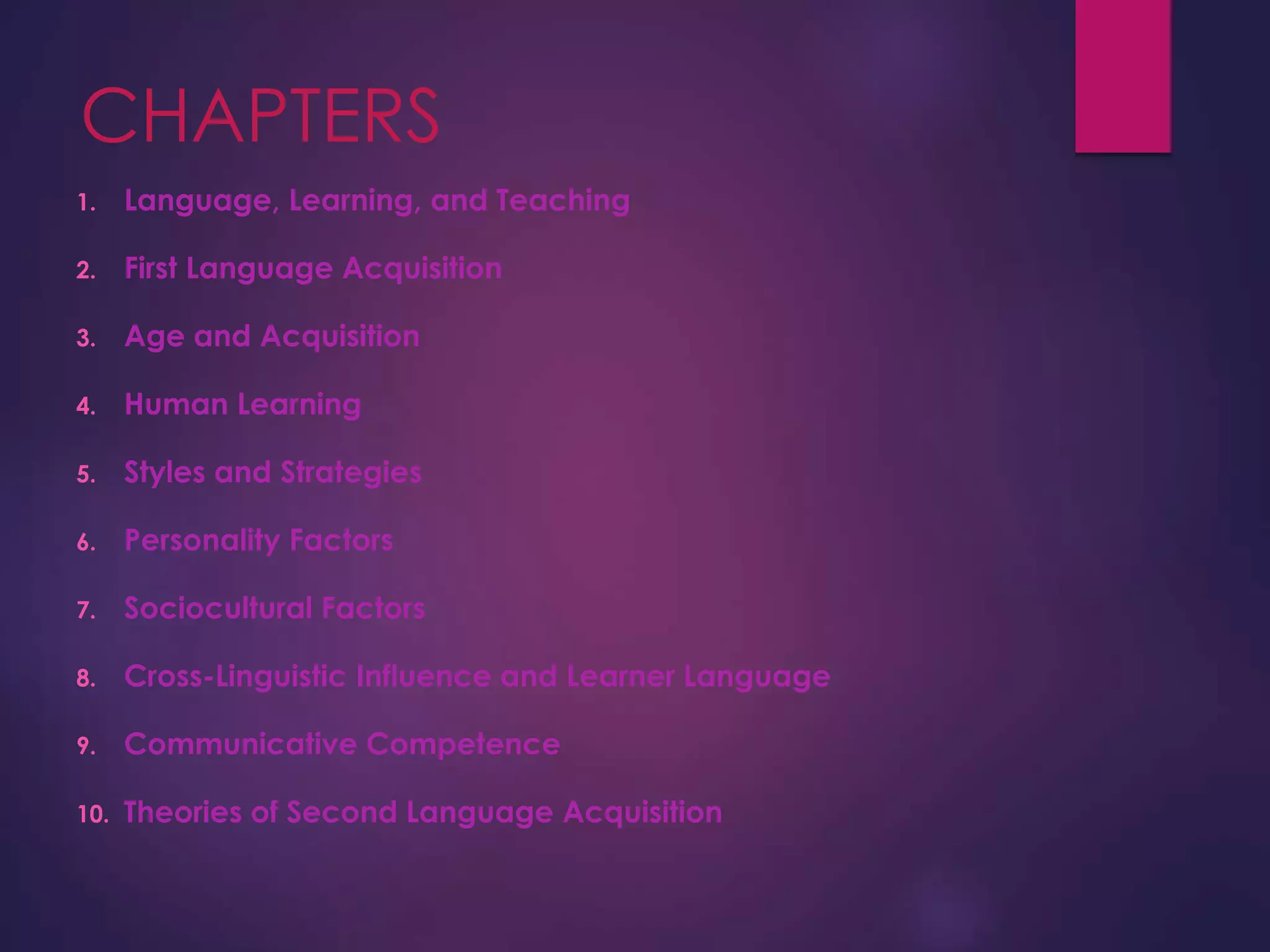
CHAPTERS
1. Language, Learning, and Teaching
2. First Language Acquisition
3. Age and Acquisition
4. Human Learning
5. Styles and Strategies
6. Personality Factors
7. Sociocultural Factors
8. Cross-Linguistic Influence and Learner Language
9. Communicative Competence
10. Theories of Second Language Acquisition
Language, Learning, and
Teaching
 Current Issues in Second Language
Acquisition
 Language Learning and Teaching Schools
of Thought in Second Language Acquisition
 Structuralism/Behaviorism Rationalism and
Cognitive
 Psychology Constructivism Language
Teaching
 Methodology In the Classroom: The
Grammar Translation Method
First Language Acquisition
 Theories of First Language Acquisition
 Competence and Performance
 Comprehension and Productions Nature or
Nurture
 Universals Systematicity and Variability
Language and Thought Imitation Practice
Input Discourse In the Classroom: Gouin
and Berlitz The First Reformers Topics and
Questions for Study and Discussion
Suggested Readings Language Learning
Experience: Journal Entry
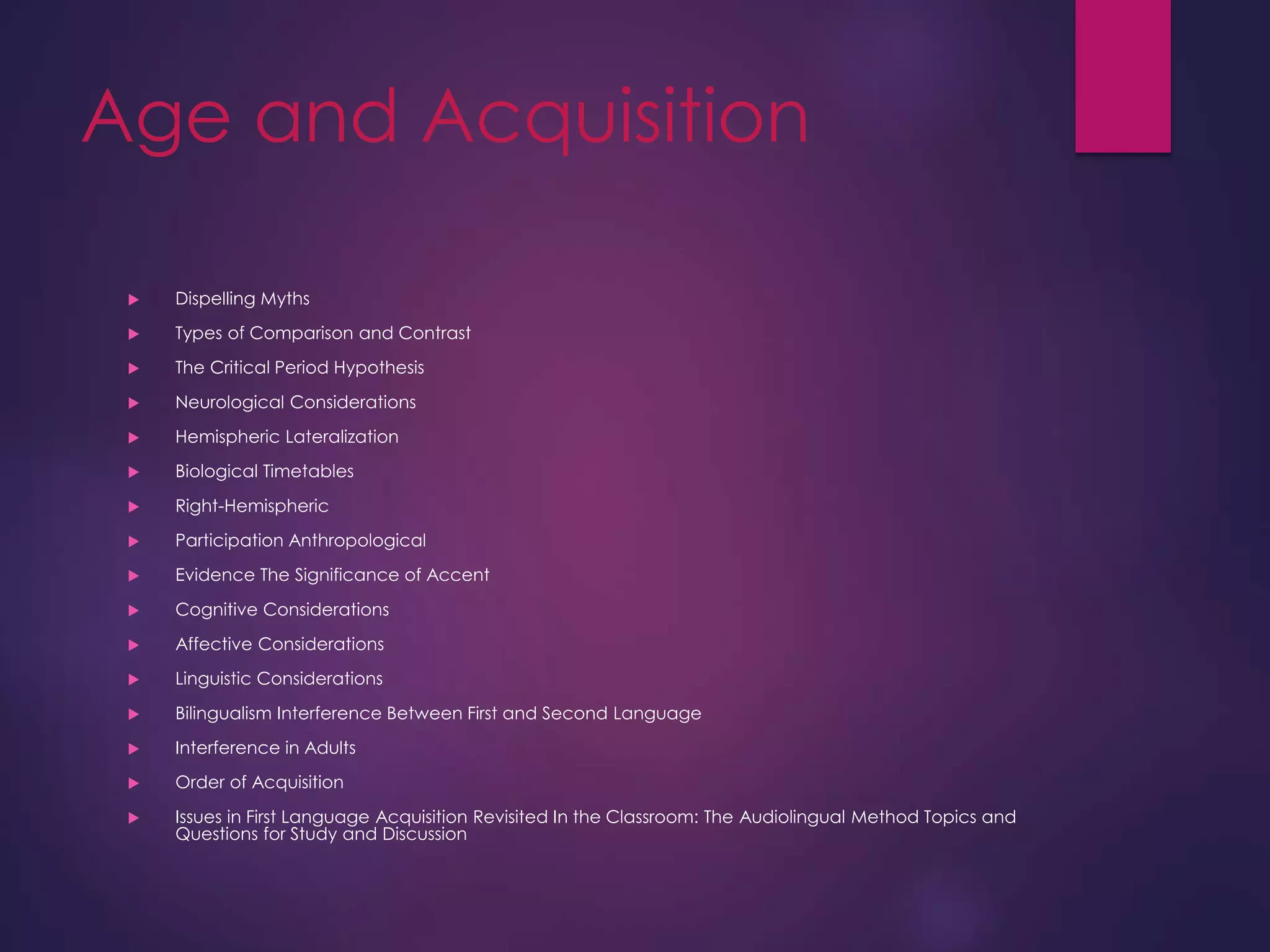
Age and Acquisition
 Dispelling Myths
 Types of Comparison and Contrast
 The Critical Period Hypothesis
 Neurological Considerations
 Hemispheric Lateralization
 Biological Timetables
 Right-Hemispheric
 Participation Anthropological
 Evidence The Significance of Accent
 Cognitive Considerations
 Affective Considerations
 Linguistic Considerations
 Bilingualism Interference Between First and Second Language
 Interference in Adults
 Order of Acquisition
 Issues in First Language Acquisition Revisited In the Classroom: The Audiolingual Method Topics and
Questions for Study and Discussion
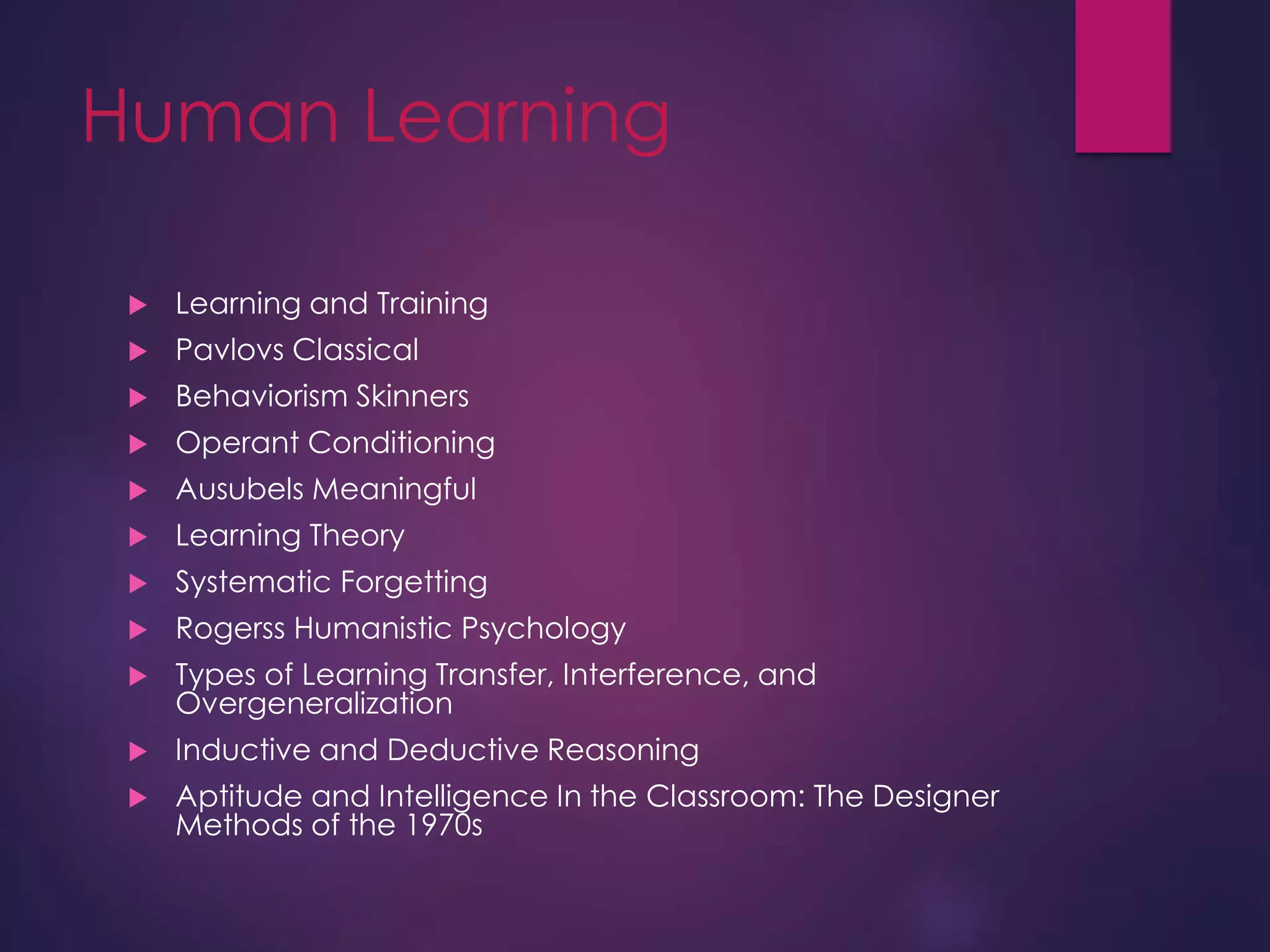
Human Learning
 Learning and Training
 Pavlovs Classical
 Behaviorism Skinners
 Operant Conditioning
 Ausubels Meaningful
 Learning Theory
 Systematic Forgetting
 Rogerss Humanistic Psychology
 Types of Learning Transfer, Interference, and
Overgeneralization
 Inductive and Deductive Reasoning
 Aptitude and Intelligence In the Classroom: The Designer
Methods of the 1970s
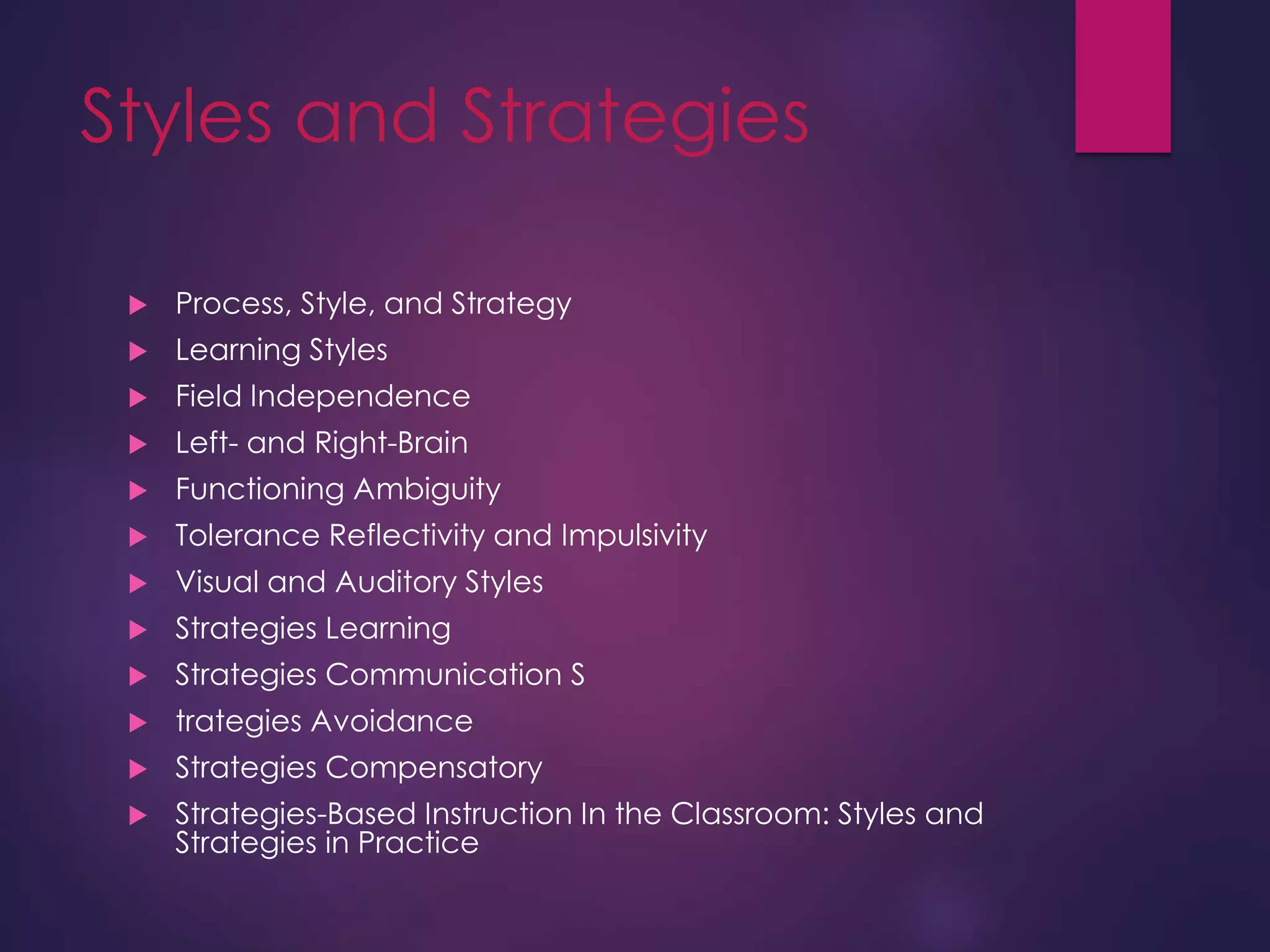
Styles and Strategies
 Process, Style, and Strategy
 Learning Styles
 Field Independence
 Left- and Right-Brain
 Functioning Ambiguity
 Tolerance Reflectivity and Impulsivity
 Visual and Auditory Styles
 Strategies Learning
 Strategies Communication S
 trategies Avoidance
 Strategies Compensatory
 Strategies-Based Instruction In the Classroom: Styles and
Strategies in Practice
Personality Factors
 The Affective Domain
 Self-Esteem
 Inhibition
 Risk-Taking Anxiety Empathy
 Extroversion
 Myers-Briggs Character
 Types Motivation
 Instrumental and Integrative Orientations
 Intrinsic and Extrinsic Motivation
 The Neurobiology of Affect
 Measuring Affective Factors In the Classroom: Putting
Methods into Perspective Topics and Questions for Study
and Discussion
Sociocultural Factors
 Culture: establishes for each person a context of cognitive and
effective behavior, a template for personal and social existence.
 Stereotype: If people recognize and understand differing world
views, they will usually adopt a positive and open-minded
attitude toward cross-cultural differences.
 Attitudes: like all aspects of cognitive development, develop in
early childhood and are a result of parents’ and peers’ attitudes,
of contacts with people from different life styles.
 Second Culture Acquisition: Most learners of a second language
learn the language with very little sense of the culture of its
speakers. A foreign language course should present culture as a
list of facts to be cognitively consumed.
 Acculturation: Second language learning involves the acquisition
of a second identity. Creation a new identity is in the very heart
of culture learning, Acculturation.
 Culture in the Classroom: Stevick learners can feel alienation in
the process of learning a second language, alienation from
people in their home, culture, the target culture, and from
themselves.
Cross-Linguistic Influence and
Learner Language
 Deeply rooted in the behavioristic and structuralist approaches, the
CAH claimed that the principal barrier to L2 is the interference of
L1system with the 2nd system.
 Categories of hierarchy of difficulty:
 Level 0. No difference or contrast is present between the two languages. Level 1 –
coalescence two items in the native language become coalesced into essentially
one item in the target language.
 Level 2 Underdifferentiation –an item in the native language is absent in the target
language. Level
 3 Reinterpretation –an item that exists in the native language is given a new shape or
distribution. Level
 4. Overdifferentiation –a new item entirely, bearing any similarity to the native
language item, must be learned. Level
 5. Split –one item in the native language becomes two or more in the target
language requiring the learner to make a new distinction.
From the The Contrastive Analysis Hypothesis to Cross-
Linguistic Influence
 Predictions of difficulty by means of contrastive procedures had many
shortcomings. The process could not account for all linguistic problems or
situations not even with the 6 categories. Lastly, the predictions of
difficulty level could not be verified with reliability.
 Syntactic , lexical, and semantic interference show far more variation
among learners than psycho-motor-based pronunciation interference.
 It accounted for degrees of principles of universal grammar. Eckman
showed that marked items in a language will be more difficult to acquire
than unmarked, and that degree of markedness will correspond to
degrees of difficulty
 The most obvious approach to analyzing interlanguage is to study the
speech and writing of learners –learner language
 The matter of how to correct errors is exceedingly complex.
 Research on error correction methods is not at all conclusive
about the most effective method or technique for error
correction.
 It seems quite clear that students in the classroom want and
expect errors to be corrected.
 Flow chart as an example of error treatment in a classroom
Communicative
Competence
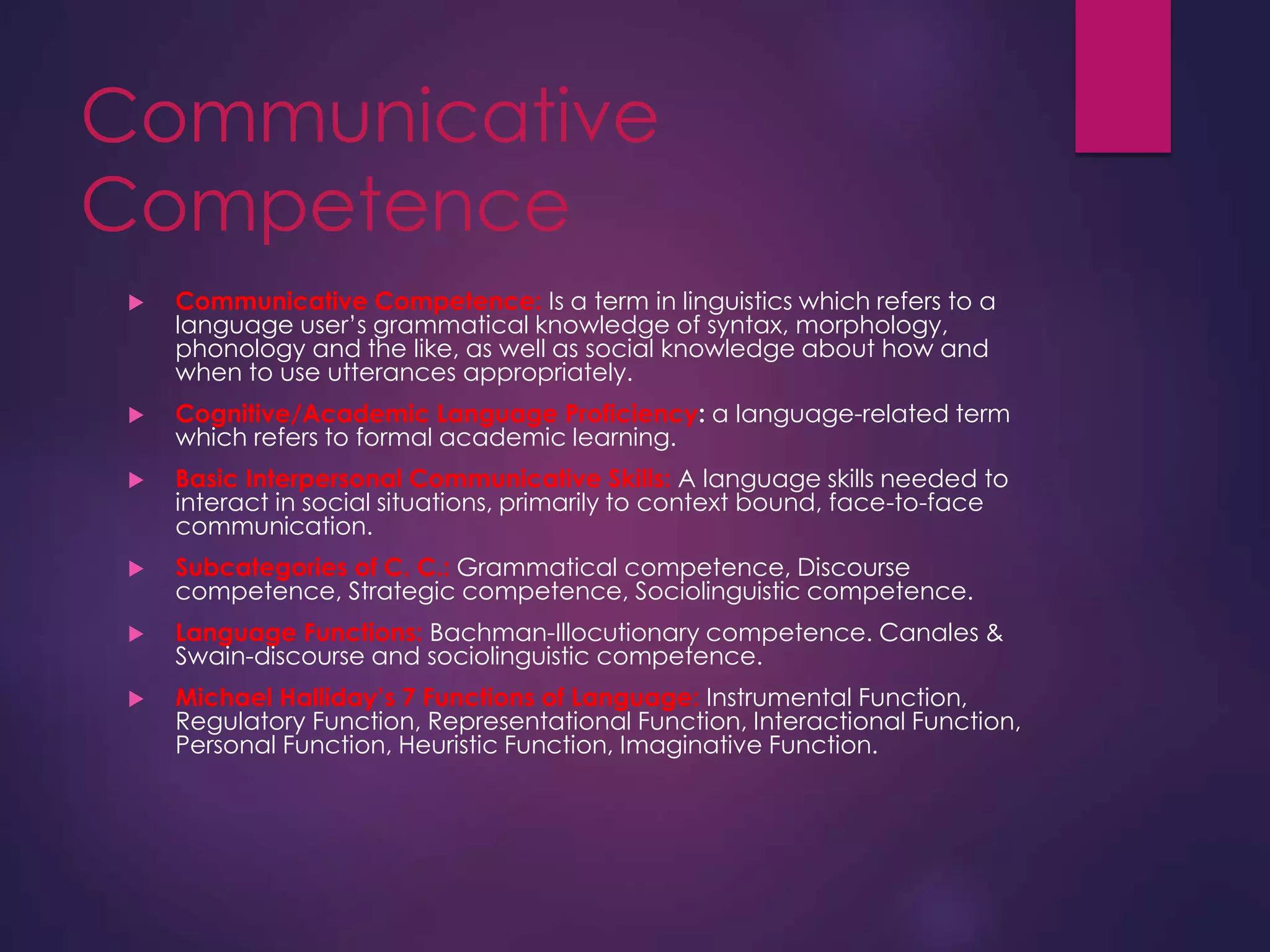
 Communicative Competence: Is a term in linguistics which refers to a
language user’s grammatical knowledge of syntax, morphology,
phonology and the like, as well as social knowledge about how and
when to use utterances appropriately.
 Cognitive/Academic Language Proficiency: a language-related term
which refers to formal academic learning.
 Basic Interpersonal Communicative Skills: A language skills needed to
interact in social situations, primarily to context bound, face-to-face
communication.
 Subcategories of C. C.: Grammatical competence, Discourse
competence, Strategic competence, Sociolinguistic competence.
 Language Functions: Bachman-Illocutionary competence. Canales &
Swain-discourse and sociolinguistic competence.
 Michael Halliday’s 7 Functions of Language: Instrumental Function,
Regulatory Function, Representational Function, Interactional Function,
Personal Function, Heuristic Function, Imaginative Function.
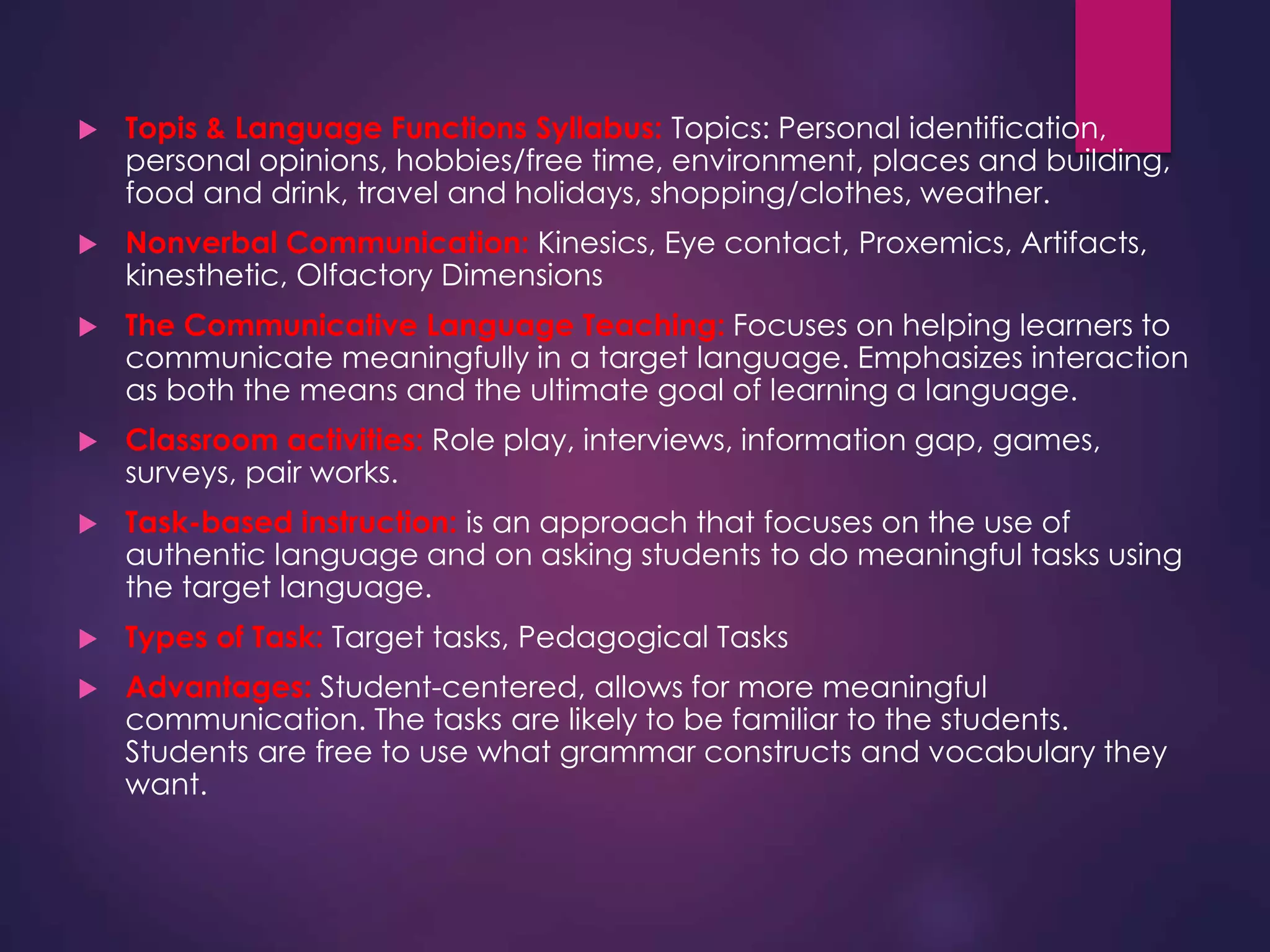
 Topis & Language Functions Syllabus: Topics: Personal identification,
personal opinions, hobbies/free time, environment, places and building,
food and drink, travel and holidays, shopping/clothes, weather.
 Nonverbal Communication: Kinesics, Eye contact, Proxemics, Artifacts,
kinesthetic, Olfactory Dimensions
 The Communicative Language Teaching: Focuses on helping learners to
communicate meaningfully in a target language. Emphasizes interaction
as both the means and the ultimate goal of learning a language.
 Classroom activities: Role play, interviews, information gap, games,
surveys, pair works.
 Task-based instruction: is an approach that focuses on the use of
authentic language and on asking students to do meaningful tasks using
the target language.
 Types of Task: Target tasks, Pedagogical Tasks
 Advantages: Student-centered, allows for more meaningful
communication. The tasks are likely to be familiar to the students.
Students are free to use what grammar constructs and vocabulary they
want.
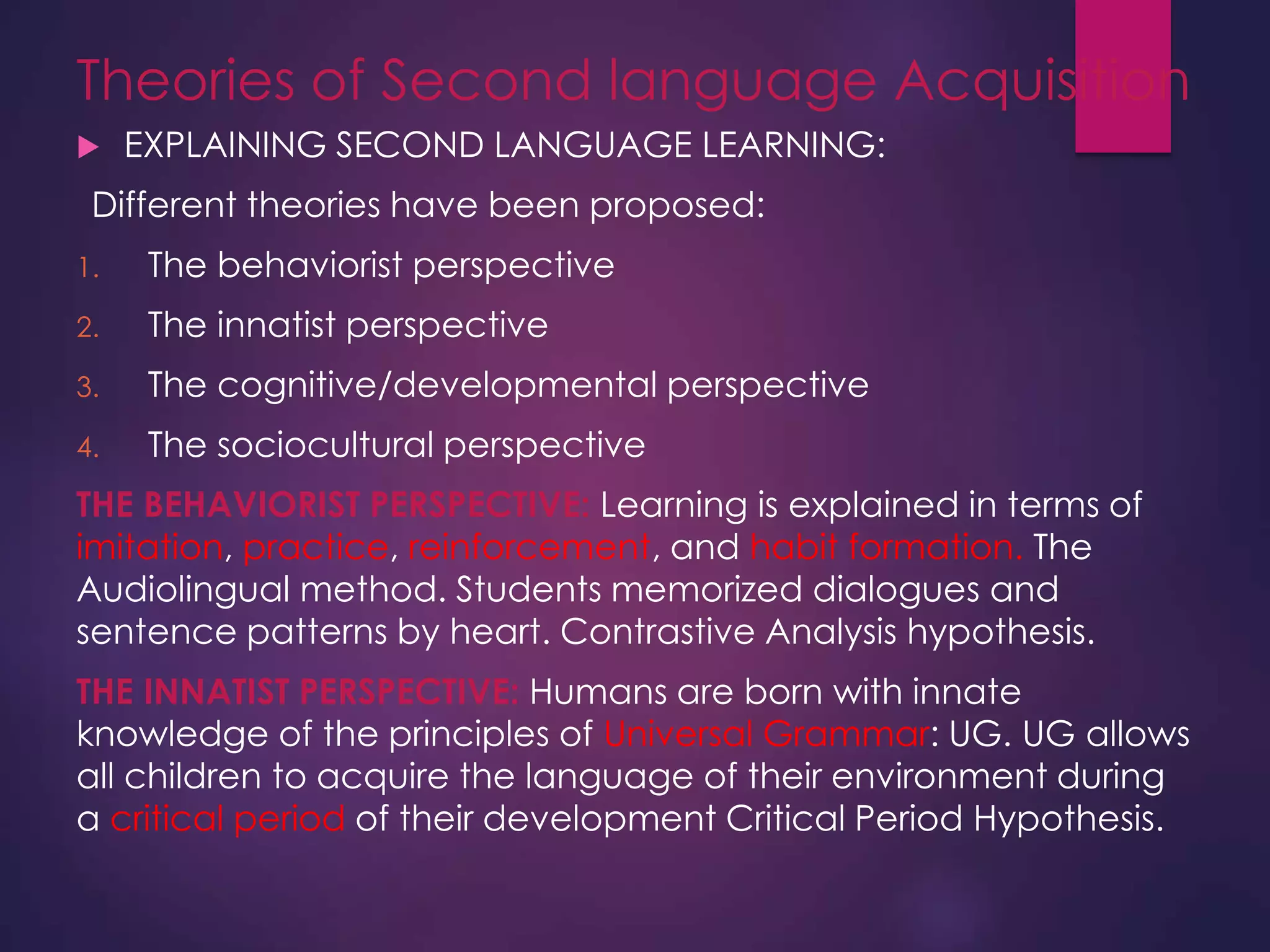
Theories of Second language Acquisition
 EXPLAINING SECOND LANGUAGE LEARNING:
Different theories have been proposed:
1. The behaviorist perspective
2. The innatist perspective
3. The cognitive/developmental perspective
4. The sociocultural perspective
THE BEHAVIORIST PERSPECTIVE: Learning is explained in terms of
imitation, practice, reinforcement, and habit formation. The
Audiolingual method. Students memorized dialogues and
sentence patterns by heart. Contrastive Analysis hypothesis.
THE INNATIST PERSPECTIVE: Humans are born with innate
knowledge of the principles of Universal Grammar: UG. UG allows
all children to acquire the language of their environment during
a critical period of their development Critical Period Hypothesis.
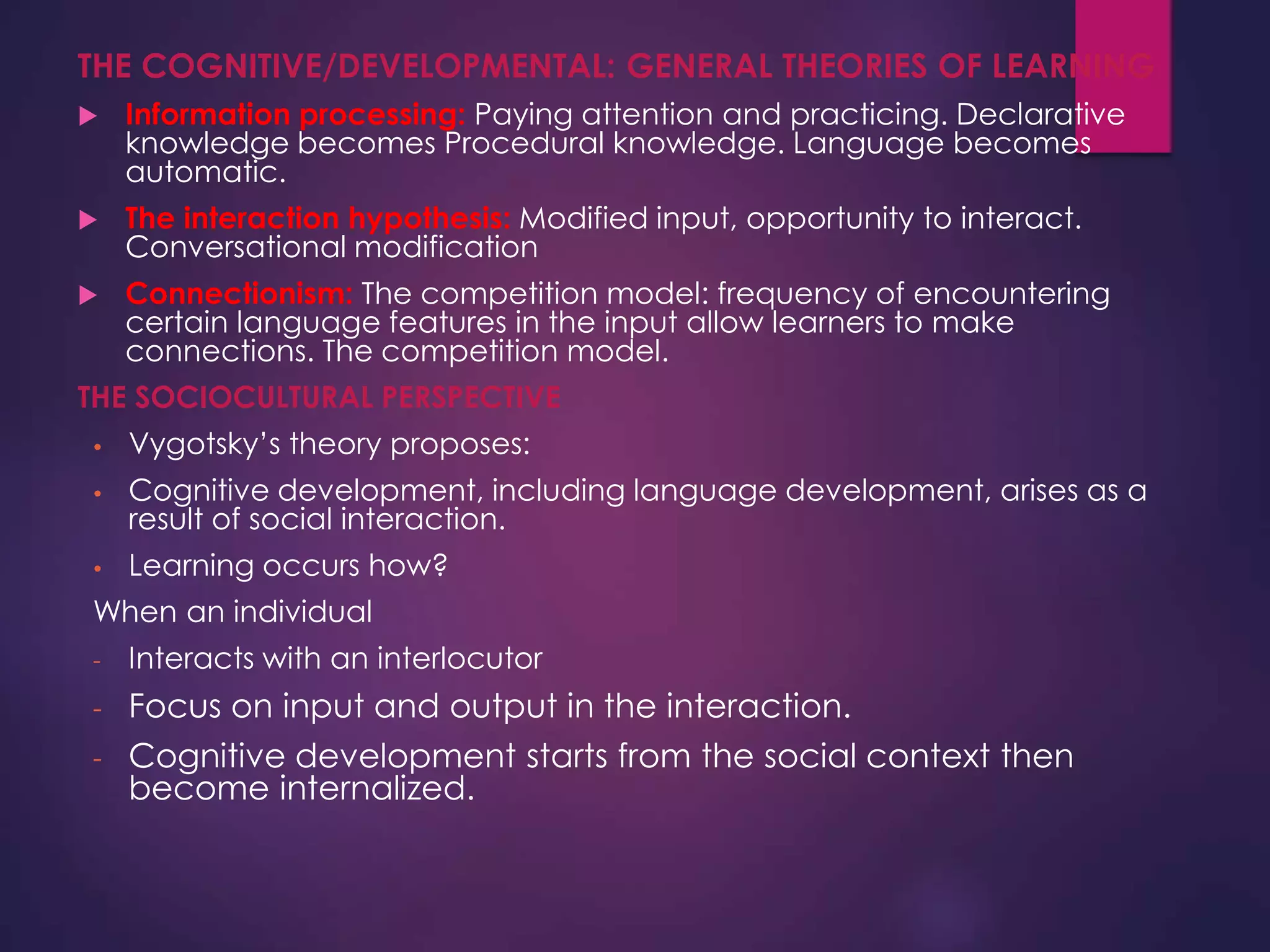
THE COGNITIVE/DEVELOPMENTAL: GENERAL THEORIES OF LEARNING
 Information processing: Paying attention and practicing. Declarative
knowledge becomes Procedural knowledge. Language becomes
automatic.
 The interaction hypothesis: Modified input, opportunity to interact.
Conversational modification
 Connectionism: The competition model: frequency of encountering
certain language features in the input allow learners to make
connections. The competition model.
THE SOCIOCULTURAL PERSPECTIVE
• Vygotsky’s theory proposes:
• Cognitive development, including language development, arises as a
result of social interaction.
• Learning occurs how?
When an individual
- Interacts with an interlocutor
- Focus on input and output in the interaction.
- Cognitive development starts from the social context then
become internalized.

Principles of language learning and teaching

  • 1.
    PRINCIPLES OF LANGUAGELEARNING AND TEACHING BY KARINA PÉREZ LANGUAGE ACQUISITION
  • 2.
    CHAPTERS 1. Language, Learning,and Teaching 2. First Language Acquisition 3. Age and Acquisition 4. Human Learning 5. Styles and Strategies 6. Personality Factors 7. Sociocultural Factors 8. Cross-Linguistic Influence and Learner Language 9. Communicative Competence 10. Theories of Second Language Acquisition
  • 3.
    Language, Learning, and Teaching Current Issues in Second Language Acquisition  Language Learning and Teaching Schools of Thought in Second Language Acquisition  Structuralism/Behaviorism Rationalism and Cognitive  Psychology Constructivism Language Teaching  Methodology In the Classroom: The Grammar Translation Method
  • 4.
    First Language Acquisition Theories of First Language Acquisition  Competence and Performance  Comprehension and Productions Nature or Nurture  Universals Systematicity and Variability Language and Thought Imitation Practice Input Discourse In the Classroom: Gouin and Berlitz The First Reformers Topics and Questions for Study and Discussion Suggested Readings Language Learning Experience: Journal Entry
  • 5.
    Age and Acquisition Dispelling Myths  Types of Comparison and Contrast  The Critical Period Hypothesis  Neurological Considerations  Hemispheric Lateralization  Biological Timetables  Right-Hemispheric  Participation Anthropological  Evidence The Significance of Accent  Cognitive Considerations  Affective Considerations  Linguistic Considerations  Bilingualism Interference Between First and Second Language  Interference in Adults  Order of Acquisition  Issues in First Language Acquisition Revisited In the Classroom: The Audiolingual Method Topics and Questions for Study and Discussion
  • 6.
    Human Learning  Learningand Training  Pavlovs Classical  Behaviorism Skinners  Operant Conditioning  Ausubels Meaningful  Learning Theory  Systematic Forgetting  Rogerss Humanistic Psychology  Types of Learning Transfer, Interference, and Overgeneralization  Inductive and Deductive Reasoning  Aptitude and Intelligence In the Classroom: The Designer Methods of the 1970s
  • 7.
    Styles and Strategies Process, Style, and Strategy  Learning Styles  Field Independence  Left- and Right-Brain  Functioning Ambiguity  Tolerance Reflectivity and Impulsivity  Visual and Auditory Styles  Strategies Learning  Strategies Communication S  trategies Avoidance  Strategies Compensatory  Strategies-Based Instruction In the Classroom: Styles and Strategies in Practice
  • 8.
    Personality Factors  TheAffective Domain  Self-Esteem  Inhibition  Risk-Taking Anxiety Empathy  Extroversion  Myers-Briggs Character  Types Motivation  Instrumental and Integrative Orientations  Intrinsic and Extrinsic Motivation  The Neurobiology of Affect  Measuring Affective Factors In the Classroom: Putting Methods into Perspective Topics and Questions for Study and Discussion
  • 9.
    Sociocultural Factors  Culture:establishes for each person a context of cognitive and effective behavior, a template for personal and social existence.  Stereotype: If people recognize and understand differing world views, they will usually adopt a positive and open-minded attitude toward cross-cultural differences.  Attitudes: like all aspects of cognitive development, develop in early childhood and are a result of parents’ and peers’ attitudes, of contacts with people from different life styles.  Second Culture Acquisition: Most learners of a second language learn the language with very little sense of the culture of its speakers. A foreign language course should present culture as a list of facts to be cognitively consumed.  Acculturation: Second language learning involves the acquisition of a second identity. Creation a new identity is in the very heart of culture learning, Acculturation.  Culture in the Classroom: Stevick learners can feel alienation in the process of learning a second language, alienation from people in their home, culture, the target culture, and from themselves.
  • 10.
    Cross-Linguistic Influence and LearnerLanguage  Deeply rooted in the behavioristic and structuralist approaches, the CAH claimed that the principal barrier to L2 is the interference of L1system with the 2nd system.  Categories of hierarchy of difficulty:  Level 0. No difference or contrast is present between the two languages. Level 1 – coalescence two items in the native language become coalesced into essentially one item in the target language.  Level 2 Underdifferentiation –an item in the native language is absent in the target language. Level  3 Reinterpretation –an item that exists in the native language is given a new shape or distribution. Level  4. Overdifferentiation –a new item entirely, bearing any similarity to the native language item, must be learned. Level  5. Split –one item in the native language becomes two or more in the target language requiring the learner to make a new distinction.
  • 11.
    From the TheContrastive Analysis Hypothesis to Cross- Linguistic Influence  Predictions of difficulty by means of contrastive procedures had many shortcomings. The process could not account for all linguistic problems or situations not even with the 6 categories. Lastly, the predictions of difficulty level could not be verified with reliability.  Syntactic , lexical, and semantic interference show far more variation among learners than psycho-motor-based pronunciation interference.  It accounted for degrees of principles of universal grammar. Eckman showed that marked items in a language will be more difficult to acquire than unmarked, and that degree of markedness will correspond to degrees of difficulty  The most obvious approach to analyzing interlanguage is to study the speech and writing of learners –learner language  The matter of how to correct errors is exceedingly complex.  Research on error correction methods is not at all conclusive about the most effective method or technique for error correction.  It seems quite clear that students in the classroom want and expect errors to be corrected.  Flow chart as an example of error treatment in a classroom
  • 12.
    Communicative Competence  Communicative Competence:Is a term in linguistics which refers to a language user’s grammatical knowledge of syntax, morphology, phonology and the like, as well as social knowledge about how and when to use utterances appropriately.  Cognitive/Academic Language Proficiency: a language-related term which refers to formal academic learning.  Basic Interpersonal Communicative Skills: A language skills needed to interact in social situations, primarily to context bound, face-to-face communication.  Subcategories of C. C.: Grammatical competence, Discourse competence, Strategic competence, Sociolinguistic competence.  Language Functions: Bachman-Illocutionary competence. Canales & Swain-discourse and sociolinguistic competence.  Michael Halliday’s 7 Functions of Language: Instrumental Function, Regulatory Function, Representational Function, Interactional Function, Personal Function, Heuristic Function, Imaginative Function.
  • 13.
     Topis &Language Functions Syllabus: Topics: Personal identification, personal opinions, hobbies/free time, environment, places and building, food and drink, travel and holidays, shopping/clothes, weather.  Nonverbal Communication: Kinesics, Eye contact, Proxemics, Artifacts, kinesthetic, Olfactory Dimensions  The Communicative Language Teaching: Focuses on helping learners to communicate meaningfully in a target language. Emphasizes interaction as both the means and the ultimate goal of learning a language.  Classroom activities: Role play, interviews, information gap, games, surveys, pair works.  Task-based instruction: is an approach that focuses on the use of authentic language and on asking students to do meaningful tasks using the target language.  Types of Task: Target tasks, Pedagogical Tasks  Advantages: Student-centered, allows for more meaningful communication. The tasks are likely to be familiar to the students. Students are free to use what grammar constructs and vocabulary they want.
  • 14.
    Theories of Secondlanguage Acquisition  EXPLAINING SECOND LANGUAGE LEARNING: Different theories have been proposed: 1. The behaviorist perspective 2. The innatist perspective 3. The cognitive/developmental perspective 4. The sociocultural perspective THE BEHAVIORIST PERSPECTIVE: Learning is explained in terms of imitation, practice, reinforcement, and habit formation. The Audiolingual method. Students memorized dialogues and sentence patterns by heart. Contrastive Analysis hypothesis. THE INNATIST PERSPECTIVE: Humans are born with innate knowledge of the principles of Universal Grammar: UG. UG allows all children to acquire the language of their environment during a critical period of their development Critical Period Hypothesis.
  • 15.
    THE COGNITIVE/DEVELOPMENTAL: GENERALTHEORIES OF LEARNING  Information processing: Paying attention and practicing. Declarative knowledge becomes Procedural knowledge. Language becomes automatic.  The interaction hypothesis: Modified input, opportunity to interact. Conversational modification  Connectionism: The competition model: frequency of encountering certain language features in the input allow learners to make connections. The competition model. THE SOCIOCULTURAL PERSPECTIVE • Vygotsky’s theory proposes: • Cognitive development, including language development, arises as a result of social interaction. • Learning occurs how? When an individual - Interacts with an interlocutor - Focus on input and output in the interaction. - Cognitive development starts from the social context then become internalized.