


LET’S CLIL
SESSION 1
Definition and advantages

Let's CLIL!


‘The best teachers
are those who
equip students to
THINK for
themselves’

Let's CLIL!
CONTENTS





CLIL Definition
Does CLIL work?
CLIL Advantages & Drawbacks

Let's CLIL!
CLIL DEFINITION

Let's CLIL!
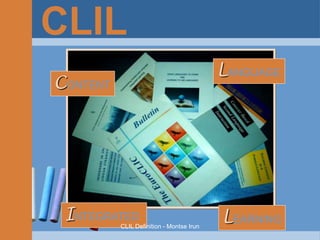
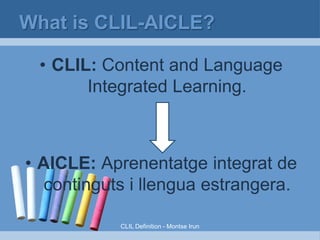
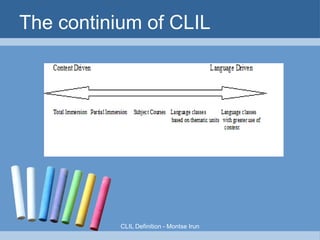
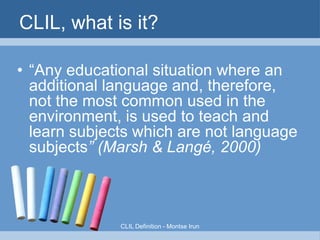
CLIL DEFINITION


LANGUAGE

CONTENT

INTEGRATED

Let's CLIL!

LEARNING
CLIL is NOT:






Backdoor language
teaching
Additional subject
teaching
A way of ‘dumbing
down’ the subject
content

Let's CLIL!
CLIL is NOT








A threat to subject
specialism
Elitist and only for
more able students
For foreign
teachers
Teaching what
students already
know
Let's CLIL!
CLIL is:
“CLIL is dual–focussed encompassing both subject
or thematic and language development although,
depending on the context and variables within,
there may be a predominance of one over the
other but never to exclusion.
However, it is the interpretation of the integration
of content and language in CLIL which has major
implications for and impact on the development of
CLIL pedagogies. “
Do Coyle
Let's CLIL!
CLIL is flexible
“CLIL models are by no
means uniform. They are
elaborated at a local level to
respond to local conditions
and desires. Indeed the
characteristics
of
CLIL
development
in
Europe
show a great variety of
solutions. ... It is the
combination of the choices
with respect to the variables
that produces a particular
CLIL project.
Let's CLIL!
Coonan (2003, 27)
THERE IS NO


specific CLIL
pedagogy (research
beginning to emerge)



prescriptive model
for planning CLIL
modules and lessons
in (dependent on
different contexts)

Let's CLIL!
THERE ARE

 pedagogical principles underlying CLIL
 several tools to help ensure that some of the
shared principles are observed despite CLIL’s
inherent flexibility
Let's CLIL!
ACRONYMS

Let's CLIL!
TEACHING IN L1 OR IN FL

Let's CLIL!
TEACHING IN L1 OR IN FL?

Let's CLIL!
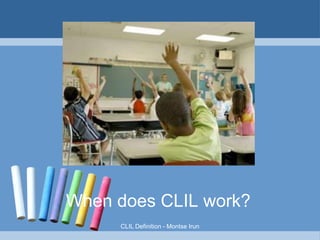
WHEN DOES CLIL WORK?

Let's CLIL!
It works if...


Foreign language is learnt.



Subject content is learnt.



First languages are not affected in a
negative way.
Let's CLIL!
Does it affect L1 in a negative
way?

No
L1 is already developed or
not affected at secondary level
Let's CLIL!
Do students learn FL?
3 essential conditions to learn a
language





Long time of exposition to the language.
Attention to the content of the message.
 Have the possibility of saying what you
would like to say.
Possibilities of interaction
 With “experts”
 With “equals”
Let's CLIL!
Do students learn FL?
2 more conditions that help ...



Intense exposition to the language
Introduction of adjustments that help
students to understand the relationship
between
meaning and form
Let's CLIL!
Do students learn FL?

Yes
The three essential
conditions are fulfilled.

Let's CLIL!
Do students learn content?

Yes ...
... If

adjustments and scalfolding
necessary for understanding
and conveying information are introduced.
Let's CLIL!
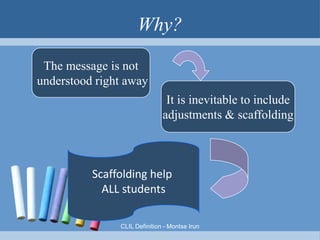
Why?
The message is not
understood right away
It is inevitable to include
adjustments & scaffolding

Scaffolding help
ALL students
Let's CLIL!
ADVANTAGES AND
DISADVANTAGES
Let's CLIL!
ADVANTAGES & DISADVANTAGES?

Let's CLIL!
ADVANTAGES









A natural way of learning a language
Different Children, Different Learning Style
A real way of approaching a language
Fosters the language and Thinking Skills
Social and cultural dimensions that CLIL
offers
Its ICT potential
A good way of approaching the curriculum
Let's CLIL!
Better than L1 subject teaching?






Methodology in FL is more
elaborate/considered than the
‘assumptive’ teaching typical of L1
classrooms.
Use of a wider range of task-types to
make sure people understand!
Students make more cognitive effort
Let's CLIL!
DRAWBACKS










Lack of linguistic competence in English
Lack of materials
Not all pupils feel motivated to learn a FL.
Not all workmates and parents see a need
to foster CLIL methodology
No clear preference for any particular
subjects
The need for teacher training more focused
on CLIL
Let's CLIL!
ASSIGNMENT

Let's CLIL!
BUILDING YOUR MINDMAP

Let's CLIL!
FURTHER READING

Let's CLIL!
Let's CLIL!

CLIL 1: What is it? Advantages and Drawbacks

  • 1.
    LET’S CLIL SESSION 1 Definitionand advantages Let's CLIL!
  • 2.
     ‘The best teachers arethose who equip students to THINK for themselves’ Let's CLIL!
  • 3.
    CONTENTS    CLIL Definition Does CLILwork? CLIL Advantages & Drawbacks Let's CLIL!
  • 4.
  • 5.
  • 6.
    CLIL is NOT:    Backdoorlanguage teaching Additional subject teaching A way of ‘dumbing down’ the subject content Let's CLIL!
  • 7.
    CLIL is NOT     Athreat to subject specialism Elitist and only for more able students For foreign teachers Teaching what students already know Let's CLIL!
  • 8.
    CLIL is: “CLIL isdual–focussed encompassing both subject or thematic and language development although, depending on the context and variables within, there may be a predominance of one over the other but never to exclusion. However, it is the interpretation of the integration of content and language in CLIL which has major implications for and impact on the development of CLIL pedagogies. “ Do Coyle Let's CLIL!
  • 9.
    CLIL is flexible “CLILmodels are by no means uniform. They are elaborated at a local level to respond to local conditions and desires. Indeed the characteristics of CLIL development in Europe show a great variety of solutions. ... It is the combination of the choices with respect to the variables that produces a particular CLIL project. Let's CLIL! Coonan (2003, 27)
  • 10.
    THERE IS NO  specificCLIL pedagogy (research beginning to emerge)  prescriptive model for planning CLIL modules and lessons in (dependent on different contexts) Let's CLIL!
  • 11.
    THERE ARE  pedagogicalprinciples underlying CLIL  several tools to help ensure that some of the shared principles are observed despite CLIL’s inherent flexibility Let's CLIL!
  • 12.
  • 13.
    TEACHING IN L1OR IN FL Let's CLIL!
  • 14.
    TEACHING IN L1OR IN FL? Let's CLIL!
  • 15.
    WHEN DOES CLILWORK? Let's CLIL!
  • 16.
    It works if...  Foreignlanguage is learnt.  Subject content is learnt.  First languages are not affected in a negative way. Let's CLIL!
  • 17.
    Does it affectL1 in a negative way? No L1 is already developed or not affected at secondary level Let's CLIL!
  • 18.
    Do students learnFL? 3 essential conditions to learn a language    Long time of exposition to the language. Attention to the content of the message.  Have the possibility of saying what you would like to say. Possibilities of interaction  With “experts”  With “equals” Let's CLIL!
  • 19.
    Do students learnFL? 2 more conditions that help ...   Intense exposition to the language Introduction of adjustments that help students to understand the relationship between meaning and form Let's CLIL!
  • 20.
    Do students learnFL? Yes The three essential conditions are fulfilled. Let's CLIL!
  • 21.
    Do students learncontent? Yes ... ... If adjustments and scalfolding necessary for understanding and conveying information are introduced. Let's CLIL!
  • 22.
    Why? The message isnot understood right away It is inevitable to include adjustments & scaffolding Scaffolding help ALL students Let's CLIL!
  • 23.
  • 24.
  • 25.
    ADVANTAGES        A natural wayof learning a language Different Children, Different Learning Style A real way of approaching a language Fosters the language and Thinking Skills Social and cultural dimensions that CLIL offers Its ICT potential A good way of approaching the curriculum Let's CLIL!
  • 26.
    Better than L1subject teaching?    Methodology in FL is more elaborate/considered than the ‘assumptive’ teaching typical of L1 classrooms. Use of a wider range of task-types to make sure people understand! Students make more cognitive effort Let's CLIL!
  • 27.
    DRAWBACKS       Lack of linguisticcompetence in English Lack of materials Not all pupils feel motivated to learn a FL. Not all workmates and parents see a need to foster CLIL methodology No clear preference for any particular subjects The need for teacher training more focused on CLIL Let's CLIL!
  • 28.
  • 29.
  • 30.
  • 31.