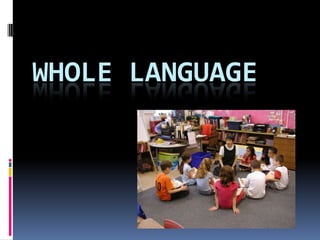
WHOLE LANGUAGE
How does it relate to other
theories and approaches?
 Emphasizes the importance of meaning and
  meaning making in teaching and learning.

 Is designed to help children and adults learn a
  second language in the same way that
  children learn their first language.

 It is seen as an approach based on the
  principle that it uses the4 main skills.
Approach: theory of language
and of learning.
 Language is a vehicle for human
  communication in which there is a
  relationship between readers and writers.


                                  Real
                Authenticity
                               situations


                          Social
                         practice
   It is authentic.
   Personalized
   Self-directed
   Collaborative
   Pluralistic

KNOWLEDGE IS SOCIALY CONSTRUCTED,
  RATHER THAN RECEIVED OR DISCOVERED.

Teacher collaborates to create knowledge using
  students’ experience, needs, interests, and
  aspirations.
Teacher’s role:
 Facilitator and active participant in the
  learning community.
 Looks for the occurrence of teachable
  moments. (no preplanned lesson plan or
  script)
 Negociates a plan of work with
 the learners.
Student’s role:


 Is a collaborator
 Evaluator
 His learning experiences are used as
   resources for learning.
 Selectors of learning materials and activities.
(real world materials)
How would you use it?

Features:
   Literature
   Process of writing
   Encouragement of cooperative learning among ss.
   Concern for ss’ attitude.
Activities:
   Individual and small group reading and writing.
   Ungraded dialogue journals
   Writing portfolios
   Writing conferences
   Student-made books
   Story writing                     (not based on a topic)
Advantages:

 Activities are meaningful.
 Facilitates the development of all aspects of a
  sencond language.
Critics:

 Anti-direct teaching
 Anti-skills
 Anti-materials.
(authentic text are
sufficient ot support
second
language teaching)
Any questions?


THANK YOU FOR YOUR ATTENTION

Whole language

  • 1.
  • 3.
    How does itrelate to other theories and approaches?  Emphasizes the importance of meaning and meaning making in teaching and learning.  Is designed to help children and adults learn a second language in the same way that children learn their first language.  It is seen as an approach based on the principle that it uses the4 main skills.
  • 4.
    Approach: theory oflanguage and of learning.  Language is a vehicle for human communication in which there is a relationship between readers and writers. Real Authenticity situations Social practice
  • 5.
    It is authentic.  Personalized  Self-directed  Collaborative  Pluralistic KNOWLEDGE IS SOCIALY CONSTRUCTED, RATHER THAN RECEIVED OR DISCOVERED. Teacher collaborates to create knowledge using students’ experience, needs, interests, and aspirations.
  • 7.
    Teacher’s role:  Facilitatorand active participant in the learning community.  Looks for the occurrence of teachable moments. (no preplanned lesson plan or script)  Negociates a plan of work with  the learners.
  • 8.
    Student’s role:  Isa collaborator  Evaluator  His learning experiences are used as resources for learning.  Selectors of learning materials and activities. (real world materials)
  • 9.
    How would youuse it? Features:  Literature  Process of writing  Encouragement of cooperative learning among ss.  Concern for ss’ attitude. Activities:  Individual and small group reading and writing.  Ungraded dialogue journals  Writing portfolios  Writing conferences  Student-made books  Story writing (not based on a topic)
  • 10.
    Advantages:  Activities aremeaningful.  Facilitates the development of all aspects of a sencond language.
  • 11.
    Critics:  Anti-direct teaching Anti-skills  Anti-materials. (authentic text are sufficient ot support second language teaching)
  • 12.
    Any questions? THANK YOUFOR YOUR ATTENTION