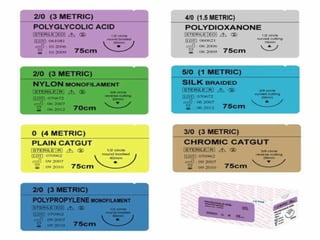
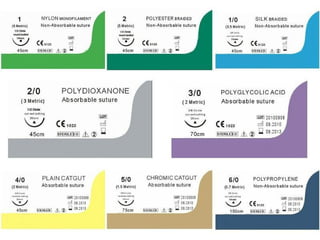
SUTURE MATERIALS
Dr. HASEEB MANZOOR
Department of Surgery
JMCH Karachi
SUTURE :
The word “suture” describes any strand of
material used to approximate (sew) tissues or
ligate (tie) blood vessels.
All sutures are foreign bodies and impact the
wound healing.
WHAT DO WE NEED ?
•THREAD
•NEEDLE
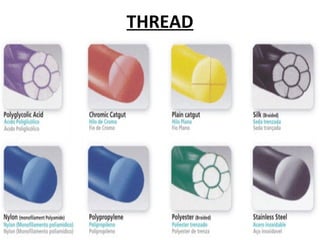
THREAD
The “Ideal” Suture thread
1.Universal applicability- only difference in
diameter
2.Limp- easy to handle, no kinks, coiling,
twisting, or levitating
3.Inert- Minimal tissue reaction
4.Strong- High tensile strength
5.Frictionless surface to glide through tissue-
minimal trauma
6.High friction for secure knotting
7.Sterlizable without composition changes
8. Resists bacterial growth
9. Capable of holding tissue layers throughout
the wound healing
10.Complete absorption, no residue, after
healing is complete- no matter how long it
takes
11.Nonelectrolytic, nonferromagnetic,
noncapillary, nonallergenic, noncarcinogenic.
12.Cost effective
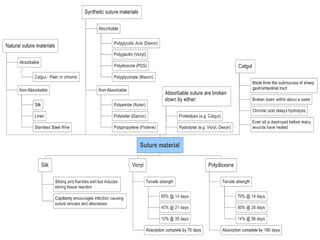
Classification of suturing threads :
According to Absorbability :
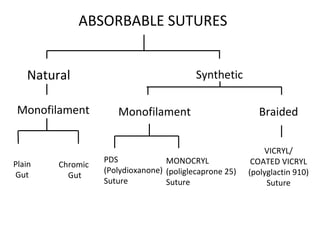
Absorbable
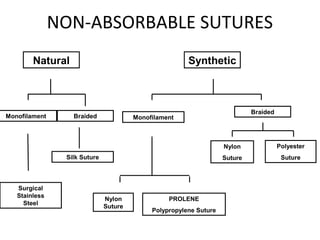
Non-absorbable
According to Raw material :
Natural
Synthetic
According to Structure :
Monofilament
Multifilament/braided
Absorbable Sutures :
•Lose 50% of breaking strength within 60 days
of implanting
•Absorbable sutures will eventually dissolve,
absorb into the tissue, and become
unidentifiable
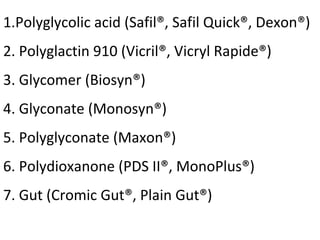
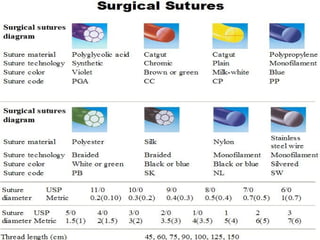
1.Polyglycolic acid (Safil®, Safil Quick®, Dexon®)
2. Polyglactin 910 (Vicril®, Vicryl Rapide®)
3. Glycomer (Biosyn®)
4. Glyconate (Monosyn®)
5. Polyglyconate (Maxon®)
6. Polydioxanone (PDS II®, MonoPlus®)
7. Gut (Cromic Gut®, Plain Gut®)
Non-Absorbable Sutures:
•Retain majority of breaking strength for more
than 60 days
•Non-absorbable sutures are permanent
fixtures in the body and, when properly tied or
secured, will remain intact indefinitely.
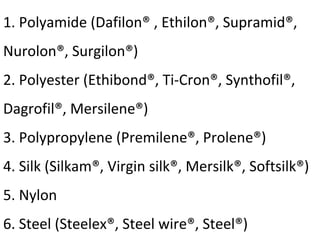
1. Polyamide (Dafilon® , Ethilon®, Supramid®,
Nurolon®, Surgilon®)
2. Polyester (Ethibond®, Ti-Cron®, Synthofil®,
Dagrofil®, Mersilene®)
3. Polypropylene (Premilene®, Prolene®)
4. Silk (Silkam®, Virgin silk®, Mersilk®, Softsilk®)
5. Nylon
6. Steel (Steelex®, Steel wire®, Steel®)
Natural Sutures :
•Sutures made of material that can be found in
nature
•Cause intense inflammatory reaction
•Examples : Cat gut, Silk, Steel
Synthetic Sutures:
•Sutures made of materials created by man
•Examples : Vicryl, monocryl, PDS, Nylon,
Prolene, Polyester
Monofilament
•Consists of a single strand of material
•passes through tissues easily - less traumatic
•Resists bacterial harboring
•require more knots to prevent slippage - 5 or 6
‘throws’
•Has more “memory”
•Preferred for skin closure because they provide
a better cosmetic result
•Examples : chromic gut, plain gut, stainless
steel, prolene, nylon
Multifilament/Braided:
•consist of several filaments or strands, twisted
or braided together
•Greater tensile strength
•Pliability and flexibility
•Better knot security
•More tissue trauma
•may harbor bacteria
•Examples : vicryl, silk, polyester, nylon
Natural
Plain
Gut
Chromic
Gut
Monofilament
Synthetic
ABSORBABLE SUTURES
PDS
(Polydioxanone)
Suture
Monofilament Braided
MONOCRYL
(poliglecaprone 25)
Suture
VICRYL/
COATED VICRYL
(polyglactin 910)
Suture
Natural
BraidedMonofilament
Surgical
Stainless
Steel
Silk Suture
Synthetic
Polyester
Suture
Braided
Monofilament
Nylon
Suture
PROLENE
Polypropylene Suture
Nylon
Suture
NON-ABSORBABLE SUTURES
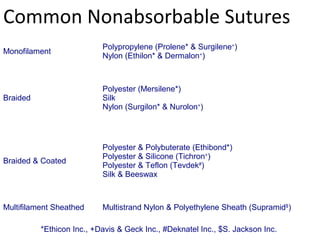
Common Nonabsorbable Sutures
Monofilament
Polypropylene (Prolene* & Surgilene+
)
Nylon (Ethilon* & Dermalon+
)
Braided
Polyester (Mersilene*)
Silk
Nylon (Surgilon* & Nurolon+
)
Braided & Coated
Polyester & Polybuterate (Ethibond*)
Polyester & Silicone (Tichron+
)
Polyester & Teflon (Tevdek#
)
Silk & Beeswax
Multifilament Sheathed Multistrand Nylon & Polyethylene Sheath (Supramid$
)
*Ethicon Inc., +Davis & Geck Inc., #Deknatel Inc., $S. Jackson Inc.
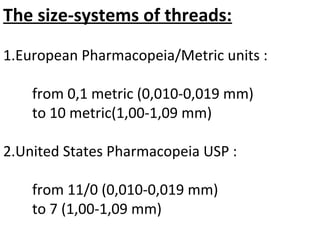
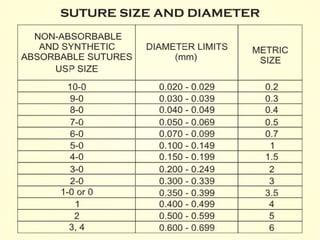
The size-systems of threads:
1.European Pharmacopeia/Metric units :
from 0,1 metric (0,010-0,019 mm)
to 10 metric(1,00-1,09 mm)
2.United States Pharmacopeia USP :
from 11/0 (0,010-0,019 mm)
to 7 (1,00-1,09 mm)
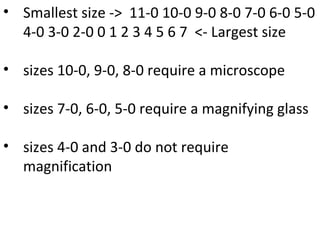
• Smallest size -> 11-0 10-0 9-0 8-0 7-0 6-0 5-0
4-0 3-0 2-0 0 1 2 3 4 5 6 7 <- Largest size
• sizes 10-0, 9-0, 8-0 require a microscope
• sizes 7-0, 6-0, 5-0 require a magnifying glass
• sizes 4-0 and 3-0 do not require
magnification
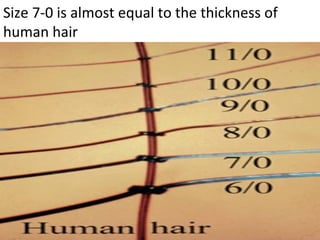
Size 7-0 is almost equal to the thickness of
human hair
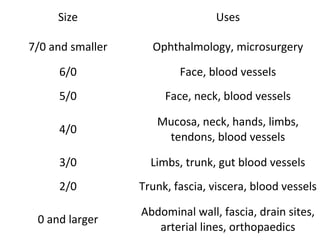
Size Uses
7/0 and smaller Ophthalmology, microsurgery
6/0 Face, blood vessels
5/0 Face, neck, blood vessels
4/0
Mucosa, neck, hands, limbs,
tendons, blood vessels
3/0 Limbs, trunk, gut blood vessels
2/0 Trunk, fascia, viscera, blood vessels
0 and larger
Abdominal wall, fascia, drain sites,
arterial lines, orthopaedics
• Absorbable sutures elicit more inflammatory
reaction than non-absorbable sutures
• Absorption method :
Natural Sutures - Enzymatic
Synthetic Sutures – Hydrolysis
• Natural sutures induce more inflammation
than synthetic ones
Plasticity :
Ability to expand when stretched and don’t
return to original length (loosen with edema)
Elasticity :
Ability to return to its original length after
stretching
High elasticity sutures should be used in
oedematous tissue
Fluid absorption and capillary action :
the tendency for a suture to absorb water and
to wick infection
breaking strength rate (BSR) :
Approximate days after placement when 50% of
breaking strength remains.
Tensile strength :
Force necessary to break a suture
consider in areas of tension (linea alba)
Knot strength :
Force required for a knot to slip
consider when ligating arteries
Memory :
tendancy to return to original shape (untied)
Tendency to stay in one position
Leads to difficulty in tying sutures
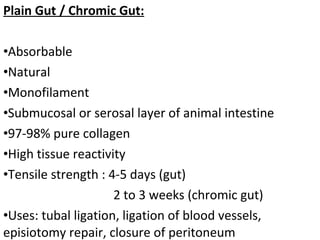
Plain Gut / Chromic Gut:
•Absorbable
•Natural
•Monofilament
•Submucosal or serosal layer of animal intestine
•97-98% pure collagen
•High tissue reactivity
•Tensile strength : 4-5 days (gut)
2 to 3 weeks (chromic gut)
•Uses: tubal ligation, ligation of blood vessels,
episiotomy repair, closure of peritoneum
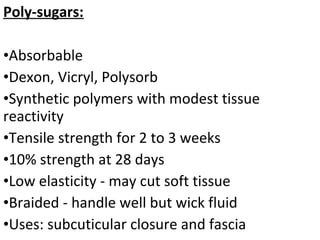
Poly-sugars:
•Absorbable
•Dexon, Vicryl, Polysorb
•Synthetic polymers with modest tissue
reactivity
•Tensile strength for 2 to 3 weeks
•10% strength at 28 days
•Low elasticity - may cut soft tissue
•Braided - handle well but wick fluid
•Uses: subcuticular closure and fascia
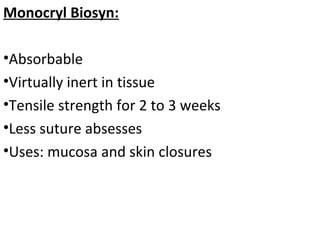
Monocryl Biosyn:
•Absorbable
•Virtually inert in tissue
•Tensile strength for 2 to 3 weeks
•Less suture absesses
•Uses: mucosa and skin closures
Silk:
•Non-absorbable
•Second only to gut for tissue inflammation
•Braided
•Best handling of any suture
•Lowest tensile strength of any suture
•Weaker when wet
Nylon:
•Non-absorbable
•Synthetic
•Mono/multifilament
•Surgilon, Ethilon, Dermalon
•Inert
•Pronounced memory - lots of knots
•Uses: skin closure, sewing in JP draines
Polypropylene:
•Non-absorbable
•Synthetic
•Monofilament
•Prolene, Surgilene, Surgipro
•Inert
•High placticity - expands to prevent strangulation,
but loosens when edema subsides
•Will stretch when pulled
•Elastic - requires extra knots
•Uses: wound closure
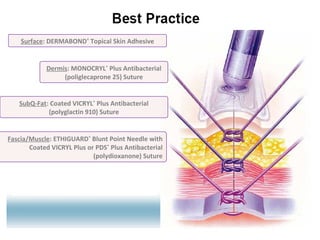
Surface: DERMABOND®
Topical Skin Adhesive
Dermis: MONOCRYL*
Plus Antibacterial
(poliglecaprone 25) Suture
SubQ-Fat: Coated VICRYL*
Plus Antibacterial
(polyglactin 910) Suture
Fascia/Muscle: ETHIGUARD*
Blunt Point Needle with
Coated VICRYL Plus or PDS*
Plus Antibacterial
(polydioxanone) Suture
NEEDLE
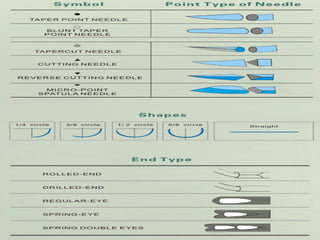
Shape of needle :
Curved
Designed to be held with a needle holder
Used for most suturing
Straight
Often hand held
Used to secure percutaneously placed devices
(e.g. central and arterial lines)
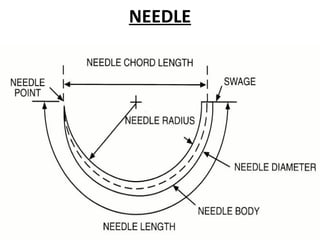
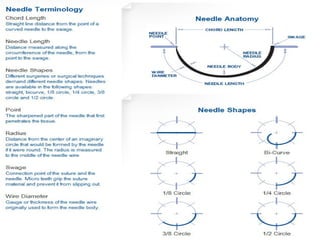
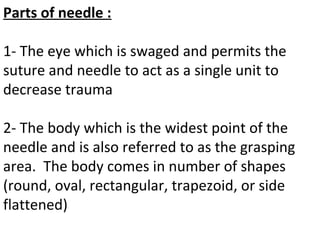
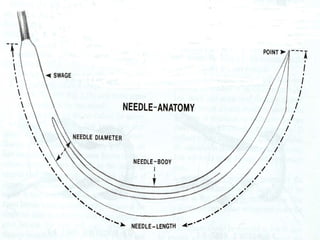
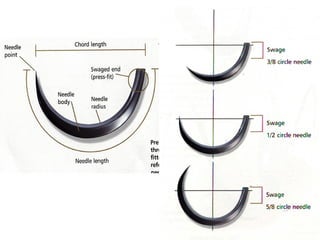
Parts of needle :
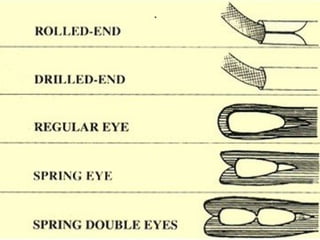
1- The eye which is swaged and permits the
suture and needle to act as a single unit to
decrease trauma
2- The body which is the widest point of the
needle and is also referred to as the grasping
area. The body comes in number of shapes
(round, oval, rectangular, trapezoid, or side
flattened)
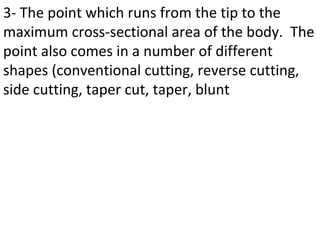
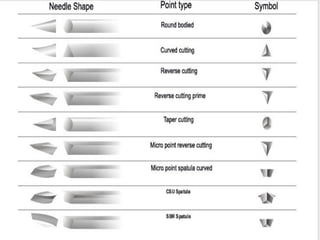
3- The point which runs from the tip to the
maximum cross-sectional area of the body. The
point also comes in a number of different
shapes (conventional cutting, reverse cutting,
side cutting, taper cut, taper, blunt
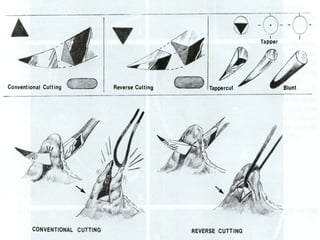
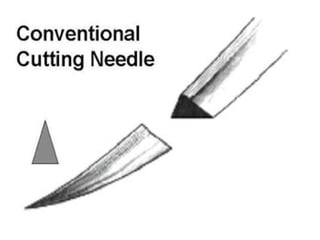
Conventional Cutting Needle:
•needle body is triangular and has a sharpened
cutting edge on the inside
• Triangular tip with the apex forming a
cutting surface
• Used for tough tissue, such as skin
• (use of a tapered needle with skin causes
excess trauma because of difficulty in
penetration)
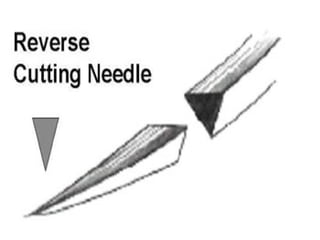
Reverse Cutting Needle:
•Similar to a conventional cutting needle except
the cutting edge faces down instead of up
•cutting edge is on outer curve
•For tough, difficult-to-penetrate tissues
•This may decrease the likelihood of sutures
pulling through soft tissue
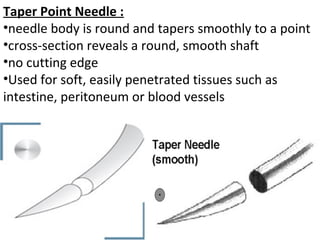
Taper Point Needle :
•needle body is round and tapers smoothly to a point
•cross-section reveals a round, smooth shaft
•no cutting edge
•Used for soft, easily penetrated tissues such as
intestine, peritoneum or blood vessels
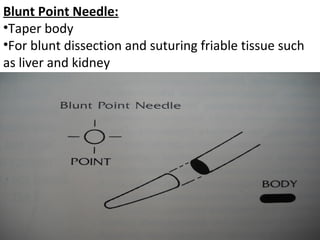
Blunt Point Needle:
•Taper body
•For blunt dissection and suturing friable tissue such
as liver and kidney
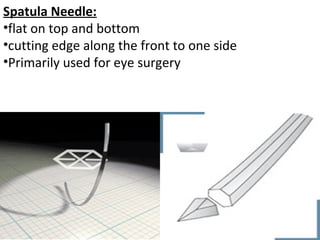
Spatula Needle:
•flat on top and bottom
•cutting edge along the front to one side
•Primarily used for eye surgery
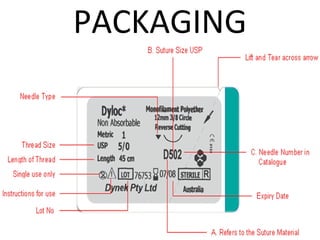
PACKAGING
Suture materials
Suture materials

Suture materials

  • 1.
    SUTURE MATERIALS Dr. HASEEBMANZOOR Department of Surgery JMCH Karachi
  • 2.
    SUTURE : The word“suture” describes any strand of material used to approximate (sew) tissues or ligate (tie) blood vessels. All sutures are foreign bodies and impact the wound healing.
  • 3.
    WHAT DO WENEED ? •THREAD •NEEDLE
  • 4.
  • 5.
    The “Ideal” Suturethread 1.Universal applicability- only difference in diameter 2.Limp- easy to handle, no kinks, coiling, twisting, or levitating 3.Inert- Minimal tissue reaction 4.Strong- High tensile strength 5.Frictionless surface to glide through tissue- minimal trauma 6.High friction for secure knotting 7.Sterlizable without composition changes
  • 6.
    8. Resists bacterialgrowth 9. Capable of holding tissue layers throughout the wound healing 10.Complete absorption, no residue, after healing is complete- no matter how long it takes 11.Nonelectrolytic, nonferromagnetic, noncapillary, nonallergenic, noncarcinogenic. 12.Cost effective
  • 7.
    Classification of suturingthreads : According to Absorbability : Absorbable Non-absorbable According to Raw material : Natural Synthetic According to Structure : Monofilament Multifilament/braided
  • 8.
    Absorbable Sutures : •Lose50% of breaking strength within 60 days of implanting •Absorbable sutures will eventually dissolve, absorb into the tissue, and become unidentifiable
  • 9.
    1.Polyglycolic acid (Safil®,Safil Quick®, Dexon®) 2. Polyglactin 910 (Vicril®, Vicryl Rapide®) 3. Glycomer (Biosyn®) 4. Glyconate (Monosyn®) 5. Polyglyconate (Maxon®) 6. Polydioxanone (PDS II®, MonoPlus®) 7. Gut (Cromic Gut®, Plain Gut®)
  • 10.
    Non-Absorbable Sutures: •Retain majorityof breaking strength for more than 60 days •Non-absorbable sutures are permanent fixtures in the body and, when properly tied or secured, will remain intact indefinitely.
  • 11.
    1. Polyamide (Dafilon®, Ethilon®, Supramid®, Nurolon®, Surgilon®) 2. Polyester (Ethibond®, Ti-Cron®, Synthofil®, Dagrofil®, Mersilene®) 3. Polypropylene (Premilene®, Prolene®) 4. Silk (Silkam®, Virgin silk®, Mersilk®, Softsilk®) 5. Nylon 6. Steel (Steelex®, Steel wire®, Steel®)
  • 12.
    Natural Sutures : •Suturesmade of material that can be found in nature •Cause intense inflammatory reaction •Examples : Cat gut, Silk, Steel
  • 13.
    Synthetic Sutures: •Sutures madeof materials created by man •Examples : Vicryl, monocryl, PDS, Nylon, Prolene, Polyester
  • 14.
    Monofilament •Consists of asingle strand of material •passes through tissues easily - less traumatic •Resists bacterial harboring •require more knots to prevent slippage - 5 or 6 ‘throws’ •Has more “memory” •Preferred for skin closure because they provide a better cosmetic result •Examples : chromic gut, plain gut, stainless steel, prolene, nylon
  • 15.
    Multifilament/Braided: •consist of severalfilaments or strands, twisted or braided together •Greater tensile strength •Pliability and flexibility •Better knot security •More tissue trauma •may harbor bacteria •Examples : vicryl, silk, polyester, nylon
  • 16.
  • 17.
  • 18.
    Common Nonabsorbable Sutures Monofilament Polypropylene(Prolene* & Surgilene+ ) Nylon (Ethilon* & Dermalon+ ) Braided Polyester (Mersilene*) Silk Nylon (Surgilon* & Nurolon+ ) Braided & Coated Polyester & Polybuterate (Ethibond*) Polyester & Silicone (Tichron+ ) Polyester & Teflon (Tevdek# ) Silk & Beeswax Multifilament Sheathed Multistrand Nylon & Polyethylene Sheath (Supramid$ ) *Ethicon Inc., +Davis & Geck Inc., #Deknatel Inc., $S. Jackson Inc.
  • 19.
    The size-systems ofthreads: 1.European Pharmacopeia/Metric units : from 0,1 metric (0,010-0,019 mm) to 10 metric(1,00-1,09 mm) 2.United States Pharmacopeia USP : from 11/0 (0,010-0,019 mm) to 7 (1,00-1,09 mm)
  • 21.
    • Smallest size-> 11-0 10-0 9-0 8-0 7-0 6-0 5-0 4-0 3-0 2-0 0 1 2 3 4 5 6 7 <- Largest size • sizes 10-0, 9-0, 8-0 require a microscope • sizes 7-0, 6-0, 5-0 require a magnifying glass • sizes 4-0 and 3-0 do not require magnification
  • 22.
    Size 7-0 isalmost equal to the thickness of human hair
  • 23.
    Size Uses 7/0 andsmaller Ophthalmology, microsurgery 6/0 Face, blood vessels 5/0 Face, neck, blood vessels 4/0 Mucosa, neck, hands, limbs, tendons, blood vessels 3/0 Limbs, trunk, gut blood vessels 2/0 Trunk, fascia, viscera, blood vessels 0 and larger Abdominal wall, fascia, drain sites, arterial lines, orthopaedics
  • 24.
    • Absorbable sutureselicit more inflammatory reaction than non-absorbable sutures • Absorption method : Natural Sutures - Enzymatic Synthetic Sutures – Hydrolysis • Natural sutures induce more inflammation than synthetic ones
  • 25.
    Plasticity : Ability toexpand when stretched and don’t return to original length (loosen with edema) Elasticity : Ability to return to its original length after stretching High elasticity sutures should be used in oedematous tissue
  • 26.
    Fluid absorption andcapillary action : the tendency for a suture to absorb water and to wick infection breaking strength rate (BSR) : Approximate days after placement when 50% of breaking strength remains.
  • 27.
    Tensile strength : Forcenecessary to break a suture consider in areas of tension (linea alba) Knot strength : Force required for a knot to slip consider when ligating arteries Memory : tendancy to return to original shape (untied) Tendency to stay in one position Leads to difficulty in tying sutures
  • 29.
    Plain Gut /Chromic Gut: •Absorbable •Natural •Monofilament •Submucosal or serosal layer of animal intestine •97-98% pure collagen •High tissue reactivity •Tensile strength : 4-5 days (gut) 2 to 3 weeks (chromic gut) •Uses: tubal ligation, ligation of blood vessels, episiotomy repair, closure of peritoneum
  • 30.
    Poly-sugars: •Absorbable •Dexon, Vicryl, Polysorb •Syntheticpolymers with modest tissue reactivity •Tensile strength for 2 to 3 weeks •10% strength at 28 days •Low elasticity - may cut soft tissue •Braided - handle well but wick fluid •Uses: subcuticular closure and fascia
  • 31.
    Monocryl Biosyn: •Absorbable •Virtually inertin tissue •Tensile strength for 2 to 3 weeks •Less suture absesses •Uses: mucosa and skin closures
  • 32.
    Silk: •Non-absorbable •Second only togut for tissue inflammation •Braided •Best handling of any suture •Lowest tensile strength of any suture •Weaker when wet
  • 33.
  • 34.
    Polypropylene: •Non-absorbable •Synthetic •Monofilament •Prolene, Surgilene, Surgipro •Inert •Highplacticity - expands to prevent strangulation, but loosens when edema subsides •Will stretch when pulled •Elastic - requires extra knots •Uses: wound closure
  • 36.
    Surface: DERMABOND® Topical SkinAdhesive Dermis: MONOCRYL* Plus Antibacterial (poliglecaprone 25) Suture SubQ-Fat: Coated VICRYL* Plus Antibacterial (polyglactin 910) Suture Fascia/Muscle: ETHIGUARD* Blunt Point Needle with Coated VICRYL Plus or PDS* Plus Antibacterial (polydioxanone) Suture
  • 37.
  • 39.
    Shape of needle: Curved Designed to be held with a needle holder Used for most suturing Straight Often hand held Used to secure percutaneously placed devices (e.g. central and arterial lines)
  • 40.
    Parts of needle: 1- The eye which is swaged and permits the suture and needle to act as a single unit to decrease trauma 2- The body which is the widest point of the needle and is also referred to as the grasping area. The body comes in number of shapes (round, oval, rectangular, trapezoid, or side flattened)
  • 41.
    3- The pointwhich runs from the tip to the maximum cross-sectional area of the body. The point also comes in a number of different shapes (conventional cutting, reverse cutting, side cutting, taper cut, taper, blunt
  • 47.
    Conventional Cutting Needle: •needlebody is triangular and has a sharpened cutting edge on the inside • Triangular tip with the apex forming a cutting surface • Used for tough tissue, such as skin • (use of a tapered needle with skin causes excess trauma because of difficulty in penetration)
  • 49.
    Reverse Cutting Needle: •Similarto a conventional cutting needle except the cutting edge faces down instead of up •cutting edge is on outer curve •For tough, difficult-to-penetrate tissues •This may decrease the likelihood of sutures pulling through soft tissue
  • 51.
    Taper Point Needle: •needle body is round and tapers smoothly to a point •cross-section reveals a round, smooth shaft •no cutting edge •Used for soft, easily penetrated tissues such as intestine, peritoneum or blood vessels
  • 52.
    Blunt Point Needle: •Taperbody •For blunt dissection and suturing friable tissue such as liver and kidney
  • 53.
    Spatula Needle: •flat ontop and bottom •cutting edge along the front to one side •Primarily used for eye surgery
  • 55.

Editor's Notes

  • #37 ETHICON promotes best practice in wound closure with products for every layer, including ETHIGUARD, Plus Sutures and DERMABOND.