Unit 2.2
Amniotic Fluid Development
PREPARED BY:
Sapana Dahal
Roll.no.22
B.Sc nursing 4th year
MNC,IOM,TU
General Objective
At the end of the session,all B.Sc nursing 3rd
year students will be able to explain about
Amniotic Fluid
Specific Objectives
At the end of this session, all participants will be
able to:
introduce amniotic fluid.
explain production and circulation.
list amniotic fluid functions.
state clinical importance.
state color deviation of amniotic fluid.
Amniotic Fluid
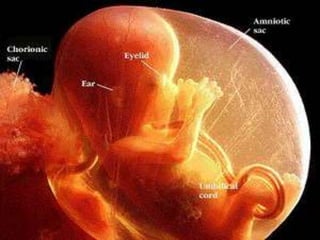
 It is a clear, alkaline and slightly yellowish
liquid contained within the amniotic sac which
is derived from maternal circulation and also
from fetal parts.
Color
• It is colorless in early pregnancy but near
term it becomes pale straw colored due to
presence of exfoliated lanugo and epidermal
cells from fetal skin.
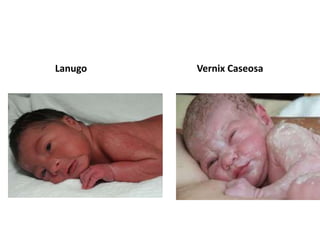
• May also look turbid due to vernix caseosa.
Constituents
• In 1st half of the pregnancy, it is almost
identical to the transudate of the plasma.
• Later it is composed of:
 Water : 98-99 %
Solid :1-2%
The solid constituents include:
1. Organic
a. Protein: 0.3 mg %
b. Glucose : 20 mg%
c. Urea:30 mg%
d. NPN :30 mg%
e. Uric acid: 4 mg%
f. Creatinine: 2 mg%
g. Total lipids : 50 mg%
h. Hormones

2. Inorganic:
It also contains sodium, potassium and
chloride in same amount as that in the maternal
blood.
c. Suspended particles
Lanugo, exfoliated squamous epithelial cells
from fetal skin, vernix caseosa. Cast off amniotic
cells and cells from respiratory tract, urinary
bladder and vagina of the fetus.
Lanugo Vernix Caseosa
 Nitrogenous wastes like urea, creatinine and uric
acid are produced from the functioning kidneys.
Protein increases in concentration as pregnancy
advances and contains mainly albumin.
Lipid increases as pregnancy advances and is in
the form of fatty acids.
 Lung secretion contributes to the
phospholipids, lecithin and cholesterol.
Carbohydrate is half of that found in maternal
serum.
Volume
• At about 10 weeks, its approximately. 30 ml.
• At 20 weeks, it increases to 450 ml.
• At 36-38 weeks, it is about 800-1000 ml.
• At term it measures about 600-800 ml.
• The volume is replaced every 3 hours.
• Fetal kidneys start producing urine at about
12 weeks.
• BY 18 weeks it produces 7-14 ml per day.
• After 20 weeks, cornification of skin prevents
diffusion but is composed largely of fetal urine
containing more urea, creatinine, uric acid.
• The osmolality of amniotic fluid is decreased with
advancing gestation.
• From 5th month beginning, fetus swallows its
own amniotic fluid and is estimated that it drinks
about 400 ml a day.
• Fetal urine is added daily in the 5th month to the
amniotic fluid and is mostly watery.
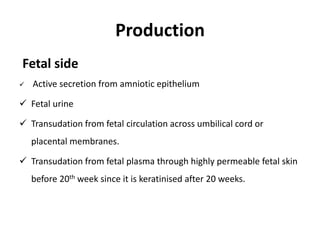
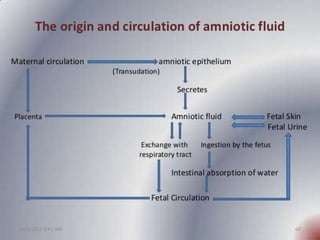
Production
Fetal side
 Active secretion from amniotic epithelium
 Fetal urine
 Transudation from fetal circulation across umbilical cord or
placental membranes.
 Transudation from fetal plasma through highly permeable fetal skin
before 20th week since it is keratinised after 20 weeks.
Maternal side
Transudation from maternal circulation across
placental membranes.
Functions
1. During Pregnancy
a. It acts as a shock absorber.
b. Maintains even temperature.
c. Allows for the growth and free movement of
fetus.
d. Adequate water supply to the fetus.
During Labor
1. Helps in the dilatation of the cervix.
2. It prevents marked interference with the
placental circulation.
3. Prevents the ascending infection to the
uterine cavity.
Clinical Importance
 Provides useful information about well being
and maturity of the fetus.
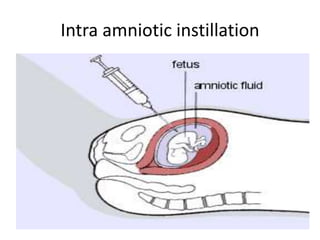
Intra- amniotic instillation of chemicals is
used as the method of induction of the
abortion.
Intra amniotic instillation
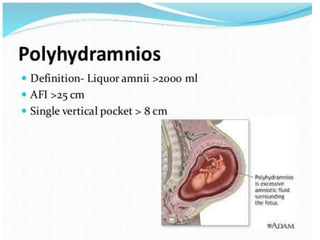
 Excess or less volume of liquor amnii is
measured to diagnose the clinical condition of
polyhydraminous or oligohydraminous.
• Polyhydraminous is found in association with
open neural tube defects and is also observed
in gut atresia.
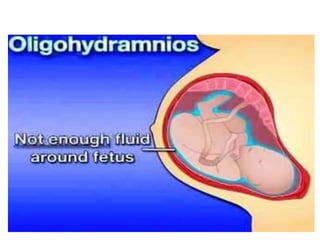
• Oligohydraminous occurs with renal agenesis
and also in IUGR.
 Amniotic fluid alpha- fetoprotein is raised in
open neural tube defect, abdominal wall
defect but is abnormally low in Down
syndrome.
 Bilirubin levels in the amniotic fluid decreases
towards term but may be raised in case of
fetal hemolysis.
 It has antibacterial property because of its pH
and contains interferon and lysozyme.
 Fibroblast found in the amniotic fluid is used
for karyotyping. In the presence of renal
defects, glial cells are found.
Deviation From Normal color
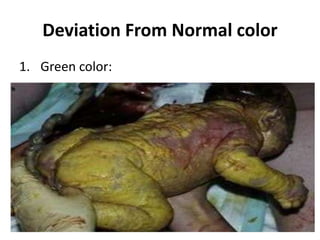
1. Green color:
• Is suggestive of fetal distress in presentations
other than breech or transverse.
• It may be thin or thick or pea souped( thick
with flakes)
• Thick with flakes suggest chronic fetal
distress.
2. Golden Yellow Color
Seen in Rh incompatibility due to excessive
hemolysis of fetal RBCs and production of excess
bilirubin.
3. Greenish yellow (Saffron)
• Seen in post maturity.
4. Dark colored:
Seen in concealed accidental hemorrhage due
to contamination of blood.
5. Dark brown ( tobacco juice):
• Is found in IUFD.
• The dark color is due to the presence of old
hemoglobin A.
Post - test
• At about 10 weeks of gestation, volume of amniotic fluid
is about
a. 200 ml b. 30 ml c. 5ml d.1000ml
• During early weeks of gestation,amniotic fluid is formed
from
a. Fetal lungs b. fetal urine c. primitive cells
d. trophoblast
• Green color of amniotic fluid suggests
a. Hemorrhage b. Rh incompatibility
c. IUFD d. Fetal distress
References:
• T.W.saddler ,Langman’s textbook of
embryology , 12th edition,Lippincott Williams
and wilkins, south asian edition published by
wolters kluwer.
• D.C. Dutta, textbook of obstetrics, 5th edition,
new central book agency Pvt ltd, India.
• Subedi durga , Gautam saraswoti, midwifery
nuring part-1, 2nd edition, medhabi publication.
• Indrani T.K(2003) Textbook of midwifery, New
Delhi:Jaypee brothers,medical publishers(P).ltd
• Jacob.A(2005) A Comprehensive Textbook of
Midwifery, Jaypee Brothers , New Delhi
• Bennett V.R, Brown L.K(2003)Myles textbook for
midwives, 14thedition,churchill,livingstone.
• Subedi Maya Devi, Manual of Midwifery A, Makalu
Publication House, Kathmandu.
• Shirish S Sheth, Essentilas of Obstetrics, 2nd edition,
Jaypee brothers, Medical publishers (P). Ltd, New Delhi
Next Class
Fetal Circulation
Home assignment

Amniotic flud

  • 1.
    Unit 2.2 Amniotic FluidDevelopment PREPARED BY: Sapana Dahal Roll.no.22 B.Sc nursing 4th year MNC,IOM,TU
  • 2.
    General Objective At theend of the session,all B.Sc nursing 3rd year students will be able to explain about Amniotic Fluid
  • 3.
    Specific Objectives At theend of this session, all participants will be able to: introduce amniotic fluid. explain production and circulation. list amniotic fluid functions. state clinical importance.
  • 4.
    state color deviationof amniotic fluid.
  • 6.
    Amniotic Fluid  Itis a clear, alkaline and slightly yellowish liquid contained within the amniotic sac which is derived from maternal circulation and also from fetal parts.
  • 7.
    Color • It iscolorless in early pregnancy but near term it becomes pale straw colored due to presence of exfoliated lanugo and epidermal cells from fetal skin. • May also look turbid due to vernix caseosa.
  • 8.
    Constituents • In 1sthalf of the pregnancy, it is almost identical to the transudate of the plasma. • Later it is composed of:  Water : 98-99 % Solid :1-2%
  • 9.
    The solid constituentsinclude: 1. Organic a. Protein: 0.3 mg % b. Glucose : 20 mg% c. Urea:30 mg% d. NPN :30 mg% e. Uric acid: 4 mg%
  • 10.
    f. Creatinine: 2mg% g. Total lipids : 50 mg% h. Hormones
  • 11.
    2. Inorganic: It alsocontains sodium, potassium and chloride in same amount as that in the maternal blood.
  • 12.
    c. Suspended particles Lanugo,exfoliated squamous epithelial cells from fetal skin, vernix caseosa. Cast off amniotic cells and cells from respiratory tract, urinary bladder and vagina of the fetus.
  • 13.
  • 14.
     Nitrogenous wasteslike urea, creatinine and uric acid are produced from the functioning kidneys. Protein increases in concentration as pregnancy advances and contains mainly albumin. Lipid increases as pregnancy advances and is in the form of fatty acids.
  • 15.
     Lung secretioncontributes to the phospholipids, lecithin and cholesterol. Carbohydrate is half of that found in maternal serum.
  • 16.
    Volume • At about10 weeks, its approximately. 30 ml. • At 20 weeks, it increases to 450 ml. • At 36-38 weeks, it is about 800-1000 ml. • At term it measures about 600-800 ml. • The volume is replaced every 3 hours.
  • 17.
    • Fetal kidneysstart producing urine at about 12 weeks. • BY 18 weeks it produces 7-14 ml per day. • After 20 weeks, cornification of skin prevents diffusion but is composed largely of fetal urine containing more urea, creatinine, uric acid.
  • 18.
    • The osmolalityof amniotic fluid is decreased with advancing gestation. • From 5th month beginning, fetus swallows its own amniotic fluid and is estimated that it drinks about 400 ml a day. • Fetal urine is added daily in the 5th month to the amniotic fluid and is mostly watery.
  • 19.
    Production Fetal side  Activesecretion from amniotic epithelium  Fetal urine  Transudation from fetal circulation across umbilical cord or placental membranes.  Transudation from fetal plasma through highly permeable fetal skin before 20th week since it is keratinised after 20 weeks.
  • 20.
    Maternal side Transudation frommaternal circulation across placental membranes.
  • 22.
    Functions 1. During Pregnancy a.It acts as a shock absorber. b. Maintains even temperature. c. Allows for the growth and free movement of fetus. d. Adequate water supply to the fetus.
  • 23.
    During Labor 1. Helpsin the dilatation of the cervix. 2. It prevents marked interference with the placental circulation. 3. Prevents the ascending infection to the uterine cavity.
  • 24.
    Clinical Importance  Providesuseful information about well being and maturity of the fetus. Intra- amniotic instillation of chemicals is used as the method of induction of the abortion.
  • 25.
  • 26.
     Excess orless volume of liquor amnii is measured to diagnose the clinical condition of polyhydraminous or oligohydraminous. • Polyhydraminous is found in association with open neural tube defects and is also observed in gut atresia.
  • 28.
    • Oligohydraminous occurswith renal agenesis and also in IUGR.
  • 30.
     Amniotic fluidalpha- fetoprotein is raised in open neural tube defect, abdominal wall defect but is abnormally low in Down syndrome.
  • 31.
     Bilirubin levelsin the amniotic fluid decreases towards term but may be raised in case of fetal hemolysis.
  • 32.
     It hasantibacterial property because of its pH and contains interferon and lysozyme.
  • 33.
     Fibroblast foundin the amniotic fluid is used for karyotyping. In the presence of renal defects, glial cells are found.
  • 34.
    Deviation From Normalcolor 1. Green color:
  • 35.
    • Is suggestiveof fetal distress in presentations other than breech or transverse. • It may be thin or thick or pea souped( thick with flakes) • Thick with flakes suggest chronic fetal distress.
  • 36.
    2. Golden YellowColor Seen in Rh incompatibility due to excessive hemolysis of fetal RBCs and production of excess bilirubin.
  • 37.
    3. Greenish yellow(Saffron) • Seen in post maturity.
  • 38.
    4. Dark colored: Seenin concealed accidental hemorrhage due to contamination of blood.
  • 39.
    5. Dark brown( tobacco juice): • Is found in IUFD. • The dark color is due to the presence of old hemoglobin A.
  • 40.
    Post - test •At about 10 weeks of gestation, volume of amniotic fluid is about a. 200 ml b. 30 ml c. 5ml d.1000ml • During early weeks of gestation,amniotic fluid is formed from a. Fetal lungs b. fetal urine c. primitive cells d. trophoblast
  • 41.
    • Green colorof amniotic fluid suggests a. Hemorrhage b. Rh incompatibility c. IUFD d. Fetal distress
  • 43.
    References: • T.W.saddler ,Langman’stextbook of embryology , 12th edition,Lippincott Williams and wilkins, south asian edition published by wolters kluwer. • D.C. Dutta, textbook of obstetrics, 5th edition, new central book agency Pvt ltd, India.
  • 44.
    • Subedi durga, Gautam saraswoti, midwifery nuring part-1, 2nd edition, medhabi publication. • Indrani T.K(2003) Textbook of midwifery, New Delhi:Jaypee brothers,medical publishers(P).ltd • Jacob.A(2005) A Comprehensive Textbook of Midwifery, Jaypee Brothers , New Delhi
  • 45.
    • Bennett V.R,Brown L.K(2003)Myles textbook for midwives, 14thedition,churchill,livingstone. • Subedi Maya Devi, Manual of Midwifery A, Makalu Publication House, Kathmandu. • Shirish S Sheth, Essentilas of Obstetrics, 2nd edition, Jaypee brothers, Medical publishers (P). Ltd, New Delhi
  • 46.
  • 47.