MM COLLEGE OF NURSING
CLINICAL TEACHING
ON
AMNION, AMNIOTIC CAVITY AND
AMNIOTIC FLUID
SUBJECT: MIDWIFERY AND OBSTETRICIAL NURSING
SUBMITTED TO: SUBMITTED BY:
MRS. SIMARJEET KAUR ABID ISMAIL
ASSISTANT PROFESSOR 1917003
B.S C NSG 4TH YEAR
INTRODUCTION OF AMNION
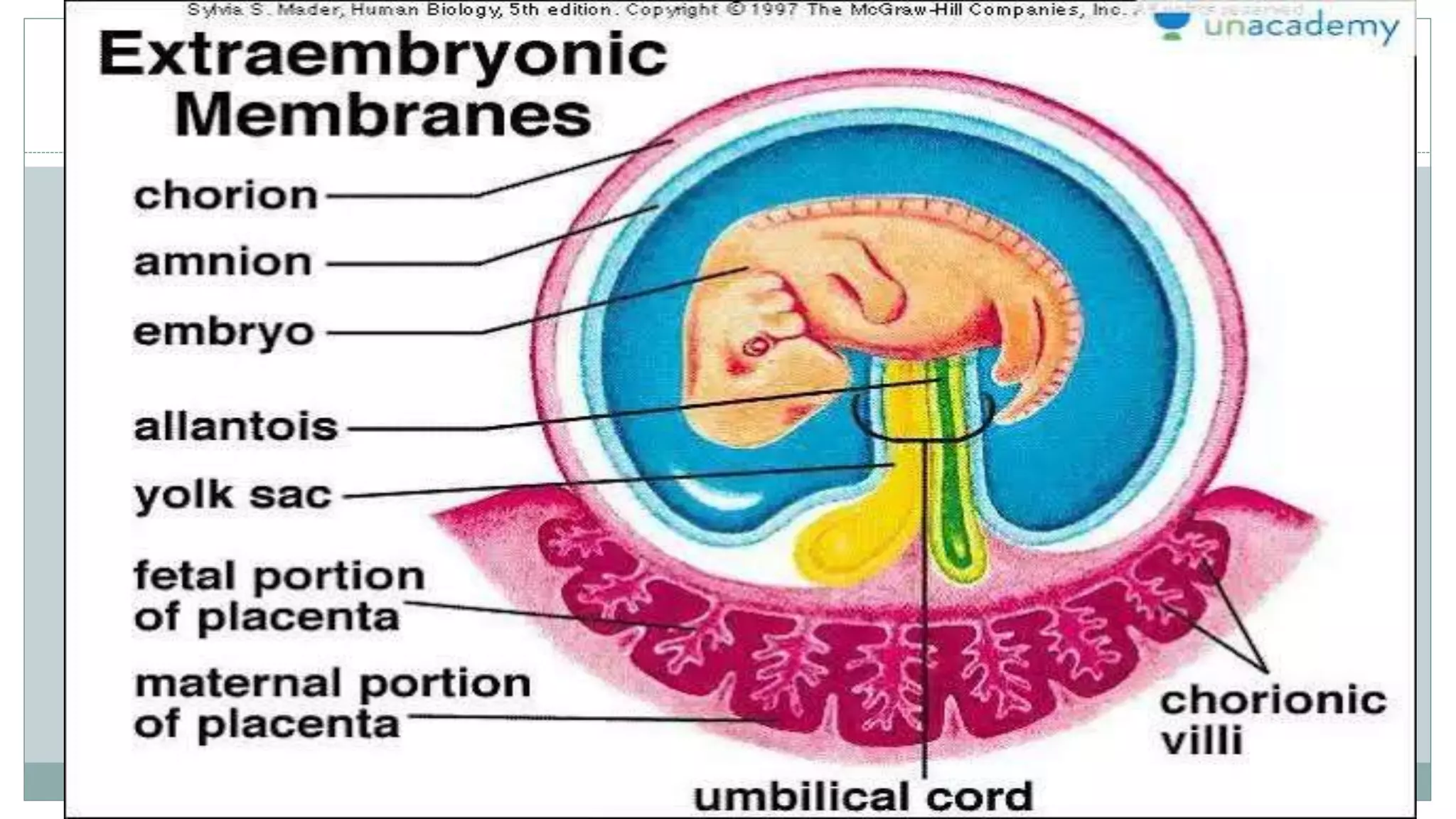
Fetal membranes consists of two layers:-
 The outer covering of fetal membranes is
the chorion
The inner covering of the fetal membranes
is the amnion
AMNION
 Amnion is the inner layer of the fetal membranes
that encloses amniotic cavity.
 It consists of two layers:-
I. INTERNAL SURFACE :- it is smooth, shiny and
is in contact with the liquor amnii( amniotic fluid).
II. OUTER SURFACE :- it consists of layer of
connective tissues and is apposed to similar tissue
on inner aspect of chorion from which it can be
peeled off.
AMNIOTIC CAVITY
 It is the closed sac
between the
embryo and the
amnion, containing
the amniotic fluid.
FORMATION OF AMNION AND AMNIOTIC CAVITY
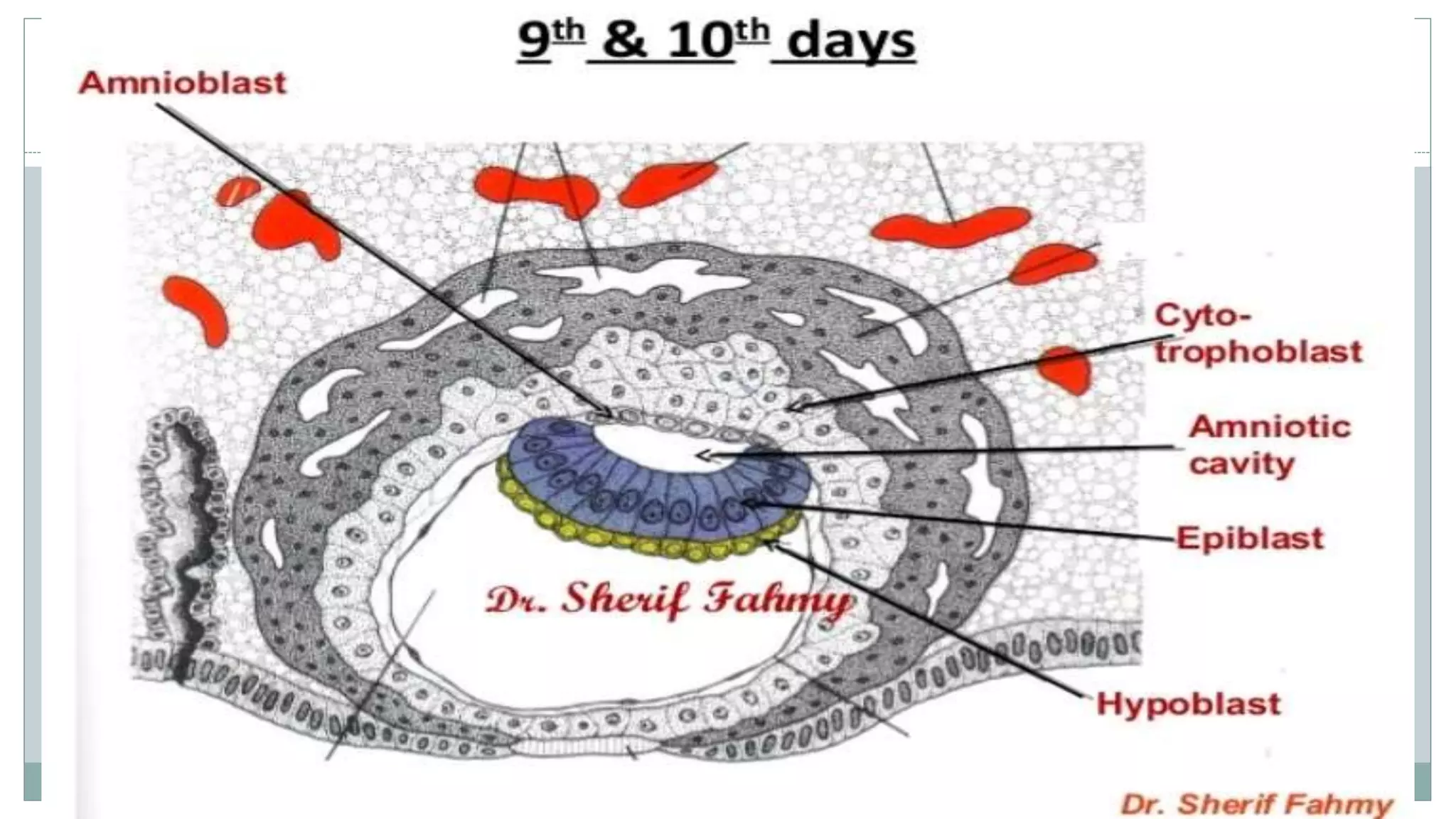
8TH DAY:- Amnion is formed as a small cavity in
epiblast cells with the formation of amnioblasts.
 Floor of the cavity is epiblast while the roof is formed
from amnioblasts.
12th DAY :- It becomes separated from cytotrophoblasts.
4th WEEK :- Expansion of amniotic cavity lead to
folding of the embryoic disic.
FORMATION OF AMNION AND AMNIOTIC CAVITY
3rd MONTH : - Amnion comes in contact with
chorion to form amnio – chorioic membrane with
obliteration of chorionic cavity.
By the end of the 3rd month, uterine cavity is
obliterated due to expansion of the amniotic cavity.
FINALLY :- The amniotic cavity surrounds the fetus
and form a tubular sheath around the umbilical cord.
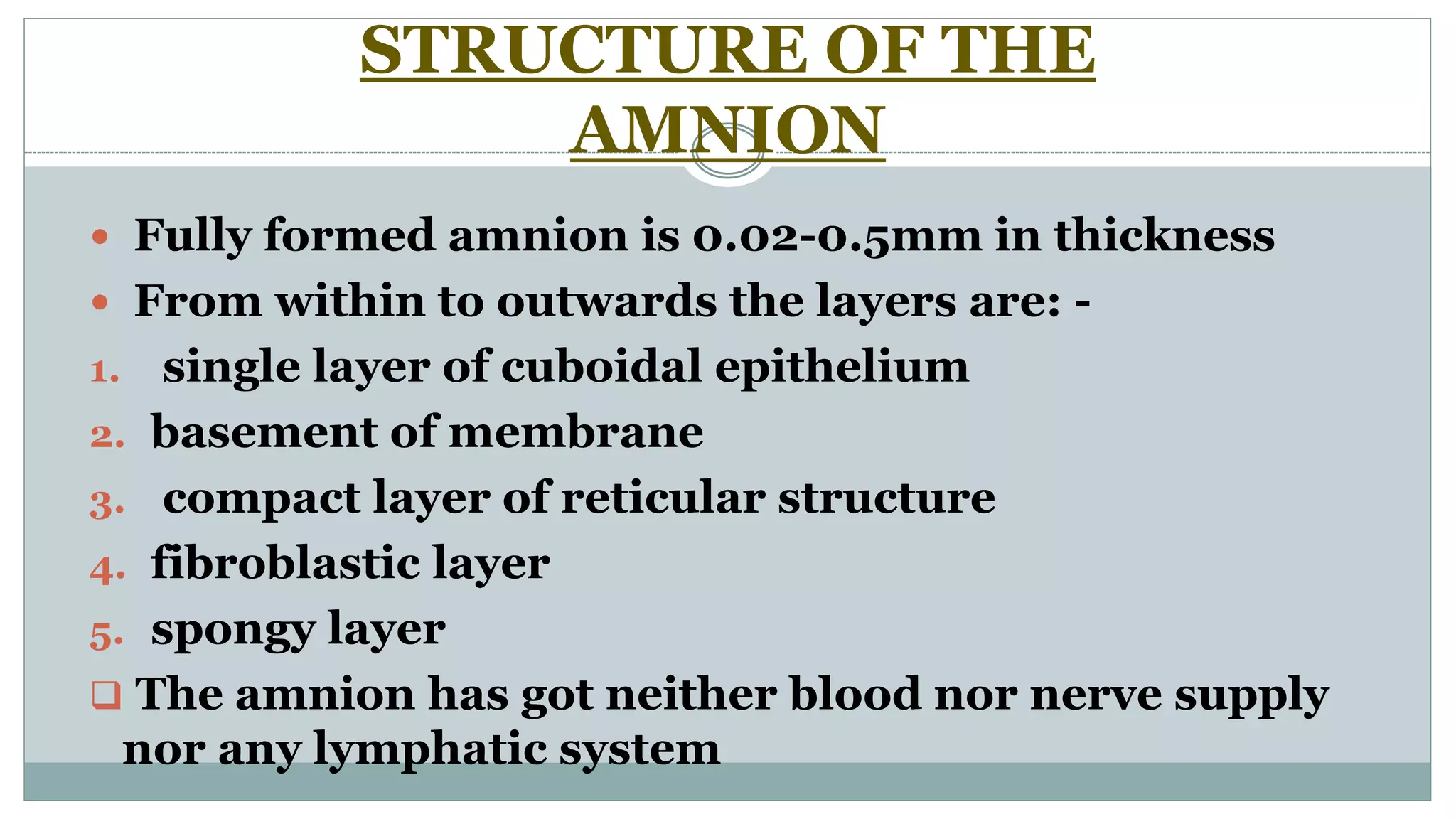
STRUCTURE OF THE
AMNION
 Fully formed amnion is 0.02-0.5mm in thickness
 From within to outwards the layers are: -
1. single layer of cuboidal epithelium
2. basement of membrane
3. compact layer of reticular structure
4. fibroblastic layer
5. spongy layer
 The amnion has got neither blood nor nerve supply
nor any lymphatic system
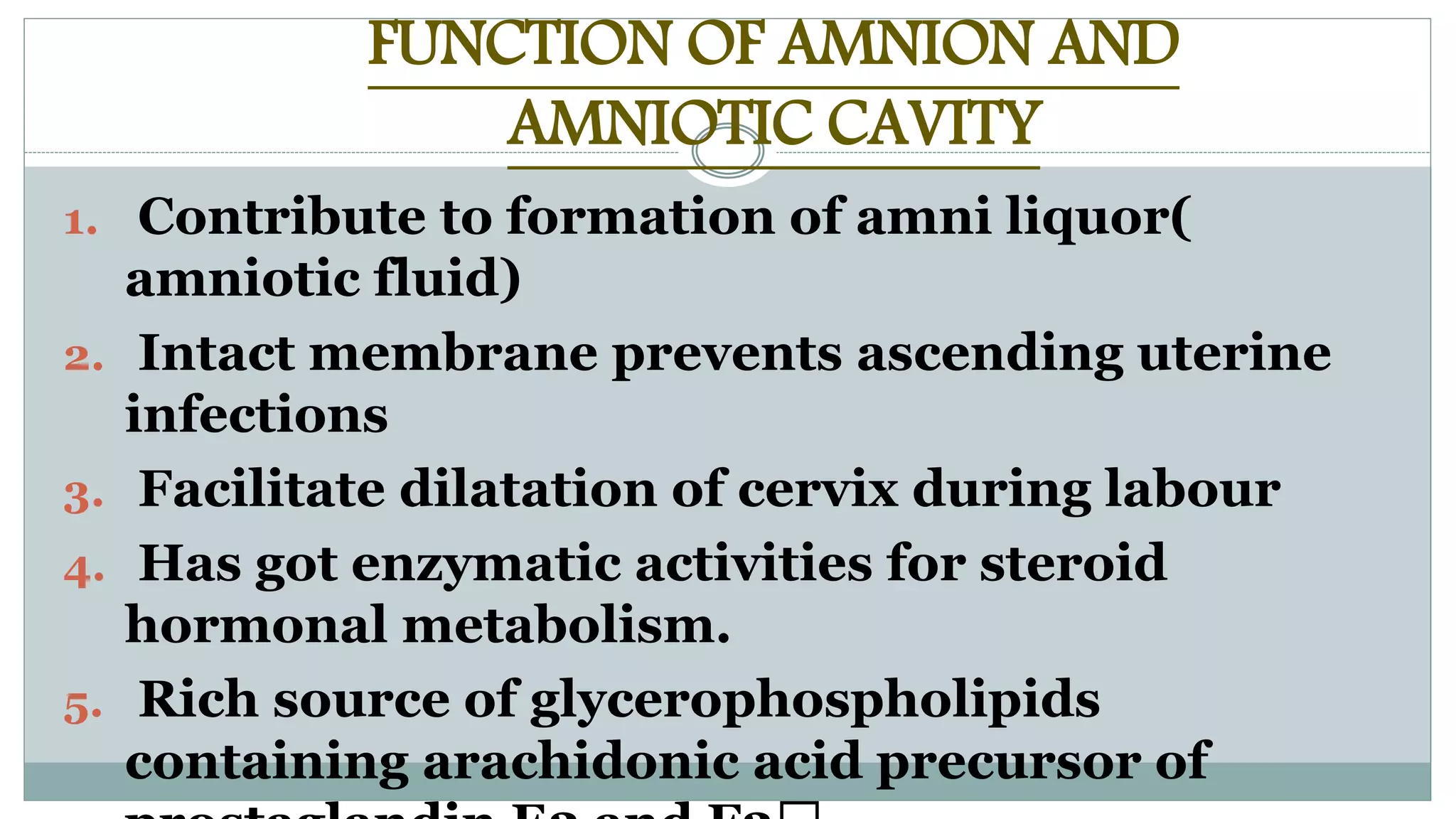
FUNCTION OF AMNION AND
AMNIOTIC CAVITY
1. Contribute to formation of amni liquor(
amniotic fluid)
2. Intact membrane prevents ascending uterine
infections
3. Facilitate dilatation of cervix during labour
4. Has got enzymatic activities for steroid
hormonal metabolism.
5. Rich source of glycerophospholipids
containing arachidonic acid precursor of
AMNIOTIC FLUID
 Amniotic fluid is a clear,
yellow fluid which is found
within the first 12 days
following conception
within the amniotic sac. It
surrounds the growing
baby in the uterus.
COMPOSITION:
(1) water 98–99% and (2) solid(1–2%). The
following are the solid constituents:
(a) Organic:
Protein–0.3 mg% Total lipids–50 mg%
Glucose–20 mg% Uric acid–4 mg% Hormones
(prolactin, insulin and renin)
Urea–30 mg% Creatinine–2 mg%
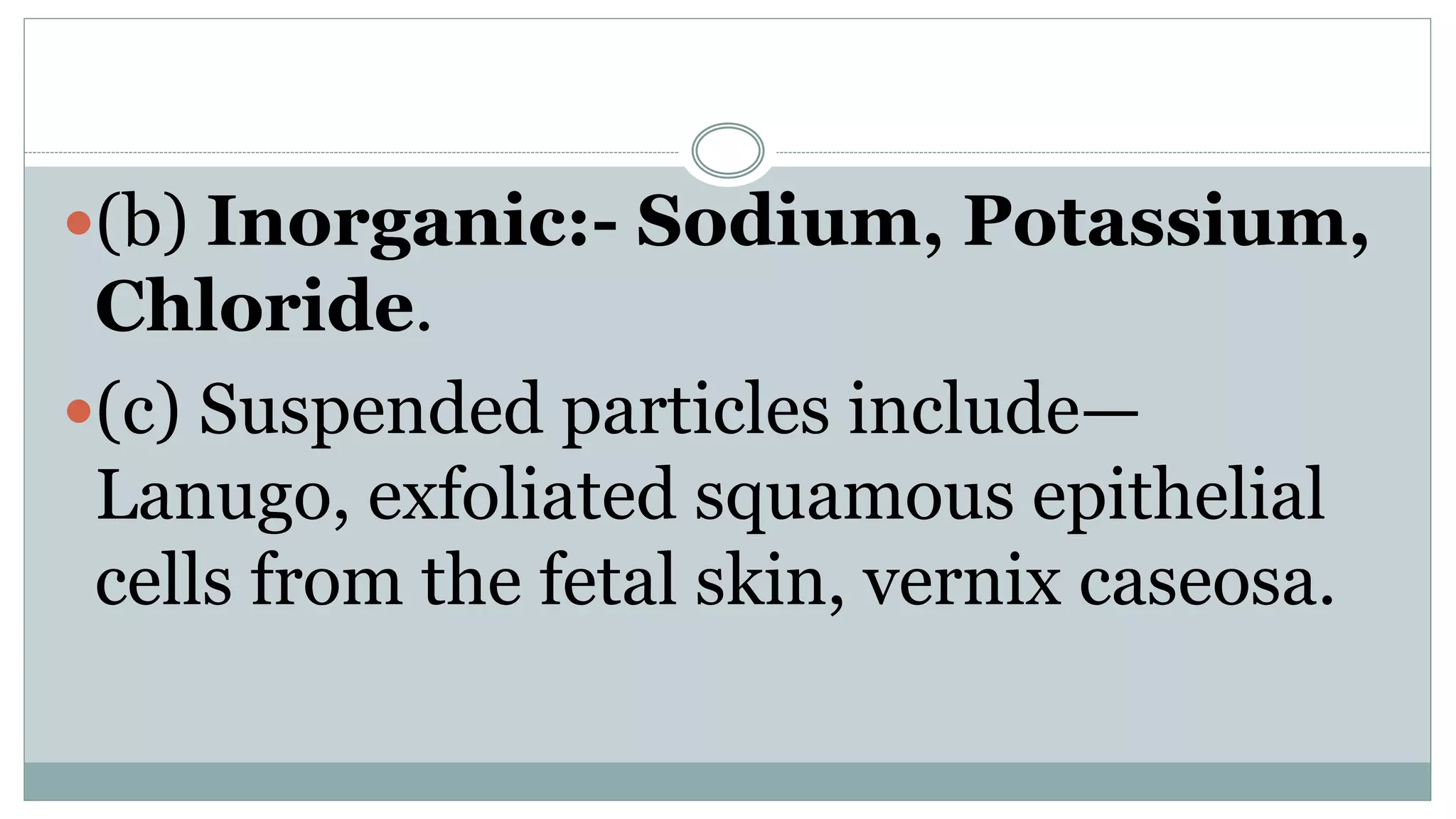
(b) Inorganic:- Sodium, Potassium,
Chloride.
(c) Suspended particles include—
Lanugo, exfoliated squamous epithelial
cells from the fetal skin, vernix caseosa.
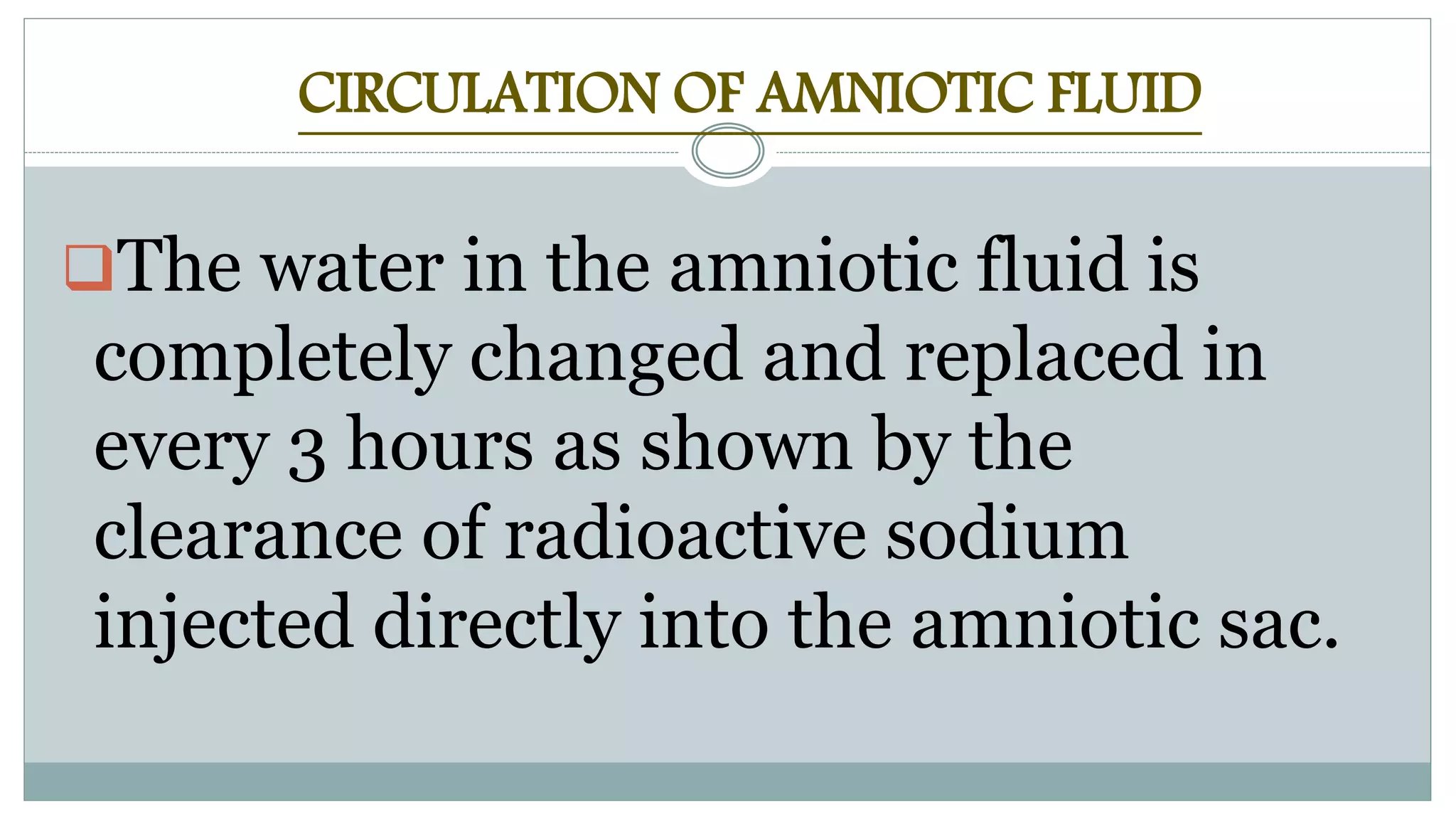
CIRCULATION OF AMNIOTIC FLUID
The water in the amniotic fluid is
completely changed and replaced in
every 3 hours as shown by the
clearance of radioactive sodium
injected directly into the amniotic sac.
VOLUME OF AMNIOTIC FLUID
 Amniotic fluid volume is related to the gestational age :
• At 12 weeks - 50ml
• At 20 weeks - 400ml
• At 36- 38 weeks - 1000ml
• At term - 600 – 800 ml
 As the pregnancy continues post term, further
reduction occurs to the extends of about 200ml at 43
weeks.
ABNORMAL AMNIOTIC FLUID VOLUME
Deviation in the normal volume has clinical
significance :
OLIGOHYDRAMNIOS :- It is condition where
the liquor amni is deficient in amount to the
extend of less than 200ml at term
POLYHYDRAMNIOS :- It is the condition
where the liquor amni exceeds 2000ml.
PHYSICAL FEATURES OF AMNIOTIC FLUID
1. The fluid is faintly alkaline with low specific gravity
of 1.010.
2. It becomes highly hypotonic to maternal serum at
term pregnancy.
3. In the early pregnancy it is colourless, but near term
it becomes pale straw coloured due to presence of
lanugo and epidermal cells from the fetal skin. It may
look turbid due to presence of vernix caseosa.
ABNORMAL AMNIOTIC FLUID COLOUR
 Duration of normal colour of liquor has go clinical significance:-
COLOUR REASON
GREEN Meconium stained due to fetal distress
GOLDEN Rh incompatibility due to excessive hemolysis
of the fetal RBC
GREENISH YELLOW Postmaturity
DARK COLOURED Concealed accidental hemorrhage is due to
contamination of blood
DARK BROWN Amniotic fluid found in intra uterine death, due
to frequent presence of old Hb.
FUNCTION OF AMNIOTIC FLUID
 Its main is to protect the fetus :-
DURING PREGNANCY
1. Act as shock absorber
2. Maintains an even temperature
3. Allow for growth and free movement
4. Prevents adhesion between the fetal part and
amniotic sac
DURING LABOUR
1. Helps in dilatation of cervix.
2. Guards against umbilical cord compression.
3. Protects against uterine contractions.
4. Sterile amniotic fluid washes vagina before
passage of baby.
CLINICAL IMPORTANCE
1. Study of amniotic fluid provides information
about maturity of fetus.
2. Volume of amniotic fluid is assessed by
amniotic fluid index.
3. Rupture of membranes with drainage of
liquor is a helpful method in induction of
labour.
SUMMARY
CONCLUSION
BIBLIOGRAPHY
 Dutta D C “ textbook of obstetrics in nursing”
published by Jaypee publisher, edition 9th , page
no. 33- 35.
Amnion, amniotic fluid and cavity.enc

Amnion, amniotic fluid and cavity.enc

  • 1.
    MM COLLEGE OFNURSING CLINICAL TEACHING ON AMNION, AMNIOTIC CAVITY AND AMNIOTIC FLUID SUBJECT: MIDWIFERY AND OBSTETRICIAL NURSING SUBMITTED TO: SUBMITTED BY: MRS. SIMARJEET KAUR ABID ISMAIL ASSISTANT PROFESSOR 1917003 B.S C NSG 4TH YEAR
  • 2.
    INTRODUCTION OF AMNION Fetalmembranes consists of two layers:-  The outer covering of fetal membranes is the chorion The inner covering of the fetal membranes is the amnion
  • 4.
    AMNION  Amnion isthe inner layer of the fetal membranes that encloses amniotic cavity.  It consists of two layers:- I. INTERNAL SURFACE :- it is smooth, shiny and is in contact with the liquor amnii( amniotic fluid). II. OUTER SURFACE :- it consists of layer of connective tissues and is apposed to similar tissue on inner aspect of chorion from which it can be peeled off.
  • 5.
    AMNIOTIC CAVITY  Itis the closed sac between the embryo and the amnion, containing the amniotic fluid.
  • 6.
    FORMATION OF AMNIONAND AMNIOTIC CAVITY 8TH DAY:- Amnion is formed as a small cavity in epiblast cells with the formation of amnioblasts.  Floor of the cavity is epiblast while the roof is formed from amnioblasts. 12th DAY :- It becomes separated from cytotrophoblasts. 4th WEEK :- Expansion of amniotic cavity lead to folding of the embryoic disic.
  • 8.
    FORMATION OF AMNIONAND AMNIOTIC CAVITY 3rd MONTH : - Amnion comes in contact with chorion to form amnio – chorioic membrane with obliteration of chorionic cavity. By the end of the 3rd month, uterine cavity is obliterated due to expansion of the amniotic cavity. FINALLY :- The amniotic cavity surrounds the fetus and form a tubular sheath around the umbilical cord.
  • 9.
    STRUCTURE OF THE AMNION Fully formed amnion is 0.02-0.5mm in thickness  From within to outwards the layers are: - 1. single layer of cuboidal epithelium 2. basement of membrane 3. compact layer of reticular structure 4. fibroblastic layer 5. spongy layer  The amnion has got neither blood nor nerve supply nor any lymphatic system
  • 11.
    FUNCTION OF AMNIONAND AMNIOTIC CAVITY 1. Contribute to formation of amni liquor( amniotic fluid) 2. Intact membrane prevents ascending uterine infections 3. Facilitate dilatation of cervix during labour 4. Has got enzymatic activities for steroid hormonal metabolism. 5. Rich source of glycerophospholipids containing arachidonic acid precursor of
  • 12.
    AMNIOTIC FLUID  Amnioticfluid is a clear, yellow fluid which is found within the first 12 days following conception within the amniotic sac. It surrounds the growing baby in the uterus.
  • 13.
    COMPOSITION: (1) water 98–99%and (2) solid(1–2%). The following are the solid constituents: (a) Organic: Protein–0.3 mg% Total lipids–50 mg% Glucose–20 mg% Uric acid–4 mg% Hormones (prolactin, insulin and renin) Urea–30 mg% Creatinine–2 mg%
  • 14.
    (b) Inorganic:- Sodium,Potassium, Chloride. (c) Suspended particles include— Lanugo, exfoliated squamous epithelial cells from the fetal skin, vernix caseosa.
  • 15.
    CIRCULATION OF AMNIOTICFLUID The water in the amniotic fluid is completely changed and replaced in every 3 hours as shown by the clearance of radioactive sodium injected directly into the amniotic sac.
  • 16.
    VOLUME OF AMNIOTICFLUID  Amniotic fluid volume is related to the gestational age : • At 12 weeks - 50ml • At 20 weeks - 400ml • At 36- 38 weeks - 1000ml • At term - 600 – 800 ml  As the pregnancy continues post term, further reduction occurs to the extends of about 200ml at 43 weeks.
  • 17.
    ABNORMAL AMNIOTIC FLUIDVOLUME Deviation in the normal volume has clinical significance : OLIGOHYDRAMNIOS :- It is condition where the liquor amni is deficient in amount to the extend of less than 200ml at term POLYHYDRAMNIOS :- It is the condition where the liquor amni exceeds 2000ml.
  • 18.
    PHYSICAL FEATURES OFAMNIOTIC FLUID 1. The fluid is faintly alkaline with low specific gravity of 1.010. 2. It becomes highly hypotonic to maternal serum at term pregnancy. 3. In the early pregnancy it is colourless, but near term it becomes pale straw coloured due to presence of lanugo and epidermal cells from the fetal skin. It may look turbid due to presence of vernix caseosa.
  • 19.
    ABNORMAL AMNIOTIC FLUIDCOLOUR  Duration of normal colour of liquor has go clinical significance:- COLOUR REASON GREEN Meconium stained due to fetal distress GOLDEN Rh incompatibility due to excessive hemolysis of the fetal RBC GREENISH YELLOW Postmaturity DARK COLOURED Concealed accidental hemorrhage is due to contamination of blood DARK BROWN Amniotic fluid found in intra uterine death, due to frequent presence of old Hb.
  • 20.
    FUNCTION OF AMNIOTICFLUID  Its main is to protect the fetus :- DURING PREGNANCY 1. Act as shock absorber 2. Maintains an even temperature 3. Allow for growth and free movement 4. Prevents adhesion between the fetal part and amniotic sac
  • 21.
    DURING LABOUR 1. Helpsin dilatation of cervix. 2. Guards against umbilical cord compression. 3. Protects against uterine contractions. 4. Sterile amniotic fluid washes vagina before passage of baby.
  • 22.
    CLINICAL IMPORTANCE 1. Studyof amniotic fluid provides information about maturity of fetus. 2. Volume of amniotic fluid is assessed by amniotic fluid index. 3. Rupture of membranes with drainage of liquor is a helpful method in induction of labour.
  • 23.
  • 24.
  • 25.
    BIBLIOGRAPHY  Dutta DC “ textbook of obstetrics in nursing” published by Jaypee publisher, edition 9th , page no. 33- 35.