Unit IX
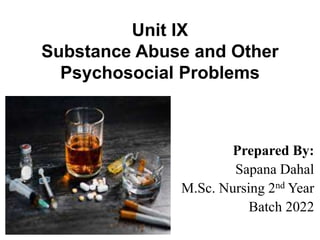
Substance Abuse and Other
Psychosocial Problems
Prepared By:
Sapana Dahal
M.Sc. Nursing 2nd Year
Batch 2022
Objective
At the end of the session, participants will be
able to explain about Substance Abuse and
Psychosocial Problems.
Contents
Psychosocial Problems
• Introduction
• Scenario
• Screening Tools
• Article
Substance Abuse
• Introduction
• Classification
Contents Contd…
• Epidemiology
• Pre-disposing factors
• Substance use disorders
• Preventive measures
• Treatment modalities
• Articles
• References
Psychosocial Problems
Introduction
• Psychosocial problems refer to the difficulties
faced by individuals in different areas of personal
and social functioning.
• On the one hand, it concerns various
psychological problems and on the other hand, it
concerns various social problems.
Psychosocial Problems
Contd…
Psychological problems
• Anxiousness, nervousness
• Depression and feeling depressed
• Burn out
• Loneliness
• Irritability
• Sleep disorder
Psychosocial Problems
Contd…
Psychological problems
• Sexual problems
• Substance abuse
• Behavior problems
• Learning difficulties
• Psychoses
• Schizophrenia
Psychosocial Problems
Contd…
Psychological problems
• Anxiety(disorder)
• Somatization disorder
• Suicide/suicidality
• Phobia/obsessive compulsive disorder
Psychosocial Problems
Contd…
Psychological problems
• Relation problems (with friend, family and/or
partner)
• Eating disorders
• Intellectual disabilities
• Personality disorder or identity problem
Psychosocial Problems
Contd…
Social problems
• Poverty/financial problems
• Housing problems
• Lack of adequate nutrition or water
• Social-cultural problems
• Problems with work or unemployment
Psychosocial Problems
Contd…
Social problems
• School problems
• Problems with social security, with health care
• Legal problems
• Adjustment problems
• Educational problems
Psychosocial Problems
Contd…
Scenario
Global : In 2019
• 301 million people were living with an anxiety
disorder including 58 million children and
adolescents.
• 280 million people were living with depression,
including 23 million children and adolescents.
Psychosocial Problems
Contd…
Global : In 2019
• Approximately 40 million people experienced
bipolar disorder.
• Approximately 24 million people or 1 in 300
people worldwide were schizophrenic.
Psychosocial Problems
Contd…
Global : In 2019
• 14 million people experienced eating disorders
including almost 3 million children and
adolescents,
• 40 million people, including children and
adolescents, were living with conduct-dissocial
disorder. ( WHO)
Psychosocial Problems
Contd…
According to the study Prevalence of Mental
Disorders in Nepal: Findings from the Pilot Study
prevalence of mental disorders among adults and
children were 13.2% and 11.2% respectively. Substance
use disorder, dissociative conversion disorder, major
depressive disorder, alcohol use disorder and psychotic
disorder were common among adults.
Psychosocial Problems
Contd…
Psychotic disorder, agoraphobia, major
depressive disorder, and anxiety disorders were
common among children.
Suicidality was present among 10.9% adults and
8.7% children. ( Jha AK,2019)
Psychosocial Problems
Contd…
A Nationwide Prevalence of Common Mental
Disorders and Suicidality in Nepal: Evidence from
National Mental Health Survey, 2019-2020
• Lifetime prevalence of any mental disorder was
found to be 10%, with a current prevalence of 4.3%.
• A lifetime prevalence of 3% was observed for mood
disorders, 0.2% for schizophrenia, schizotypal and
other delusional disorders
Psychosocial Problems
Contd…
• 0.1% for anti-social personality disorder.
• Current prevalence of mood disorder was nearly
half (1.4%) than that of lifetime mood disorder.
• Prevalence of alcohol use disorder and other
substance use disorders (excluding tobacco) in the
past 12-months - 4.2% and 0.2%, respectively
Psychosocial Problems
Contd…
• Neurotic and stress-related disorders was 3%.
• Highest prevalence was seen for dissociative
disorder (1%), followed by generalized anxiety
disorder (0.8%), panic disorder (0.7%), phobic
anxiety disorder (0.2%), and obsessive-
compulsive disorder (0.2%)
Psychosocial Problems
Contd…
• Suicidality (Current and Lifetime both) 7.2%
and among them, the prevalence of current
suicidal thoughts and lifetime suicidal attempts
was found to be 6.5% and 1.1%, respectively. (
Dhimal M et al. 2019-2020)
Screening Tools for
Psychosocial Problems
Anxiety
Generalized Anxiety Disorder Scale
Depression:
Patient Health Questionnaire (PHQ-9)
Delirium Assessment
Confusion Assessment Method (CAM)
Proposed Treatment by GAD-7
Scale
Patient Health Questionnaire
(PHQ-9)
Screening Tools Contd…
Dementia Assessment
Mini-Mental State Examination
Sleep disorders
Insomnia Severity Index
Sleep Assessment Questionnaire (SAQ)
Screening Tools Contd…
Substance Use:
CAGE Questionaire
AUDIT(Alcohol Use Disorders Identification
Test)
Article
Prevalence and factors associated with
depression among higher secondary school
adolescents of Pokhara Metropolitan, Nepal: a
cross -sectional study concluded that high
prevalence of depression was observed among
high school students.
It was also observed that students’ level of
perceived social support, self-esteem and help-
seeking behavior are somehow related to their
mental well-being.
Article Contd…
Hence, improving social support and self-esteem
may alleviate depression and mental distress
among these adolescents (Bhattarai D,2020).
Substance Abuse
Introduction
The most commonly used drugs have been part
of human existence for thousands of years.
Opium has been used for medicinal purposes for
at least 3,500 years, references to cannabis
(marijuana) as a medicinal can be found in
ancient Chinese herbals.
Substance Abuse
Contd…
Wine is mentioned frequently in the Bible, and
the natives of the Western Hemisphere smoked
tobacco and chewed coca leaves.
Substance Abuse
Contd…
Substance use is defined as the continued use of
substances, illegal drugs, or the misuse of
prescription or over-the-counter drugs with
negative consequences.
Substance Abuse
Contd…
In Nepal’s context Illegal drugs include Opium,
Heroin, Morphine, Cocaine whereas tobacco and
alcohol are drugs controlled by law.
Substance Abuse
Contd…
According to Narcotic Drugs (Control) Act, 2033
(1976), Section 3
“Narcotic Drug”
• Cannabis/ marijuana
• Medicinal cannabis/ marijuana
• Opium
• Processed opium
• Medicinal opium
Substance Abuse
Contd…
• Plants and leaves of coca
• Any natural or synthetic narcotic drug or
psychotropic substances and their salts and other
substances as may be specified by the
Government of Nepal by a notification published
in the Nepal Gazette, from time to time.
Cannabis Opium
Coca plant
Substance Abuse
Contd…
According to DSM-5-TR :
• Alcohol
• Caffeine
• Cannabis
• Hallucinogens
• Inhalants
Substance Abuse
Contd…
• Opioids
• Sedatives
• Hypnotics, or anxiolytics
• Stimulants (including amphetamine-type
substances, cocaine, and other stimulants)
• Tobacco
List of Narcotics and
Psychotropic Substances
Identified for Import and Use
Narcotics
1. Codeine 2. Dextropropoxyphene 3.
Ethylmorphine 4. Etorphine 5. Fentanyl 6.
Methadone 7. Morphine 8. Phethidene 9.
Pholcodine
List of Narcotics and
Psychotropic Substances
Identified for Import and Use
Psychotropic Substances
• Schedule III
1. Buprenorphine 2. Glutethiamide 3.
Pentazocine 4. Pentobarbital
List of Narcotics and
Psychotropic Substances
Identified for Import and Use
• Schedule IV
1. Alprazolam 2. Chlordiazepoxide 3. Clobazam
4. Clonazepam 5. Diazepam 6. Flurazepam 7.
Lorazepam 8. Medazepam 9. Meprobamate 10.
Midazolam 11. Nitrazepam 12. Oxazepam 13.
Oxazolam 14. Phenobarbital 15. Phentermine 16.
Prazepam 17. Triazolam 18. Zolpidem
Epidemiology of Substance use
About 270 million people (or about 5.5% of
global population aged 15-64) had used
psychoactive drugs and about 35 million people
are estimated to be affected by drug use
disorders (harmful pattern of drug use or drug
dependence).
Epidemiology of Substance use
Contd…
It is estimated that about 0.5 million death annually
are attributable to drug use with about 350,000 male
and 150,000 female deaths.
More than 42 million years of healthy life loss
(DALY) were attributable to drug use in 2017; that
is about 1.3% of the global burden of disease.
Epidemiology of Substance use
Contd…
It is estimated that worldwide there are almost 11
million people who inject drugs, of whom 1.4
million live with HIV and 5.6 million - with
hepatitis C ( WHO).
Epidemiology of Substance use
Contd…
Drug users in Nepal - 1,30,424 according to
Nepal Drug User Survey 2076.
In 2069 - 91,534 drug users.
According to the survey report of 2076, the
annual growth rate of drug users is 5.06 percent.
Nepal Drug User Survey 2076
• Cigarette smoking was reported by 96.8 percent
of the drug users
• More than two-third (64.8 percent) of the drug
users had used alcohol at least once in their
lifetime
• More than four out of five (84.7 percent) drug
users had reported having ever used cannabis
Nepal Drug User Survey 2076
Contd….
• Use of opiates was reported by 46.8 percent
• Almost three out of four (73.1 percent) drug users
reported having ever used tranquilizers
• Among all the drug users 3.9 reported having ever
used any inhalant
• Other types of drug were used by 31.0 percent
Substance Use Disorders
A substance use disorder as a pathological use of a
substance that leads to a disorder of use.
-APA
According to (DSM-5 TR) (American Psychiatric
Association (APA), 2022), criteria for substance
abuse are:
Substance Use Disorders
Contd…
A maladaptive pattern of substance use leading to
clinically significant impairment or distress, as
manifested by 2 (or more) of the following,
occurring within a 12-month period
• Recurrent substance use resulting in a failure to
fulfill major role obligations at work, school, or
home
Substance Use Disorders
Contd…
• Recurrent substance use in situations in which
it is physically hazardous .
• Continued substance use despite having
persistent or recurrent social or interpersonal
problems caused or exacerbated by the effects
of the substance
Substance Use Disorders
Contd…
• Tolerance, as defined by either of the
following
–a need for markedly increased amounts of
the substance to achieve intoxication or
desired effect.
–markedly diminished effect with continued
use of the same amount of the substance.
Substance Use Disorders
Contd…
• Withdrawal, as manifested by either of the
following:
–The characteristic withdrawal syndrome for
the substance.
–The same (or a closely related) substance is
taken to relieve or avoid withdrawal
symptoms
Substance Use Disorders
Contd…
• The substance is often taken in larger amounts or
over a longer period than was intended.
• There is a persistent desire or unsuccessful efforts
to cut down or control substance use.
• A great deal of time is spent in activities necessary
to obtain the substance, use the substance, or
recover from its effects.
Substance Use Disorders
Contd…
• Important social, occupational or recreational
activities are given up or reduced because of
substance use are given up or reduced because of
substance use
• The substance use is continued despite knowledge of
having a persistent or recurrent physical or
psychological problem that is likely to have been
caused or exacerbated by the substance.
Substance Use Disorders
Contd…
• Craving or a strong desire or urge to use a
specific substance.
Levels of Substance Use
Disorder Severity
• Mild substance use disorder
• Moderate substance use disorder
• Severe substance use disorder
Predisposing Factors to
Substance-Related Disorders
Biological Factors
• Genetics
• Biochemical Aspects
Psychological Factors
• Developmental Influences
• Personality Factors
Predisposing Factors to
Substance-Related Disorders
Contd…
Sociocultural Factors
• Social Learning
• Conditioning
• Cultural and Ethnic Influences
Alcohol
• Alcohol is a toxic and psychoactive substance
with dependence producing properties.
• Contributes to 3 million deaths each year globally
as well as to the disabilities and poor health of
millions of people.
• Harmful use of alcohol is responsible for 5.1% of
the global burden of disease
Alcohol Contd…
• Leading risk factor for premature mortality and
disability among those aged 15 to 49 years,
accounting for 10% of all deaths in this age(
WHO,2022).
Alcohol Contd…
• In Nepal,72.2% of adults (56% men and 86.5%
women) were life-time abstainers, with
significant differences between men and
women. Almost 1 in 8 men (11.7%) drink daily
or almost daily. (STEPS Survey,2019).
Alcohol Use Disorder
It is a medical condition characterized by an
impaired ability to stop or control alcohol use
despite adverse social, occupational, or health
consequences.
Bipolar disorders, schizophrenia, and antisocial
personality disorder are associated with an
increase in rates of alcohol use disorder
National Alcohol Regulation and
Control Policy 2017
• Minimum age of 21 for alcohol purchase
• Regulate time of alcohol sales
• Require licensing of alcohol outlets and
impose a ban on all kinds of alcohol
advertisements and promotions.
• Pictorial warning sign in the label of alcohol
National Alcohol Regulation and
Control Policy 2017 Contd…
Core features
• Total ban of alcohol advertisement, promotion
and sponsorship.
• Decreasing availability: in the future alcohol
will only be sold by especially licensed shops
for certain hours.
National Alcohol Regulation and
Control Policy 2017 Contd…
• All alcohol containers will have at least a 75%
health warning. Nepal will be first country in
the world to introduce 75% pictorial warning.
• Alcohol will no longer be used in Government-
sponsored programs and events.
National Alcohol Regulation and
Control Policy 2017 Contd…
• Alcohol is no longer allowed to be sold in
public places including heritage sites,
educational institutions, and sports complexes.
Caffeine Related Disorders
Consumption of caffeine at recommended
dietary doses is not generally associated with
negative health consequences and caffeine has
some clinical utility, such as for enhancement of
analgesia.
Caffeine Related Disorders
Contd…
Higher doses of caffeine can produce dysphoric
subjective effects and caffeine intoxication,
including restlessness, nervousness, insomnia,
gastrointestinal distress, and irregular heartbeat.
Excessive use is associated with psychiatric
problems such as bipolar disorders, eating disorders
and sleep disorders.
Cannabis Use Disorder
• Cannabis is the most widely abused illicit drug
globally.
• It comes from the dried leaves, flowers, stems,
and seeds of the hemp plant, Cannabis sativa.
• Approximately 3.9% of the world population
(15-64 years) used cannabis in 2016
approximately 3.9% of the world population (15-
64 years) used cannabis in 2016
Cannabis Use Disorder
Contd…
West and Central Africa come first with 34.3
million users (13.2%), followed by North
America with 41.5 million (12.9%), Oceania 2.9
million (11%), and least in East and South-East
Asia with 9.7 million users (0.6%).
Cannabis Use Disorder
Contd…
According to the Global burden of disease
(2019), cannabis use disorders resulted in
690,000 global years lost due to disability (YLD)
accounting for 0.08% (0.05-0.1%) of total global
YLDs.
Opoid Use Disorder
• Opioids are a class of drugs, that interacts with
opioid receptors on nerve cells in the body and
brain, and reduce the intensity of pain signals
and feelings of pain.
• Includes the illegal drug heroin; synthetic
opioids such as fentanyl and pain medications.
Opioid Use Disorder Contd…
• Opioid Use Disorder (OUD), a substance use
disorder, is a problematic pattern of opioid use
that causes significant impairment or distress.
• In 2020, an estimated 2.7 million people ages
12 or older reported having an OUD. –CDC
Tobacco Use Disorder
• Cigarettes are the most commonly used
tobacco product.
• Causes premature death and disease worldwide
which is mostly preventable
• An estimated 1.3 billion people worldwide use
tobacco products, 80% of whom are in low-
and middle-income countries.
Tobacco Use Disorder
• Every year, more than 8 million people die from
tobacco use.
• Second-hand smoke exposure has also been
implicated in adverse health outcomes, causing 1.2
million deaths annually.
• Nearly half of all children breathe air polluted by
tobacco smoke and 65 000 children die each year
due to illnesses related to second-hand smoke.
Tobacco Control Law
Nepal became a party to the WHO Framework
Convention on Tobacco Control on February 5,
2007.
• Smoke Free Places
• Tobacco Advertising, Promotion and
Sponsorship
Tobacco Control Law Contd…
• Tobacco Packaging and Labeling
• Cigarette Contents and Disclosures
• Sales Restrictions
Roadmap to Tobacco Control
Legislation
• The Tobacco Product (Control and Regulation)
Act, 2010 is the primary law governing
tobacco control in Nepal.
• One regulation and three directives have been
issued under the Act to implement its
provisions:
1. The Tobacco Products (Control and
Regulation) Regulation – 2068 (2011);
Roadmap to Tobacco Control
Legislation Contd…
2.Directive for Printing and Labeling of Warning
Message and Graphics in the Boxes, Packets,
Wrappers, Cartons, Parcels and Packaging of
Tobacco Products
3.Tobacco Product Control and Regulatory
Directive, 2014; and
Roadmap to Tobacco Control
Legislation Contd…
• Directive on Printing Warning Messages and
Pictures on Tobacco Product Boxes, Packets,
Cartons, Parcels and Packaging Materials,
2014
Hallucinogens
• Also known as psychedelics which are a class
of psychoactive drugs that produce temporary
mental changes that include distorted sensory
perception and dreamlike states of
consciousness.
Hallucinogens Contd…
• Types of hallucinogens include LSD, peyote,
PCP, psilocybin and others.
• According to NEPAL DRUG USERS
SURVEY 2076, 1.1 percent reported having
ever used any hallucinogen
Amphetamines
Amphetamines are synthetic drugs, structurally
similar to adrenaline
The use of these drugs results in psychic
dependence.
Narcotics
• Heroin, morphine, codein, methadone, pethidine
are narcotic analgesics.
Narcotics Contd…
The Narcotic Drugs Control Act, 2033 (1976),
is the major law to control the production,
import, sale and consumption of drugs in Nepal.
Volatile Solvents( Inhalants)
• Solvents abuse is a relatively recent development.
• Various substances are used as glues (toluene),
paints, varnishes and lacquers (trichlorethylene,
methylchloride and toluene), cleansing fluids
(trichlorethane),petrol,aerosols,acetone and butane.
Volatile Solvents( Inhalants)
• Plant sources of some commonly abused
substances are Cannabis sativa, Coca plant,
Opium plant, Ergot of Rye
Prevention of Substance abuse
• Primary Prevention
Identification and treatment of family members
who may be contributing to the drug abuse
Introduction of social changes is likely to affect
drinking patterns in the population as a whole.
Prevention of Substance abuse
Contd….
• Secondary Prevention
Early detection and counseling
Detoxification with benzodiazepines
• Tertiary Prevention
Alcohol deterrent therapy
Activities for relapse prevention
Treatment Modalities of
Substance Abuse
• Detoxification
• Psychotherapies
• Psychosocial rehabilitation
Rehabilitation
• The aim of rehabilitation is to enable him to leave
the drug sub-culture and to develop new social
contacts.
Some Rehabilitation Centers are:
• Aashraya Samuha Drug and Alcohol Rehabilitation
Center, Kathmandu
• Mental Disease Treatment and Rehabilitation Centre,
Kathmandu
Rehabilitation Contd…
• Addiction Recovery Center, Jhapa
• Richmond Fellowship, Morang
• KYC – Punarjivan Kendra, Sunsari
• Bijam Rehabilitation Center, Parsa
• Support & Care Rehabilitation Center, Chitwan
• Nava Kiran, Makwanpur
National Policy for Drug Control,
2063 (2006)
• Vision
Attainment of Healthy and prosperous Society
Free from Drugs Addiction.
Policy Strategies
• Supply control
• Demand Reduction
Drug Abuse Prevention
Treatment and Rehabilitation
National Policy for Drug Control,
2063 (2006) Contd…
Risk Reduction
Research and Development
Collaboration, Partnership & Resource
Mobilization
Article
A Study conducted on Substance use and
symptoms of mental health disorders: a
prospective cohort of patients with severe
substance use disorders in Norway concluded
that people with SUD have considerable
symptoms of mental health disorders and
psychological distress.
Article Contd…
Mental health problems were particularly
observed among females, people with frequent
use of cannabis, opioids, and benzodiazepines,
and less among people using amphetamines.
Time trend analyses could suggest that the
differences observed indicates self-medication or
a flattening effect rather than medication-related
decline in mental health (Gjestad R.et al .2021).
Article Contd…
A study conducted on Substance Abuse Among
Medical Students – A Survey in a Medical
College in Nepal concluded that majority of
students were occasional abusers and there was
no evidence of physical dependence. Male
substance abusers 81% exceeded female abusers
19%. Substances most commonly abused were
alcohol 60%, minor tranquilizers 48%, and
tobacco 35%, and only 11% abused cannabis.
Article Contd…
While most students were multidrug users, there
was a low frequency of daily drug use. A general
lifetime (occasional use) prevalence of substance
use of 56% was found. Drugs consumed on a
daily basis were alcohol 2% and tobacco 6%.
The prevalence of drug use was highest among
the fourth and final year students.(Roy R. K.,
Roy D. K., & Goit R. K. 2018)
References
• Stuart G. Principles and Practice of Psychiatric
Nursing: Chemically Mediated Response and
Substance Related Disorders.10th Edition. United
States of America; Elsevier Mosby Publishers.
2014.
• Townsend M. Psychiatric Mental Health
Nursing:Nursing Care of Clients with Alterations
in Psychosocial Adaptation.9th Edition. New
Delhi; Jaypee Brothers Publishers.2012.
• Halter M. Foundations of Psychiatric-Mental
Health Nursing: Substance-Related and Addictive
Disorders.9thEdition.Missouri;Elsevier
Publishers.2022.
References Contd…
• Sadock B ,Sadock V,Ruiz P.Synopsis of Psychiatry:
Substance Use and Addictive Disorders.11th Edition.
Wolters Kluwer Publishers.2015.
• Aas CF, Vold JH, Gjestad R, Skurtveit S, Lim AG, Gjerde
KV, Løberg EM, Johansson KA, Fadnes LT. Substance use
and symptoms of mental health disorders: a prospective
cohort of patients with severe substance use disorders in
Norway. Substance abuse treatment, prevention, and
policy. 2021 Dec;16:1-0.
• Bhattarai D, Shrestha N, Paudel S. Prevalence and factors
associated with depression among higher secondary school
adolescents of Pokhara Metropolitan, Nepal: a cross-
sectional study. BMJ Open 2020;10:e044042. doi:10.1136/
bmjopen-2020-044042.
References Contd…
• Jha AK, Ojha SP, Dahal S, Sharma P, Pant SB,
Labh S, Marahatta K, Shakya S, Adhikari RP,
Joshi D, Luitel NP, Dhimal M. Prevalence of
Mental Disorders in Nepal: Findings from the
Pilot Study. J Nepal Health Res Counc. 2019 Aug
4;17(2):141-147. doi: 10.33314/jnhrc.v0i0.1960.
PMID: 31455924.
• Mental disorders.World Health Organization.
Available from: https://www.who.int/news-
room/fact-sheets/detail/mental-disorders.
References Contd…
• National Policy for Drug Control, 2063 (2006). Available
from : https://www.lawcommission.gov.np/en/wp-
content/upload s/2018/09/national-policy-for-drug-control-
2063-2006.pdf
• Roy, R. K., Roy, D. K., & Goit, R. K. (2018). Substance
Abuse Among Medical Students – A Survey in a Medical
College in Nepal. Journal of Nepalgunj Medical
College, 16(1), 71–75.
https://doi.org/10.3126/jngmc.v16i1.24236
• Available from
:https://www.tobaccocontrollaws.org/legislation/Nepal
THANK YOU

Unit IX substance aaa.pptx

  • 1.
    Unit IX Substance Abuseand Other Psychosocial Problems Prepared By: Sapana Dahal M.Sc. Nursing 2nd Year Batch 2022
  • 2.
    Objective At the endof the session, participants will be able to explain about Substance Abuse and Psychosocial Problems.
  • 3.
    Contents Psychosocial Problems • Introduction •Scenario • Screening Tools • Article Substance Abuse • Introduction • Classification
  • 4.
    Contents Contd… • Epidemiology •Pre-disposing factors • Substance use disorders • Preventive measures • Treatment modalities • Articles • References
  • 5.
    Psychosocial Problems Introduction • Psychosocialproblems refer to the difficulties faced by individuals in different areas of personal and social functioning. • On the one hand, it concerns various psychological problems and on the other hand, it concerns various social problems.
  • 6.
    Psychosocial Problems Contd… Psychological problems •Anxiousness, nervousness • Depression and feeling depressed • Burn out • Loneliness • Irritability • Sleep disorder
  • 7.
    Psychosocial Problems Contd… Psychological problems •Sexual problems • Substance abuse • Behavior problems • Learning difficulties • Psychoses • Schizophrenia
  • 8.
    Psychosocial Problems Contd… Psychological problems •Anxiety(disorder) • Somatization disorder • Suicide/suicidality • Phobia/obsessive compulsive disorder
  • 9.
    Psychosocial Problems Contd… Psychological problems •Relation problems (with friend, family and/or partner) • Eating disorders • Intellectual disabilities • Personality disorder or identity problem
  • 10.
    Psychosocial Problems Contd… Social problems •Poverty/financial problems • Housing problems • Lack of adequate nutrition or water • Social-cultural problems • Problems with work or unemployment
  • 11.
    Psychosocial Problems Contd… Social problems •School problems • Problems with social security, with health care • Legal problems • Adjustment problems • Educational problems
  • 12.
    Psychosocial Problems Contd… Scenario Global :In 2019 • 301 million people were living with an anxiety disorder including 58 million children and adolescents. • 280 million people were living with depression, including 23 million children and adolescents.
  • 13.
    Psychosocial Problems Contd… Global :In 2019 • Approximately 40 million people experienced bipolar disorder. • Approximately 24 million people or 1 in 300 people worldwide were schizophrenic.
  • 14.
    Psychosocial Problems Contd… Global :In 2019 • 14 million people experienced eating disorders including almost 3 million children and adolescents, • 40 million people, including children and adolescents, were living with conduct-dissocial disorder. ( WHO)
  • 15.
    Psychosocial Problems Contd… According tothe study Prevalence of Mental Disorders in Nepal: Findings from the Pilot Study prevalence of mental disorders among adults and children were 13.2% and 11.2% respectively. Substance use disorder, dissociative conversion disorder, major depressive disorder, alcohol use disorder and psychotic disorder were common among adults.
  • 16.
    Psychosocial Problems Contd… Psychotic disorder,agoraphobia, major depressive disorder, and anxiety disorders were common among children. Suicidality was present among 10.9% adults and 8.7% children. ( Jha AK,2019)
  • 17.
    Psychosocial Problems Contd… A NationwidePrevalence of Common Mental Disorders and Suicidality in Nepal: Evidence from National Mental Health Survey, 2019-2020 • Lifetime prevalence of any mental disorder was found to be 10%, with a current prevalence of 4.3%. • A lifetime prevalence of 3% was observed for mood disorders, 0.2% for schizophrenia, schizotypal and other delusional disorders
  • 18.
    Psychosocial Problems Contd… • 0.1%for anti-social personality disorder. • Current prevalence of mood disorder was nearly half (1.4%) than that of lifetime mood disorder. • Prevalence of alcohol use disorder and other substance use disorders (excluding tobacco) in the past 12-months - 4.2% and 0.2%, respectively
  • 19.
    Psychosocial Problems Contd… • Neuroticand stress-related disorders was 3%. • Highest prevalence was seen for dissociative disorder (1%), followed by generalized anxiety disorder (0.8%), panic disorder (0.7%), phobic anxiety disorder (0.2%), and obsessive- compulsive disorder (0.2%)
  • 20.
    Psychosocial Problems Contd… • Suicidality(Current and Lifetime both) 7.2% and among them, the prevalence of current suicidal thoughts and lifetime suicidal attempts was found to be 6.5% and 1.1%, respectively. ( Dhimal M et al. 2019-2020)
  • 21.
    Screening Tools for PsychosocialProblems Anxiety Generalized Anxiety Disorder Scale Depression: Patient Health Questionnaire (PHQ-9) Delirium Assessment Confusion Assessment Method (CAM)
  • 23.
  • 24.
  • 26.
    Screening Tools Contd… DementiaAssessment Mini-Mental State Examination Sleep disorders Insomnia Severity Index Sleep Assessment Questionnaire (SAQ)
  • 27.
    Screening Tools Contd… SubstanceUse: CAGE Questionaire AUDIT(Alcohol Use Disorders Identification Test)
  • 29.
    Article Prevalence and factorsassociated with depression among higher secondary school adolescents of Pokhara Metropolitan, Nepal: a cross -sectional study concluded that high prevalence of depression was observed among high school students. It was also observed that students’ level of perceived social support, self-esteem and help- seeking behavior are somehow related to their mental well-being.
  • 30.
    Article Contd… Hence, improvingsocial support and self-esteem may alleviate depression and mental distress among these adolescents (Bhattarai D,2020).
  • 31.
    Substance Abuse Introduction The mostcommonly used drugs have been part of human existence for thousands of years. Opium has been used for medicinal purposes for at least 3,500 years, references to cannabis (marijuana) as a medicinal can be found in ancient Chinese herbals.
  • 32.
    Substance Abuse Contd… Wine ismentioned frequently in the Bible, and the natives of the Western Hemisphere smoked tobacco and chewed coca leaves.
  • 33.
    Substance Abuse Contd… Substance useis defined as the continued use of substances, illegal drugs, or the misuse of prescription or over-the-counter drugs with negative consequences.
  • 34.
    Substance Abuse Contd… In Nepal’scontext Illegal drugs include Opium, Heroin, Morphine, Cocaine whereas tobacco and alcohol are drugs controlled by law.
  • 35.
    Substance Abuse Contd… According toNarcotic Drugs (Control) Act, 2033 (1976), Section 3 “Narcotic Drug” • Cannabis/ marijuana • Medicinal cannabis/ marijuana • Opium • Processed opium • Medicinal opium
  • 36.
    Substance Abuse Contd… • Plantsand leaves of coca • Any natural or synthetic narcotic drug or psychotropic substances and their salts and other substances as may be specified by the Government of Nepal by a notification published in the Nepal Gazette, from time to time.
  • 37.
  • 38.
    Substance Abuse Contd… According toDSM-5-TR : • Alcohol • Caffeine • Cannabis • Hallucinogens • Inhalants
  • 39.
    Substance Abuse Contd… • Opioids •Sedatives • Hypnotics, or anxiolytics • Stimulants (including amphetamine-type substances, cocaine, and other stimulants) • Tobacco
  • 40.
    List of Narcoticsand Psychotropic Substances Identified for Import and Use Narcotics 1. Codeine 2. Dextropropoxyphene 3. Ethylmorphine 4. Etorphine 5. Fentanyl 6. Methadone 7. Morphine 8. Phethidene 9. Pholcodine
  • 41.
    List of Narcoticsand Psychotropic Substances Identified for Import and Use Psychotropic Substances • Schedule III 1. Buprenorphine 2. Glutethiamide 3. Pentazocine 4. Pentobarbital
  • 42.
    List of Narcoticsand Psychotropic Substances Identified for Import and Use • Schedule IV 1. Alprazolam 2. Chlordiazepoxide 3. Clobazam 4. Clonazepam 5. Diazepam 6. Flurazepam 7. Lorazepam 8. Medazepam 9. Meprobamate 10. Midazolam 11. Nitrazepam 12. Oxazepam 13. Oxazolam 14. Phenobarbital 15. Phentermine 16. Prazepam 17. Triazolam 18. Zolpidem
  • 43.
    Epidemiology of Substanceuse About 270 million people (or about 5.5% of global population aged 15-64) had used psychoactive drugs and about 35 million people are estimated to be affected by drug use disorders (harmful pattern of drug use or drug dependence).
  • 44.
    Epidemiology of Substanceuse Contd… It is estimated that about 0.5 million death annually are attributable to drug use with about 350,000 male and 150,000 female deaths. More than 42 million years of healthy life loss (DALY) were attributable to drug use in 2017; that is about 1.3% of the global burden of disease.
  • 45.
    Epidemiology of Substanceuse Contd… It is estimated that worldwide there are almost 11 million people who inject drugs, of whom 1.4 million live with HIV and 5.6 million - with hepatitis C ( WHO).
  • 46.
    Epidemiology of Substanceuse Contd… Drug users in Nepal - 1,30,424 according to Nepal Drug User Survey 2076. In 2069 - 91,534 drug users. According to the survey report of 2076, the annual growth rate of drug users is 5.06 percent.
  • 47.
    Nepal Drug UserSurvey 2076 • Cigarette smoking was reported by 96.8 percent of the drug users • More than two-third (64.8 percent) of the drug users had used alcohol at least once in their lifetime • More than four out of five (84.7 percent) drug users had reported having ever used cannabis
  • 48.
    Nepal Drug UserSurvey 2076 Contd…. • Use of opiates was reported by 46.8 percent • Almost three out of four (73.1 percent) drug users reported having ever used tranquilizers • Among all the drug users 3.9 reported having ever used any inhalant • Other types of drug were used by 31.0 percent
  • 49.
    Substance Use Disorders Asubstance use disorder as a pathological use of a substance that leads to a disorder of use. -APA According to (DSM-5 TR) (American Psychiatric Association (APA), 2022), criteria for substance abuse are:
  • 50.
    Substance Use Disorders Contd… Amaladaptive pattern of substance use leading to clinically significant impairment or distress, as manifested by 2 (or more) of the following, occurring within a 12-month period • Recurrent substance use resulting in a failure to fulfill major role obligations at work, school, or home
  • 51.
    Substance Use Disorders Contd… •Recurrent substance use in situations in which it is physically hazardous . • Continued substance use despite having persistent or recurrent social or interpersonal problems caused or exacerbated by the effects of the substance
  • 52.
    Substance Use Disorders Contd… •Tolerance, as defined by either of the following –a need for markedly increased amounts of the substance to achieve intoxication or desired effect. –markedly diminished effect with continued use of the same amount of the substance.
  • 53.
    Substance Use Disorders Contd… •Withdrawal, as manifested by either of the following: –The characteristic withdrawal syndrome for the substance. –The same (or a closely related) substance is taken to relieve or avoid withdrawal symptoms
  • 54.
    Substance Use Disorders Contd… •The substance is often taken in larger amounts or over a longer period than was intended. • There is a persistent desire or unsuccessful efforts to cut down or control substance use. • A great deal of time is spent in activities necessary to obtain the substance, use the substance, or recover from its effects.
  • 55.
    Substance Use Disorders Contd… •Important social, occupational or recreational activities are given up or reduced because of substance use are given up or reduced because of substance use • The substance use is continued despite knowledge of having a persistent or recurrent physical or psychological problem that is likely to have been caused or exacerbated by the substance.
  • 56.
    Substance Use Disorders Contd… •Craving or a strong desire or urge to use a specific substance.
  • 57.
    Levels of SubstanceUse Disorder Severity • Mild substance use disorder • Moderate substance use disorder • Severe substance use disorder
  • 58.
    Predisposing Factors to Substance-RelatedDisorders Biological Factors • Genetics • Biochemical Aspects Psychological Factors • Developmental Influences • Personality Factors
  • 59.
    Predisposing Factors to Substance-RelatedDisorders Contd… Sociocultural Factors • Social Learning • Conditioning • Cultural and Ethnic Influences
  • 60.
    Alcohol • Alcohol isa toxic and psychoactive substance with dependence producing properties. • Contributes to 3 million deaths each year globally as well as to the disabilities and poor health of millions of people. • Harmful use of alcohol is responsible for 5.1% of the global burden of disease
  • 61.
    Alcohol Contd… • Leadingrisk factor for premature mortality and disability among those aged 15 to 49 years, accounting for 10% of all deaths in this age( WHO,2022).
  • 62.
    Alcohol Contd… • InNepal,72.2% of adults (56% men and 86.5% women) were life-time abstainers, with significant differences between men and women. Almost 1 in 8 men (11.7%) drink daily or almost daily. (STEPS Survey,2019).
  • 63.
    Alcohol Use Disorder Itis a medical condition characterized by an impaired ability to stop or control alcohol use despite adverse social, occupational, or health consequences. Bipolar disorders, schizophrenia, and antisocial personality disorder are associated with an increase in rates of alcohol use disorder
  • 64.
    National Alcohol Regulationand Control Policy 2017 • Minimum age of 21 for alcohol purchase • Regulate time of alcohol sales • Require licensing of alcohol outlets and impose a ban on all kinds of alcohol advertisements and promotions. • Pictorial warning sign in the label of alcohol
  • 65.
    National Alcohol Regulationand Control Policy 2017 Contd… Core features • Total ban of alcohol advertisement, promotion and sponsorship. • Decreasing availability: in the future alcohol will only be sold by especially licensed shops for certain hours.
  • 66.
    National Alcohol Regulationand Control Policy 2017 Contd… • All alcohol containers will have at least a 75% health warning. Nepal will be first country in the world to introduce 75% pictorial warning. • Alcohol will no longer be used in Government- sponsored programs and events.
  • 67.
    National Alcohol Regulationand Control Policy 2017 Contd… • Alcohol is no longer allowed to be sold in public places including heritage sites, educational institutions, and sports complexes.
  • 68.
    Caffeine Related Disorders Consumptionof caffeine at recommended dietary doses is not generally associated with negative health consequences and caffeine has some clinical utility, such as for enhancement of analgesia.
  • 69.
    Caffeine Related Disorders Contd… Higherdoses of caffeine can produce dysphoric subjective effects and caffeine intoxication, including restlessness, nervousness, insomnia, gastrointestinal distress, and irregular heartbeat. Excessive use is associated with psychiatric problems such as bipolar disorders, eating disorders and sleep disorders.
  • 70.
    Cannabis Use Disorder •Cannabis is the most widely abused illicit drug globally. • It comes from the dried leaves, flowers, stems, and seeds of the hemp plant, Cannabis sativa. • Approximately 3.9% of the world population (15-64 years) used cannabis in 2016 approximately 3.9% of the world population (15- 64 years) used cannabis in 2016
  • 71.
    Cannabis Use Disorder Contd… Westand Central Africa come first with 34.3 million users (13.2%), followed by North America with 41.5 million (12.9%), Oceania 2.9 million (11%), and least in East and South-East Asia with 9.7 million users (0.6%).
  • 72.
    Cannabis Use Disorder Contd… Accordingto the Global burden of disease (2019), cannabis use disorders resulted in 690,000 global years lost due to disability (YLD) accounting for 0.08% (0.05-0.1%) of total global YLDs.
  • 73.
    Opoid Use Disorder •Opioids are a class of drugs, that interacts with opioid receptors on nerve cells in the body and brain, and reduce the intensity of pain signals and feelings of pain. • Includes the illegal drug heroin; synthetic opioids such as fentanyl and pain medications.
  • 74.
    Opioid Use DisorderContd… • Opioid Use Disorder (OUD), a substance use disorder, is a problematic pattern of opioid use that causes significant impairment or distress. • In 2020, an estimated 2.7 million people ages 12 or older reported having an OUD. –CDC
  • 75.
    Tobacco Use Disorder •Cigarettes are the most commonly used tobacco product. • Causes premature death and disease worldwide which is mostly preventable • An estimated 1.3 billion people worldwide use tobacco products, 80% of whom are in low- and middle-income countries.
  • 76.
    Tobacco Use Disorder •Every year, more than 8 million people die from tobacco use. • Second-hand smoke exposure has also been implicated in adverse health outcomes, causing 1.2 million deaths annually. • Nearly half of all children breathe air polluted by tobacco smoke and 65 000 children die each year due to illnesses related to second-hand smoke.
  • 77.
    Tobacco Control Law Nepalbecame a party to the WHO Framework Convention on Tobacco Control on February 5, 2007. • Smoke Free Places • Tobacco Advertising, Promotion and Sponsorship
  • 78.
    Tobacco Control LawContd… • Tobacco Packaging and Labeling • Cigarette Contents and Disclosures • Sales Restrictions
  • 79.
    Roadmap to TobaccoControl Legislation • The Tobacco Product (Control and Regulation) Act, 2010 is the primary law governing tobacco control in Nepal. • One regulation and three directives have been issued under the Act to implement its provisions: 1. The Tobacco Products (Control and Regulation) Regulation – 2068 (2011);
  • 80.
    Roadmap to TobaccoControl Legislation Contd… 2.Directive for Printing and Labeling of Warning Message and Graphics in the Boxes, Packets, Wrappers, Cartons, Parcels and Packaging of Tobacco Products 3.Tobacco Product Control and Regulatory Directive, 2014; and
  • 81.
    Roadmap to TobaccoControl Legislation Contd… • Directive on Printing Warning Messages and Pictures on Tobacco Product Boxes, Packets, Cartons, Parcels and Packaging Materials, 2014
  • 82.
    Hallucinogens • Also knownas psychedelics which are a class of psychoactive drugs that produce temporary mental changes that include distorted sensory perception and dreamlike states of consciousness.
  • 83.
    Hallucinogens Contd… • Typesof hallucinogens include LSD, peyote, PCP, psilocybin and others. • According to NEPAL DRUG USERS SURVEY 2076, 1.1 percent reported having ever used any hallucinogen
  • 84.
    Amphetamines Amphetamines are syntheticdrugs, structurally similar to adrenaline The use of these drugs results in psychic dependence. Narcotics • Heroin, morphine, codein, methadone, pethidine are narcotic analgesics.
  • 85.
    Narcotics Contd… The NarcoticDrugs Control Act, 2033 (1976), is the major law to control the production, import, sale and consumption of drugs in Nepal.
  • 86.
    Volatile Solvents( Inhalants) •Solvents abuse is a relatively recent development. • Various substances are used as glues (toluene), paints, varnishes and lacquers (trichlorethylene, methylchloride and toluene), cleansing fluids (trichlorethane),petrol,aerosols,acetone and butane.
  • 87.
    Volatile Solvents( Inhalants) •Plant sources of some commonly abused substances are Cannabis sativa, Coca plant, Opium plant, Ergot of Rye
  • 88.
    Prevention of Substanceabuse • Primary Prevention Identification and treatment of family members who may be contributing to the drug abuse Introduction of social changes is likely to affect drinking patterns in the population as a whole.
  • 89.
    Prevention of Substanceabuse Contd…. • Secondary Prevention Early detection and counseling Detoxification with benzodiazepines • Tertiary Prevention Alcohol deterrent therapy Activities for relapse prevention
  • 90.
    Treatment Modalities of SubstanceAbuse • Detoxification • Psychotherapies • Psychosocial rehabilitation
  • 91.
    Rehabilitation • The aimof rehabilitation is to enable him to leave the drug sub-culture and to develop new social contacts. Some Rehabilitation Centers are: • Aashraya Samuha Drug and Alcohol Rehabilitation Center, Kathmandu • Mental Disease Treatment and Rehabilitation Centre, Kathmandu
  • 92.
    Rehabilitation Contd… • AddictionRecovery Center, Jhapa • Richmond Fellowship, Morang • KYC – Punarjivan Kendra, Sunsari • Bijam Rehabilitation Center, Parsa • Support & Care Rehabilitation Center, Chitwan • Nava Kiran, Makwanpur
  • 93.
    National Policy forDrug Control, 2063 (2006) • Vision Attainment of Healthy and prosperous Society Free from Drugs Addiction. Policy Strategies • Supply control • Demand Reduction Drug Abuse Prevention Treatment and Rehabilitation
  • 94.
    National Policy forDrug Control, 2063 (2006) Contd… Risk Reduction Research and Development Collaboration, Partnership & Resource Mobilization
  • 95.
    Article A Study conductedon Substance use and symptoms of mental health disorders: a prospective cohort of patients with severe substance use disorders in Norway concluded that people with SUD have considerable symptoms of mental health disorders and psychological distress.
  • 96.
    Article Contd… Mental healthproblems were particularly observed among females, people with frequent use of cannabis, opioids, and benzodiazepines, and less among people using amphetamines. Time trend analyses could suggest that the differences observed indicates self-medication or a flattening effect rather than medication-related decline in mental health (Gjestad R.et al .2021).
  • 97.
    Article Contd… A studyconducted on Substance Abuse Among Medical Students – A Survey in a Medical College in Nepal concluded that majority of students were occasional abusers and there was no evidence of physical dependence. Male substance abusers 81% exceeded female abusers 19%. Substances most commonly abused were alcohol 60%, minor tranquilizers 48%, and tobacco 35%, and only 11% abused cannabis.
  • 98.
    Article Contd… While moststudents were multidrug users, there was a low frequency of daily drug use. A general lifetime (occasional use) prevalence of substance use of 56% was found. Drugs consumed on a daily basis were alcohol 2% and tobacco 6%. The prevalence of drug use was highest among the fourth and final year students.(Roy R. K., Roy D. K., & Goit R. K. 2018)
  • 99.
    References • Stuart G.Principles and Practice of Psychiatric Nursing: Chemically Mediated Response and Substance Related Disorders.10th Edition. United States of America; Elsevier Mosby Publishers. 2014. • Townsend M. Psychiatric Mental Health Nursing:Nursing Care of Clients with Alterations in Psychosocial Adaptation.9th Edition. New Delhi; Jaypee Brothers Publishers.2012. • Halter M. Foundations of Psychiatric-Mental Health Nursing: Substance-Related and Addictive Disorders.9thEdition.Missouri;Elsevier Publishers.2022.
  • 100.
    References Contd… • SadockB ,Sadock V,Ruiz P.Synopsis of Psychiatry: Substance Use and Addictive Disorders.11th Edition. Wolters Kluwer Publishers.2015. • Aas CF, Vold JH, Gjestad R, Skurtveit S, Lim AG, Gjerde KV, Løberg EM, Johansson KA, Fadnes LT. Substance use and symptoms of mental health disorders: a prospective cohort of patients with severe substance use disorders in Norway. Substance abuse treatment, prevention, and policy. 2021 Dec;16:1-0. • Bhattarai D, Shrestha N, Paudel S. Prevalence and factors associated with depression among higher secondary school adolescents of Pokhara Metropolitan, Nepal: a cross- sectional study. BMJ Open 2020;10:e044042. doi:10.1136/ bmjopen-2020-044042.
  • 101.
    References Contd… • JhaAK, Ojha SP, Dahal S, Sharma P, Pant SB, Labh S, Marahatta K, Shakya S, Adhikari RP, Joshi D, Luitel NP, Dhimal M. Prevalence of Mental Disorders in Nepal: Findings from the Pilot Study. J Nepal Health Res Counc. 2019 Aug 4;17(2):141-147. doi: 10.33314/jnhrc.v0i0.1960. PMID: 31455924. • Mental disorders.World Health Organization. Available from: https://www.who.int/news- room/fact-sheets/detail/mental-disorders.
  • 102.
    References Contd… • NationalPolicy for Drug Control, 2063 (2006). Available from : https://www.lawcommission.gov.np/en/wp- content/upload s/2018/09/national-policy-for-drug-control- 2063-2006.pdf • Roy, R. K., Roy, D. K., & Goit, R. K. (2018). Substance Abuse Among Medical Students – A Survey in a Medical College in Nepal. Journal of Nepalgunj Medical College, 16(1), 71–75. https://doi.org/10.3126/jngmc.v16i1.24236 • Available from :https://www.tobaccocontrollaws.org/legislation/Nepal
  • 103.