EPISIOTOMY
MRS RAMESHWORI TH
ASSOCIATE PROFESSOR
EPISIOTOMY AND SUTURING
Introduction:
โ€ข Episiotomy is a surgical enlargement of the vaginal
orifice by an incision to the perineum.
โ€ข It is clear that much evidence exists supporting a
restricted policy for episiotomy and do not intend to
suggest that episiotomy should be routinely performed.
โ€ข Episiotomy is necessary, to achieve optimum outcomes
for mother and infant, without any adverse risk of perineal
or anal sphincter injury.
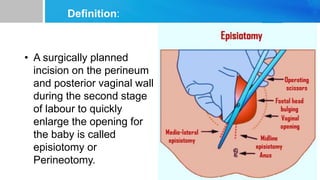
Definition:
โ€ข A surgically planned
incision on the perineum
and posterior vaginal wall
during the second stage
of labour to quickly
enlarge the opening for
the baby is called
episiotomy or
Perineotomy.
Purposes:
โ€ข To prevent the perineum from tearing.
โ€ข To allow more space for manipulative vaginal deliveries, e.g.
forceps
โ€ข To shorten the second stage of labour e.g. with fetal distress.
โ€ข To enlarge the vaginal introitus
โ€ข To facilitate easy and safe delivery
โ€ข To minimize out stretching and rupture of the perinealmuscles
and fascia
โ€ข To reduce the stress and strain on the fetal head
โ€ข To reduce prolonged maternal pushing efforts
Indication:
Anticipating perineal tear:
โ€ข Primi as an elective procedure
โ€ข Face to pubis delivery,
โ€ข Big baby
โ€ข Narrow pubic arch
Inelastic perineum:
โ€ข Perineal rigidity in elderly primi
โ€ข Old perineal scar of episiotomy
โ€ข Perineorrhaphy
Manipulative delivery:
โ€ข Needed to get more space
โ€ข Forceps
โ€ข Breech
โ€ข Internal version
To cut the second stage:
โ€ข Heart disease
โ€ข Severe pre eclampsia or eclampsia
โ€ข Post caesarean cases
โ€ข Post maturity
Fetal interest:
โ€ข Fetal distress
โ€ข Premature baby
โ€ข Breech delivery โ€“ to minimize
compression of the after coming head
Risks of the procedure:
โ€ข Bleeding
โ€ข Tearing the rectal tissues and anal sphincter
โ€ข Perineal pain
โ€ข Infection
โ€ข Perineal hematoma (Collection of blood in the
perineal tissues)
โ€ข Pain during sexual intercourse
Timing of the episiotomy:
โ€ข The timing of performing the episiotomy requires
judgement.
โ€ข If done early the blood loss will be more and if done late, it
fails to prevent the invisible lacerations of the perineal
body and thereby fails to protect the pelvic floor.
โ€ข Bulging thinned perineum during contraction just prior to
crowning is the ideal time
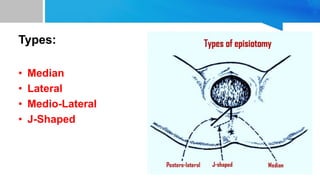
Types:
โ€ข Median
โ€ข Lateral
โ€ข Medio-Lateral
โ€ข J-Shaped
Mediolateral:
โ€ข Down wards and out wards
from the mid point of the
fourchette
โ€ข Either to the right or left.
โ€ข Runs about 2.5 cm away from
the anus
Median:
Centre of the fourchette and
extends posteriorly along
the midline for about 2.5 cm
Lateral:
โ€ข 1 cm away from the centre
of the fourchette
โ€ข Extends laterally
โ€ข Might injure the bartholinโ€™s
duct
J shaped:
โ€ข Begins in the centre of the
fourchette
โ€ข Directed posteriorly along
the midline about 1.5 cm
โ€ข Directed downwards and
outwards along 5 or 7 oโ€™
clock position .
Merits & demerits of Median:
Merits:
โ€ข The muscles are not cut
โ€ข Blood loss is least
โ€ข Repair is easy
โ€ข Post op. comfort is better
โ€ข Healing is superior
โ€ข Wound disruption is rare
โ€ข Dyspareunia is rare
Demerits:
โ€ข Extension if occurs may
involve the rectum
โ€ข Not suitable for
manipulative delivery or
in abnormal presentation
or position
โ€ข Its use is selective
Mediolateral:
Merits
โ€ข Safety from rectal
involvement
โ€ข Incision can be extended
โ€ข Demerits:
โ€ข Apposition is not so good
โ€ข Blood loss is more
โ€ข โ€ข Post op. discomfort is
more
โ€ข โ€ข Increased incidence of
wound disruption
โ€ข โ€ข Dyspareunia
Classification of episiotomy:
Classified by degrees that are based on the severity or extent of the tear:
First degree:
โ€ข A first-degree episiotomy
consists of a small tear that
only extends through the lining
of the vagina.
โ€ข It doesnโ€™t involve the
underlying tissues.
Second degree:
โ€ข This is the most common
type of episiotomy.
โ€ข It extends through the
vaginal lining as well as
the vaginal tissue.
โ€ข However, it doesnโ€™t
involve the rectal lining or
anal sphincter.
โ€ข Third degree:
โ€ข It involves the vaginal
lining, the vaginal tissues,
and part of the anal
sphincter
โ€ข Fourth degree:
โ€ข The most severe type of
episiotomy includes the
vaginal lining, vaginal
tissues, anal sphincter,
and rectal lining
Preparation:
โ€ข Explain the procedure to
the mother
โ€ข Provide privacy and
drape the mother
โ€ข Advice the mother to
empty her bladder /
catheterize the bladder.
โ€ข Monitor the uterine
contractions (duration,
frequency and intensity)
โ€ข Monitor FHR every 15
mins
โ€ข Do per vaginal
examination
โ€ข Observe the color of
amniotic fluid
Preparation of equipment:
โ€ข A sterile delivery packs containing:-
โ€ข Episiotomy scissor - 1.
โ€ข Artery forceps - 2.
โ€ข Sponge holding forceps - 1
โ€ข Syringe loaded with 2% of xylocaine(5 to10ml-)
โ€ข Cord cutting Scissors- 1
โ€ข Bowl for cleaning solution- 1
โ€ข 4 x4 gauze pieces โ€“ 5
โ€ข Cotton balls -7
โ€ข Gauze pad for supporting the perineum -2
โ€ข Center hole towel
โ€ข Cord clamp
โ€ข Bulb / mucous sucker
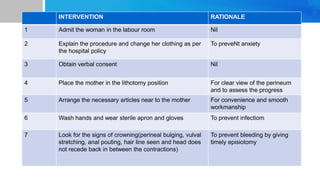
INTERVENTION RATIONALE
1 Admit the woman in the labour room Nil
2 Explain the procedure and change her clothing as per
the hospital policy
To preveNt anxiety
3 Obtain verbal consent Nil
4 Place the mother in the lithotomy position For clear view of the perineum
and to assess the progress
5 Arrange the necessary articles near to the mother For convenience and smooth
workmanship
6 Wash hands and wear sterile apron and gloves To prevent infectiom
7 Look for the signs of crowning(perineal bulging, vulval
stretching, anal pouting, hair line seen and head does
not recede back in between the contractions)
To prevent bleeding by giving
timely episiotomy
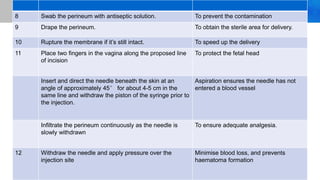
8 Swab the perineum with antiseptic solution. To prevent the contamination
9 Drape the perineum. To obtain the sterile area for delivery.
10 Rupture the membrane if itโ€™s still intact. To speed up the delivery
11 Place two fingers in the vagina along the proposed line
of incision
To protect the fetal head
Insert and direct the needle beneath the skin at an
angle of approximately 45ยฐ for about 4-5 cm in the
same line and withdraw the piston of the syringe prior to
the injection.
Aspiration ensures the needle has not
entered a blood vessel
Infiltrate the perineum continuously as the needle is
slowly withdrawn
To ensure adequate analgesia.
12 Withdraw the needle and apply pressure over the
injection site
Minimise blood loss, and prevents
haematoma formation
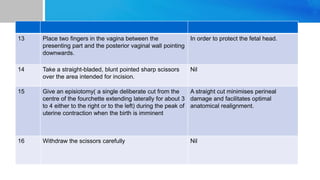
13 Place two fingers in the vagina between the
presenting part and the posterior vaginal wall pointing
downwards.
In order to protect the fetal head.
14 Take a straight-bladed, blunt pointed sharp scissors
over the area intended for incision.
Nil
15 Give an episiotomy( a single deliberate cut from the
centre of the fourchette extending laterally for about 3
to 4 either to the right or to the left) during the peak of
uterine contraction when the birth is imminent
A straight cut minimises perineal
damage and facilitates optimal
anatomical realignment.
16 Withdraw the scissors carefully Nil
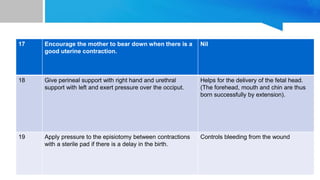
17 Encourage the mother to bear down when there is a
good uterine contraction.
Nil
18 Give perineal support with right hand and urethral
support with left and exert pressure over the occiput.
Helps for the delivery of the fetal head.
(The forehead, mouth and chin are thus
born successfully by extension).
19 Apply pressure to the episiotomy between contractions
with a sterile pad if there is a delay in the birth.
Controls bleeding from the wound
STRUCTURES CUT DURING EPISIOTOMY
โ€ข Structures cut during episiotomy
โ€ข Posterior vaginal wall
โ€ข Superficial and deep transverse perineal
muscles,
โ€ข Bulbospongiosus and part of levator ani
โ€ข Fascia covering those muscles.
โ€ข Transverse perineal branches of pudental
vessels and nerves.
โ€ข Subcutaneous tissue and skin.
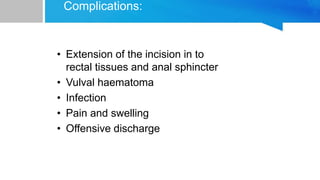
Complications:
โ€ข Extension of the incision in to
rectal tissues and anal sphincter
โ€ข Vulval haematoma
โ€ข Infection
โ€ข Pain and swelling
โ€ข Offensive discharge

EPISIOTOMY.pptx

  • 1.
  • 2.
    EPISIOTOMY AND SUTURING Introduction: โ€ขEpisiotomy is a surgical enlargement of the vaginal orifice by an incision to the perineum. โ€ข It is clear that much evidence exists supporting a restricted policy for episiotomy and do not intend to suggest that episiotomy should be routinely performed. โ€ข Episiotomy is necessary, to achieve optimum outcomes for mother and infant, without any adverse risk of perineal or anal sphincter injury.
  • 3.
    Definition: โ€ข A surgicallyplanned incision on the perineum and posterior vaginal wall during the second stage of labour to quickly enlarge the opening for the baby is called episiotomy or Perineotomy.
  • 4.
    Purposes: โ€ข To preventthe perineum from tearing. โ€ข To allow more space for manipulative vaginal deliveries, e.g. forceps โ€ข To shorten the second stage of labour e.g. with fetal distress. โ€ข To enlarge the vaginal introitus โ€ข To facilitate easy and safe delivery โ€ข To minimize out stretching and rupture of the perinealmuscles and fascia โ€ข To reduce the stress and strain on the fetal head โ€ข To reduce prolonged maternal pushing efforts
  • 5.
    Indication: Anticipating perineal tear: โ€ขPrimi as an elective procedure โ€ข Face to pubis delivery, โ€ข Big baby โ€ข Narrow pubic arch Inelastic perineum: โ€ข Perineal rigidity in elderly primi โ€ข Old perineal scar of episiotomy โ€ข Perineorrhaphy Manipulative delivery: โ€ข Needed to get more space โ€ข Forceps โ€ข Breech โ€ข Internal version To cut the second stage: โ€ข Heart disease โ€ข Severe pre eclampsia or eclampsia โ€ข Post caesarean cases โ€ข Post maturity Fetal interest: โ€ข Fetal distress โ€ข Premature baby โ€ข Breech delivery โ€“ to minimize compression of the after coming head
  • 6.
    Risks of theprocedure: โ€ข Bleeding โ€ข Tearing the rectal tissues and anal sphincter โ€ข Perineal pain โ€ข Infection โ€ข Perineal hematoma (Collection of blood in the perineal tissues) โ€ข Pain during sexual intercourse
  • 7.
    Timing of theepisiotomy: โ€ข The timing of performing the episiotomy requires judgement. โ€ข If done early the blood loss will be more and if done late, it fails to prevent the invisible lacerations of the perineal body and thereby fails to protect the pelvic floor. โ€ข Bulging thinned perineum during contraction just prior to crowning is the ideal time
  • 8.
    Types: โ€ข Median โ€ข Lateral โ€ขMedio-Lateral โ€ข J-Shaped
  • 9.
    Mediolateral: โ€ข Down wardsand out wards from the mid point of the fourchette โ€ข Either to the right or left. โ€ข Runs about 2.5 cm away from the anus Median: Centre of the fourchette and extends posteriorly along the midline for about 2.5 cm
  • 10.
    Lateral: โ€ข 1 cmaway from the centre of the fourchette โ€ข Extends laterally โ€ข Might injure the bartholinโ€™s duct J shaped: โ€ข Begins in the centre of the fourchette โ€ข Directed posteriorly along the midline about 1.5 cm โ€ข Directed downwards and outwards along 5 or 7 oโ€™ clock position .
  • 11.
    Merits & demeritsof Median: Merits: โ€ข The muscles are not cut โ€ข Blood loss is least โ€ข Repair is easy โ€ข Post op. comfort is better โ€ข Healing is superior โ€ข Wound disruption is rare โ€ข Dyspareunia is rare Demerits: โ€ข Extension if occurs may involve the rectum โ€ข Not suitable for manipulative delivery or in abnormal presentation or position โ€ข Its use is selective
  • 12.
    Mediolateral: Merits โ€ข Safety fromrectal involvement โ€ข Incision can be extended โ€ข Demerits: โ€ข Apposition is not so good โ€ข Blood loss is more โ€ข โ€ข Post op. discomfort is more โ€ข โ€ข Increased incidence of wound disruption โ€ข โ€ข Dyspareunia
  • 13.
    Classification of episiotomy: Classifiedby degrees that are based on the severity or extent of the tear: First degree: โ€ข A first-degree episiotomy consists of a small tear that only extends through the lining of the vagina. โ€ข It doesnโ€™t involve the underlying tissues. Second degree: โ€ข This is the most common type of episiotomy. โ€ข It extends through the vaginal lining as well as the vaginal tissue. โ€ข However, it doesnโ€™t involve the rectal lining or anal sphincter.
  • 14.
    โ€ข Third degree: โ€ขIt involves the vaginal lining, the vaginal tissues, and part of the anal sphincter โ€ข Fourth degree: โ€ข The most severe type of episiotomy includes the vaginal lining, vaginal tissues, anal sphincter, and rectal lining
  • 15.
    Preparation: โ€ข Explain theprocedure to the mother โ€ข Provide privacy and drape the mother โ€ข Advice the mother to empty her bladder / catheterize the bladder. โ€ข Monitor the uterine contractions (duration, frequency and intensity) โ€ข Monitor FHR every 15 mins โ€ข Do per vaginal examination โ€ข Observe the color of amniotic fluid
  • 16.
    Preparation of equipment: โ€ขA sterile delivery packs containing:- โ€ข Episiotomy scissor - 1. โ€ข Artery forceps - 2. โ€ข Sponge holding forceps - 1 โ€ข Syringe loaded with 2% of xylocaine(5 to10ml-) โ€ข Cord cutting Scissors- 1 โ€ข Bowl for cleaning solution- 1 โ€ข 4 x4 gauze pieces โ€“ 5 โ€ข Cotton balls -7 โ€ข Gauze pad for supporting the perineum -2 โ€ข Center hole towel โ€ข Cord clamp โ€ข Bulb / mucous sucker
  • 17.
    INTERVENTION RATIONALE 1 Admitthe woman in the labour room Nil 2 Explain the procedure and change her clothing as per the hospital policy To preveNt anxiety 3 Obtain verbal consent Nil 4 Place the mother in the lithotomy position For clear view of the perineum and to assess the progress 5 Arrange the necessary articles near to the mother For convenience and smooth workmanship 6 Wash hands and wear sterile apron and gloves To prevent infectiom 7 Look for the signs of crowning(perineal bulging, vulval stretching, anal pouting, hair line seen and head does not recede back in between the contractions) To prevent bleeding by giving timely episiotomy
  • 18.
    8 Swab theperineum with antiseptic solution. To prevent the contamination 9 Drape the perineum. To obtain the sterile area for delivery. 10 Rupture the membrane if itโ€™s still intact. To speed up the delivery 11 Place two fingers in the vagina along the proposed line of incision To protect the fetal head Insert and direct the needle beneath the skin at an angle of approximately 45ยฐ for about 4-5 cm in the same line and withdraw the piston of the syringe prior to the injection. Aspiration ensures the needle has not entered a blood vessel Infiltrate the perineum continuously as the needle is slowly withdrawn To ensure adequate analgesia. 12 Withdraw the needle and apply pressure over the injection site Minimise blood loss, and prevents haematoma formation
  • 19.
    13 Place twofingers in the vagina between the presenting part and the posterior vaginal wall pointing downwards. In order to protect the fetal head. 14 Take a straight-bladed, blunt pointed sharp scissors over the area intended for incision. Nil 15 Give an episiotomy( a single deliberate cut from the centre of the fourchette extending laterally for about 3 to 4 either to the right or to the left) during the peak of uterine contraction when the birth is imminent A straight cut minimises perineal damage and facilitates optimal anatomical realignment. 16 Withdraw the scissors carefully Nil
  • 20.
    17 Encourage themother to bear down when there is a good uterine contraction. Nil 18 Give perineal support with right hand and urethral support with left and exert pressure over the occiput. Helps for the delivery of the fetal head. (The forehead, mouth and chin are thus born successfully by extension). 19 Apply pressure to the episiotomy between contractions with a sterile pad if there is a delay in the birth. Controls bleeding from the wound
  • 21.
    STRUCTURES CUT DURINGEPISIOTOMY โ€ข Structures cut during episiotomy โ€ข Posterior vaginal wall โ€ข Superficial and deep transverse perineal muscles, โ€ข Bulbospongiosus and part of levator ani โ€ข Fascia covering those muscles. โ€ข Transverse perineal branches of pudental vessels and nerves. โ€ข Subcutaneous tissue and skin.
  • 22.
    Complications: โ€ข Extension ofthe incision in to rectal tissues and anal sphincter โ€ข Vulval haematoma โ€ข Infection โ€ข Pain and swelling โ€ข Offensive discharge