UTERINE INERTIA
Definition
• This is one of the faults in the power of the
uterus leading to abnormal uterine action
resulting in prolonged labour
• Its divided into two:
1. Primary uterine inertia
2. Secondery uterine inertia
Primary uterine inertia
• The pt is frequently primigravida through it
might occur in a pts who has had several
delivery.
• The contraction have normal polarity in that
they start at the fundus & go down, but they
are abnormally weak, short lived & infrequent
• The problem usually affects labour from start
& progress is very slow
• The condition is usually seen in primigravida
who have CPD
• It is as if the uterus is trying to protect the
woman by never allowing labour to be
established
• As pain is minimal & the contraction are week,
the condition of the pts & the fetus usually
remain normal with little danger to either,
unless membranes rupture & infection
complicates prolonged labour
MNX
• As soon women often have CPD any attempt
to stimulate the uterine contraction will
overcome the inertia but will sometimes be
unsuccessful in achieving a vaginal delivery.
• The woman might also develop obstructed
labour so C/S is done
Secondary uterine inertia
• This is essentially uterine exhaustion or
uterine muscle fatigue. It follows prolonged or
excessive strong uterine action in the 2nd stage
of labour
• It might occur late in first stage
• The 2nd stage or during the 3rd stage & leads to
post partum haemorrahage
causes
• During labour the uterine muscle has to do a
lot of work like muscles elsewhere in it needs,
glucose & O2 as a source of energy.
• Product of fat metabolism known as ketones
accumulate in the blood
• These are acidic
• The pt & blood become acidic with altered
blood electrolytes & PH & this causes
hypotonia of the uterus
• Aceline appear in urine
MNX
• I.V fluid dextrose/ saline to correct electrolyte
imbalance
• V.E to R/O CPD
• If no CPD- Stimulate the uterus with
syntocinon (2- nunits per litre)
• This may help the uterus to contraction
• If membranes not ruptured then rupture then
this also improves the uterine contraction
• I CPD is present then do C/S
FAVOURABLE FACTORS FOR
INDUCTION OF LABOUR
• Gestation- When gestation is more than 38
wks induction of labour is more likely to be
successful as the nearer to term pg is the
more sensitive is the uterus to induction
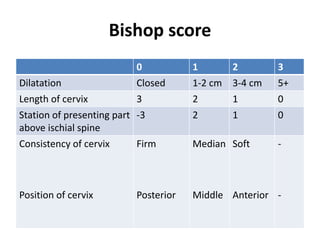
• Ripe cervix ( shown by bishop score)
• The bishop score is an objective method of
assessing whether the cervix is favorably for
induction of labour
• Five different features are considered & each
is a warded a score of between 0 & 3
• When the total score is six or over the
prognosis for induction of labour is good
Bishop score
0 1 2 3
Dilatation Closed 1-2 cm 3-4 cm 5+
Length of cervix 3 2 1 0
Station of presenting part
above ischial spine
-3 2 1 0
Consistency of cervix
Position of cervix
Firm
Posterior
Median
Middle
Soft
Anterior
-
-
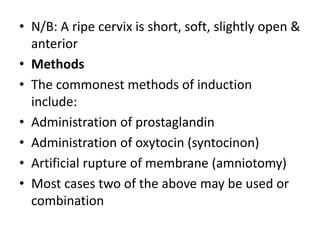
• N/B: A ripe cervix is short, soft, slightly open &
anterior
• Methods
• The commonest methods of induction
include:
• Administration of prostaglandin
• Administration of oxytocin (syntocinon)
• Artificial rupture of membrane (amniotomy)
• Most cases two of the above may be used or
combination
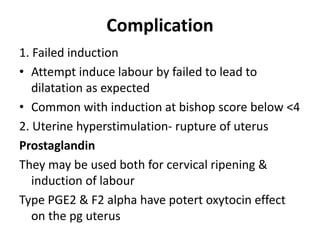
Complication
1. Failed induction
• Attempt induce labour by failed to lead to
dilatation as expected
• Common with induction at bishop score below <4
2. Uterine hyperstimulation- rupture of uterus
Prostaglandin
They may be used both for cervical ripening &
induction of labour
Type PGE2 & F2 alpha have potert oxytocin effect
on the pg uterus
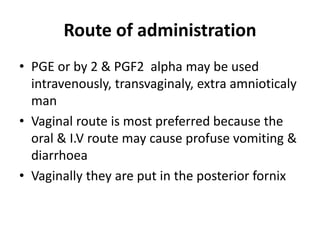
Route of administration
• PGE or by 2 & PGF2 alpha may be used
intravenously, transvaginaly, extra amnioticaly
man
• Vaginal route is most preferred because the
oral & I.V route may cause profuse vomiting &
diarrhoea
• Vaginally they are put in the posterior fornix
Dosage
a. The primigravid requires 2mg of PGE2 six hly
unitil labour is established or 5mg of PGF2
alpha six hrly until labour is established
b. Multiparous need half the above dose six hrly
until labour is established
• N/B: PGE, has powerful oxytocin effects on the
uterus at any stage of pg is performed for
cervical ripening
• The fetal heart rate should be monitored in
both cases offer lead to contraction which can
cause fetal distress
• Complications
• Fetal distress
• Infections
• Rupture of uterus
• Hyperstimulation
• N/B: Collection of electrolyte imbalance alone
can correct the situation leading to good
contraction & hence delivery
• 3rd stage is managed actively with ergometrin
and controlled cord traction.
SHOCK IN OBSTETRIC
• This is a reduction effective circulatory volume
& blood pressure leading to profound
depression of body function
• Causes
• Severe haemorrhage e.g PPH, APH
• Electrolyte imbalance e.g prolonged labour
• Trauma during operative deliveries
• Abruptio placenta (pain & DIC)
• Rupture of the uterus
• Inversion of uterus (acute)
• Amniotic embolism thromboplastic leading to
DIC
• Pulmonary embolism
• Adrenal haemorrhage
• Bacteraemia/septicaemia leading to endotoxic
shock i.e endotoxicity of gram –ve organism
E.coli
S/S
• Thready rapid weak pulse
• Restlessness & drowsiness & light sweating
• Rapid shallow respiration which as the
condition deteriorates becomes deep & slow
• Reduced urine output
• BP low but BP drops after 20% of blood has
been lost but become un recordable when
more than 40% has been lost
Complication
• Renal failure
• Anaemia
• Sheehan syndrome leading to decrease GTH
hence amenorrhoea
• Psychological effect
• Infection
MNX
• I.V fluid- Aim at above 100MMHG
• Blood for GXM
• Pethedine if in excess pain
• Serial B.P monitoring
• Manage the cause
• N/B: The inadequate perfusion of all the tissue
leads to oxygen depletion & the accumulation
of metabolites
• I.V ergmetrin 5mg stat
• I.V line with 10 unit syntocinon in 5%
500mls of dextrose
• Give oxygen
• Check for placenta condition
• Manual if not expelly
• Failure – D/C
• Massage the uterus & squeeze to expel clots
• Inspect for tears as cervix vagina & uvulva
repair them if bleeding still continue do
prolonged manual compression of the uterus
• Incase bleeding due to clotting defect
transfuse fresh blood
• Hysterectomy if all above fails
CAUSES OF VAGINAL DISCHARGE IN A
26 YR OLD FEMALE
• Infection
• Bacterial infection e.g Chlamydia, Gonorrhoea,
E. coli
• Viral infection e.g Herpes simplex
• Fungal infection e.g candida albican
• FB, chemical e.g contraceptive, spermicide +
condom
• Protozoa e.g TV
• Chronic cervicitis
• Cervical erosion
• Clinical features
• Depend on cause
• Diploccocus gonorrhoea- Yellowish greenish
discharge, painful micturation, lower
abdominal pain & Hx of sexual intercourse (3-
5 days age)
• Candidiasis- Thick whitish discharge, Severe
pruritus or burning sensation, red meat
irritated vulva
• Cervicitis- ½ mucopurent discharge
• Cervical erosion- ½ red cervix on speculum
exam painful set
• Herpes simplex- Blister like painful rash,
Shallow ulcer on genitalia
Investigations
• Good Hx taking ( pts may give Hx of sexual
contact)
• Urinalysis- Urinalysis, microscopy
• High vaginal swab- Microscopy, C/S
• RX
• G/C- Spectinomycin 2 stat
• Caps ampicilin 3g stat with probencid 1 g stat
• Candidiasis- Tabs fasgin III od x 3/7
• Conestatin pessaries 1 bd x 1/5
• T.V- T. flagyl 400mg td 1/52
• Herpes simplex- Asymtomatic, Analgesic,
Sedative, G.V paint, Acyolovir 200mg 5 times
• Cervicits- Cauterization, antibiotic
• Cervical erosion- Cauterisation, then
antibiotics

UTERINE INERTIA.ppt

  • 1.
  • 2.
    Definition • This isone of the faults in the power of the uterus leading to abnormal uterine action resulting in prolonged labour • Its divided into two: 1. Primary uterine inertia 2. Secondery uterine inertia Primary uterine inertia • The pt is frequently primigravida through it might occur in a pts who has had several delivery.
  • 3.
    • The contractionhave normal polarity in that they start at the fundus & go down, but they are abnormally weak, short lived & infrequent • The problem usually affects labour from start & progress is very slow • The condition is usually seen in primigravida who have CPD • It is as if the uterus is trying to protect the woman by never allowing labour to be established
  • 4.
    • As painis minimal & the contraction are week, the condition of the pts & the fetus usually remain normal with little danger to either, unless membranes rupture & infection complicates prolonged labour MNX • As soon women often have CPD any attempt to stimulate the uterine contraction will overcome the inertia but will sometimes be unsuccessful in achieving a vaginal delivery. • The woman might also develop obstructed labour so C/S is done
  • 5.
    Secondary uterine inertia •This is essentially uterine exhaustion or uterine muscle fatigue. It follows prolonged or excessive strong uterine action in the 2nd stage of labour • It might occur late in first stage • The 2nd stage or during the 3rd stage & leads to post partum haemorrahage
  • 6.
    causes • During labourthe uterine muscle has to do a lot of work like muscles elsewhere in it needs, glucose & O2 as a source of energy. • Product of fat metabolism known as ketones accumulate in the blood • These are acidic • The pt & blood become acidic with altered blood electrolytes & PH & this causes hypotonia of the uterus • Aceline appear in urine
  • 7.
    MNX • I.V fluiddextrose/ saline to correct electrolyte imbalance • V.E to R/O CPD • If no CPD- Stimulate the uterus with syntocinon (2- nunits per litre) • This may help the uterus to contraction • If membranes not ruptured then rupture then this also improves the uterine contraction • I CPD is present then do C/S
  • 8.
    FAVOURABLE FACTORS FOR INDUCTIONOF LABOUR • Gestation- When gestation is more than 38 wks induction of labour is more likely to be successful as the nearer to term pg is the more sensitive is the uterus to induction • Ripe cervix ( shown by bishop score) • The bishop score is an objective method of assessing whether the cervix is favorably for induction of labour
  • 9.
    • Five differentfeatures are considered & each is a warded a score of between 0 & 3 • When the total score is six or over the prognosis for induction of labour is good
  • 10.
    Bishop score 0 12 3 Dilatation Closed 1-2 cm 3-4 cm 5+ Length of cervix 3 2 1 0 Station of presenting part above ischial spine -3 2 1 0 Consistency of cervix Position of cervix Firm Posterior Median Middle Soft Anterior - -
  • 11.
    • N/B: Aripe cervix is short, soft, slightly open & anterior • Methods • The commonest methods of induction include: • Administration of prostaglandin • Administration of oxytocin (syntocinon) • Artificial rupture of membrane (amniotomy) • Most cases two of the above may be used or combination
  • 12.
    Complication 1. Failed induction •Attempt induce labour by failed to lead to dilatation as expected • Common with induction at bishop score below <4 2. Uterine hyperstimulation- rupture of uterus Prostaglandin They may be used both for cervical ripening & induction of labour Type PGE2 & F2 alpha have potert oxytocin effect on the pg uterus
  • 13.
    Route of administration •PGE or by 2 & PGF2 alpha may be used intravenously, transvaginaly, extra amnioticaly man • Vaginal route is most preferred because the oral & I.V route may cause profuse vomiting & diarrhoea • Vaginally they are put in the posterior fornix
  • 14.
    Dosage a. The primigravidrequires 2mg of PGE2 six hly unitil labour is established or 5mg of PGF2 alpha six hrly until labour is established b. Multiparous need half the above dose six hrly until labour is established • N/B: PGE, has powerful oxytocin effects on the uterus at any stage of pg is performed for cervical ripening
  • 15.
    • The fetalheart rate should be monitored in both cases offer lead to contraction which can cause fetal distress • Complications • Fetal distress • Infections • Rupture of uterus • Hyperstimulation
  • 16.
    • N/B: Collectionof electrolyte imbalance alone can correct the situation leading to good contraction & hence delivery • 3rd stage is managed actively with ergometrin and controlled cord traction.
  • 17.
    SHOCK IN OBSTETRIC •This is a reduction effective circulatory volume & blood pressure leading to profound depression of body function • Causes • Severe haemorrhage e.g PPH, APH • Electrolyte imbalance e.g prolonged labour • Trauma during operative deliveries • Abruptio placenta (pain & DIC)
  • 18.
    • Rupture ofthe uterus • Inversion of uterus (acute) • Amniotic embolism thromboplastic leading to DIC • Pulmonary embolism • Adrenal haemorrhage • Bacteraemia/septicaemia leading to endotoxic shock i.e endotoxicity of gram –ve organism E.coli
  • 19.
    S/S • Thready rapidweak pulse • Restlessness & drowsiness & light sweating • Rapid shallow respiration which as the condition deteriorates becomes deep & slow • Reduced urine output • BP low but BP drops after 20% of blood has been lost but become un recordable when more than 40% has been lost
  • 20.
    Complication • Renal failure •Anaemia • Sheehan syndrome leading to decrease GTH hence amenorrhoea • Psychological effect • Infection
  • 21.
    MNX • I.V fluid-Aim at above 100MMHG • Blood for GXM • Pethedine if in excess pain • Serial B.P monitoring • Manage the cause • N/B: The inadequate perfusion of all the tissue leads to oxygen depletion & the accumulation of metabolites
  • 22.
    • I.V ergmetrin5mg stat • I.V line with 10 unit syntocinon in 5% 500mls of dextrose • Give oxygen • Check for placenta condition • Manual if not expelly • Failure – D/C
  • 23.
    • Massage theuterus & squeeze to expel clots • Inspect for tears as cervix vagina & uvulva repair them if bleeding still continue do prolonged manual compression of the uterus • Incase bleeding due to clotting defect transfuse fresh blood • Hysterectomy if all above fails
  • 24.
    CAUSES OF VAGINALDISCHARGE IN A 26 YR OLD FEMALE • Infection • Bacterial infection e.g Chlamydia, Gonorrhoea, E. coli • Viral infection e.g Herpes simplex • Fungal infection e.g candida albican • FB, chemical e.g contraceptive, spermicide + condom • Protozoa e.g TV
  • 25.
    • Chronic cervicitis •Cervical erosion • Clinical features • Depend on cause • Diploccocus gonorrhoea- Yellowish greenish discharge, painful micturation, lower abdominal pain & Hx of sexual intercourse (3- 5 days age) • Candidiasis- Thick whitish discharge, Severe pruritus or burning sensation, red meat irritated vulva
  • 26.
    • Cervicitis- ½mucopurent discharge • Cervical erosion- ½ red cervix on speculum exam painful set • Herpes simplex- Blister like painful rash, Shallow ulcer on genitalia
  • 27.
    Investigations • Good Hxtaking ( pts may give Hx of sexual contact) • Urinalysis- Urinalysis, microscopy • High vaginal swab- Microscopy, C/S • RX • G/C- Spectinomycin 2 stat • Caps ampicilin 3g stat with probencid 1 g stat • Candidiasis- Tabs fasgin III od x 3/7
  • 28.
    • Conestatin pessaries1 bd x 1/5 • T.V- T. flagyl 400mg td 1/52 • Herpes simplex- Asymtomatic, Analgesic, Sedative, G.V paint, Acyolovir 200mg 5 times • Cervicits- Cauterization, antibiotic • Cervical erosion- Cauterisation, then antibiotics