D R . O K E C H U K W U A . U G W U
L A G O S U N I V E R S I T Y T E A C H I N G
H O S P I T A L
5/31/2016OKEY UGWU
1
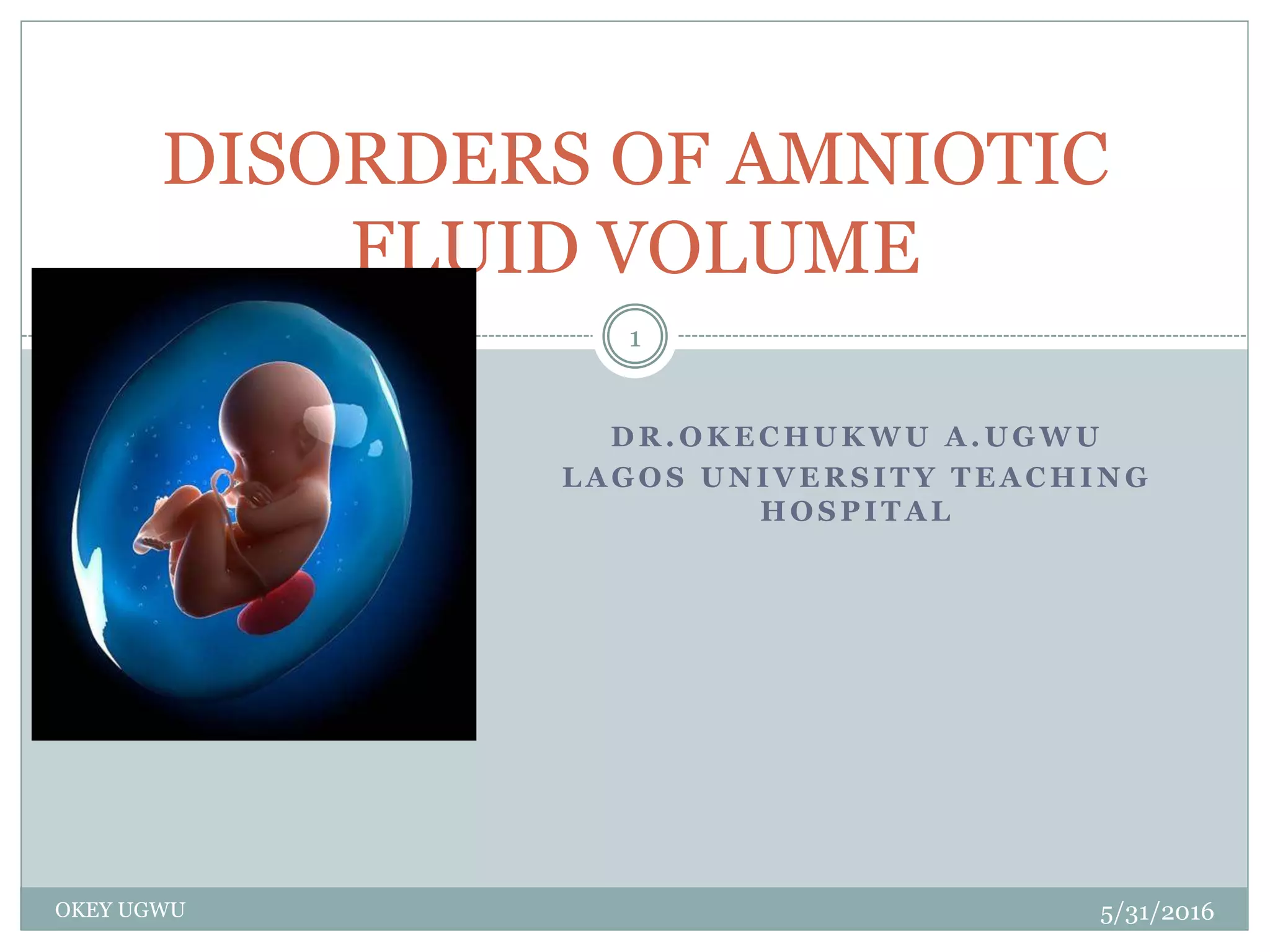
DISORDERS OF AMNIOTIC
FLUID VOLUME
Outline
5/31/2016OKEY UGWU
2
 Origin
 physical features
 Components
 Functions of A.F
 Clinical Relevance
 Oligo/Poly-Hydramnios
 Definition
 Etiology
 Diagnosis
 Treatment
 Complications
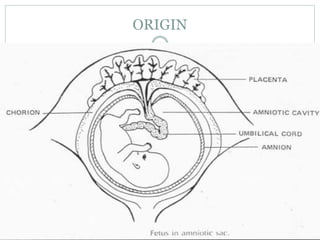
ORIGIN
5/31/2016OKEY UGWU
3
Origin contd
5/31/2016OKEY UGWU
4
 First & early second trimester :
Amount is 5-50 ml & arises from:
- ultra filtrate of Maternal plasma through the
vascularized uterine decidua
- Transudation of fetal plasma through the fetal skin &
umbilical cord (up to 20 weeks' gestation).
* It is iso-osmolar with fetal & maternal plasma,
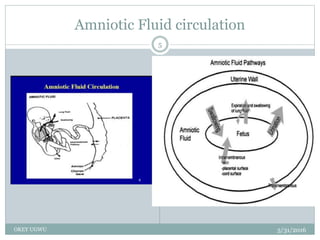
Amniotic Fluid circulation
5/31/2016OKEY UGWU
5
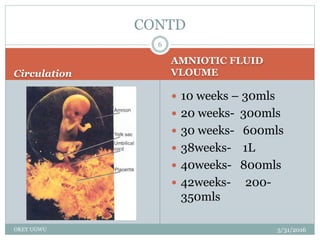
Circulation
AMNIOTIC FLUID
VLOUME
5/31/2016OKEY UGWU
 10 weeks – 30mls
 20 weeks- 300mls
 30 weeks- 600mls
 38weeks- 1L
 40weeks- 800mls
 42weeks- 200-
350mls
6
CONTD
Physical features
5/31/2016OKEY UGWU
7
 Alkaline- 7.2
 Low specific gravity – 1.0069 – 1.008.
 Hypotonic to maternal serum at term
 Osmolarity – 250 Osmol
 Colour
– in early pregnancy colourless
- at term it become pale straw colored
Physical features-contd
5/31/2016OKEY UGWU
8
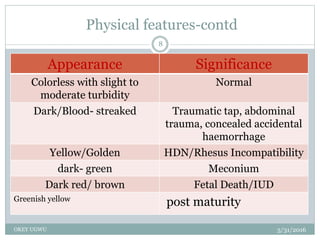
Appearance Significance
Colorless with slight to
moderate turbidity
Normal
Dark/Blood- streaked Traumatic tap, abdominal
trauma, concealed accidental
haemorrhage
Yellow/Golden HDN/Rhesus Incompatibility
dark- green Meconium
Dark red/ brown Fetal Death/IUD
Greenish yellow
post maturity
Composition
5/31/2016OKEY UGWU
9
98% water, 2% solid substances
a)Organic
b) Non organic
c) Suspended particles
Functions of A.F
5/31/2016OKEY UGWU
10
During pregnancy
 Cushions the fetus from physical trauma
 Provides a barrier against infection
 Permits proper lung development
 Thermoregulation
 Allow room for fetal growth, movement and development
During labor
 The bag of fore water allows regular dilatation of the cervix.
 After rupture of membrane the amniotic fluid serves as a lubricant for
fetus descent.
 Also the amniotic fluid is bacteriostatic
Clinical importance
5/31/2016OKEY UGWU
11
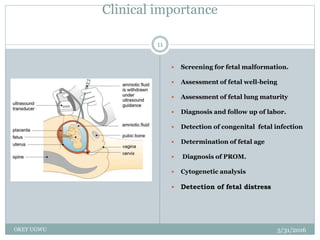
 Screening for fetal malformation.
 Assessment of fetal well-being
 Assessment of fetal lung maturity
 Diagnosis and follow up of labor.
 Detection of congenital fetal infection
 Determination of fetal age
 Diagnosis of PROM.
 Cytogenetic analysis
 Detection of fetal distress
chemical tests performed on amniotic fluid
5/31/2016OKEY UGWU
12
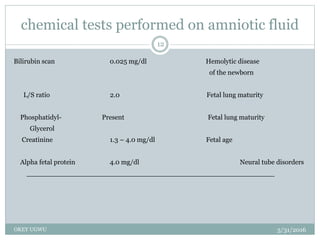
Bilirubin scan 0.025 mg/dl Hemolytic disease
of the newborn
L/S ratio 2.0 Fetal lung maturity
Phosphatidyl- Present Fetal lung maturity
Glycerol
Creatinine 1.3 – 4.0 mg/dl Fetal age
Alpha fetal protein 4.0 mg/dl Neural tube disorders
__________________________________________________________
POLYHYDRAMINOS
5/31/2016OKEY UGWU
13
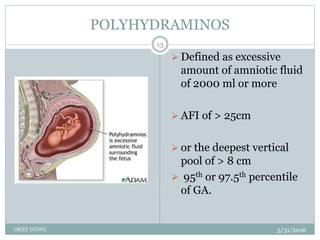
 Defined as excessive
amount of amniotic fluid
of 2000 ml or more
 AFI of > 25cm
 or the deepest vertical
pool of > 8 cm
 95th or 97.5th percentile
of GA.
Polyhydraminos- contd
5/31/2016OKEY UGWU
14
 Incidence of 0.5 -1%
 50-60% are idiopathic
 10-20% of the neonates are born with a congenital anomaly
 Gastrointestinal system -40%
 central nervous system -26%
 cardiovascular system 22%
 genitourinary system 13%
Measurement of Amniotic Fluid Volume
5/31/2016OKEY UGWU
15
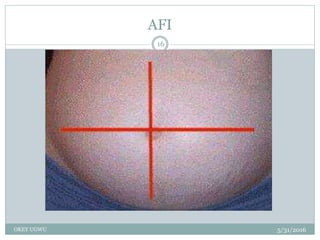
 AFI
 Single deepest pocket method
 Two diameter fluid pocket
 Several factors may modulate AFI
-increase with high altitude
- Maternal hydration increases AFI
- fluid restriction or dehydration decrease
AFI
5/31/2016OKEY UGWU
16
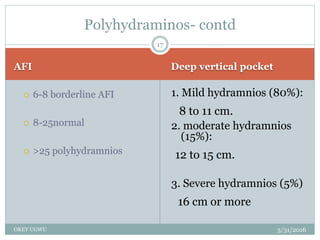
AFI Deep vertical pocket
5/31/2016OKEY UGWU
 6-8 borderline AFI
 8-25normal
 >25 polyhydramnios
1. Mild hydramnios (80%):
8 to 11 cm.
2. moderate hydramnios
(15%):
12 to 15 cm.
3. Severe hydramnios (5%)
16 cm or more
17
Polyhydraminos- contd
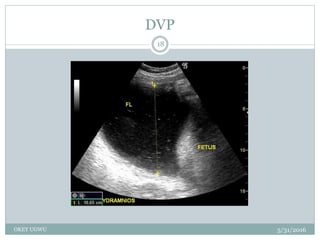
DVP
5/31/2016OKEY UGWU
18
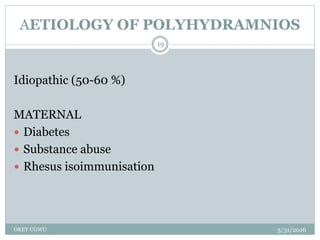
AETIOLOGY OF POLYHYDRAMNIOS
5/31/2016OKEY UGWU
19
Idiopathic (50-60 %)
MATERNAL
 Diabetes
 Substance abuse
 Rhesus isoimmunisation
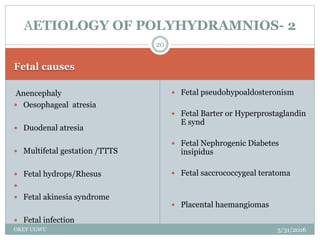
Fetal causes
5/31/2016OKEY UGWU
Anencephaly
 Oesophageal atresia
 Duodenal atresia
 Multifetal gestation /TTTS
 Fetal hydrops/Rhesus

 Fetal akinesia syndrome
 Fetal infection
 Fetal pseudohypoaldosteronism
 Fetal Barter or Hyperprostaglandin
E synd
 Fetal Nephrogenic Diabetes
insipidus
 Fetal saccrococcygeal teratoma
 Placental haemangiomas
20
AETIOLOGY OF POLYHYDRAMNIOS- 2
Types of Polyhydraminos
5/31/2016OKEY UGWU
21
Acute Polyhydraminos:
 Is very rare
 Usually occurs at about 16- 20
weeks
 sudden onset - 3 – 4 days
 associated with monozygotic
twins
 Ends with spontaneous abortion
most of the time before 28 weeks
 Severe abdominal pain is
common symptom
Chronic Polyhydraminos:
 Is gradual in onset
 Usually from 30 weeks of
pregnancy
 Is the most common type
Mgt 1- History
5/31/2016OKEY UGWU
22
Clinical features
Symptomatic/ asymptomatic:
 dyspnea.
 edema.
 abdominal distention
 Abdominal girth increase rapidly in acute Polyhydraminos
 Oliguria from ureteric obstruction
 preterm labour
 Heart burn/Indigestion
 Varicose vein
 Mirror syndrome
Mgt 2- Physical Examination
5/31/2016OKEY UGWU
23
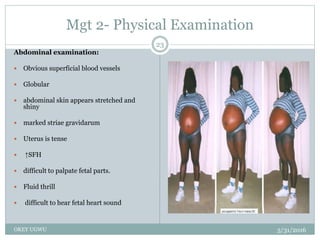
Abdominal examination:
 Obvious superficial blood vessels
 Globular
 abdominal skin appears stretched and
shiny
 marked striae gravidarum
 Uterus is tense
 ↑SFH
 difficult to palpate fetal parts.
 Fluid thrill
 difficult to hear fetal heart sound
Mgt 3- Investigation
5/31/2016OKEY UGWU
24
Full blood count
TORCH screening
FBS/OGTT
SEUCR+ uric acid
Abd X-ray- historic importance
Placenta Biopsy
Assess fatal wellbeing (U/S/CTG/Doppler/BPP
 - excessive amniotic fluid.
 - fetal abnormalities
Management 4
5/31/2016OKEY UGWU
25
 The cause of the condition should be determined if
possible.
 Management depends on:
1. Condition of the fetus and the mother
2. The cause and degree of Polyhydraminos
3. Stage of pregnancy
4. Fetus Compatible with Extra uterine life
Mgt 5
5/31/2016OKEY UGWU
26
Mgt of Symptomatic Polyhydraminos
 Schedule weekly or twice weekly perinatal visits –depending on GA/severity
 Hospital admission- dyspnea, abdominal pain or difficult ambulation.
 serial ultrasonography
 Antacids to relive heart burn
 Reductive Amniocentesis- serially
 Induction of labour if worsening- cord prolapse, abruptio
 Delivery should be hospital
 Role of Indomethacin
Mgt 6- Indomethacin
5/31/2016OKEY UGWU
27
 Impairs fetal lung liquid production
 Enhances absorption
 Increases fluid movement across fetal membranes
 Reduce fetal urinary production
 premature closure of the fetal ductus arteriosus
 Periventricular Leucomalacia
 not used after 35 weeks
Mgt 7
5/31/2016OKEY UGWU
28
 Treat underlying cause
 Fetal anemia: Fetal transfusion
 TTTS- Laser ablation of placental vessels
 Diabetes: control blood sugar
Complications of Polyhydraminos contd
5/31/2016OKEY UGWU
29
Fetal
 Unstable lie
 Malpresentation
 Cord presentation and cord
prolapse
 PROM
 Placental abruption
 Premature labour
 High perinatal mortality rate
Maternal
 ureteric obstruction
 PPH
 Low threshold for C/S
 Maternal morbidity and
mortality
Oligohydramnios
5/31/2016OKEY UGWU
30
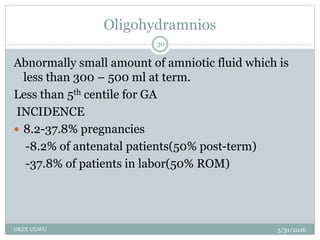
Abnormally small amount of amniotic fluid which is
less than 300 – 500 ml at term.
Less than 5th centile for GA
INCIDENCE
 8.2-37.8% pregnancies
-8.2% of antenatal patients(50% post-term)
-37.8% of patients in labor(50% ROM)
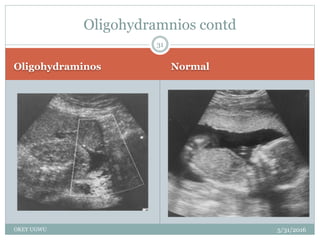
Oligohydraminos Normal
5/31/2016OKEY UGWU
31
Oligohydramnios contd
AETIOLOGY
5/31/2016OKEY UGWU
32
 FETAL
 •PROM (50%)
 •CHROMOSOMAL ANOMALIES
 •CONGENITAL ANOMALIES – porter's syndrome
 •IUGR
 •IUFD
 •POSTTERM PREGNANCY
 PLACENTAL
 •CHRONIC ABRUPTION
 •TTTS
 IDIOPATHIC
 MATERNAL – Placental
insufficiency
 •PREECLAMPSIA
 •CHRONIC HT
 Diabetes
 DRUGS
 •PG SYNTHETASE INHIBITORS
 •ACE INHIBITORS
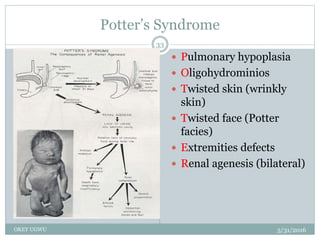
Potter’s Syndrome
5/31/2016OKEY UGWU
33
 Pulmonary hypoplasia
 Oligohydrominios
 Twisted skin (wrinkly
skin)
 Twisted face (Potter
facies)
 Extremities defects
 Renal agenesis (bilateral)
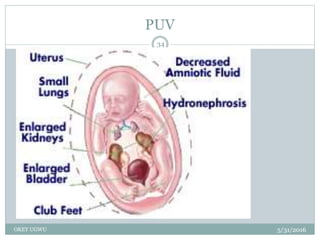
PUV
5/31/2016OKEY UGWU
34
5/31/2016OKEY UGWU
34
SYMPTOMS
5/31/2016OKEY UGWU
35
 NO SPECIFIC SYMPTOMS
 H/O leaking p/v
 Post term
 CHT/preclampsia
 Drugs
 Less fetal movements
 SIGNS
 Uterus – small for date
 Malpresentation
 IUGR
 FHR
normal/nonreassuring
 Small columns by
ultrasound
Management 1
5/31/2016OKEY UGWU
36
 MANAGEMENT DEPENDS UPON
 AETIOLOGY
 GESTATIONAL AGE
 SEVERITY
 FETAL STATUS & WELL BEING- fetus surviving
extra uterine life
Management 2
5/31/2016OKEY UGWU
37
 DETERMINE AETIOLOGY
 R/O PROM
 TARGETED USG FOR ANOMALIES
 R/O IUGR ,IUFD when suspected
 Amniocentesis if chromosomal anomalies suspected
– early symmetric IUGR
Mgt 3- Investigations
5/31/2016OKEY UGWU
38
 instillation of indigo carmine may be used to
evaluate for PROM
 Amniosure- PROM
 Nitrazine yellow paper/litmus paper
 Ultrasound scan
 FBC/FBS/OGTT
TREATMENT
5/31/2016OKEY UGWU
39
 ADEQUATE REST – decreases dehydration
 HYDRATION – Oral/IV Hypotonic fluids(2 Lit/d)
 Amino infusion by normal saline (helpful during labour, prior
 to ECV, USG
 •SERIAL USG – Monitor growth, AFI,BPP
 INDUCTION OF LABOUR/ LSCS
Lung maturity attained
Lethal malformation
Fetal jeopardy
Sev IUGR
Severe oligo
Treatment- contd
5/31/2016OKEY UGWU
40
 DIRECTED TO CAUSE
 •Drug induced – OMIT DRUG
 •PROM –
 •PPROM – Antibiotics, steroid – Induction
 •FETAL SURGERY
 VESICO AMNIOTIC SHUNT-PUV
 Laser photocoagulation for TTTS
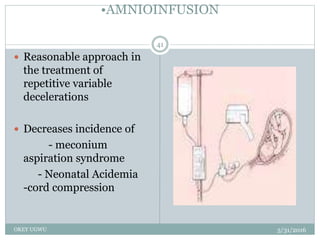
•AMNIOINFUSION
5/31/2016OKEY UGWU
41
 Reasonable approach in
the treatment of
repetitive variable
decelerations
 Decreases incidence of
- meconium
aspiration syndrome
- Neonatal Acidemia
-cord compression
FETAL MATERNAL
5/31/2016OKEY UGWU
 Abortion
 Prematurity
 IUFD
 Deformities –contractures
 Potters syndrome
 pulmonary hypoplasia
 Malpresentations
 Fetal distress
 Low APGAR
 Increased morbidity
 Prolonged labour:
uterine inertia
 Increased operative
intervention
42
COMPLICATIONS
Pregnancy Outcome in Oligohydramnios
5/31/2016OKEY UGWU
43
 The mortality and morbidity rate in Oligohydramnios is high
 Pulmonary hypoplasia
 IUGR
 Meconium aspiration
 Non reassuring Fetal heart rate
 Poor tolerance of labor
 Stillbirth
 Fetal malformation
 Fetal acidosis
 Neonatal death
Pulmonary Hypoplasia and Oligohydramnios
5/31/2016OKEY UGWU
44
 thoracic compression may prevent chest wall
excursion and lung expansion
 lack of fetal breathing movement decreases lung
inflow
 a failure to retain intrapulmonary amniotic fluid or
an increased outflow with impaired lung growth and
development
Conclusion
5/31/2016OKEY UGWU
45
 Amni0tic fluid evaluation allows assessment of the
fetal intrauterine environment
 Potentially invaluable information
 Requires close follow-up and evaluation
END
5/31/2016OKEY UGWU
46

Amniotic fluid disorders

  • 1.
    D R .O K E C H U K W U A . U G W U L A G O S U N I V E R S I T Y T E A C H I N G H O S P I T A L 5/31/2016OKEY UGWU 1 DISORDERS OF AMNIOTIC FLUID VOLUME
  • 2.
    Outline 5/31/2016OKEY UGWU 2  Origin physical features  Components  Functions of A.F  Clinical Relevance  Oligo/Poly-Hydramnios  Definition  Etiology  Diagnosis  Treatment  Complications
  • 3.
  • 4.
    Origin contd 5/31/2016OKEY UGWU 4 First & early second trimester : Amount is 5-50 ml & arises from: - ultra filtrate of Maternal plasma through the vascularized uterine decidua - Transudation of fetal plasma through the fetal skin & umbilical cord (up to 20 weeks' gestation). * It is iso-osmolar with fetal & maternal plasma,
  • 5.
  • 6.
    Circulation AMNIOTIC FLUID VLOUME 5/31/2016OKEY UGWU 10 weeks – 30mls  20 weeks- 300mls  30 weeks- 600mls  38weeks- 1L  40weeks- 800mls  42weeks- 200- 350mls 6 CONTD
  • 7.
    Physical features 5/31/2016OKEY UGWU 7 Alkaline- 7.2  Low specific gravity – 1.0069 – 1.008.  Hypotonic to maternal serum at term  Osmolarity – 250 Osmol  Colour – in early pregnancy colourless - at term it become pale straw colored
  • 8.
    Physical features-contd 5/31/2016OKEY UGWU 8 AppearanceSignificance Colorless with slight to moderate turbidity Normal Dark/Blood- streaked Traumatic tap, abdominal trauma, concealed accidental haemorrhage Yellow/Golden HDN/Rhesus Incompatibility dark- green Meconium Dark red/ brown Fetal Death/IUD Greenish yellow post maturity
  • 9.
    Composition 5/31/2016OKEY UGWU 9 98% water,2% solid substances a)Organic b) Non organic c) Suspended particles
  • 10.
    Functions of A.F 5/31/2016OKEYUGWU 10 During pregnancy  Cushions the fetus from physical trauma  Provides a barrier against infection  Permits proper lung development  Thermoregulation  Allow room for fetal growth, movement and development During labor  The bag of fore water allows regular dilatation of the cervix.  After rupture of membrane the amniotic fluid serves as a lubricant for fetus descent.  Also the amniotic fluid is bacteriostatic
  • 11.
    Clinical importance 5/31/2016OKEY UGWU 11 Screening for fetal malformation.  Assessment of fetal well-being  Assessment of fetal lung maturity  Diagnosis and follow up of labor.  Detection of congenital fetal infection  Determination of fetal age  Diagnosis of PROM.  Cytogenetic analysis  Detection of fetal distress
  • 12.
    chemical tests performedon amniotic fluid 5/31/2016OKEY UGWU 12 Bilirubin scan 0.025 mg/dl Hemolytic disease of the newborn L/S ratio 2.0 Fetal lung maturity Phosphatidyl- Present Fetal lung maturity Glycerol Creatinine 1.3 – 4.0 mg/dl Fetal age Alpha fetal protein 4.0 mg/dl Neural tube disorders __________________________________________________________
  • 13.
    POLYHYDRAMINOS 5/31/2016OKEY UGWU 13  Definedas excessive amount of amniotic fluid of 2000 ml or more  AFI of > 25cm  or the deepest vertical pool of > 8 cm  95th or 97.5th percentile of GA.
  • 14.
    Polyhydraminos- contd 5/31/2016OKEY UGWU 14 Incidence of 0.5 -1%  50-60% are idiopathic  10-20% of the neonates are born with a congenital anomaly  Gastrointestinal system -40%  central nervous system -26%  cardiovascular system 22%  genitourinary system 13%
  • 15.
    Measurement of AmnioticFluid Volume 5/31/2016OKEY UGWU 15  AFI  Single deepest pocket method  Two diameter fluid pocket  Several factors may modulate AFI -increase with high altitude - Maternal hydration increases AFI - fluid restriction or dehydration decrease
  • 16.
  • 17.
    AFI Deep verticalpocket 5/31/2016OKEY UGWU  6-8 borderline AFI  8-25normal  >25 polyhydramnios 1. Mild hydramnios (80%): 8 to 11 cm. 2. moderate hydramnios (15%): 12 to 15 cm. 3. Severe hydramnios (5%) 16 cm or more 17 Polyhydraminos- contd
  • 18.
  • 19.
    AETIOLOGY OF POLYHYDRAMNIOS 5/31/2016OKEYUGWU 19 Idiopathic (50-60 %) MATERNAL  Diabetes  Substance abuse  Rhesus isoimmunisation
  • 20.
    Fetal causes 5/31/2016OKEY UGWU Anencephaly Oesophageal atresia  Duodenal atresia  Multifetal gestation /TTTS  Fetal hydrops/Rhesus   Fetal akinesia syndrome  Fetal infection  Fetal pseudohypoaldosteronism  Fetal Barter or Hyperprostaglandin E synd  Fetal Nephrogenic Diabetes insipidus  Fetal saccrococcygeal teratoma  Placental haemangiomas 20 AETIOLOGY OF POLYHYDRAMNIOS- 2
  • 21.
    Types of Polyhydraminos 5/31/2016OKEYUGWU 21 Acute Polyhydraminos:  Is very rare  Usually occurs at about 16- 20 weeks  sudden onset - 3 – 4 days  associated with monozygotic twins  Ends with spontaneous abortion most of the time before 28 weeks  Severe abdominal pain is common symptom Chronic Polyhydraminos:  Is gradual in onset  Usually from 30 weeks of pregnancy  Is the most common type
  • 22.
    Mgt 1- History 5/31/2016OKEYUGWU 22 Clinical features Symptomatic/ asymptomatic:  dyspnea.  edema.  abdominal distention  Abdominal girth increase rapidly in acute Polyhydraminos  Oliguria from ureteric obstruction  preterm labour  Heart burn/Indigestion  Varicose vein  Mirror syndrome
  • 23.
    Mgt 2- PhysicalExamination 5/31/2016OKEY UGWU 23 Abdominal examination:  Obvious superficial blood vessels  Globular  abdominal skin appears stretched and shiny  marked striae gravidarum  Uterus is tense  ↑SFH  difficult to palpate fetal parts.  Fluid thrill  difficult to hear fetal heart sound
  • 24.
    Mgt 3- Investigation 5/31/2016OKEYUGWU 24 Full blood count TORCH screening FBS/OGTT SEUCR+ uric acid Abd X-ray- historic importance Placenta Biopsy Assess fatal wellbeing (U/S/CTG/Doppler/BPP  - excessive amniotic fluid.  - fetal abnormalities
  • 25.
    Management 4 5/31/2016OKEY UGWU 25 The cause of the condition should be determined if possible.  Management depends on: 1. Condition of the fetus and the mother 2. The cause and degree of Polyhydraminos 3. Stage of pregnancy 4. Fetus Compatible with Extra uterine life
  • 26.
    Mgt 5 5/31/2016OKEY UGWU 26 Mgtof Symptomatic Polyhydraminos  Schedule weekly or twice weekly perinatal visits –depending on GA/severity  Hospital admission- dyspnea, abdominal pain or difficult ambulation.  serial ultrasonography  Antacids to relive heart burn  Reductive Amniocentesis- serially  Induction of labour if worsening- cord prolapse, abruptio  Delivery should be hospital  Role of Indomethacin
  • 27.
    Mgt 6- Indomethacin 5/31/2016OKEYUGWU 27  Impairs fetal lung liquid production  Enhances absorption  Increases fluid movement across fetal membranes  Reduce fetal urinary production  premature closure of the fetal ductus arteriosus  Periventricular Leucomalacia  not used after 35 weeks
  • 28.
    Mgt 7 5/31/2016OKEY UGWU 28 Treat underlying cause  Fetal anemia: Fetal transfusion  TTTS- Laser ablation of placental vessels  Diabetes: control blood sugar
  • 29.
    Complications of Polyhydraminoscontd 5/31/2016OKEY UGWU 29 Fetal  Unstable lie  Malpresentation  Cord presentation and cord prolapse  PROM  Placental abruption  Premature labour  High perinatal mortality rate Maternal  ureteric obstruction  PPH  Low threshold for C/S  Maternal morbidity and mortality
  • 30.
    Oligohydramnios 5/31/2016OKEY UGWU 30 Abnormally smallamount of amniotic fluid which is less than 300 – 500 ml at term. Less than 5th centile for GA INCIDENCE  8.2-37.8% pregnancies -8.2% of antenatal patients(50% post-term) -37.8% of patients in labor(50% ROM)
  • 31.
  • 32.
    AETIOLOGY 5/31/2016OKEY UGWU 32  FETAL •PROM (50%)  •CHROMOSOMAL ANOMALIES  •CONGENITAL ANOMALIES – porter's syndrome  •IUGR  •IUFD  •POSTTERM PREGNANCY  PLACENTAL  •CHRONIC ABRUPTION  •TTTS  IDIOPATHIC  MATERNAL – Placental insufficiency  •PREECLAMPSIA  •CHRONIC HT  Diabetes  DRUGS  •PG SYNTHETASE INHIBITORS  •ACE INHIBITORS
  • 33.
    Potter’s Syndrome 5/31/2016OKEY UGWU 33 Pulmonary hypoplasia  Oligohydrominios  Twisted skin (wrinkly skin)  Twisted face (Potter facies)  Extremities defects  Renal agenesis (bilateral)
  • 34.
  • 35.
    SYMPTOMS 5/31/2016OKEY UGWU 35  NOSPECIFIC SYMPTOMS  H/O leaking p/v  Post term  CHT/preclampsia  Drugs  Less fetal movements  SIGNS  Uterus – small for date  Malpresentation  IUGR  FHR normal/nonreassuring  Small columns by ultrasound
  • 36.
    Management 1 5/31/2016OKEY UGWU 36 MANAGEMENT DEPENDS UPON  AETIOLOGY  GESTATIONAL AGE  SEVERITY  FETAL STATUS & WELL BEING- fetus surviving extra uterine life
  • 37.
    Management 2 5/31/2016OKEY UGWU 37 DETERMINE AETIOLOGY  R/O PROM  TARGETED USG FOR ANOMALIES  R/O IUGR ,IUFD when suspected  Amniocentesis if chromosomal anomalies suspected – early symmetric IUGR
  • 38.
    Mgt 3- Investigations 5/31/2016OKEYUGWU 38  instillation of indigo carmine may be used to evaluate for PROM  Amniosure- PROM  Nitrazine yellow paper/litmus paper  Ultrasound scan  FBC/FBS/OGTT
  • 39.
    TREATMENT 5/31/2016OKEY UGWU 39  ADEQUATEREST – decreases dehydration  HYDRATION – Oral/IV Hypotonic fluids(2 Lit/d)  Amino infusion by normal saline (helpful during labour, prior  to ECV, USG  •SERIAL USG – Monitor growth, AFI,BPP  INDUCTION OF LABOUR/ LSCS Lung maturity attained Lethal malformation Fetal jeopardy Sev IUGR Severe oligo
  • 40.
    Treatment- contd 5/31/2016OKEY UGWU 40 DIRECTED TO CAUSE  •Drug induced – OMIT DRUG  •PROM –  •PPROM – Antibiotics, steroid – Induction  •FETAL SURGERY  VESICO AMNIOTIC SHUNT-PUV  Laser photocoagulation for TTTS
  • 41.
    •AMNIOINFUSION 5/31/2016OKEY UGWU 41  Reasonableapproach in the treatment of repetitive variable decelerations  Decreases incidence of - meconium aspiration syndrome - Neonatal Acidemia -cord compression
  • 42.
    FETAL MATERNAL 5/31/2016OKEY UGWU Abortion  Prematurity  IUFD  Deformities –contractures  Potters syndrome  pulmonary hypoplasia  Malpresentations  Fetal distress  Low APGAR  Increased morbidity  Prolonged labour: uterine inertia  Increased operative intervention 42 COMPLICATIONS
  • 43.
    Pregnancy Outcome inOligohydramnios 5/31/2016OKEY UGWU 43  The mortality and morbidity rate in Oligohydramnios is high  Pulmonary hypoplasia  IUGR  Meconium aspiration  Non reassuring Fetal heart rate  Poor tolerance of labor  Stillbirth  Fetal malformation  Fetal acidosis  Neonatal death
  • 44.
    Pulmonary Hypoplasia andOligohydramnios 5/31/2016OKEY UGWU 44  thoracic compression may prevent chest wall excursion and lung expansion  lack of fetal breathing movement decreases lung inflow  a failure to retain intrapulmonary amniotic fluid or an increased outflow with impaired lung growth and development
  • 45.
    Conclusion 5/31/2016OKEY UGWU 45  Amni0ticfluid evaluation allows assessment of the fetal intrauterine environment  Potentially invaluable information  Requires close follow-up and evaluation
  • 46.

Editor's Notes

  • #5 Fetal swallowing- 25% of fetal weight Fetal urine- Daily urine production is approximately 30% of fetal weight
  • #17  Amniotic fluid index (AFI). It is a total of the DVPs in each four quadrants of the uterus. it is a more sensitive indicator of AFV throughout pregnancy
  • #20 In Dm, reflex hyperglycemia in fetus leads to osmotic diuresis , women requiring insulin have five fold increase of hydraminos.
  • #21 Anencephaly/spina bifida- increased fluid transudation from exposed meninges, abnormal swallowing, excessive urination from either stimulation of cerebrospinal centers or deprived of their protective coverings or by lack of antidiuretic effect because of impaired arginine vasopressin production. Hyperprostaglandin E syndrome (HPS) is the antenatal variant of Bartter syndrome and characterized by polyhydramnios and preterm delivery in the antenatal period and salt-wasting, isosthenuric or hyposthenuric polyuria, hypercalciuria and nephrocalcinosis in the postnatal period. We report a one-month-old infant with HPS with a 15-year-old sister with Bartter syndrome
  • #22 Hydrops fetalis: congestive heart failure, severe anaemia or hypoproteinemia → placental transudation
  • #23 Symptoms mostly from pressure symptoms. Mirror syndrome was defined by Ballantyne in 1892- the mother develops edema and protinuria and frequently eclampsia
  • #33 Pulmonary hypoplasia Oligohydrominios Twisted skin (wrinkly skin) Twisted face (Potter facies) Extremities defects Renal agenesis (bilateral)
  • #39 Serial FBC- WBC, absolute neutrophil count
  • #42 1.Diagnostic 2.Prophylactic 3.Therapeutic
  • #44 Pulmonary hypoplasia-.