AMNIOTIC FLUID
Utilities of Analysis:

• Determination of fetal lung maturity
• Detection of fetal distress
• Cytogenetic analysis
• Detection of hereditary, teratology
  and infectious disorders
• Determination of fetal age
Formation and Physiology:
•    formation in the amnion is regulated by
    balance between the production of fetal
    urine and lung fluid and the absorption
    from fetal swallowing and
    intramembranous flow
• Functions:
     (1) provides a protective cushion for the
         fetus
     (2) allows fetal movement
     (3) stabilizes the temperature to protect
        the fetus from extreme temperature
        changes
     (4) permit proper lung development.
Volume:
 Approximately 35 mL during the 1st
 trimester, peaks during the 3rd trimester
 (approx.1 L) and gradually decreases prior
 to deliver; major contributors are
 maternal circulation (1st trimester) and
 fetal urine (after the 1st trimester)
Polyhydramnios
 Excessive accumulation of amniotic fluid
 usually resulting from the failure of the
 fetus to begin swallowing; indicates fetal
 distress often associated with neural tube
 disorders
Oligohydramnios
  Decreased amniotic fluid due
  primarily to increased fetal
  swallowing urinary tract
  deformities, and membrane leakage
Composition:
  Same as that of maternal plasma
  plus a small amount of sloughed fetal
  cells, biochemical substance
  produced by the fetus, and a portion
  from the fetal respiratory tract, fetal
  urine, the amniotic membrane, and
  the umbilical cod
1. Specimen Considerations

a. Amniocentesis
  • Needle aspiration of amniotic fluid from
    the amniotic as; may be transabdominal
    or transvaginal; safety performed after
    the 14th week of gestation , volume
    collected:
2. Specimen handling

a. Fluid for FLM tests
 • Transported in ice and refrigerated up
   to 72 hours prior to testing or kept
   frozen and tested within 72 hours;
   filtration or low-speed centrifugation is
   recommended
b. Fluid for cytogenetic studies
  • Maintained at room temperature
    or incubated at 37°C prior to
    analysis
c. Fluid for chemical testing
  • Separated from cellular elements and
    debris ASAP to prevent distortion of
    chemical constituents by cellular
    metabolism or disitegration.

d. Fluid for bilirubin analysis


  •    placed in amber bottles or
      containers covered with a black
      plastic.
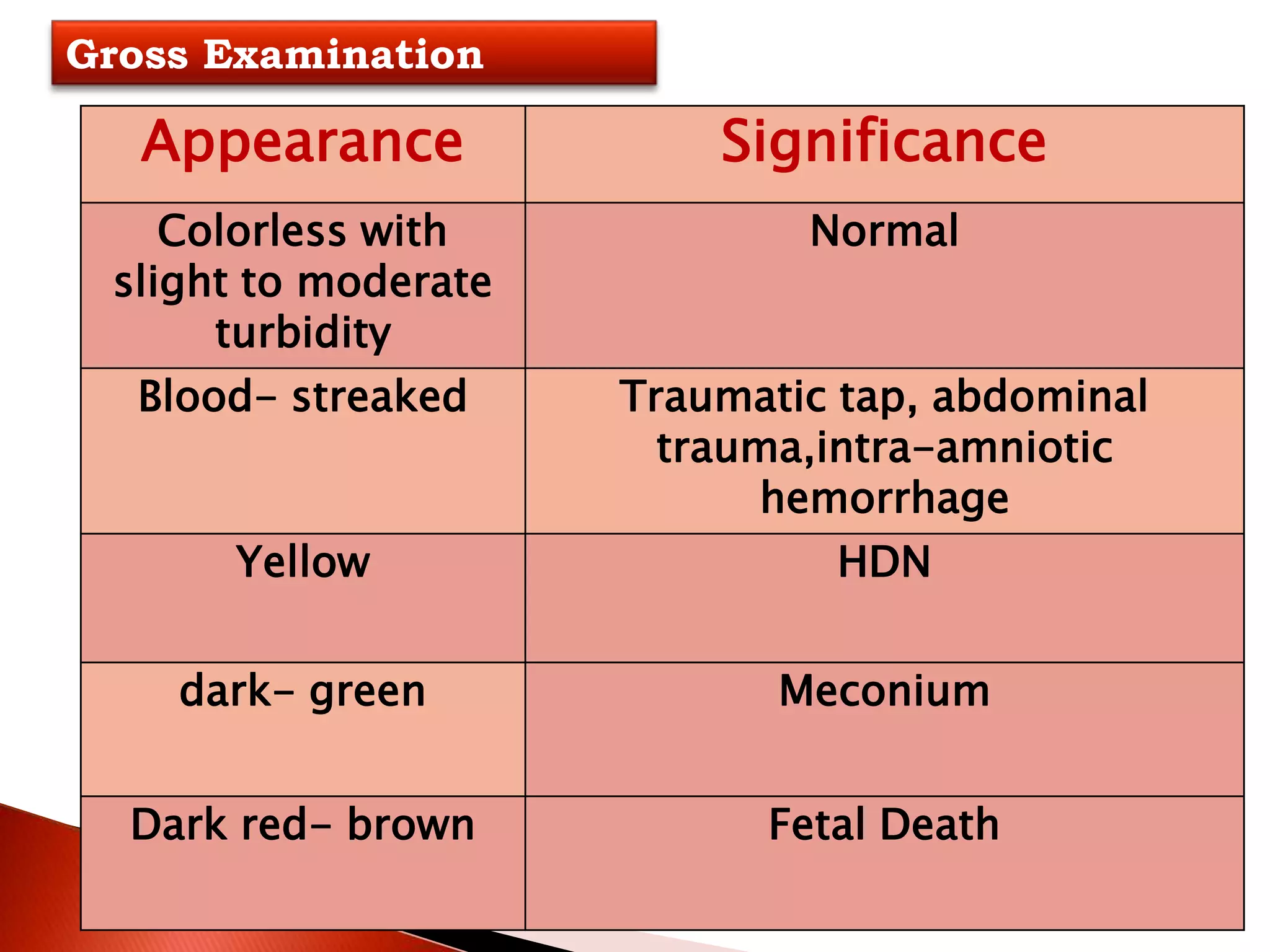
Gross Examination

   Appearance             Significance
    Colorless with            Normal
 slight to moderate
      turbidity
  Blood- streaked     Traumatic tap, abdominal
                        trauma,intra-amniotic
                             hemorrhage
      Yellow                   HDN


    dark- green              Meconium


  Dark red- brown           Fetal Death
Tests for Lung Maturity
1. Lecithin/ sphingomyelin ratio

a. Method:____________________________
b. Principles: Lecithin is produced at a relatively low and constant rate until the
   35th week of gestation while sphingomyelin is produced at a constant rate
   after about 26 week’ gestation and therefore conserve as a control on which
   to base the rise in lecithin. Prior to 35 week’ gestation, L/S ratio is ˂1.6 and
   rises to >2.0 when lecithin production increases.


2. Amniostat-FLM


a. Method:________________________
b. Principle: the test uses antisera for phosphatidly glycerol and is
   affectected by specimen contamination with blood and meconium.
3. Foam stability index

 a. method:_____________________________
 b. Principle: a semiquatitative measure of the amount of surfactant is
    done by adding 0.5 mL of amniotic fluid to increasing amounts of 95%
    ethanol (0.42 mL to 0.55 mL in 0.01-mL increments), shaken for 15
    seconds, and allowed to sit undisturbed for 15 minutes. If a sufficient
    amount of phospholipid is present, a continuous line of bubbles will be
    observed even in the presence of alcohol, an anti-foaming agent.


4. Microviscosity


  a. Method:______________________
  b. Principle: Phospholipids decrease the microviscosity of amniotic
     fluid and the change is detected by determining the surfactant to
     albumin ratio (mg/g) based on the polarization of a fluorescent dye
     that combines (internal standard, decreased fluorescence lifetime
     and high polarization).
5. Lamellar body count

   a. Method:___________________________
   b. Principle: Lamellar bodies (lamellated phospholipids that represent
      a storage from of surfactants secreted by the type II pneumocytes of
      the fetal lung)range in size from 1.7 to 7.3 fL, and therefore can be
      counted using the platelet channel of hematology analyzers.


6. Optical density at 650 nm


  a. Method:_________________________
  b. Principle : the increase in OD of the amniotic fluid caused by the
     presence of lamella bodies in determined by centrifuging the
     specimen at 2000 g for 10 min and reading the absorbance at
     650 nm.
Table 24. Tests for fetal lung maturity
                          Normal            Significance
                          values
L/S ratio               ≥2.0         FLM

Amniostat-FLM           Positive     FLM/phosphotidyl glycerol

Foams Stability index   ≥47          FLM


Microviscosity          ≥55 mg/ g    FLM

Lamellar body count     ≥32,00/ mL   FLM

OD at 650 nm            ≥0.150       FLM

Bilirubin scan          A 450 less   HDN
                        .025
Alpha Fetoprotein       Less than    Neural tube disorder
                        2.0 MoM
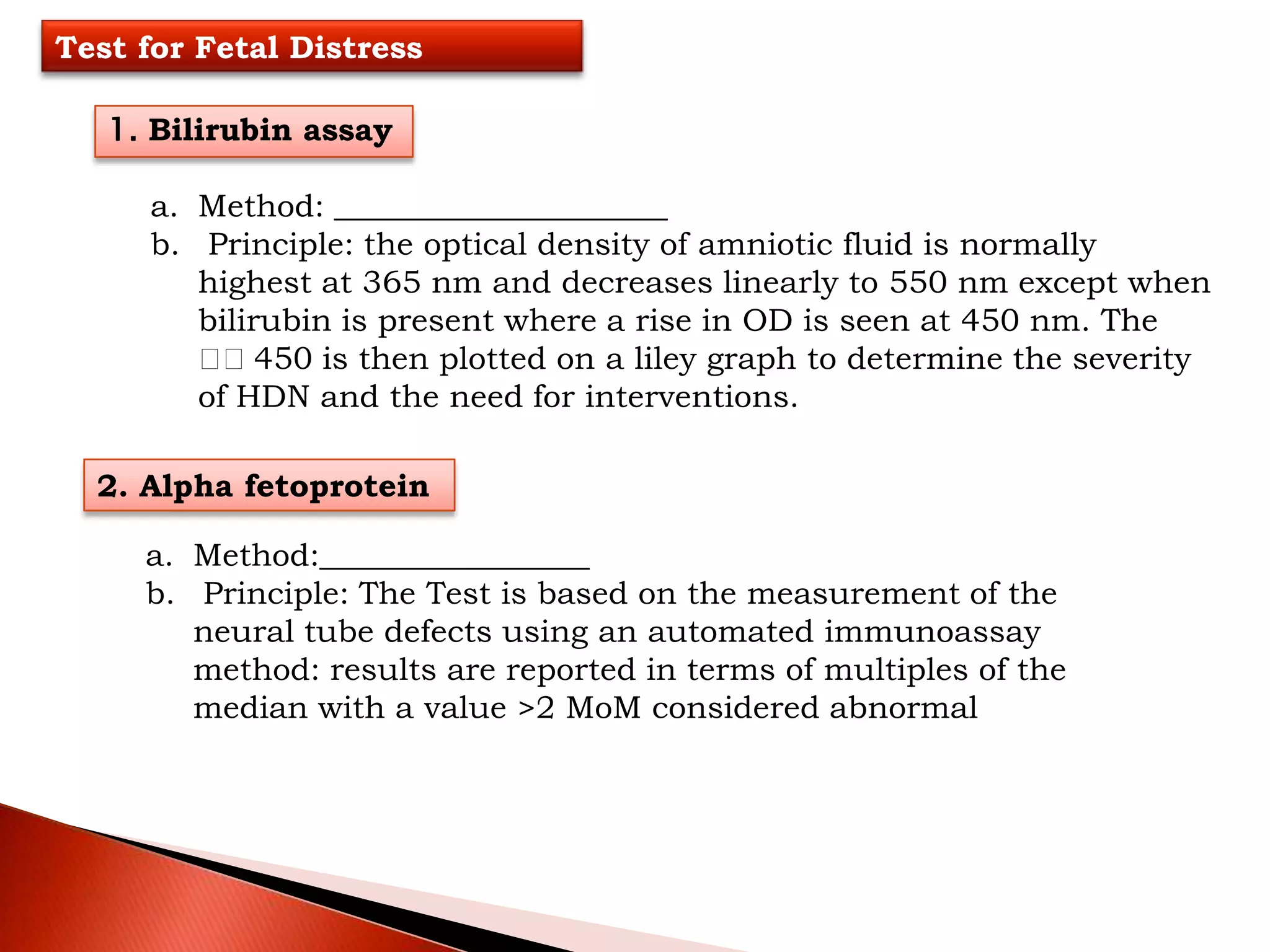
Test for Fetal Distress

   1. Bilirubin assay

     a. Method: _____________________
     b. Principle: the optical density of amniotic fluid is normally
        highest at 365 nm and decreases linearly to 550 nm except when
        bilirubin is present where a rise in OD is seen at 450 nm. The
        ᴧ ᴧ450 is then plotted on a liley graph to determine the severity
        of HDN and the need for interventions.

  2. Alpha fetoprotein

     a. Method:_________________
     b. Principle: The Test is based on the measurement of the
        neural tube defects using an automated immunoassay
        method: results are reported in terms of multiples of the
        median with a value >2 MoM considered abnormal
3. Acetylcholinesterase

   a. Method: ____________________
   b. Principle: Ache is an enzyme derived primarily from the
      neural tissue and is normally absent in amniotic fluid. Its
      presence in amniotic fluid in conjunction with elevated AFP
      values is highly diagnostic of NTDs.
Other Tests

 1. Differentiation of amniotic fluid from maternal urine
     •   Creatinine is ˂3.5 mg/ dL and urea is ˂30
         mg/dL in amniotic fluid, whereas high as 10
         mg/ dL creatinine and 300 mg/dL urea may
         be found in urine
 2. Determination of fetal age

    • AF creatinine level ranges from 1.5 to 2.0
      mg/ dL prior to 36 weeks’ gestation and rises
      above 2.0 mg/dL thereafter, providing a
      means of determining fetal age as >36 weeks
 3. Kleihauer-Betke test


    • used to determine the source of the
      blood (maternal or fetal) in a bloody
      specimen for further case management.

amniotic fluid analysis

  • 1.
  • 2.
    Utilities of Analysis: •Determination of fetal lung maturity • Detection of fetal distress • Cytogenetic analysis • Detection of hereditary, teratology and infectious disorders • Determination of fetal age
  • 3.
    Formation and Physiology: • formation in the amnion is regulated by balance between the production of fetal urine and lung fluid and the absorption from fetal swallowing and intramembranous flow • Functions: (1) provides a protective cushion for the fetus (2) allows fetal movement (3) stabilizes the temperature to protect the fetus from extreme temperature changes (4) permit proper lung development.
  • 4.
    Volume: Approximately 35mL during the 1st trimester, peaks during the 3rd trimester (approx.1 L) and gradually decreases prior to deliver; major contributors are maternal circulation (1st trimester) and fetal urine (after the 1st trimester) Polyhydramnios Excessive accumulation of amniotic fluid usually resulting from the failure of the fetus to begin swallowing; indicates fetal distress often associated with neural tube disorders
  • 5.
    Oligohydramnios Decreasedamniotic fluid due primarily to increased fetal swallowing urinary tract deformities, and membrane leakage Composition: Same as that of maternal plasma plus a small amount of sloughed fetal cells, biochemical substance produced by the fetus, and a portion from the fetal respiratory tract, fetal urine, the amniotic membrane, and the umbilical cod
  • 6.
    1. Specimen Considerations a.Amniocentesis • Needle aspiration of amniotic fluid from the amniotic as; may be transabdominal or transvaginal; safety performed after the 14th week of gestation , volume collected:
  • 7.
    2. Specimen handling a.Fluid for FLM tests • Transported in ice and refrigerated up to 72 hours prior to testing or kept frozen and tested within 72 hours; filtration or low-speed centrifugation is recommended b. Fluid for cytogenetic studies • Maintained at room temperature or incubated at 37°C prior to analysis
  • 8.
    c. Fluid forchemical testing • Separated from cellular elements and debris ASAP to prevent distortion of chemical constituents by cellular metabolism or disitegration. d. Fluid for bilirubin analysis • placed in amber bottles or containers covered with a black plastic.
  • 9.
    Gross Examination Appearance Significance Colorless with Normal slight to moderate turbidity Blood- streaked Traumatic tap, abdominal trauma,intra-amniotic hemorrhage Yellow HDN dark- green Meconium Dark red- brown Fetal Death
  • 10.
    Tests for LungMaturity 1. Lecithin/ sphingomyelin ratio a. Method:____________________________ b. Principles: Lecithin is produced at a relatively low and constant rate until the 35th week of gestation while sphingomyelin is produced at a constant rate after about 26 week’ gestation and therefore conserve as a control on which to base the rise in lecithin. Prior to 35 week’ gestation, L/S ratio is ˂1.6 and rises to >2.0 when lecithin production increases. 2. Amniostat-FLM a. Method:________________________ b. Principle: the test uses antisera for phosphatidly glycerol and is affectected by specimen contamination with blood and meconium.
  • 11.
    3. Foam stabilityindex a. method:_____________________________ b. Principle: a semiquatitative measure of the amount of surfactant is done by adding 0.5 mL of amniotic fluid to increasing amounts of 95% ethanol (0.42 mL to 0.55 mL in 0.01-mL increments), shaken for 15 seconds, and allowed to sit undisturbed for 15 minutes. If a sufficient amount of phospholipid is present, a continuous line of bubbles will be observed even in the presence of alcohol, an anti-foaming agent. 4. Microviscosity a. Method:______________________ b. Principle: Phospholipids decrease the microviscosity of amniotic fluid and the change is detected by determining the surfactant to albumin ratio (mg/g) based on the polarization of a fluorescent dye that combines (internal standard, decreased fluorescence lifetime and high polarization).
  • 12.
    5. Lamellar bodycount a. Method:___________________________ b. Principle: Lamellar bodies (lamellated phospholipids that represent a storage from of surfactants secreted by the type II pneumocytes of the fetal lung)range in size from 1.7 to 7.3 fL, and therefore can be counted using the platelet channel of hematology analyzers. 6. Optical density at 650 nm a. Method:_________________________ b. Principle : the increase in OD of the amniotic fluid caused by the presence of lamella bodies in determined by centrifuging the specimen at 2000 g for 10 min and reading the absorbance at 650 nm.
  • 13.
    Table 24. Testsfor fetal lung maturity Normal Significance values L/S ratio ≥2.0 FLM Amniostat-FLM Positive FLM/phosphotidyl glycerol Foams Stability index ≥47 FLM Microviscosity ≥55 mg/ g FLM Lamellar body count ≥32,00/ mL FLM OD at 650 nm ≥0.150 FLM Bilirubin scan A 450 less HDN .025 Alpha Fetoprotein Less than Neural tube disorder 2.0 MoM
  • 14.
    Test for FetalDistress 1. Bilirubin assay a. Method: _____________________ b. Principle: the optical density of amniotic fluid is normally highest at 365 nm and decreases linearly to 550 nm except when bilirubin is present where a rise in OD is seen at 450 nm. The ᴧ ᴧ450 is then plotted on a liley graph to determine the severity of HDN and the need for interventions. 2. Alpha fetoprotein a. Method:_________________ b. Principle: The Test is based on the measurement of the neural tube defects using an automated immunoassay method: results are reported in terms of multiples of the median with a value >2 MoM considered abnormal
  • 15.
    3. Acetylcholinesterase a. Method: ____________________ b. Principle: Ache is an enzyme derived primarily from the neural tissue and is normally absent in amniotic fluid. Its presence in amniotic fluid in conjunction with elevated AFP values is highly diagnostic of NTDs.
  • 16.
    Other Tests 1.Differentiation of amniotic fluid from maternal urine • Creatinine is ˂3.5 mg/ dL and urea is ˂30 mg/dL in amniotic fluid, whereas high as 10 mg/ dL creatinine and 300 mg/dL urea may be found in urine 2. Determination of fetal age • AF creatinine level ranges from 1.5 to 2.0 mg/ dL prior to 36 weeks’ gestation and rises above 2.0 mg/dL thereafter, providing a means of determining fetal age as >36 weeks 3. Kleihauer-Betke test • used to determine the source of the blood (maternal or fetal) in a bloody specimen for further case management.