FETAL MEMBRANES,
AMNIOTIC CAVITY AND
AMNIOTIC FLUID
OBJECTIVES
 Fetal Membranes
 Functions of Fetal Membranes
 Amniotic Cavity
 Amniotic Fluid
 Normal Features of Amniotic Fluid
 Functions of Amniotic Fluid
 Clinical Significance of Amniotic Fluid
 Abnormalities of Amniotic Fluid
 Conclusion
 Assignment
 Bibliography
 Evaluation with Answer Key
FETAL MEMBRANES
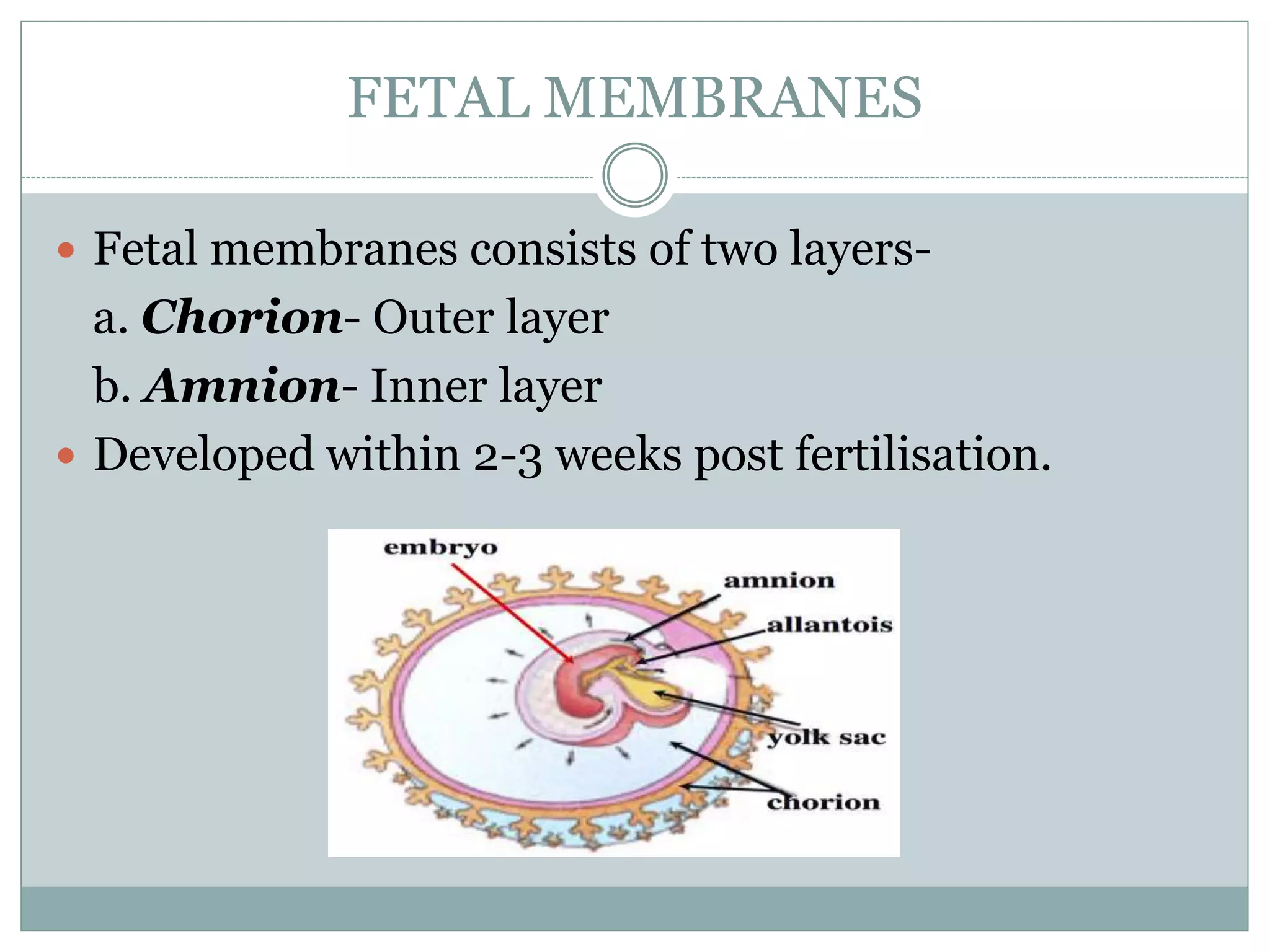
 Fetal membranes consists of two layers-
a. Chorion- Outer layer
b. Amnion- Inner layer
 Developed within 2-3 weeks post fertilisation.
CHORION
 The outer layer of fetal membrane.
 Represents the remnant of “Chorion Laeve”.
 Ends at the margin of placenta.
 Thicker than amnion, friable and shaggy on both
sides.
The chorionic villi on the decidua capsularis gradually undergoes atrophy
from pressure and is converted to chorion laeve by 3rd month.
AMNION
 The inner layer of fetal membrane.
 Extends on the fetal surface of placenta and over the
cord.
 Thinner than chorion (0.02-0.5 mm) and can be
peeled off .
 Smooth and shiny and is in contact with liquor
amnii.
 There is no blood supply or nerve supply in amnion.
FUNCTIONS OF FETAL MEMBRANES
 Contribute to the formation of liquor amnii.
 Intact membranes prevents ascending uterine
infection.
 Facilitate dilatation of cervix during labor.
AMNIOTIC CAVITY
 Cavity which develops on dorsal surface of
embryonic disc between ectodermal layer and
cytotrophoblast is called as amniotic cavity.
 It is the space enclosed by amnion containing
amniotic fluid.
 The fetus lies within the cavity surrounded by the
fluid.
 Appears on 12th day post fertilization.
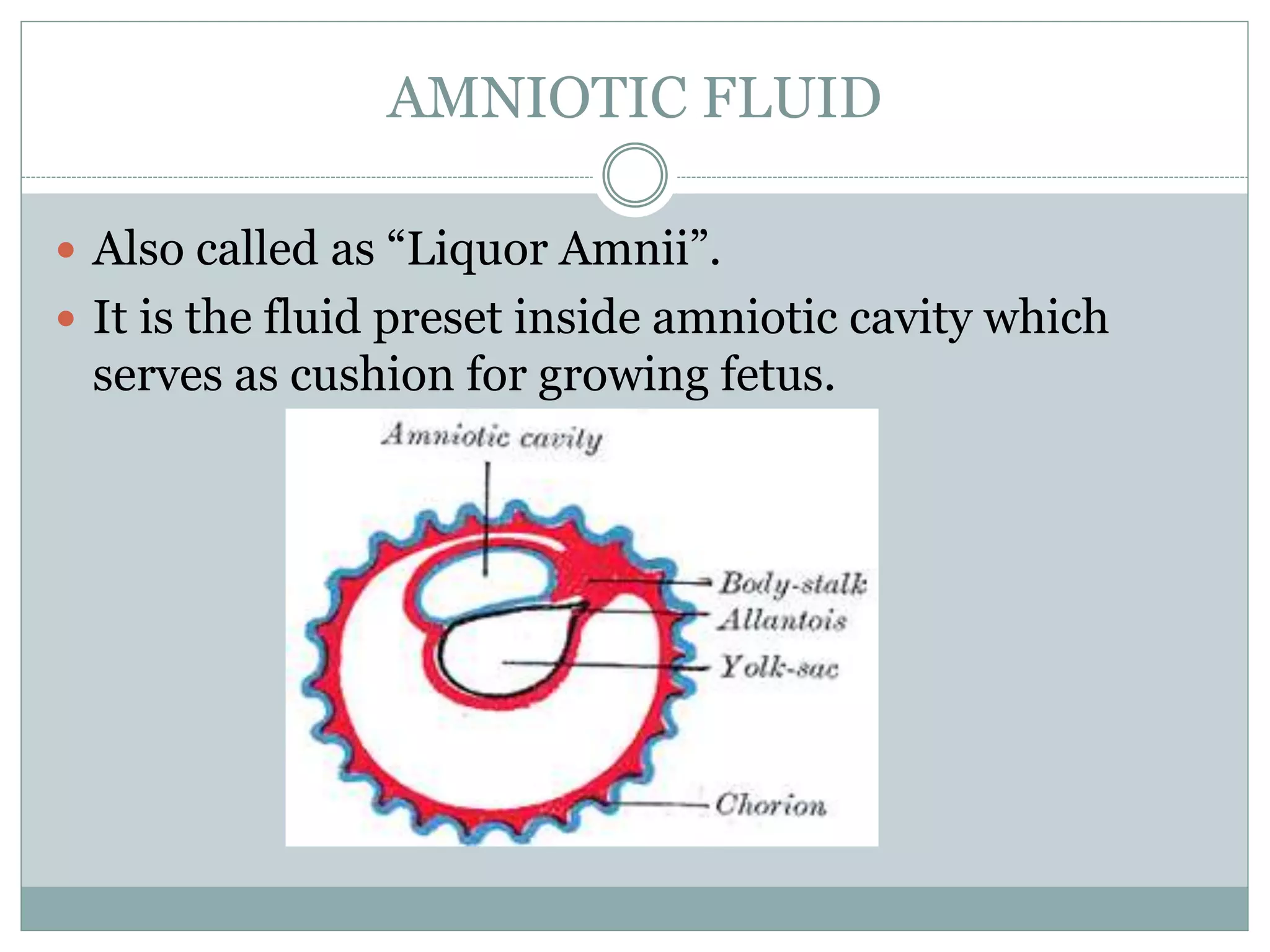
AMNIOTIC FLUID
 Also called as “Liquor Amnii”.
 It is the fluid preset inside amniotic cavity which
serves as cushion for growing fetus.
NORMAL FEATURES OF AMNIOTIC FLUID
 Colour : Colourless in early Pregnancy
Clear, pale straw at term
 Specific Gravity : 1.010
 pH : 7.1 – 7.3
 Reaction : Slightly Alkaline
 Osmolarity : Hypotonic 250 mOsmol/L
(Suggestive of fetal maturity)
 Source : Maternal Plasma, Amnion, Fetal urine, Umbilical Cord
 Composition : Water -98%
Solid -2%
Organic Inorganic Suspended
Protein Sodium Fetal Urine
Glucose Chlorine Skin Cells
Lipids Potassium Lanugo
Hormones Vernix Caseosa
Urea Creatinine
Uric Acid
Contd……….
 Volume : Weeks Amount
12 50ml
20 400ml
36-38 1000ml
40 (term) 600-800ml
43 (post term) 200ml
• The amniotic fluid is replaced in every 3 hrs.
FUNCTIONS OF AMNIOTIC FLUID
 Protects the fetus from possible injuries and
infections.
 Fluid distends the amniotic cavity and thereby allows
free movement and growth of fetus.
 Prevents umbilical cord compression.
 Flushes the birth canal at the end of 1st stage of
labour.
 Drainage of liquor after rupture of membrane
facilitates the labour.
CLINICAL SIGNIFICANCE OF
AMNIOTIC FLUID
 Helps to diagnose fetal wellbeing and fetal maturity.
 Assessment of volume through AFI (amniotic fluid
index) helps to detect excess or deficient amniotic
fluid.
 Amniocentesis helps to detect any genetic
abnormalities.
 Assessment of color helps to detect certain
abnormalities.
 Intra amniotic instillation helps in induction of
abortion.
ABNORMALITIES OF AMNIOTIC FLUID
 ABNORMALITIES RELATED TO VOLUME:
a. Polyhydramnios : Excess amount of amniotic fluid > 1500ml at
term.
b. Oligohydramnios : Deficient amount of amniotic fluid < 200-
300ml at term
 ABNORMALITIES RELATED TO COLOUR:
a. Greenish Colour : Fetal Distress, Meconium Stained
b. Golden Colour : Rh Incompatibility
c. Greenish Yellow : Post Maturity
d. Dark Brown : IUD (Intra Uterine Death)
e. Dark Red : Haemorrhage
CONCLUSION
The knowlegde of normal features and abnormal
variations of amniotic fluid helps to detect many
clinical conditions of fetus and mother and helps to
prevent complication as early as possible thereby
saving the life of mother and baby.
ASSIGNMENT
Explain in detail about the features and clinical
significance of amniotic fluid.
BIBLIOGRAPHY
 Dutta D.C, “Textbook Of Obstetrics”, New Central
Book Agency(P)LTD, 6th edition, Pg.28-29
 Jacob Annamma, “A Comprehensive Textbook of
Midwifery”, Jaypee Brothers Medical
Publishers(P)LTD, 2nd edition, Pg.75-78
 Myles, “ Textbook for Midwives”, Churchill
Livingstone Publishers, 13th edition, Pg.143-147
EVALUATION
I. Fill in the blanks: 10×1= 10
a. Golden colour of amniotic fluid indicates _________.
b. Amount of amniotic fluid at term is __________.
c. The outer layer of fetal membrane is called as _________.
d. Amniotic cavity appears between ectoderm and ________
e. Deficient amount of amniotic fluid is called as _____.
f. The process of aspiration of amniotic fluid is called as ____________.
g. The normal AFI is ______.
h. Chorion represents the remnant of ___________.
i. The specific gravity of amniotic fluid is ______.
j. The normal osmolarity of amniotic fluid suggests ________.
II. Write down the clinical significance of amniotic fluid. 5
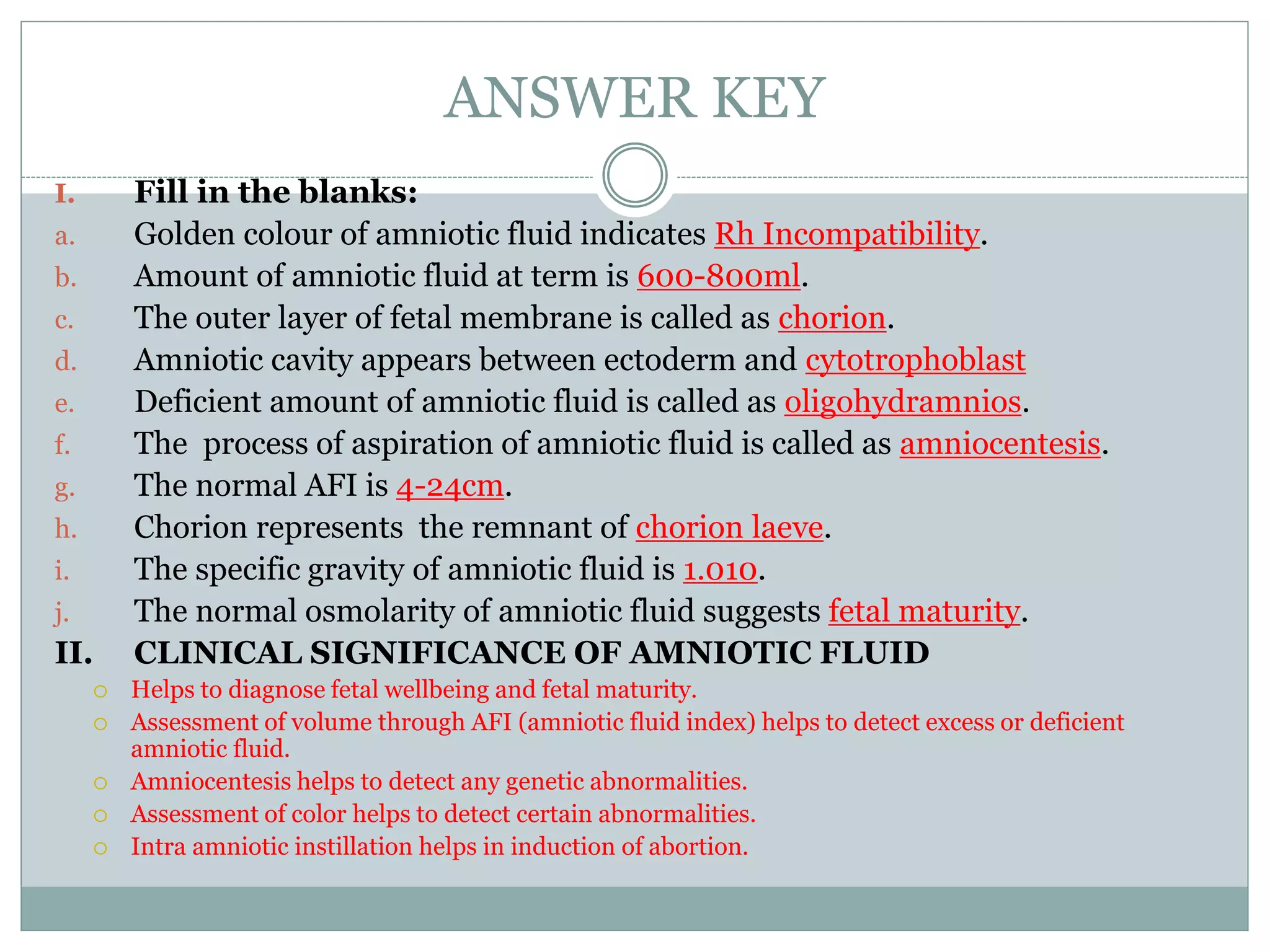
ANSWER KEY
I. Fill in the blanks:
a. Golden colour of amniotic fluid indicates Rh Incompatibility.
b. Amount of amniotic fluid at term is 600-800ml.
c. The outer layer of fetal membrane is called as chorion.
d. Amniotic cavity appears between ectoderm and cytotrophoblast
e. Deficient amount of amniotic fluid is called as oligohydramnios.
f. The process of aspiration of amniotic fluid is called as amniocentesis.
g. The normal AFI is 4-24cm.
h. Chorion represents the remnant of chorion laeve.
i. The specific gravity of amniotic fluid is 1.010.
j. The normal osmolarity of amniotic fluid suggests fetal maturity.
II. CLINICAL SIGNIFICANCE OF AMNIOTIC FLUID
 Helps to diagnose fetal wellbeing and fetal maturity.
 Assessment of volume through AFI (amniotic fluid index) helps to detect excess or deficient
amniotic fluid.
 Amniocentesis helps to detect any genetic abnormalities.
 Assessment of color helps to detect certain abnormalities.
 Intra amniotic instillation helps in induction of abortion.
Fetal Membranes, Amniotic Cavity and Amniotic Fluid

Fetal Membranes, Amniotic Cavity and Amniotic Fluid

  • 1.
  • 2.
    OBJECTIVES  Fetal Membranes Functions of Fetal Membranes  Amniotic Cavity  Amniotic Fluid  Normal Features of Amniotic Fluid  Functions of Amniotic Fluid  Clinical Significance of Amniotic Fluid  Abnormalities of Amniotic Fluid  Conclusion  Assignment  Bibliography  Evaluation with Answer Key
  • 3.
    FETAL MEMBRANES  Fetalmembranes consists of two layers- a. Chorion- Outer layer b. Amnion- Inner layer  Developed within 2-3 weeks post fertilisation.
  • 4.
    CHORION  The outerlayer of fetal membrane.  Represents the remnant of “Chorion Laeve”.  Ends at the margin of placenta.  Thicker than amnion, friable and shaggy on both sides. The chorionic villi on the decidua capsularis gradually undergoes atrophy from pressure and is converted to chorion laeve by 3rd month.
  • 5.
    AMNION  The innerlayer of fetal membrane.  Extends on the fetal surface of placenta and over the cord.  Thinner than chorion (0.02-0.5 mm) and can be peeled off .  Smooth and shiny and is in contact with liquor amnii.  There is no blood supply or nerve supply in amnion.
  • 6.
    FUNCTIONS OF FETALMEMBRANES  Contribute to the formation of liquor amnii.  Intact membranes prevents ascending uterine infection.  Facilitate dilatation of cervix during labor.
  • 7.
    AMNIOTIC CAVITY  Cavitywhich develops on dorsal surface of embryonic disc between ectodermal layer and cytotrophoblast is called as amniotic cavity.  It is the space enclosed by amnion containing amniotic fluid.  The fetus lies within the cavity surrounded by the fluid.  Appears on 12th day post fertilization.
  • 8.
    AMNIOTIC FLUID  Alsocalled as “Liquor Amnii”.  It is the fluid preset inside amniotic cavity which serves as cushion for growing fetus.
  • 9.
    NORMAL FEATURES OFAMNIOTIC FLUID  Colour : Colourless in early Pregnancy Clear, pale straw at term  Specific Gravity : 1.010  pH : 7.1 – 7.3  Reaction : Slightly Alkaline  Osmolarity : Hypotonic 250 mOsmol/L (Suggestive of fetal maturity)  Source : Maternal Plasma, Amnion, Fetal urine, Umbilical Cord  Composition : Water -98% Solid -2% Organic Inorganic Suspended Protein Sodium Fetal Urine Glucose Chlorine Skin Cells Lipids Potassium Lanugo Hormones Vernix Caseosa Urea Creatinine Uric Acid
  • 10.
    Contd……….  Volume :Weeks Amount 12 50ml 20 400ml 36-38 1000ml 40 (term) 600-800ml 43 (post term) 200ml • The amniotic fluid is replaced in every 3 hrs.
  • 11.
    FUNCTIONS OF AMNIOTICFLUID  Protects the fetus from possible injuries and infections.  Fluid distends the amniotic cavity and thereby allows free movement and growth of fetus.  Prevents umbilical cord compression.  Flushes the birth canal at the end of 1st stage of labour.  Drainage of liquor after rupture of membrane facilitates the labour.
  • 12.
    CLINICAL SIGNIFICANCE OF AMNIOTICFLUID  Helps to diagnose fetal wellbeing and fetal maturity.  Assessment of volume through AFI (amniotic fluid index) helps to detect excess or deficient amniotic fluid.  Amniocentesis helps to detect any genetic abnormalities.  Assessment of color helps to detect certain abnormalities.  Intra amniotic instillation helps in induction of abortion.
  • 13.
    ABNORMALITIES OF AMNIOTICFLUID  ABNORMALITIES RELATED TO VOLUME: a. Polyhydramnios : Excess amount of amniotic fluid > 1500ml at term. b. Oligohydramnios : Deficient amount of amniotic fluid < 200- 300ml at term  ABNORMALITIES RELATED TO COLOUR: a. Greenish Colour : Fetal Distress, Meconium Stained b. Golden Colour : Rh Incompatibility c. Greenish Yellow : Post Maturity d. Dark Brown : IUD (Intra Uterine Death) e. Dark Red : Haemorrhage
  • 14.
    CONCLUSION The knowlegde ofnormal features and abnormal variations of amniotic fluid helps to detect many clinical conditions of fetus and mother and helps to prevent complication as early as possible thereby saving the life of mother and baby.
  • 15.
    ASSIGNMENT Explain in detailabout the features and clinical significance of amniotic fluid.
  • 16.
    BIBLIOGRAPHY  Dutta D.C,“Textbook Of Obstetrics”, New Central Book Agency(P)LTD, 6th edition, Pg.28-29  Jacob Annamma, “A Comprehensive Textbook of Midwifery”, Jaypee Brothers Medical Publishers(P)LTD, 2nd edition, Pg.75-78  Myles, “ Textbook for Midwives”, Churchill Livingstone Publishers, 13th edition, Pg.143-147
  • 17.
    EVALUATION I. Fill inthe blanks: 10×1= 10 a. Golden colour of amniotic fluid indicates _________. b. Amount of amniotic fluid at term is __________. c. The outer layer of fetal membrane is called as _________. d. Amniotic cavity appears between ectoderm and ________ e. Deficient amount of amniotic fluid is called as _____. f. The process of aspiration of amniotic fluid is called as ____________. g. The normal AFI is ______. h. Chorion represents the remnant of ___________. i. The specific gravity of amniotic fluid is ______. j. The normal osmolarity of amniotic fluid suggests ________. II. Write down the clinical significance of amniotic fluid. 5
  • 18.
    ANSWER KEY I. Fillin the blanks: a. Golden colour of amniotic fluid indicates Rh Incompatibility. b. Amount of amniotic fluid at term is 600-800ml. c. The outer layer of fetal membrane is called as chorion. d. Amniotic cavity appears between ectoderm and cytotrophoblast e. Deficient amount of amniotic fluid is called as oligohydramnios. f. The process of aspiration of amniotic fluid is called as amniocentesis. g. The normal AFI is 4-24cm. h. Chorion represents the remnant of chorion laeve. i. The specific gravity of amniotic fluid is 1.010. j. The normal osmolarity of amniotic fluid suggests fetal maturity. II. CLINICAL SIGNIFICANCE OF AMNIOTIC FLUID  Helps to diagnose fetal wellbeing and fetal maturity.  Assessment of volume through AFI (amniotic fluid index) helps to detect excess or deficient amniotic fluid.  Amniocentesis helps to detect any genetic abnormalities.  Assessment of color helps to detect certain abnormalities.  Intra amniotic instillation helps in induction of abortion.

Editor's Notes

  • #5 The chorionic villi on the decidua capsularis gradually undergoes atrophy from pressure and is converted to chorion laeve by 3rd month.
  • #13 The normal AFI is 4-24cm.